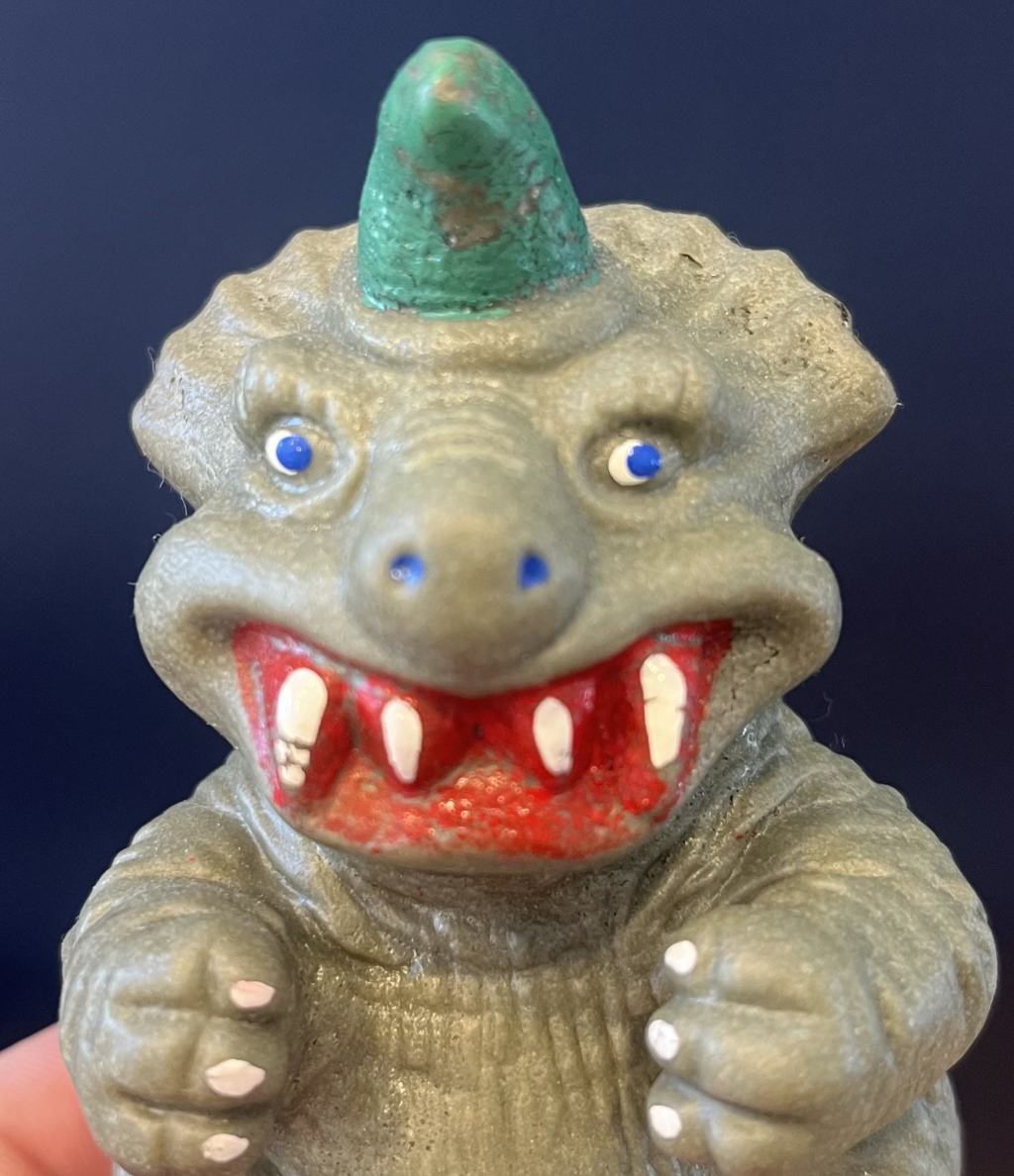
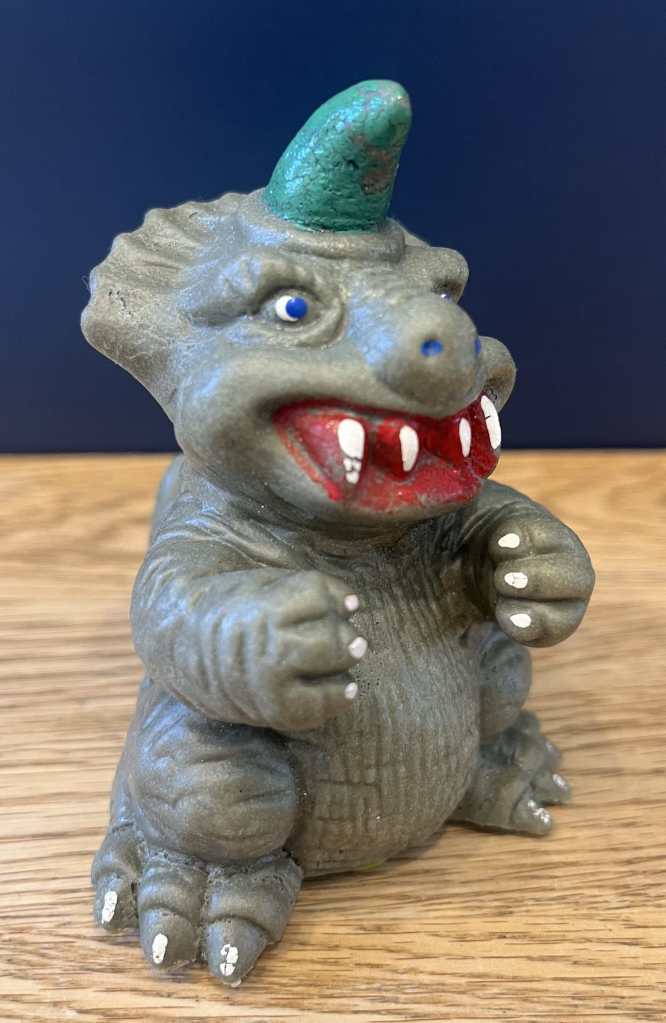
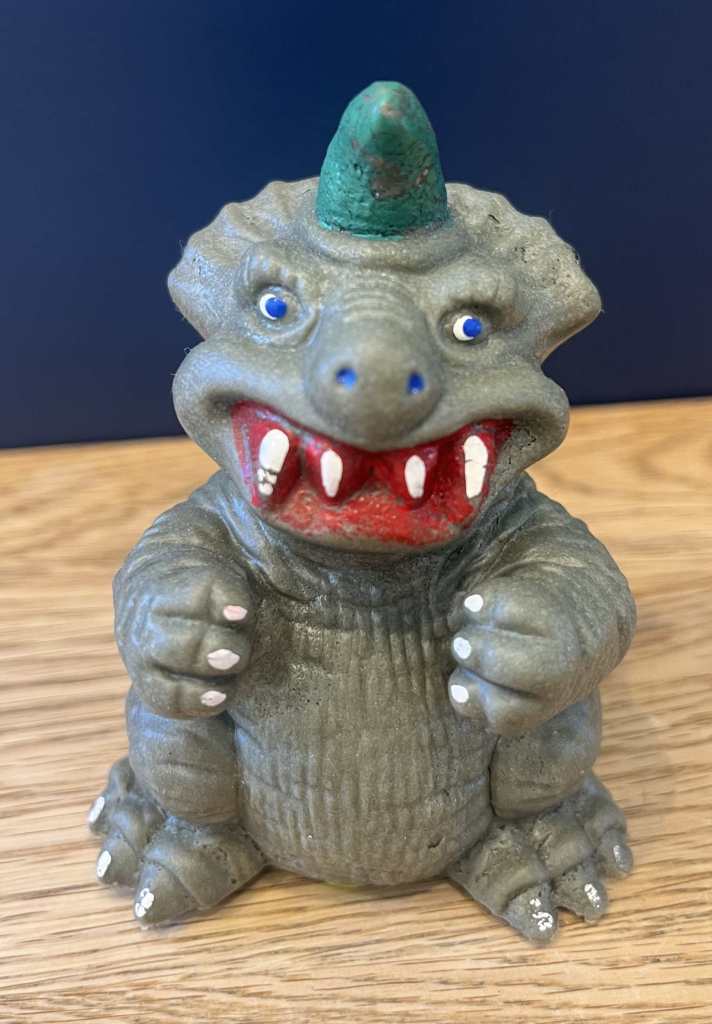
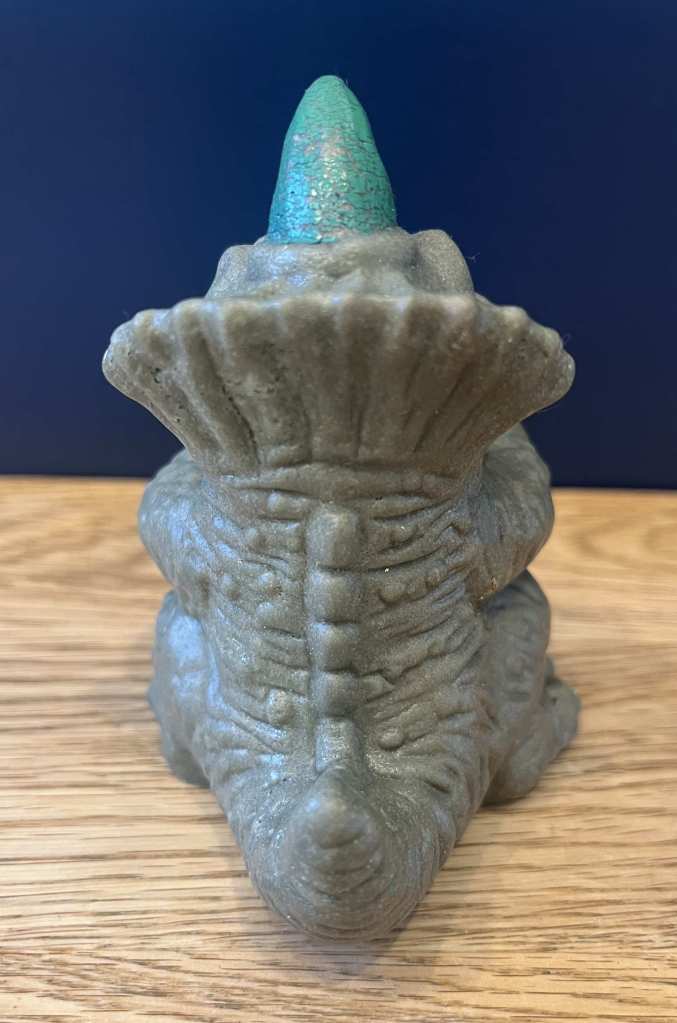
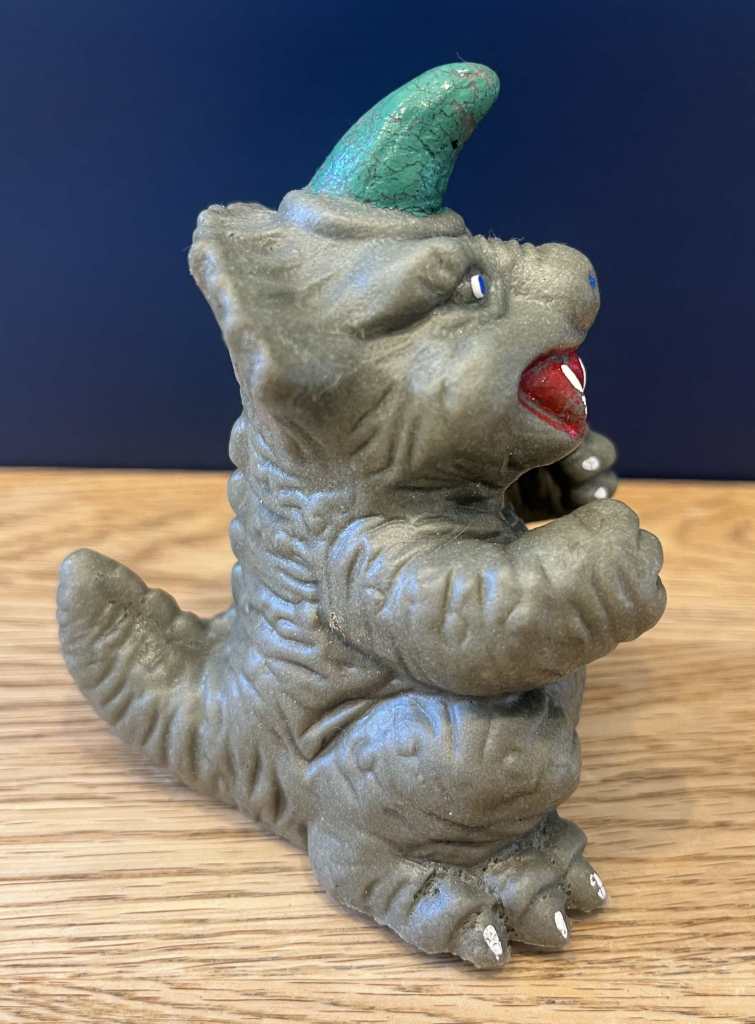
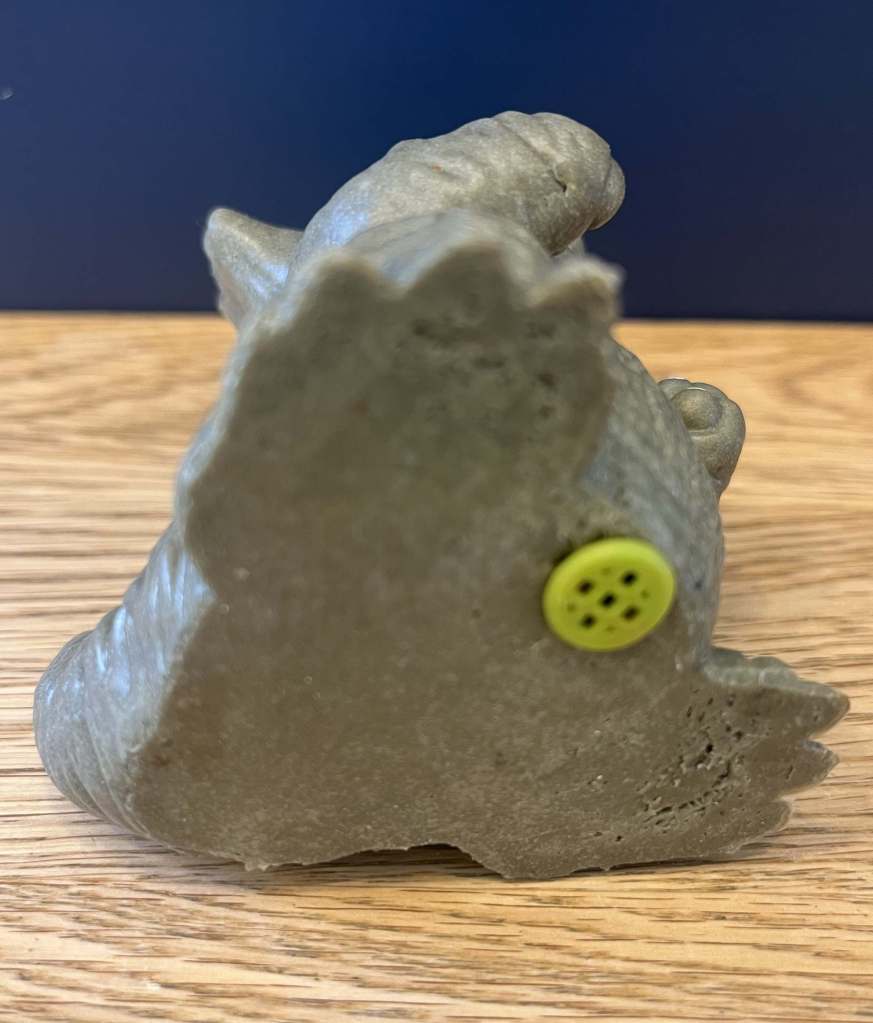
Sometimes the hunting of new and rare kaiju takes you into strange territory. While online and idling away a long sleepless night sometime ago, I stumbled across a toy offered by a Polish seller just north west of Warsaw, described as a USSR-made character named Cebulka (‘Little Onion’), but in fact a previously unrecorded Polish bootleg of a well known Chinese pachi made for the Western market.
Of course I bought it, and can now compare it closely to my example of the original. Firstly, it was not so unreasonable to identify this as Cebulka. That identification was presumably suggested by the green ‘sprout-like’ spike on top of the figure’s head, and the character of Cebulka comes from Gianni Rodari’s famous fairy tale: Le avventure di Cipollino (Cipollino = Cebulka, in Italian), written in 1951, as a political fairy tale. In this, fruits and vegetables are led into revolt by Cipollino, our hero, against the oppressive and aristocratic garden-based rulers, such as Prince Lemon, Cavalier Tomato and Baron Sweet-Orange, eventually overthrowing these nobles and proclaiming a free republic. Of course, this heavily politicised narrative of the other-throw of aristocratic overlords by the common man (or greengrocery) was popular behind the Iron Curtain, and it was made into a Soviet animated film by Boris Dyozhkin in 1961 (a Soyuzmultfilm [‘Union Cartoon’], also known as SMF Animation Studio in English and Soyuzdetmultfilm [‘Union Childrens’ Cartoon’]), a Soviet musical comedy film by Tamara Lisitsian in 1972, and was even produced as a ballet by Karen Khachaturian (1920-2011), and originally staged in the Taras Shevchenko National Opera and Ballet Theatre of Ukraine on 8 November 1974. Its characters were common in the popular culture of the Soviet Union in a multitude of forms, prominently on stamps and as small rubber toys:
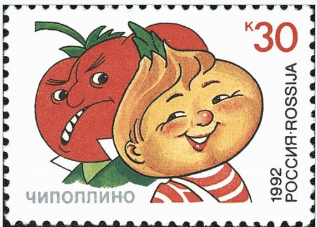
(Image of a 1992 stamp from here)
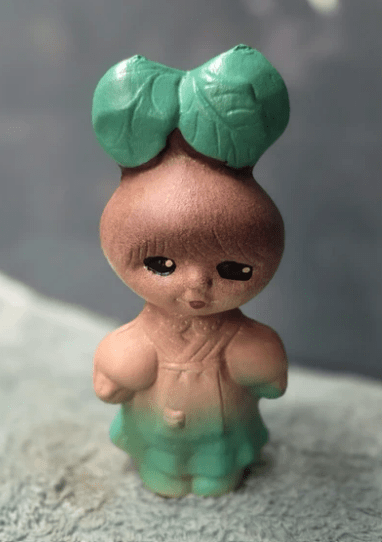
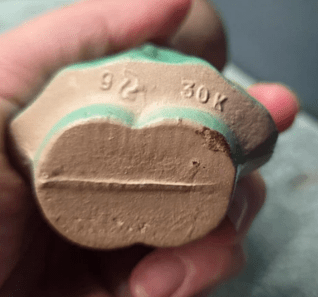
(Soviet toy of an anthropomorphic beetroot, with original price in kopecks on the lower part; image from a Vinted listing)
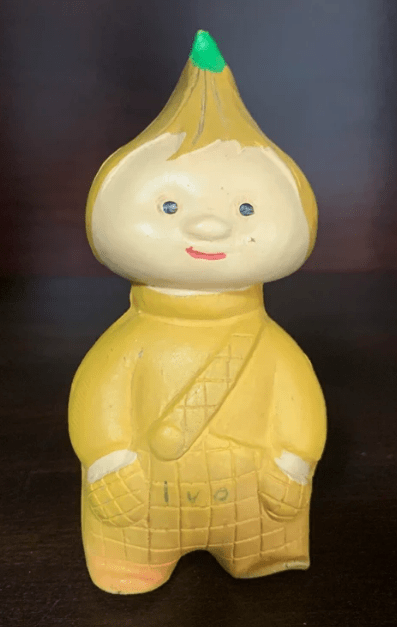
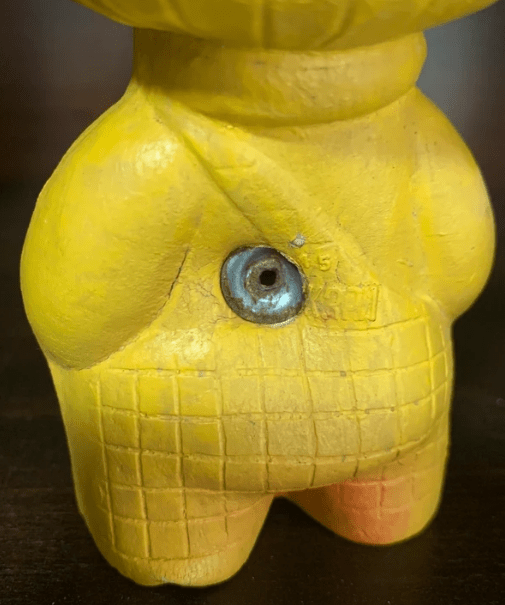
(This toy, I believe, is an authentic Cebulka squeaker toy, again with the original price in Kopecks on its back; image from a Vinted listing)
⁂
However, to those interested in kaiju, this small rubber toy is clearly a copy of this pachi:
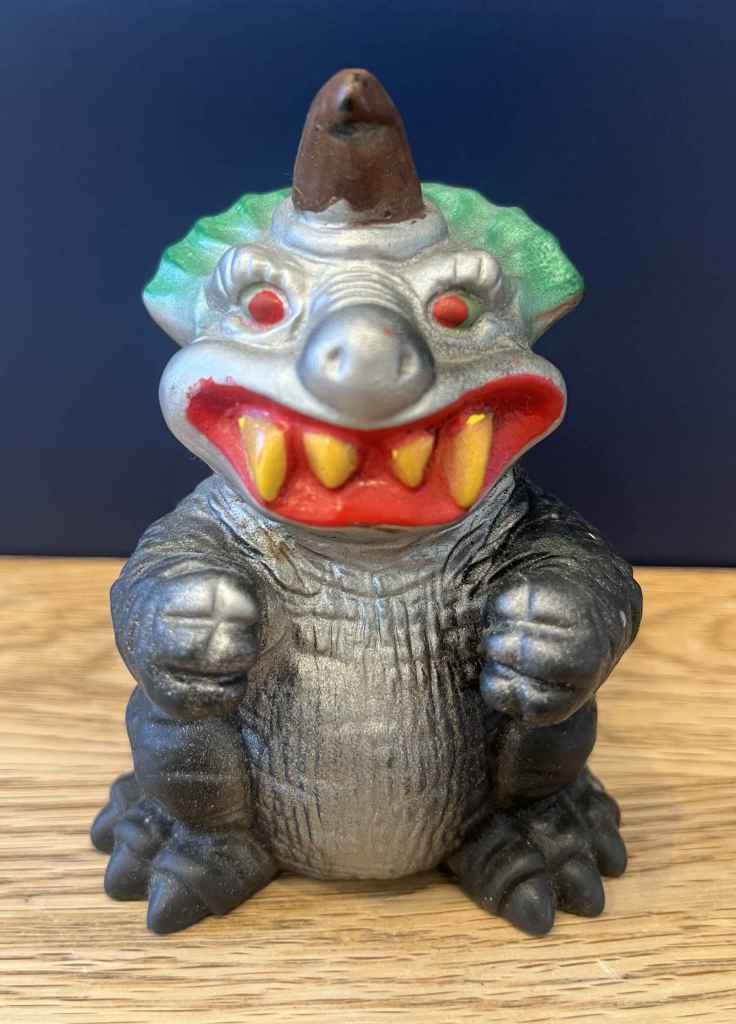
In a future post I shall attempt to sort out the various groups of a series of closely related large and mini pachi made in China in the late 1980s and early 1990s, but it is suffice to say here that while we can name most of those interrelated toylines (Super Dinosaurs, Ultra Dinosaurs, Super Dino Monsters and so on), this common pachi is a member of an, as yet, unnamed toyline within this group.
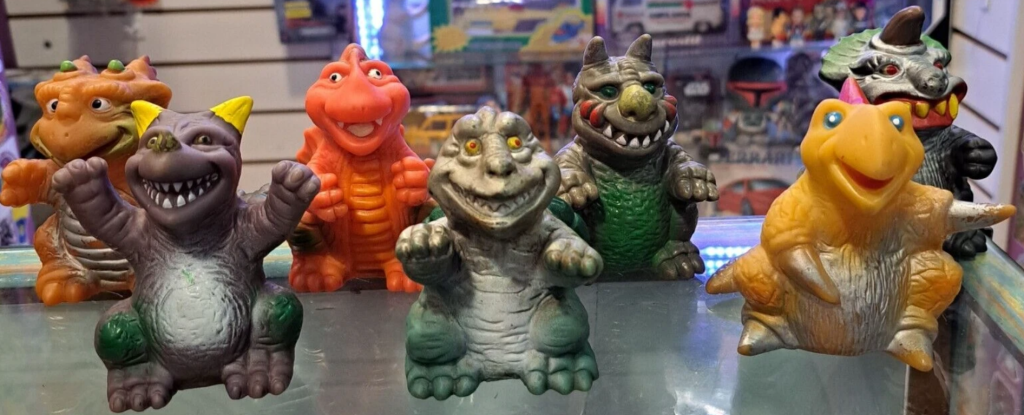
(Our pachi (back right) among his siblings; image from eBay)
There would appear to be at seven in this group, and they all share their outlandish cartoony features with wide mouths and seated positions giving them large flat undersides with “MADE IN CHINA” in a circular depression, around the central ‘squeaker’ hole. This Chinese-made model sits 98mm. high and weighs 34g., and is made of rather robust rubber.
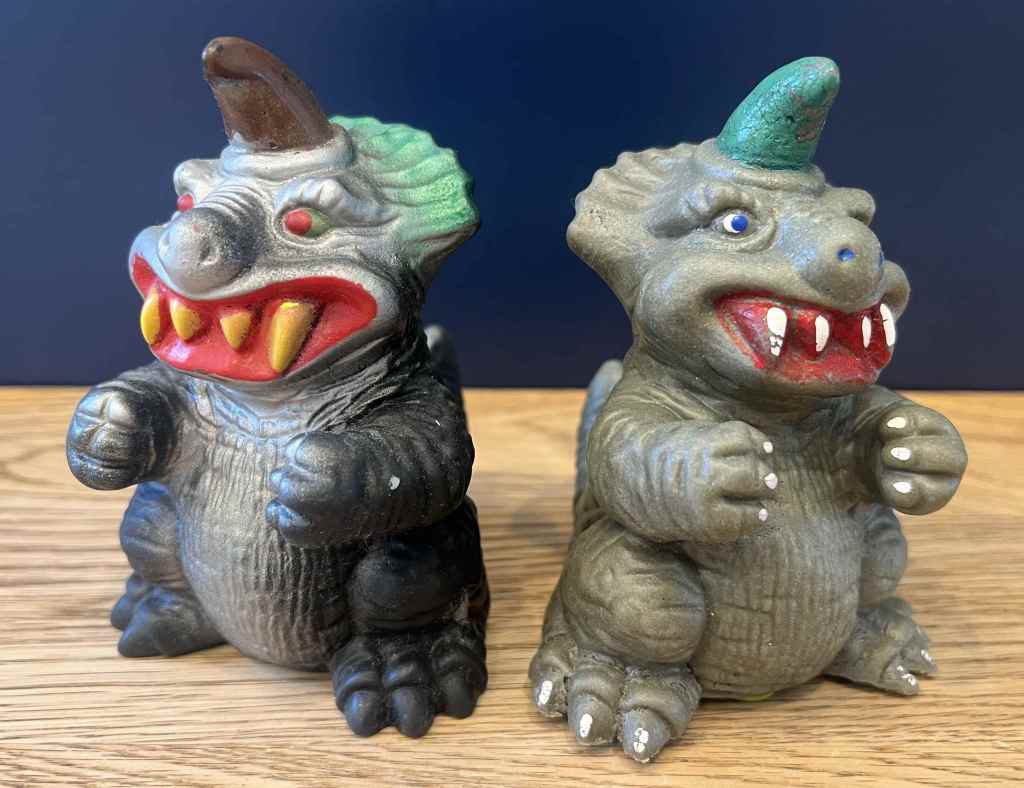
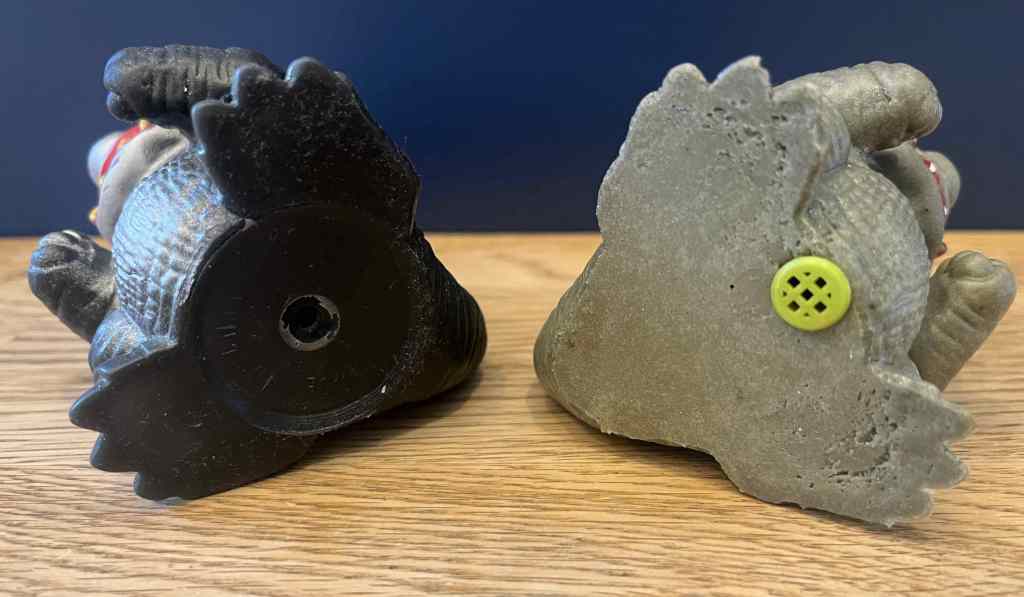
(Left: Chinese-made original; right: Polish bootleg)
The newly discovered bootleg is identical in size and details of design, indicating it was probably cast from the Chinese-made pachi, and weighs 46g. While it is slightly heavier, it was made in now quite fragile and more pliable grey rubber, and its foot is completely flat except for a pale green ‘squeaker’ set at the front edge of the figure. The areas under the feet of the figure show small pitted areas in the surface of the rubber, and examination of the rest of its surface shows numerous other flaws in the rubber. It was painted in different colours to the original, leaving much more of the natural grey rubber as a base colour, with a red mouth and green horn (not brown, as in the original), as well as white teeth (not gold) and white claws. Finally, the eyes are a more natural blue on white (than the red on green of the original).
The Polish toy bootlegging industry during the 1980s and 1990s was as well organised and as diverse as that of Spain in the same period, and set it apart from its neighbours where few, or usually, no such bootlegs can be found (indeed, if we look through the prism of much more numerous Star Wars bootlegs, then only Hungary and Russia also produced illicit copies of Western toys, and those at a much lesser rate and diversity than in Poland). In a future post, I shall collect together all the examples of bootleg Godzillas known to me, but we can observe here that the same poor quality rubber and casting imperfections connect this to many Polish toys, and the discovery of this bootleg mini pachi in Poland argues strongly for its origin there.
The date of its production depends largely on the date we assign its Chinese-made model, and that post is yet to be written. However, a date around 1990 or in the years that immediately followed seems likely, putting the creation of this Polish bootleg in the aftermath of the slow and orderly implosion of the Communist Polish People’s Republic from mid-1989 onwards and around the dissolution of the communist Polish United Workers’ Party in January 1990, and the election of Lech Wałęsa as the country’s first democratically elected president in November 1990. It seems probable that the appearance of this pachi kaiju and several of the Godzilla bootlegs produced there, happened as part of the opening up of Polish society to the influences of the West.
This newly discovered bootleg shares an affinity with the hard plastic Spanish copy of a Super Dino commonly (but erroneously) identified as a pachi ‘King Caesar’ (see my earlier post on these), and it appears that these mini pachi with all their charm and comically grotesque features had an irresistible appeal to buyers in the West, and individual examples were copied by bootleggers wherever those industries flourished.
⁂⁂⁂
I do not know of any other example of this pachi bootleg, or any other example of a Polish bootleg of other mini pachi from the original Chinese-made toyline. This example is so fragile that it may be one of only a handful to now survive. I have enormous affection for this relic of a now-lost time, and its fragile witness to the tastes of children growing up in Poland during the fall of the Communist era.
- 'MUTTON DRESSED AS LAMB': Godzillas and kaiju that look vintage, but are not
- American made Pachi
- BOOTLEG DINOSAURS – a little off topic, but sometimes needed here
- BOOTLEG GODZILLAS
- Bootleg Tokusatsu from China and its immediate neighbours
- Bootleg Tokusatsu from the Americas
- BOOTLEG TOKUSATSU HEROES
- Central Europe – Godzillas and kaiju from behind the Iron Curtain
- Chinese-region bootleg Godzillas -the plastic tide from the East
- Chinese-region made Pachi
- European made Pachi
- European-made Godzillas
- PACHI
- Pachi kaiju
- Pachi kongs
- Pachi superheroes – Ultraman and similar
- The Americas – bootleg Godzillas from the New World

 Confessions of a Kaiju Hunter
Leave a comment