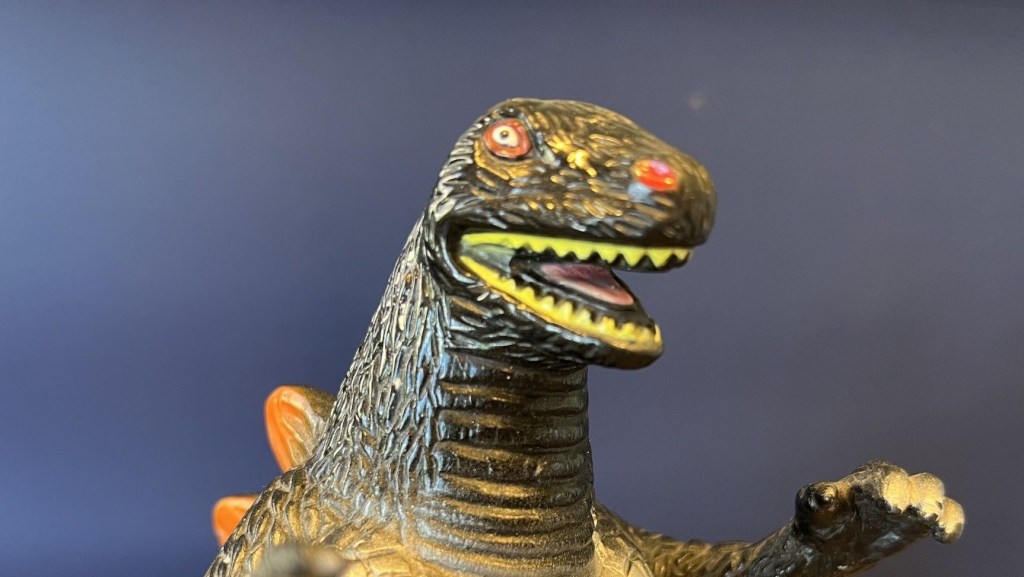
This post is a little different to my others, as it originates from a nearly empty file of mine, despite lengthy searches for information. I have hit a wall, and so this post is more an appeal for information, than a crystallisation of my conclusions.
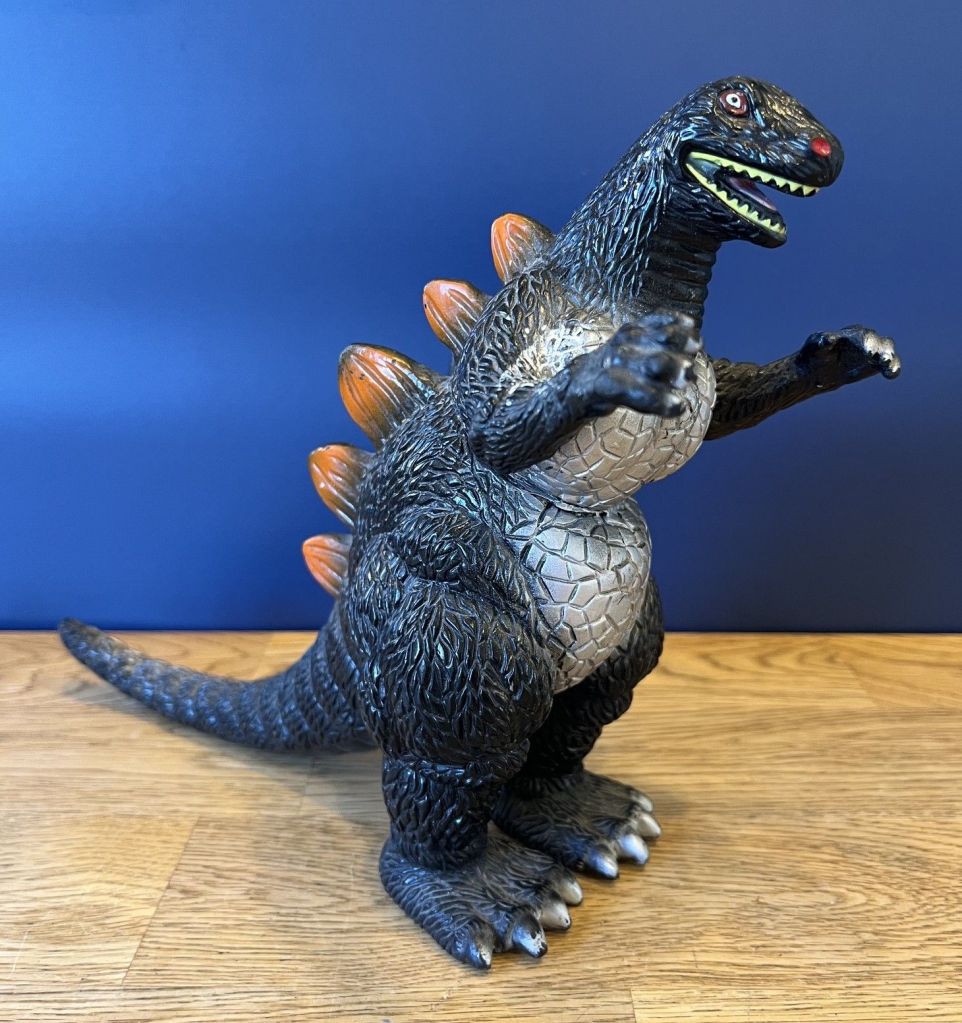
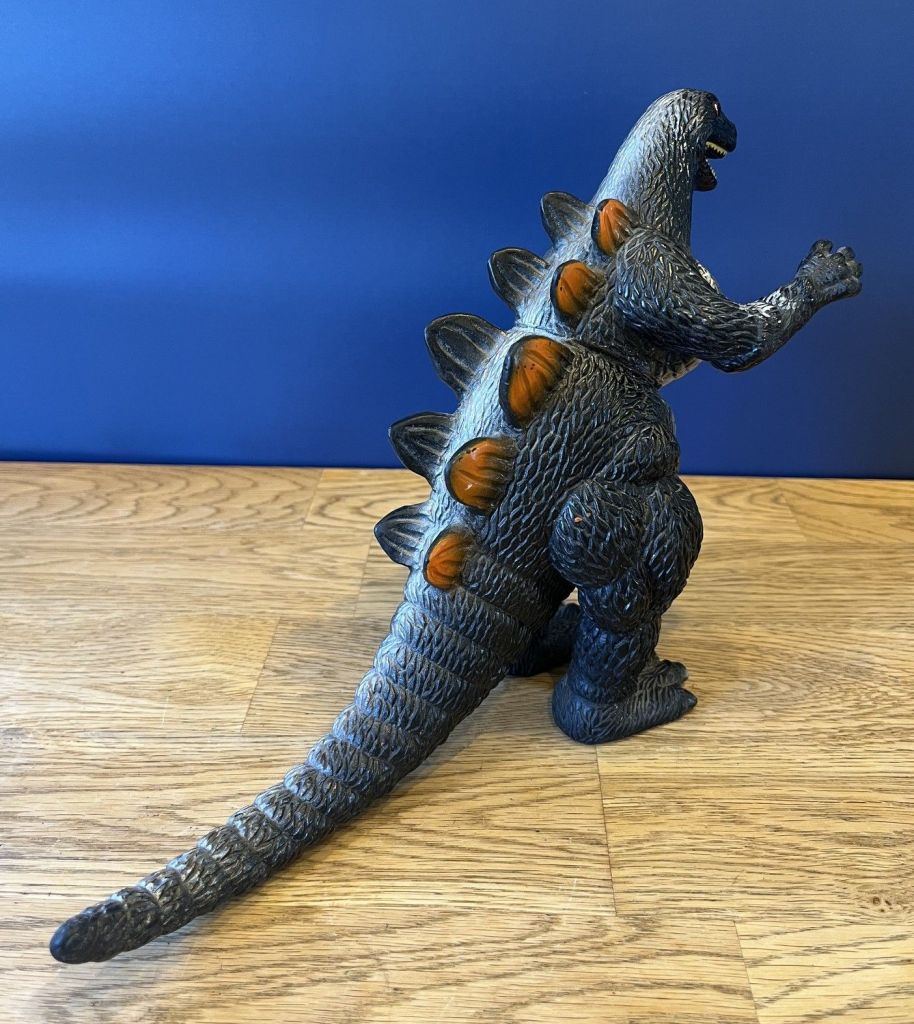
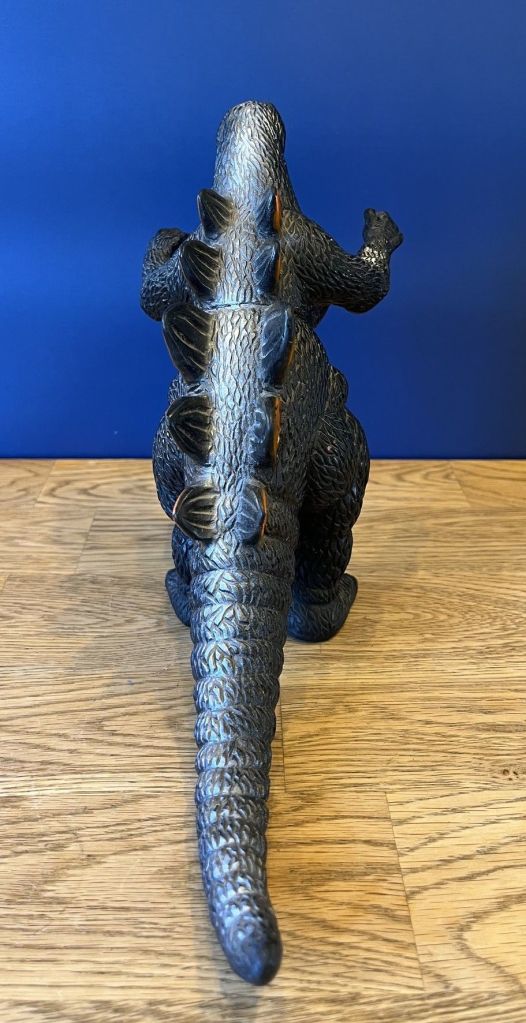
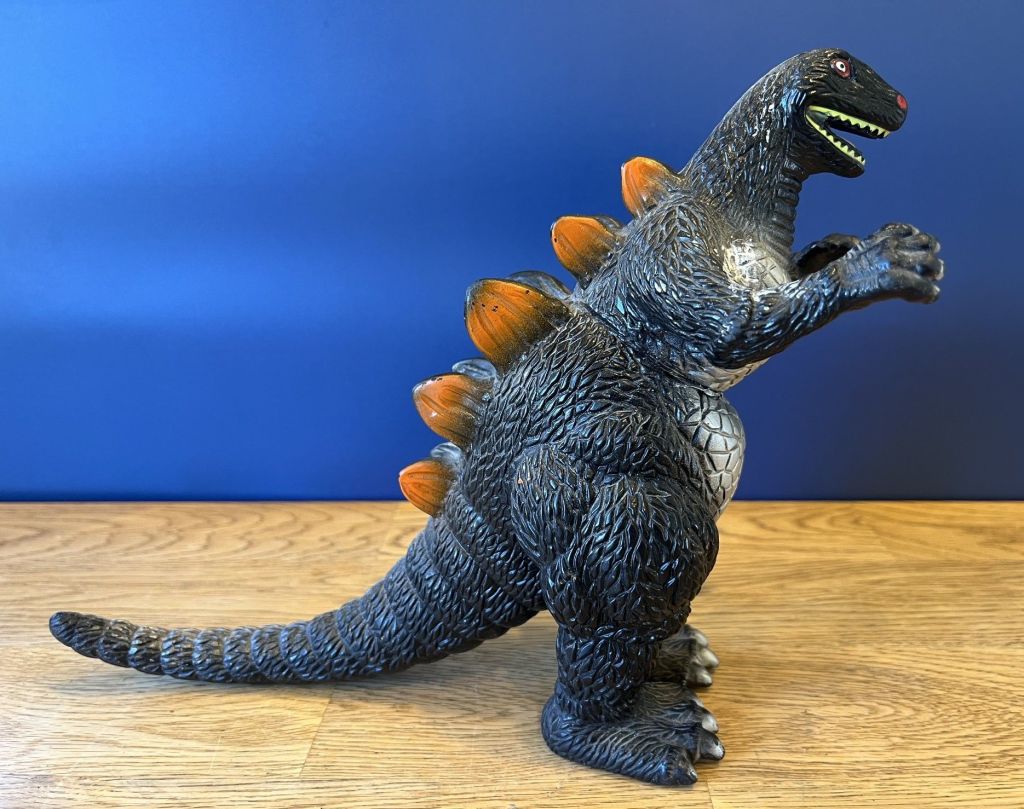
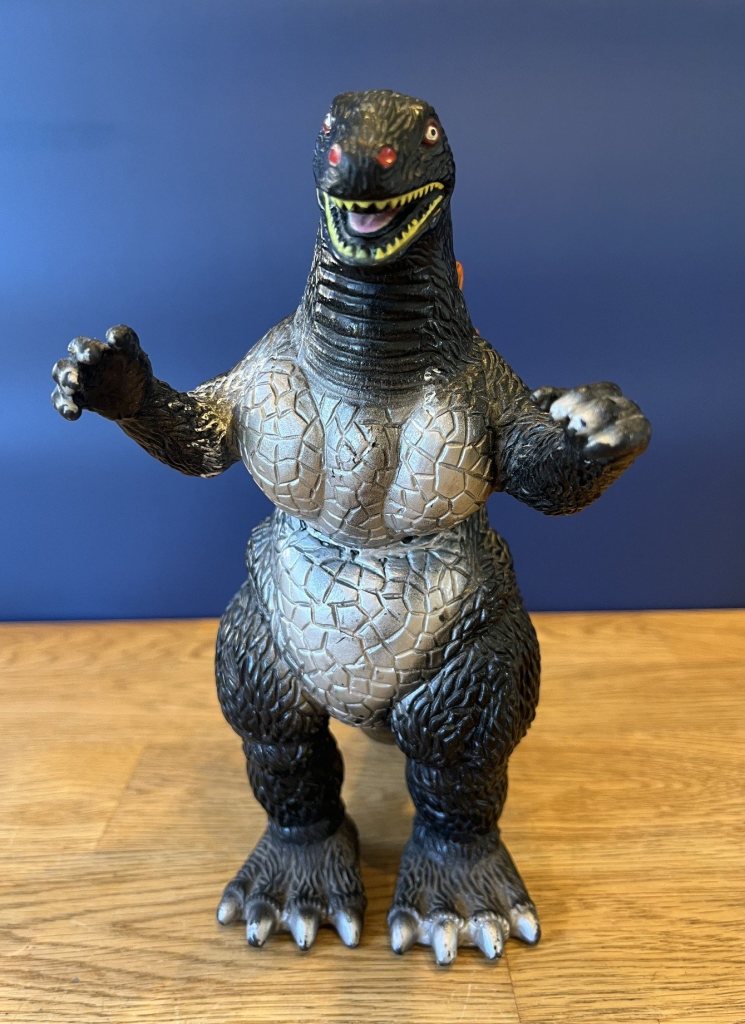
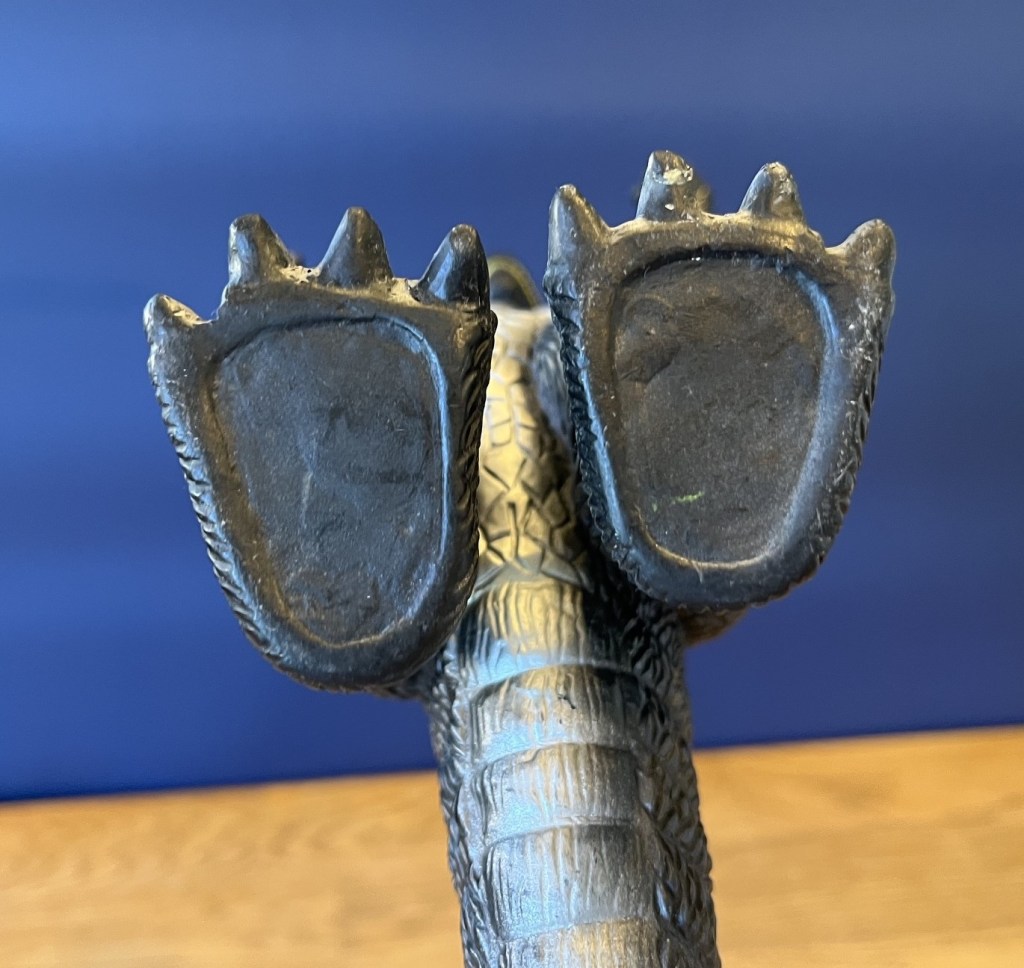
It concerns an exceptionally rare Godzilla bootleg, produced in hollow vinyl, standing 200mm. tall, and weighing 195g. I have seen only one example (my own) ‘in the flesh’, but I have seen photographs of three or four others. All have the same colour-scheme: black base vinyl, with two rows of spine-fins, these sprayed orange on their outside, and with stripes of metallic silver along the spine and stomach. The beast’s claws are also sprayed in silver, and the tiny and perhaps even beady eyes are coloured white and edged in red, perhaps giving the creature a ‘morning after the night before’ appearance. The nostrils are painted red and the rows of teeth are pale yellow, and there is a pink tongue inside the mouth attached to the lower palate. The feet (which are enormous) have large and almost rectangular recesses in their soles, and in mine these recesses have no marks on them (and that is the same for those I have seen pictures of the soles of the feet, or have read descriptions of these). The tail is formed of a series of small bands, and the scale pattern is a series of diamond shapes, except for the chest and stomach, which has a crazy-paving-like effect. The arms are fixed in a partially raised position and there is no articulation anywhere on the toy. The most notable feature, though, is that the creature was made in two parts, with bulging chest (in three bulges where the pectoral muscles should be) and a ‘thicc’ butt (as the kids’ say today), and these parts join at its midriff in an impressively tiny waist – this giving it a distinctive ‘hourglass figure’ that a corseted Victorian upper class lady would have given her last pound note for.
It has a kind of lumpy and irregular beauty, and like with some particularly ugly, bald and strange looking dogs who permanently have their tongues lolling out, I find I rather like it for all of its physiological challenges.

(Picture to show the beast’s hour-glass-waist to its fullest effect)
It is clear what it is a bootleg of – the enormous feet with their recesses underneath, and bulging pectoral muscles separated by another, and only slightly smaller, middle bulge, must come from one of the Godzilla sofubi produced by Bandai in the early 1990s, all as variations of the same mold. Bandai’s Ghido-Goji from 1991, the Bato-Goji from 1992 and Rado-Goji from 1993 all fit perfectly (see the amazing resource Clubtokyo for these, here, here and here). The first and last of those were produced in black vinyl, while the middle one was in dark grey. All three use silver for highlighting.
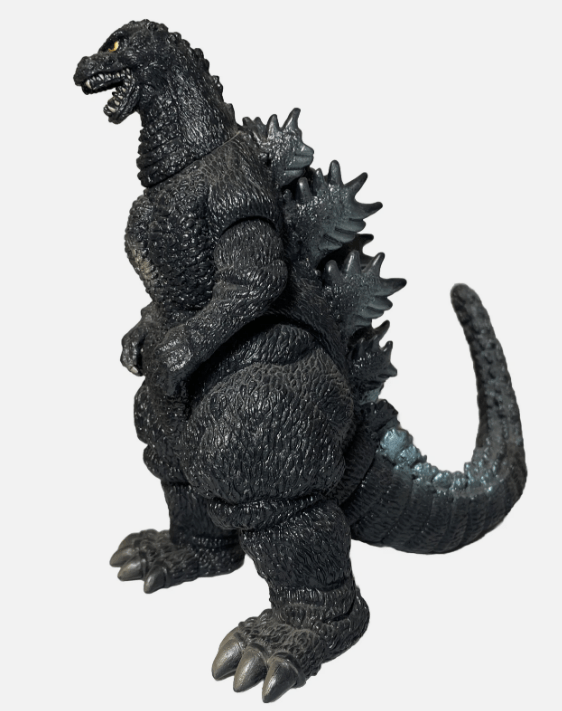
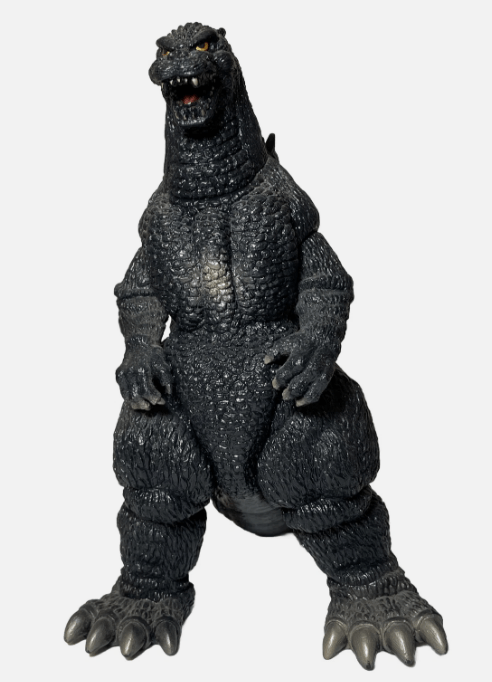
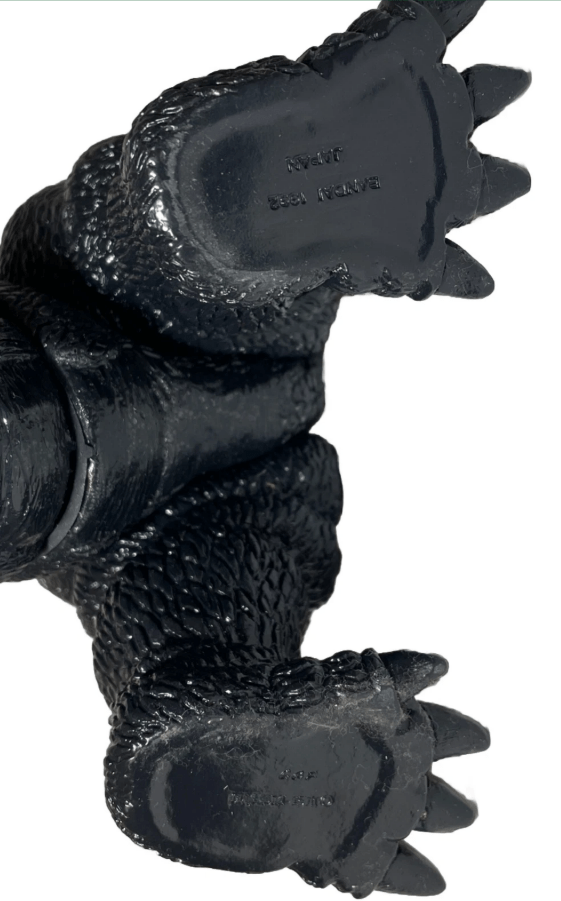
(These images from an eBay sale listing)
The problem begins when we move to consider where these bootlegs were made. A US toyseller offered one for sale on their Instagram account on 5 July 2024 confidently stating that this Godzilla was “80’s TAIWAN 🇹🇼 PACHI GODZILLA”. However, there are no marks indicating a Taiwan origin on mine that I can see, and likewise there are no marks on the one shown in the Instagram post that I can see, and in their post they show all sides of the beast, including under its feet. That said, that toyseller is usually very knowledgeable and has had some remarkable pachi pass through their hands, including more Taiwanese items than I know of anywhere else – so I am inclined to trust them.
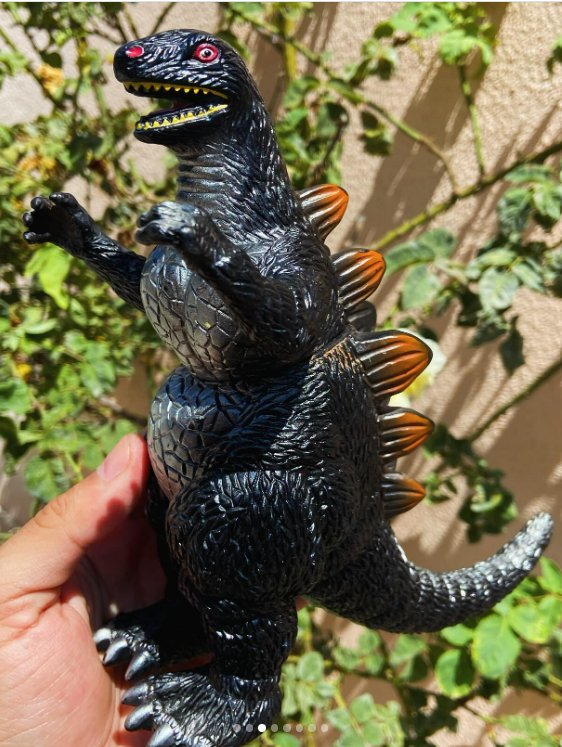

(These images from the Instagram post noted above and not mine; if they are yours and object to their use here then please get in contact and we will remove them: but to do that you will have to get in contact – muah ha ha ha! [fiendish laugh])
I have had no luck in trying to make contact with that Instagram seller – and, of course, we have all met an unresponsive toyseller at some point. Perhaps I sympathise with them: I am aware how annoying it could be to receive long and detail-orientated messages from an apparent nerd asking for mm. measurements and precise weights of toys you sold months ago, especially when you have a business to run and many other things to do. However, the ever helpful Otakumerica (nice people btw with great things – if you don’t know and adore them already where have you been hiding?) did confirm to me that they had sold one several years ago, and that they remembered (but could be wrong) that it had Taiwanese markings on it. Perhaps, like with other Godzilla bootlegs the marks were only added to some of the toys. Otakumerica also told me that from the feel and look of the model they thought it to be from the 1990s, and that fits well with the Bandai designs this must have been copying.
That is where the matter sat, as an open case on my kaiju hunter files, until about a week ago when a Facebook user named Pancho Jorquera posted in the ‘Bootleg / Counterfeit Godzilla kits and figures group’ there, about a beloved childhood toy that had been bought for him by his “father in Valparaíso, Chile, sometime before 1994. It was sold loose (no packaging or tag) in a local toy store”.
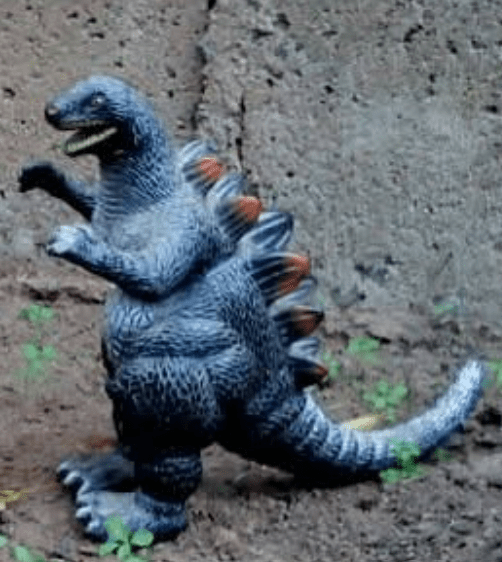
(Señor Jorquera’s picture of his childhood toy from his Facebook post; and thus this image not mine – if it is yours and object to its reuse here then please get in contact and we will remove them: but again to do that you will have to get in contact – muah ha ha ha! [second and louder fiendish laugh])
Unfortunately, the toy had been recently given to Señor Jorquera’s children and was accidentally thrown away. I have tried to contact this Facebook user, and while my comments on his post got ‘likes’ from him, he appears not to see my messages (I’m starting to feel hurt by this radio-silence via various messaging apps on this bootleg. Could this be some form of Taiwanese toy-bootlegger’s curse? Is the first rule of Taiwanese Godzilla pachi fight club, that no one speaks about Taiwanese Godzilla pachi fight club?). Anyway, it is his witness to the age of the toy that is most important – placing it exactly where I and Otakumerica had done: in the early 1990s.
There is little to learn from the geographical range of the surviving examples. Mine was bought in Spain, and that in the Instagram sale post above, as well as another one noted in the comments to his post, are both in the US. The lost childhood toy was bought in Chile.
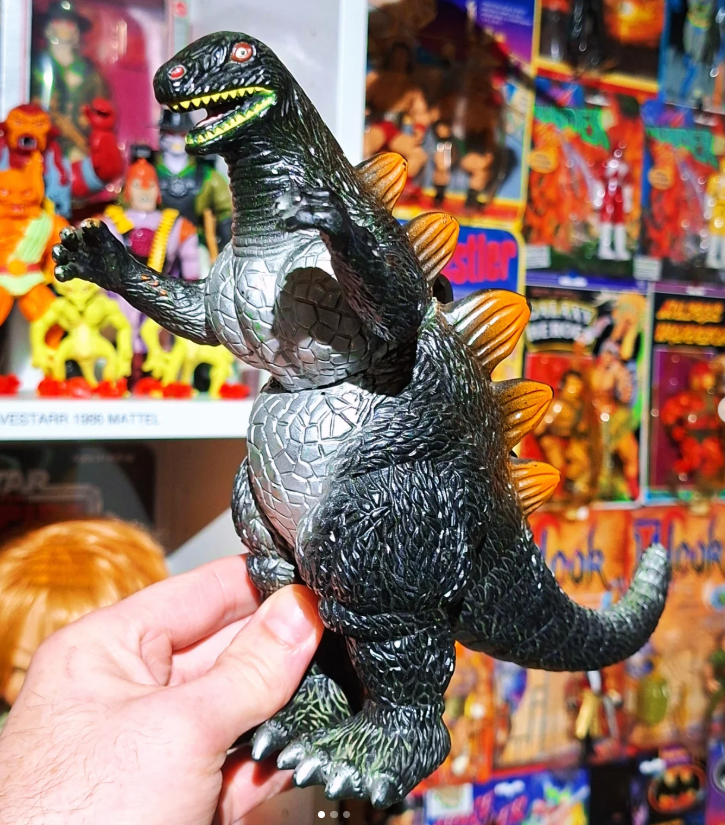
(This image of Retrobottoys reproduced here with their permission)
[UPDATE 1 July 2026: a Belgian collector, called ‘retrobottoys’ on Instagram has got in contact to say that he has one of these as well, bought some time ago in The Netherlands (his Instagram post on it can be seen here).
[UPDATE 3 July 2026: a German collector has got in touch via Facebook to say that he bought one of these a few years ago in Berlin. Interestingly, we might just be getting a spike of them turning up in European collections]
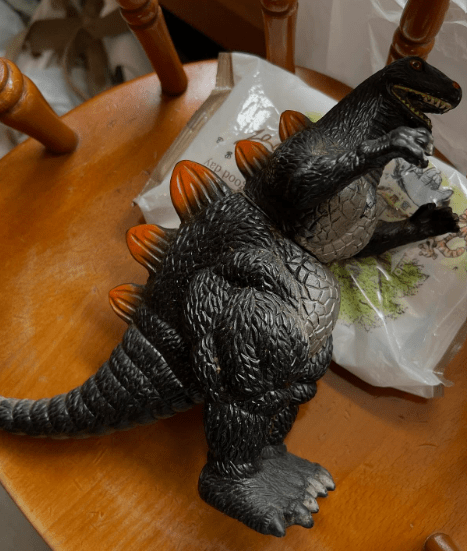
(Image from ‘stimpy_vintage’s Instagram account of the example in the Shizuoka Toy Summit last year; reproduced here with their permission)
I know of only one in Japan, spotted by an Instagram toyseller named ‘stimpy_vintage’ at the Shizuoka Toy Summit in Japan in a post from November last year. However, I suspect that it was an item carried to Japan by the recent collector’s market. If this toy was made in Taiwan, like the ‘Science Space Monster’ line and their siblings the ET and Kong pachi and bootleg warty Ewoks and bipedal Jabbas (see my earlier post on these), then it would fit well that these ‘hourglass figure’ Godzillas were made in Taiwan for sale in the West.
⁂⁂⁂
That is where this post ends, with an appeal to any reader for more information on this bootleg Godzilla. If you know why it must be Taiwanese, or anything else about it, I am all ears – and if there really is a Taiwanese pachi Godzilla fight club can someone please nominate me for membership so I can get past this Goji omertà.
- 'MUTTON DRESSED AS LAMB': Godzillas and kaiju that look vintage, but are not
- American made Pachi
- BOOTLEG DINOSAURS – a little off topic, but sometimes needed here
- BOOTLEG GODZILLAS
- Bootleg Tokusatsu from China and its immediate neighbours
- Bootleg Tokusatsu from the Americas
- BOOTLEG TOKUSATSU HEROES
- Central Europe – Godzillas and kaiju from behind the Iron Curtain
- Chinese-region bootleg Godzillas -the plastic tide from the East
- Chinese-region made Pachi
- European made Pachi
- European-made Godzillas
- PACHI
- Pachi kaiju
- Pachi kongs
- Pachi superheroes – Ultraman and similar
- The Americas – bootleg Godzillas from the New World

 Confessions of a Kaiju Hunter
Leave a comment