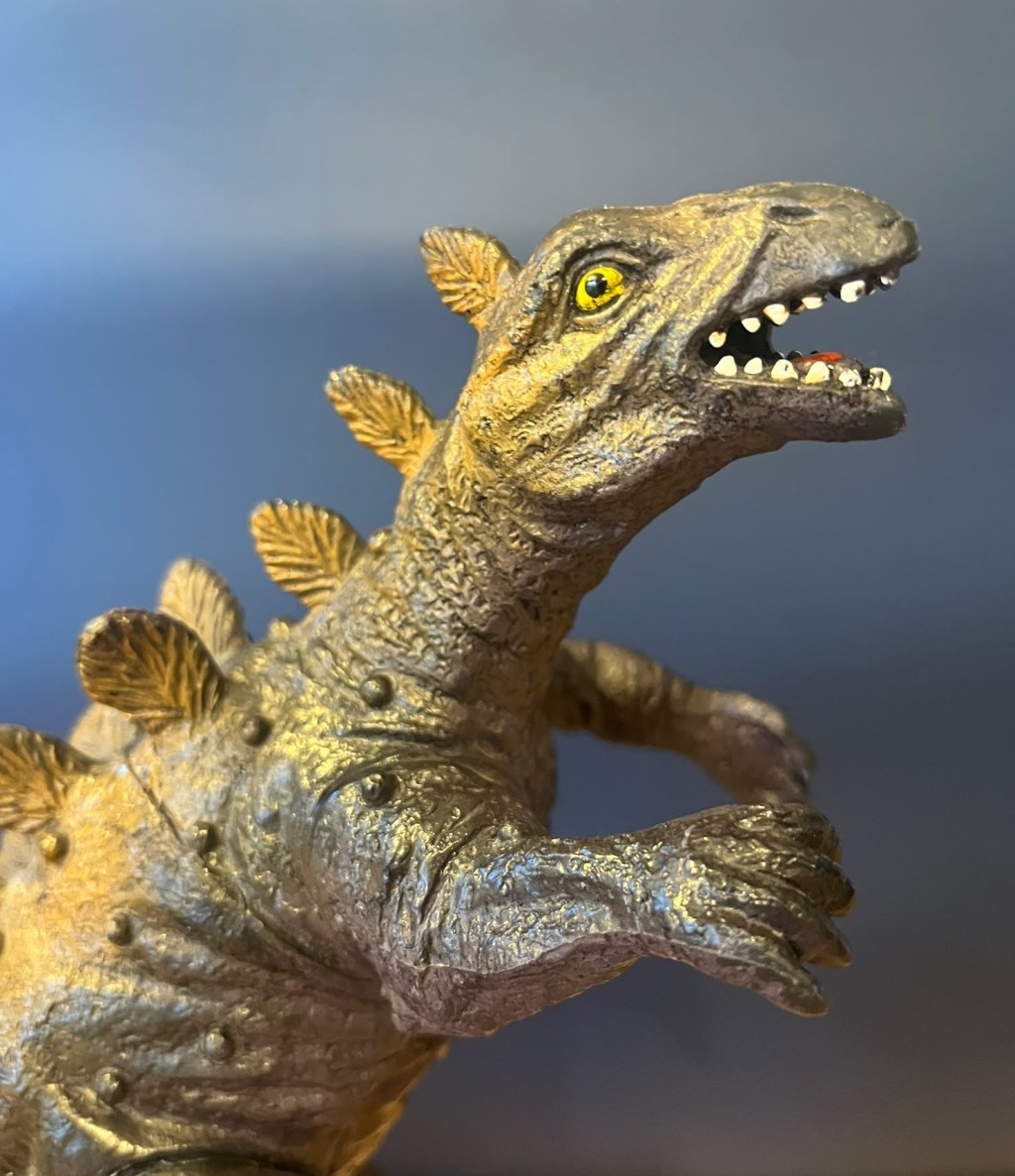
For a while, I have eyed these dino-abominations from a distance, always finding them on Polish sale sites, and usually in collections of 1980s and ‘90s dinosaurs – until recently I purchased one in a job-lot in order to get the bootleg Godzilla toy included there. Then after the parcel arrived, I was entranced by this peculiarly clumsy dinosaur toy to the exclusion of all others therein, and so I sourced another to compare their features.
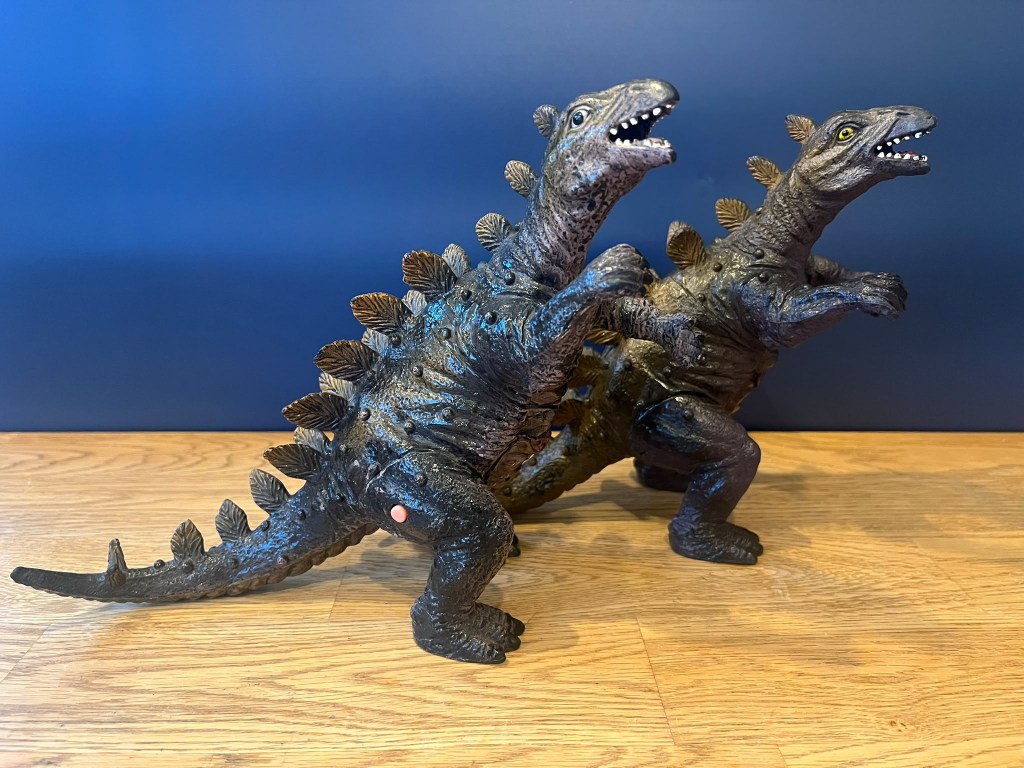
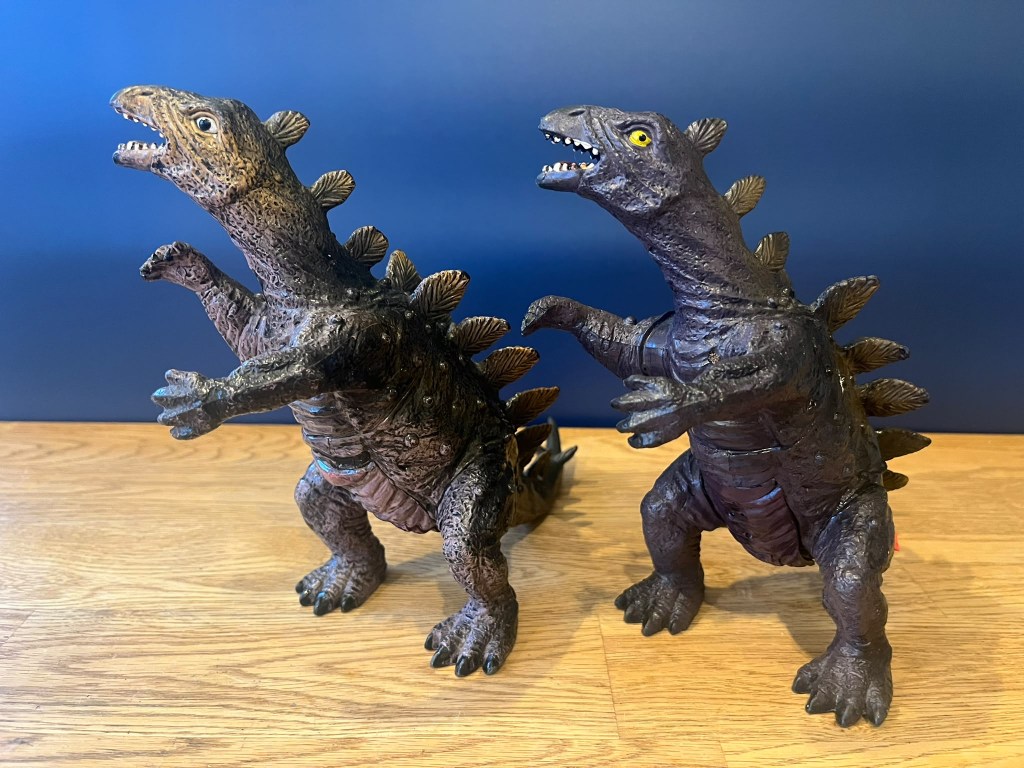
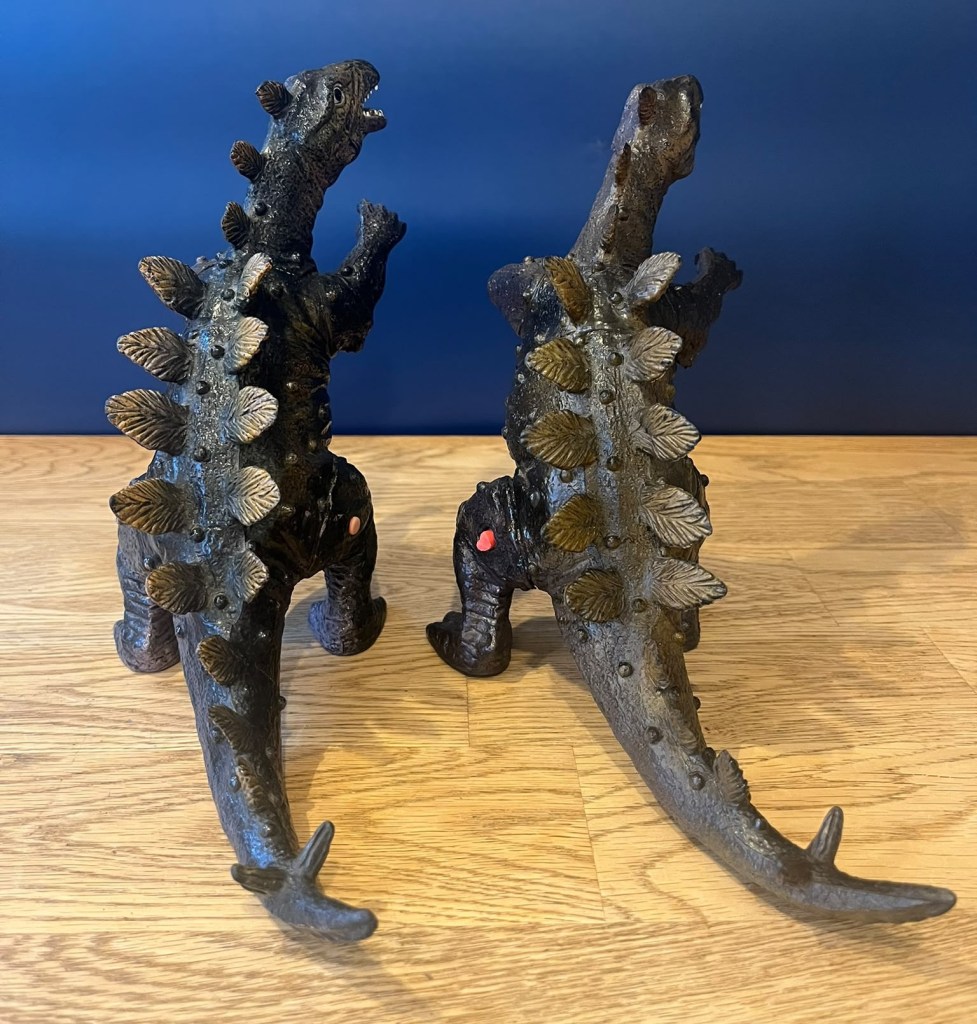
These odd and warty beasts were produced in black vinyl, are sprayed different shades of purple, with one (the lighter shade of purple) given an overwash in black, and both highlighted along the spine in yellow-green. One has a white base-colour to its eye, and the other yellow. They stand about 185mm. tall, and the two I have handled weigh a close 268 and 277g (the difference may be accounted for by the inclusion of batteries, or not). These two Stegozillas share a lack of marks under their feet, which are recessed like Bandai’s sofubi of the Ghido-Goji from 1991, the Bato-Goji from 1992 and Rado-Goji from 1993.
As Lewis Carroll had Alice say as she grew kaiju-like tall, this gets “Curiouser and curiouser” the more you look, and from the get-go it is clear that these were not made by a large and professional factory.
Let us take their peculiarities point by point:
1. The first strange feature to strike me is that the uppermost dorsal spine of the beast is mounted high up on the back of the top of the beast’s head, like a mullet-mohawk (and this same feature is shared with another, almost certainly Polish, Godzilla bootleg – see my earlier post on these, where the one in question is labelled no. 3 there).
2. Next, the first Stegozilla I received is spectacularly badly put together, with one limb clumsily jammed in, presumably to set it at the desired angle relative to its body, but leaving about 5mm. of the flushing exposed (that usually hidden within the beast’s body cavity).
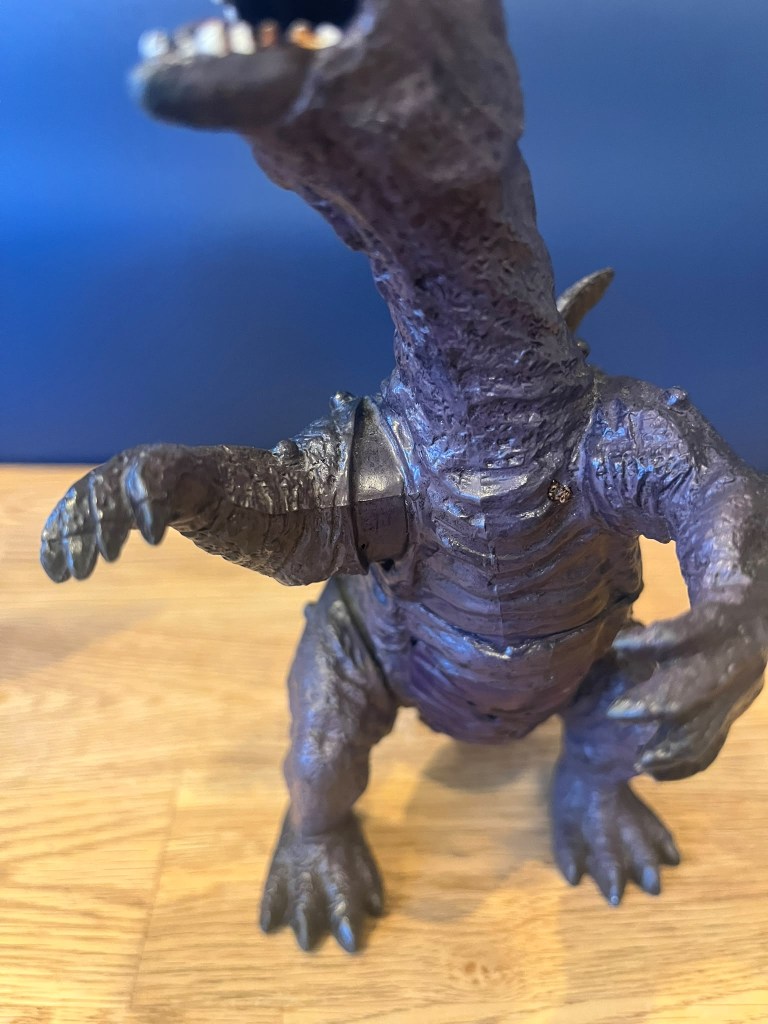
3. In addition, both have small red or pink circular rubber buttons to operate the roaring mechanism mounted through a hole drilled in their thighs. However, the assembly operatives have chosen different legs with each of the two I have handled. The roarer devices are concealed within the body, and happily for our purposes here, these roarers are copies of Godzilla’s ‘leather gloved hands pulled over metal strings’ screeches – and are so close to the ‘roars’ of the later Dor Mei Godzilla bootlegs, that I suspect that they are audio-bootlegs taken from those mechanisms (note that, the roaring version of the Dor Mei bootleg most probably dates to the late 1980s or ’90s).
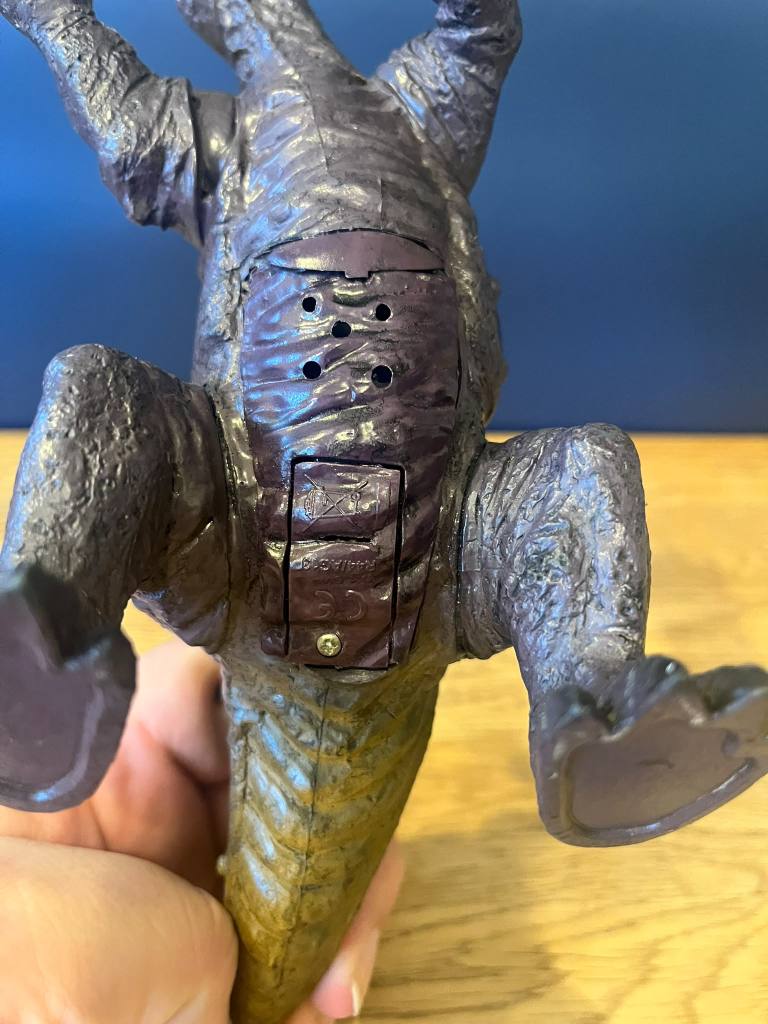
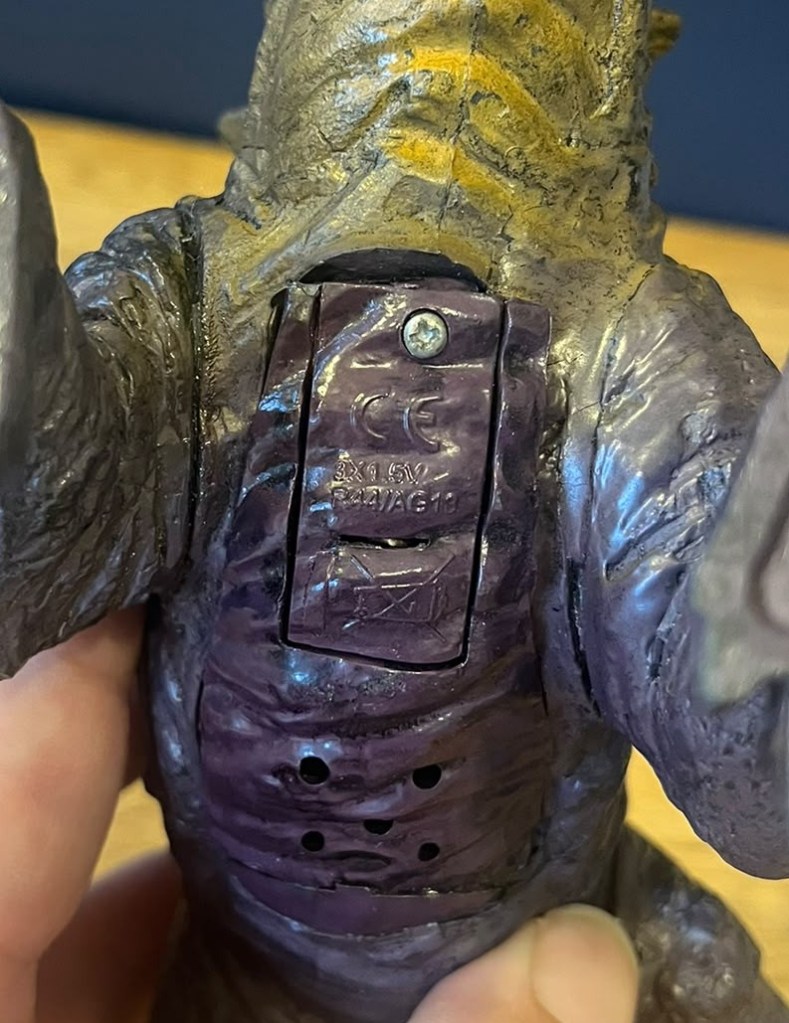
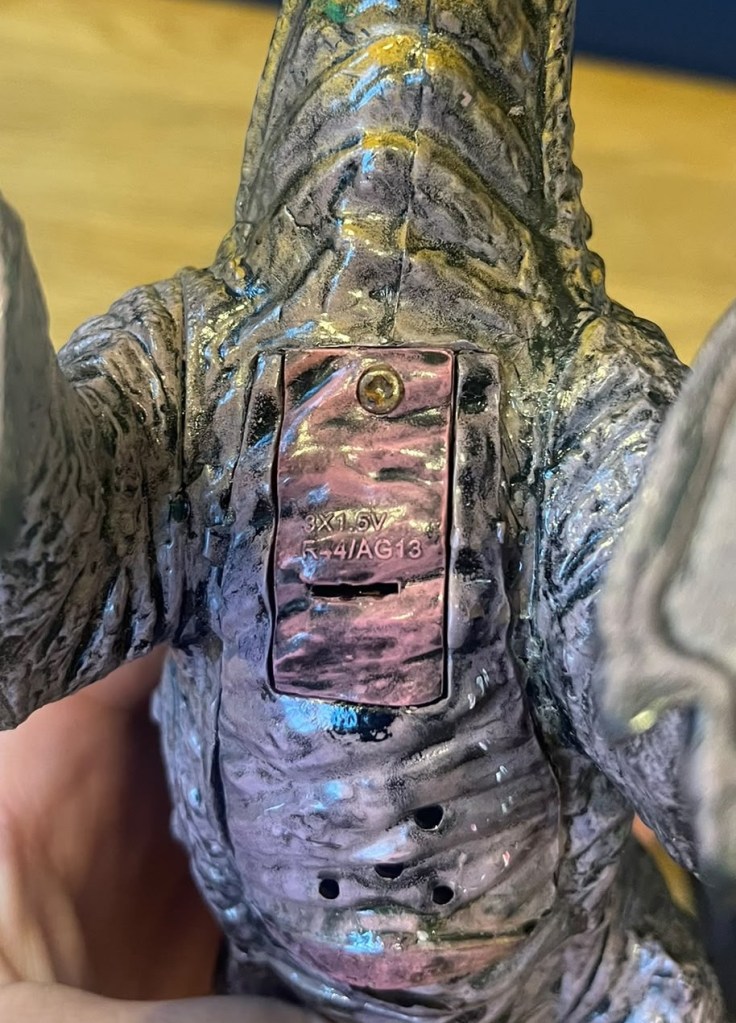
4. Finally, the battery compartment cover on the belly of the beast is so badly constructed as to be suggestive of bootlegging in itself. A small semi-circular section of plastic has been added to its side nearest the chest of the beast, apparently as the original mold omitted to provide a ‘lip’ that the main compartment lid could sit its uppermost edge under, or the tools used to cut the hole in the right place were unable to do so at the angle required. In addition, among the marks there on both examples I have seen, specifying the batteries to use (“3×1.5V”) and an apparent product number (“R44/AG13”), one figure (the first to arrive) has a slightly clumsy “CE” mark and diagrammatic instructions informing the owner not to throw it away in general trash. I would be flabbergasted if either one of the toys I have handled met the exacting ‘Conformité Européenne’ standards (indicated by the ‘CE’ mark), and thus met EU health, safety and environmental protection standards (note, this mark was used from July 1993 onwards), and the presence of the symbol on one, but not the other, surely identifies this as a forged mark, added at a later stage of production to try to reassure the unwitting buyer of the high quality of the toy.
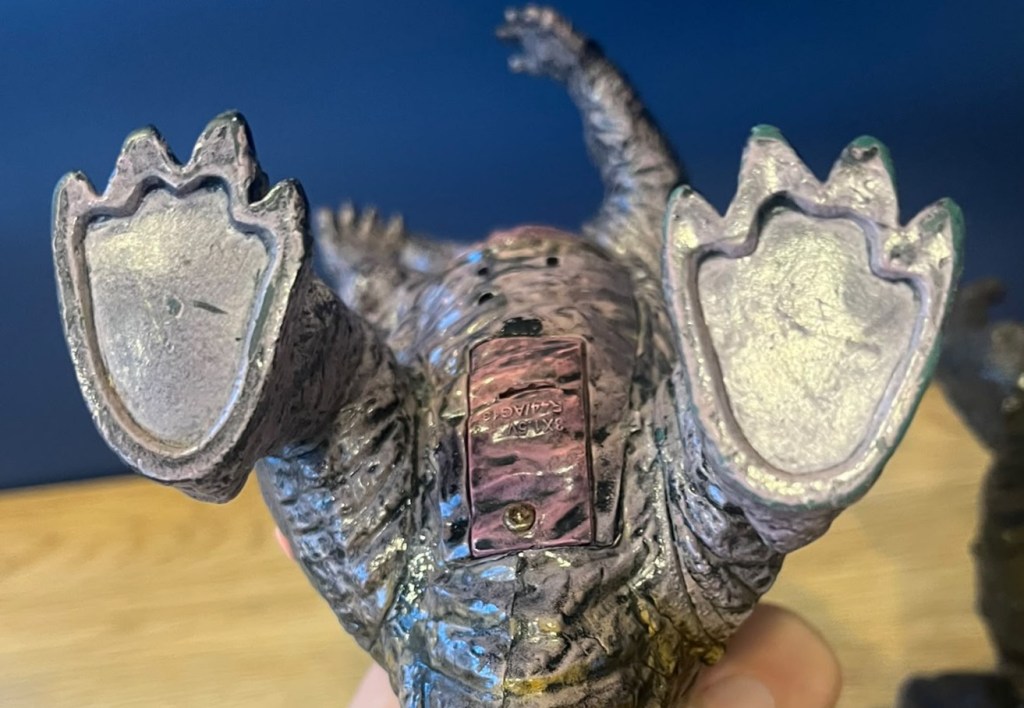
⁂
When we turn to potential models for the form of this dino, I draw a blank, as do those that I trust in the dino-toy collecting community. I simply cannot find a vintage Stegosaurus standing up on its hindlegs with even remotely the same posture, and it occurs to me that the grasping hand-like front paws are not suited to a quadrupedal animal, and fit better with a bipedal theropod instead. If any reader has an idea, please do reach out.
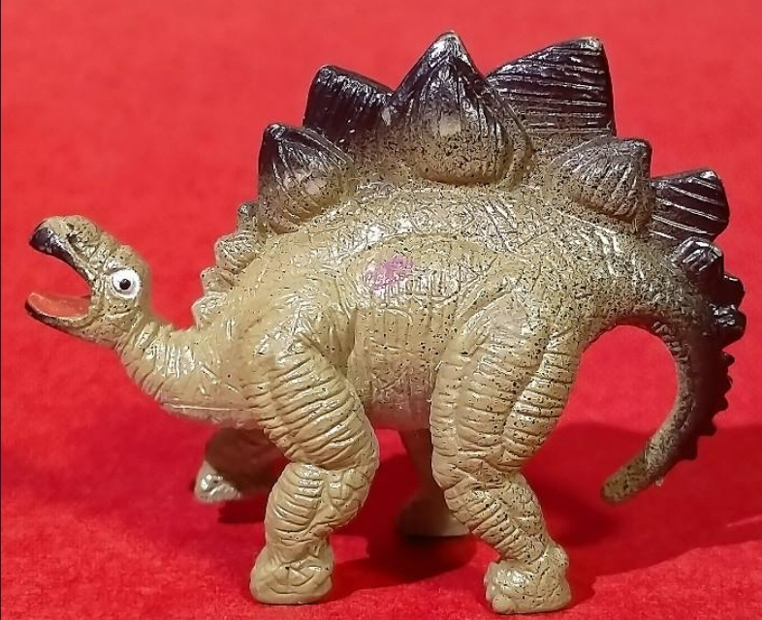
(Image from a long defunct online sales listing; this stegosaurus is either channeling my inner frustration at searching for hours in vain for a close comparison, or has just stepped on a Lego brick. Perhaps both. Eitherway, I know his pain and sympathise)
On reflection, my best guess is that what we are looking at here is a ‘mash-up’ of a Stegosaurus toy with a bipedal dino. I suspect the base form is an Edmontosaurus produced in the ‘U.K.R.D.’ line and stamped with a copyright date of ‘1991’:
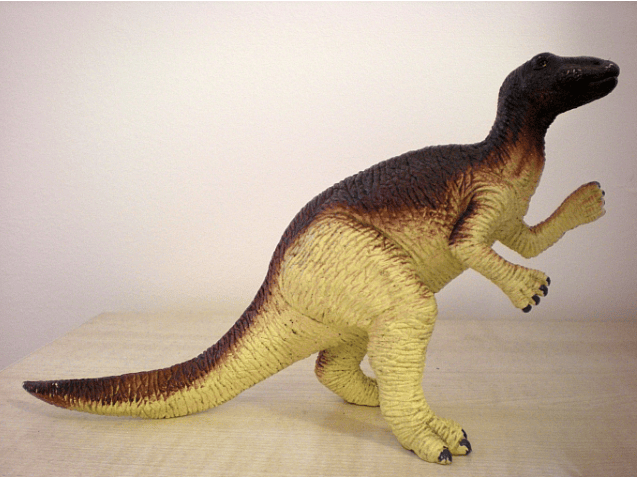
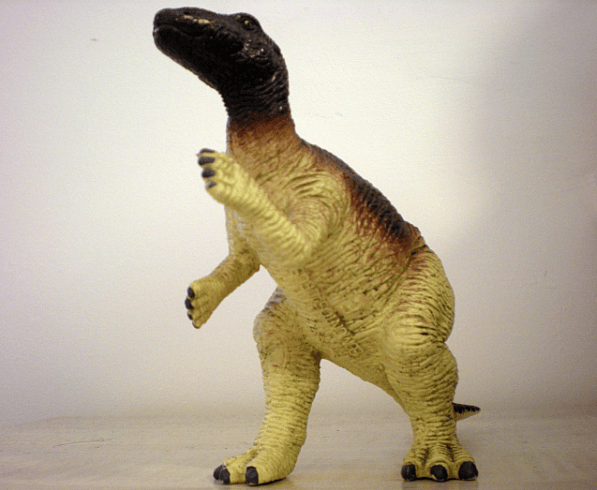
(The ‘UKRD’ Edmontosaurus – image from this dinoblog post; see also here on this toy)
The number of toes is different, but the same posture is there, and the four-‘fingered’ hands are close enough to suggest direct inspiration. The warty Stegosaurus body that seems to have been forced into this shape in a medical procedure worthy of H.G. Well’s Dr Moreau (despite reading and adoring that book as a youth, I cannot now see any other picture in my head of that ‘doctor’ apart from Marlon Brando’s white-draped elephantine form – and by extension lakeside Cam in the TV series Modern Family), could be from any number of dino-figures from Dor Mei’s stegosaurus onwards (that with a copyright mark of 1985).
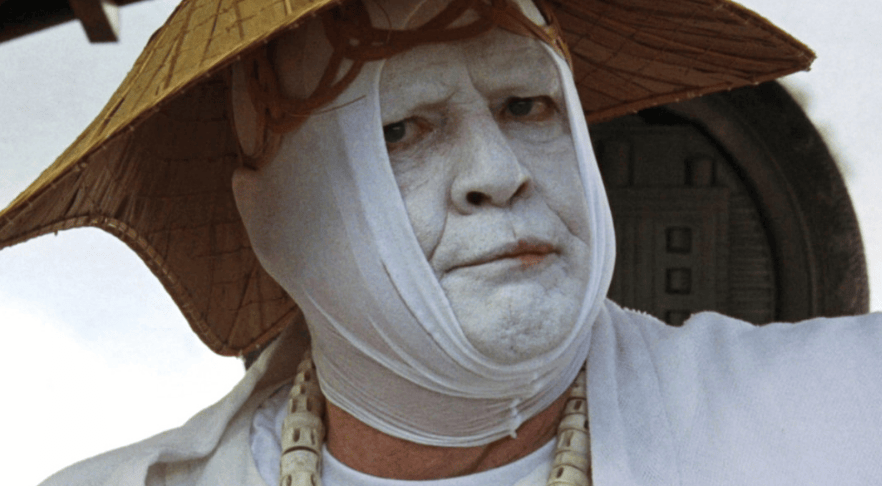
(The ‘doctor’ is equally perplexed as me by this apparent ‘mash up’)
⁂
When we consider where the item might have been produced, we can be a little more certain. I have seen nine of these Stegozillas, all on Polish Vinted or OLX, and none anywhere else, with a single exception: an Instagram user named ‘kollektornius’ was the only person to respond to an appeal for information by me there and in the ‘Warriors of the Universe’ group on Facebook. Excitingly, they got in touch with the news that they purchased an example of the same beast, but in red vinyl, in Mallorca earlier this year:
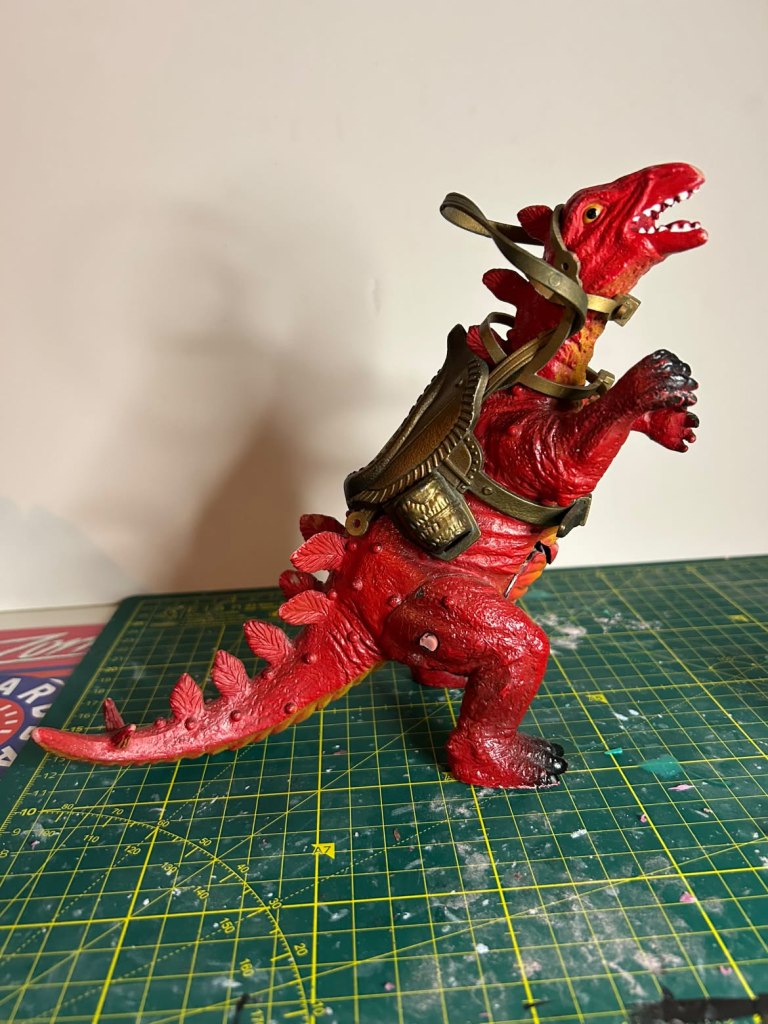
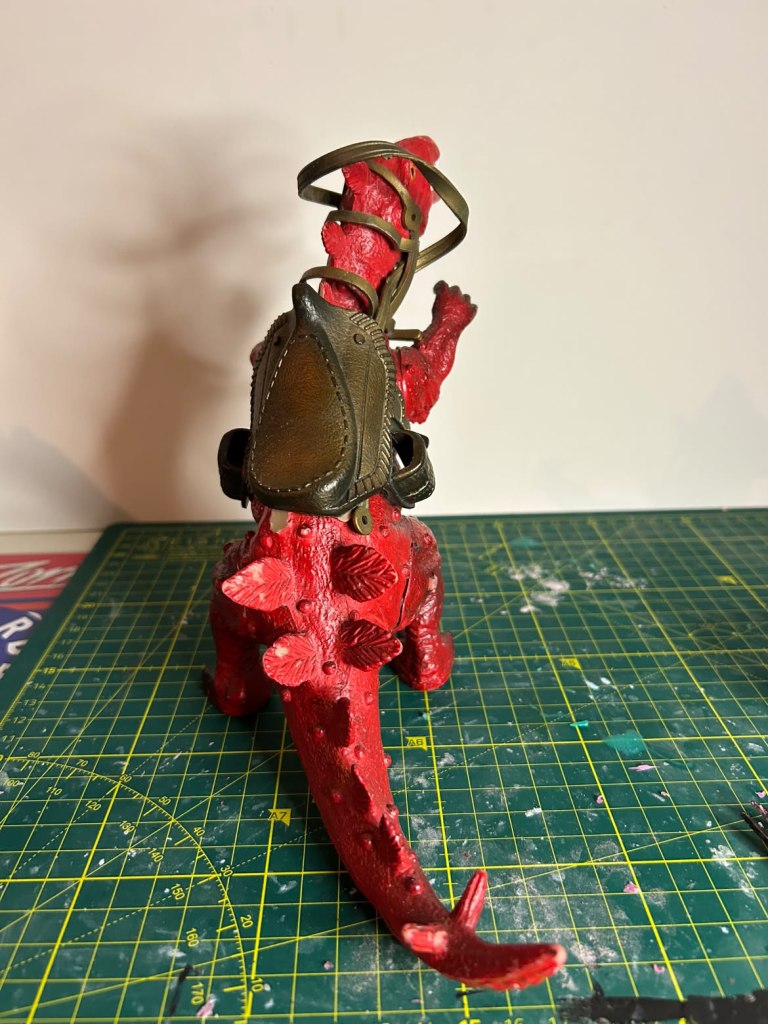
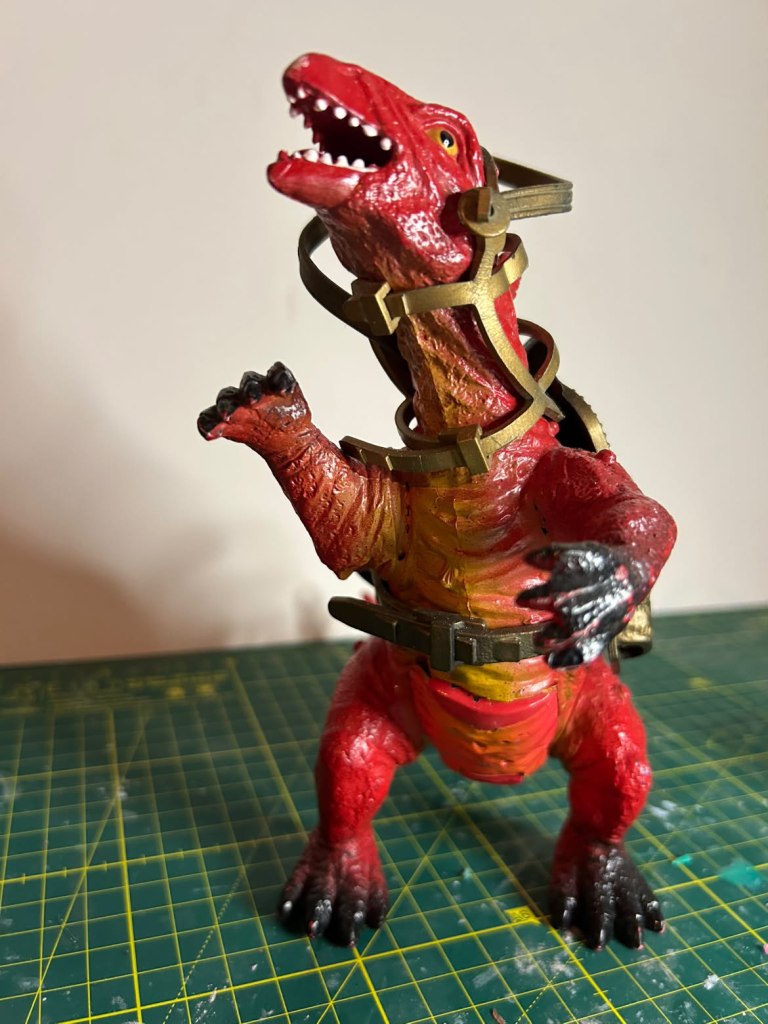
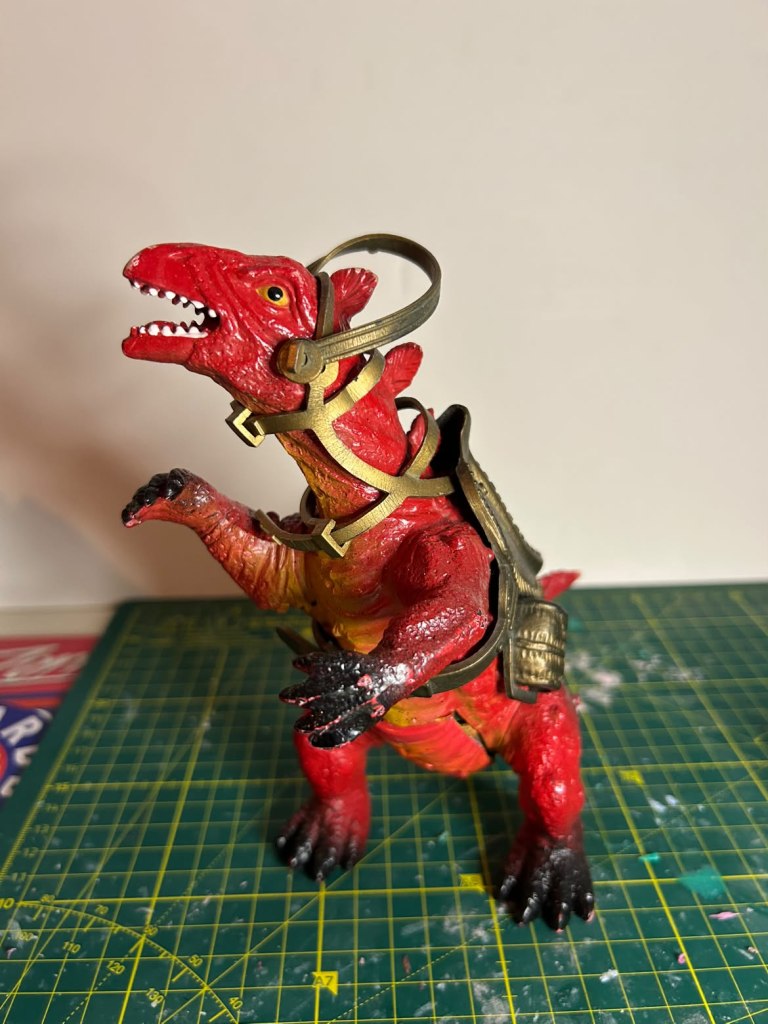
(Images supplied by ‘kollektornius’ – and I think the harness here is from another toy and I fear a previous owner may have cut away a few of the dorsal fins to make that fit; images reproduced here with the kind permission of ‘kollektornius’)
This ‘Big Red’ is a proud beast, and the colour is deliciously attractive. Interestingly, while the battery case cover of this new one is identical in form and ill-fitting nature to the other two, there are no marks at all on this one:
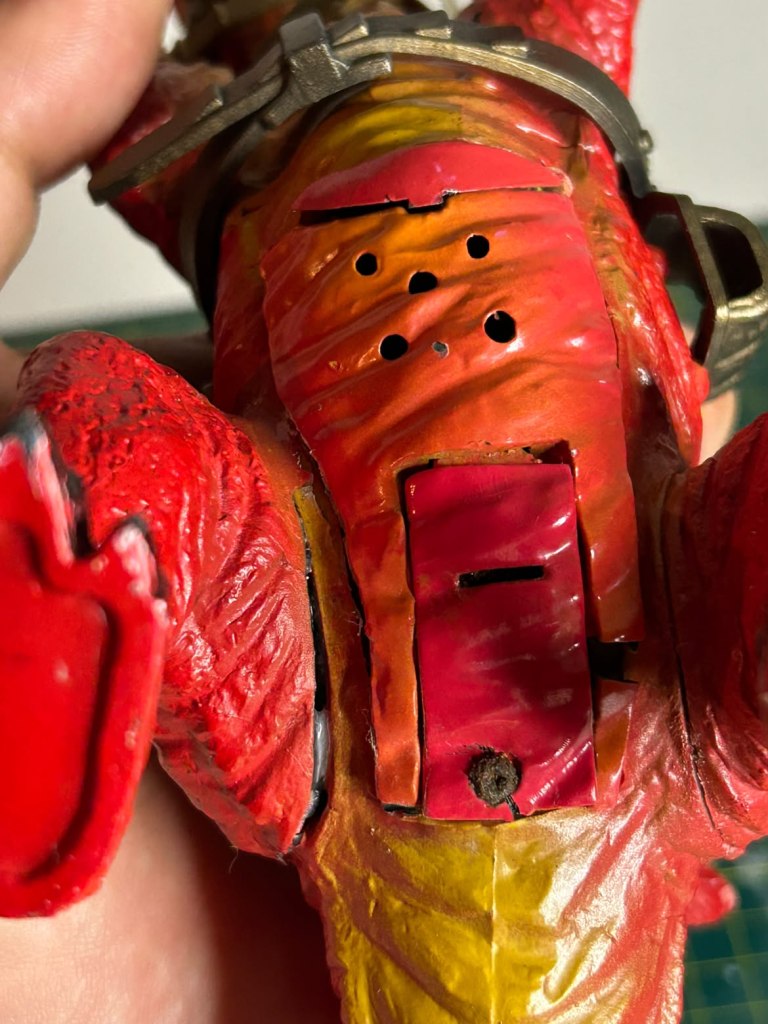
If some sense and order can be made of this inconsistent use of marks, I suspect that ‘big red’ may have come first, then the model with the battery instructions but no ‘CE’ mark. Then after July 1993, when it became relevant, the last set of marks with the ‘CE’ mark was used. The red version would appear to be the rarest, with this one the only one presently known to me.
[QUICK AND TEMPORARY UPDATE 2 October 2026: another example of ‘Big Red’ has come to light, and it adds much to our understanding of that piece of this puzzle. It is on its way to me now, and I will do a post of that one as soon as it arrives, and then tweak this main post – so if the red one here interests you, check back again soon].
Returning to our question of localisation – the clumsiness of the bootlegs might well be as much at home in Poland as well as in Spain. However, a thorough search of Todocoleccion’s current sales and sold-lot-archive (perhaps the most comprehensive resource out there for this sort of search) for the simplest and most productive of search terms here: ‘dinosaurio’, shows no other example in the Spanish market.
The frequency of the appearance of these dinos on the secondhand market overwhelmingly indicate an origin point in Poland, and perhaps the south and east of that country, with all examples currently known to me from Tarnowskie Góry, near Katowice in SW Poland; Bałów near Lublin in SW Poland as well as Lublin itself; and Ełk in NE Poland (for the statisticians among my readers, I should note that only one known to me comes from the geographically indistinct: “Poland”, that posted by an apparently coy seller). As I have noted before, the specific conditions of bootleg toy production in Poland meant that such toys tend to have had only local distribution, and so mapping their appearances in the market today can point to where the production originally took place (on this, see my earlier posts on Polish bootlegged Godzillas and dinosaurs).
⁂⁂⁂
What then to say in conclusion here? These roaring Stegozillas – half Godzilla and half Stegosaurus – seem to have an origin in southern or eastern Poland, and if we follow the apparent models used, then we should probably suggest a creation date in the early 1990s, around 1991-93. A production run that spanned 1993 might well explain why some figures have no ‘CE’ mark, and others do, as that mark was introduced in that year.
To me, they are glorious to behold, because of their poor design and numerous imperfections – and are still remarkably cheap. If any reader without access to the Polish secondhand toy market wants one, just get in touch, and I will consider it a duty to fix you up at cost price, and send these Stegozillas across the globe in a hideously-warty Cold War-era diaspora.
As a final note: as with all these ‘identification of new bootlegs’ posts, I will update this post if further information comes to light. In that vein, if any reader has another snippet of information that might be useful here, then please do get in touch.
- 'MUTTON DRESSED AS LAMB': Godzillas and kaiju that look vintage, but are not
- American made Pachi
- BOOTLEG DINOSAURS – a little off topic, but sometimes needed here
- BOOTLEG GODZILLAS
- BOOTLEG MECHA
- Bootleg Mecha from Europe
- BOOTLEG PRODUCTION MATERIALS – MOLDS ETC.
- Bootleg Tokusatsu from China and its immediate neighbours
- Bootleg Tokusatsu from Europe
- Bootleg Tokusatsu from the Americas
- BOOTLEG TOKUSATSU HEROES
- Central Europe – Godzillas and kaiju from behind the Iron Curtain
- Chinese-region bootleg Godzillas -the plastic tide from the East
- Chinese-region made Pachi
- European made Pachi
- European-made Godzillas
- Japanese-made pachi
- Japanese-made Pachi
- LICENSED GODZILLAS AND KAIJU – deserving honorable mentions despite their official status
- PACHI
- Pachi kaiju
- Pachi kongs
- Pachi superheroes – Ultraman and similar
- The Americas – bootleg Godzillas from the New World
- Uncategorized


Leave a Reply