The same Orion Home Movie rental promotion that released the bootleg Godzilla-clock into the United States in November 1989, which in turn gave birth to the near-identical Chinese bootleg (see previous post on the Serbian bootleg Godzilla), also gave rise to a group of common bootleg Godzillas in Spain.
Spain had a booming toy-bootlegging market from the 1960s onwards, encouraged by famously lax enforcement of copyright laws. In those decades, companies such as Yolanda (these usually producing copies under license), JHL and Hermanos Pardines played important roles (these to be the subject of future posts), and other anonymous companies produced lesser quality items for sale on market stalls and as inexpensive counter or ‘rack’ items in shops.
However, at the same time an anonymous Spanish company also produced unlicensed copies of the Chinese bootleg of the ‘Orion clock Godzilla’.
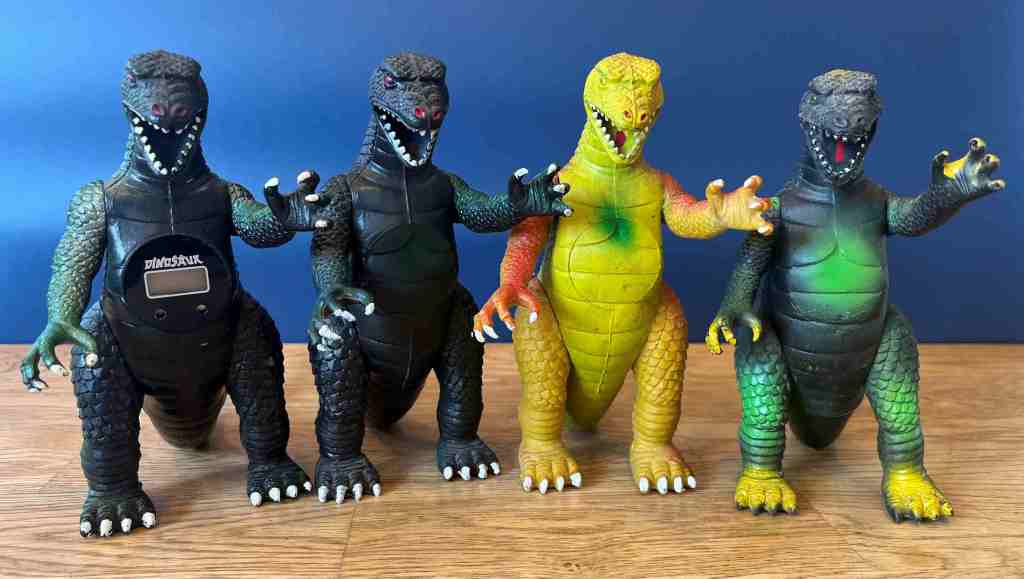
(From left to right: the Orion clock Godzilla; the Chinese bootlegs of that in black and yellow; and the initial phase of the Spanish bootleg of them)
- The Orion Godzilla-clock:
A bootleg Godzilla with a clock set in its chest, standing 150mm. tall, weighing 115g., and with articulated arms, legs and tail (that articulated at a single point at its base), but with a head in a fixed position. It was issued in two colour schemes – these copied almost exactly by the Chinese bootleg, except that the black and green model had silver highlights as well. It was produced for an Orion Home Video Japanese and Korean monster films promotion in the United States in 1989, with the first copies of this free gift apparently given out in the United States in November of that year.
2. The Chinese bootleg of this clock:
These are hollow and made in hard rubber, and 155mm. tall, weighing 127g., and with a throat closed at the top of the larynx, leaving the whole head empty. The arms and legs articulate, as does the tail in a single point at its base, but the head does not. I know of them in yellow with orange and green highlights and black with dark green highlights. Somewhat oddly, many of them have convex soles to their feet, as if their legs were molded in a process that generated an internal air pressure higher than the surrounding atmosphere. These have “CHINA” stamped into one of their right foot, often faintly.
3. The Spanish bootleg of these (phase one):
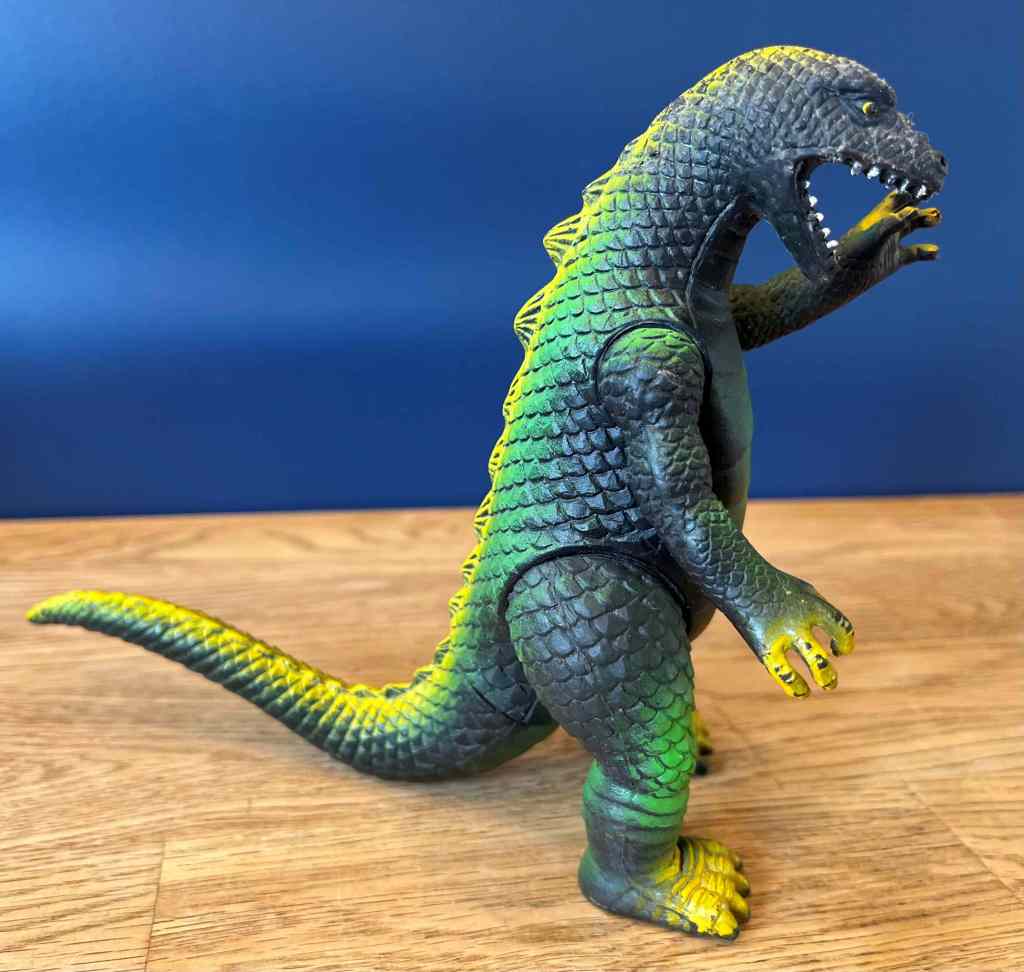
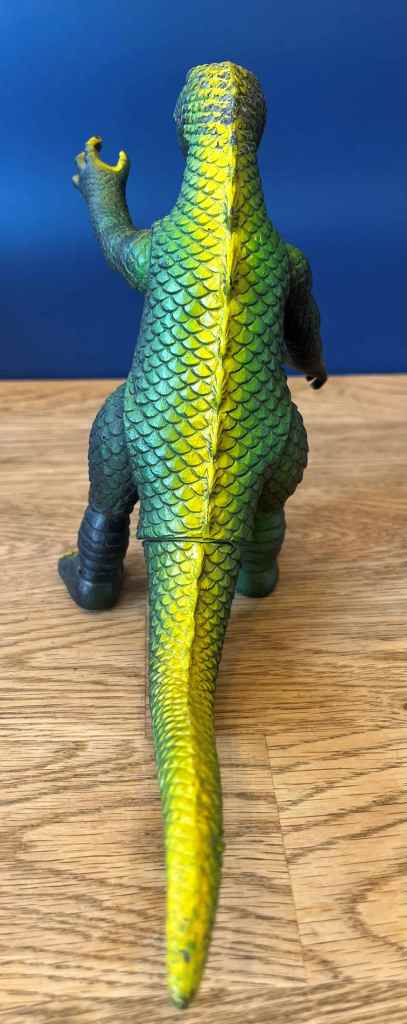
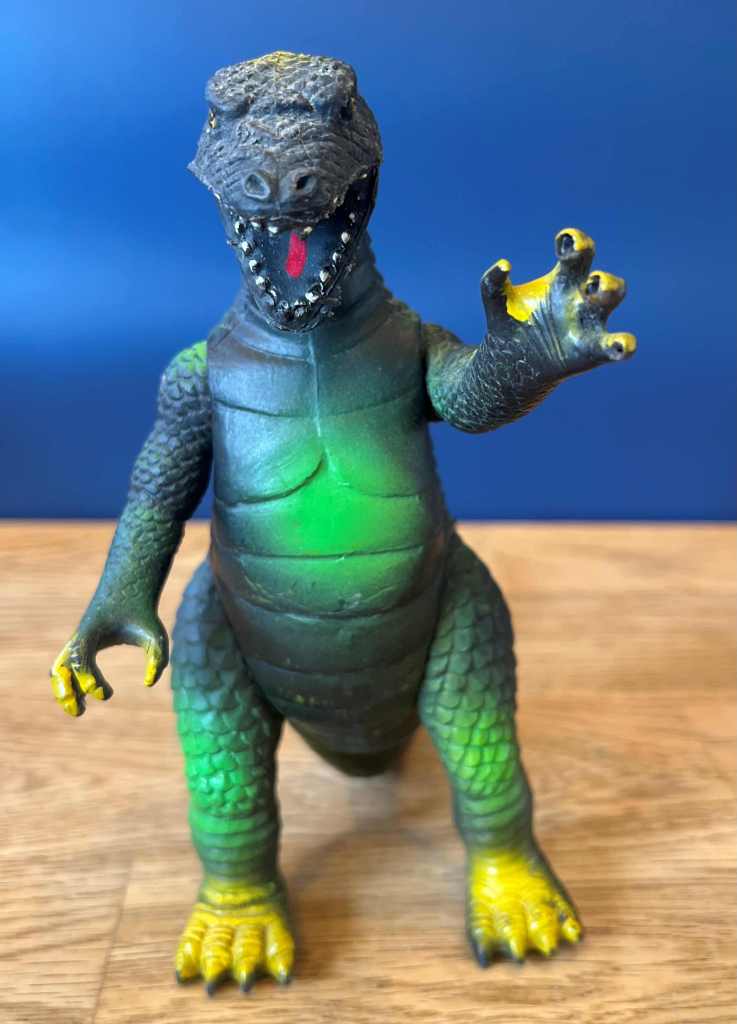
These are made in somewhat pliable hard rubber (so that the arms can be bent quite easily), with hollow body parts, stand 150mm. tall and weigh about 113g. Their throats are sealed at the point that their upper and lower jaws meet, and they articulate as with the other models discussed here. They are known to me mainly in black with green and yellow highlights.
The large flattened circular area on their chest, was, as with the Serbian bootleg and its Chinese predecessor, the site of the clock in the ‘Orion clock Godzilla’, with that removed and the surface resculpted to form pectoral muscles and two lower folds of the beast’s body. These resculpted areas are near identical in detail to the Chinese bootleg, as are the hands, heads, feet, spine-fins and even scales and folds of the body. There are no marks on the soles of the feet.
One interesting feature is that in all models seen by me the legs are of slightly different lengths (left: 73mm. and right: 68mm.) giving the figure a pronounced sideways lean .
These are so close to the Chinese bootleg that I think we may presume they were the initial ones produced by this anonymous Spanish company.
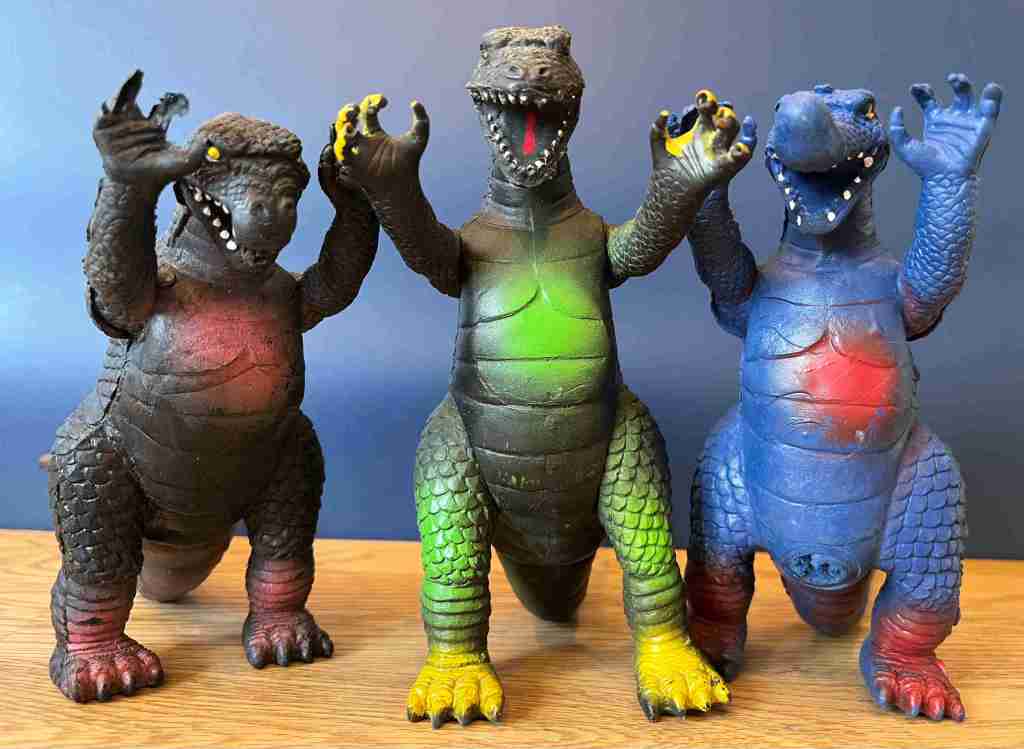
(The Spanish bootlegs: from left to right: Phase 3; Phase 1; and Phase 2)
4. The Spanish bootleg (phase two):
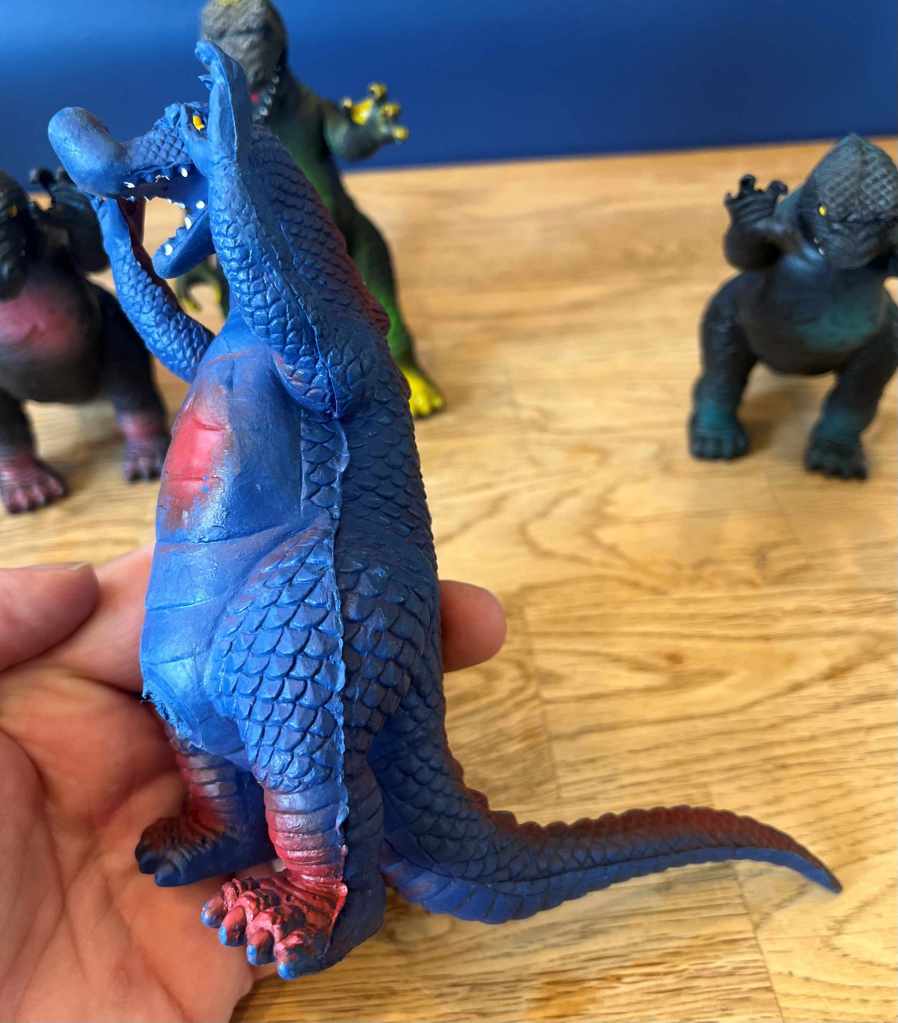
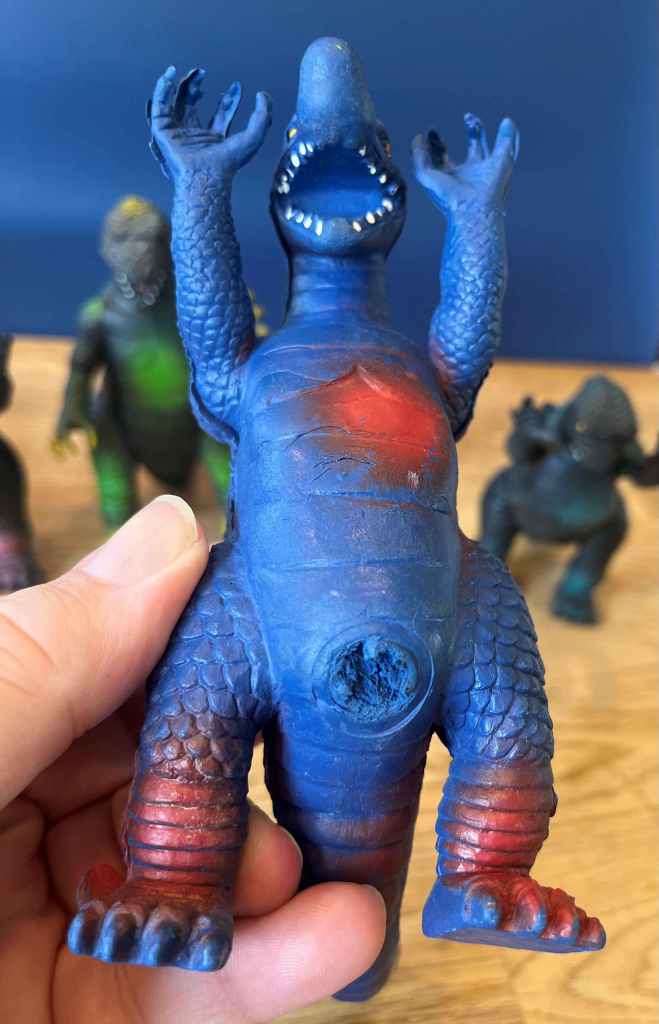
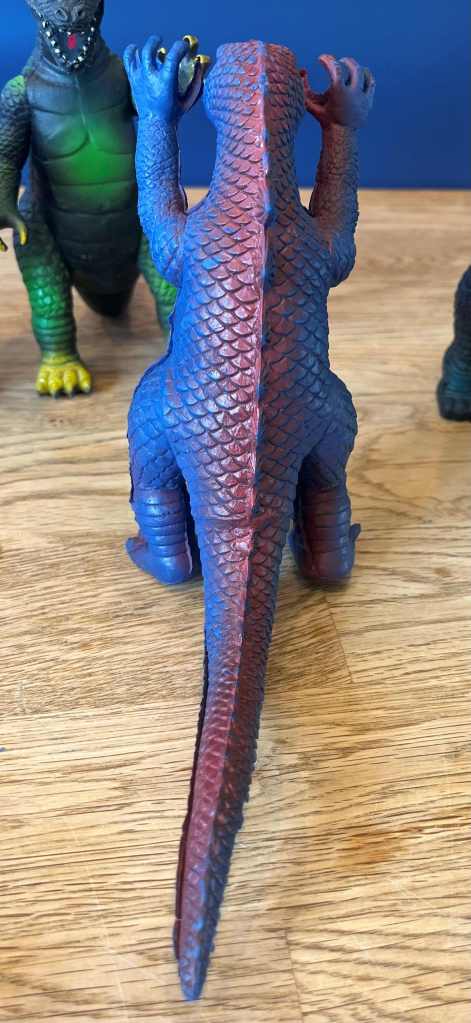
These are near-identical to those of phase one, except that they are slightly shorter, standing some 140mm. tall, and are made of solid rubber, and thus weigh an impressive 265g. No parts of their bodies articulate, but traces of lines and edges at the joints and seams of their bodies show that they were cast from an articulated model of the form of phase one. They have their arms raised above their head in a fixed ‘don’t shoot’ position, and their legs are again of slightly different lengths and fixed too far back in an awkward position that puts them permanently slightly off-balance. These models have distinctive circular marks on their bellies, showing signs of having been torn away from a rubber spit at this point, and such large bulbous and upturned noses that they always make me think of Jimmy Durante (if you are too young to get that, look it up). Both of these features must be the remains of the injection points of the rubber into the mold.
As solid inarticulate castings of those in phase two, these must have been an attempt to more cheaply mass-produce the earlier model, and thus date to after the initial phase of production.
[UPDATE OF 1 JUNE 2026: an outstanding example of one of the phase two type discussed above, in translucent tangerine orange rubber, has come to light in the collection of an Instagram poster named el Mergares, and it is so far above its peers in its beauty and desirability that it deserves to be added here if only to give the rest of us something to lust after:
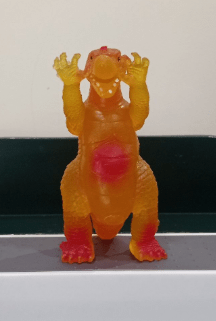
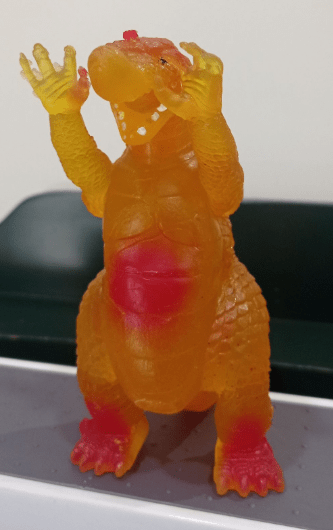
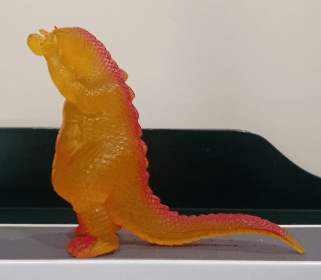
(Images supplied by el Margares, and reproduced here with his permission)]
5. The Spanish bootleg (phase three):
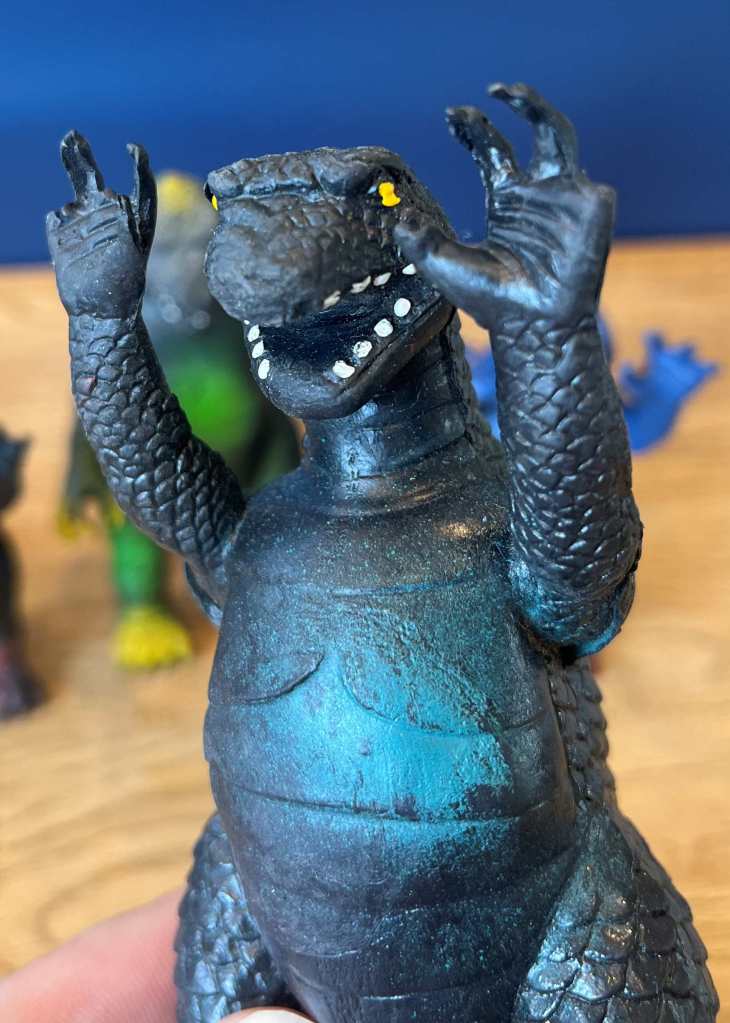
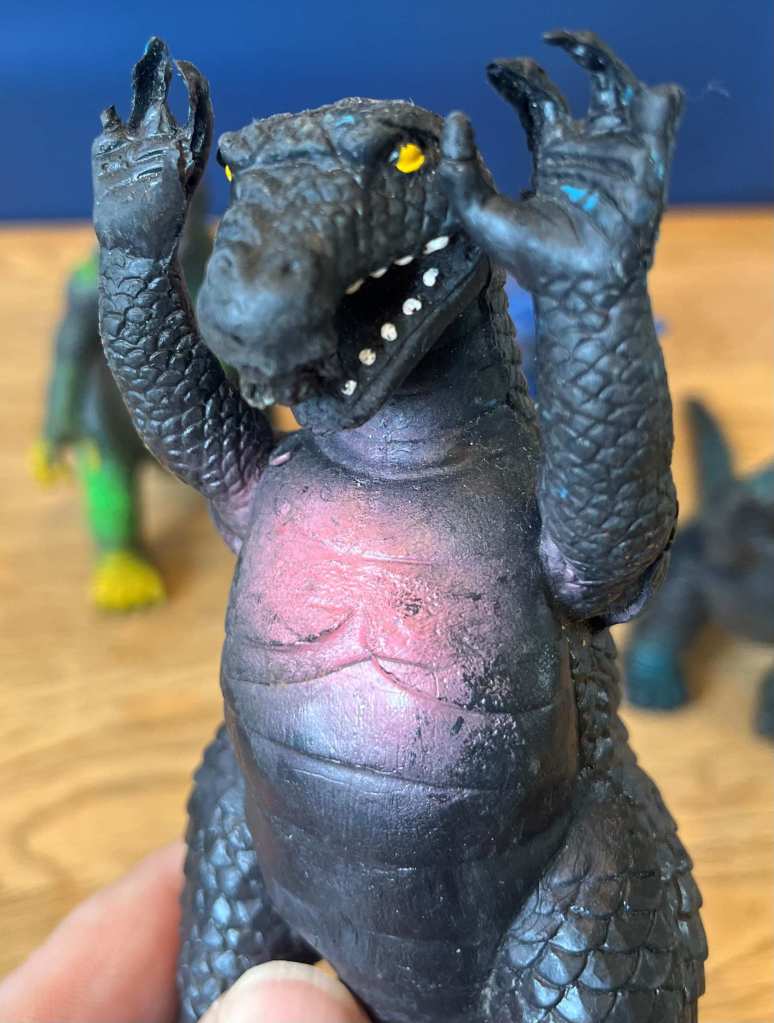
These are identical to those of phase two, except that the circular mold marks have been eliminated and the enormous bulbous upturned noses improved – presumably as better mold techniques were employed. I say improved, rather than corrected, as two more of these owned by me have no circular mold marks on their stomachs, but do have drooping noses with extra rubber or severely truncated faces.
Addendum: a two-headed version of the same:
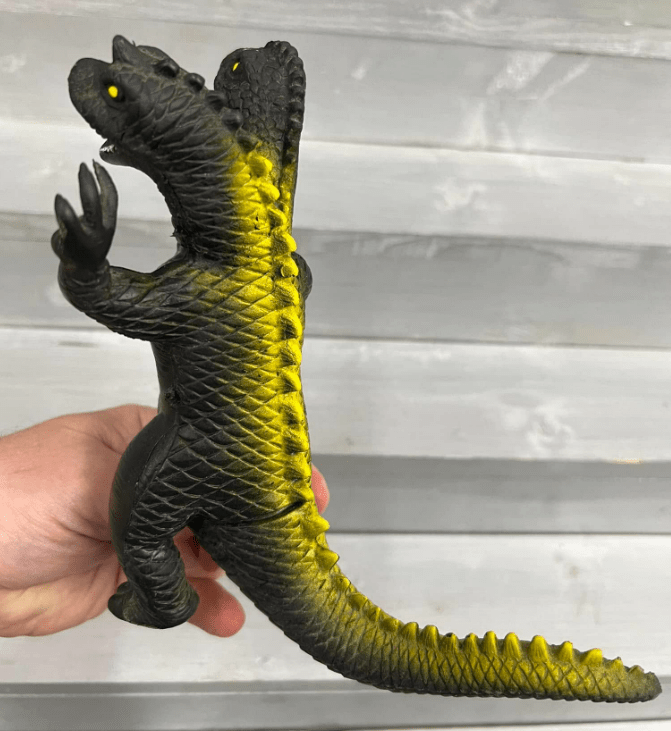
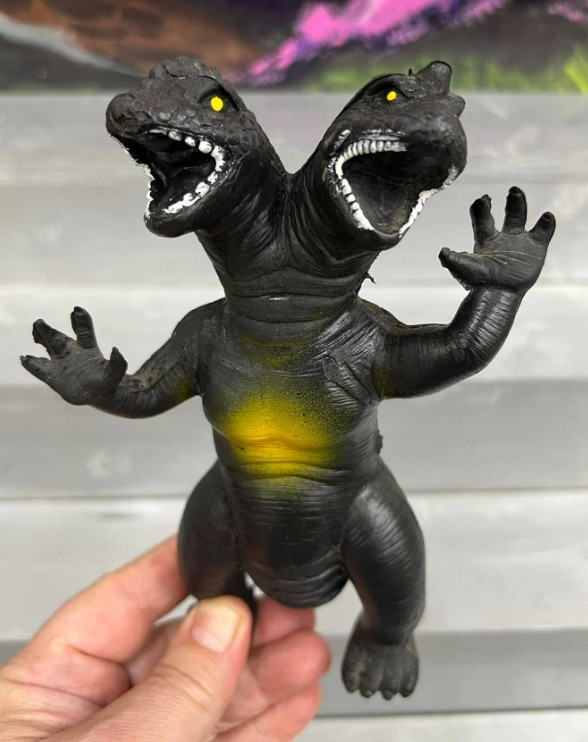
(These images taken from Chance Priest’s Facebook post: see below)
Immeidately, after this blog was finished, I stumbled across a 28 March 2024 post by Chance Priest, before a sale on his wonderful ‘Warriors of the Universe’ page on Facebook, with a rare example of a two-headed version of this Spanish bootleg Godzilla. It shares the facial sculpt, lack of a circular mold mark on its stomach and slight nose problems with the last version here. I would dearly love to hear from anyone with another of these – if only to get an accurate height and weight, and to establish if the tail articulates, or if that is a residual mold mark from casting from something with an articulated tail.
⁂⁂⁂
All three Spanish phases can be obtained easily in the European market (but not the two-headed one: I never seen one of those for sale), with the second and third Spanish phases quite common on Spanish online marketplaces.
These are often linked to the bootlegging company JHL online and dated to the 1980s. However, their bodies and details are quite different to the JHL models, and I cannot see why when so many others display the standard JHL marks on the soles of their feet (“JHL” followed by a capital ‘R’ in a circle and followed by “MADE / IN SPAIN”), these should not. They are most probably the work of another, unnamed toy-bootlegging company (or group of companies).
Importantly, the links set out here concerning their models, and the models behind those models, firmly establish that no phase of these Spanish bootleg Godzillas can predate November 1989, and all of them are likely to date to the early 1990s.
- 'MUTTON DRESSED AS LAMB': Godzillas and kaiju that look vintage, but are not
- American made Pachi
- BOOTLEG DINOSAURS – a little off topic, but sometimes needed here
- BOOTLEG GODZILLAS
- Bootleg Tokusatsu from China and its immediate neighbours
- Bootleg Tokusatsu from the Americas
- BOOTLEG TOKUSATSU HEROES
- Central Europe – Godzillas and kaiju from behind the Iron Curtain
- Chinese-region bootleg Godzillas -the plastic tide from the East
- Chinese-region made Pachi
- European made Pachi
- European-made Godzillas
- PACHI
- Pachi kaiju
- Pachi kongs
- Pachi superheroes – Ultraman and similar
- The Americas – bootleg Godzillas from the New World

 Confessions of a Kaiju Hunter
Leave a comment