China and Hong Kong dominate the world of bootleg Godzillas, and thus any produced elsewhere are fascinating in themselves, and the few produced in Europe are extremely so. European bootleg toys were not produced everywhere, and seem to have been made mainly where political barriers (such as the Iron Curtain) or economic hardships placed the purchase of Chinese or Hong Kong models beyond the grasp of the average parent or collector. In addition, an already active toy-bootlegging industry, or at the very least a single company producing a range of lines, appears to have been a prerequisite for the activity to take hold firmly.
We turn now to a Godzilla bootleg produced in the last incarnation of Yugoslavia, contemporary with the Revolutions of 1989, the break-up of that country into its constituent Balkan states (leaving only Serbia and Montenegro remaining together as the ‘Federal Republic of Yugoslavia’) and the Yugoslav Wars.
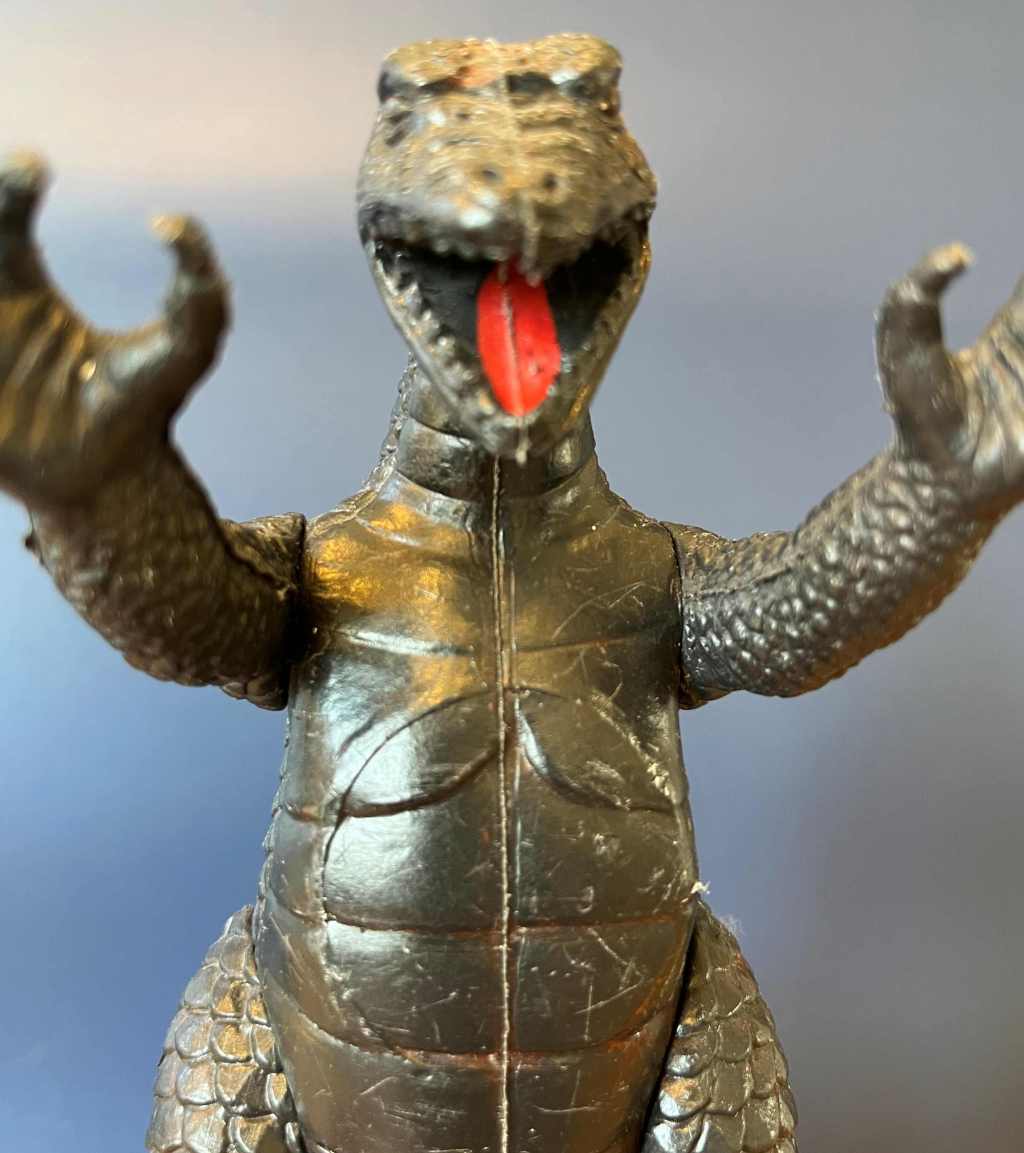
Sometime immediately after 1989 a toy department store named Oz in Zemun (once an independent town, but now a part of Belgrade) produced a distinctive-looking Godzilla bootleg in hard blow-molded plastic, with their logo on the soles of both feet (“OZ” within a stylised castle; and this integrally part of the mold, rather than stamped in later). They reportedly also produced other copies of toys, mainly MOTU, GI Joe, dinosaurs and animals, by the same method, all identifiable by the same logo.
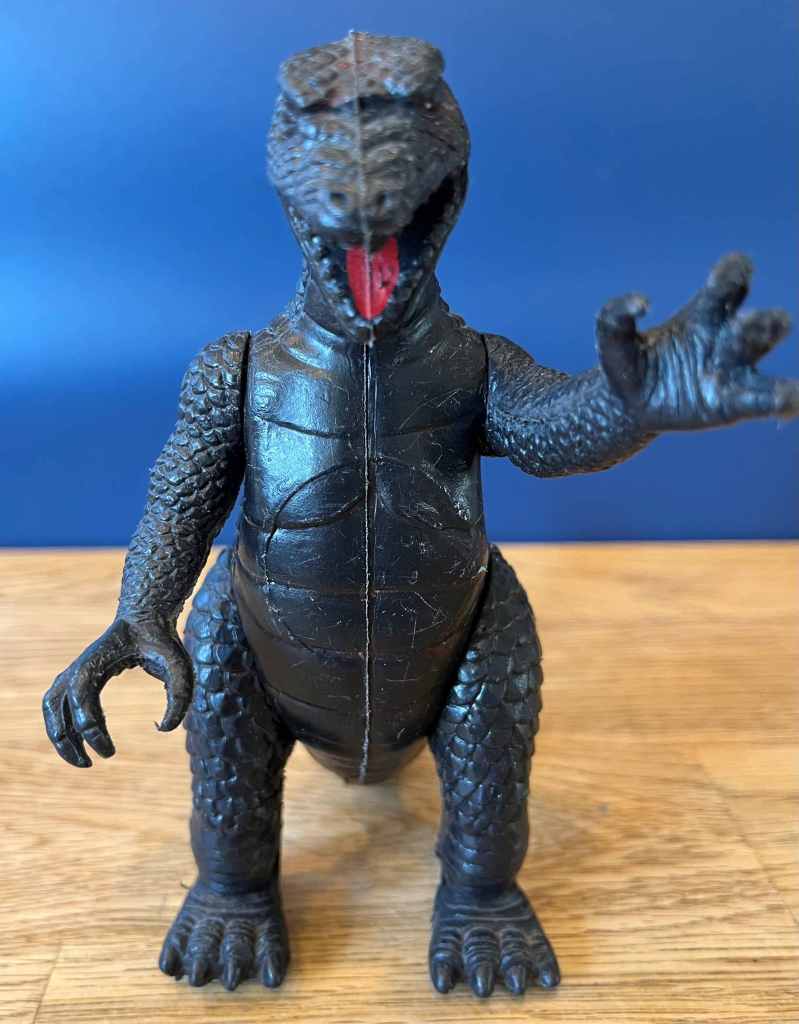
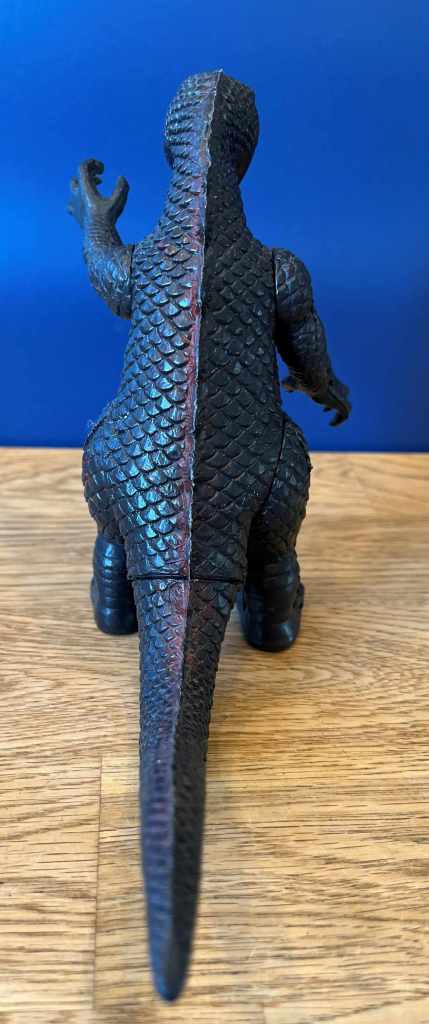
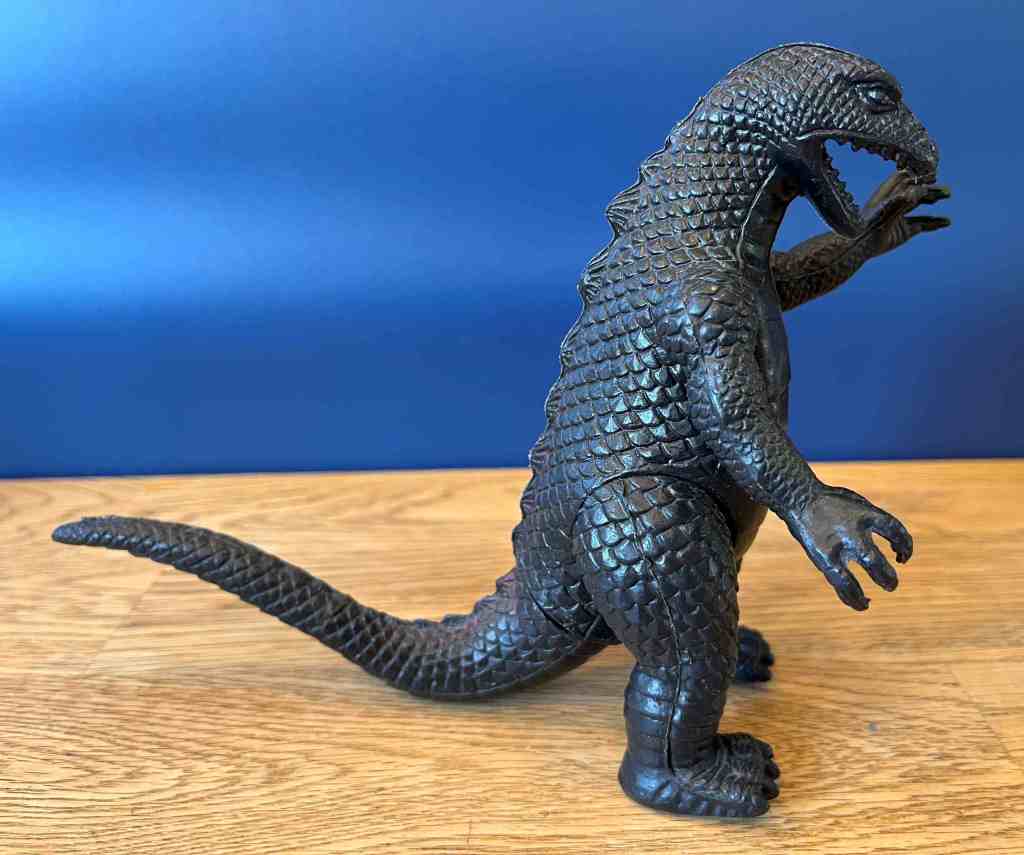
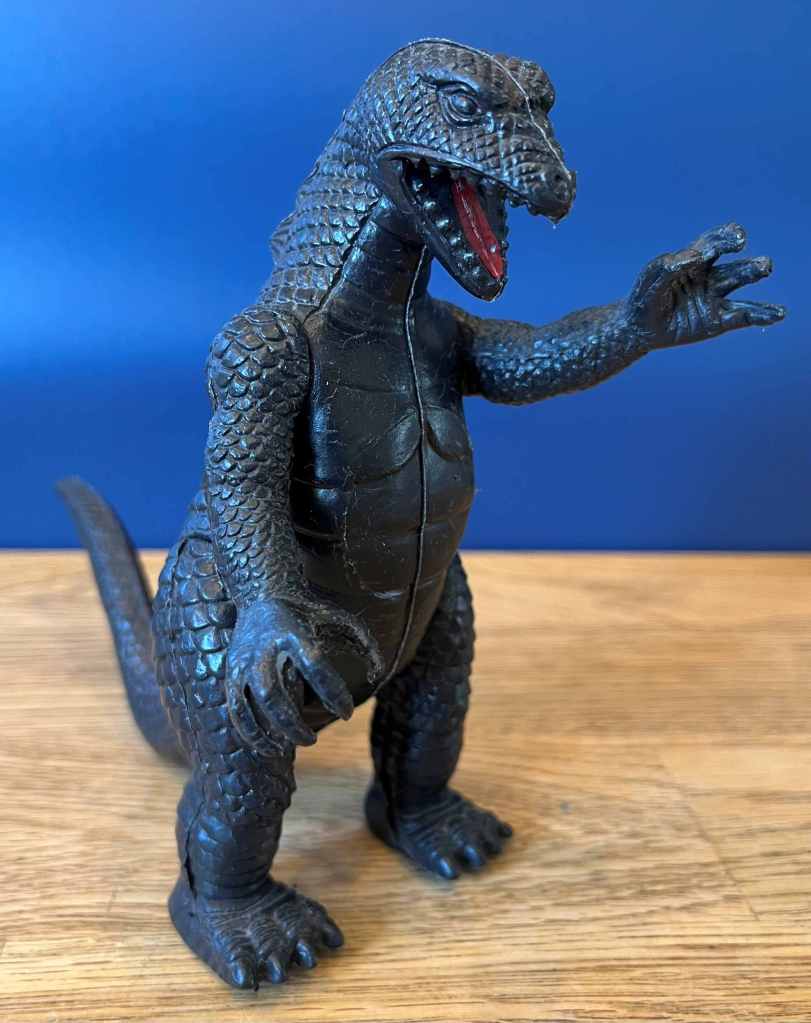
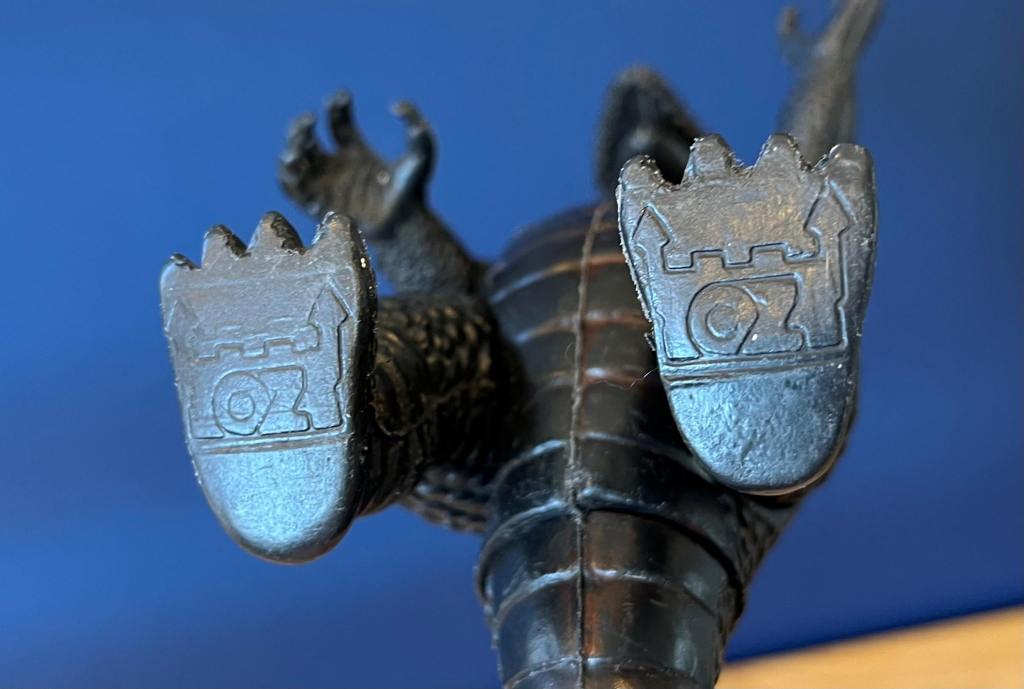
These stand about 140mm. tall, weigh about 64g, and with a throat closed at the meeting point of the upper and lower jaw. These were produced in green or black with orange-red or green highlights, respectively, or silver painted over black. The arms and legs articulate, as does the tail in a single point at its base, but the head does not. Most oddly, a large flattened circular area can be seen on the chest.
There are elements here that point towards the Imperial Chinese model (such as the four toes that end together in a single line: see my Chinese bootleg Godzilla post), or the Chinese ‘company X’ model (such as the saw-toothed spine fins: see Chinese bootleg Godzilla post). However, neither of those is the actual model, and the key to identifying what is lies in that large flattened circular spot on the chest of the beast.
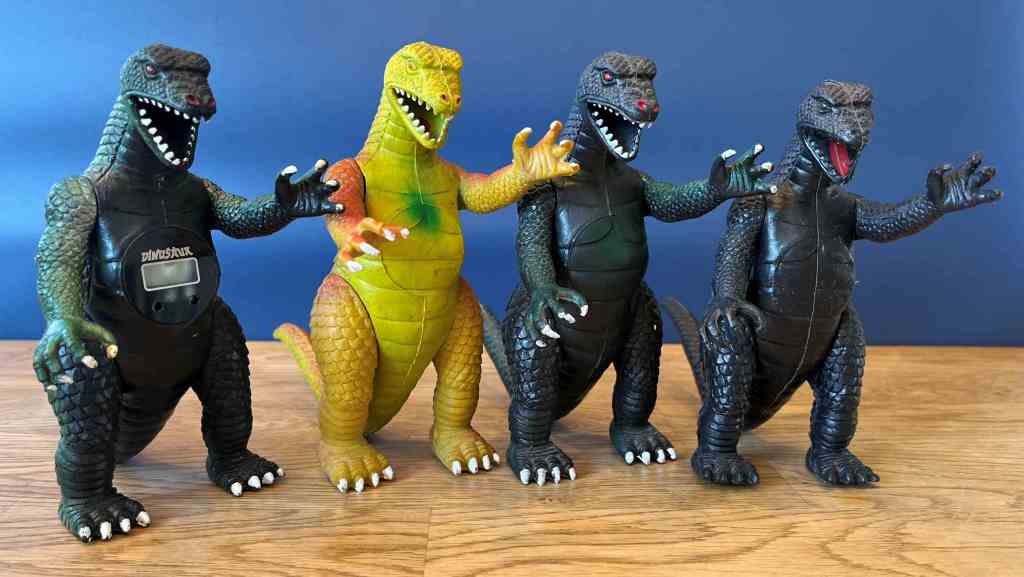
(From left to right: Orion clock Godzilla; Chinese bootlegs of that in yellow and black; Serbian ‘Oz’ Godzilla)
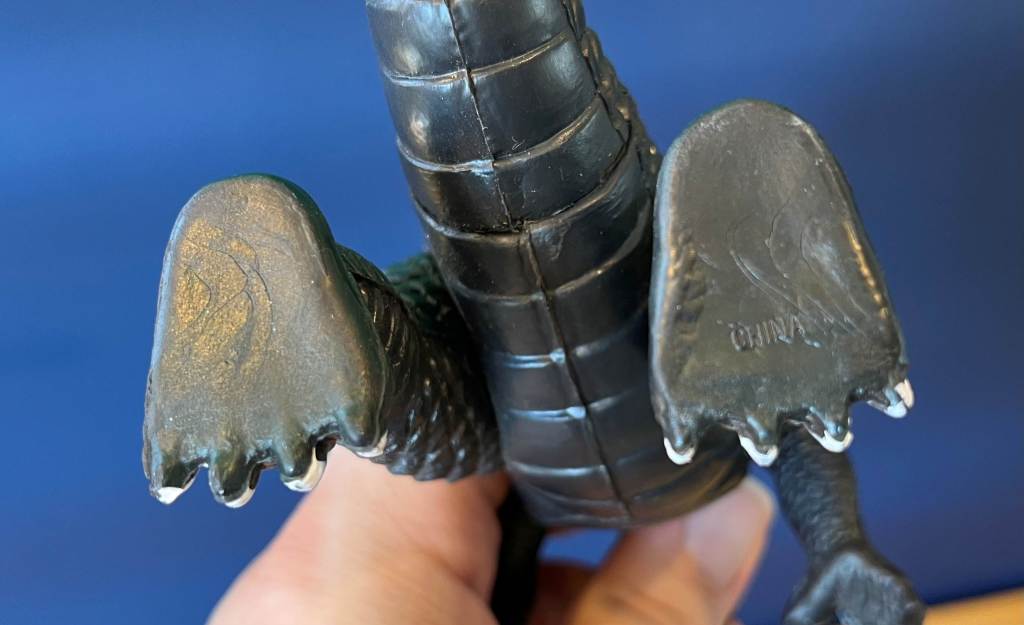
The immediate model is that of a Chinese bootleg Godzilla, made in hard rubber as hollow figures, and only slightly taller at 155mm. tall, weigh about 127g., and have a throat closed at the top of the larynx, leaving the whole head empty. I know of them in yellow with orange and green highlights and black with dark green highlights. Somewhat oddly, many of them have convex soles to their feet, as if their legs were molded in a process that generated an internal air pressure higher than the surrounding atmosphere. These have “CHINA” marks under their right feet, often faintly. They articulate exactly like the Serbian bootlegs. The two are, in fact, so close that virtually every scale and fold of the bodies is identical, and we must presume that the Serbian one was cast from a Chinese one through some process which slightly reduced the size of the offspring.
The Chinese one in turn has an easily identifiable model in a bootleg Godzilla with a clock set in its chest, which stands 150mm. tall, weighs 115g., and articulates exactly like the other two. It was issued in two colour schemes – these copied almost exactly by the Chinese bootleg, except that the black and green model had silver highlights as well.
When placed side-by-side (see picture above) it is obvious that the flat circular face of the clock is the reason for the flattened circle on the chest of the other two, with the Chinese bootlegger resculpting the lines of the pectoral muscles and two further folds of the body over the area originally occupied by the clock-face.
There are no marks on the feet of the Godzilla-clock, but its origins are well known. It was produced for an Orion Home Video Japanese and Korean monster films promotion in the United States in the late 1980s. Orion expanded into home video distribution with the formation of Orion Home Entertainment Corporation in 1985, and was distributing videos under the Orion Home Video label from 1987. Luckily a copy of a magazine advert for this monster film promotion, dated 1989 at its foot, has been reposted on Instagram, giving us the most likely date (16 November 1989) of the initial giving away of these Godzilla-clocks in the United States:
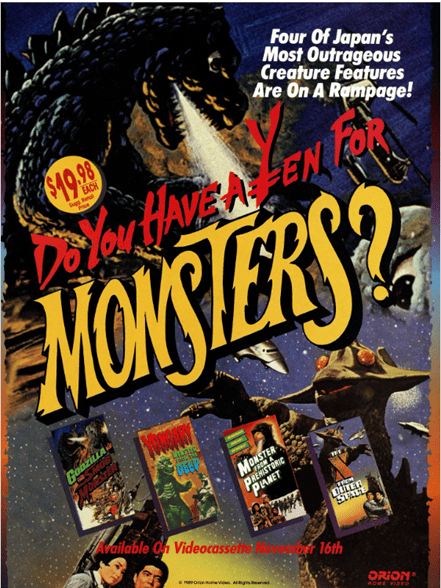
(Picture from an Instagram post)
The films included in the promotion were:
- Godzilla vs the Smog Monster: the 1972 American release of Godzilla vs Hedorah (1971);
- Yongary, Monster from the Deep: the 1969 American release of the Korean classic Godzilla rip-off, Daegoesu yonggari (1967);
- Monster from a Prehistoric Planet: the 1967/8 American rebranding of Gappa: The Triphibian Monster (1967);
- The X from Outer Space: the 1968 American release of the Japanese 1967 original.
Other images of the original packaging of these novelty clocks show that these were released under the title “Dinosaur Clock”, but re-using the tagline “King of the Monsters” (taken from the 1956 film: ‘Godzilla: king of the monsters’, and featured prominently on the Imperial Godzilla toy marketing materials), and noting the production site as Hong Kong:

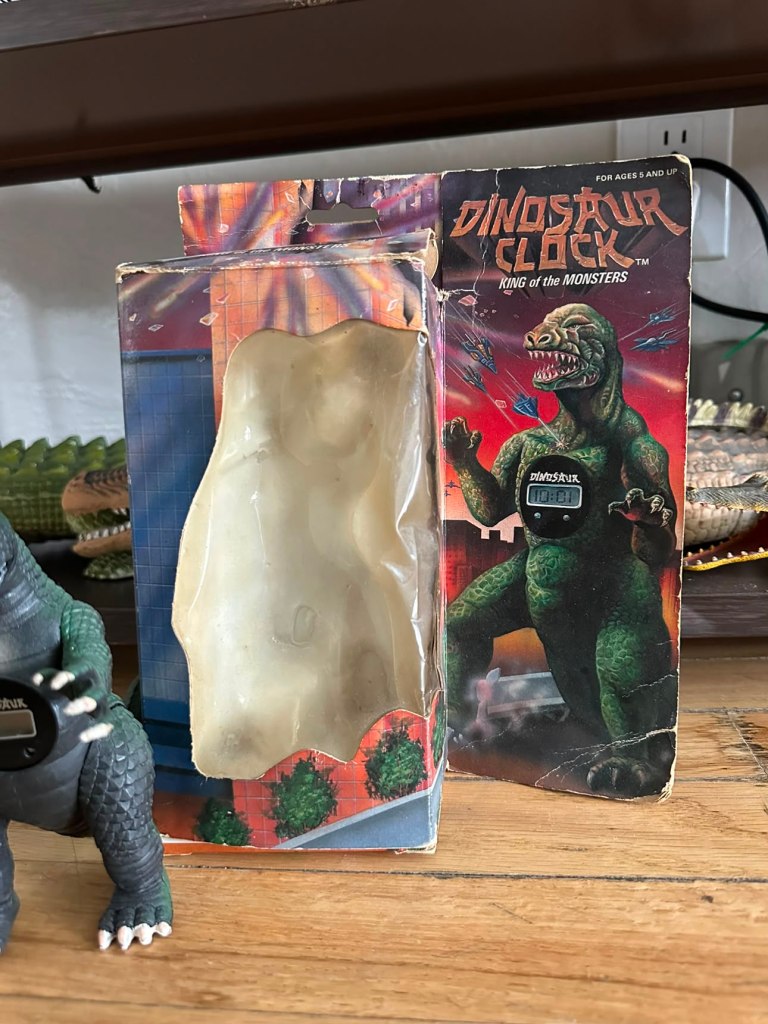
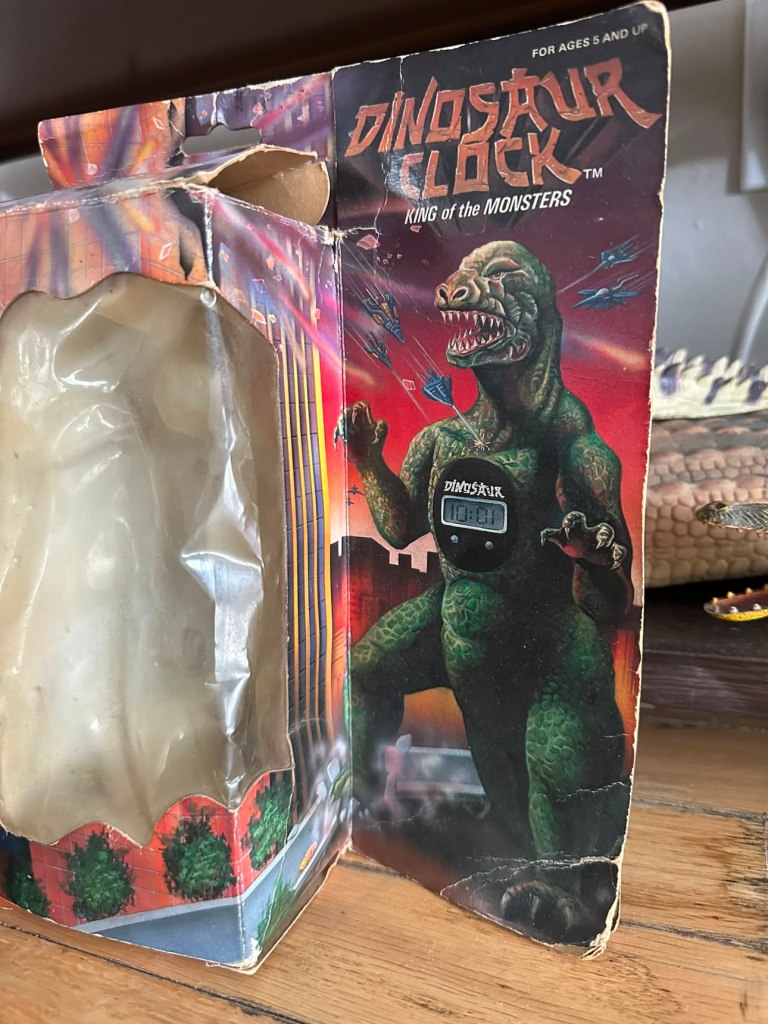

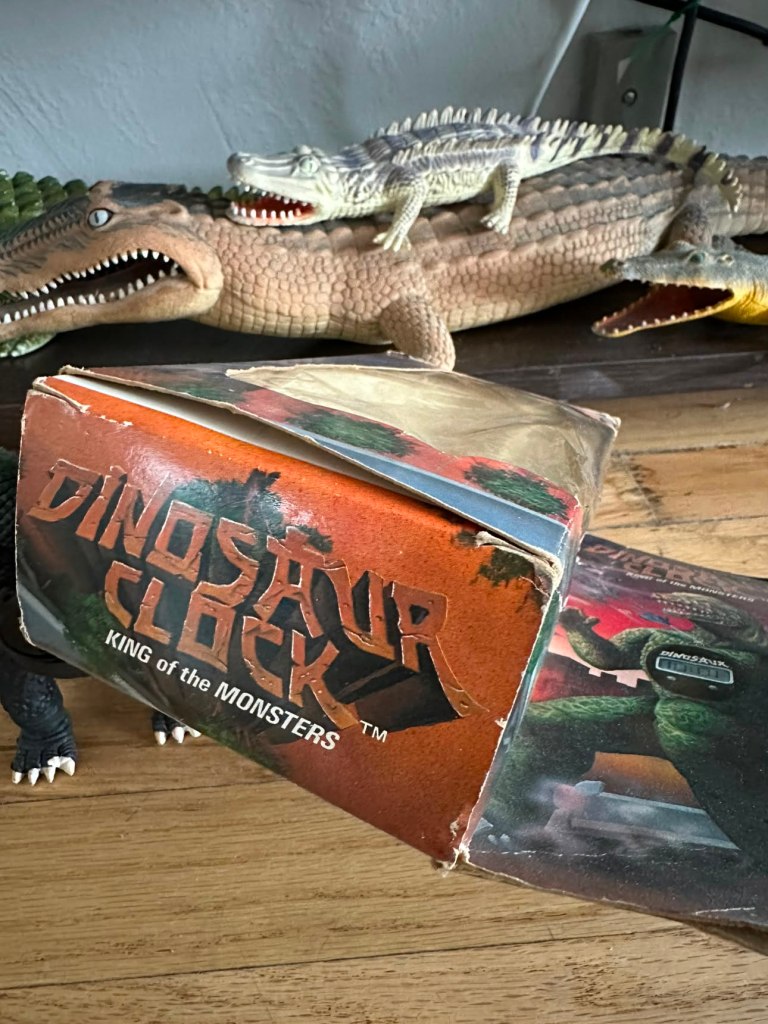
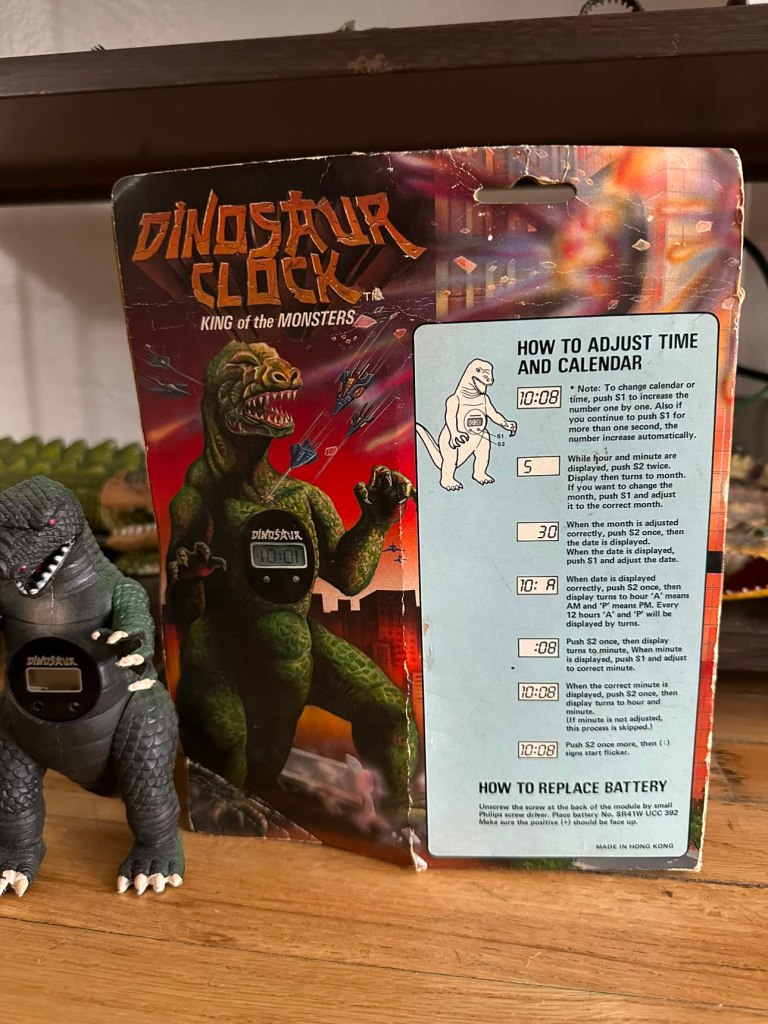
(These 360 degree images are of an exceptionally well-preserved box in the collection of an Instagram poster named ‘weirdo_dungeon‘, and supplied to me through his generosity; reproduced here with his kind permission)
So, to summarise, around November 1989, Orion Home Videos gave away the original model of this Godzilla bootleg as a free gift with a promotion of theirs. The packaging allows us to see that they were made in Hong Kong, presumably from an original sculpt for this item, pulling in elements of the numerous Chinese Godzilla bootlegs. Then, presumably attracted by the lack of any copyright issues as the clocks were themselves bootlegs, a Chinese manufacturer produced close copies in hard rubber that were slightly taller, and in turn one of those was copied in the months or years that followed on the European mainland, in Serbia, in the rump of the former Yugoslavia, to produce the subject of this post.
These Serbian or former Yugoslavian bootleg Godzillas are not completely unknown – the online presence of the ‘20 Cola Museum’ based in Kragujevac, Serbia (which aims to document twentieth-century culture there) did until recently have one among its online holdings, but they are not often discussed or documented and are extremely rare outside of Serbia. This is due, in part, to the slight reticence of toy dealers in Serbia to send anything outside of that country, or list them for sale anywhere that would allow a foreigner to purchase one (I am extremely grateful to a single vintage toy seller who I made contact with, and who sourced one and listed it on eBay for me to purchase, as well as giving me virtually all the information I have on its production company Oz). The immediate link to Chinese models is well known in Serbia, but I do not know of anywhere else that has identified the Orion Godzilla-clock as the ultimate model of both.
A cautionary note must also be added that many Serbian sellers think that they have native Godzilla bootlegs, but in fact they have the Chinese models – even when the Chinese marks on the feet are too faint to distinguish clearly, they can be easily separated by the material they are made from, the colours of the painting and the height and weight.

 Confessions of a Kaiju Hunter
Leave a comment