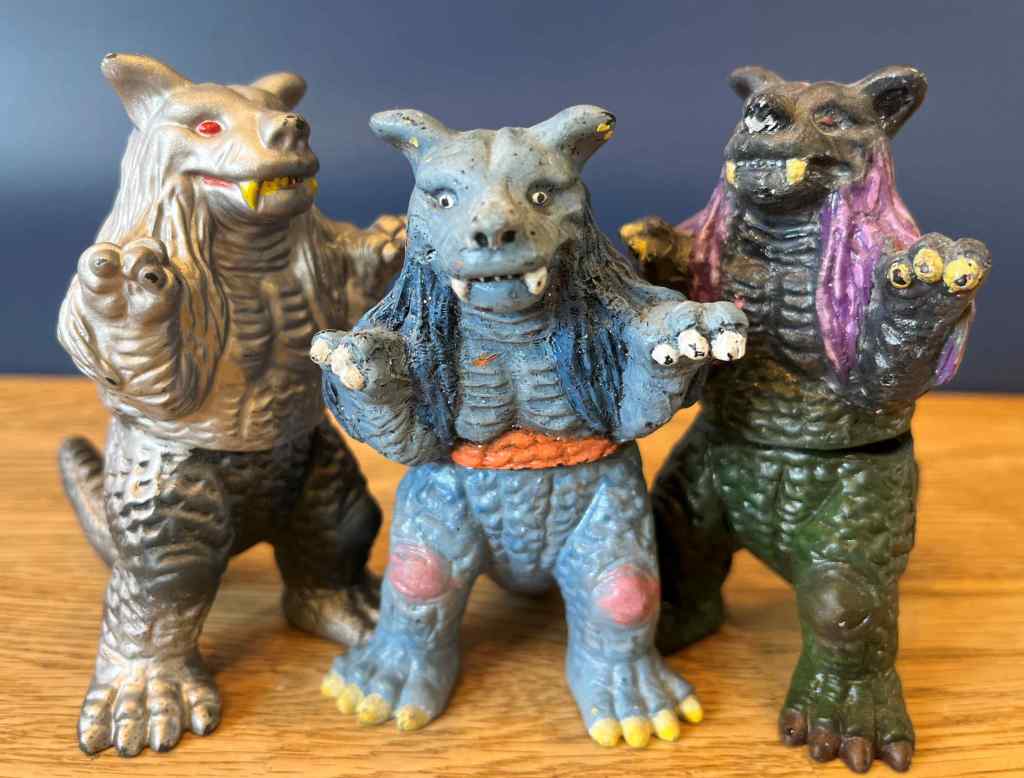
I will discuss the ‘Super Dino Monsters’ minis line of pachi in another post, and will show there that these were probably produced by Muraoka in China at some point in the late 1980s, or more probably the early 1990s, and marketed to the United States and to Japan (in the latter’s case with the involvement of another company named Pony).
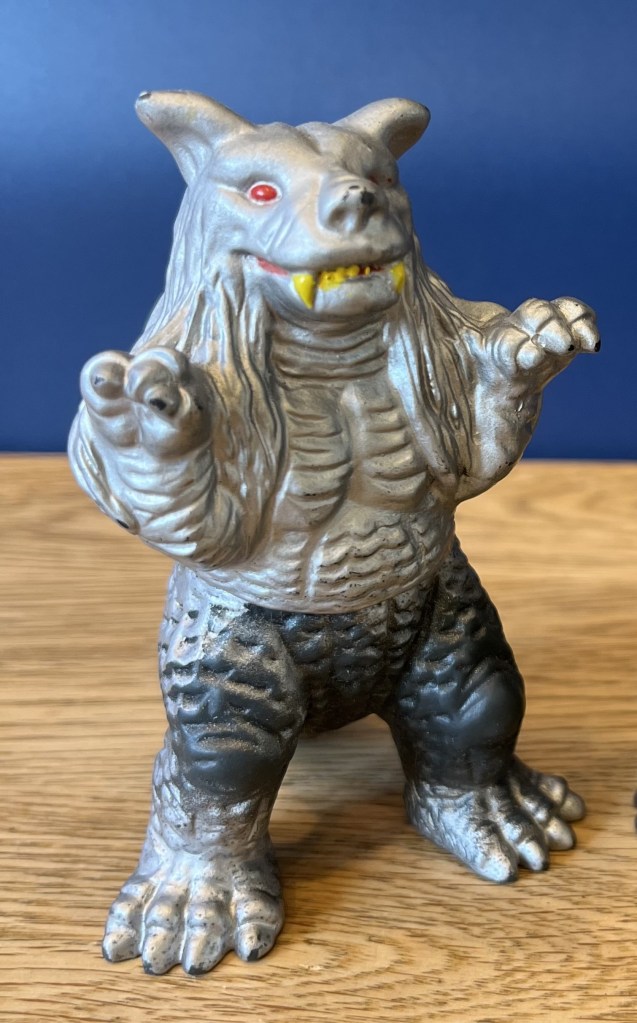
Of the figures in that mini-line, one resembles a dog-like creature in black and silver with protruding fangs and a long hanging mane, that is usually identified as a reinterpretation of the kaiju, King Caesar (or King Seesar, or the original: Kingu Shīsā). However, while waiting for an auction to get to the lot I wanted the other night, I stumbled across what must be the actual model. He is, in fact, copied from the 170mm. tall Ikkaku in the Daiei Yokai series produced by Nitto in the late 1960s (Clubtoyko gives 1968). I do not own one of these, and am unlikely to find one soon (especially since the one in the recent auction: ‘Show Era Icons, The Mark K. Collection’ on 24 February 2026, lot 225, made an eye-watering $1342), but the excellent Bakadesubakadesu blog helpfully gives images, such as that here.
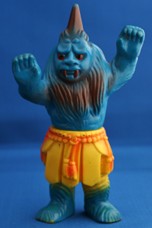
(This from the Bakadesubakadesu blog)
The two prominent fangs, the red staring eyes, the hair that hangs either side of the head, the naked musculature of the stomach and the posture (feet splayed apart, with both hands raised, one slightly higher than the other), all show this to the be inspiration for this pachi mini. The same basic form and detail stands behind the figure of Aobuzo from a second Yokai set of three figures produced by Bear Model in 1999, but that is too late to be the inspiration for our ‘Super Dino Monster’. As an aside, I am aware that this rather wrecks the twist in the tail of the title I have chosen here, but as I have no idea what Ikkaku the Yokai would be in Spanish let’s move swiftly on.
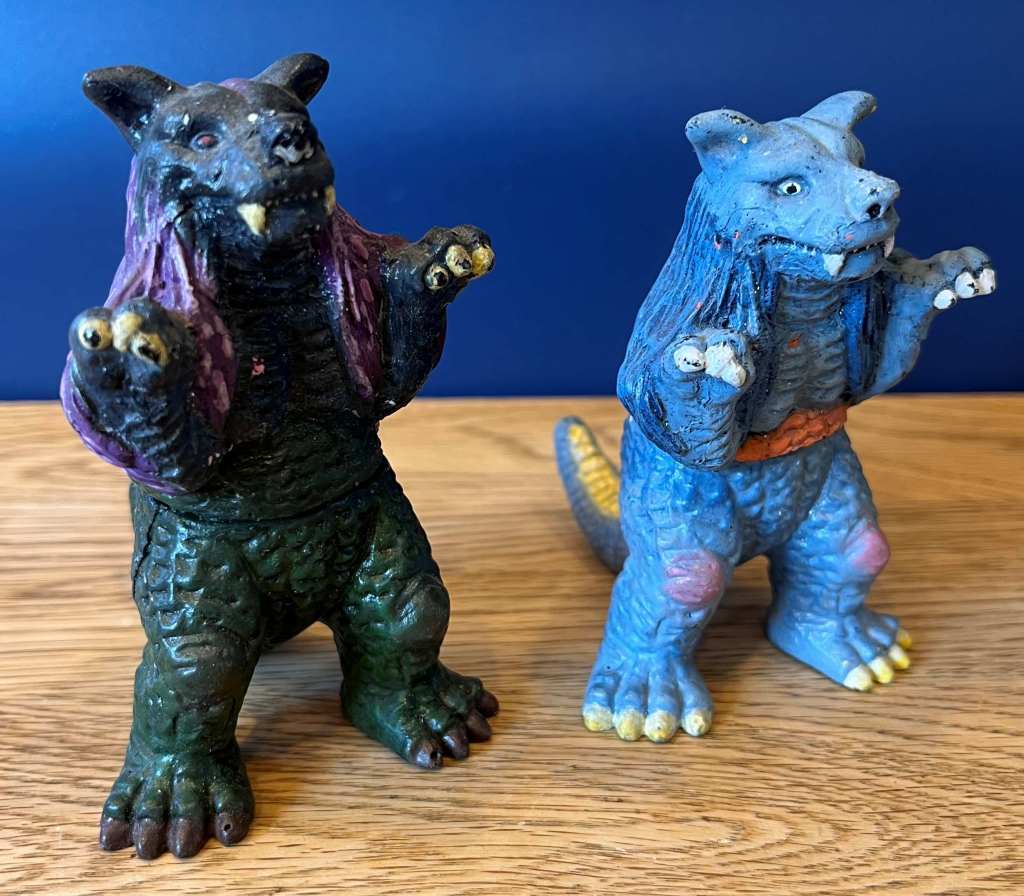
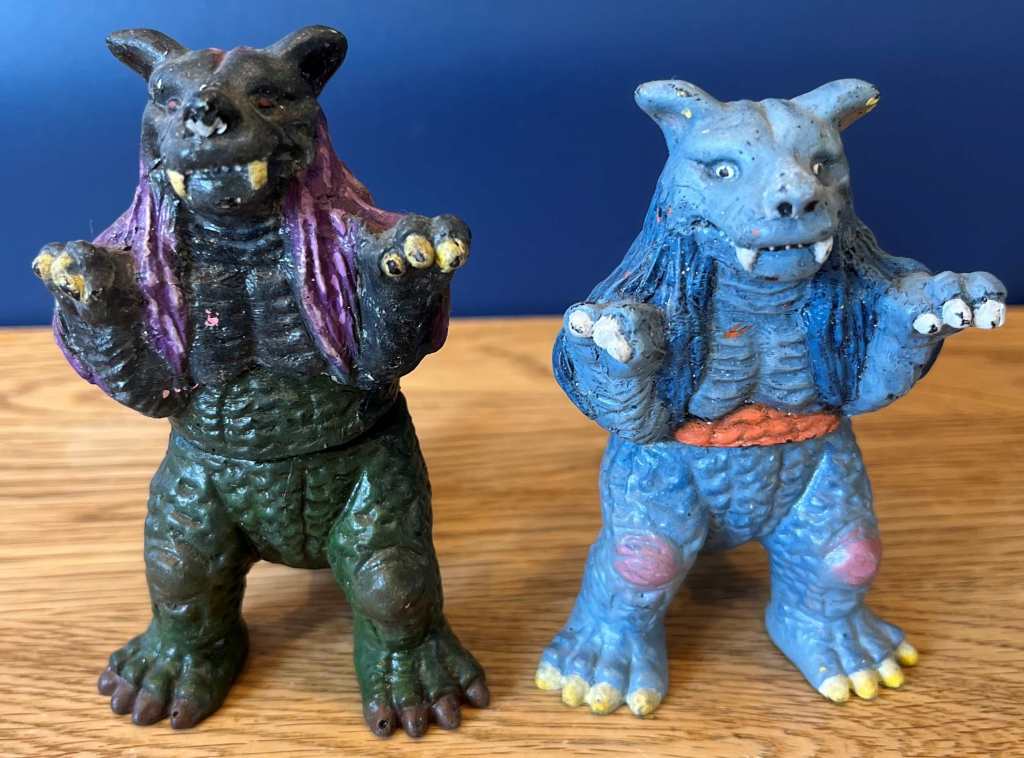
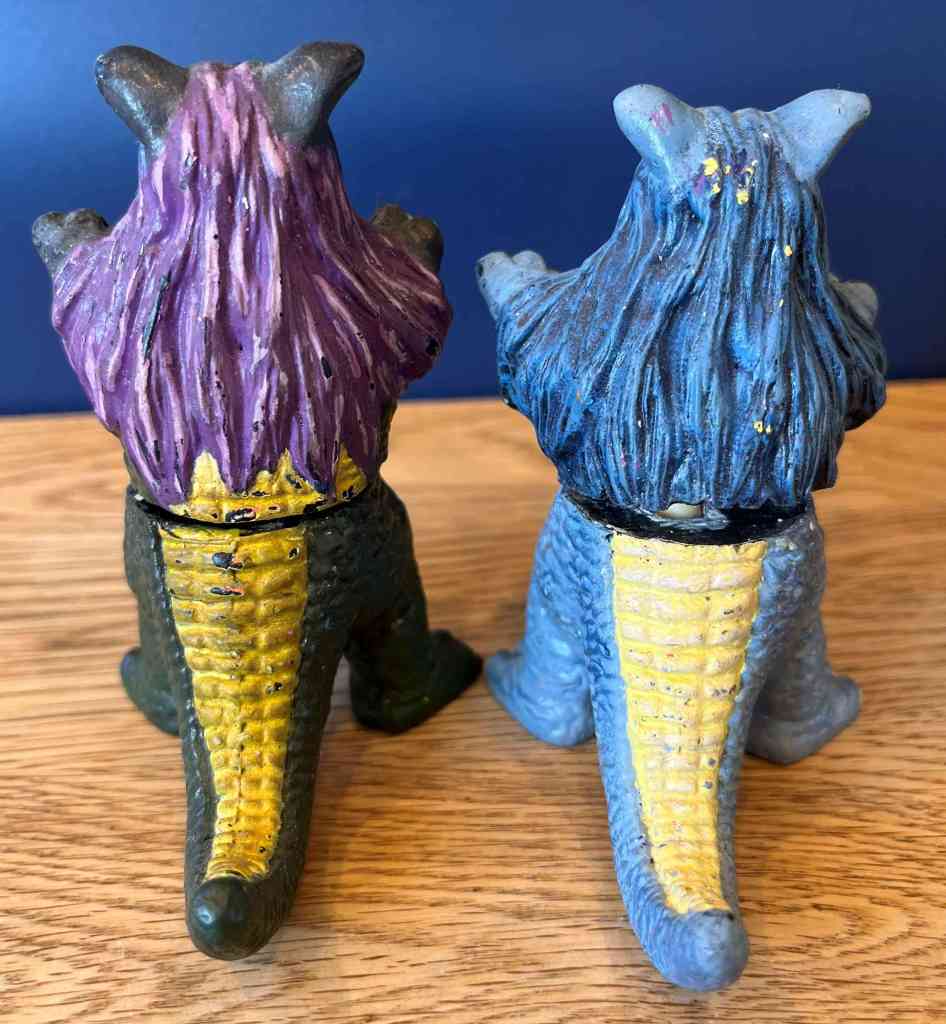
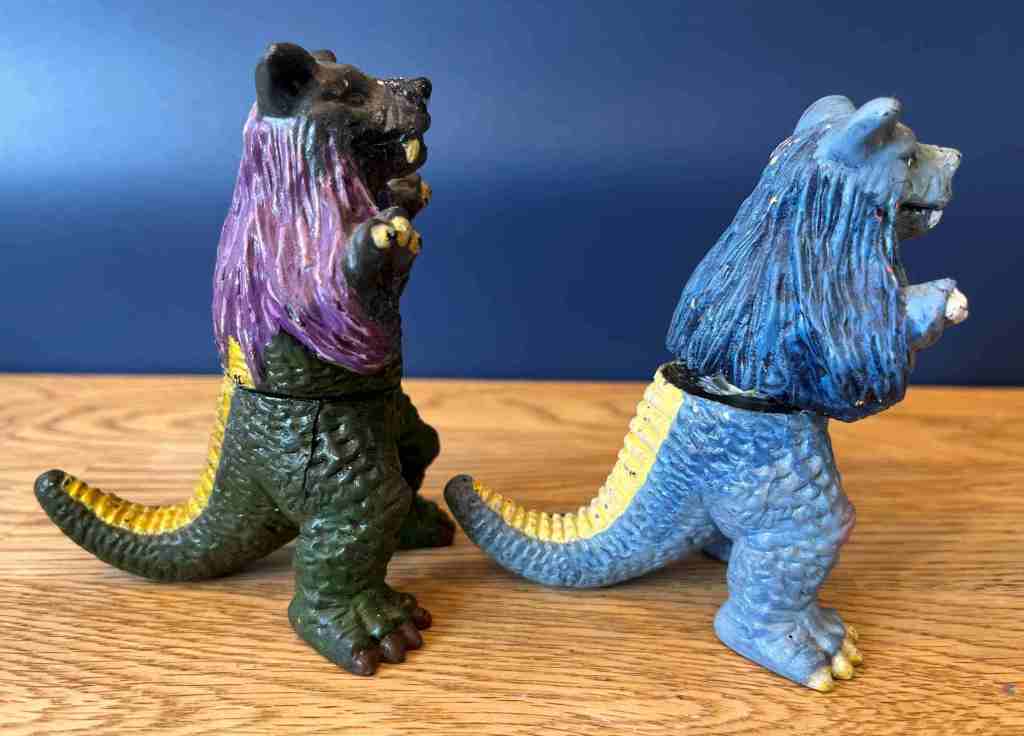
I recently discovered in Spain, and acquired, two examples of a European bootleg of this Chinese pachi/bootleg. The manufacturers there had made casts directly from one of the original ‘Super Dino Monsters’ figures, and locally produced copies in cheap white plastic, notable for its many bubbles within its structure. Bizarrely, they are slightly different heights and weights (standing 95mm. and 89mm. tall, and weighing 88g and 80g, respectively), and so may come from two different production runs. They were painted in brighter colours than the original, in fragile iridescent paint that scuffs easily off the figures:
- in a dark green with purple mane and yellow stripe down the upper edge of his tail as well as brown claws ,
- and a pale blue with an orange stripe around his waist and pink knees, and the same yellow stripe down the upper edge of his tail and yellow claws.
With the dark green one, the painter had kept the original’s featureless glowing red eyes, but for the pale blue one they painted naturalistic white eyes with pupils. Neither has any marks on the soles of their feet, but then neither did the ‘Super Dino Monsters’ originals. These are the only examples of these bootlegs I can trace – and I would dearly love to know if a reader has others.
Neither has any indication of who produced them, and I think we can presume these were sold on countertops or stalls without any further packaging. We are left to look at the items themselves for any clues. The material they are made from and the casual way they are painted with slightly iridescent paint most closely resembles the common Spanish copies of Smurf figurines, Mazinger Z bootlegs and small MOTU figures in hard white PVC from the 1980s and early 1990s. These bootleg kaiju may well have been produced by one of the same toy-bootleggers as the other toy lines noted above as a short-lived experimental line, that was soon abandoned. They must date to the years immediately after the production of the ‘Super Dino Monsters’, and so to the early to mid 1990s.
As a bootleg, I find the pale blue one to have even greater appeal than the rather emotionless and ‘heavy formed’ ‘Super Dino Monsters’ figure – it is probably the more naturalistic eyes. I am also aware that I am deeply indebted to some now middle-aged Spanish person for playing with these very carefully and apparently only infrequently in their childhood.
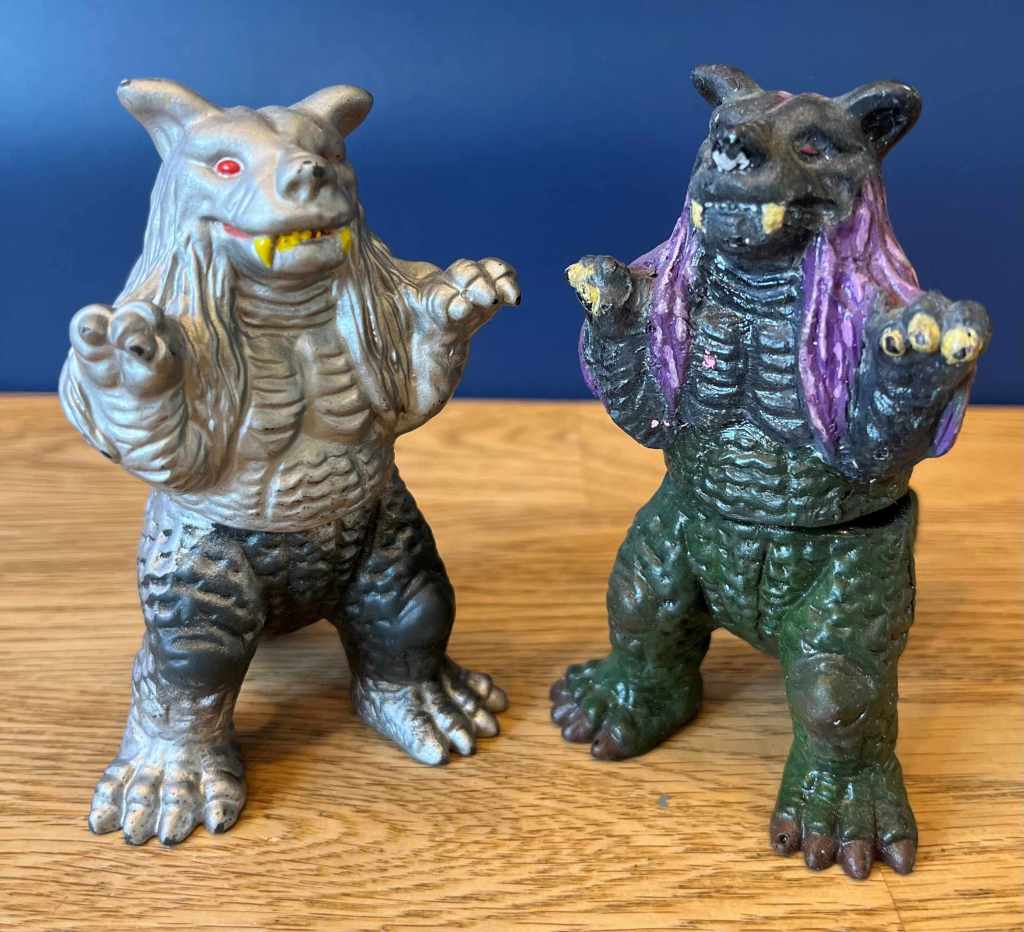
(Image of the original ‘Super Dino Monster’ and the Spanish bootleg for side-by-side comparison)
Whatever our reaction to them, they are extremely rare examples of the illicit copying of kaiju in Europe, and certainly worthy of our attention here.
- 'MUTTON DRESSED AS LAMB': Godzillas and kaiju that look vintage, but are not
- American made Pachi
- BOOTLEG DINOSAURS – a little off topic, but sometimes needed here
- BOOTLEG GODZILLAS
- Bootleg Tokusatsu from China and its immediate neighbours
- Bootleg Tokusatsu from the Americas
- BOOTLEG TOKUSATSU HEROES
- Central Europe – Godzillas and kaiju from behind the Iron Curtain
- Chinese-region bootleg Godzillas -the plastic tide from the East
- Chinese-region made Pachi
- European made Pachi
- European-made Godzillas
- PACHI
- Pachi kaiju
- Pachi kongs
- Pachi superheroes – Ultraman and similar
- The Americas – bootleg Godzillas from the New World

 Confessions of a Kaiju Hunter
Leave a comment