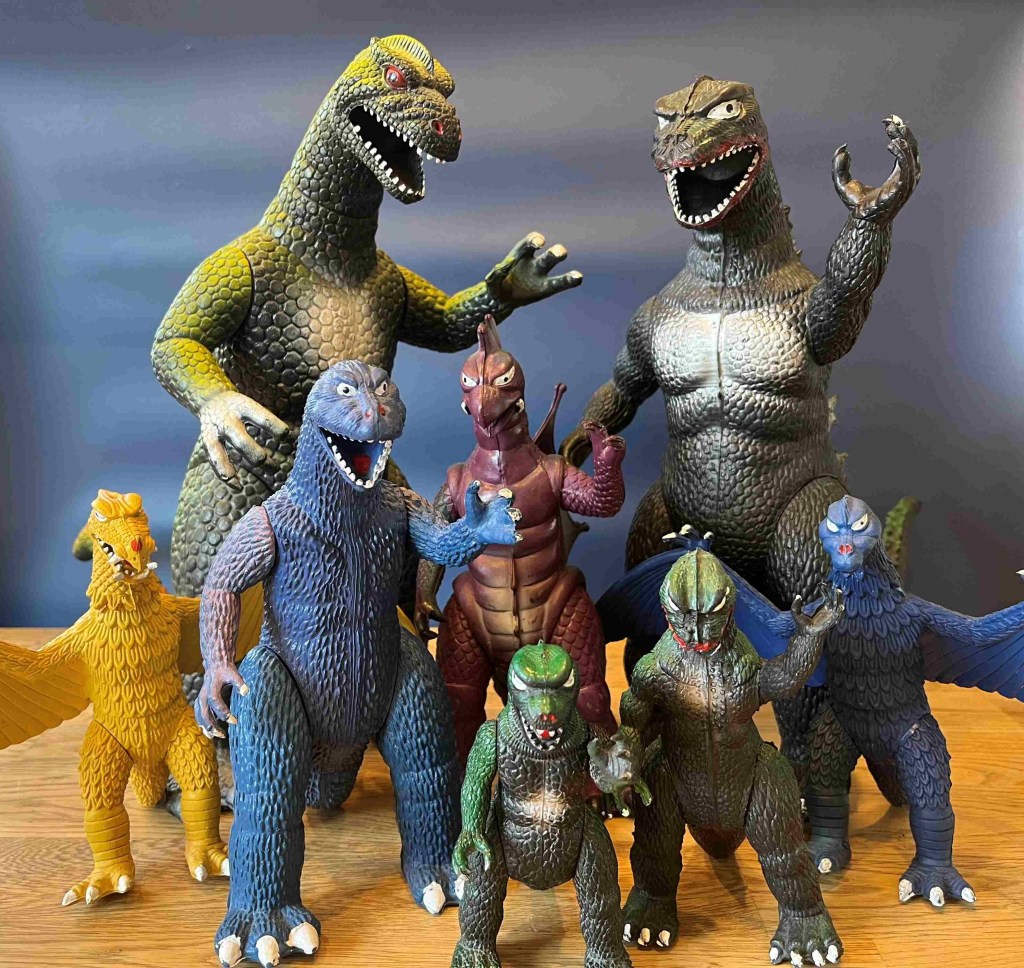
For those interested in bootleg Godzillas and a few related kaiju, the company names of Imperial and Dor Mei are the bedrock from which all else has been built. These are the ones that we, outside Japan, played with as children, and the vast majority of surviving bootleg Godzillas can be seen as an adaptation of these two fundamental bootleg toys. In addition, we must add to these, the, as yet, unnamed Chinese company who produced another common Godzilla bootleg as well as the related figures commonly called ‘Gigan’ and ‘Rodan’ bootlegs – and in what follows this company will be called ‘company X’.
A focus on the reuse or not of certain physical features of these toys, by the figures that followed, as well as keeping an eye on their dimensions, allows us, like the biologist, to see the ‘evolution’ of bootleg Godzillas in the producers of the Chinese-region, and to approach a comprehensive taxonomy of them. This family tree is then the baseline from which other Godzillas and some kaiju bootlegs were produced in across the globe, and is the foundation-stone of almost all accurate dating of bootleg Godzillas.
The Imperial, Dor Mei and ‘company X’ Godzillas were all produced in the wake of the release of the film ‘Godzilla’ on 23 August 1985. I am unaware of definitive proof that any one of these companies produced their model before the other, with Imperial ones appearing with the year ‘1985’ stamped into the soles of their feet, some ‘company X’ models having ‘1986’ in the same place, and Dor Mei figures most likely appearing first in the same year (some versions produced in China have ‘1986’ under their feet, and the earliest advert for one is dated ‘1986’: see below). However, as Imperial sought out (and presumably paid for) permission from Toho before producing their Godzilla (unlike their rivals), and the date given for them is one year earlier than the others, I suspect they were first. As an aside, this also means that theirs are not really bootlegs, but they are so far away from Toho’s Godzilla and spawned so many of the bootlegs that followed, that I think we may quietly overlook that here and include them as the joint-heads of our family tree. A large part of that which follows here has been written about already, but it has not to my knowledge been pulled together in one place, and in the place of a comprehensive resource an awful lot of rubbish has been assumed and repeated ad nauseam. Thus, I think it is worth repeating here (with full credit and links, of course, to all who have entered the fray before me).
In addition, now that this post has grown to vast and encyclopedic propositions, there is probably a need for some guidance on how to use it (even I in my bookish nerdiness don’t think any modern reader would sit and read this for nearly an hour). So, for the guidance of the reader here – this post begins with discussions of the three fundamental Godzilla bootlegs:
● A. The Imperial Godzilla;
● B. The Dor-Mei Godzilla;
● and C. The Godzilla (aka ‘Sharkzilla’) produced by the still anonymous ‘company X’ (this discussion necessarily takes in discussion of the two related kaiju, a ‘Gigan’ and a ‘Rodan’, produced by the same company.
Those fundamental blocks then set the stage for lists of Godzilla bootlegs subsequently produced in the Chinese region that followed those three basic models – with, at present, 10 examples listed that follow the Imperial model, 6 that follow the Dor Mei model, and one that follows that of ‘company x’. Unfortunately, this must be lengthy in order to attempt to be comprehensive – but I have added lots of pictures in the hope that readers might scroll through and find the one they are interested in through the images first, before reading the accompanying text.
Good luck!
⁂
⁂
The three fundamental companies and their products:
A. The Imperial Godzilla:
The earliest Imperial model was made of hard vinyl, came in two sizes (a 330mm. tall version that weighs about 810g; and a smaller version that stands about 150mm. tall [just under 6 inches], and weighs approximately 110g). They look like this:
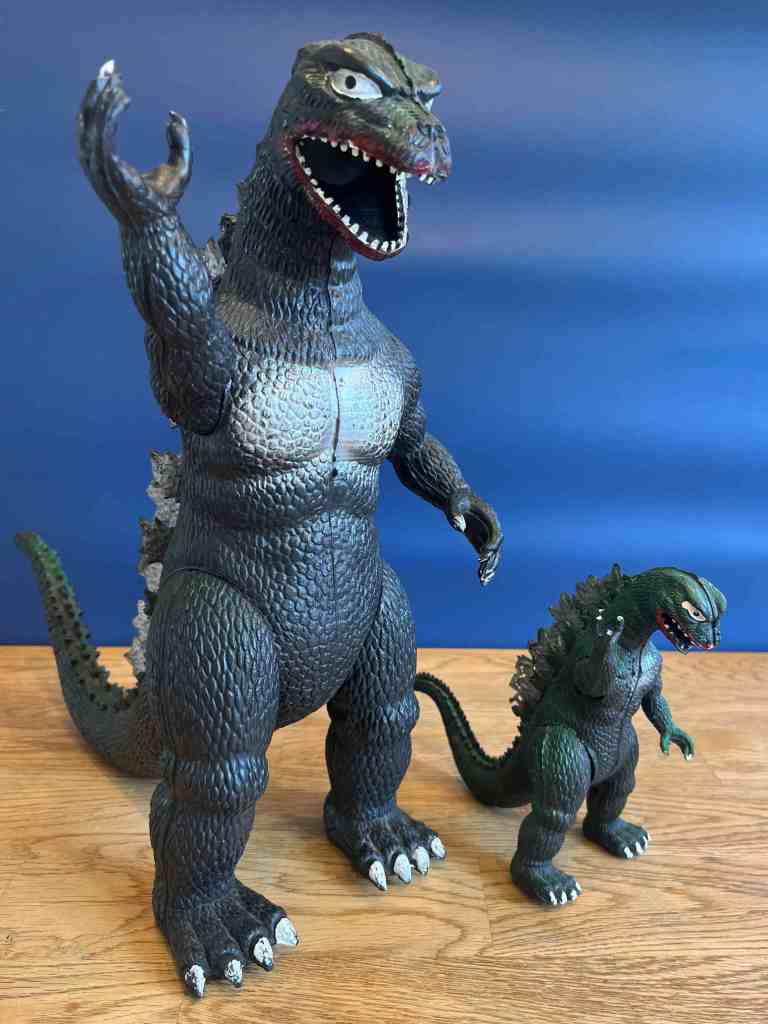
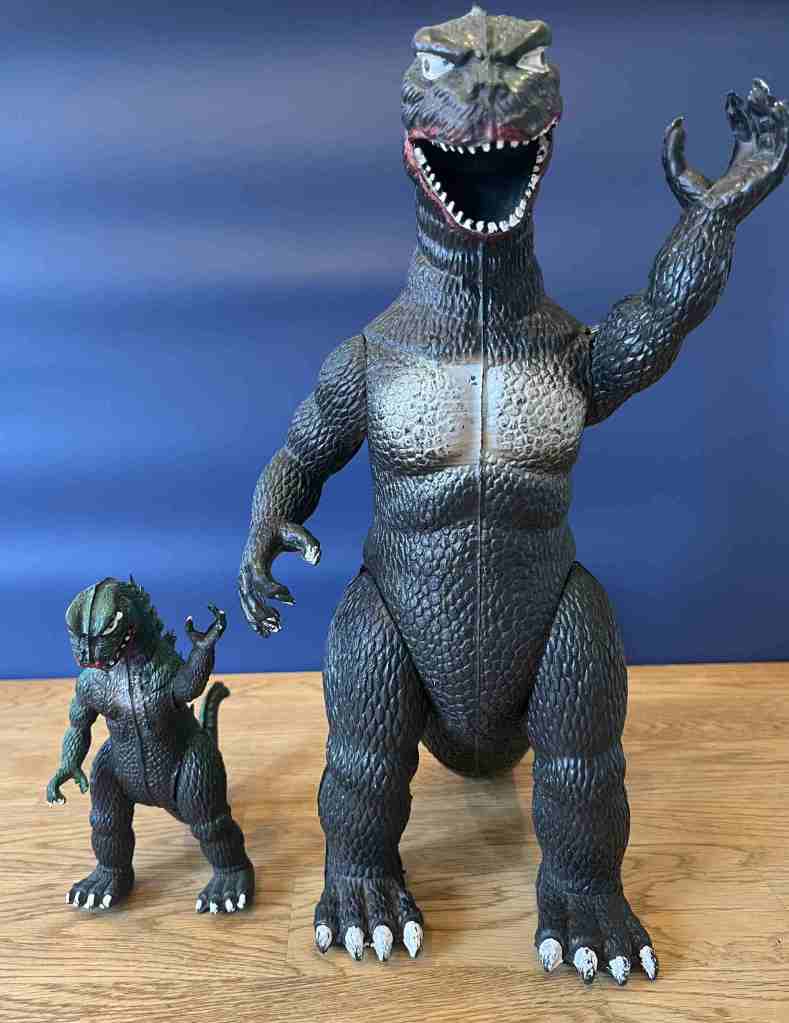
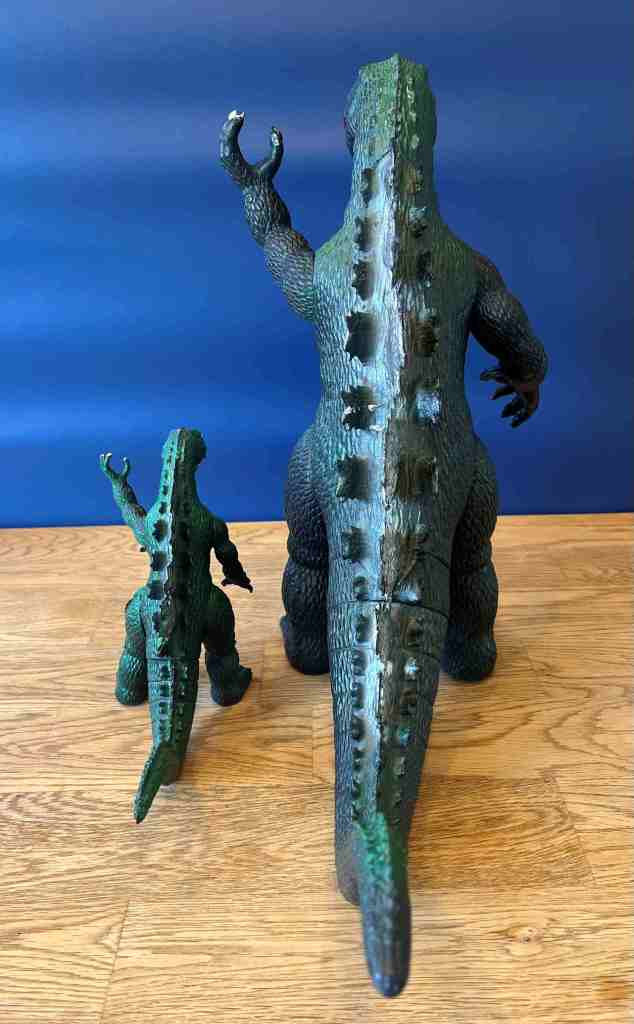
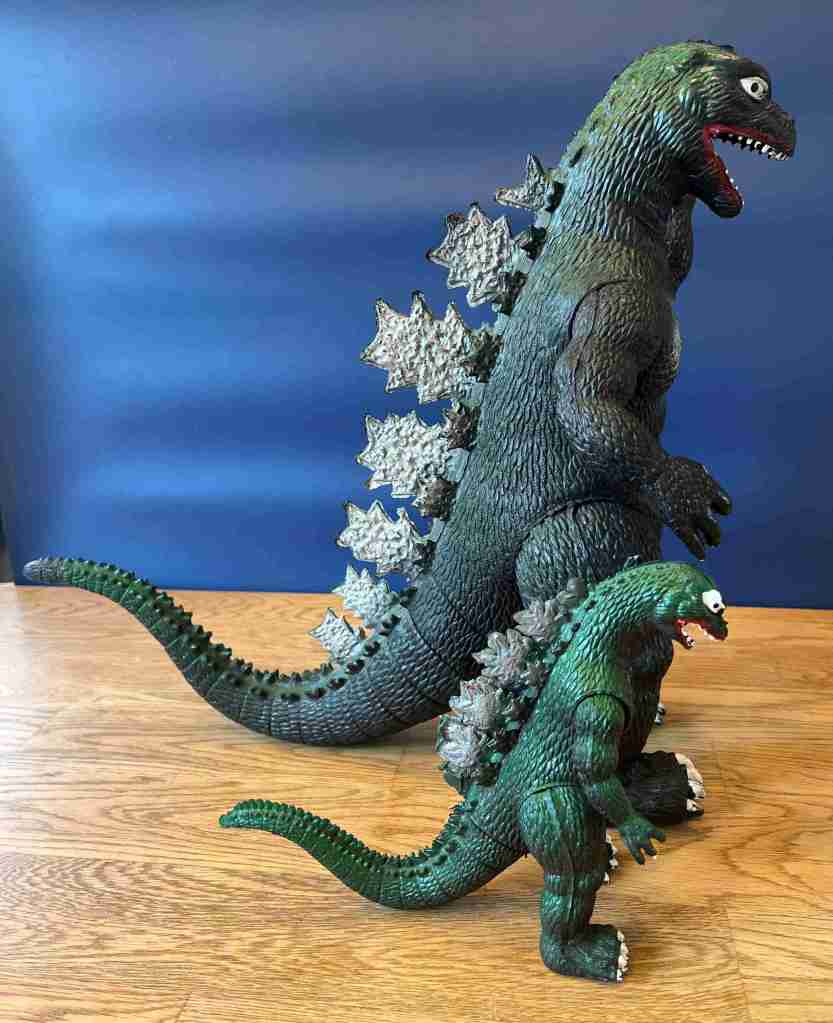
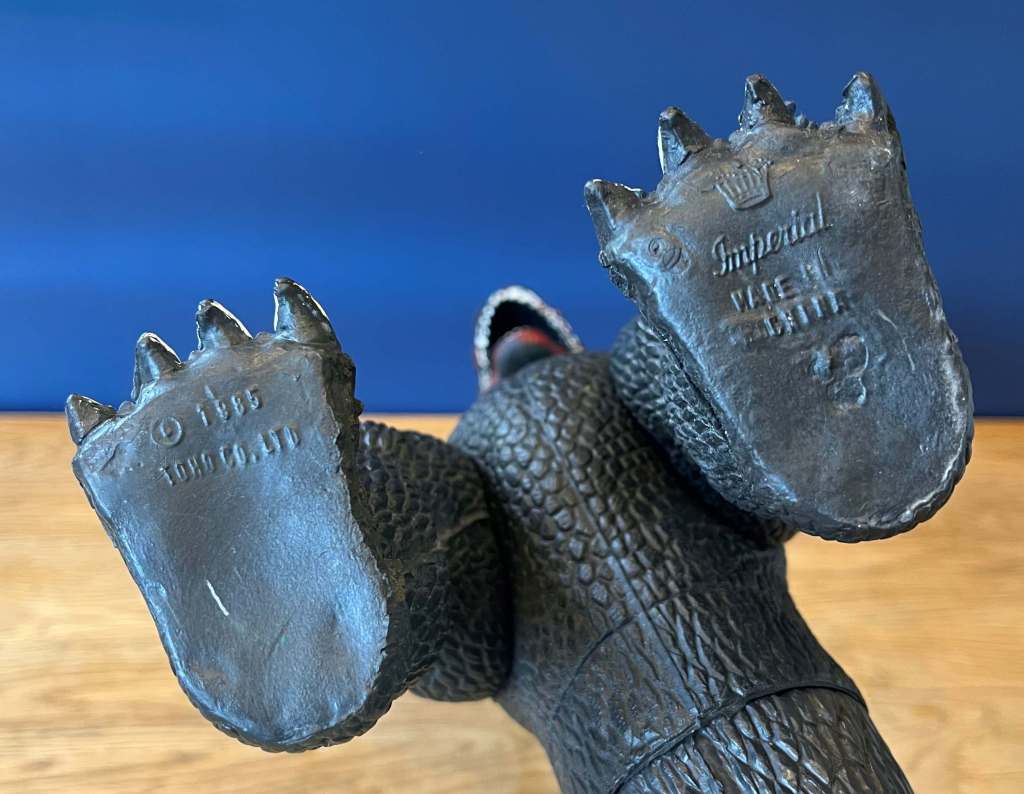
The arms, legs and tail articulate, but the head does not, and the feet have four toes that end together in a flat line. The back of the throat was walled off, unlike the ubiquitous open-mouthed and silently screaming chinasaurs. The scale-pattern is that of interlocking diamond shapes. No real effort was made to remove the extra plastic that spilled out between the edges of the molds and the painting was often slapdash at best.
The marks on the right foot of both sizes note the company’s name and logo (‘Imperial’ beneath a crown), and those on the left foot give the year ‘1985’ (as part of a “© 1985”) and the note of copyright permission, ‘Toho co. ltd’.
This was the Godzilla which came to be the standard toy of the brand if you grew up in the 1980s outside of Japan. Now the date of the beginning of production is firmly fixed by the ‘1985’ on the foot, however, I cannot believe that the millions of Imperial Godzillas that exist were produced in a single productive run in that year, especially since variants exist with changes to the foot marks noting that production was also carried out in Hong Kong – there producing a slightly smaller version of the large Godzilla (some 12 & 3/8 inches tall, against the full 13 inches as produced in China: see this excellent blog by the Sphinx on these variants, with the same foot-marks, but on reversed feet. As the Sphinx notes, both sizes were reissued by Imperial in 1992 with the same year ‘1985’ and updated paper tags, and it seems likely that production continued for many of the years between 1985 and 1992, with the year given marking Toho’s stamp of authority rather than an accurate date of production.
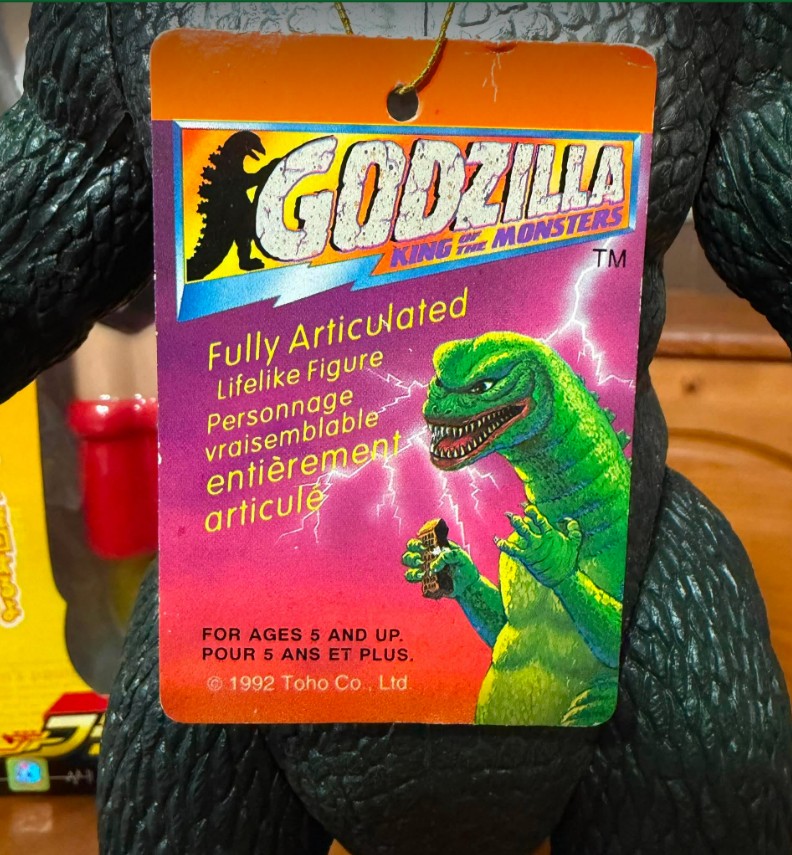
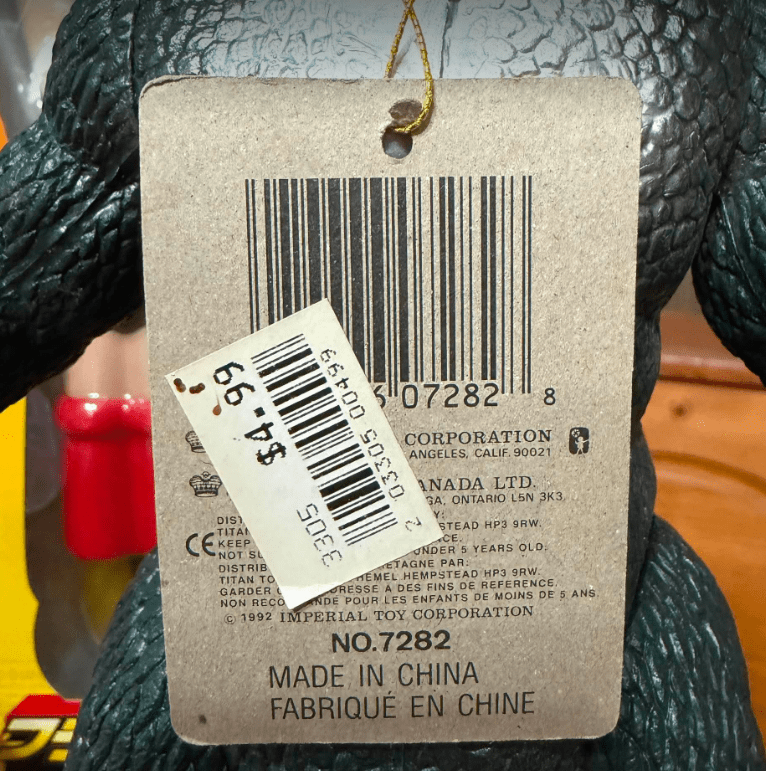
(An example of the updated ‘1992’ paper tag on an Imperial large size Godzilla, from a photograph kindly supplied to us by that famous titan of the fleamarket, Froggy Flips, of an Imperial Godzilla he posted to Facebook on 8 June 2026; images reproduced here with his permission)
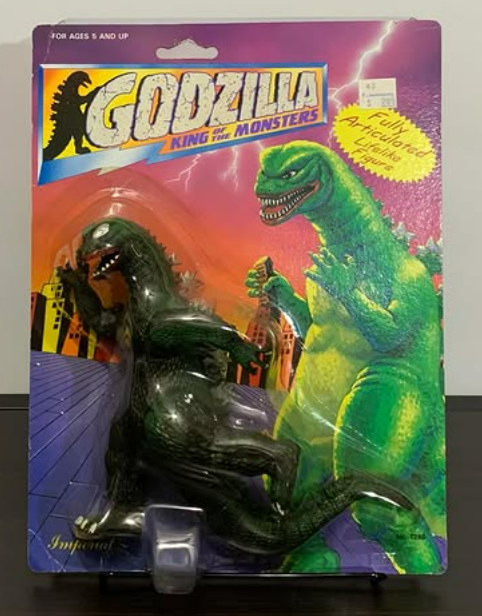
(Image from nj_kaiju_collection_toys’ Instagram post; reproduced here with his permission)
In addition, an Instagram user, named nj_kaiju_collection_toys, posted an image on 28 May 2026 of one of these smaller Imperial models on a card using the same artwork as on the label above (see here).
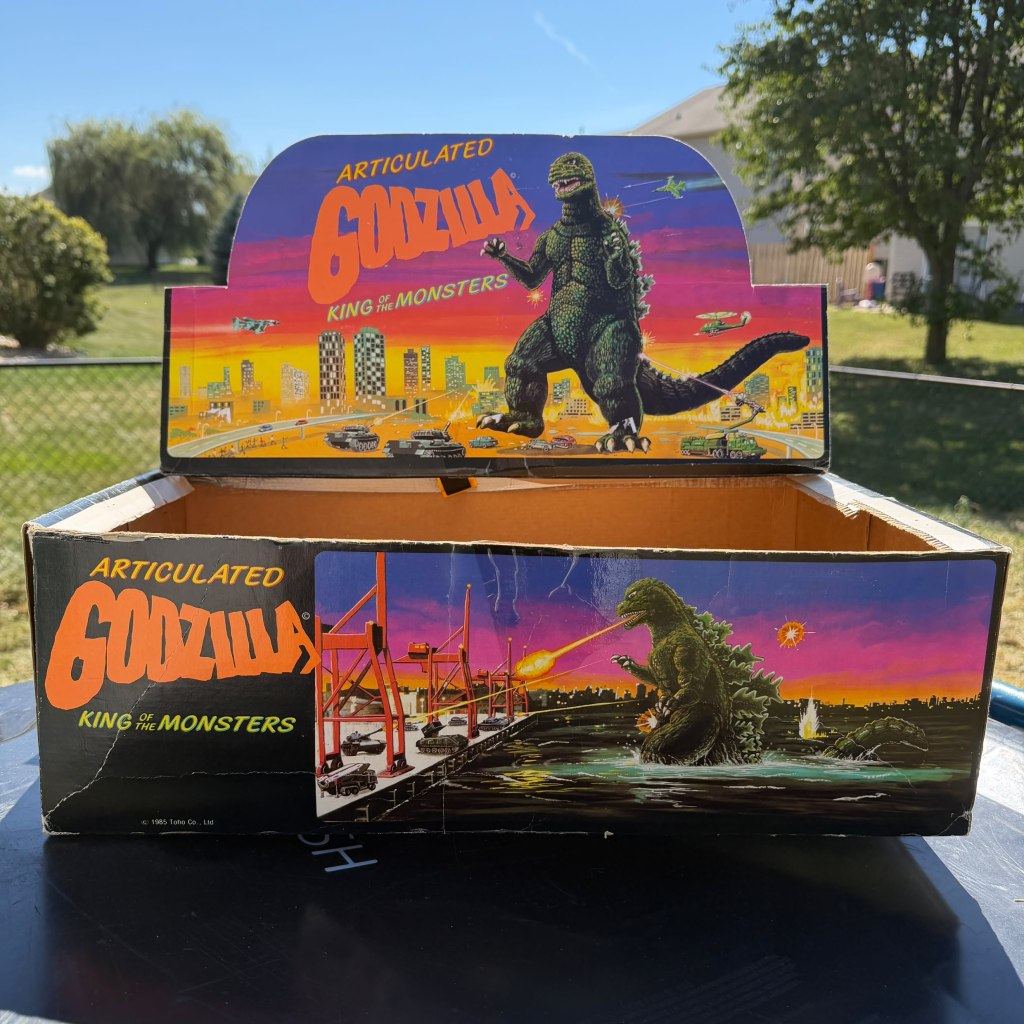
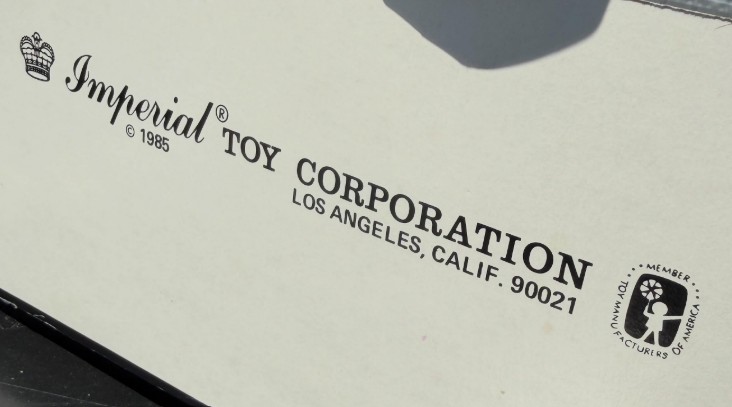
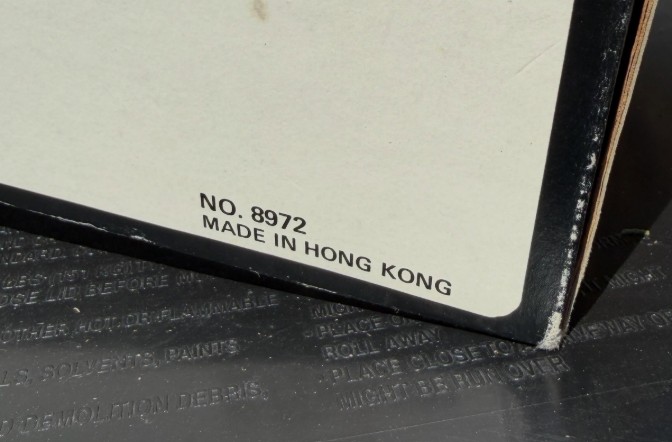
(Images from ‘Froggyflips’ Instagram post; reproduced here with his permission)
However, it is clear that there was other packaging. The toyhunter and resale titan, ‘Froggyflips’ (I know you all just said “Gnarly” in a kid’s voice in your head), has a sale point display box for two dozen such Imperial Godzilla minis (see here), with marks showing that it was produced by Imperial Toy Corporation’s Los Angeles office.
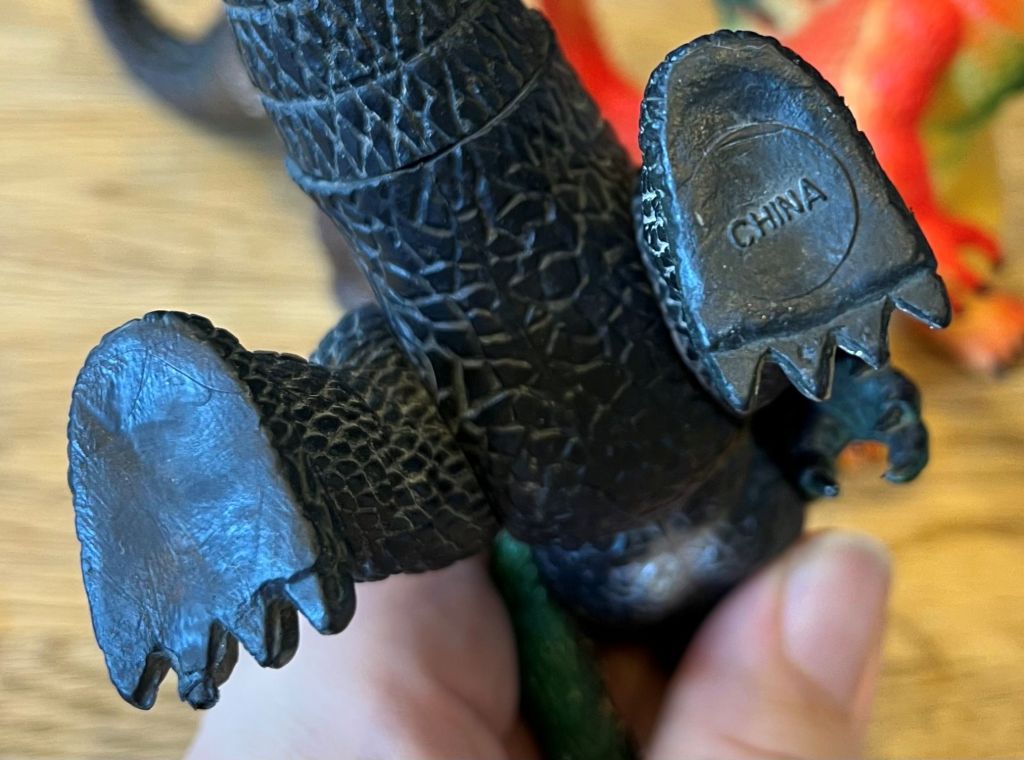
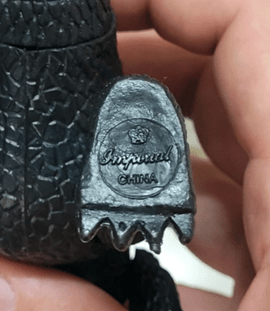
At some point after 1985, Imperial appear to have decided to improve on their smaller Godzilla model, with an updated and smaller design. A new model was developed (hereafter called the ‘spotty finned variant’). This was a head height smaller than the previous small Imperial model, standing only 125mm. tall (just under 5 inches), and weighing about 16g. It shared much with the earlier design, but had done away with the smallest fish-tail-like scale at the very top of the spine fins, had its scales resculpted to follow the same general lines but give the model more realism, and the mold of the head was adapted to give the figure more clearly defined triangular teeth, and a gaze that looked out on a horizontal plane (rather than downwards at a point just infront of himself), as well as a wider open mouth and tightly pressed together nostrils visible as twin bumps at the tip of his snout (as seen in Toho Godzilla designs from 1954 onwards). Most notably, the rough texture of the surface of the spine-fins now becomes as series of rows of clearly delineated raised dots, with these set in rows radiating from the figures back out towards the end of the spine fins. Any previous problems with extra vinyl from the mold process have now been dealt with, no such overspill is found in any of these examples. These figures come with a wide variety of marks on the soles of their feet – and I own examples with no marks at all, a faint “CHINA” and the same “CHINA” within a circle (about 13mm. in diameter), and this proliferation of marks has lead to many of these being described as bootlegs of the Imperial design. However, they are also found with clear Imperial marks on the sole of their right feet (as well as the same “CHINA”, but not the date and nod to ‘Toho’ on the left foot found on the earlier Imperial models):
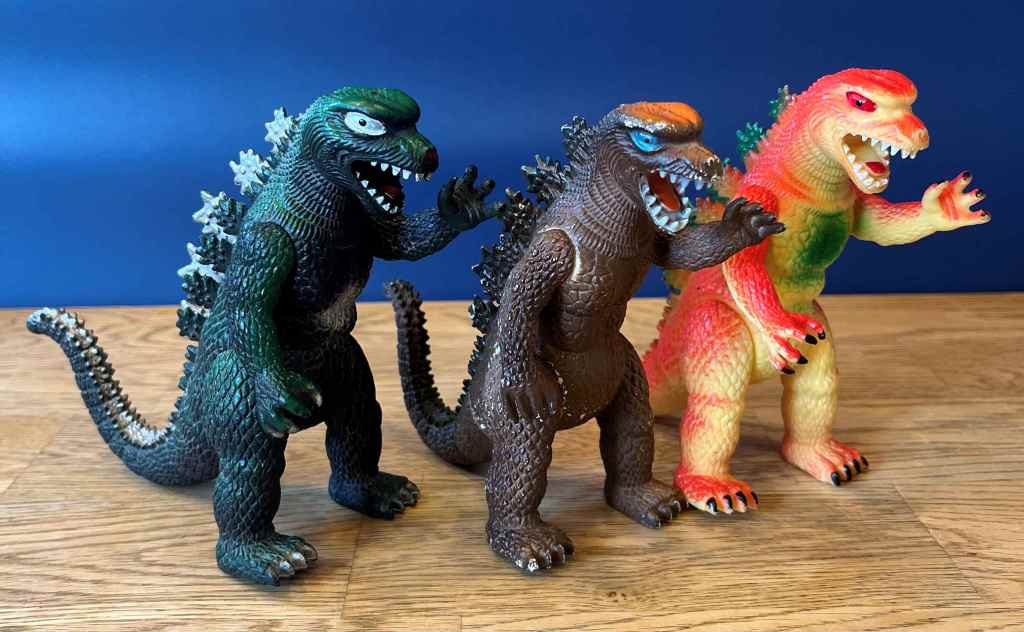
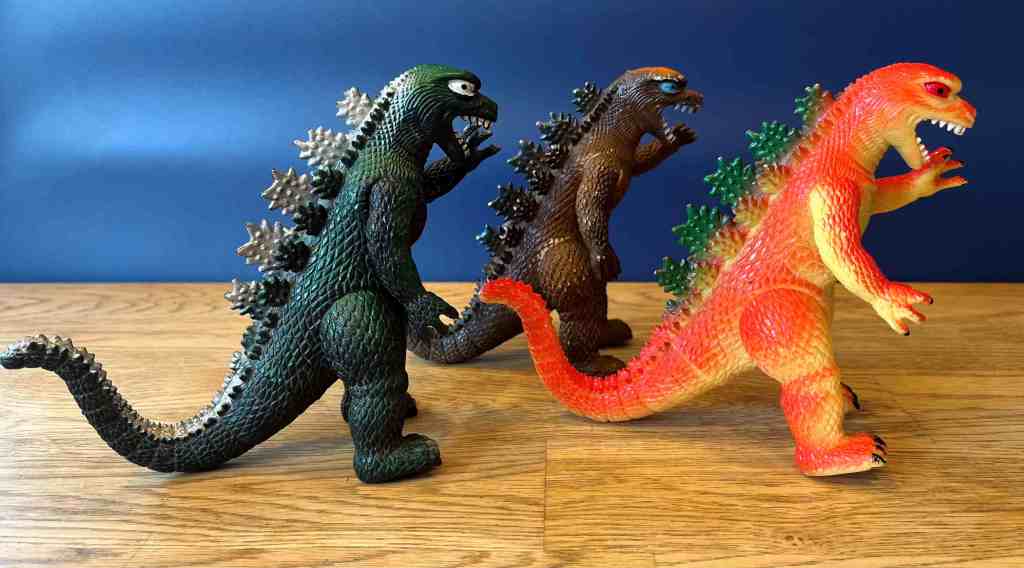
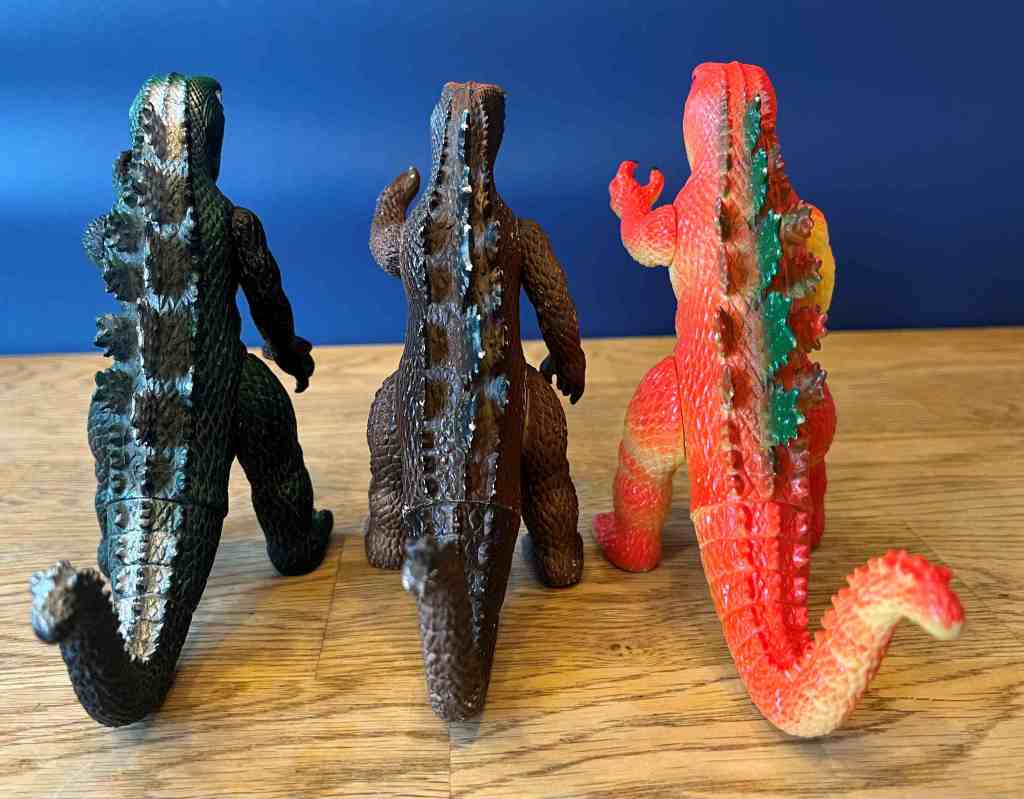
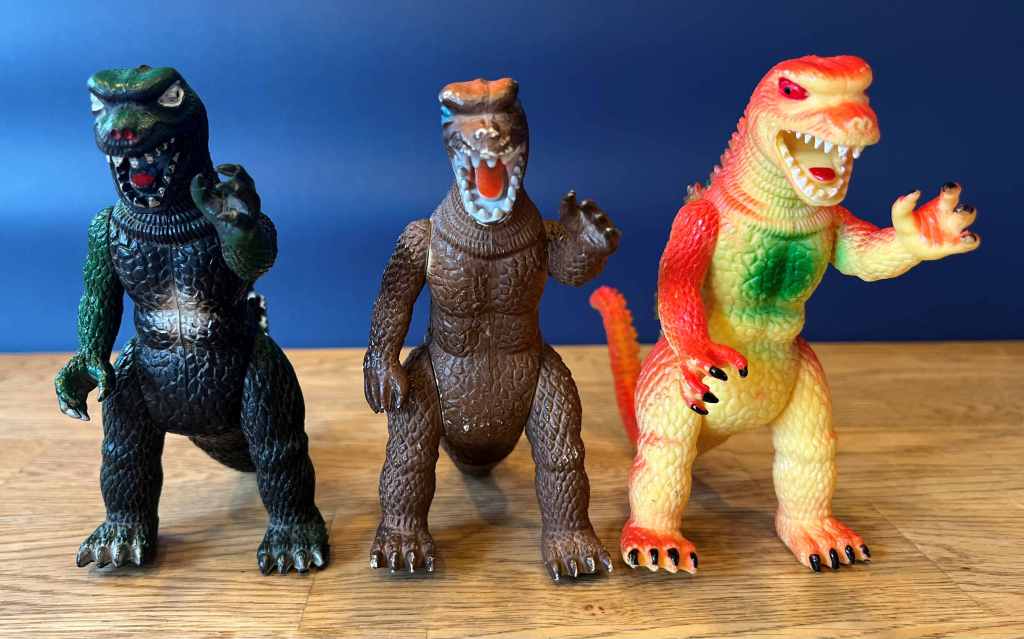
(This last image from an online sale listing, now long defunct, that I did not record the origin of)
Amazingly a counter-top sale box for these variants (that were sold under the toyline name “King of the Monsters”) survives in the private collection of Dich Vin of Puebla, Mexico (see their Instagram and Facebook posts of December 2025 (link)
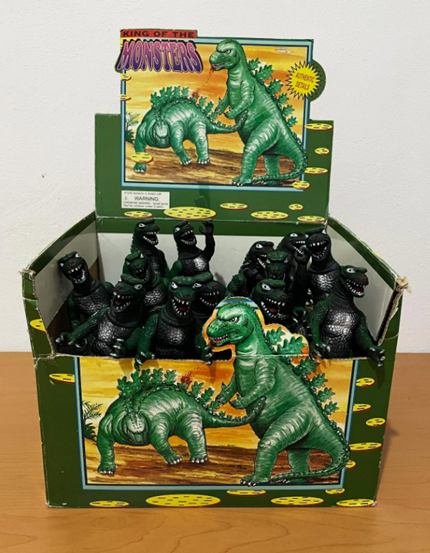
(Image reproduced with owner’s permission; note also how the artwork here closely follows the toys, with the same pattern of raised dots along the spine fins – this allows us to be certain that these toys have been with this box since its production, and were not added by a later dealer looking to increase the price of an empty display box)
(Image from nj_kaiju_collection_toys’ Instagram post; reproduced here with his permission)
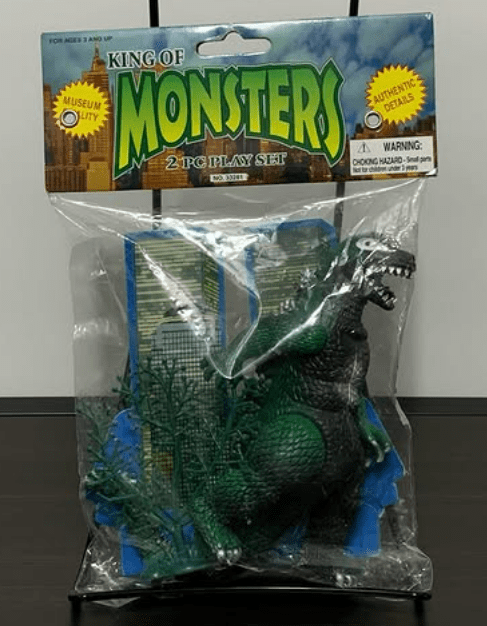
In addition, the Instagram user, nj_kaiju_collection_toys, posted an image on 21 May 2026, of one of these later Imperial mini Godzillas in a sealed bag with some simple plastic high-rise buildings and trees (see here). The header card for this bag does not have the Imperial logo, but it uses the same slogan “King of the Monsters” in a similar format to that found in other examples above, as well as the somewhat strange claim that these toys were “Museum Quality” in their “Authentic Details”.
These come in both the green and black as earlier models, as well as bright orange and yellow with bright green highlights, bright orange or yellow with only brown highlights, and a brown model highlighted in metallic blue that unusually for Imperial was produced in flesh-coloured vinyl and then painted (the original colour showing at the joints of the limbs and in any scuffs). The mainly yellow and brown variants are the rarest, and are the only ones that I have not seen examples with Imperial marks on the soles of their feet. They may represent production by an offshoot company – hopefully some reader will send me images of the examples in their collection.
(Images from a Vinted listing)
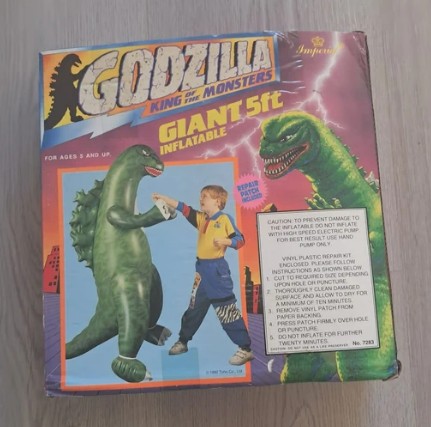
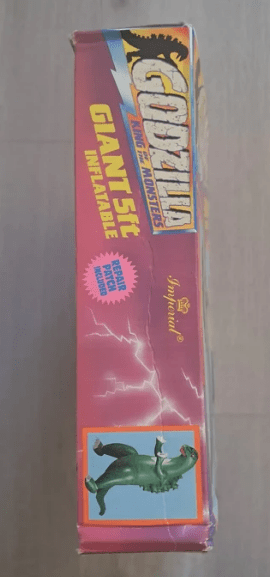
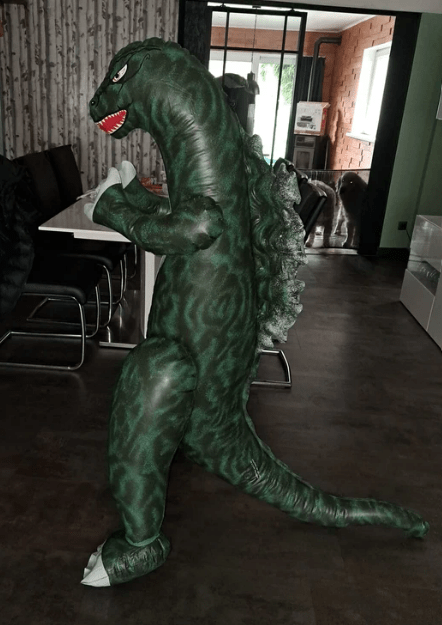
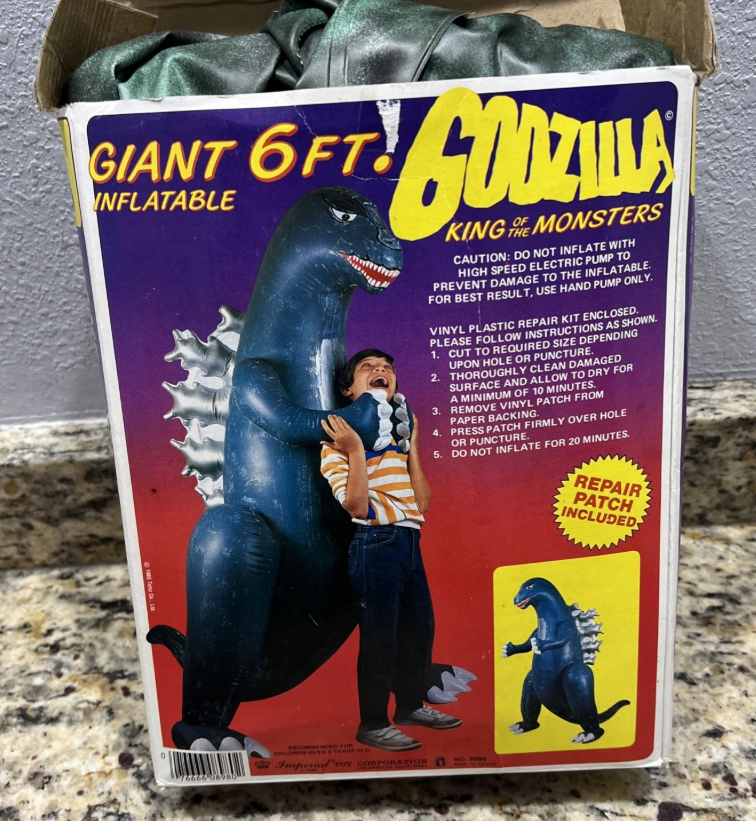
Finally, Imperial made large size inflatable Godzillas still under the ‘1985’ copyright license from Toho, in three sizes: 4 foot tall, 5 foot tall and 6 foot tall, for children to box and wrestle with, as well as a 48 inch tall ‘Bop Bag’ (an inflatable punch bag with an image of Godzilla printed on it; for the ‘Bop Bag’ see this Instagram post by nj_kaiju_collection_toys on 28 May 2026). The 5 foot tall model was reportedly produced in 1992, and the 6 foot tall model has text printed on the model itself showing that these were made in Taiwan for the Los Angeles office of Imperial.
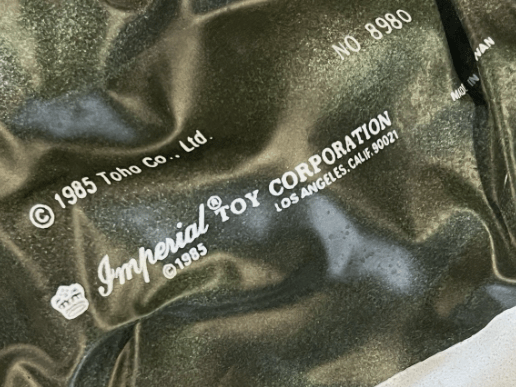
(Images from an eBay listing)
The need for Imperial to announce loudly on the packaging that there was a “REPAIR PATCH INCLUDED”, seems to me to explain why few of these survive.
After this point we enter the realm of the bootlegs of this figure, which we will return to in a moment after a description of the Dor Mei and ‘company x’ basic types.
⁂
⁂
B. The Dor-Mei Godzilla:
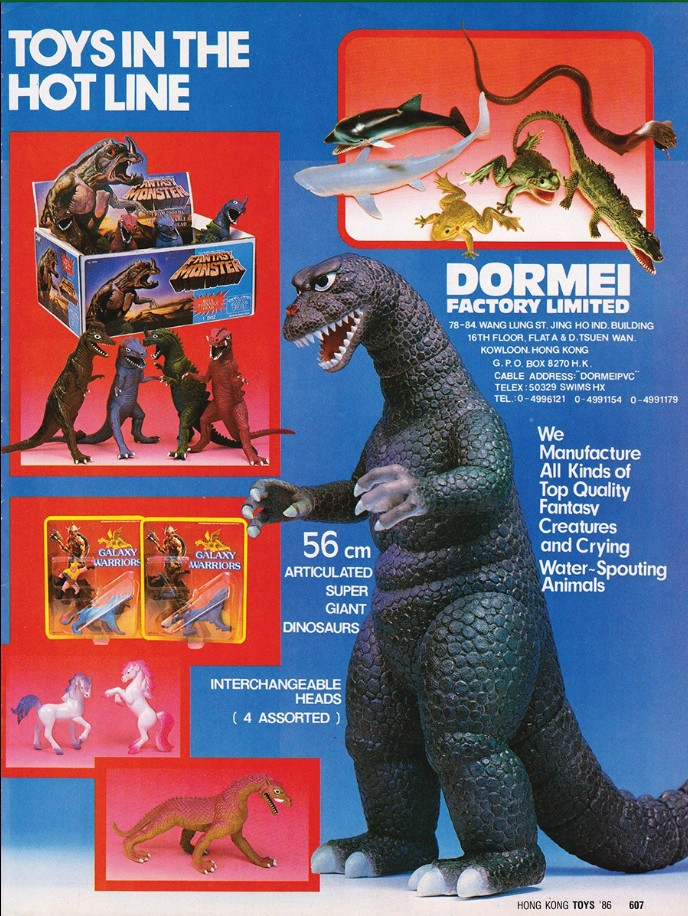
The other contender for the head of our family tree was produced by Dor Mei most probably in 1986. The company was incorporated as ‘Dor Mei Factory Ltd.’ in Hong Kong in 1978, and initially carried out production there, later shifting all or some of this to China. The figures are in hard vinyl, stand approximately 340mm. tall and weigh just over 1000g for the 1980s release (of course, each different head sculpt produces variability in these numbers), rising by a few 10s of mm. for the 1997 model. The survival of advertising for them from 1986 (see below) shows that all four head sculpts (including the one associated with the additional ‘LEADWORKS’ foot mark: see below) were created at once for the inception of the toy, rather than across time. Again, I envisage that production took place over many years. This is a good example of one of the early figures:
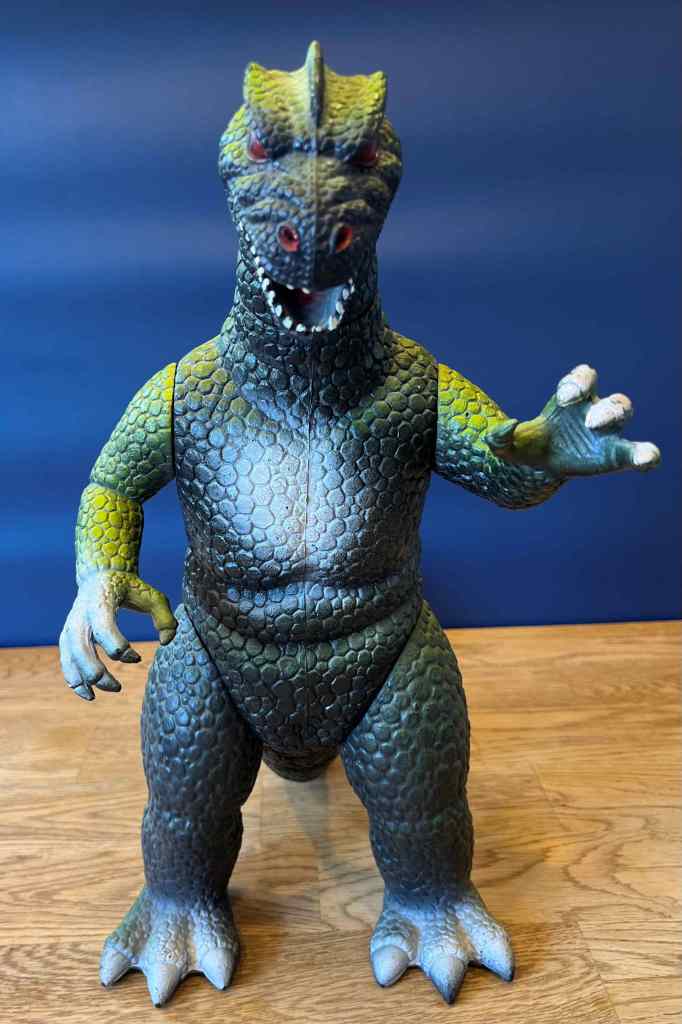
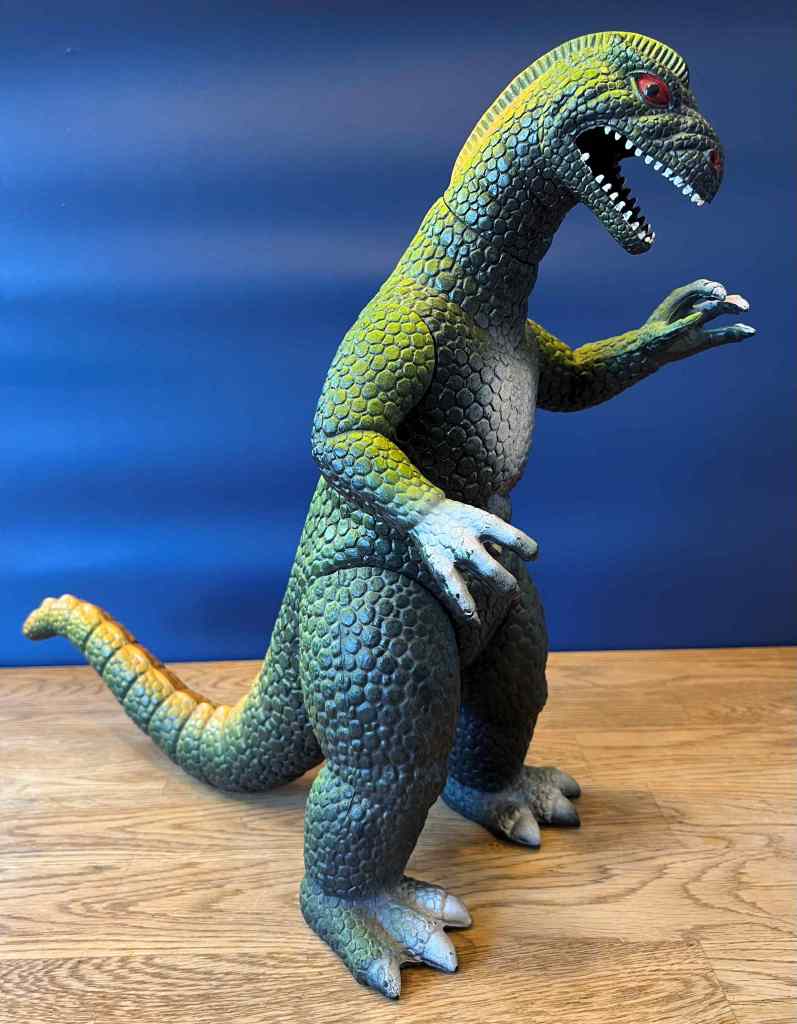
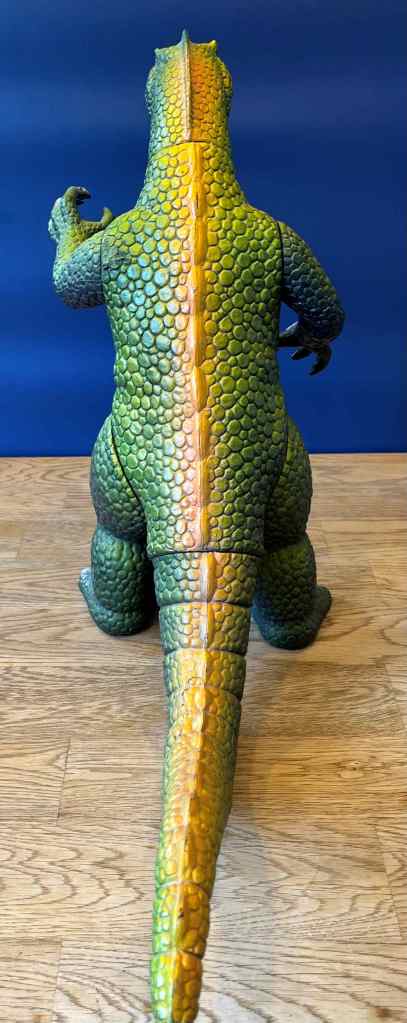
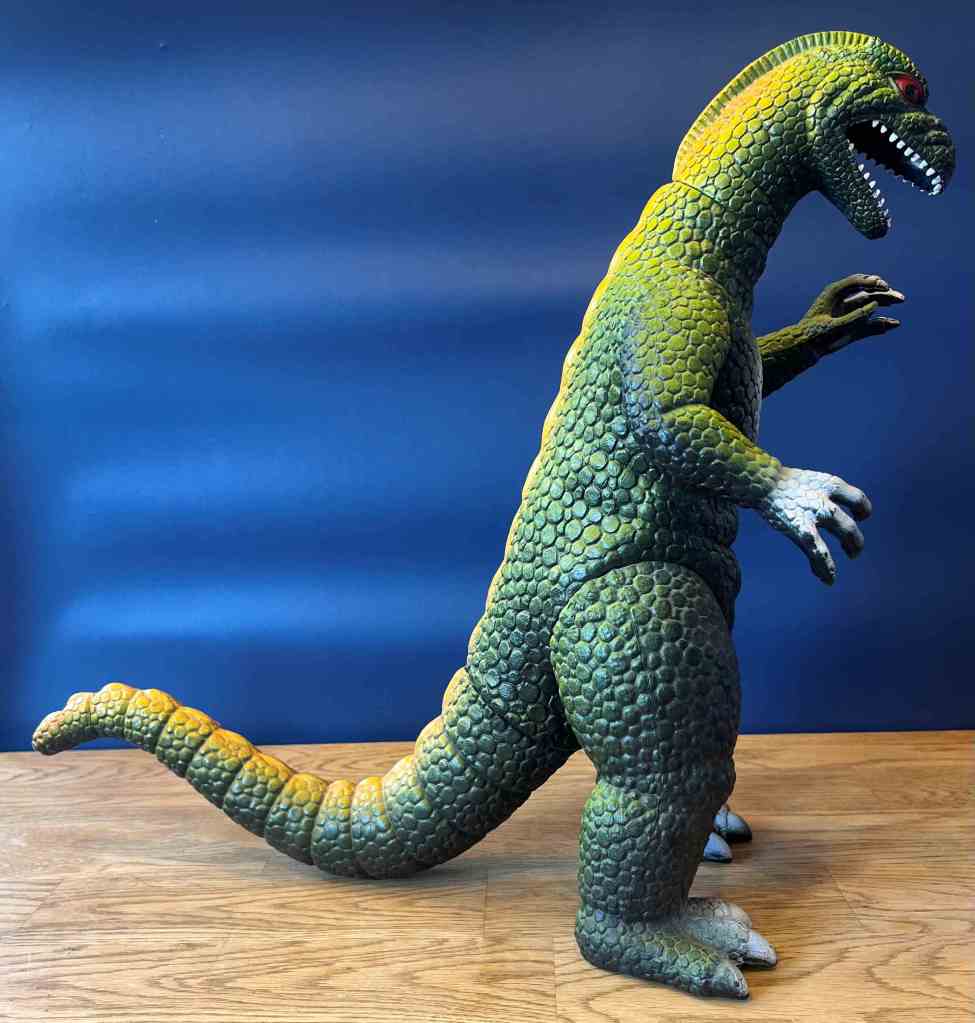
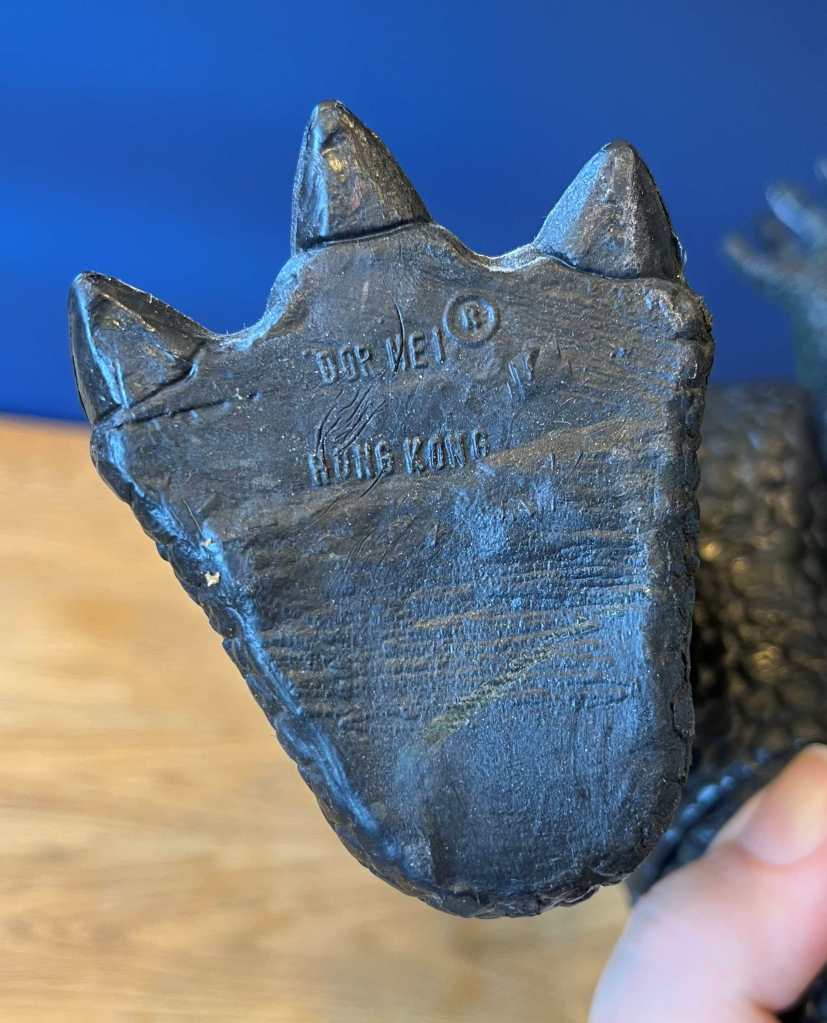
These models have three toes, with the central one more forward than the ones at the side, and in addition to articulated arms, heads and tail (initially single place at base, then later in 1990s with a another point of articulation further along the tail), they also had a head that could turn around. The back of the throat is again closed off. The scale pattern is more like fish-net, and there is little evidence of extra plastic from the edges of the mold. The overall effect is of a more refined and better made Godzilla.
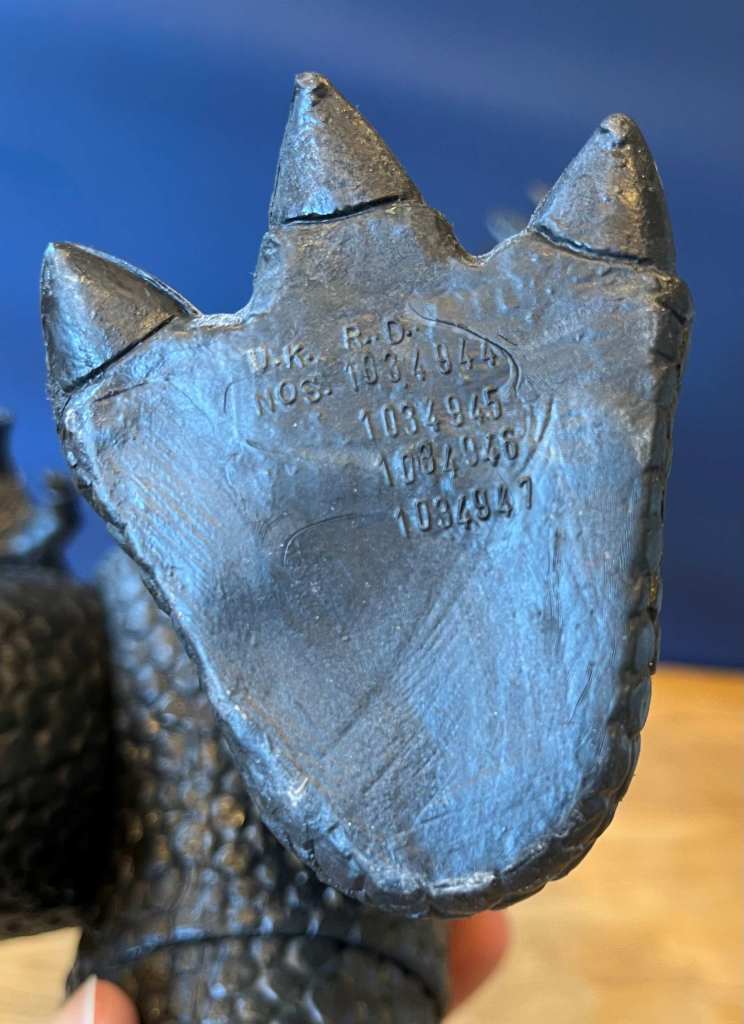
The marks on the right feet record production in Hong Kong (and some have the word “LEADWORKS” clumsily added to Dor Mei’s company name). No year is given there, and the left feet have patent pending information suggesting that the designs were registered with the United Kingdom Intellectual Property Office:
“UK R.D. [expanding to mean: United Kingdom Registered Designs]
Nos. 1034944
1034945
1034946
1034947”
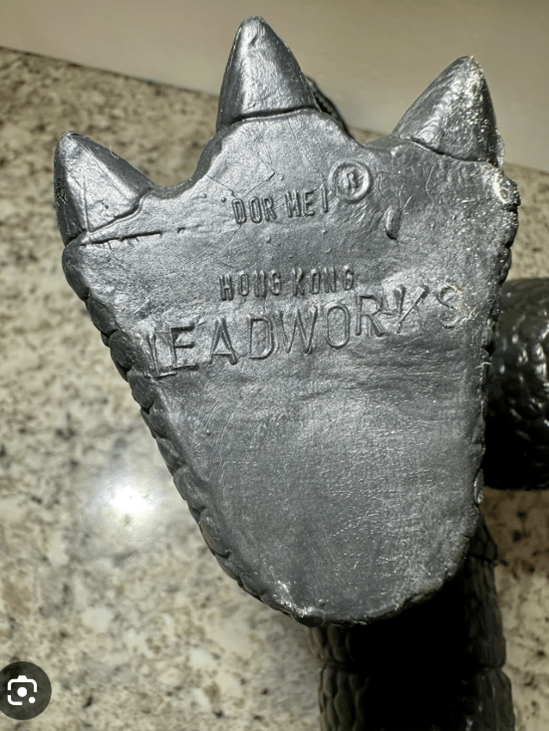
(This image from a long defunct eBay listing)
(This image from a Facebook post; reproduced here with permission of the owner)
Fortunately, an advert for a Dor Mei bootleg Godzilla survives, clearly labelled “Hong Kong Toys ’86” (i.e. 1986) at its foot.
In addition, an apparently later variant appears with the place of production changed to China, and the year ‘1986’ – but this most probably recording the date of the original copyrighting of the design, rather than actual production in China.
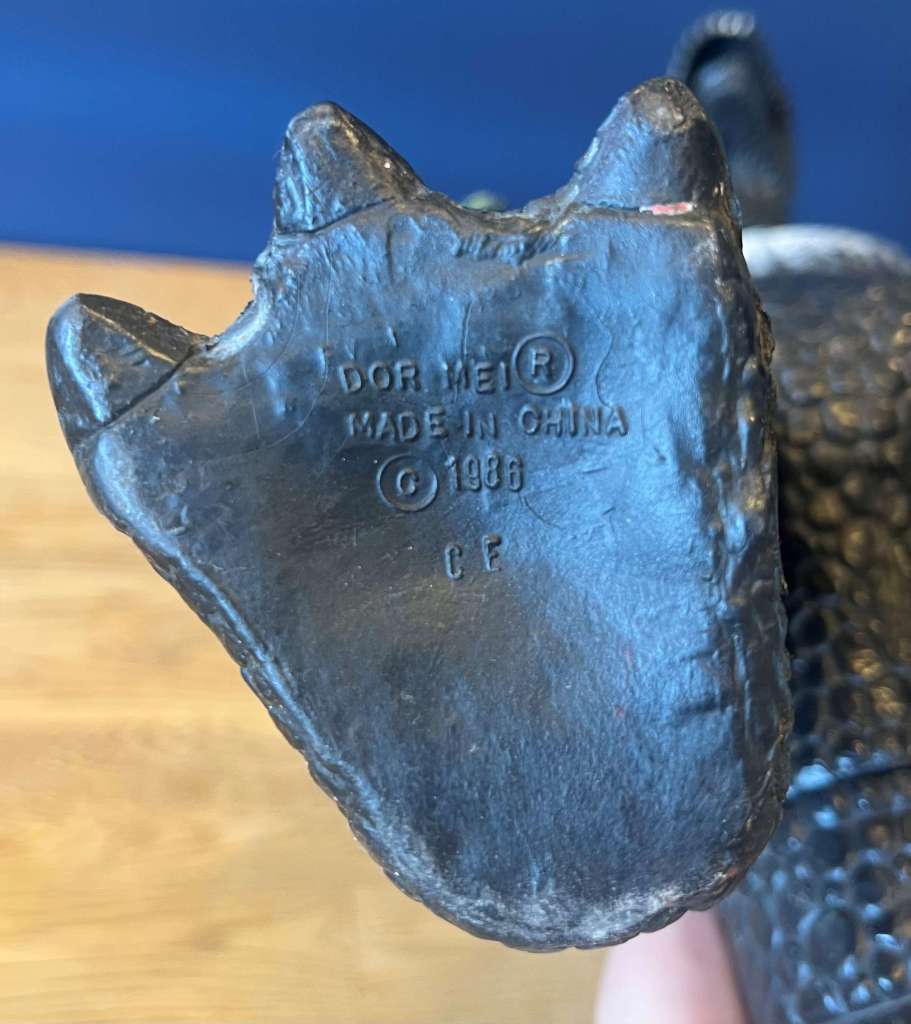
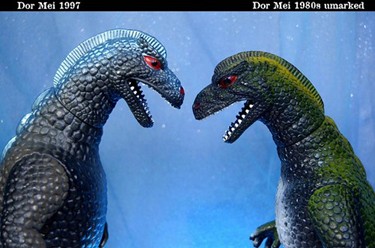
A final variant can also be found in different font and with the date ‘1997’, also with marks indicating production in ‘China’, and a chunkier body and leg design, with less pronounced stomach folds (with the chest measuring 95mm. at the midpoint of the arms – with earlier versions measuring 90mm. in the same place; and about 80mm. across the side of the thigh at its widest place – with earlier versions measuring about 70mm. in the same place). As the Hong Kong company directory records Dor Mei Factory Ltd. as being dissolved in 1994, those very last models were likely produced by a smaller offshoot of the original company or a separate company who bought the molds and the trademark rights.
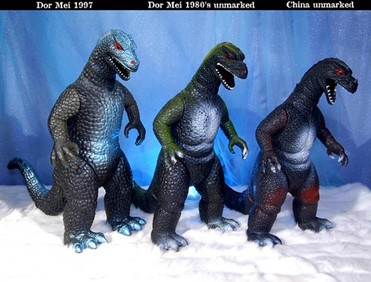
Here I give the side-by-side images of an internet user calling themselves Splitt in 2013 (and later Rebecca Loves-Monsters and Splittyhead on Flickr), who compiled a database of these variants that remains to the best of my knowledge sadly unpublished. I do not have contact with them, and if a reader could please put me in touch with them, or Splitt get in direct contact, as I owe them much gratitude and perhaps a bootleg Godzilla or two, and I live in hope of finally seeing that Holy Grail of a database. They posted images on a forum in 2013 that brilliantly compares the Dor Mei 1980s model to the chunkier 1997 model (for the moment, please ignore the third one here named “China unmarked”) (link)
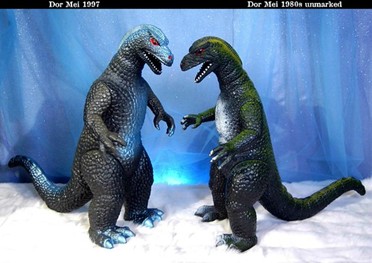
And in the same place, images of one of the variants (here on the left, again please ignore the one on the right named “China unmarked” for the moment):
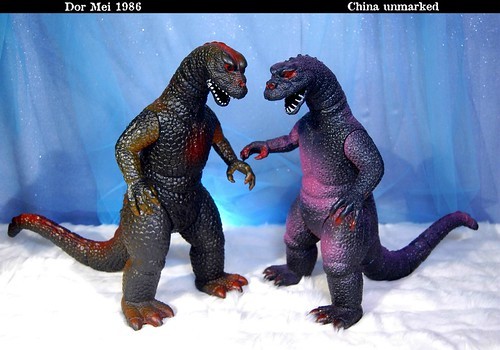
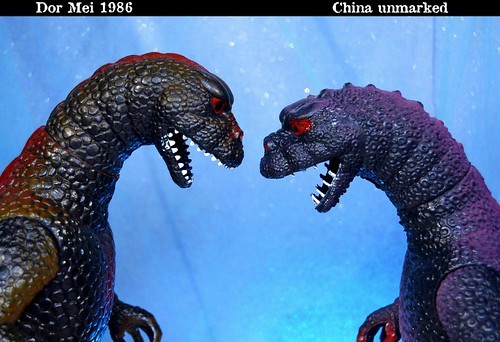
These Godzillas appear in colour variants of green with orange highlights, black with red or green highlights, and a rarer pale blueish white with orange or yellow highlights (this entirely painted over in blueish white, rather than using a plastic of that colour, and so very often surviving in a scuffed or scratched state). The blueish white models are all marked with “China” on the soles of their feet, and I shall post on their sub-group separately (in fact, see two dedicated blogs on this site on these). The 1997 models also appeared in black with metallic grey-blue highlights.
There is also a head sculpt that is mainly associated with the figures marked “Dor Mei” + “Leadworks” on the soles of their feet, with slightly less detailed features and large staring eyes:
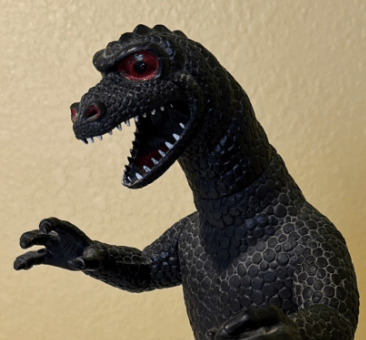
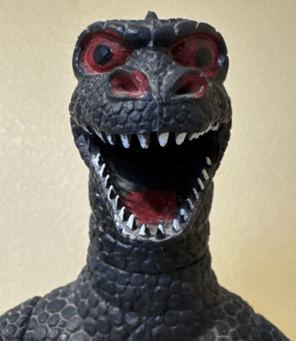
(The ‘Leadworks’ head sculpt; these images from a Vinted listing)
I say ‘mainly’ here, as I do know of a single example without the “Leadworks” addition to the marks on their feet.
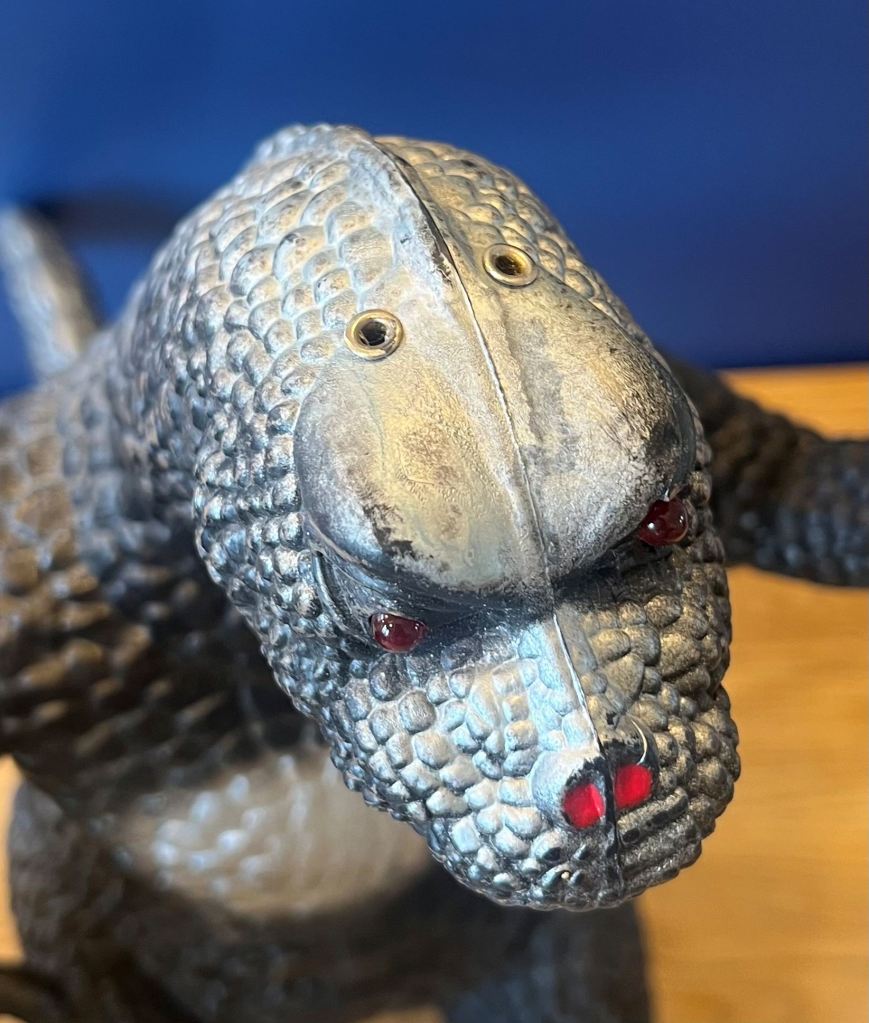
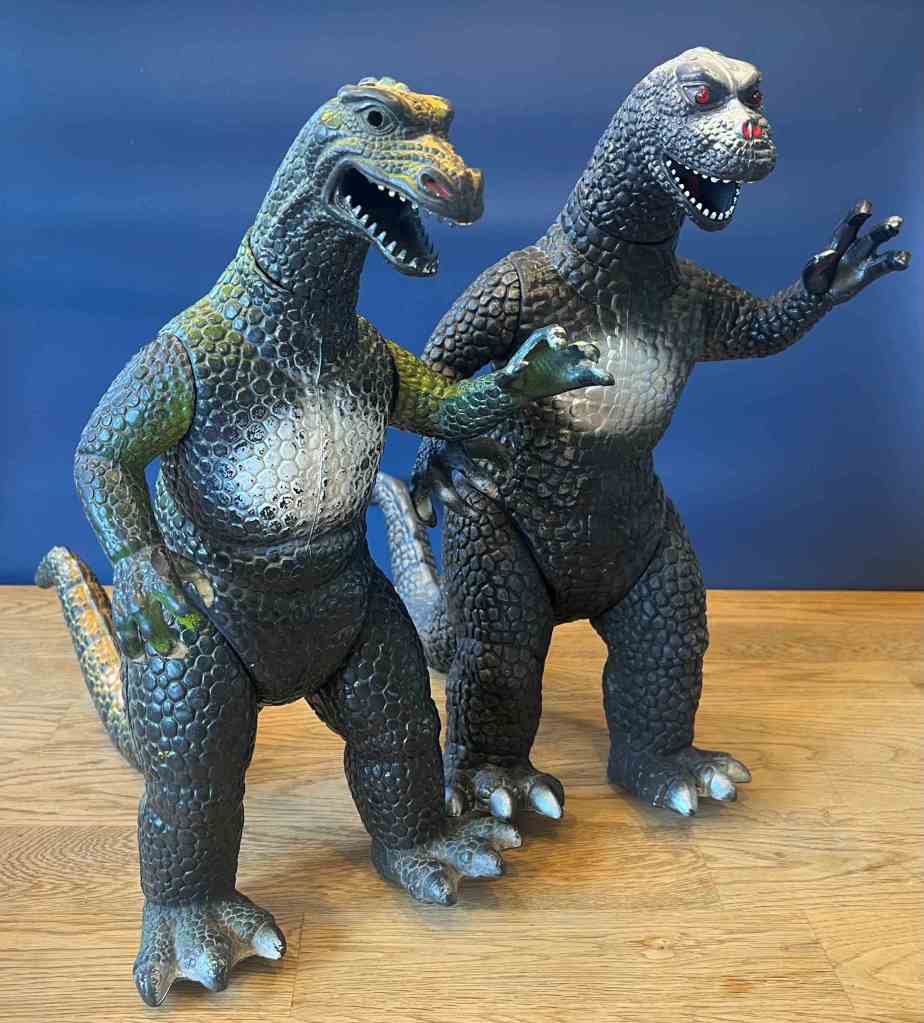
Finally, a late version has two metal circles on top of its head – these being sensors which when touched make the eyes light up while the figure emits a roaring sound. These figures exist for several head-sculpts.
Pictures of one of these roaring Godzillas still in its original packaging for a toyline named “DINOSAURS Dinosaurs” (the first word shouted, and the second whispered?), and with a copyright mark dated 1991, survive on a single eBay listing (but already sold by the time I spotted it: there is a Worthpoint record here). This is of value as a record of the so often lost packaging, as well as for the comedy value for the interpretation of Godzilla’s roar as a repeated “WO … WA …! WO … WA …!” They do not make any such noise, but instead make a kaiju-like roar or screech.
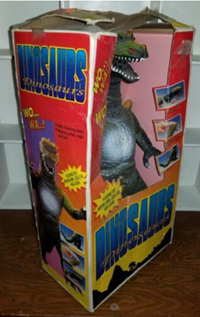
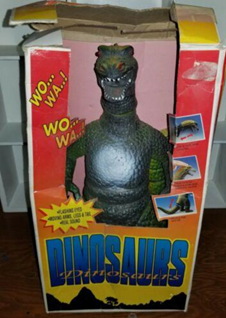
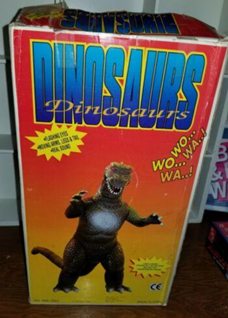
(These images taken from Worthpoint listing).
I do not expect this packaging to have been consistent across all countries, and they are likely to have been marketed under several different toyline names, but is worth reporting when such things survive or appear in photographs.
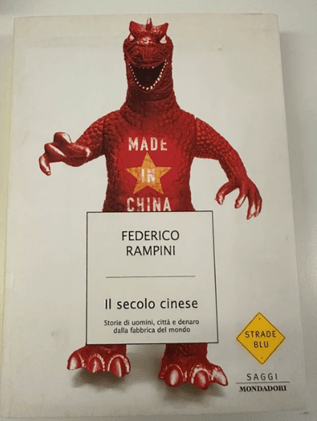
As a final note on the Dor Mei bootleg, we should acknowledge that it has become so iconic for the brand of Chinese bootleg toys that in 2006 it was used, in a red respray not found in any actual Dor Mei product, as the front cover image of a book on the rise of Chinese mass production, by Italian author Federico Rampini.
⁂
⁂
C. The Godzilla (aka ‘Sharkzilla’) and the two kaiju produced by ‘company X’
The ‘Sharkzilla’:
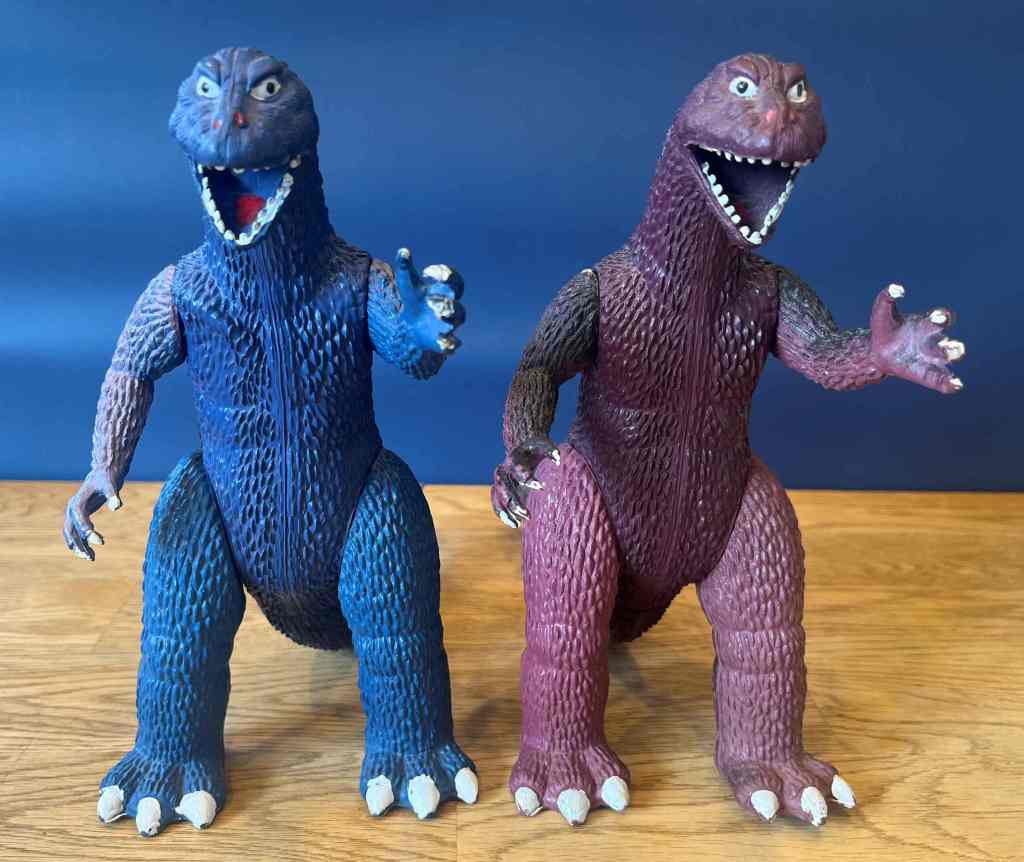
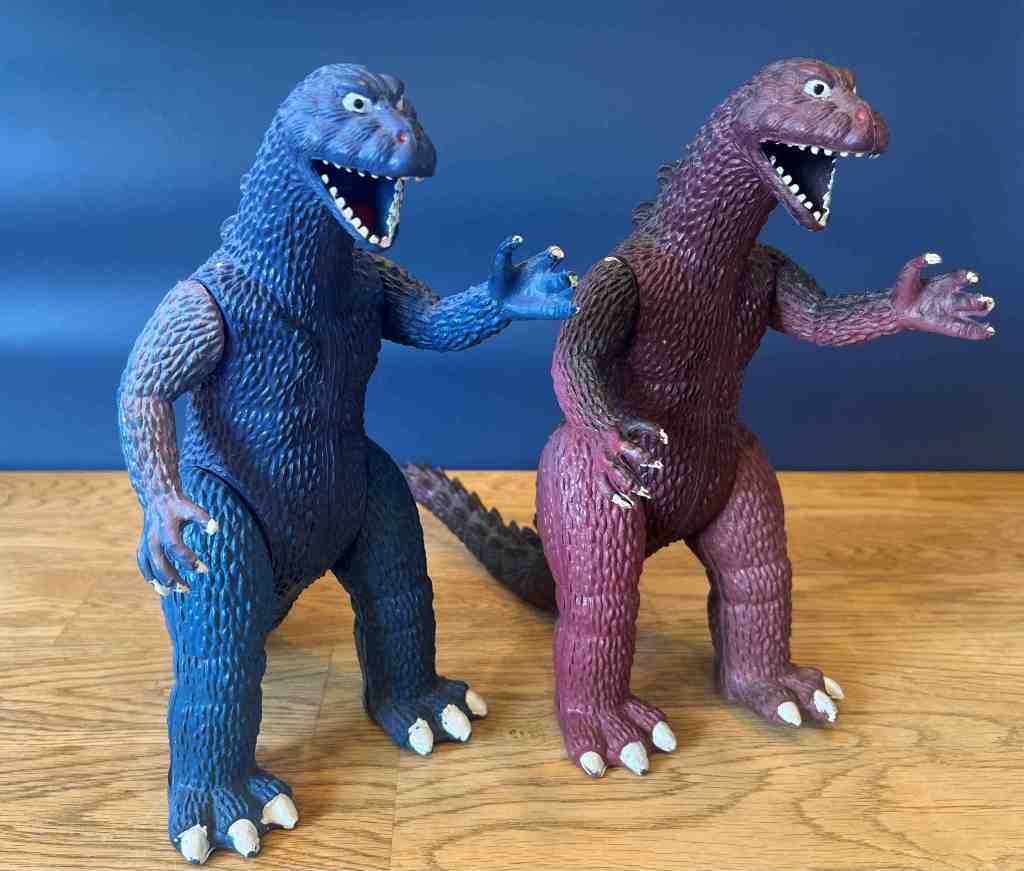
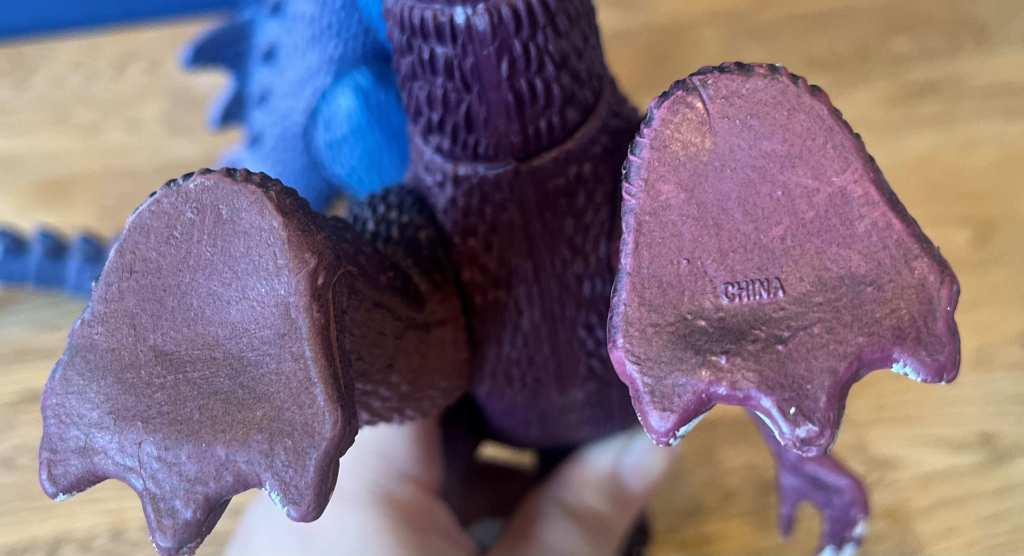
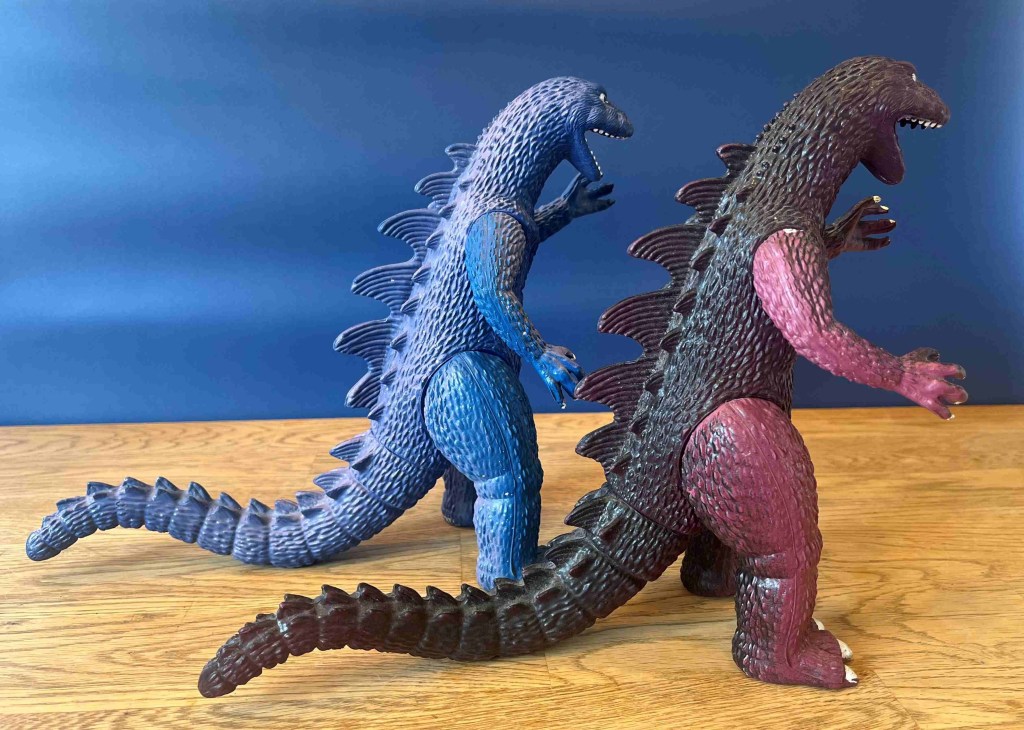
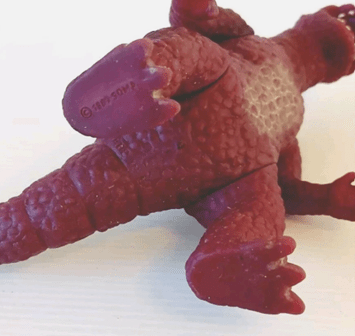
This Godzilla figure was made of hard vinyl, stands 215mm. tall, and the small army of these I own weigh between 263-311g. It is clearly a mix of elements of the Dor Mei and Imperial bootlegs, and so appear to have been produced third among our prototypes. The facial features of this model owe much to one of the main sculpts of the early Dor Mei bootlegs, yet the scale pattern is that of interlocking diamonds, like the early Imperial model, but here these scales are raised and bulbous, rather than sitting flat against the body. Again, like the Imperial Godzilla, the arms and legs articulate, as does the tail in a single point at its base, but the head does not. The feet have three toes that resemble the Dor Mei models, and while there are some signs of residual plastic from the mold-joints, these are not as bad as with the early Imperial models. The spine-fins have a distinctive individual design, made up of rows of sharkfin-like triangles, with a straight back edge and a curved front edge (hence the popular name online: ‘Sharkzilla’), and the central row of three rows of fins stands much taller than the others. The throat is sealed, and they appear most commonly in various shades of purple, blue and orange, either without highlighting or with black highlights subtly applied to darken the extremities of the model (for the rarer examples in orange with yellow highlighting see below). I have also seen a single example of black version highlighted in green, and apparently coloured to emulate the Imperial and Dor Mei models (see below on this). To be completely certain of what I say next, I would need to acquire a much larger sample of these than the ten or thereabouts I own, and as there are many examples with only partial or no foot-stamps and online sellers frequently ignore or do not show the foot-stamps, it is hard to know what you are acquiring until the box arrives. However, there appear to be at least five distinct phases of production of this model: four in China and a final one in Hong Kong. We begin with an initial phase usually in strong purple or blue, which has only the word “CHINA” under the sole of its right foot, with the left foot left blank.
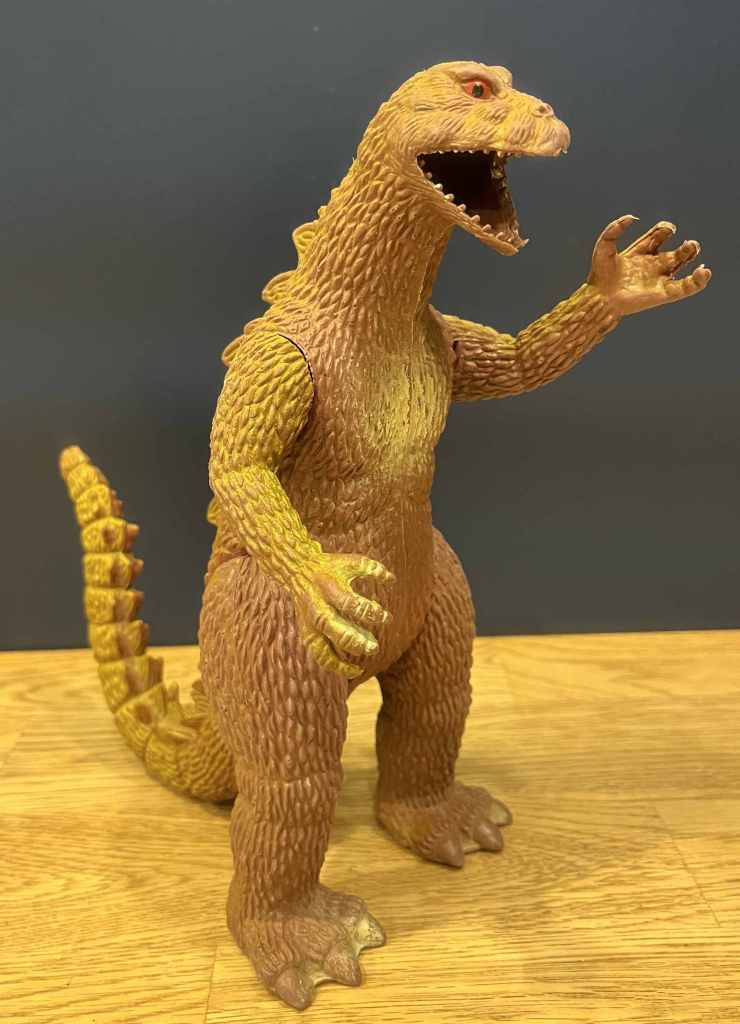
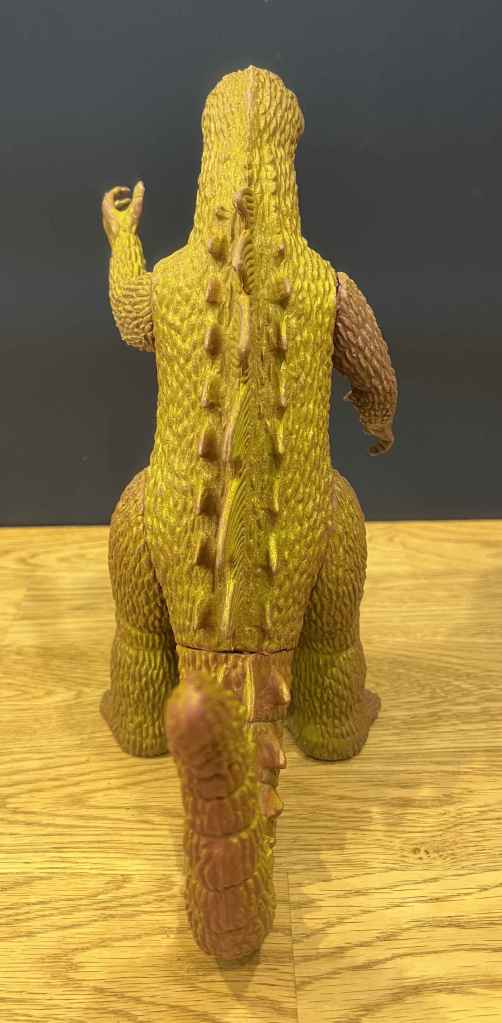
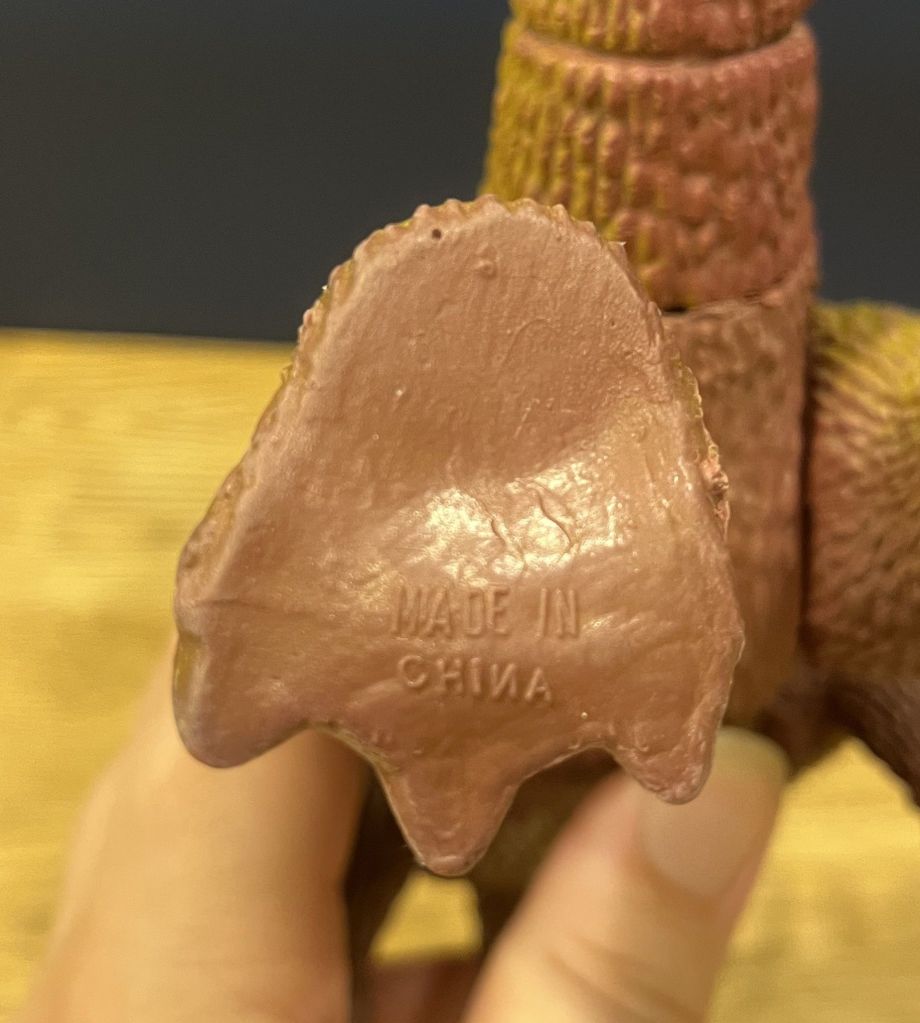
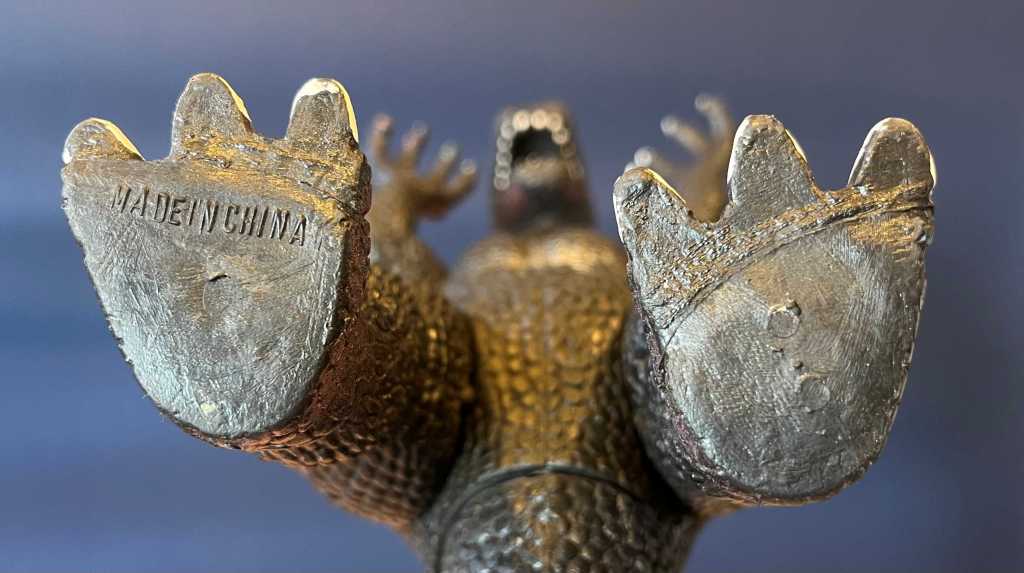
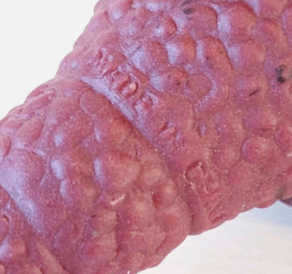
Then a second phase, usually made in blue with black highlighting or a pale red-orange with the yellow highlighting, but with a single example known to me in bright yellow with green highlighting and a splash of white on the chest and the claws, have “MADE IN / CHINA” or “MADE IN / CHINA / CE” on the sole of the figure’s left foot – where the first and last lines are in a slightly different font and the ‘N’ of China is backwards. This is usually accompanied by “© 1986” on the sole of the right foot. With the blue versions of these, the eyes are commonly bright yellow and the dark highlighting is heavier and perhaps even clumsier than the earlier models. These are made in more pliable rubbery vinyl that bends under the pinch of a finger and thumb, and the two I own weigh 251g (red-orange one) and 259g (bright yellow one).
What this allows us to see is that the molds of the legs at least for these castings were re-sculpted or duplicated and adapted, and in carving the initial “CHINA” in reverse, a simple human error led to the inversion of the ‘N’. There may be examples with just “CHINA” in this form, but I have not seen any. Then these new molds had further information added to them: “MADE IN” and sometimes “CE”, showing this process happened as a later adaptation of an earlier design.
These two initial phases of this bootleg make up the vast majority of examples of this figure.
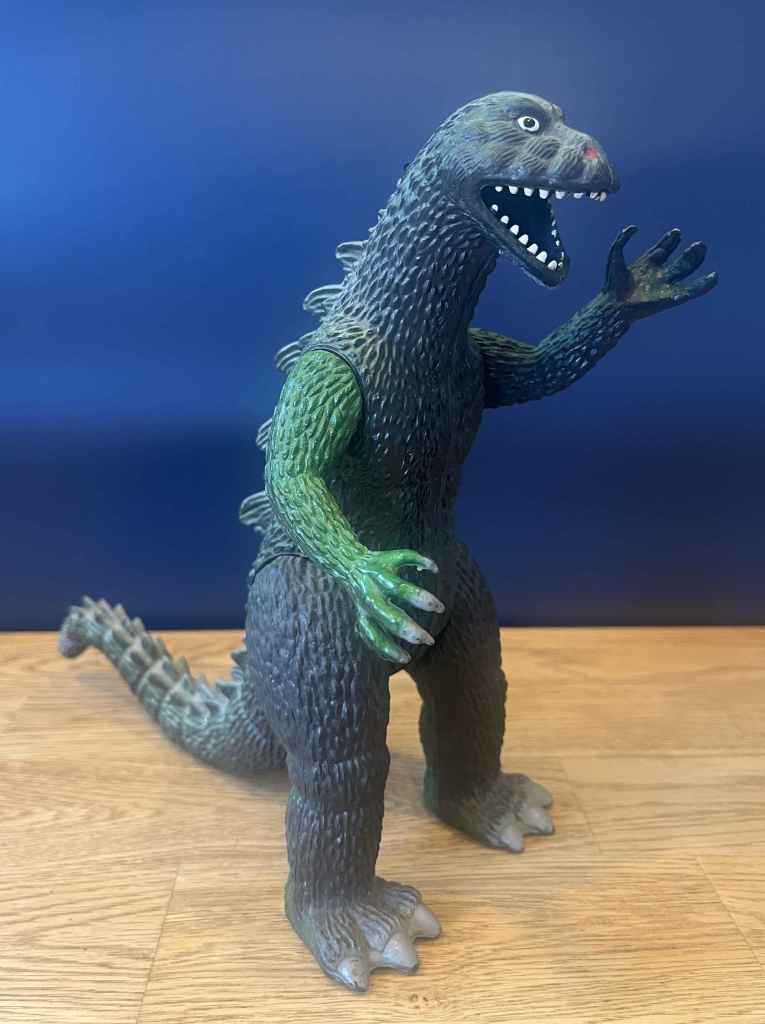
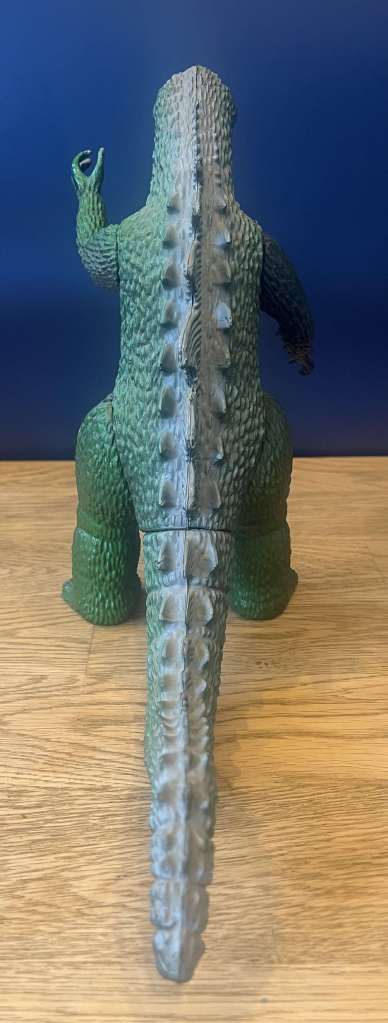
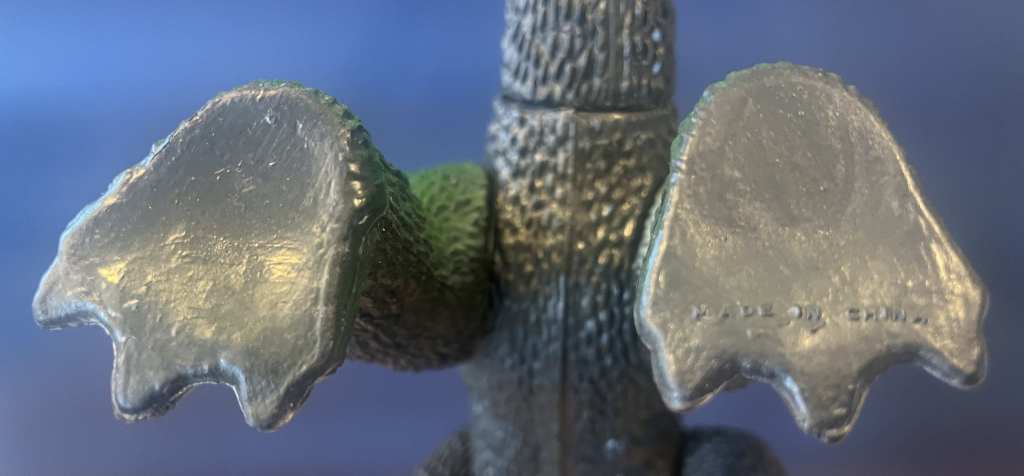
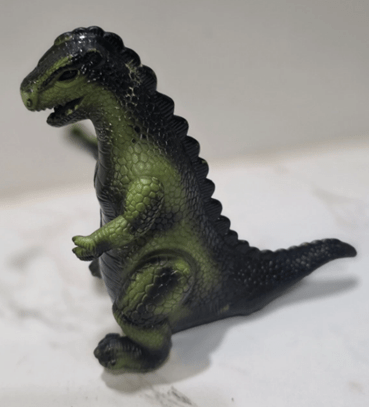
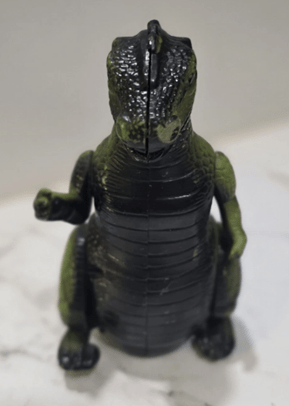
A third rarer variant, seems to have been an attempt to flatten out the various untidy fonts in the updated marks on the soles of feet of these bootlegs – and presents a new mark: “MADE IN CHINA” all in one line, apparently using tools used for the original mark. The only one of these known to me is in black vinyl with green and distinctively heavy grey highlights, intended to make it look like the Imperial or Dor Mei models.
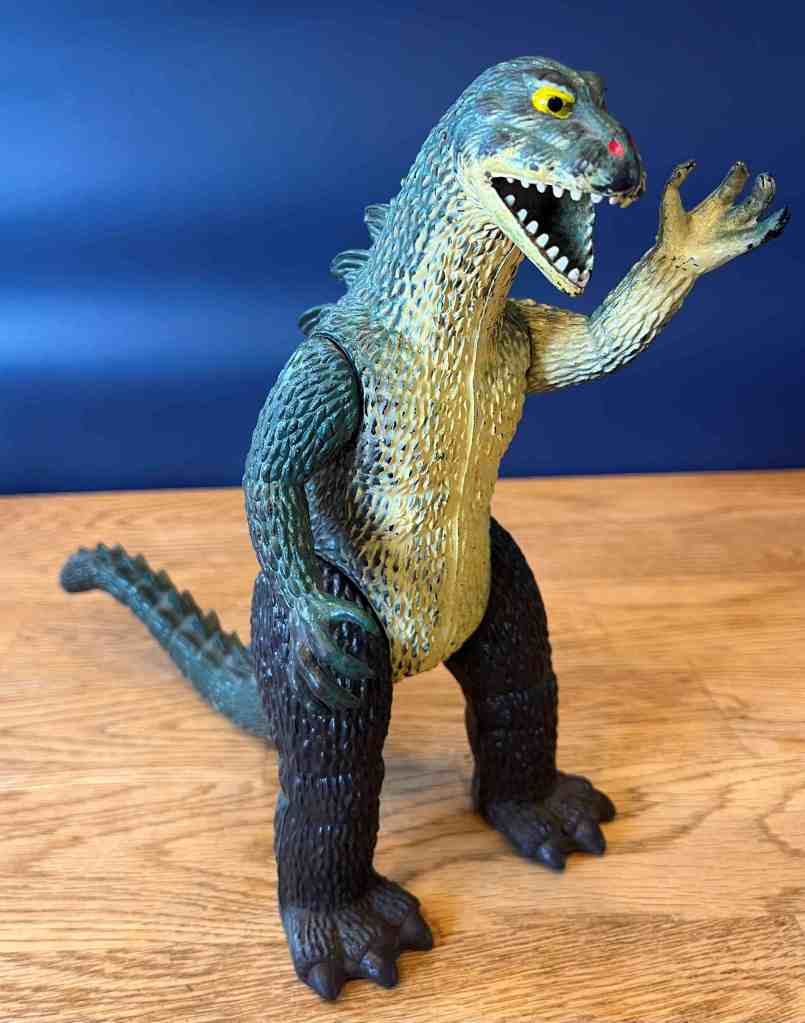
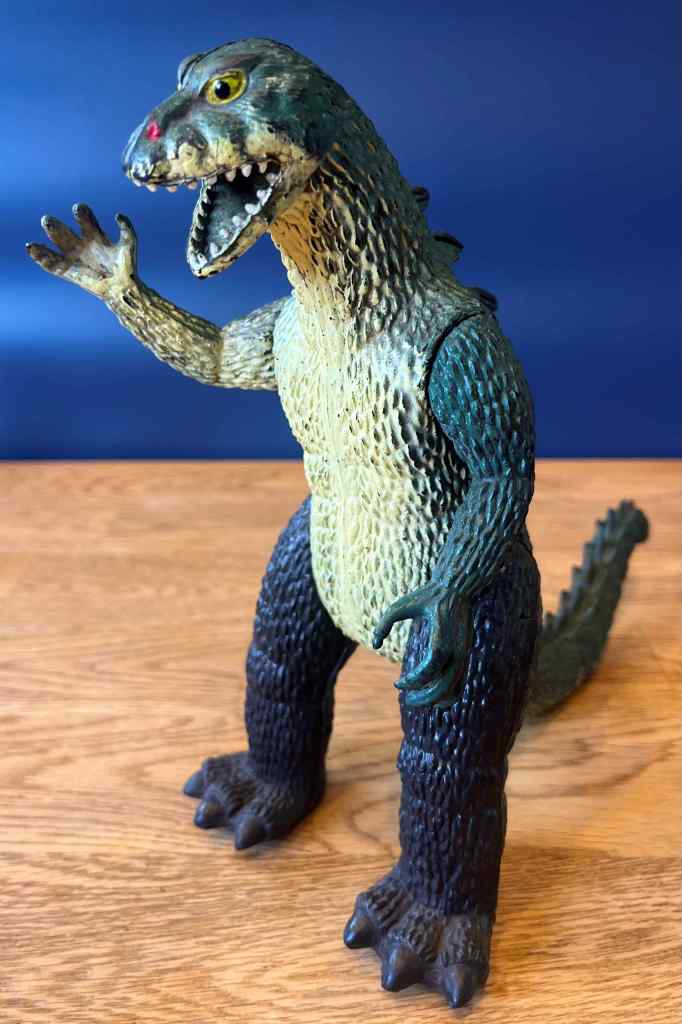
That said, the variation does not stop there, and interestingly, a very small number of these Godzilla bootlegs seem to take influences from other bootlegs in a way that suggests direct contact. I know of a few in more naturalistic strong dark green with a cream belly area – and this green and the combination of it with a cream highlight that covers the whole underside of the beast (not a splash in the chest area) is found in no other example known to me except what I have called below the ‘three-toed copy of the second spotty finned Godzilla’ (my *Bootleg of Imperial model 2, below). In addition, the ‘three-toed copy of the second spotty finned Godzilla’ is notable for using legs taken from the ‘company x’ model and with its identifying marks. All this points to a presumably late offshoot-production-workshop mixing and matching body parts from two fundamental models, or a direct crossover between production companies in the form of body parts sold from one to another, in a workshop that came up with their own colours and spray patterns. This will be discussed more fully below in the section on my *Bootleg of Imperial model 2, the ‘the second spotty finned Godzilla’.
NB. a picture of another one of these distinctive and rare Sharkzillas with the same green body and cream underbelly, was posted to the Instagram account of a user named ‘Creaturesafari’ on 12 March 2021.
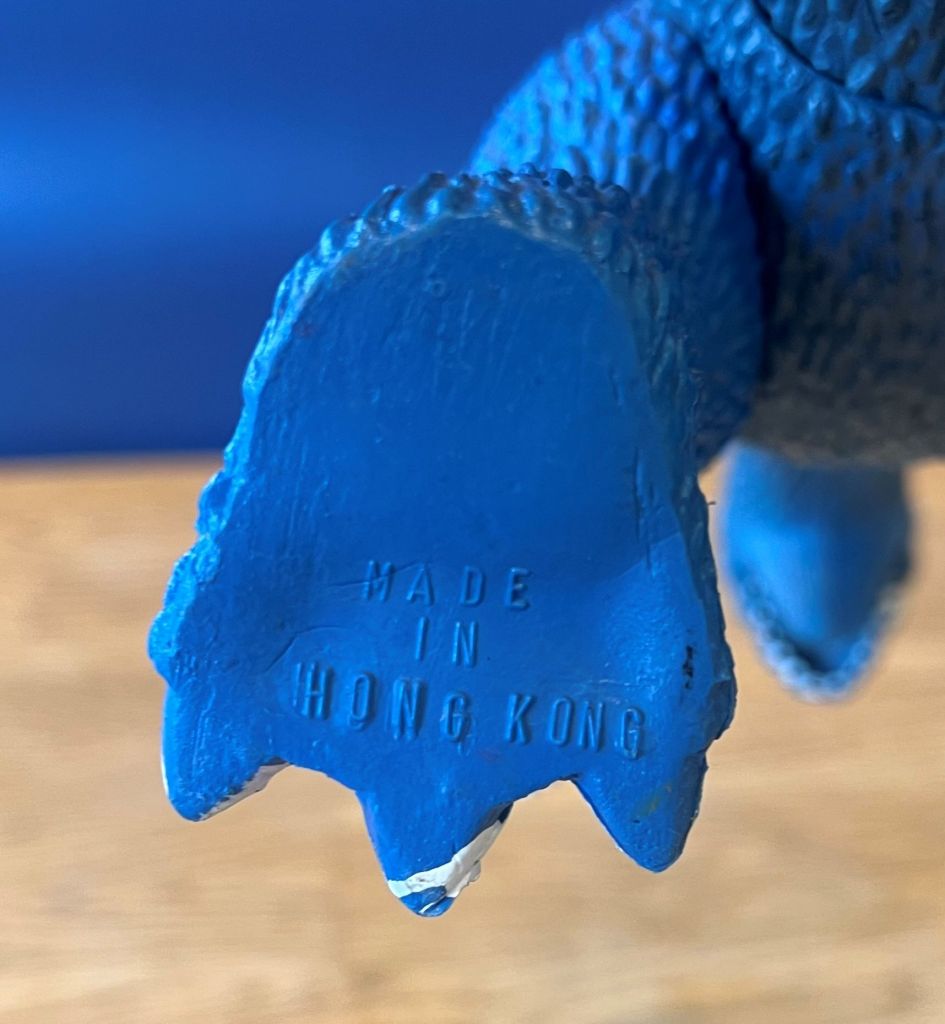
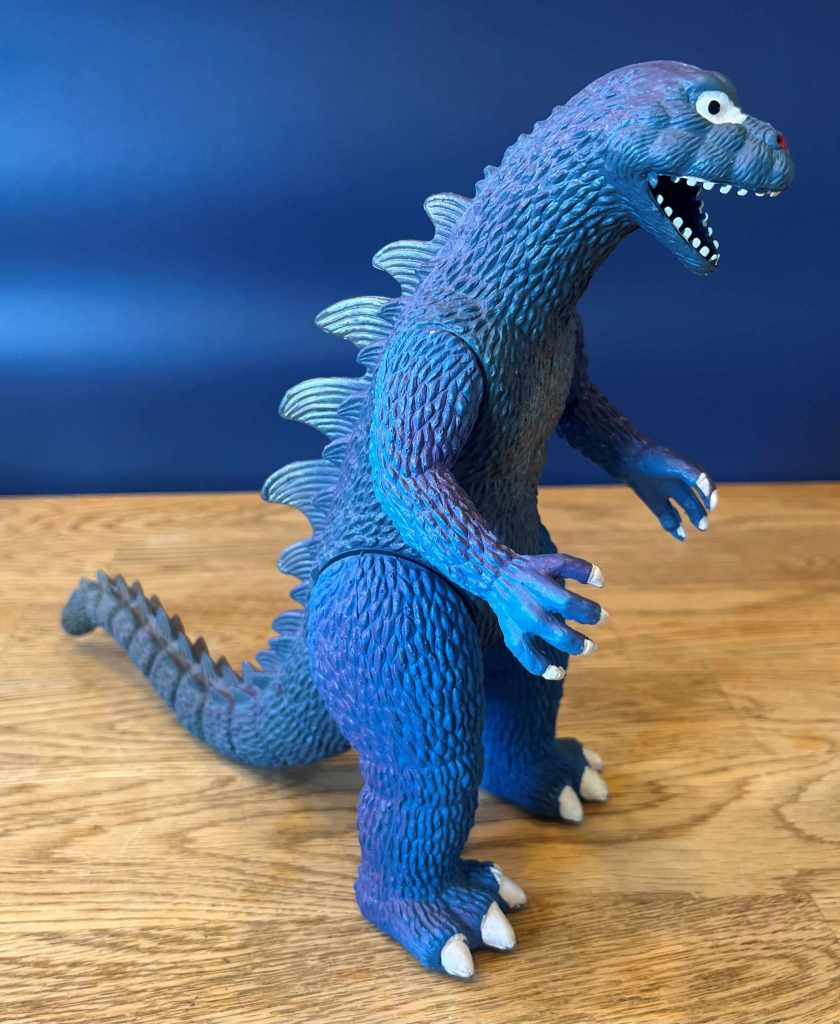
Finally, it should be noted that a variant produced in a base colour of light blue (usually very pale blue, that can fade over time to a green), often have “MADE / IN / HONG KONG” marks on the soles of their feet, or no marks at all. These most probably come from a late offshoot of the production, moved from China to Hong Kong, or from a subsidiary company based in Hong Kong and with access to a set of original molds, which they reused with adapted legs.
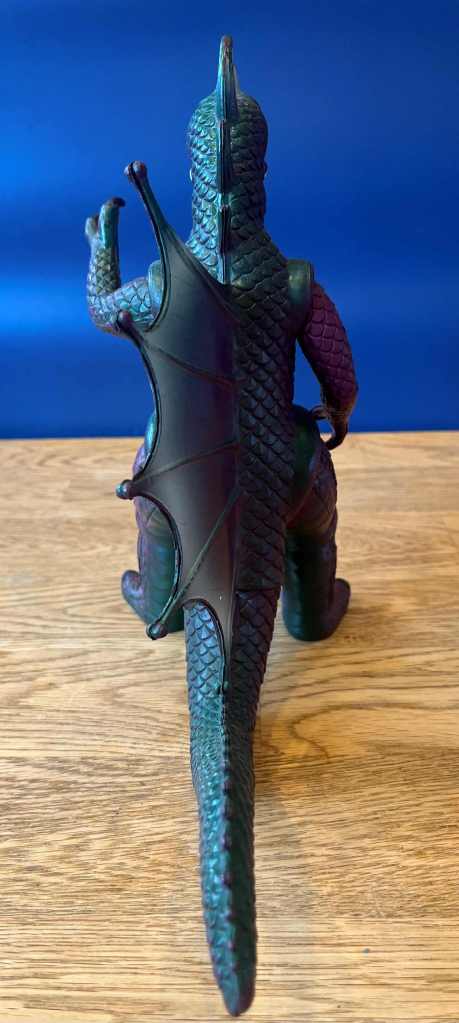
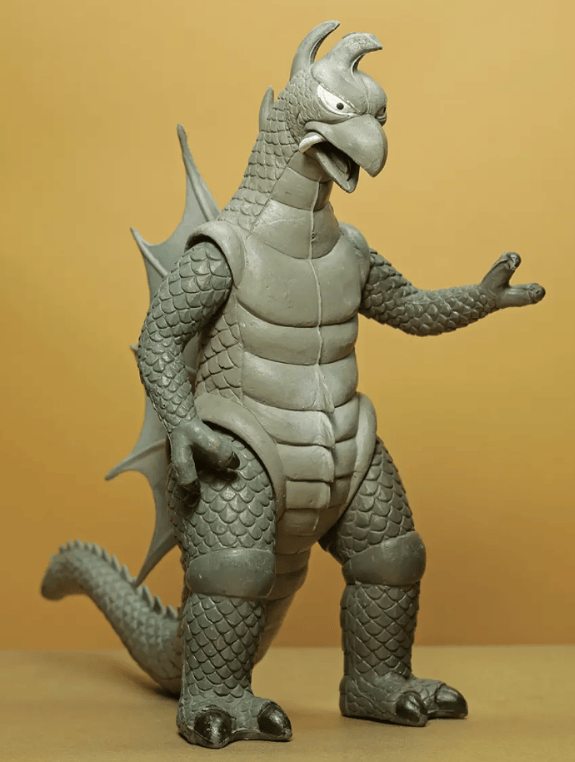
The ‘Gigan’ bootleg:
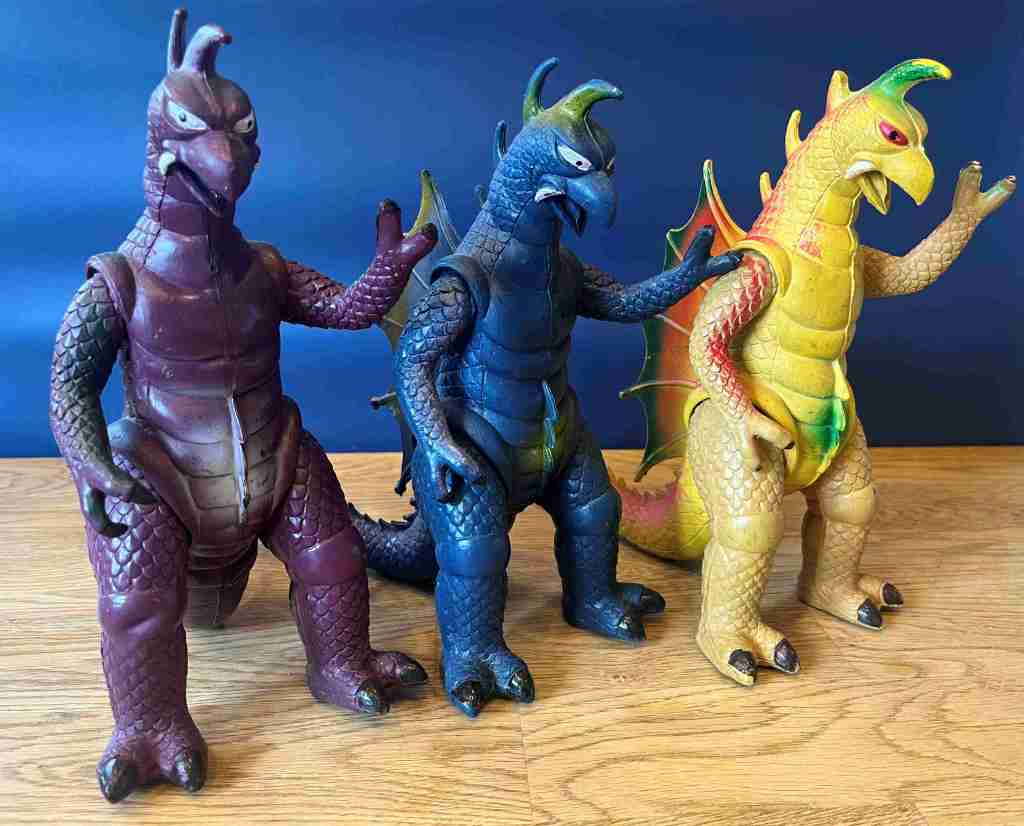
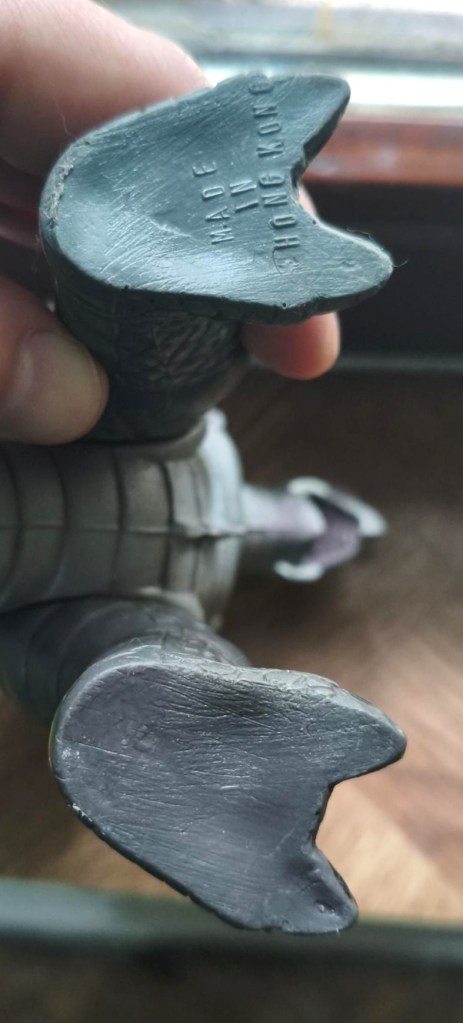
The same simple “CHINA” stamp of the earliest models of the ‘Sharkzilla’ bootleg also appears in an identical size on the left foot of the so-called ‘Gigan’ kaiju bootleg, allowing us to identify it as another product of this ‘company x’.
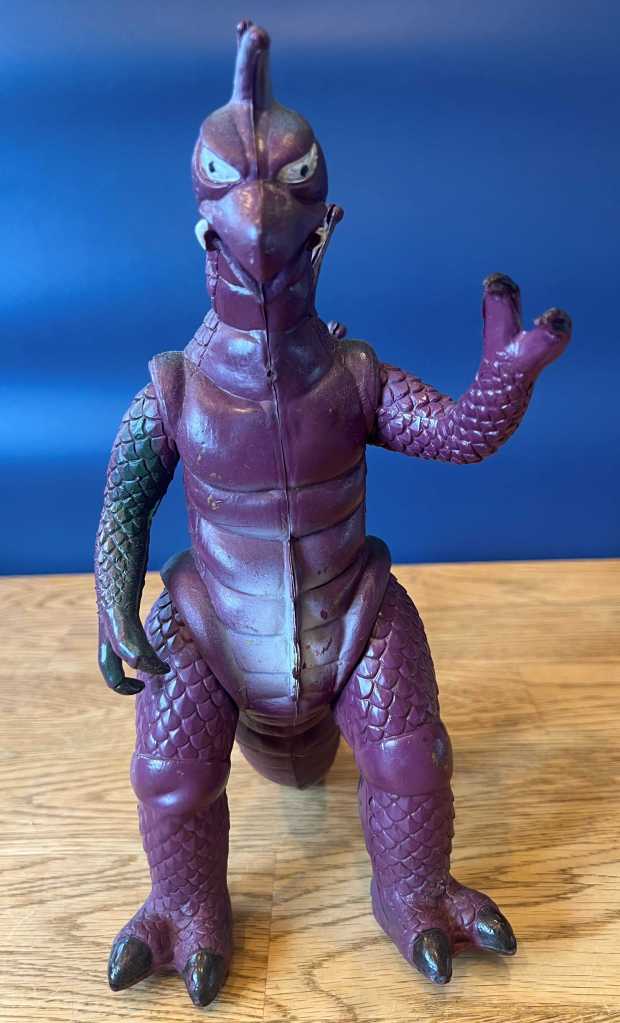
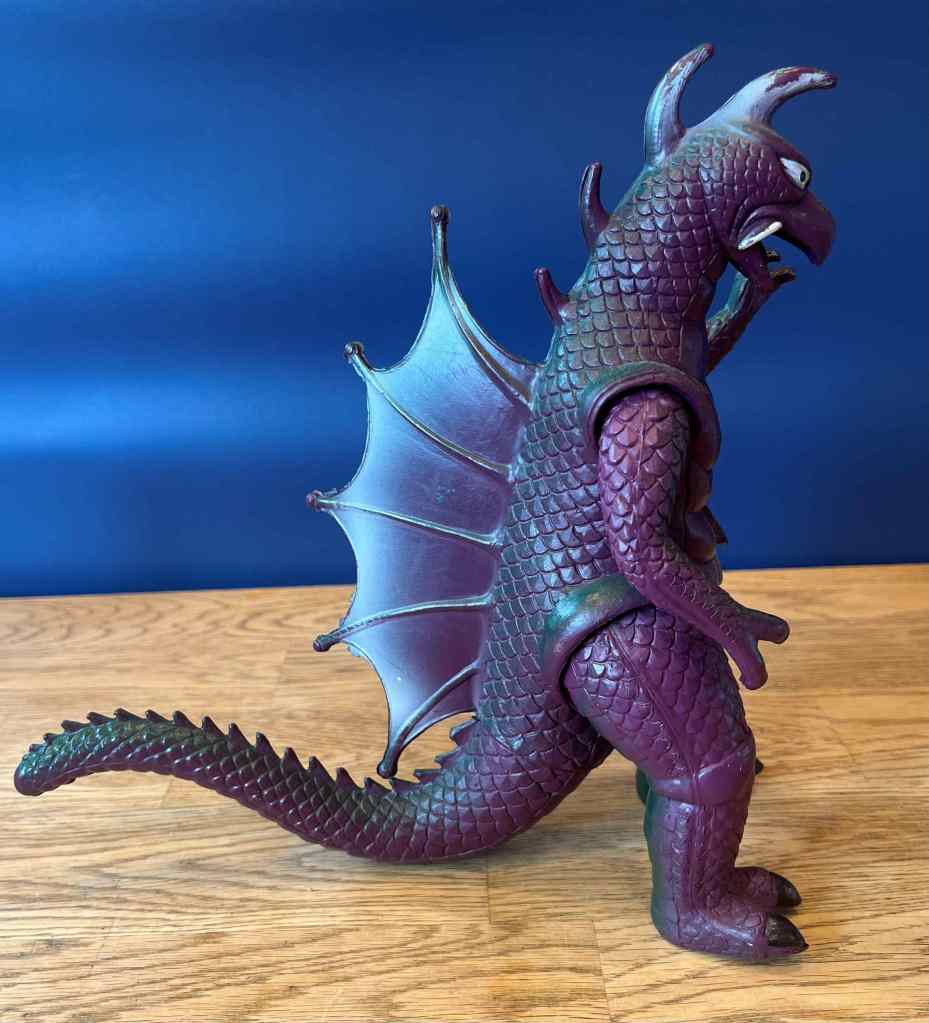
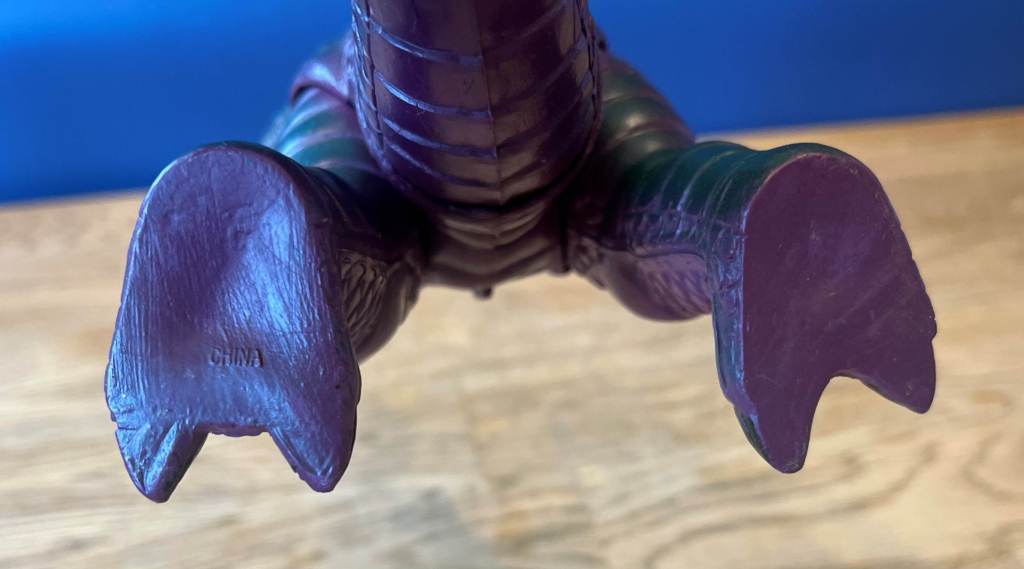
In addition, I know of a few examples with this expanded to a “MADE / IN / CHINA”, and even fewer with “MADE / IN /HONG KONG” under its foot instead, which in the case of the former look very much like the marks of the Hong Kong-made Godzilla bootlegs noted immediately above.
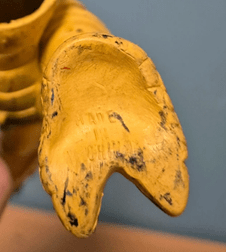
(This image from a Vinted listing)
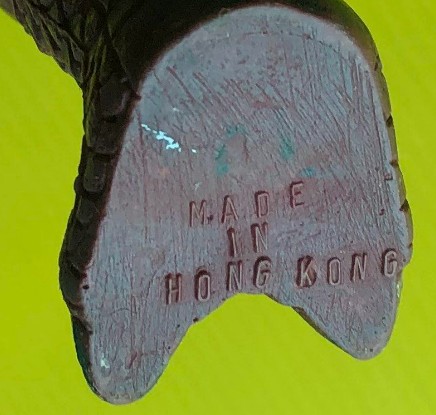
(This image from an old Carousell listing)
This was made in hard vinyl, stands just under 225mm. high, and weighs 288g. The articulation is the same as the same company’s ‘Godzilla’, but the scales have been remodelled into more realistic overlapping fishscale-like pattern. It has two toes, and shows some signs of residual plastic remaining from the mold-joins, but not as badly as the Imperial models. The throat is closed. They appear in blue edged with yellow-green, burgundy-red edged with green or the quite snazzy red, orange and yellow edged with green. The back fin often is folded over to one side, and this presumably was a common production defect – this is also found with chinasaurs with large dorsal fins.
(Images reproduced from the Instagram account cited below, with that collector’s kind permission)
As a final note, it is worth recording here that a grey variant one of these, with footmarks that show it was made in Hong Kong, has come to light in the collection of an Instagram user named ‘toybrut‘ (see here for the specific post). This variant is extremely rare, and was perhaps produced only in tiny numbers as an experimental batch by the Hong Kong factory.
The ‘Rodan’ bootleg
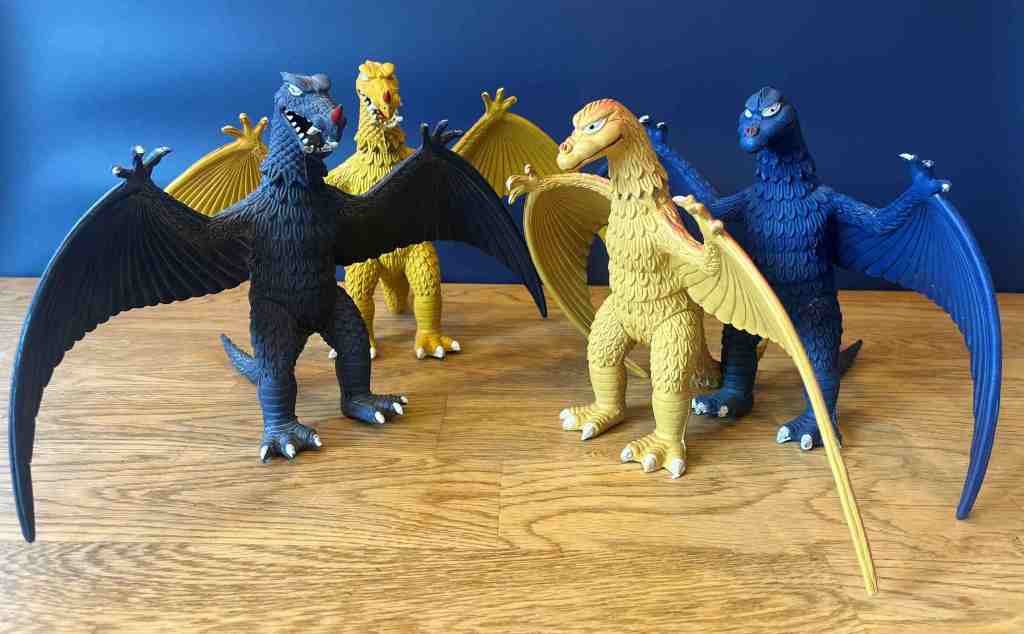
A final member of this group, the so-called ‘Rodan’ kaiju made by ‘company X’, can again be identified by the same identical foot mark: “CHINA”.
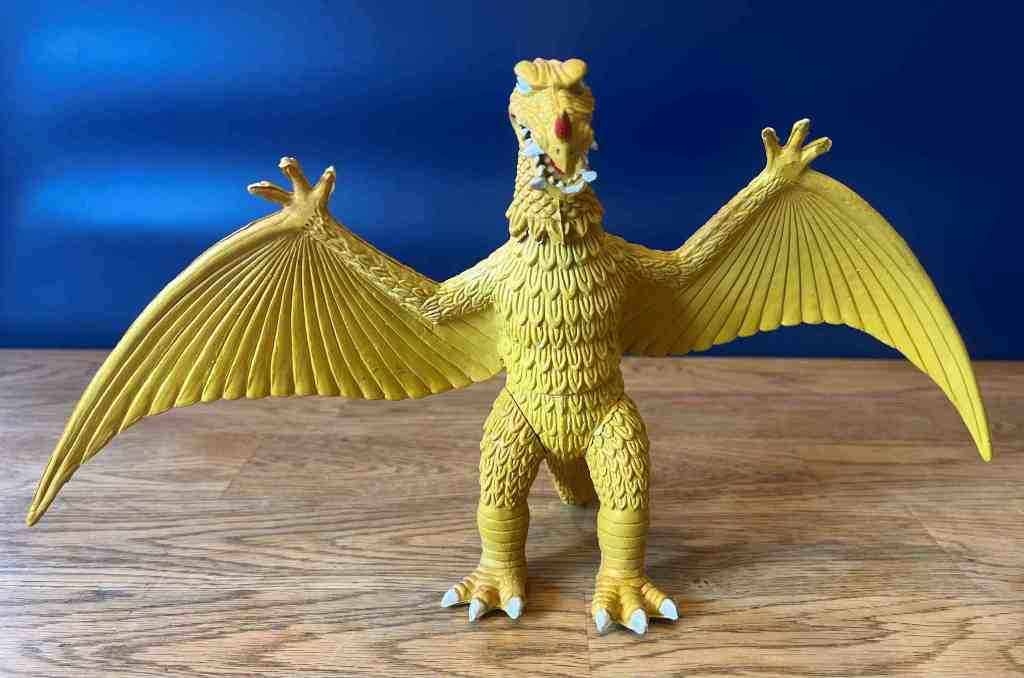
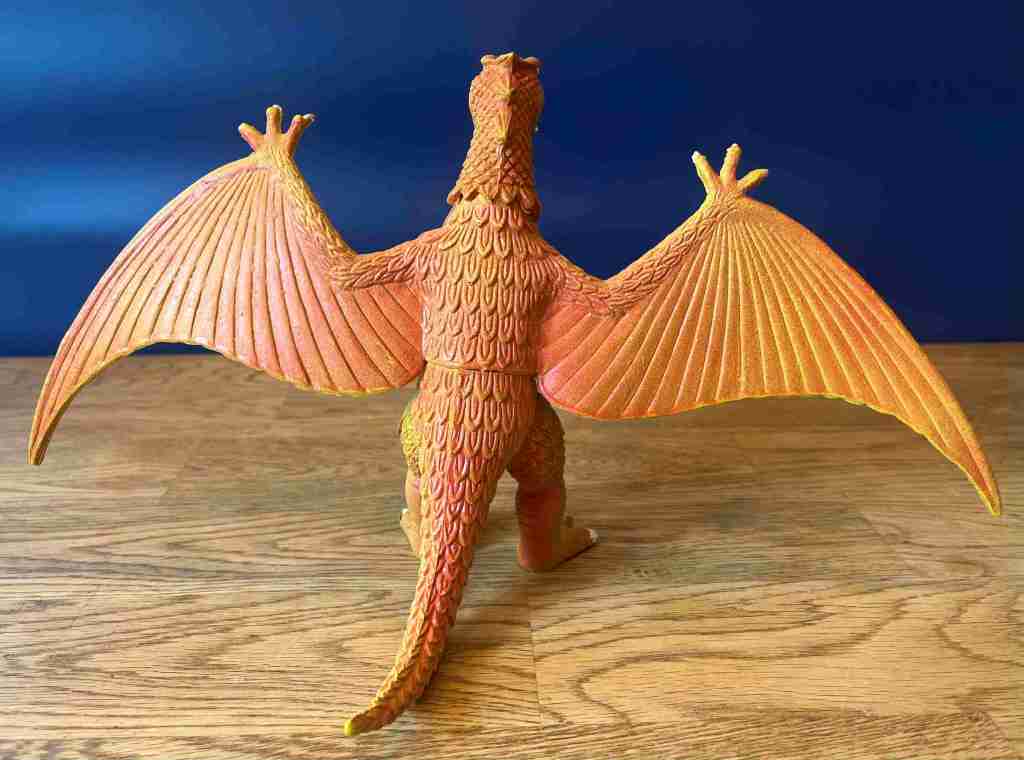
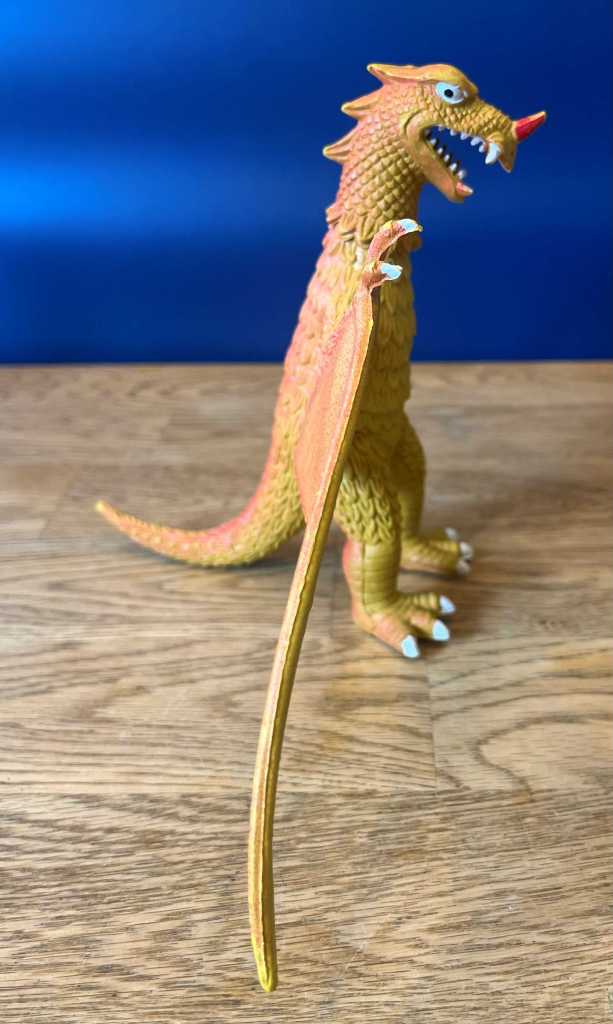
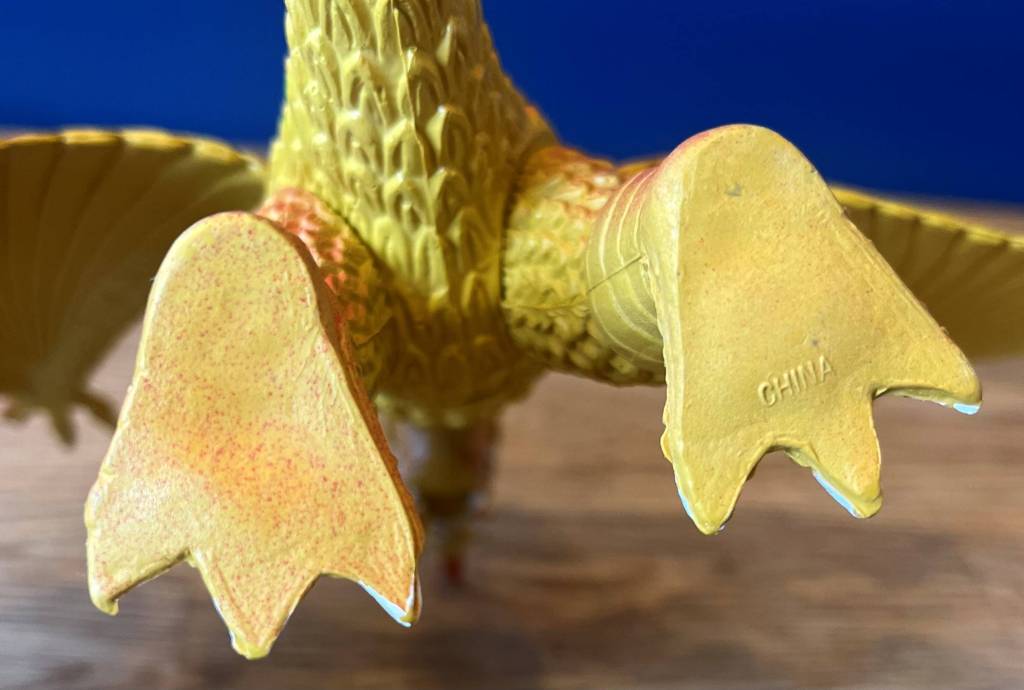
This one was also produced in hard plastic, but is smaller than the others, standing 165mm. tall, and weighing about 127g. It has wings instead of arms, and these do not articulate, and has a solid tail that does not articulate either. Instead, it has articulated legs, and a mid section and head that can revolve in a horizontal plane. It has three toes, and a scale pattern of elongated shapes marked with internal grooves to resemble feathers. The throat is closed. These come in blue or yellow colour variants, with head variants with or without open snarling or closed mouths, prominent fangs, side-facing or partly front-facing eyes, backward facing head spines and head shapes that resemble some forms of Godzilla or just perhaps the monster from ‘The Giant Claw’ (1957).
There have been occasional suggestions (mostly in online sale listings) that these were produced by Imperial, but apart from the production in both China and Hong Kong, there is little to commend this suggestion. There are few solid links between the sculpts or colour schemes, and no agreement over dimensions, and I fail to see why Imperial, having diligently marked their Godzillas with their names and copyright marks for over a decade, should run a sideline without these features.
⁂⁂⁂
⁂⁂⁂
⁂⁂⁂
The Chinese region bootlegs of these models: the copies of the Imperial Godzillas:
*Bootleg of Imperial model 1, the ‘chonky leg Godzilla’
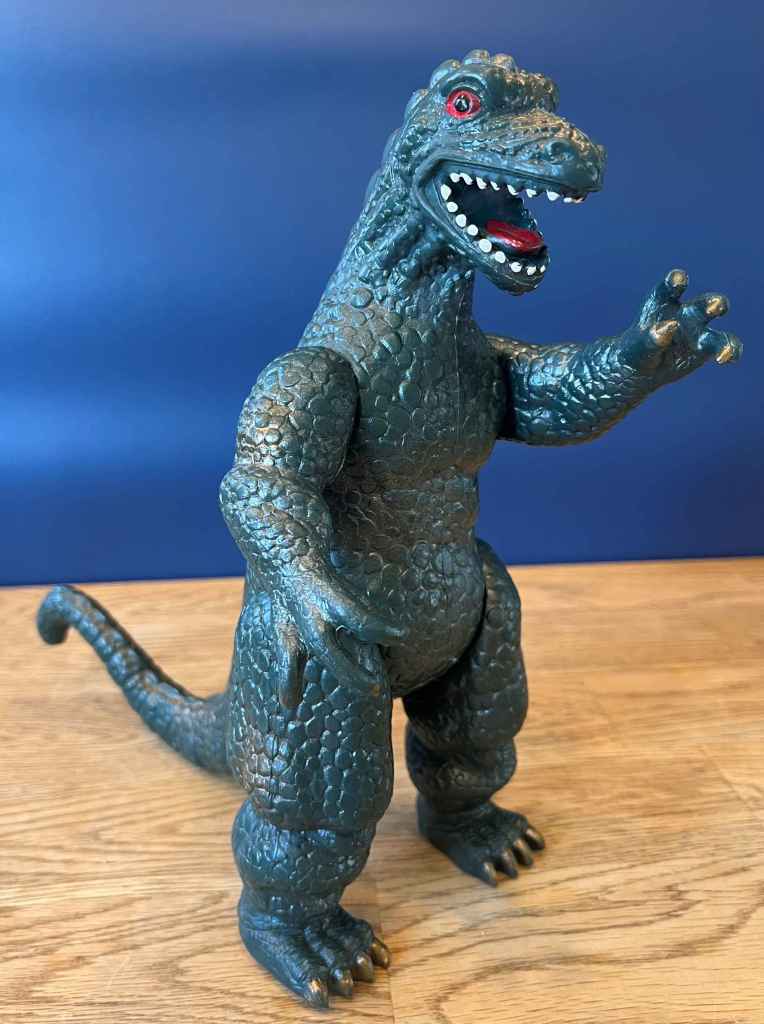
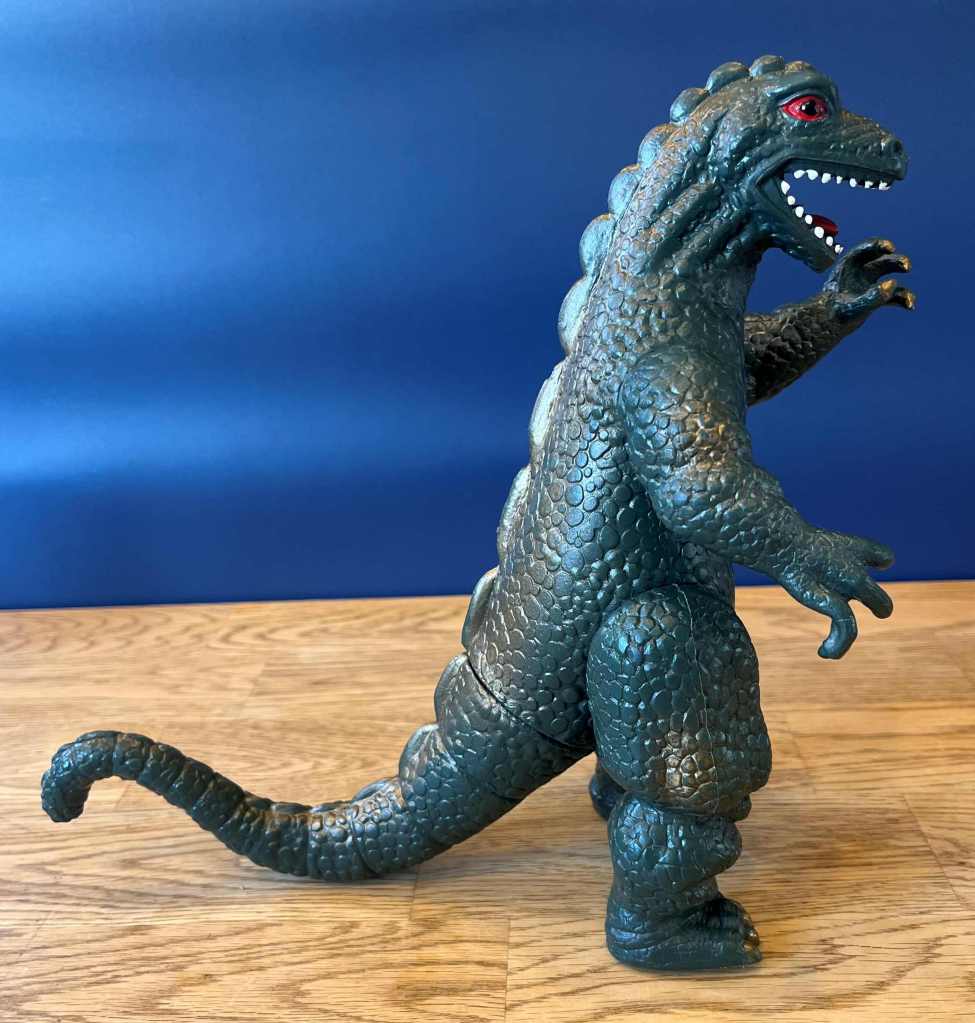
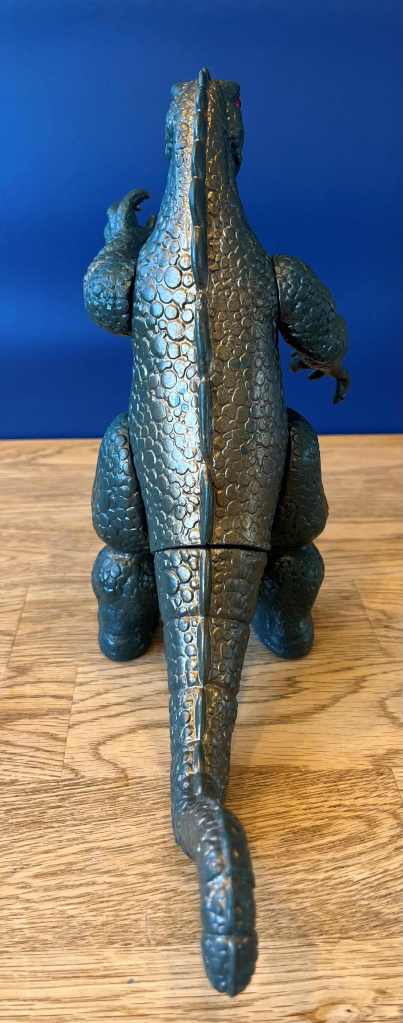
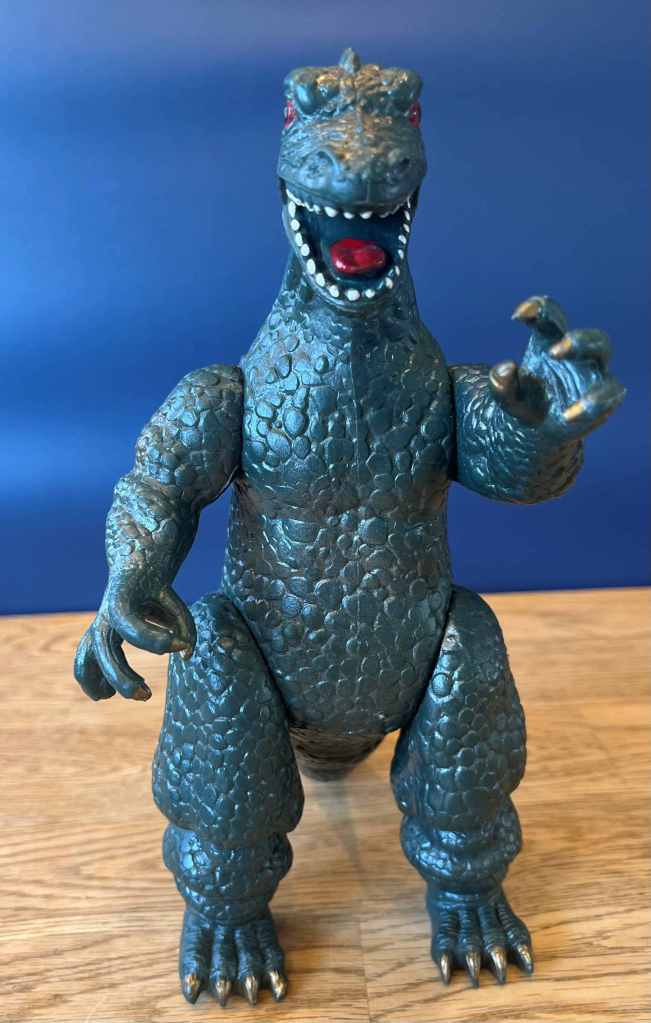
This model is made in hard vinyl, is 230mm. tall and weighs approximately 270g. It most closely resembles the secondary version of the Imperial Godzilla, with its raised head and wider open mouth, but its nostrils have been remodelled to be more lizard-like, and the spine fins of the Imperial model have been cast out in favour of the simpler ones employed by Dor Mei. The arms and legs articulate, as does the tail in a single point at its base, but the head does not (like the Imperial model). Crucially, like the Imperial model, it has four toes, which end together in a flat line. It has a closed throat, and a bulging red tongue has been added to the resculpt of the features inside the mouth. The most notable feature is that the legs, and in particular the thighs have been remodelled to try to reflect Toho Godzilla’s heavy and sagging legs.
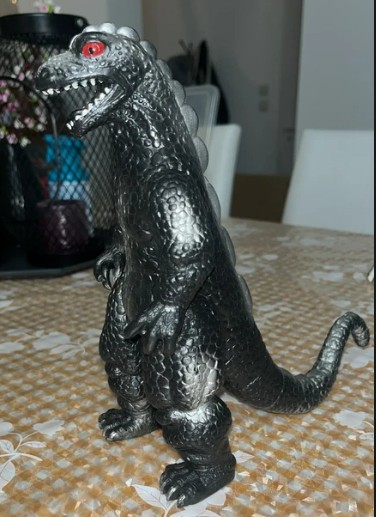
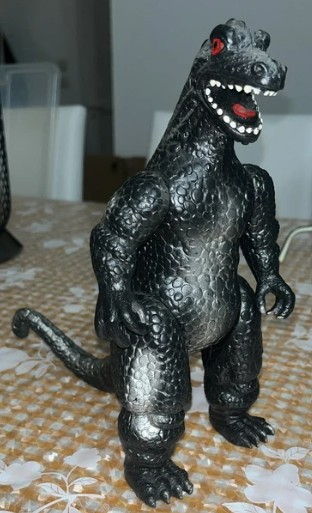
(These images from a now defunct Vinted listing)
They are commonly in green or brown with gold highlighting, and I have seen a single example in black with silver highlighting (see image above).
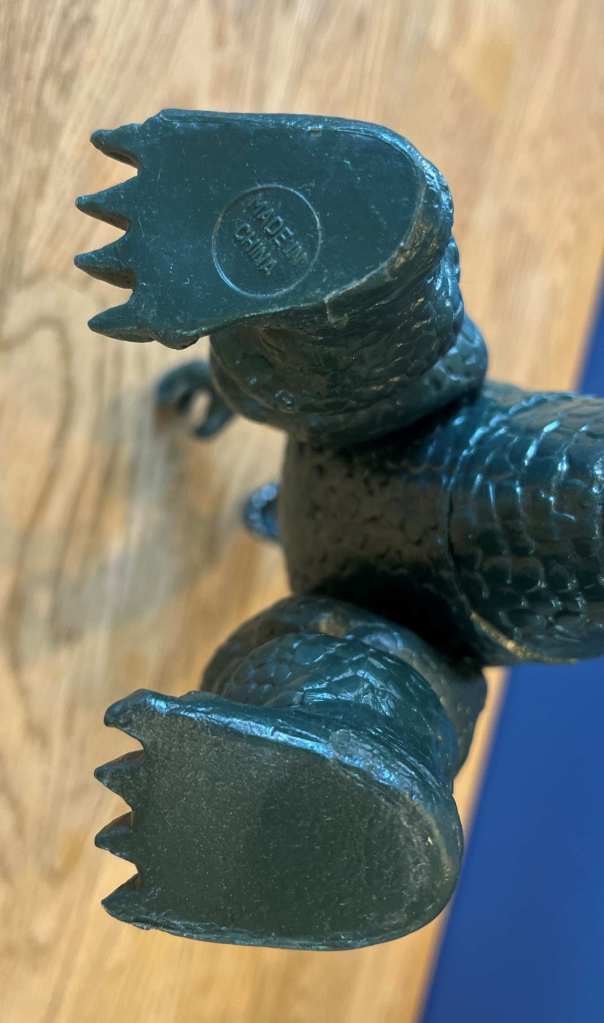
The left foot has a clear manufacturer’s mark on its sole – a “MADE IN / CHINA” within a depressed circle, approximately 13mm. in diameter. This same maker’s mark in near-identical dimensions (15mm. in diameter, and the small differences in size due to the depth to which the hot embossing tool was pressed into the sold of the foot) appears on the foot of a close copy of the Imperial Godzilla that measures 230mm. tall (my ‘Bootleg of Imperial model 2’ below), and the two must have been produced by the same Chinese bootlegging company.
The closeness to the secondary Imperial model in this ‘chonky leg Godzilla’, as well as the lack of articulation in the tail causes us to place this model’s production in the second half of the 1980s.
*Bootleg of Imperial model 2, ‘the second spotty finned Godzilla’
This bootleg exists in two close variants: a common one with four toes and a rarer one with three. We shall deal with the more common four toed variant first.
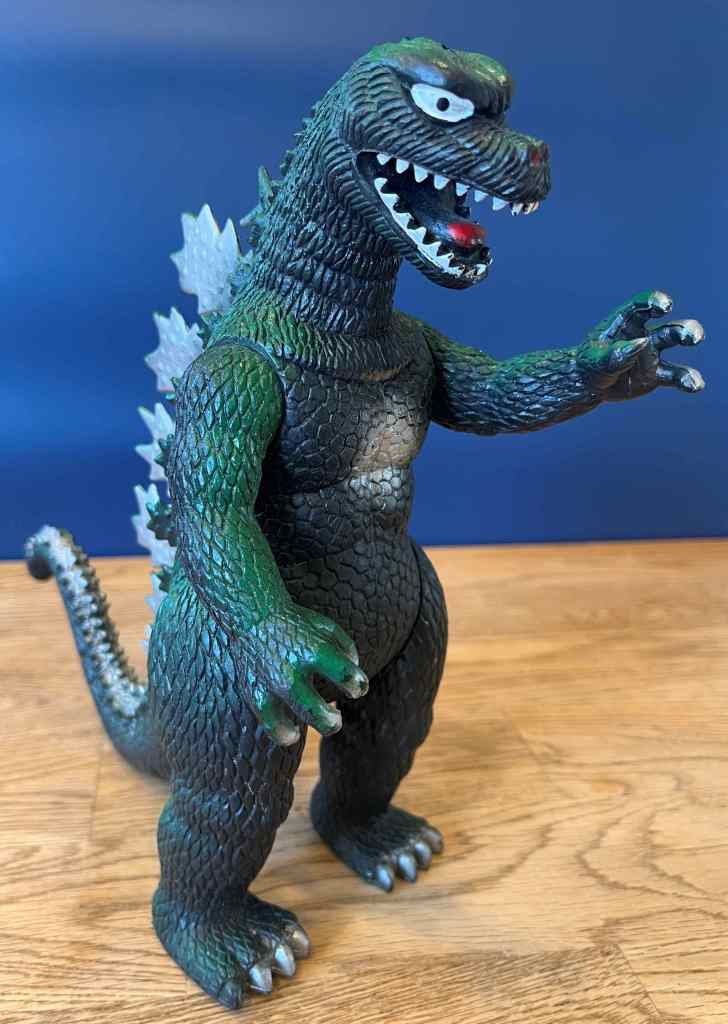
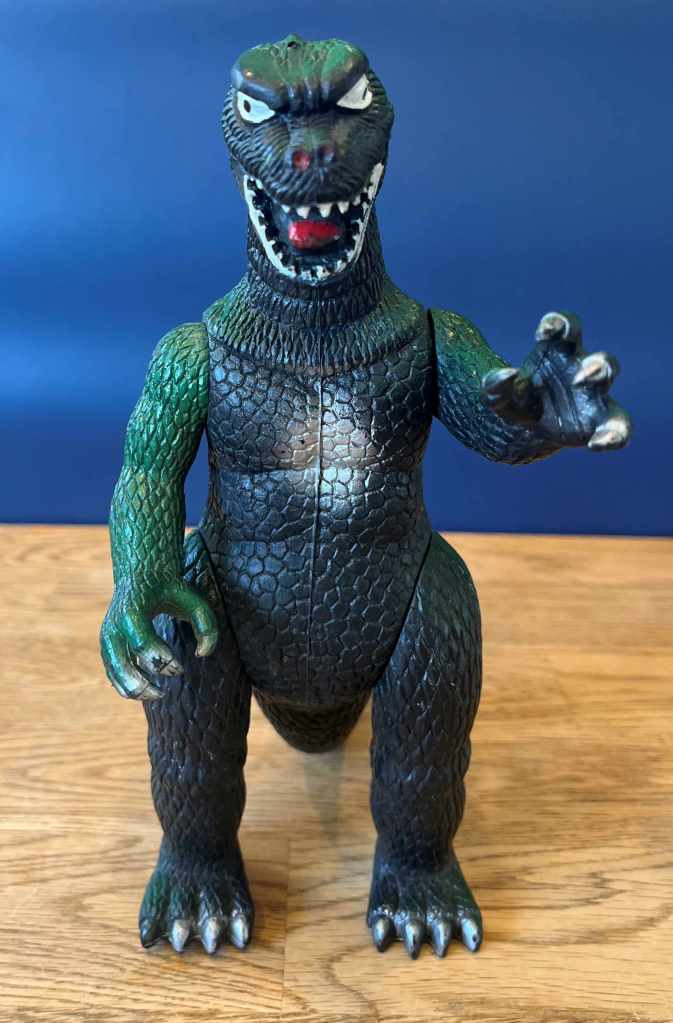
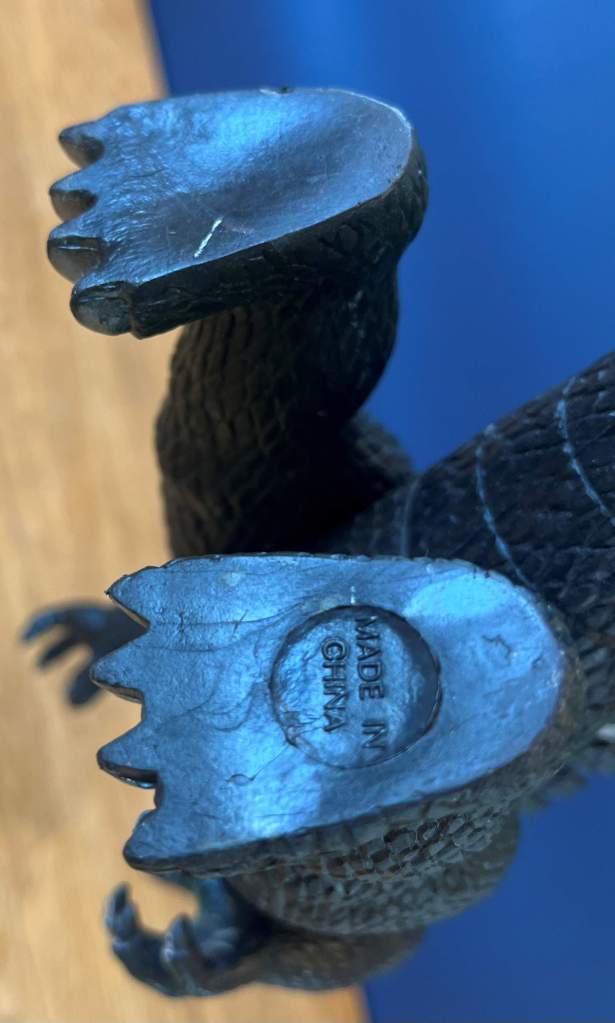
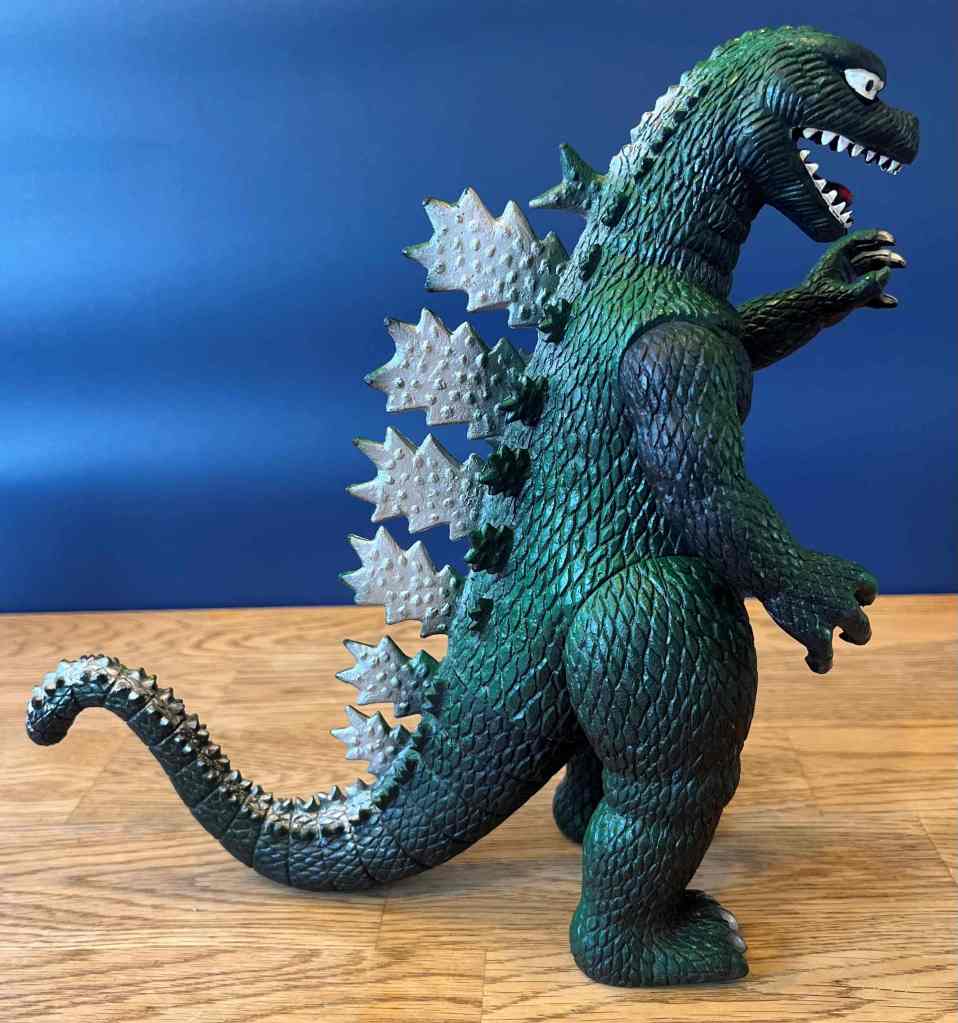
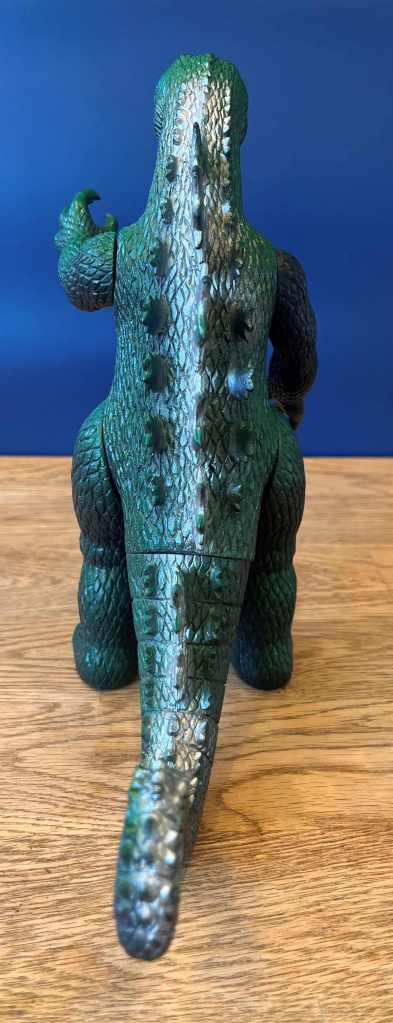
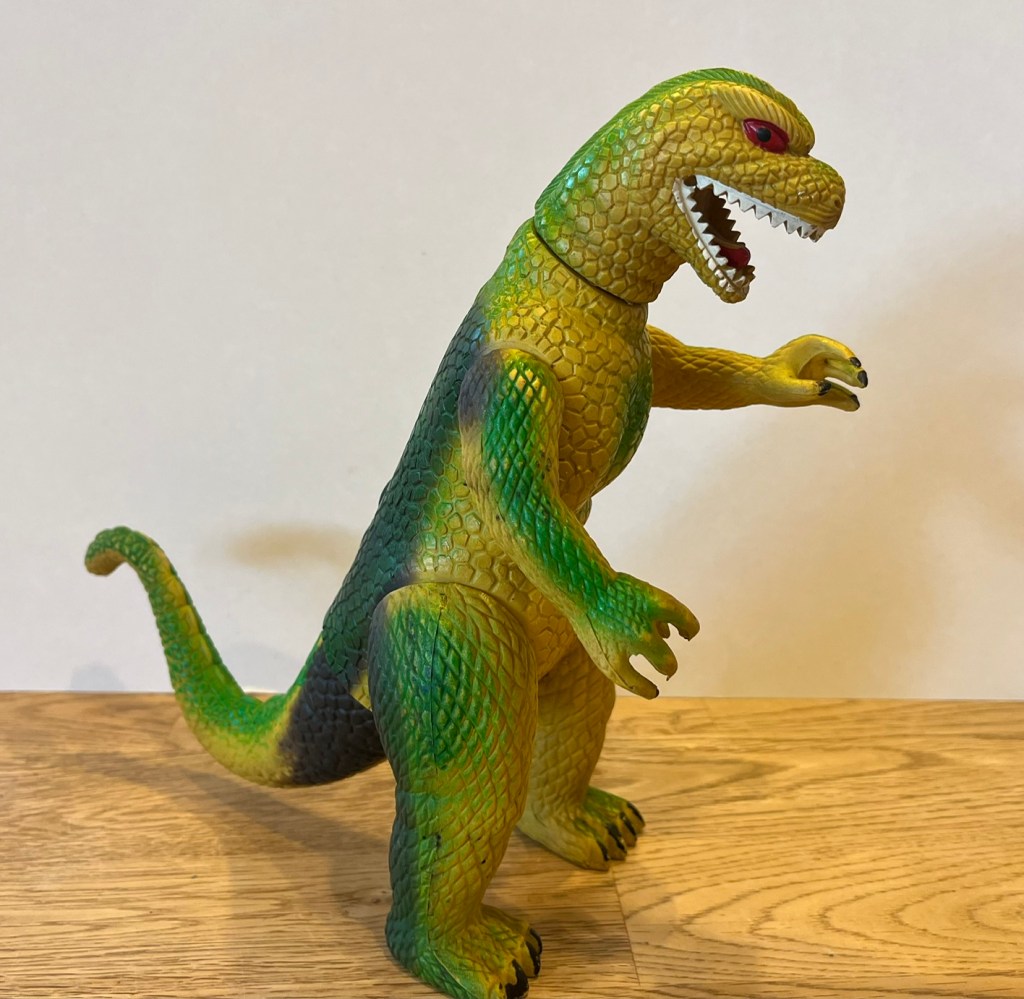
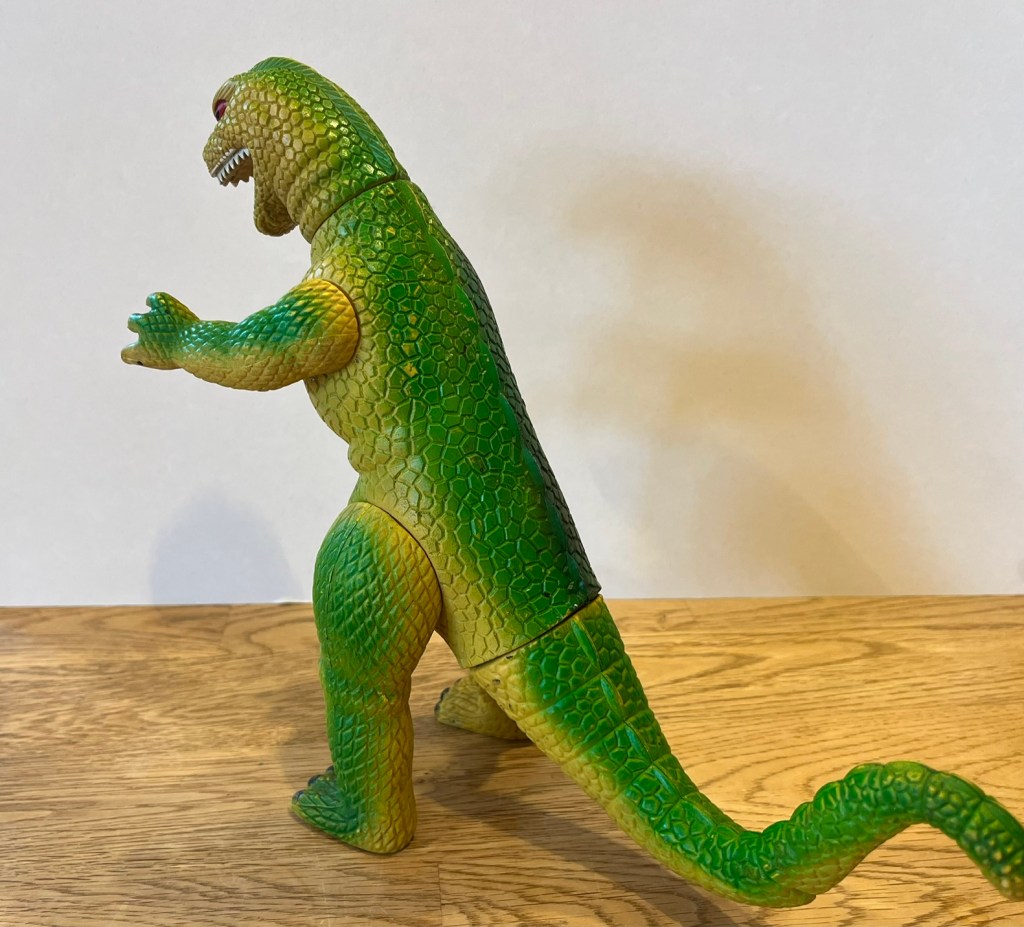
This bootleg is a close copy of the updated model of the Imperial Godzilla, in hard plastic, and measures 220mm. (approximately 8 and 3/4 inches tall), and weighs about 72g. The face has been very slightly remodelled to give it staring eyes and an almost smiling mouth that is a little creepy when combined with the eyes. In addition, while the throat is closed, a bulging red tongue has been added to the sculpt inside of the mouth just as with the ‘chonky leg Godzilla’. While the spine fins and their prominent dots have been carefully copied from the later Imperial minis, the dots are now no longer in neat rows, and the fishtail-like uppermost central fin of the earlier Imperial figure has been brought back (this either from the influence of the earlier Imperial model of through this fin being part of Toho’s design of Godzilla from 1955 onwards). However, great care was taken to copy the colour scheme, scale pattern and articulation points of the later Imperial model mini, and some features such as the well defined triangular teeth are perfectly copied. The distinguishing marks of this model are its size (halfway between the large and small Imperial models), the facial remodelling and the spine-fins that have parallel rows of raised dots along them.
These have the same “MADE IN CHINA” marks within a circle on the sole of the right foot as my ‘big leg Godzilla’ bootleg immediately above, and these marks are of near-identical size. They must, therefore, be a product of the same anonymous company, here apparently trying to sneak into the Imperial Godzilla market with this similar ‘cuckoo in the nest’. Interestingly, my copy (like others) has another, very faint and half erased mark under its left foot: a “MADE IN CHINA” positioned so that the text sits underneath the toes, with its top towards the inner part of the foot, and its bottom towards the toeline – this will become relevant in the next entry, the ‘three-toed copy of the second spotty finned Godzilla’.
As with its ‘sister model’ we must place this model’s production in the second half of the 1980s, perhaps stretching into the early 1990s.
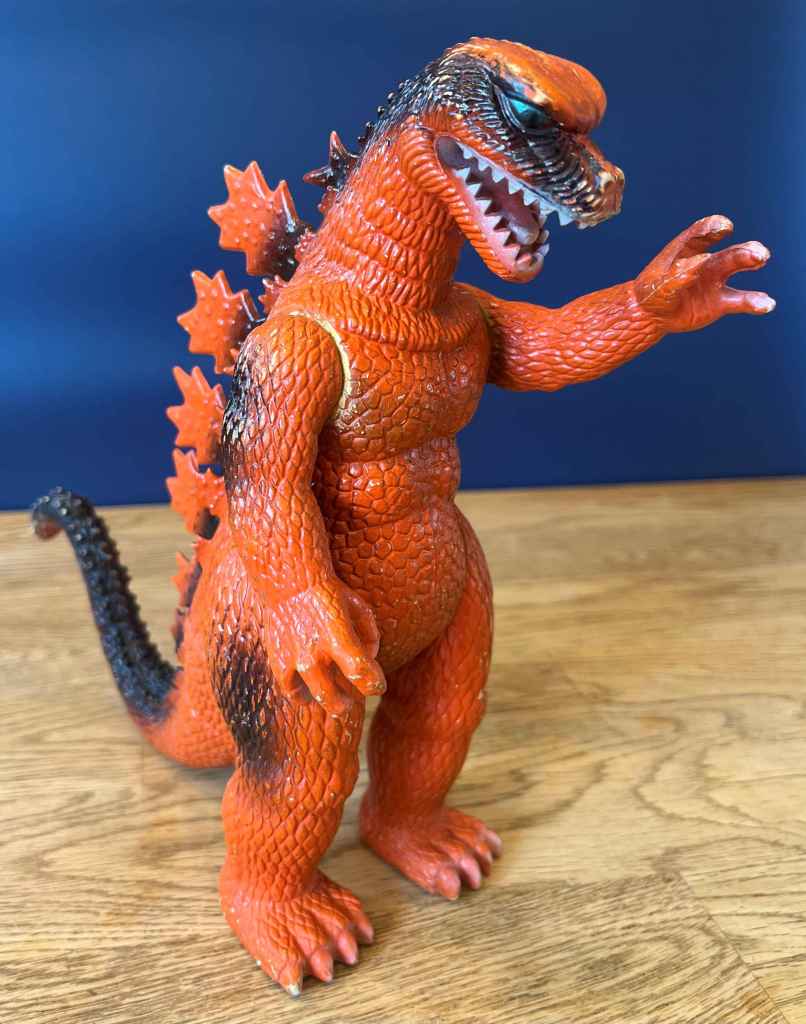
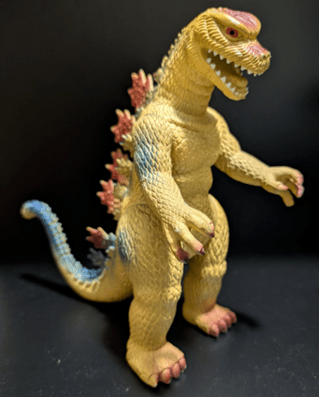
In addition, some examples exist in pale yellow with red and metallic blue highlights, or brown or bright orange with black or silver highlights. The colours of the last two of these were often crudely painted over flesh-coloured plastic (presumably as this was cheaper than sourcing materials in the desired base colour), and the base colour is often visible at the arm joints and at any scuff sites. These models, while clearly of identical form to the green ones, have no marks on the soles of their feet known to me, and the sole example I own (a bright orange model shown here) as well as the yellow model shown above in a private collection in the US, are slightly shorter than the green ones (standing 10mm. shorter).
Interestingly, their choice of colour scheme seems to closely follow the colour changes of the later models of the Imperial mini design, which appeared in similar browns and oranges. This seems to indicate the rapid flexibility of the bootleg producers, responding to new trends within their models quickly and without much apparent effort, in order to continue to sneak their products into the legitimate Imperial supply chain.
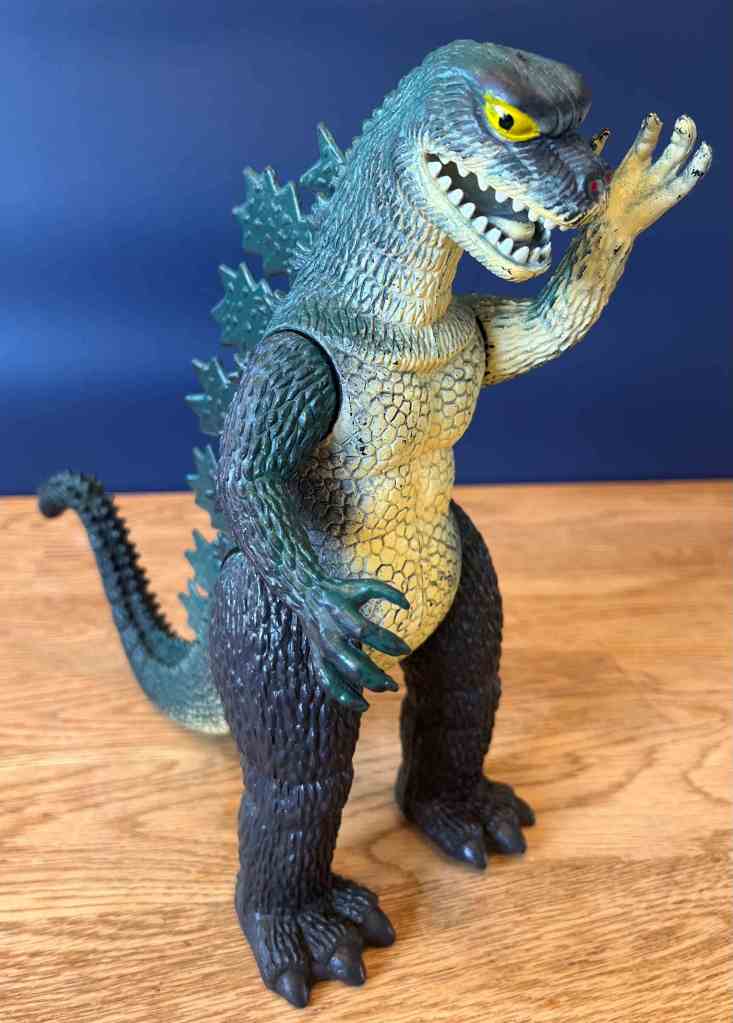
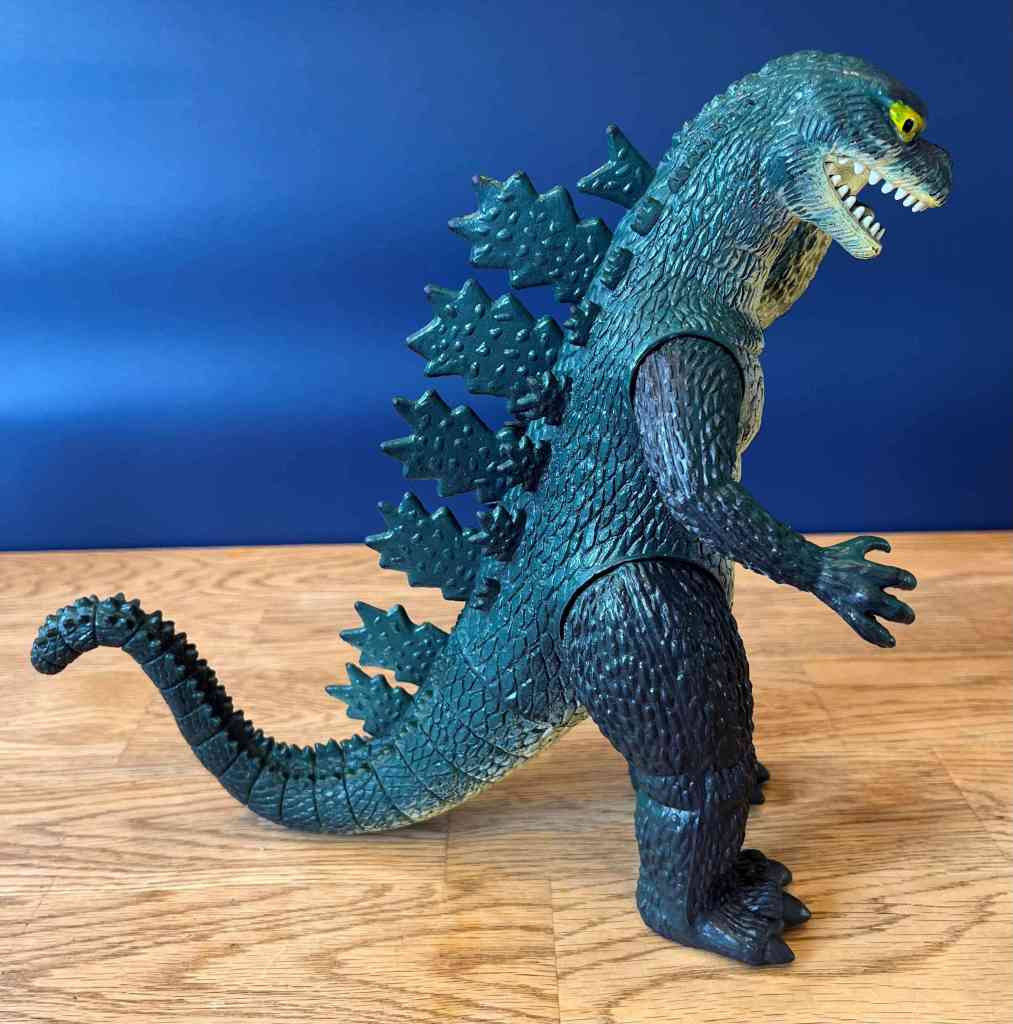
Now we turn to the three-toed variant of the same bootleg. It was made in the same material, has the same approximate dimensions (measures 220mm. tall) and articulation as its ‘sister-bootleg’. Its principal differences are:
1. the legs and feet, which have been changed from the earlier four-toed form to a three-toed form – and in fact, this has been achieved by using legs identical to those of the ‘company X’ bootleg with their “CHINA” or an expanded “MADE IN CHINA”, and these are most probably legs actually produced by ‘company x’ or from their molds;
and 2. the colour-scheme, which has now become a dark green with cream shaded underbelly, or purple-burgundy with black and silver highlights. These may exist in further colours, but the figures are rare, and I welcome any contact with a collector who has one of these, to compare notes.
It seems most likely that here we have the same model as the green four-toed variant discussed immediately above but with the addition of legs made by ‘company x’ for their Godzilla bootleg or from their molds. As noted above, one of the novel colour schemes of the three-toed variety here links it to a rare and apparently late version of the ‘company x’ bootleg, and might suggest direct contact between ‘company x’ late in its production run with the bootleggers in question here, or that an offshoot of ‘company x’ established that form of contact, or that the bootleggers in question here obtained a number of sets of legs or a set of molds from ‘company x’ and borrowed the colour scheme of a late model as well. Any of these are possible.
*Bootleg of Imperial model 3, the ‘Wattle-asaurus’
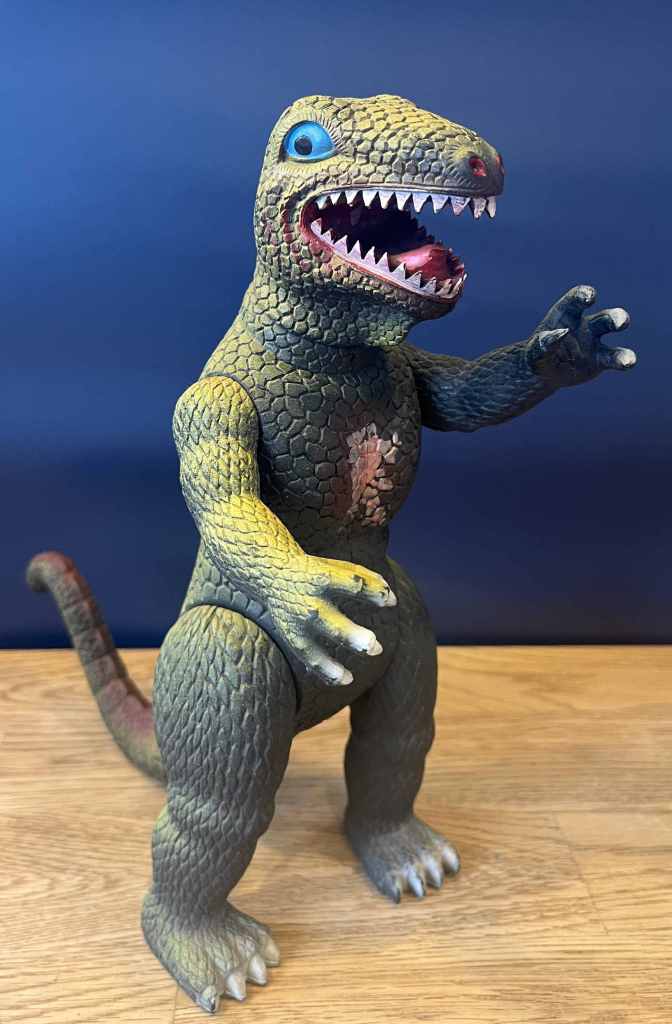
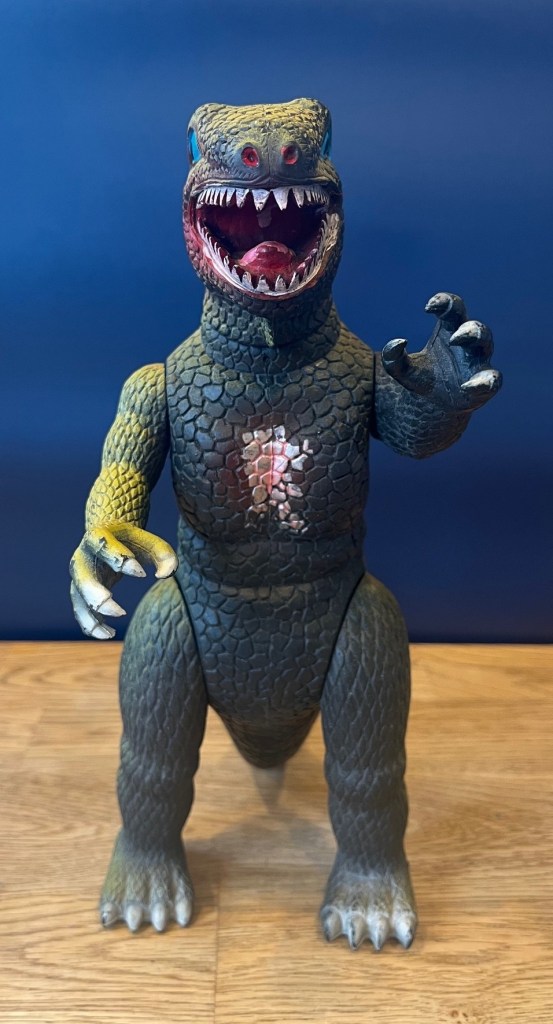
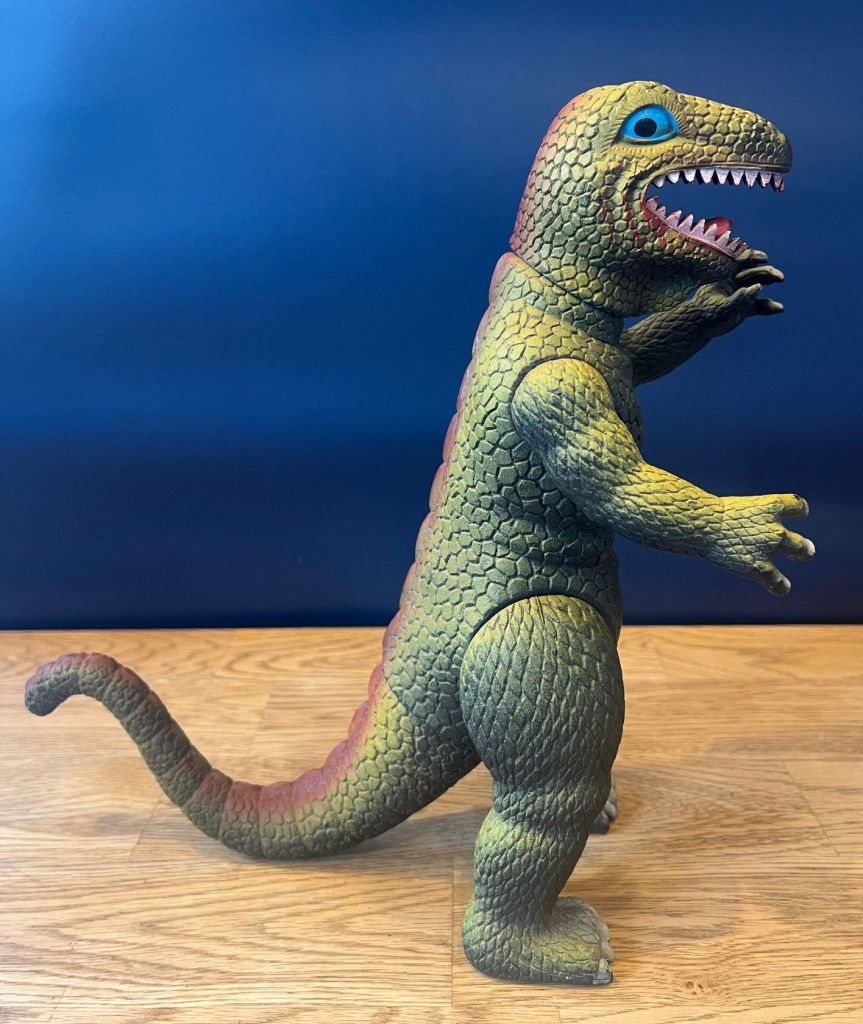
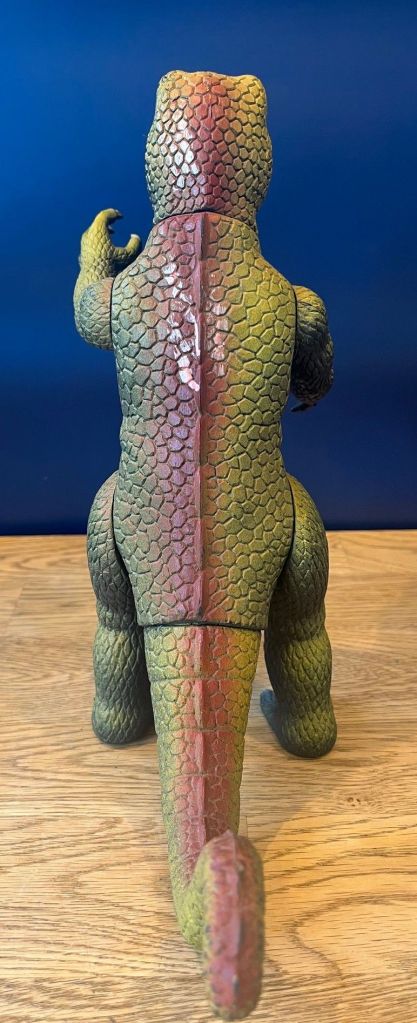
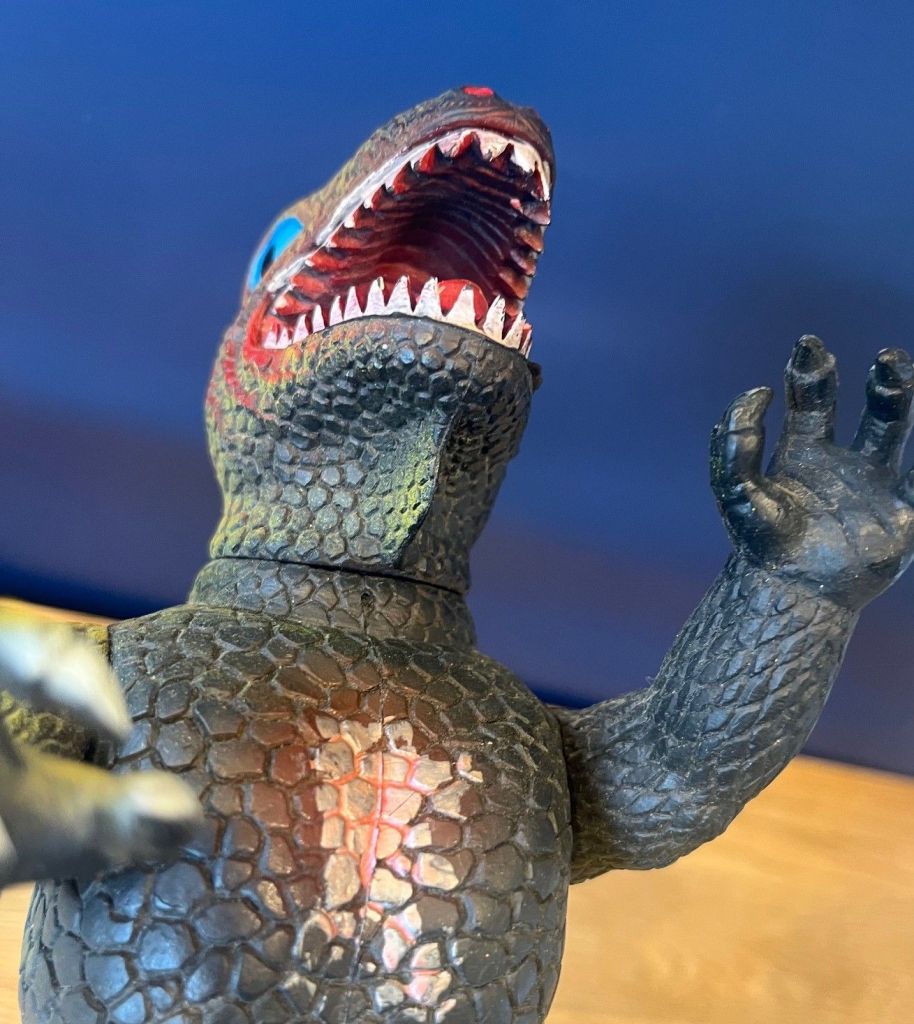
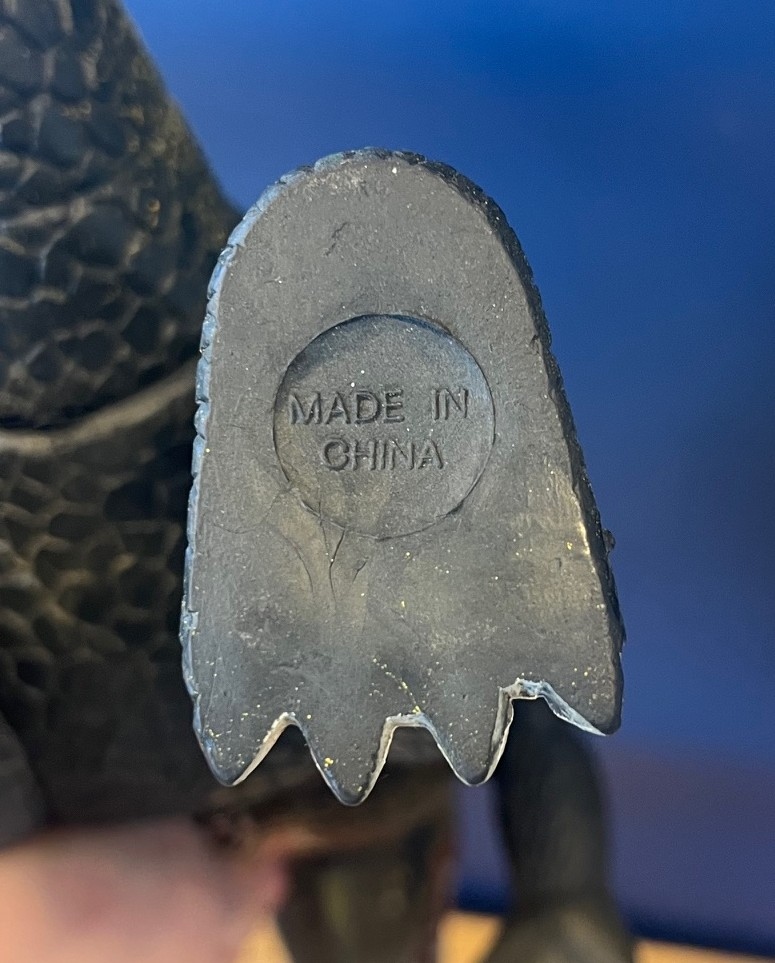
The figure is 245mm. tall and weighs about 300g., and was produced in black plastic, sprayed light green everywhere except the stomach, with a deep red used to highlight the spine-fins. A splash of metallic silver and pink is found in the centre of the chest, and perhaps accidental brushstrokes in the same are found on the back of mine. It reuses the general form of the body, arms and tail produced for its sibling: the ‘second spotty finned Godzilla’, except that it is a little taller (about 15mm. so), the spine-fins have been reduced to a series of small bumps (like in the Dor Mei models), and the scale-pattern found on the front of the ‘second spotty finned Godzilla’ has now been extended around the back, over the head and down the tail (the legs remain in the same scale-pattern as the ‘second spotty finned Godzilla’). A new more realistic dinosaur-like head has been added, with enlarged eyes that are painted bright blue. The head, unlike with its siblings, articulates. The same bulging tongue is present as with its siblings, and its most prominent features are delicately delineated eyelashes and a large and thin neck-wattle that makes me think of Chinese-produced toy dinosaurs such as this below:
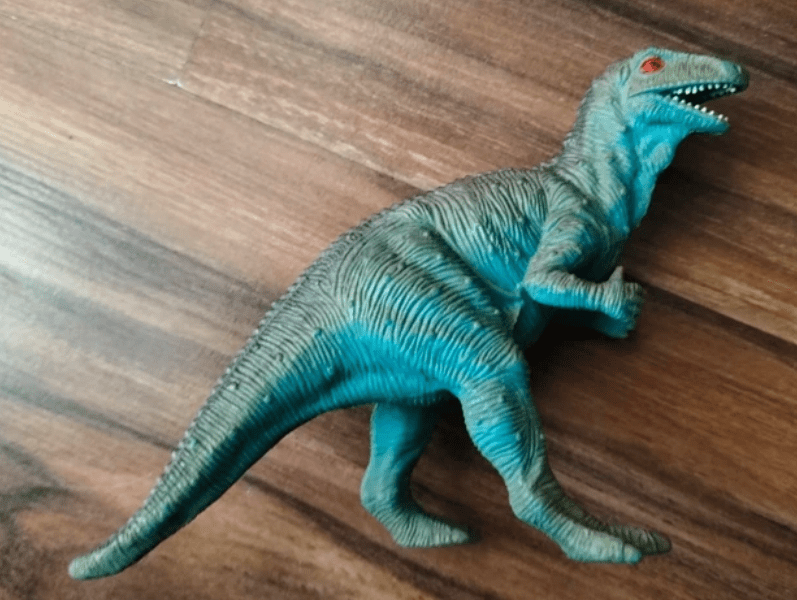
(This Allosaurus toy with a close head-sculpt, by an unknown – at least to me- Chinese manufacturer; this image from a Vinted sales listing)
These are far rarer than the other two in this group, and I only know of two examples (correction: now three examples: see below), one in a Mexican collection and mine. I managed to acquire mine from the Phillippines through the kindness and diligence of the seller (Mini Mayhem on Facebook – as highly recommended as I can). Like both its siblings, all examples known to me have the distinctive “MADE IN CHINA” marks within a circle (14mm. diameter) on the sole of the right foot, and mine has the same faint and half erased “MADE IN CHINA” on the sold of the left foot (positioned exactly like the second mark on my own example of ‘second spotty finned Godzilla’ discussed above).
These were, most probably, produced side-by-side with the ‘second spotty finned Godzilla’, as an attempt to enter the lucrative market for more realistic dinosaur toys dominated in China by Imperial, Dor Mei, AAA and others.
Addendum:
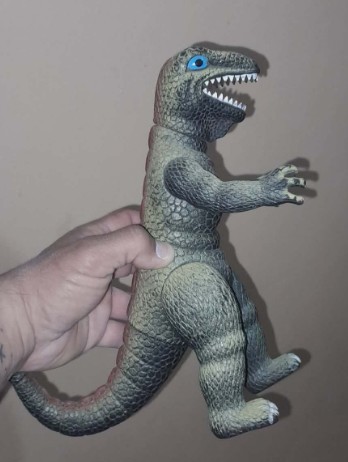
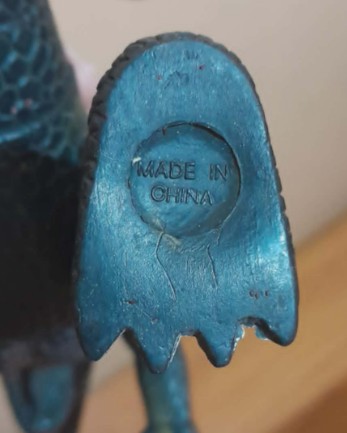
(Images of the newly discovered example in Chile: these pictures reproduced with the owner’s permission)
Having posted this blog, a third example of this rare bootleg came to light in the collection of Cristian Fabian Barrientos Candia in Chile – I owe him warm thanks for bringing this glorious Godzilla to my attention.
*Bootleg of Imperial model 3A, the ‘Teef-zilla’

Just when you think you are done with a group, another new member pops up on eBay – forcing you to create subnumbers 😉
This figure stands some 230mm. tall, and weighs 288g. It is made from hollow vinyl, and articulates as the last two bootlegs described above (including at the neck). The presence of the by-now familiar “MADE IN / CHINA” within a circle stamp underneath the left foot (with another blank circle of the same dimensions under the right foot) shows that it was produced by the same bootleggers as the last three figures describe above – and close examination shows that this one shares its general body type with the ‘second spotty finned Godzilla’ (but with the semi-circular roll of flesh at the neckline removed – that in itself inherited from the Imperial model), and legs with the ‘Wattle-asaurus’.
Despite placing notes online on Instagram and Facebook asking for people with any other example to get in contact, this one is still known to me in only this example.
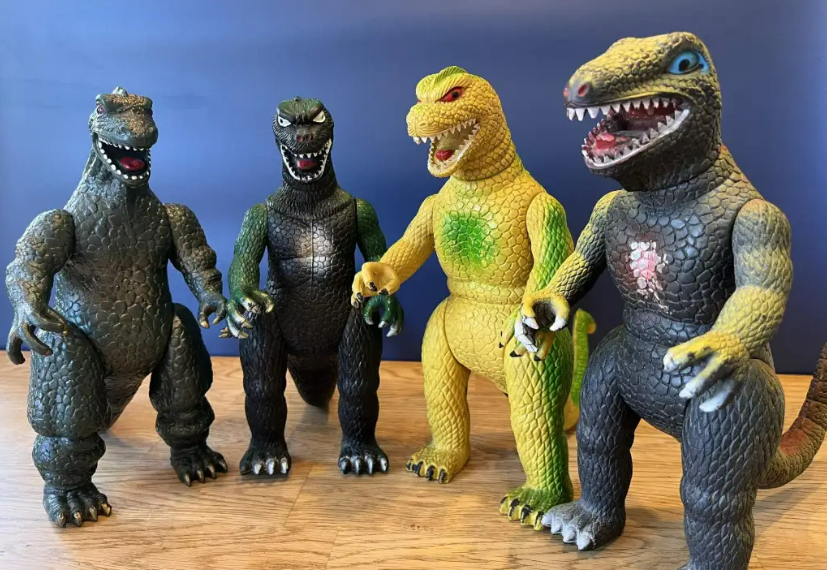
(Family portrait! All the siblings in this group, together)
I have written a blogpost just on this newly discovered bootleg, and readers are directed there for more images and detail.
*Bootleg of Imperial model 4, the ‘Yongary-Chinasaur bootleg’
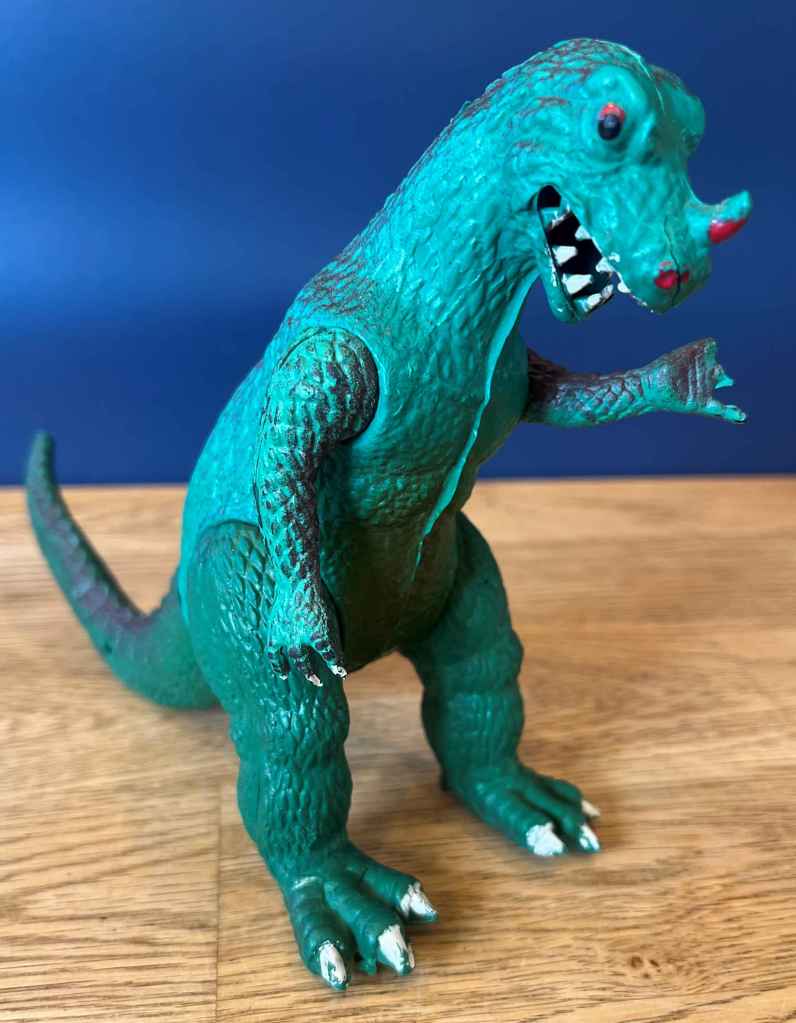
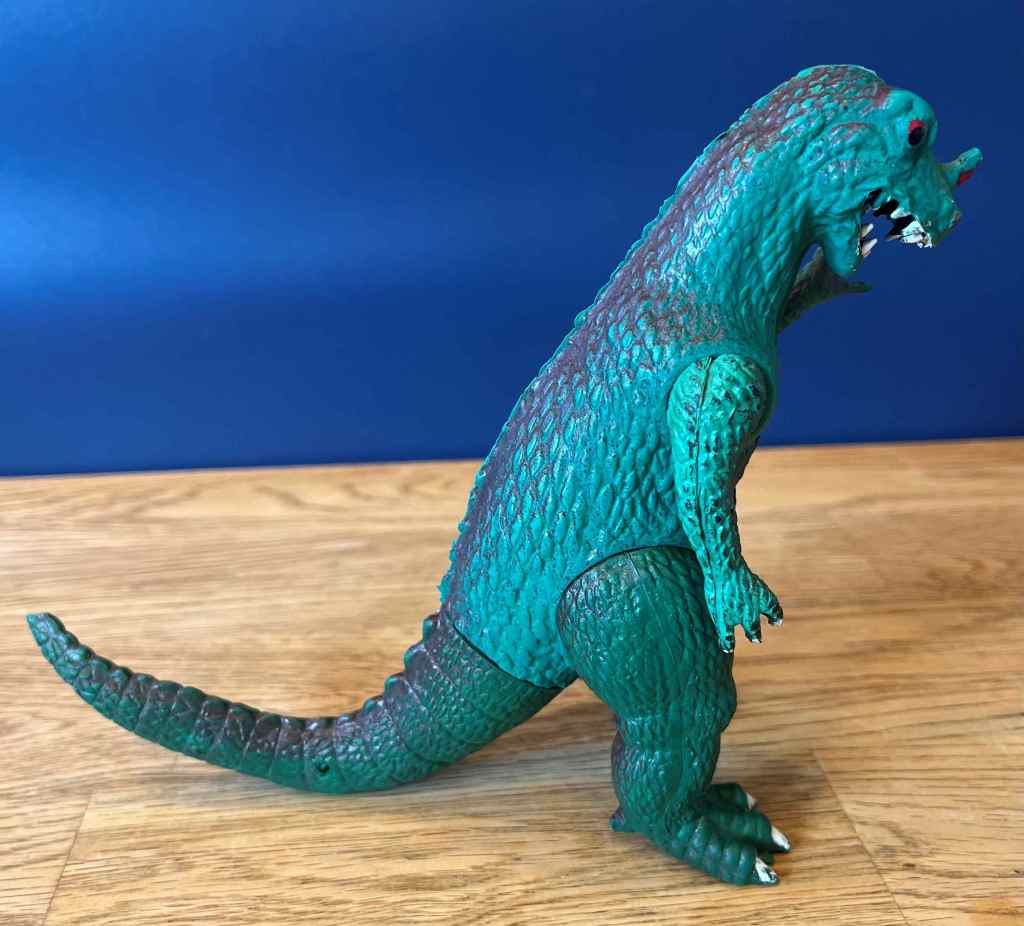
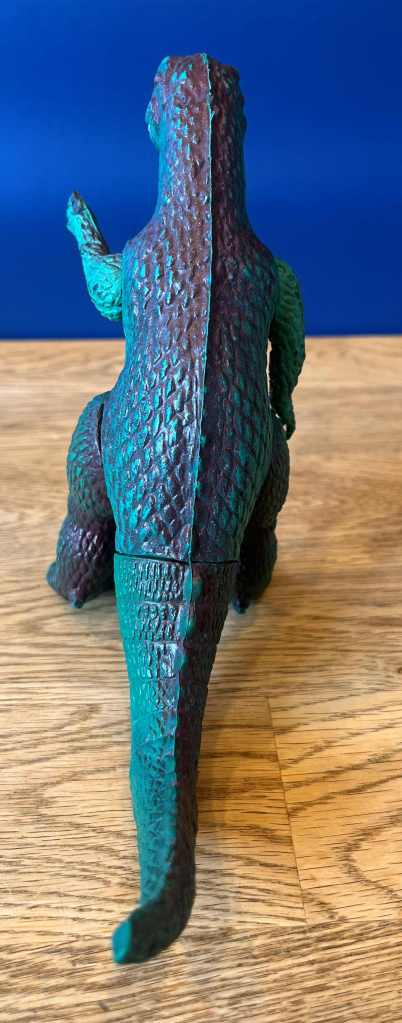
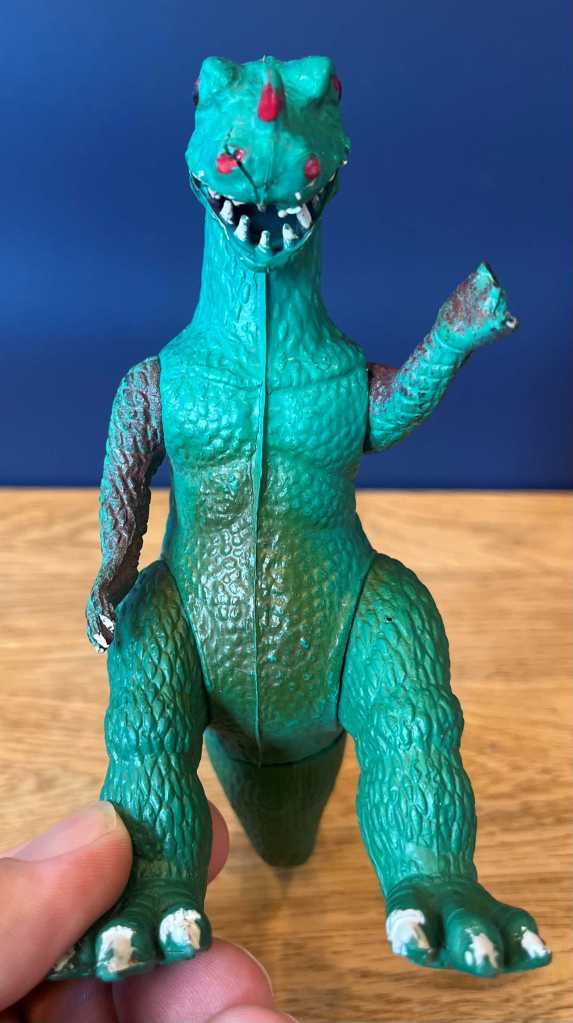
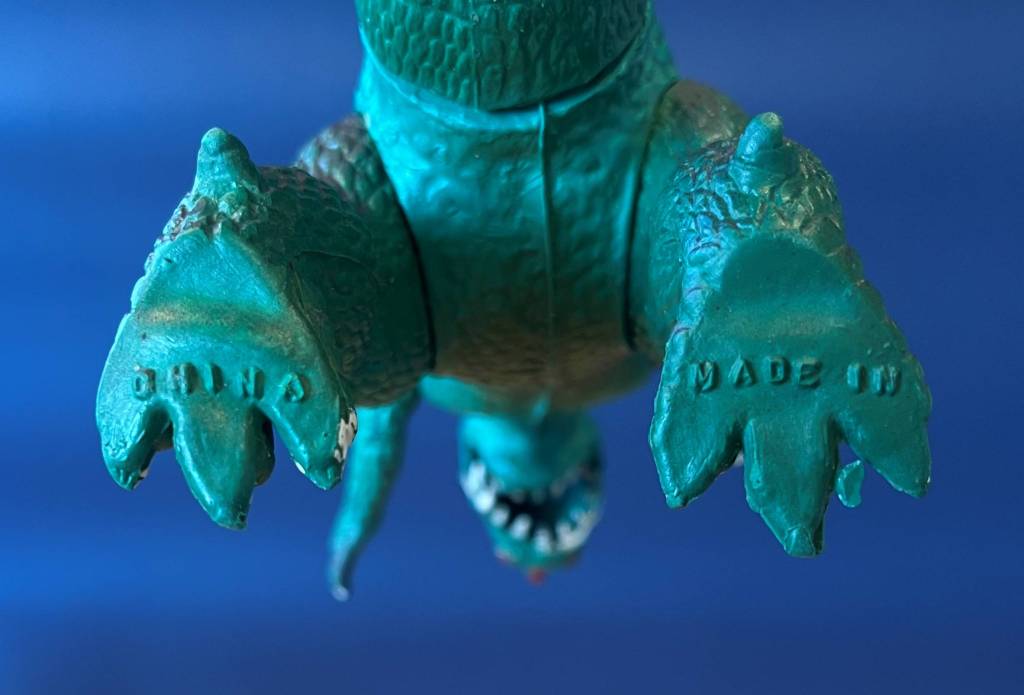
There are a large number of cheap plastic Chinese chinasaurs that sit somewhere between a clunky Tyrannosaurus Rex and Godzilla (with a subset of them with spurs behind their feet as here, these spurs following contemporary plastic toys of T-Rexs), and most of these have been set aside here as they do not show sufficient links to any of the main Godzilla bootlegs. However, one stands out from that crowd as clearly produced with either the Imperial figure or the ‘second spotty finned Godzilla’ (*Bootleg of Imperial model 2 above) as its partial model. Most importantly, this bootleg has a pronounced semicircular fold around the front of its neck following the line of its collarbone (if it had one), that must be due to casting that part of its body at least from the Imperial model or one of its bootlegs. I am in two minds as to whether this warrants inclusion here, but let us err on the side of caution.
It stands about 135mm. tall, and weighs about 100g. It was produced in slightly pliable vinyl, that in places bends under the pressure of a fingertip or two. The base colour of the vinyl is a bright and perhaps even lurid green, with shading added in lavender-purple/brown, with details touched in red or white paint. In the main the body follows that of the other Chinese chinasaurs with spurred heels, but the torso does appear to have been modelled as a smaller version of the torso of the ‘second spotty finned Godzilla’, and the same scale-pattern is copied here (this not found, to my knowledge, in other similar Chinasaurs). The spine-fins are reduced to almost nothing down the back of the torso and a series of low bumps along the tail, that might resemble those of the Dor Mei models (close variants of this figure can also be found with large Stegosaurus-like spine fins). The most startling resculpt is that of the head, which steps away from the T-Rex-like heads of the Chinese chinasaurs with spurred heels, adding high eyebrow ridges and a downward pointing face that may be a nod towards other Godzilla models or bootlegs, such as the early Imperial one. At the end of the nose, the sculptor(s) added a single prominent horn that looks similar to the monster in the 1967 Korean Kaiju movie, Yongary, or perhaps a number of Chinese-made dinosaur toys.
*Bootleg of Imperial model 5, the ‘Heisei bootleg’
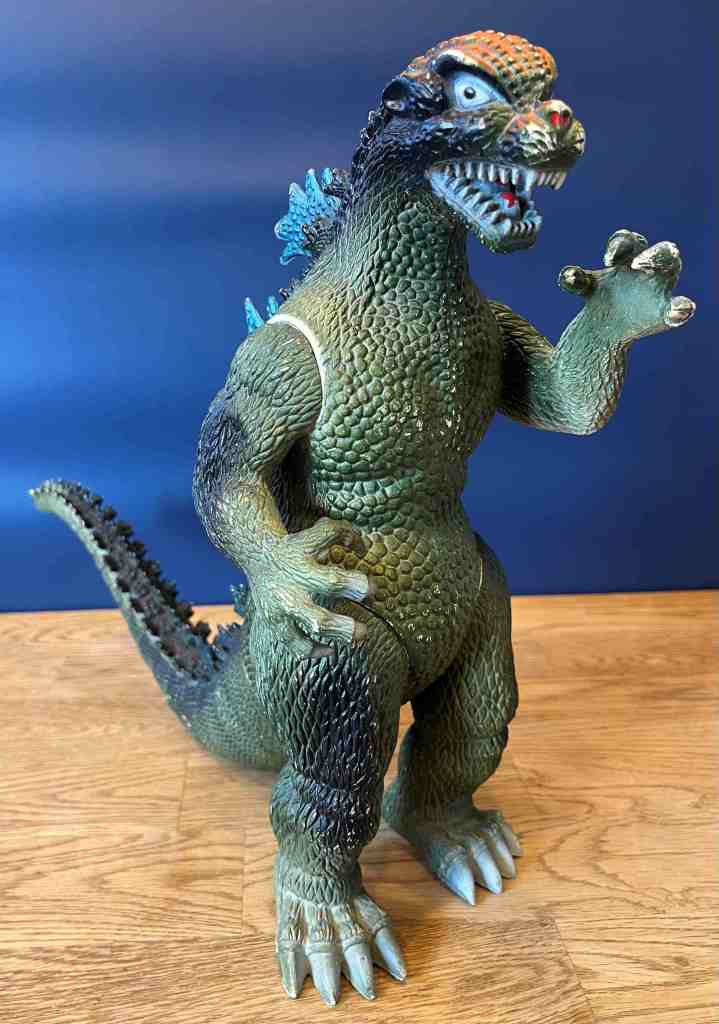
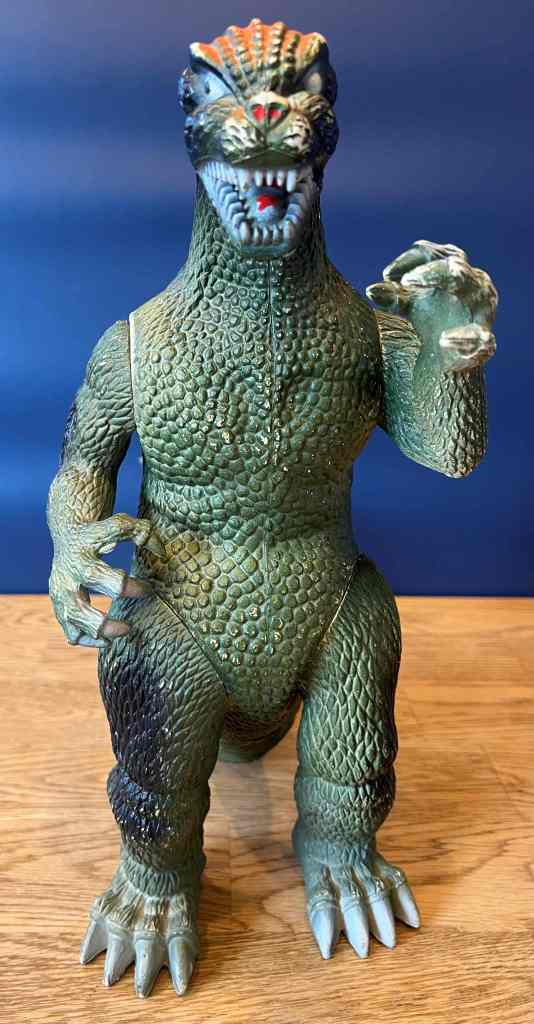
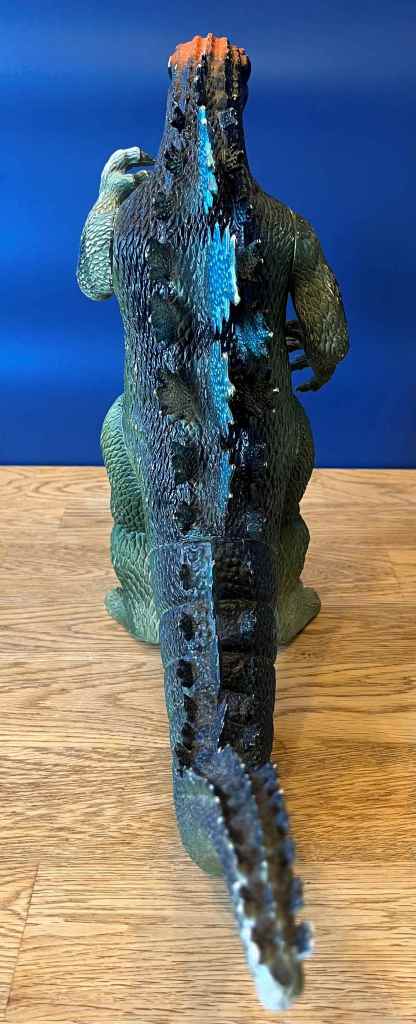
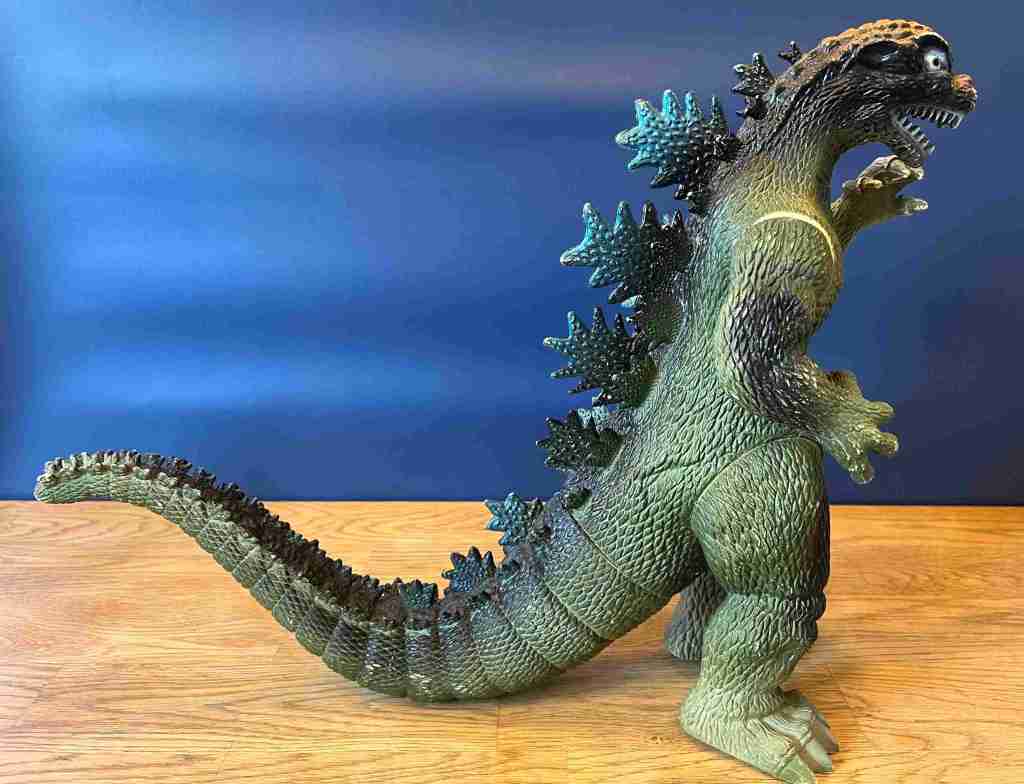
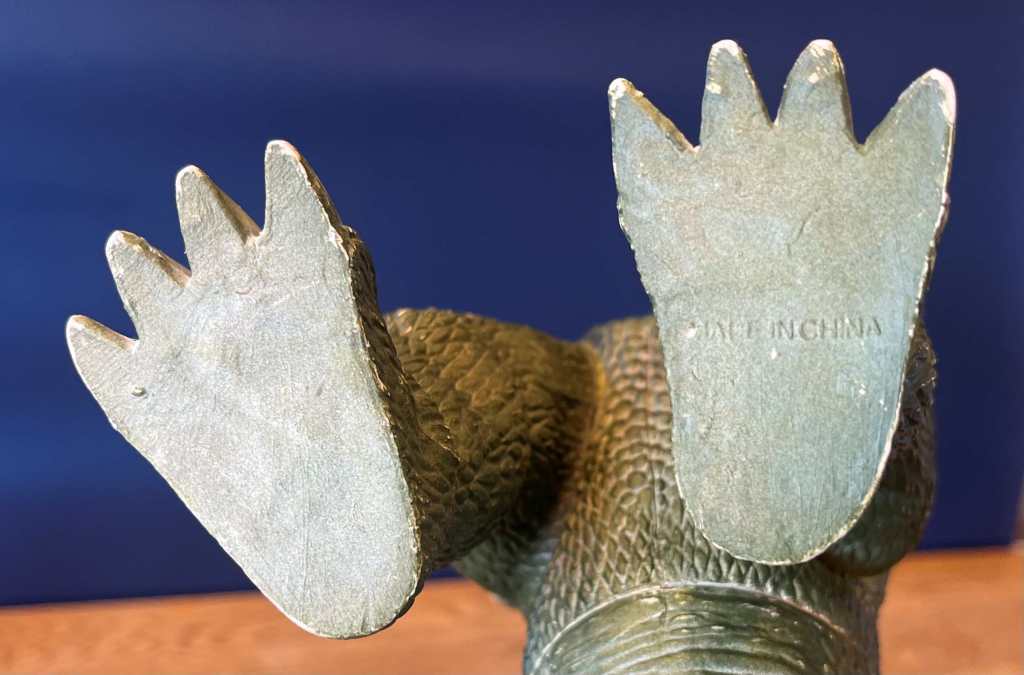
At some time in the 1990s, a Chinese-region bootlegging company (who we can now name as Playmaker Toys of Huizhou City, China, and Hong Kong: see below) took the large Imperial figures and resculpted them to blend elements of the Imperial and Dor Mei designs, and update the facial sculpt to a Heisei period form. The resulting bootlegs were made in hard rubber, stand 305mm. tall, and weigh 835g. The vinyl is notably thin and can be easily bent by a thumb and forefinger. The snout was shortened and the nostrils made more prominent to align with the Trendmasters 1994 resculpt. Imperial’s diamond-shaped scales were abandoned in favour of a fish-net pattern previously found on the Dor Mei models. In agreement with Imperial, the model has four toes that end flat together, and a non-articulated head. The arms, legs and tail were articulated. These appeared in black with green/orange and silver highlights, bright orange with black highlights and a strange green variant with an orange head and blue spine-fins, where the entire colour has been painted onto flesh-coloured plastic (and so scuffs easily and often shows strips of flesh-colour at the edges of the articulated joints: on these see the excellent post for Toho Kingdom
These have a simple “MADE IN CHINA” under their left foot (Toho Kingdom blog claims this mark was under the right foot, so perhaps it appears under both in different models).
The Toho kingdom blog notes that they were marketed as ‘Super Dinosaur’ models.
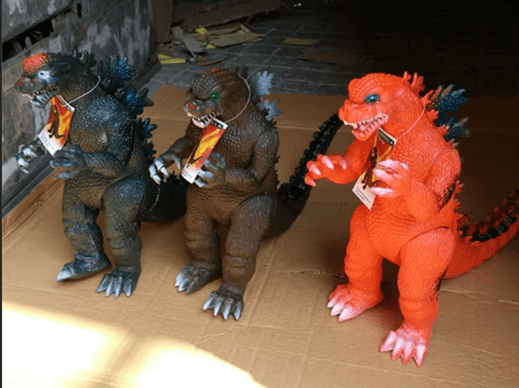
(Image from Toho Kingdom blog, showing colour variants and marketing tags).
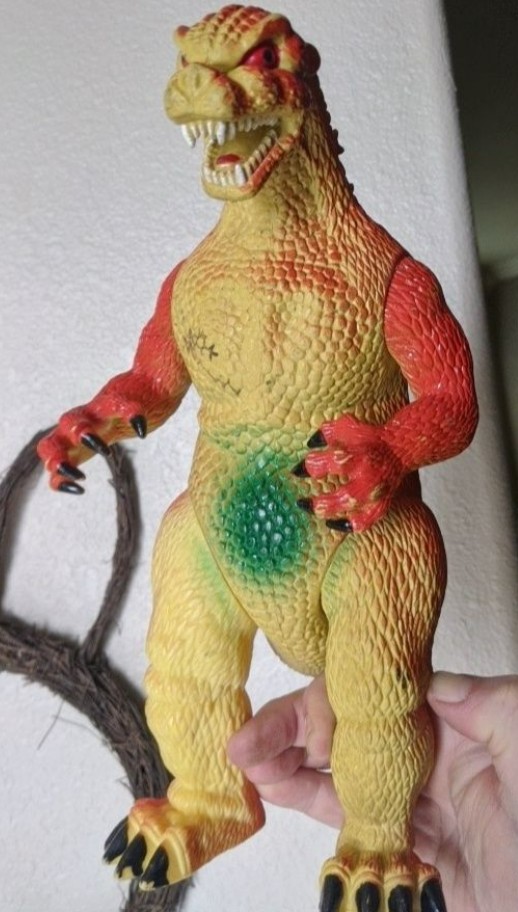
(Image used here with owner’s permission)
In addition, I am aware of a few examples of this bootleg in the same orange-red with green highlights as some of the later issues of the Imperial mini figure (the image here taken from a post by a private collector to the ‘Warriors of the Universe’ group on Facebook on 16 April 2026). This is important as it demonstrates that, like other Chinese bootleggers discussed here, the producers of this toy were responding in real time to innovations and developments in the models produced by the main companies such as Imperial.
Excitingly (well for me at least, I clearly need to get out more) an example of this with a printed mark on the sole of its right foot came to light in August 2026, identifying the producer as Playmaker Toys of Huizhou City, Guangdong province, China, who must have been working in concert with Playmaker Toys (HK) of Hong Kong:
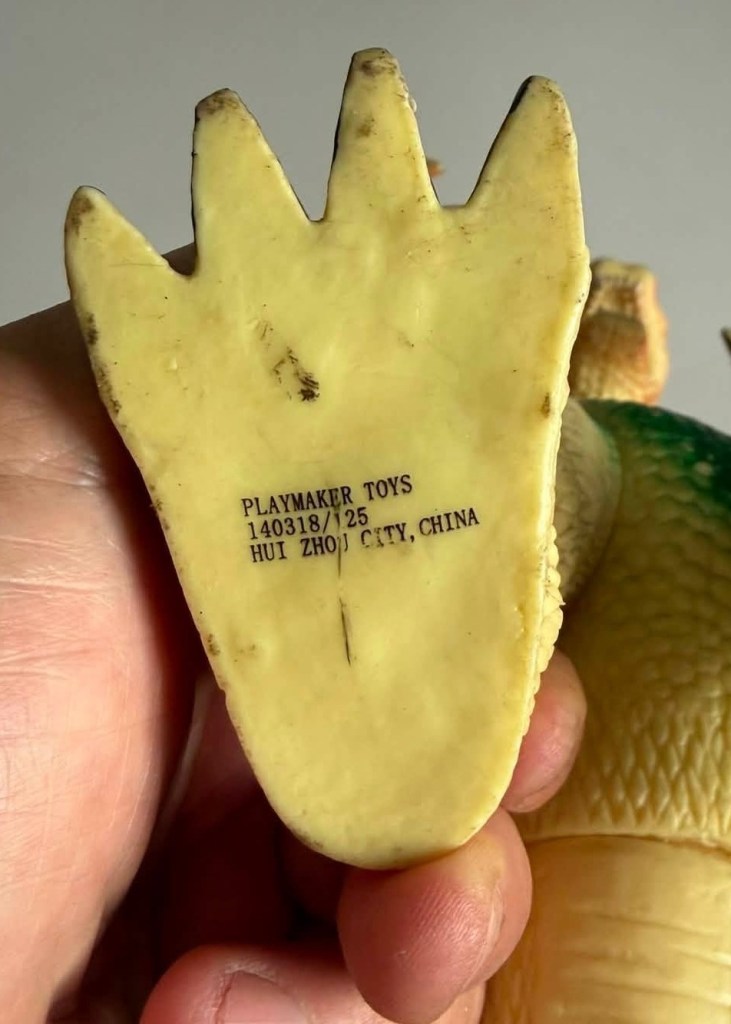
(Image from a Facebook sales listing)
I have written a blog post on that discovery and its implications. Readers are directed there for detailed discussion.
*Bootleg of Imperial model 6, the ‘long-muzzled Heisei bootleg’ (these perhaps not Chinese?)
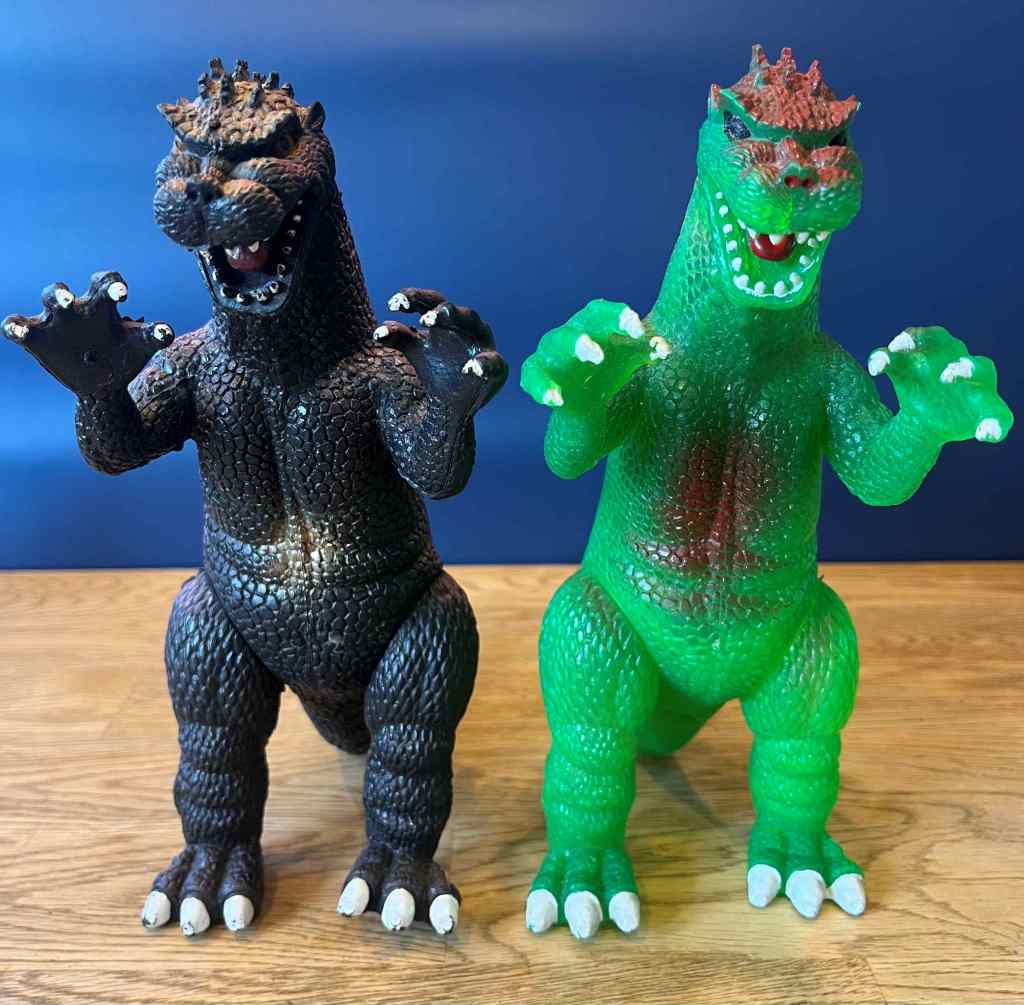
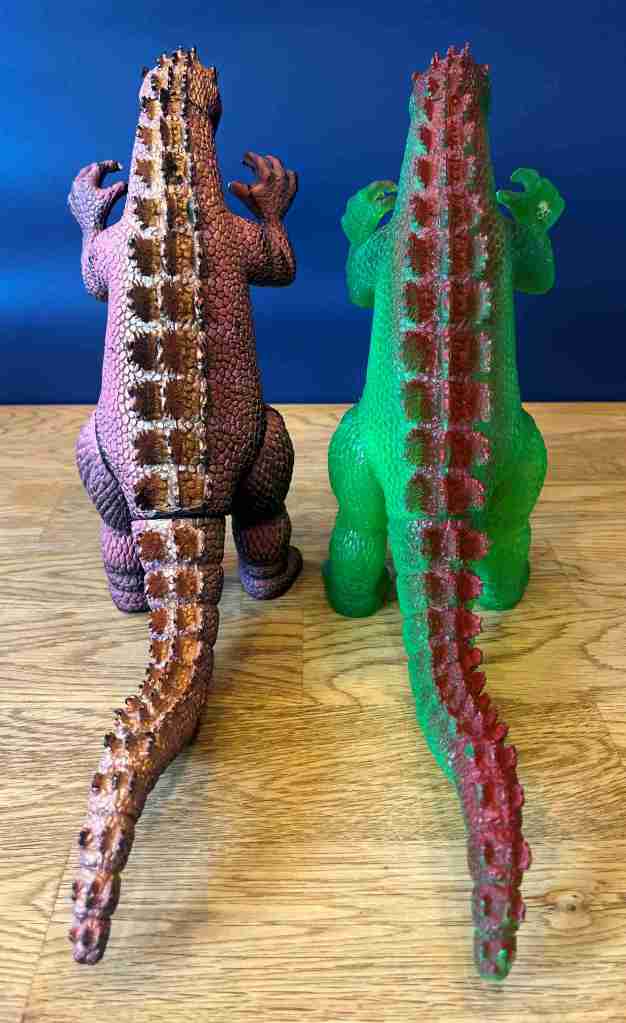
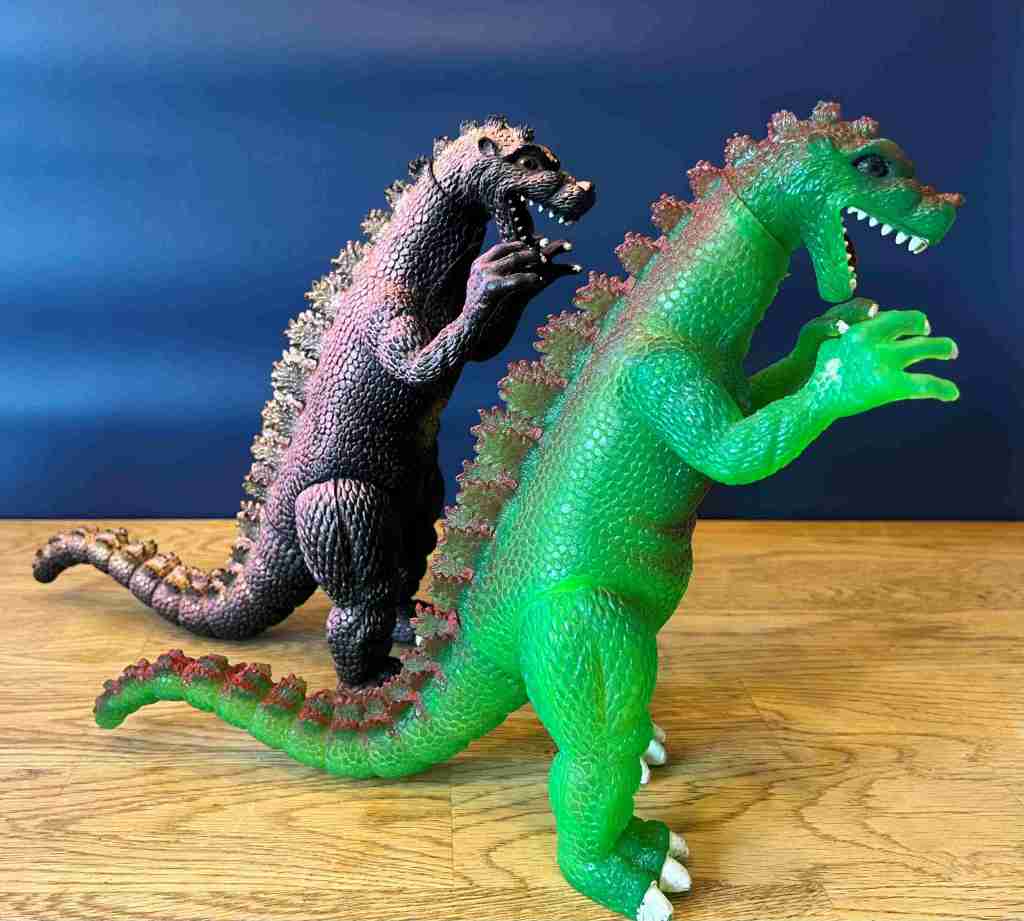
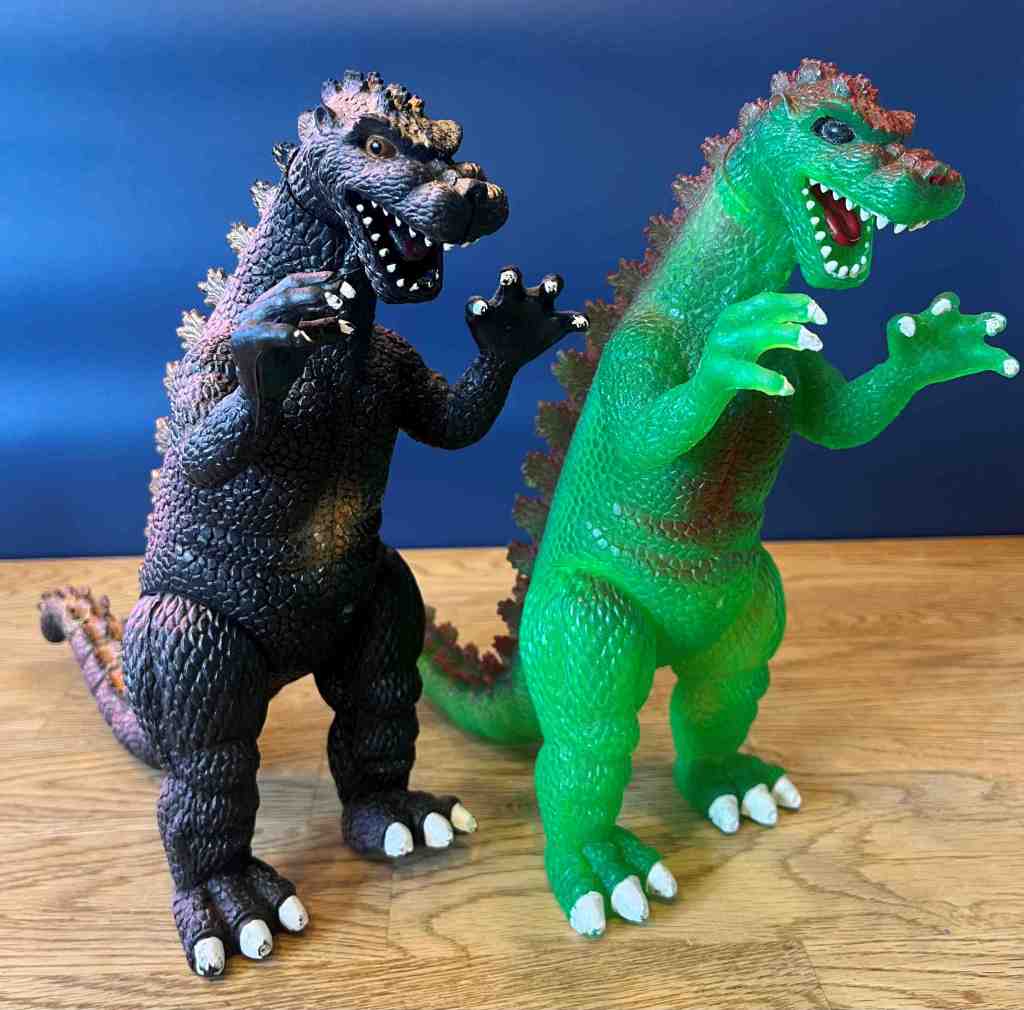
(This image from a Polish sale site: Olx; the listing long defunct)
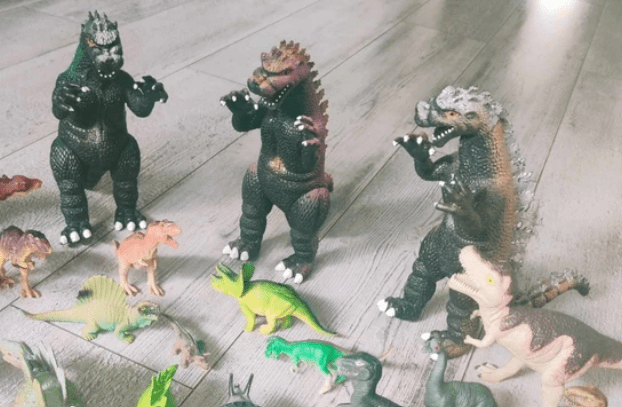
These are strange beasts. They are enormously rare, known to me only in five examples, of which I own two. One of mine (the black and purple one) clearly has “MADE IN CHINA” on the sole of its right foot. Normally I would not doubt the country of origin when confronted with such a blatant statement, but nothing else here agrees with a Chinese origin. The facts are:
1. I know of these only through Polish marketplace sites, and in such small numbers that if I had not seen the Chinese marks on the foot of the one I own, I would have assumed these were Polish;
2. Their arms are fixed in a raised ‘don’t shoot’ position – and this is unlike any other Chinese bootleg, but does agree with several European bootlegs of Chinese models;
3. The quality of the rubbery plastic they are produced in is worse than even the ‘lunar skin bootleg Godzilla’ discussed above;
4. There is evidence of some of these being resprayed after an initial spraying of all examples black with green shading (see below) – this again seems out of place in a Chinese production setting;
Finally 5. Quality – the Chinese producers may be using amateurish sculpts, but those sculpts do actually look like dino-monsters and are executed to a reasonably high standard, and no other Chinese example has legs that do not equally meet the floor (as here: see below) as commonly in European bootlegs. If these must be Chinese in origin, then their closest affinities are to the silently-screaming Chinasaurs.
So these are included here as only a possible Chinese product, and may well turn out to be European, and probably Polish, in origin. If the latter is the case, then we might speculate that a “Made in China” label was attached to a local European product to give it a seal of authenticity and probably push up its retail value. Of course, I would be delighted if any reader with one would report it to me, as well as where they obtained it.
They are made in thin rubber that bends easily when squeezed, and stand 240mm. tall, and weigh about 350g. They have articulated legs and at a single point at the base of the tail. They also have an articulated head, but the arms are fixed in the raised ‘don’t shoot’ position. They seem to have been predominantly black with green shading and silver spine-fins. Some have orange shading with silver spine-fins and others (as with one of mine) have pink-purple shading with gold spine-fins – however, close inspection of mine reveals that a base-coat green shows through on the spine-fins and so it must have originally have been shaded in that colour, before some of these bootlegs were over-painted in the other two colour schemes. Another one, in my collection, has a quite different colour scheme – and was produced in translucent bright green, with solidly black eyes and the edges of its spine-fins coloured orange-brown. It is identical in its features to the others, and clearly from the same molds, but was made in very different rubber. This one has no “Made in China” marks under its feet.
Clearly they follow the facial resculpt of the ‘Heisei bootleg’ with the same facial features down to the carefully sculpted (rather than painted) bulging tongue, but the muzzle is lengthened and the fins extended over the top of the head. Moreover, they are considerably smaller than their model, and while their toes end in a single flat line together, one of the toes of the ‘Heisei bootleg’ has been cast away to give this model three equally long toes. The impression is not one of quality, and the legs do not meet the floor equally in all but one examples I have seen. That said, they do have great charm, and score high on the ‘derpy’-scale.
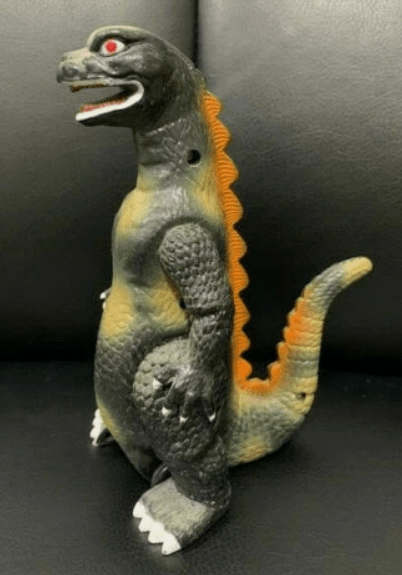
*Bootleg of Imperial model 7, the ‘Dino King walking Godzilla’
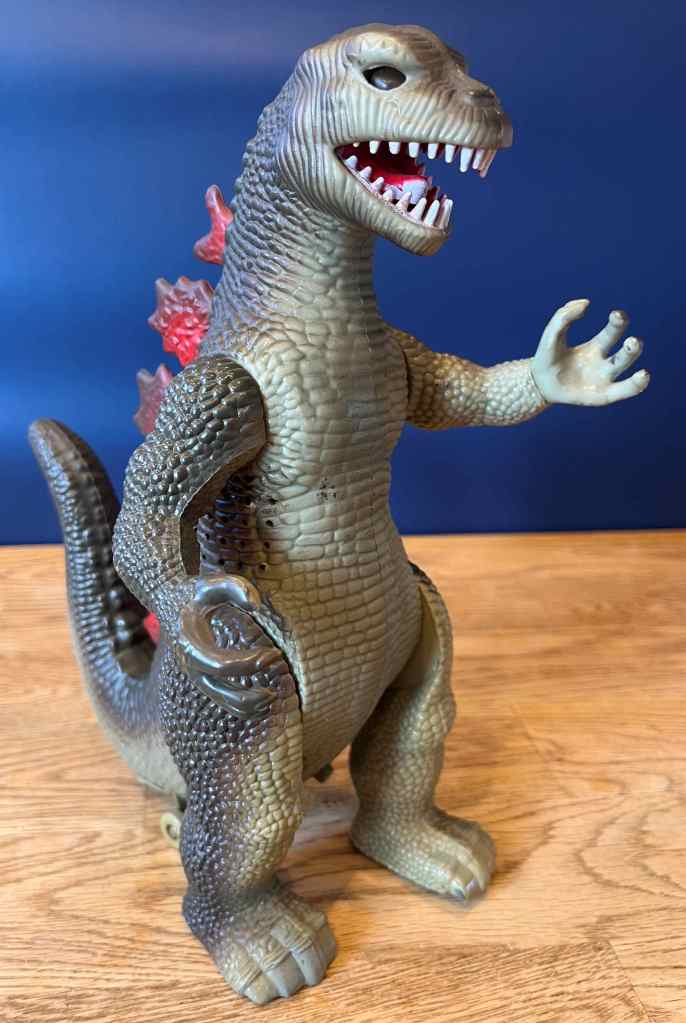
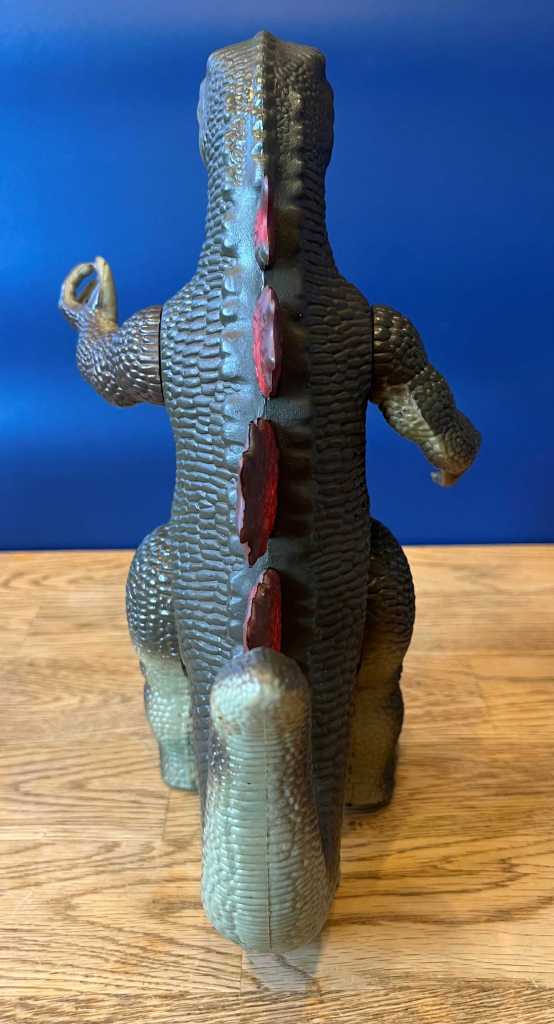
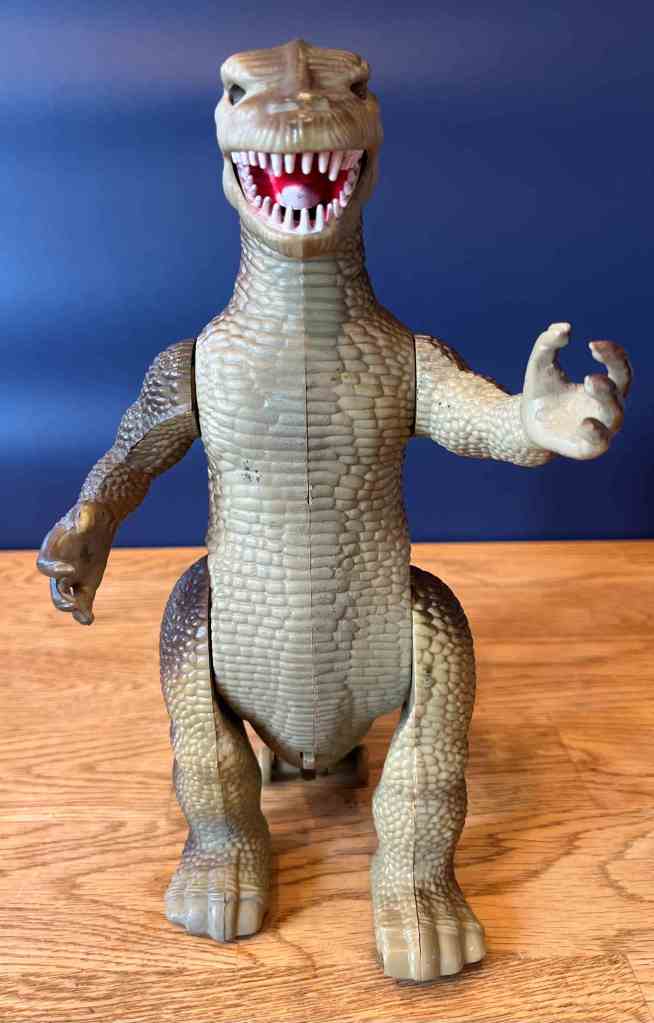
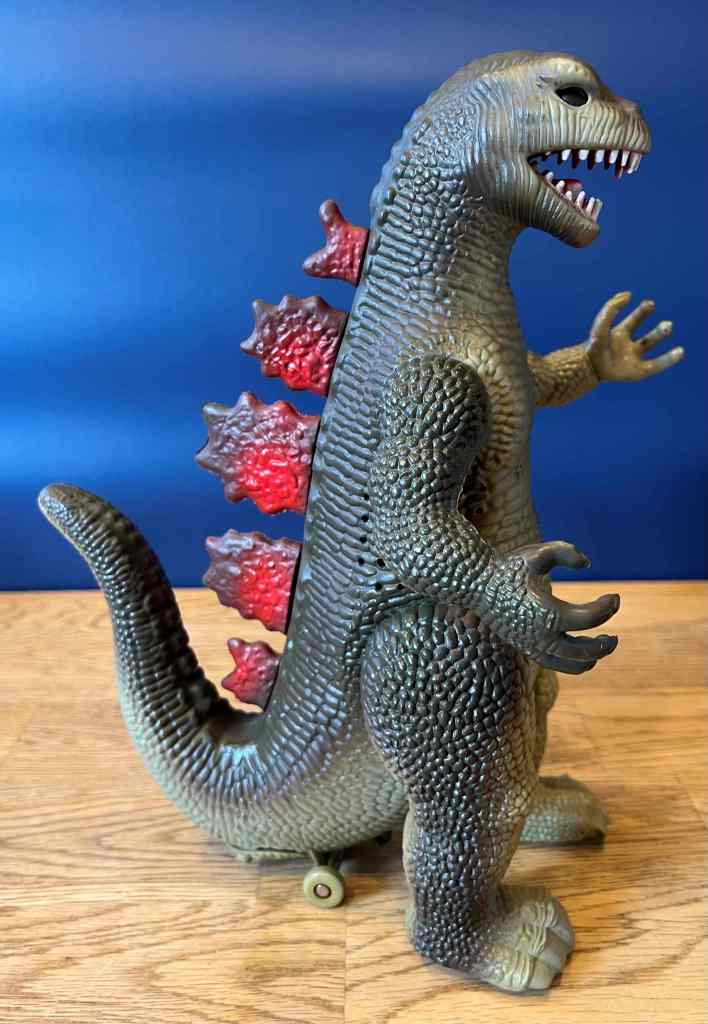
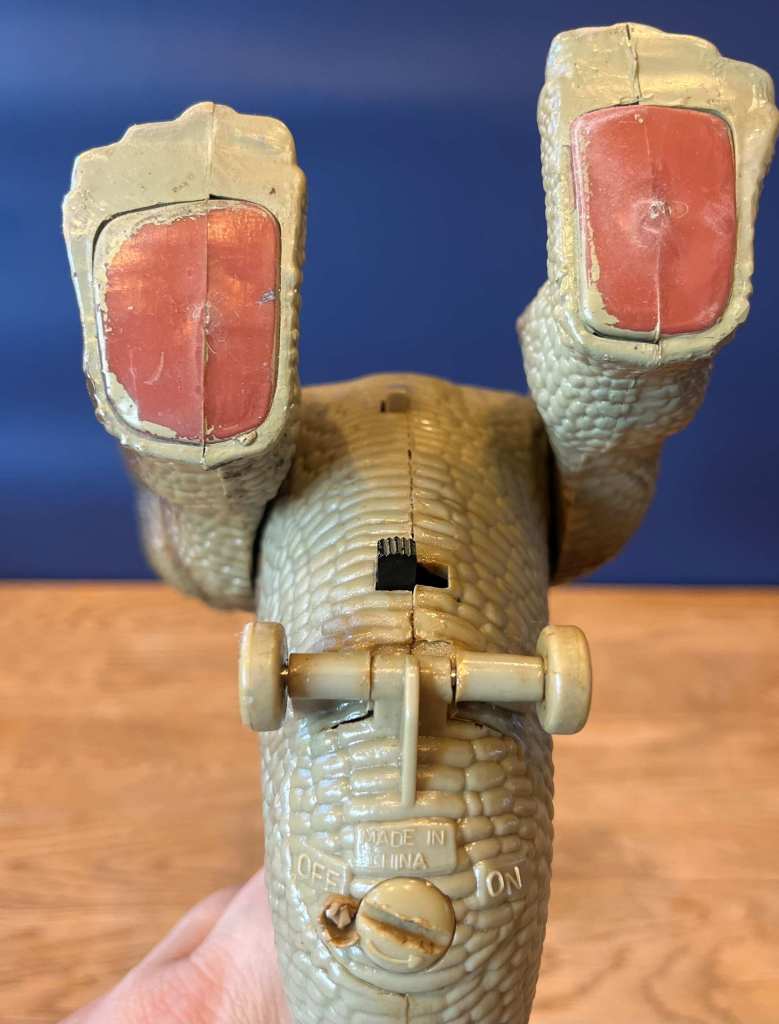
Here I do own an example, and can give a fuller report of its details. It was produced in hard plastic in green with paler shading on its underside, stands 260mm. tall (approximately 10 and 1/4 inches), and weighs about 100g without any batteries. The face sculpt most closely resembles the later Imperial mini (angle of head, open mouth and nostrils at upper edge of muzzle), but with a bulging tongue. The spine fins are soft orange rubber and most close to those found in the earlier Imperial models. The tail has been lifted up to be closer to the body, and the body is supported by a wheel at the base of the tail, while rubber grip pads under each foot allow the beast to drag itself forward when walking. A battery compartment sits inside the base of the tail, and when activated by a switch or a button in the same place, the creature roars (through a speaker mounted in the right hand side of its torso and visible through a series of small hoels in rows there), its eyes flash with light and it walks forward, moving it legs and arms as it does so. The only marks on the model itself are a tiny “MADE IN / CHINA” on the battery case cover. However, these are common, and thankfully original packaging survives for many examples:
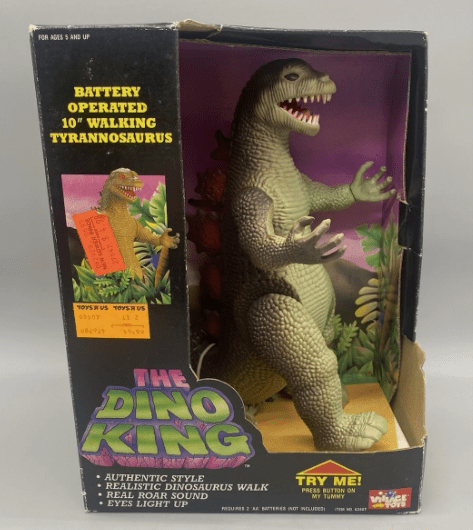
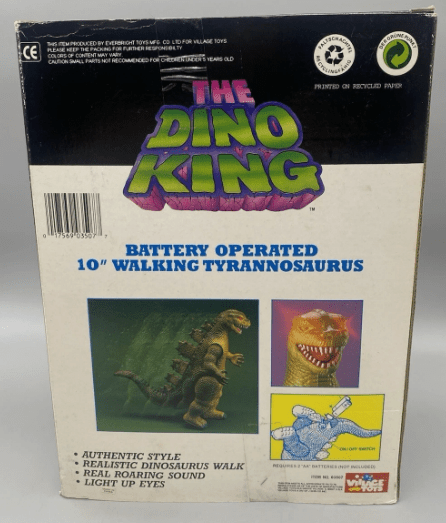
(These images from an unrecorded online sale site)
These show that it was produced in China by Everbright Toys MFG Co. ltd. (a Hong Kong toymaker), for Village Toys (a US company mostly known for importing and rebranding Japanese robot toys in the 1980s). Online sale listings and some brief appearances on Facebook and Instagram (these in Italian and by a single poster) offer the date 1980, but that would be extremely early (and impossibly predating the Imperial model it copies) and as there is nothing known to us to support this, it may well be nothing more than a guess. A blog notes two versions, one in light green, one in dark, and two versions of the packaging giving it the toyline-name ‘Dino King’ or the less common ‘Prehistoric Animals’.
*Bootleg of Imperial model 8, the ‘Monster Dinosaur pull back and go action Godzilla’
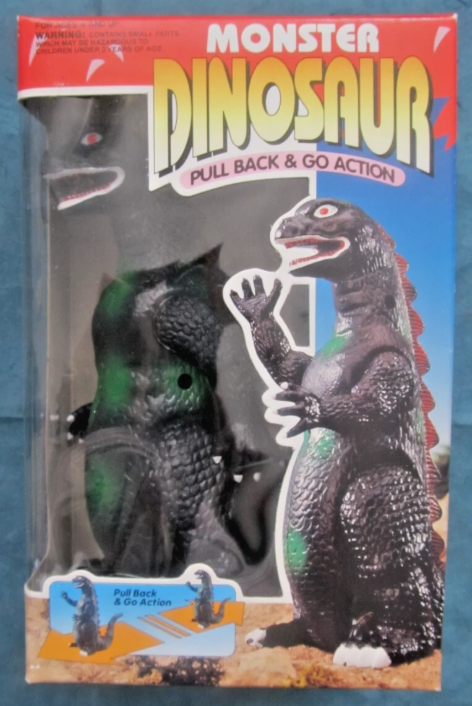
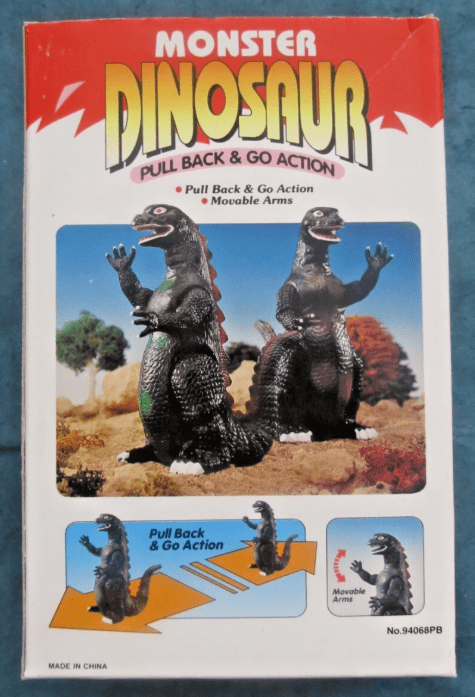
(These images taken from two separate eBay listings)
I do not own one of these and so all details here have been taken from online sale listings. This bootleg takes the Imperial model to the extreme of removing the space between the belly and the ground, so that the figure can be balanced for the ‘pull back and go’ action. The spine find have been simplified, but the facial molding and colouration is unmistakably from the Imperial model.
The packaging clearly states it was “Made in China” on its reverse, but gives no company name. It was perhaps produced mainly for the US market.
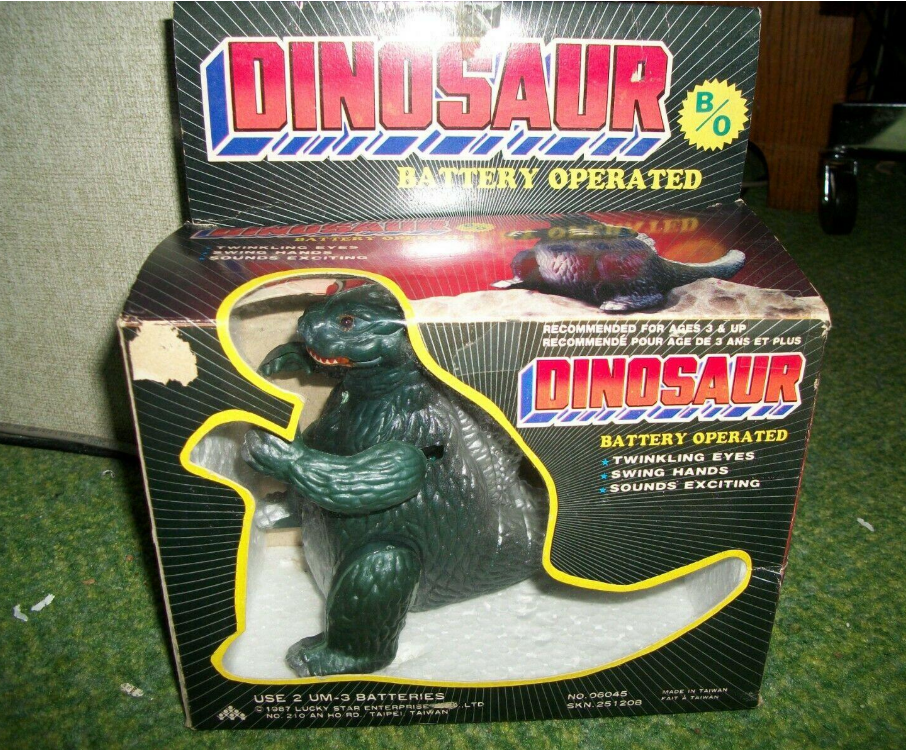
*Bootleg of Imperial model 9, the ‘Lucky Star Enterprises walking Godzilla’
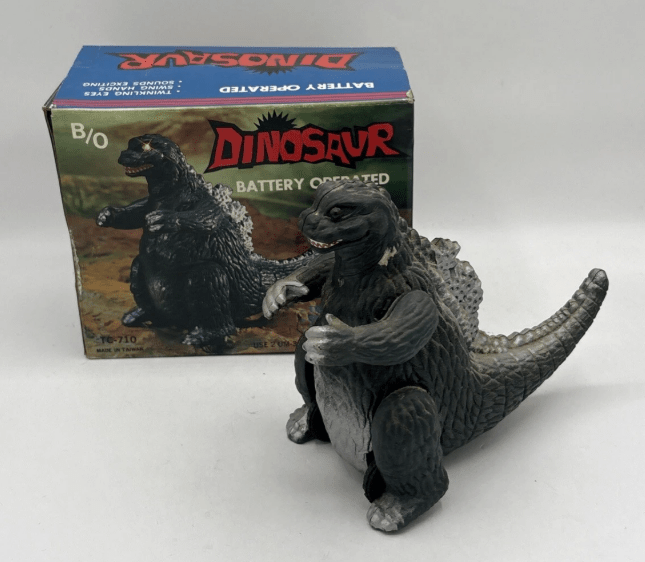
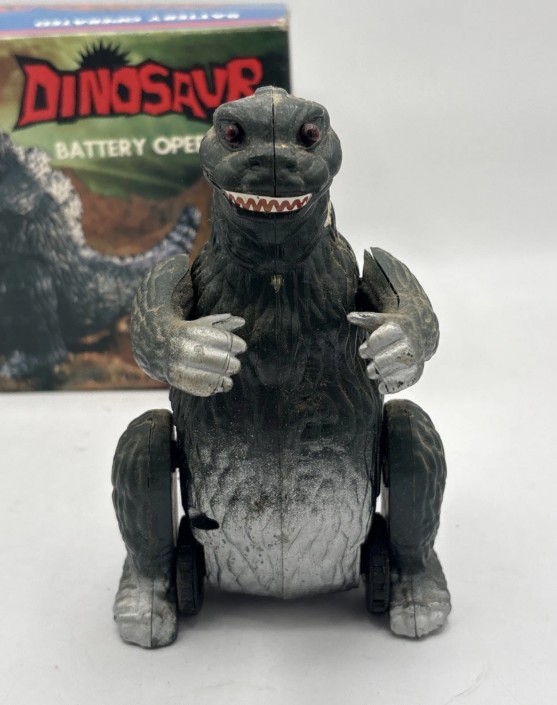
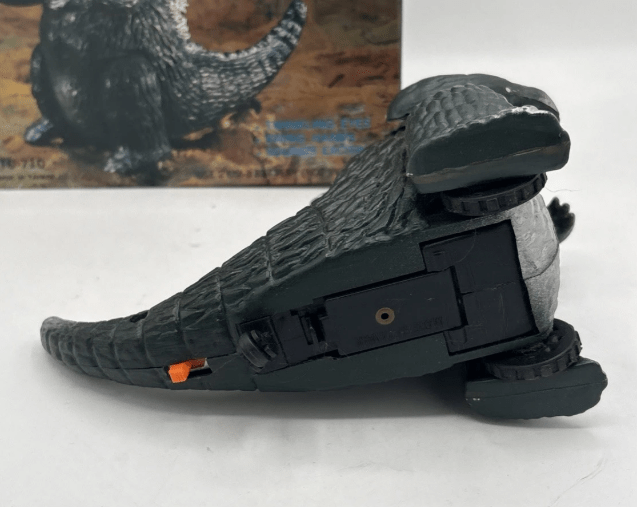
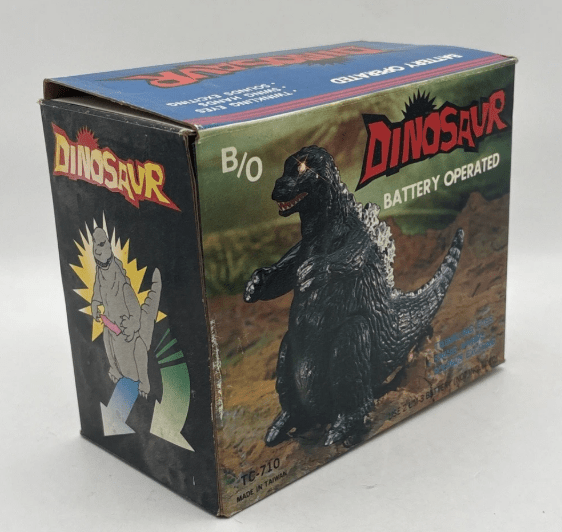
(Images from an eBay listing)
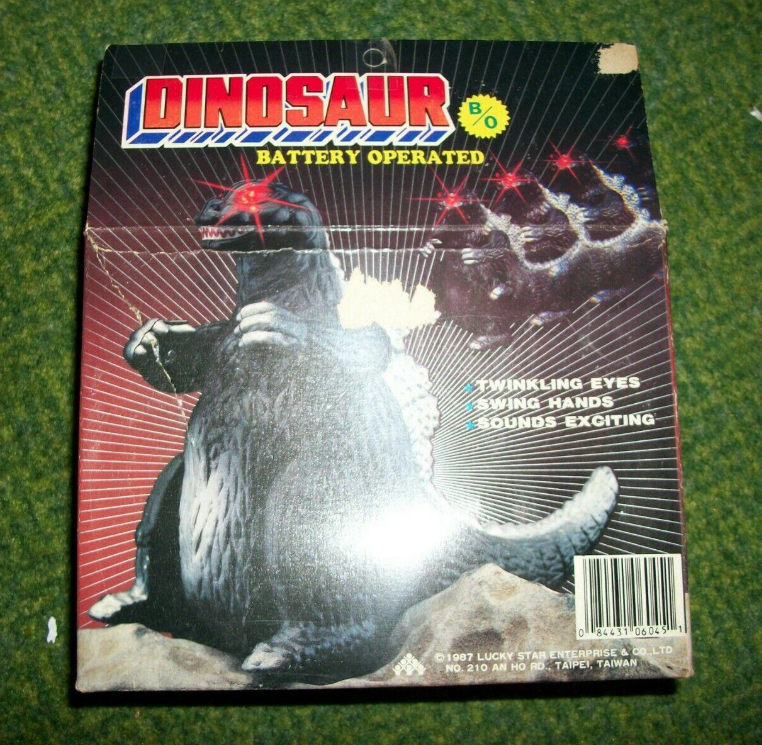
(Variant packaging for the same item, from a Worthpoint listing)
Again, I do not own one of these, but the distinctive scale pattern, many ringed tail and most importantly the fins with their pits in them (in a configuration close to that of the raised bumps on the Imperial model) show that the Imperial Godzilla, or one of its bootlegs, must have been the model here. They were marketed under the simple title “DINOSAUR”, and like the other walking Godzillas, are battery operated and have a low slung body to give the figure balance as it moves along on wheels underneath itself, moving its arms and legs and flashing its eyes red. The packaging promises that it “sounds exciting” but as I have never heard one I cannot vouch for that. Like other Taiwanese bootleg toys this is called a “B/O” toy (see my later post on the Taiwanese Bemstars and their ilk), and I still have no idea what this stands for.
The packaging also allows us to see that these were made by Lucky Star Enterprises in Taipei, Taiwan, initially in 1987 (and has a copyright mark of that year). The company was founded by the Yeh brothers in 1968, and still exists, with offices now in Taipei, Hong Kong, Shanghai, Guangdong and Los Angeles.
*Bootleg of Imperial model 10, the ‘Dinosaur Epoch’ bootleg Godzilla
These seem to be a relatively late addition to this club, but their distinctive shaped spine-fins with neat rows of raised bumps along them, as well as the general design of the head, show that, at least in part, they were copies of the later version of the Imperial mini, or one of its bootlegs. In addition, they owe much to numerous other T-Rex toys of their era. They were likely mass produced in China for some time, and repackaged and remarketed again and again, and exist in two main versions: a smaller one with a fixed open mouth, and a larger with a moveable jaw:
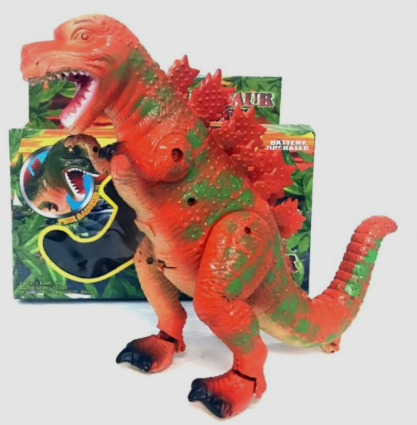
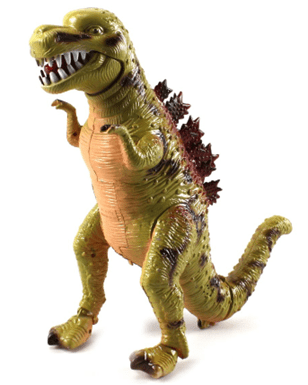
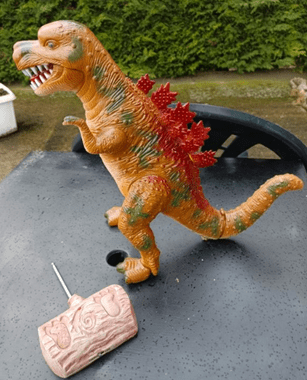
(These images from a 2013 post to a Toho Kingdom forum on bootleg Godzillas, but with no further information there; and and sales listings on Leboncoin and Shopee Thailand)
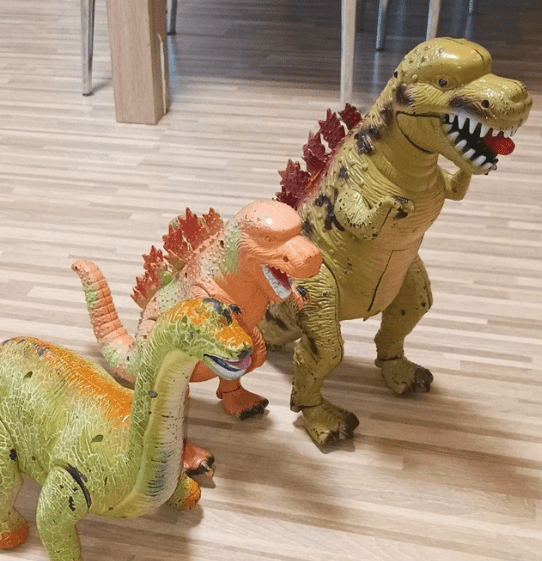
(This image showing the difference in size between the two models; from a Vinted listing)
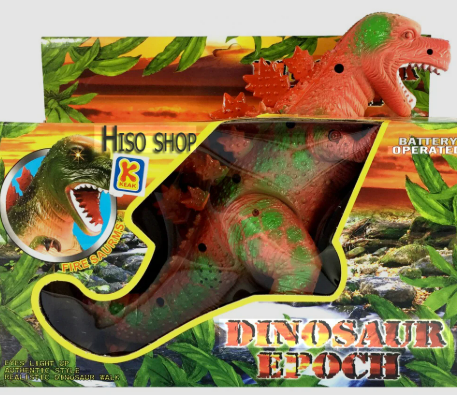
(This image from a Shopee Thailand sales listing)
Better images of the packaging can be found online, but are not in a format that can be reused here. These show that these bootlegs were made in China, with some at least having labels listing the Guangdong Edukiddo Innovative and Education Technology Co. behind their production. The packaging can be found without the “Hiso Shop” logo here, and that was probably added for a consignment to that distributor. I do not know when these where made, but anecdotal evidence online, from people who remember buying them, suggest this may have been as late as the 2000s. Online searches for them usually erroneously end up with the so-called ‘Abomination Rex’, as an image of one of them, jumbled up to form a chaotic mutant figure, was recently used by a fan to form a fan-made kaiju (see here).
⁂
⁂
The Chinese region bootlegs of these models: the copies of the Dor Mei Godzillas
*Bootleg of Dor Mei model 1, the ‘lunar-crater skin Godzilla’
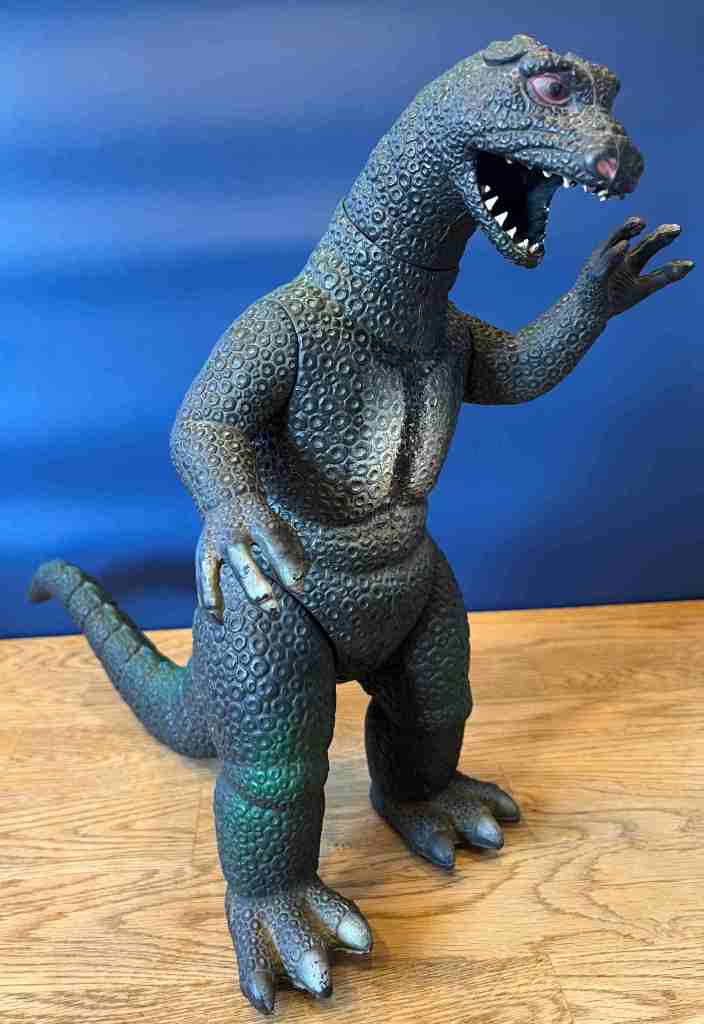
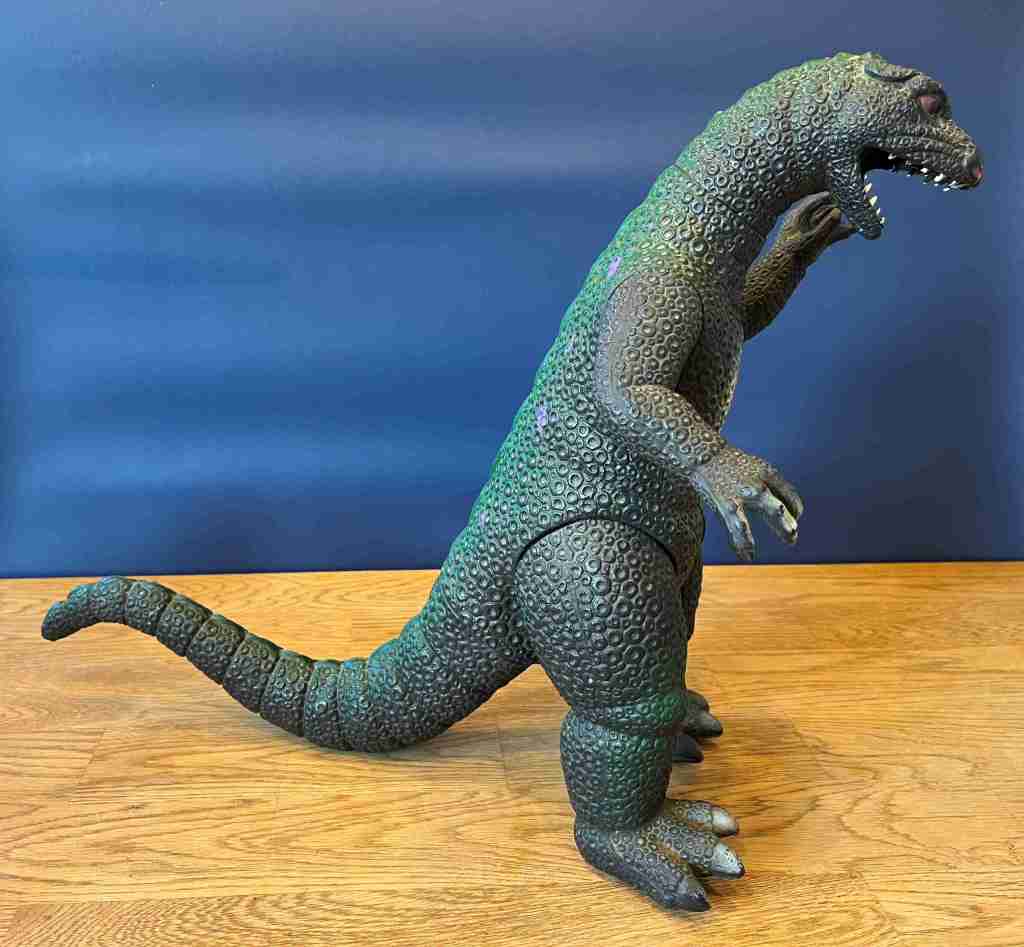
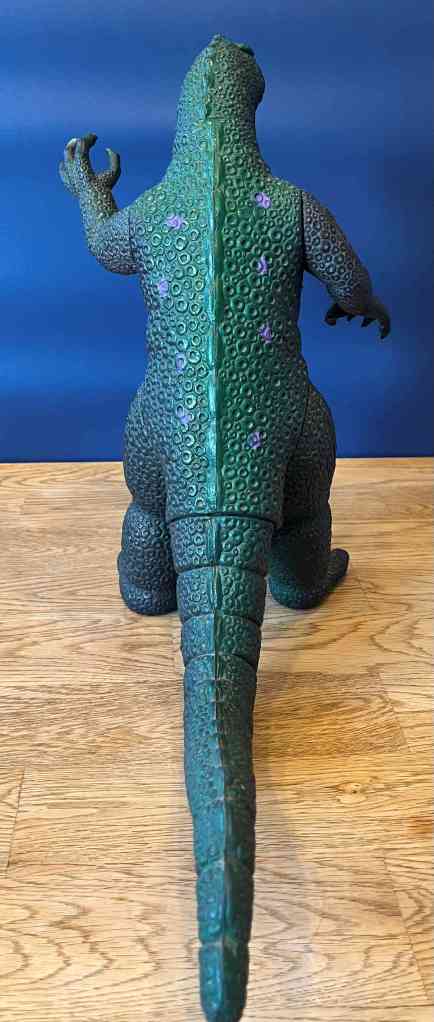
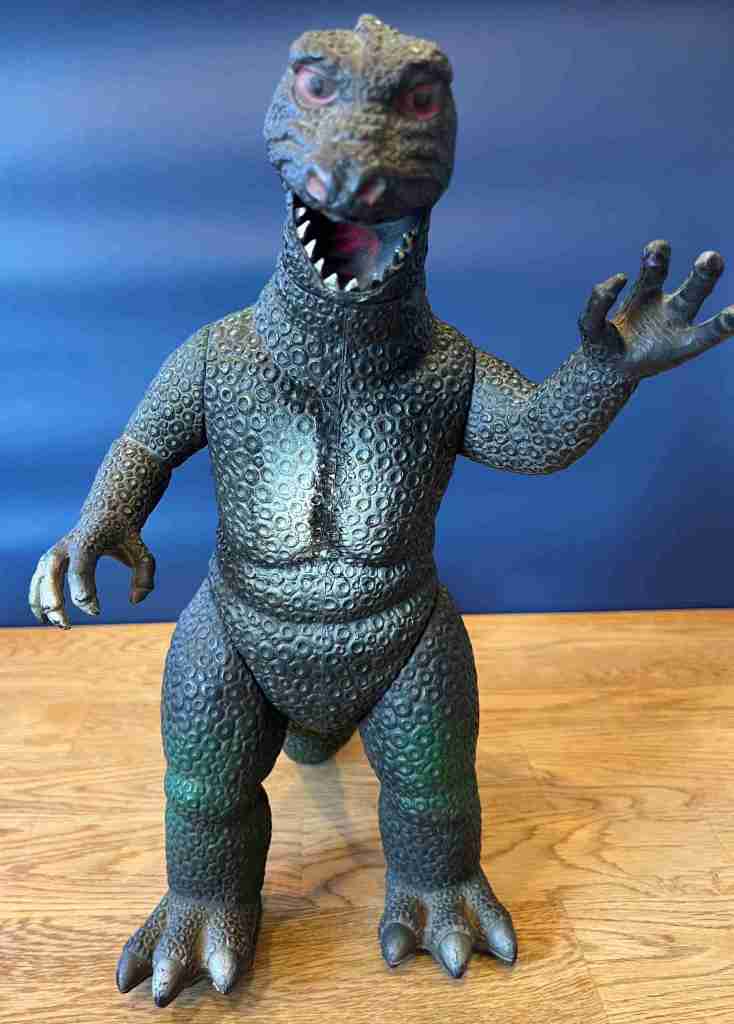
This is the model that Splitt drew our attention to as both of the “China unmarked” models in her pictures. It is slightly shorter than the Dor Mei models, and made of thinner hard plastic (in fact, when one picks it up around the waist the plastic bends enough that one risks breaking it there with a forceful grab). It stand 325mm. tall, and weighs approximately 150g. The articulation is the same as the early Dor Mei models, with a turnable head and only one point of articulation of the tail (at the base). The throat is closed, but many models have a small hole piercing that barrier. There are three toes, with the middle more prominent as with Dor Mei. The colour-range follows those of the Dor Mei examples, but can also include dark blue with occasional striking pink or purple highlights – and these would appear to be the only models to use this vibrant pink or purple in their colour schemes.
The most notable feature of this model is the skin texture, in which the depiction of scales has been cast to the four winds, and instead the figure is covered with tiny interlocking lunar-crater-like circles.
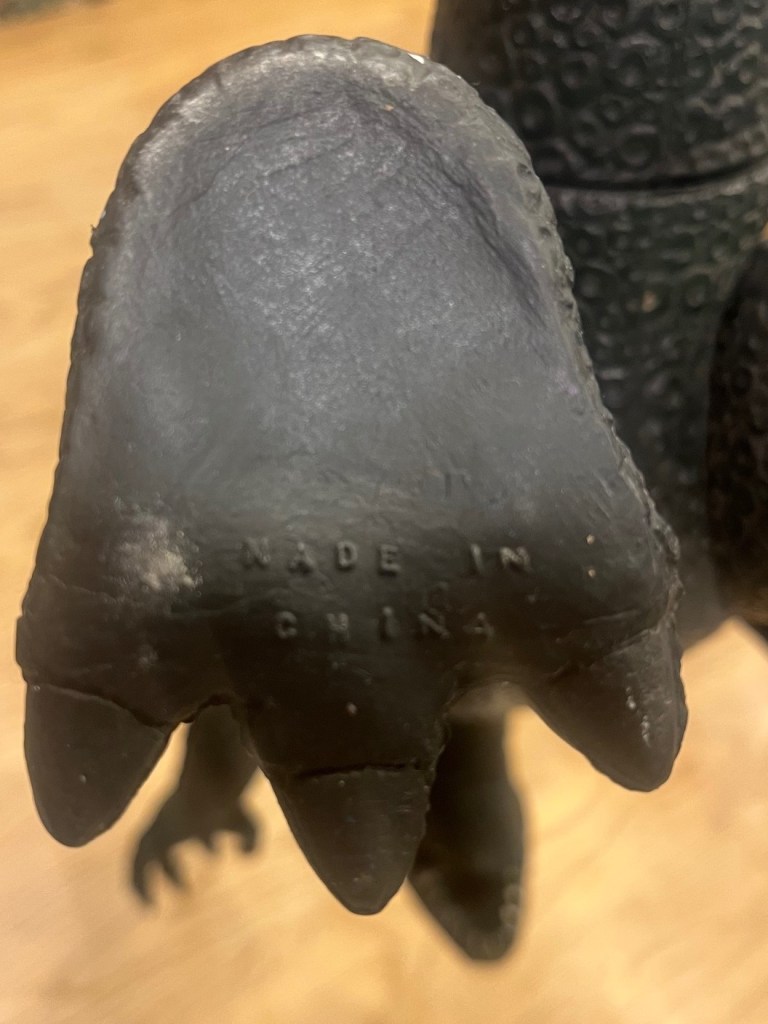
The feet are contoured with a large hollowed out area behind the ball of the foot, and have the mark “MADE IN / CHINA” under the left foot in a notably large and spaced out letters (some 23mm. from the beginning of the ‘M’ to the end of the ‘N’ in the first line). There are several head variants or resculpts, each drawing on a different Dor Mei head. Splitt gives two in her images, and I add a third here. In addition, there is a head-sculpt that appears to be unique to this model: that based on the Dor Mei Leadworks face but with a tall head fin reminiscent of Titanosaurus in the 1975 film Terror of Mechagodzilla.
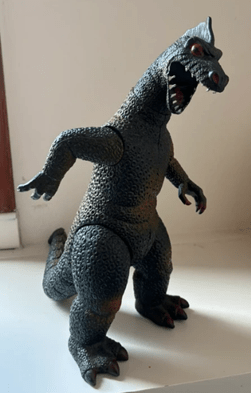
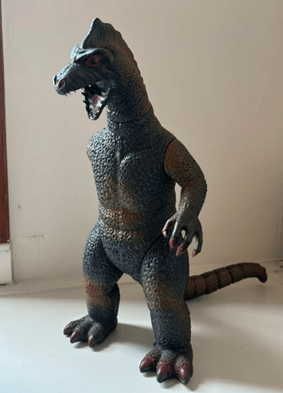
(These images from a Vinted sale listing)
I will add further examples when I acquire them.
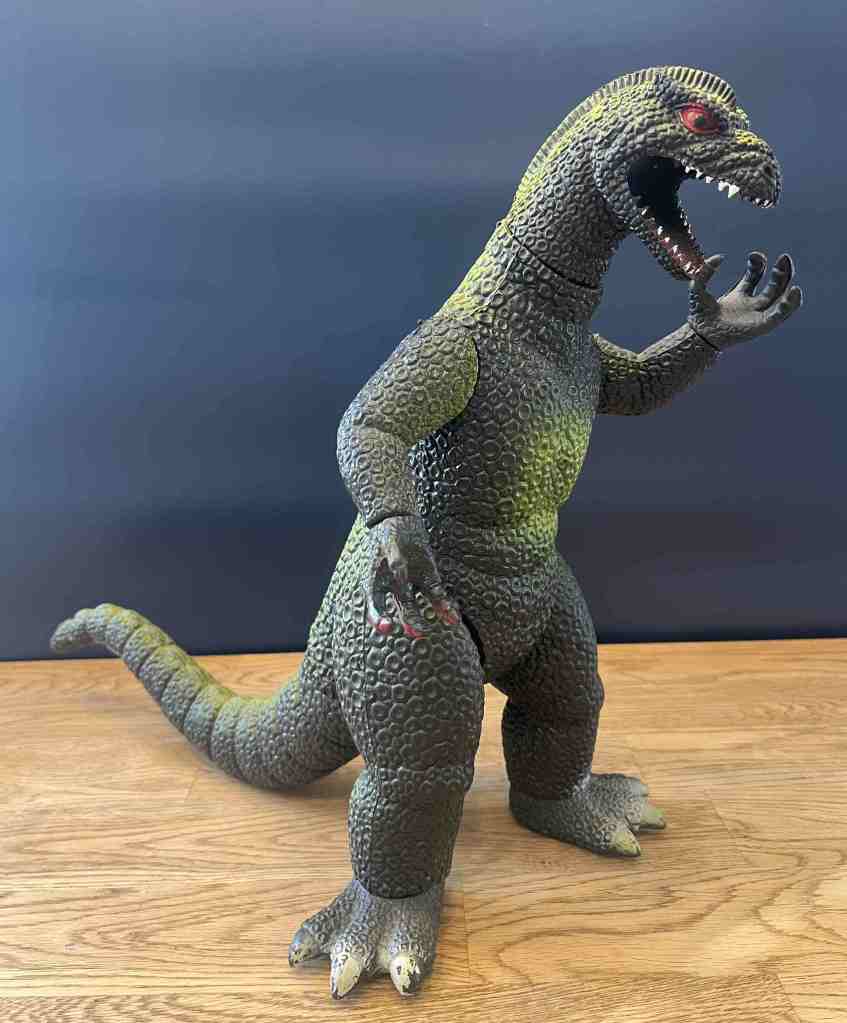
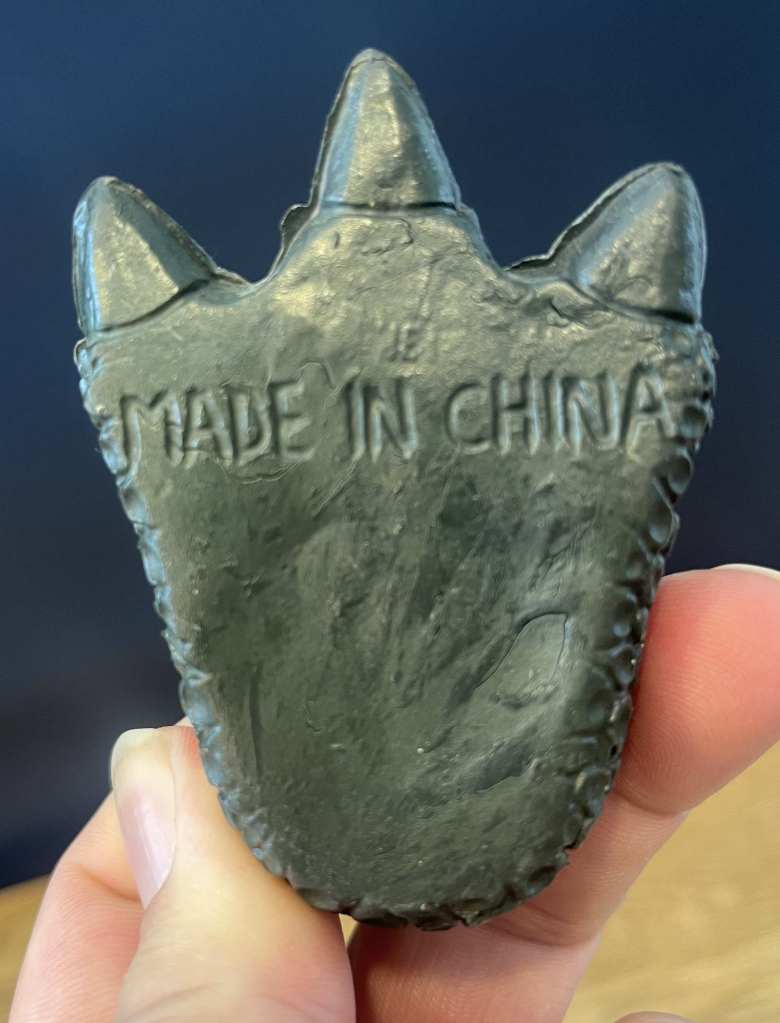
Additionally, some months after the initial body of this post was written, I realised that an extra-articulated version of this bootleg exists, with hands and feet that rotate at the wrist- and ankle-points, and often a tail with an additional articulation point halfway along its length. These have a different set of footmarks, and joints (especially the tail) that fit badly. This was a major remodel of this toy, and I have written a separate post on these.
(This image drawn from Alejandro Kiryluk’s Facebook post (see following text), and reused here with his permission)
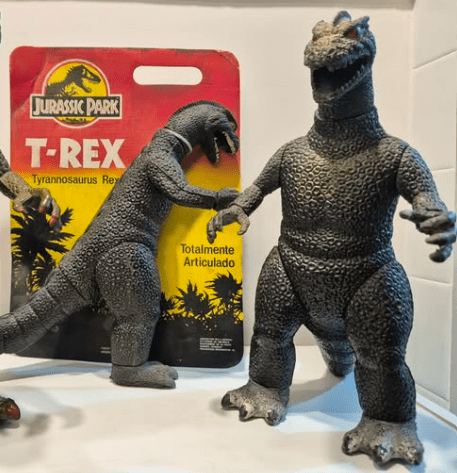
A fragment of evidence for the marketing of these extra-articulated bootlegs in Argentina after June 1993, survives in a cardback with a figure attached posted by a Facebook user named Alejandro Kiryluk to the excellent bootleg group ‘Warriors of the Universe’ on 22 December 2025. As he notes there, these were certainly Chinese, but marketed in Argentina attached to cards with “Jurassic Park T-Rex” and standard ‘all rights reserved’ statements on them in a spectacularly flagrant flouting of copyright issues. These card backs were marked “Argentina” at their foot, and had text in Spanish so this must be a local attempt to repackage and sell these bootlegs after the release of Jurassic Park in June 1993 (in US, then released in Argentina one month later), but I would dearly love to know if any reader has evidence this also happened elsewhere.
The loose models of this type must date to soon after the Dor Mei bootlegs and the development of their numerous head variants – so in the late 1980s and early 1990s.
*Bootleg of Dor Mei model 2, the ‘New Bright Big Rex walking Godzilla’
(These images taken from an eBay listing)
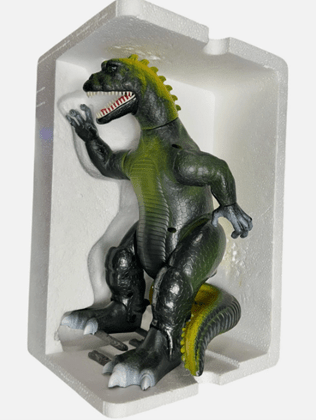
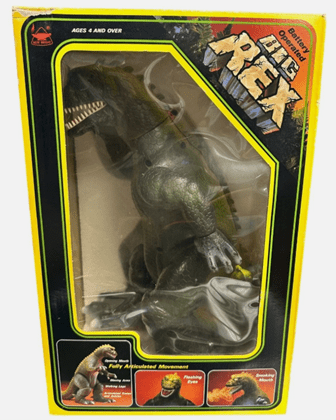
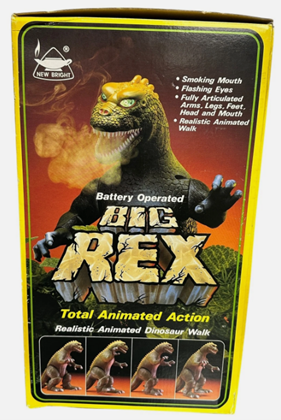
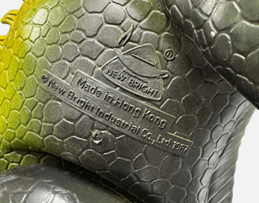
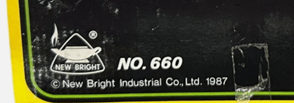
I do not own one of these, and so all information here has been gleaned from online sale sites. This bootleg is clearly a copy of one of the popular sculpts of the Dor Mei model, and stands about the same height (reportedly 13” tall). It is battery operated and walks and has a smoking mouth and light-up eyes. It clearly identifies its manufacturer on its side and on the packaging as New Bright Industrial Co. ltd. of Wixom, MI, USA (founded 1955), and its place and date of production as Hong Kong and 1987.
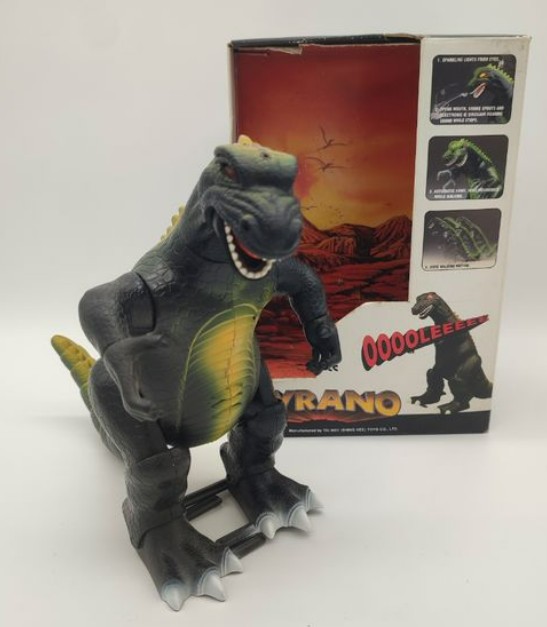
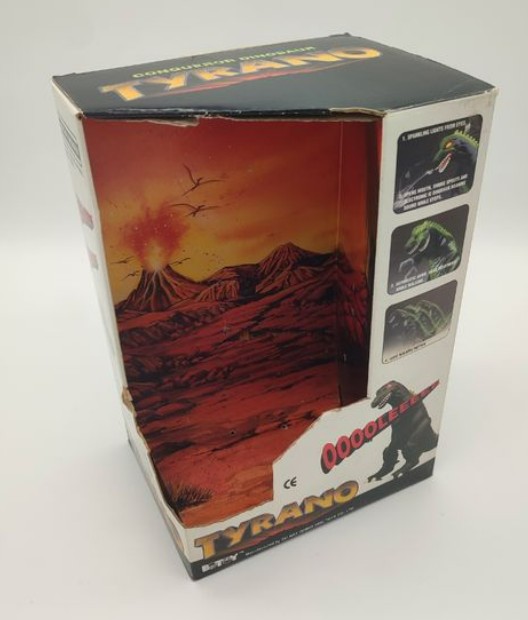
*Bootleg of Dor Mei model 3: the ‘Conqueror Dinosaur Tyrano’ walking Godzilla
(These images from a Vinting sale listing)
(These images from a Leboncoin sale listing)
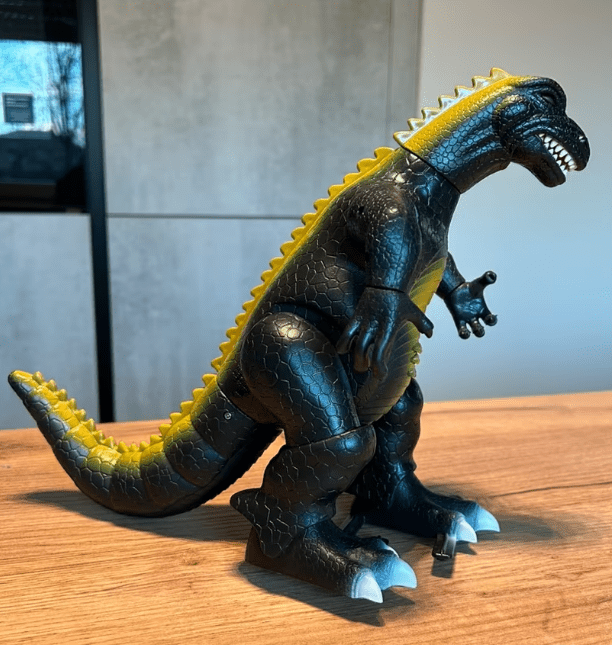
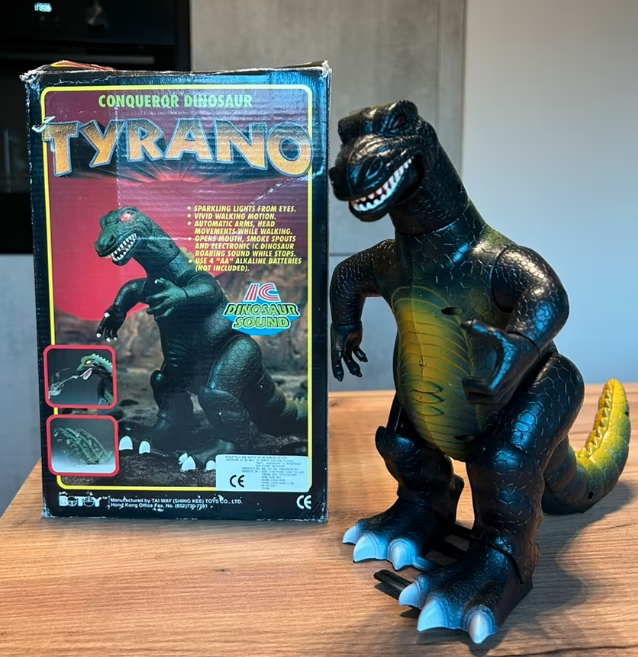
I do not own a copy of this bootleg, but it is relatively common, and so all details are reported here from online sale sites. It clearly copies one of the head sculpts of the Dor Mei models – and one that was produced by Dor Mei with light up eyes late in the production run. That here, was made from hard plastic, stands reportedly 240mm. tall, and was battery operated – walking with flashing eyes, moving limbs and mouth and smoke coming from its mouth. The battery compartment is accessible by a detachable tail.
The packaging uses the label ‘BOTOY’ and announces the manufacturer as Tai Wai (Shing Kee) Toys Co. ltd., and gives contact details for a Hong Kong office. Its production is undated, but must be somewhere in the late 1980s or very early 1990s. Marks on the soles of both feet confirm the production under the ‘BOTOY’ label and name China as the place of production.
The packaging offers a somewhat comical rendering of the creature’s roar, as “OOOOLEEEEE”. I have not heard one of these, but I seriously doubt it sounds much like that, and I have a hard time reading it without thinking of the Spanish “¡Olé!”.
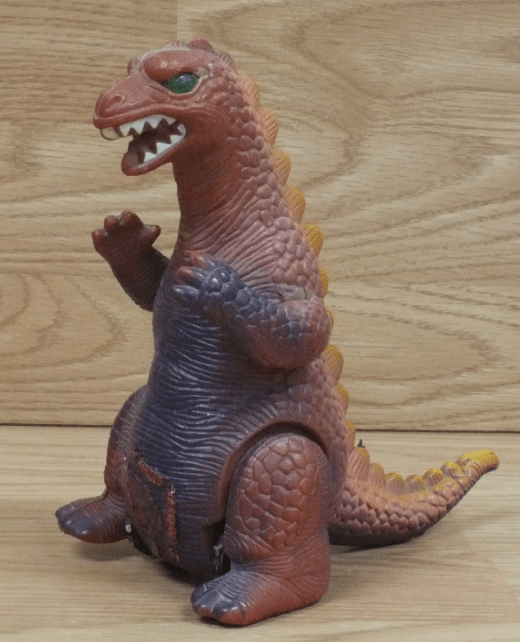
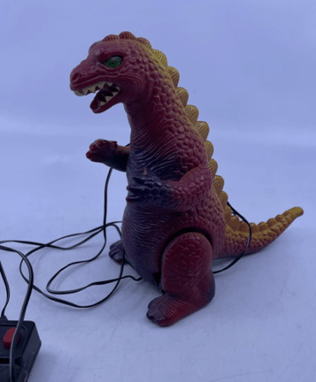
*Bootleg of Dor Mei model 4, the ‘the unbranded radio controlled Godzilla’
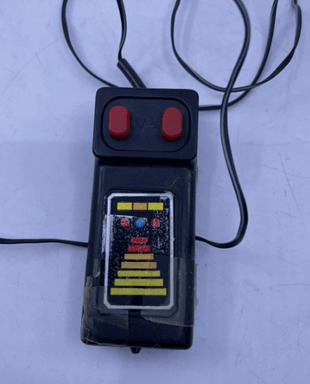
(These images from various eBay sale listings)
I do not own one of these, and so all details are taken from online sale sites. This bootleg is made in hard plastic, and takes much of its design from one of the Dor Mei sculpts, albeit with the body adapted to remove any space between the belly and the floor to stabilise the figure when moving. It comes in a yellow and green, or pale burgundy red with sandy yellow versions, and stands 6.5” tall. It is most probably Chinese in origin, and the only surviving packaging known to me states that it was produced in China directly for Radio Shack, and makes the somewhat excessive claim that when playing with it, “You are transported back to a time when dinosaurs ruled the earth. Roam the primeval forest with the most powerful creature that ever existed”.
Somewhat confusingly, the packaging art shows a close affinity to the Imperial Godzilla tags. In addition, the same art shows a final and pronounced semicircular ring of skin where the neck joins the body, which more closely resembles the Imperial models and their bootlegs, than it does the actual Godzilla bootleg here.
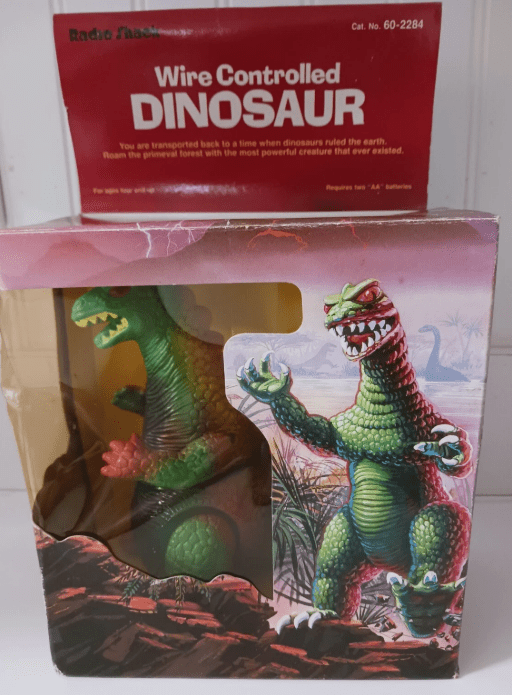
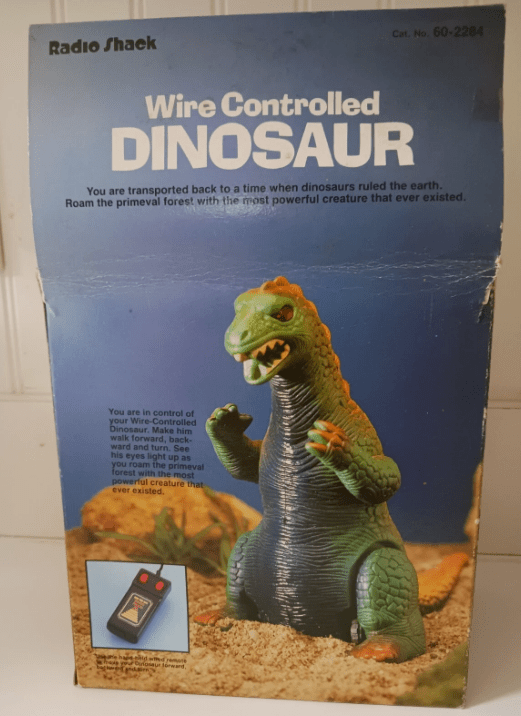
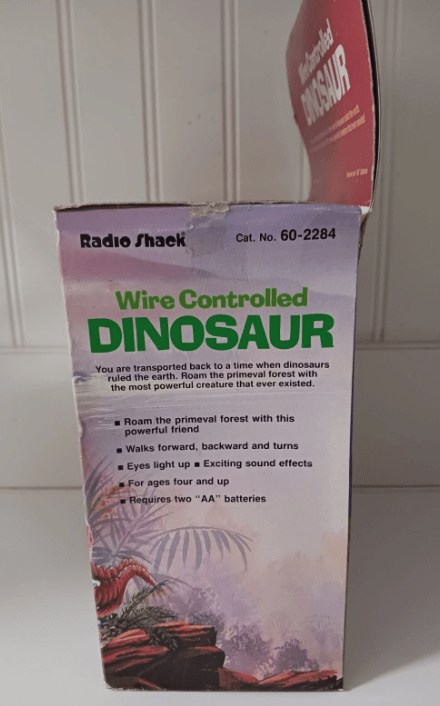
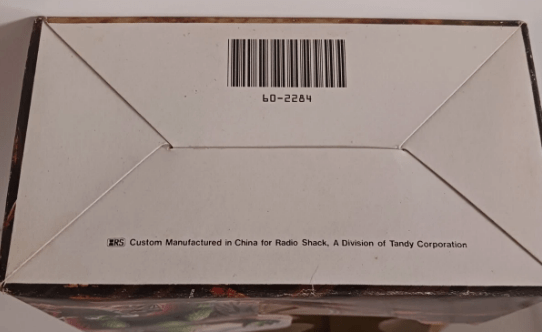
(Images from an eBay listing)
In addition, many examples have the ‘“’Radio Shack’”’ logo on their handsets.
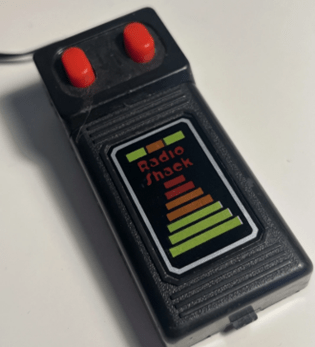
Occasional identifications in sale listings as a product of the toy manufacturer Soma are probably a misidentification for another similar looking bootleg (see below).
They also made a Stegosaurus figure in the same line:
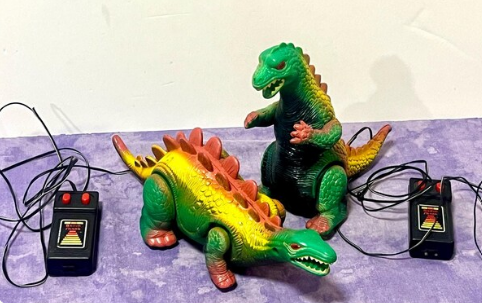
(This image from an Etsy listing, and item already sold)
Later, reportedly in the 1990s, they made an inflatable version of the same, that sat on a large brown plastic mount that could be radio controlled.
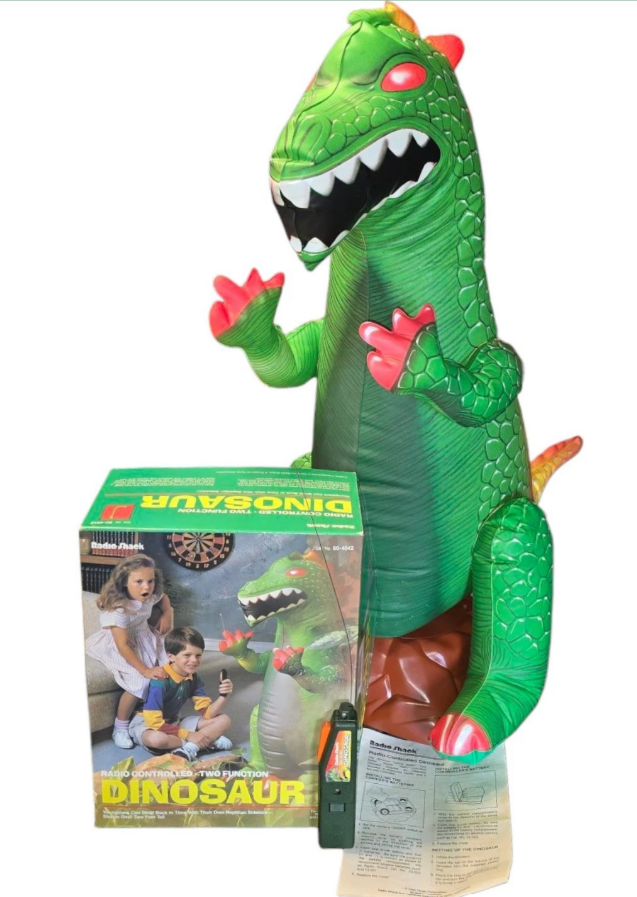
(Image from an eBay listing)
*Bootleg of Dor Mei model 5, the ‘smiling Soma bootleg’
(Images here from various eBay listings)
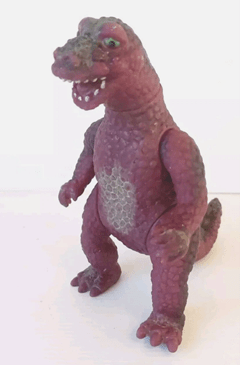
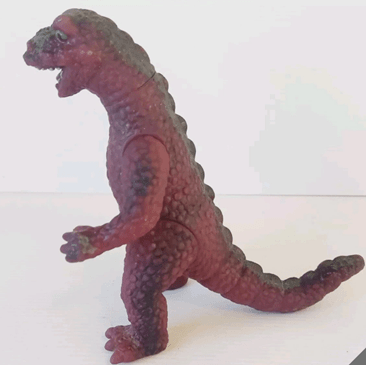
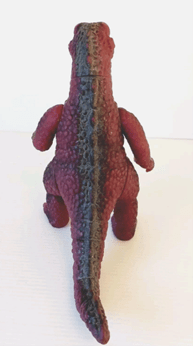
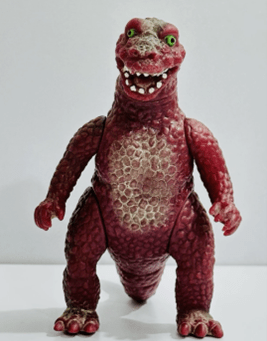
Again I do not yet own one of these, and so all details are taken from sale listings. These are more individual in their designs than those we have seen before, but the small humped spine fins and scale pattern points towards the Dor Mei model. In addition, they articulate in the same way as the Dor Mei models. They are reported as standing about 155 mm. tall, and appear to have been produced in relatively thick plastic. The head sculpt is more like a realistic tyrannosaur than any other, but was most probably was drawn from the Dor Mei, and has an accidental overall effect of a smiling or happy dinosaur. I know of them only in red with white highlights. They have “© 1987 SOMA” underneath both of their feet, as well as “MADE IN CHINA” stamped underneath the base of the tail. These allow us to identify them as products of the Hong-Kong based Soma Toys company, who were founded in 1967 as a trading company and distributor of various diecast brands, and continued toy production throughout the 1980s and 1990s, with a particular speciality in numerous lines of dinosaur toys and related products.
*Bootleg of Dor Mei model 6, the ‘1992 Soma Godzilla bootleg
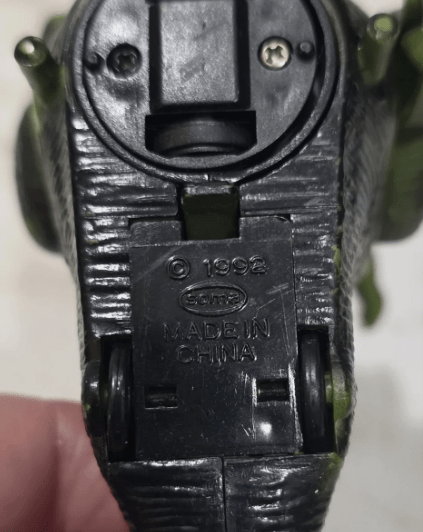
(Images here from an eBay listing)
I do not own one of these and the details here are taken from online sale sites. There is much to link this model and ‘the unbranded radio controlled Godzilla’ described above, with the main differences being to do with minor sculpt details (such as the scale pattern on the stomach and details of the feet and head). It appears to be much the same size, but unlike the radio controlled version, this one is battery operated, and has a wheel underneath to allow it to turn as it moved forward. Just below this wheel we find the ‘Soma’ company mark within a circle, a statement “MADE IN CHINA” and a copyright assertion dated 1992.
⁂
⁂
The Chinese region bootlegs of these models: the copy of the ‘company X’ Godzilla:
*Bootleg of ‘company X’ model 1, the ‘large Soma bootleg’
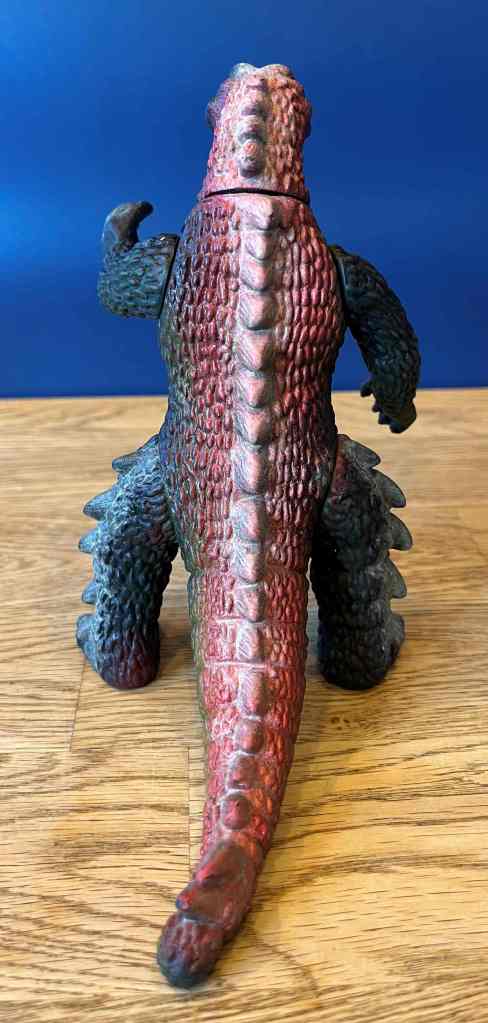
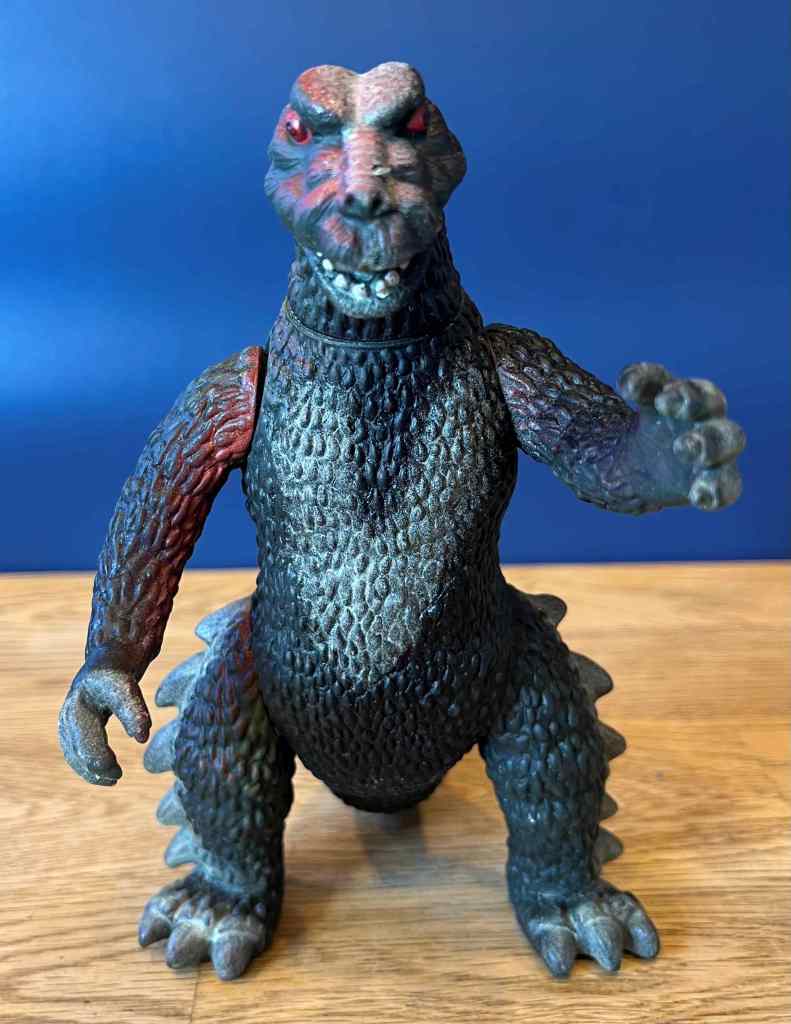
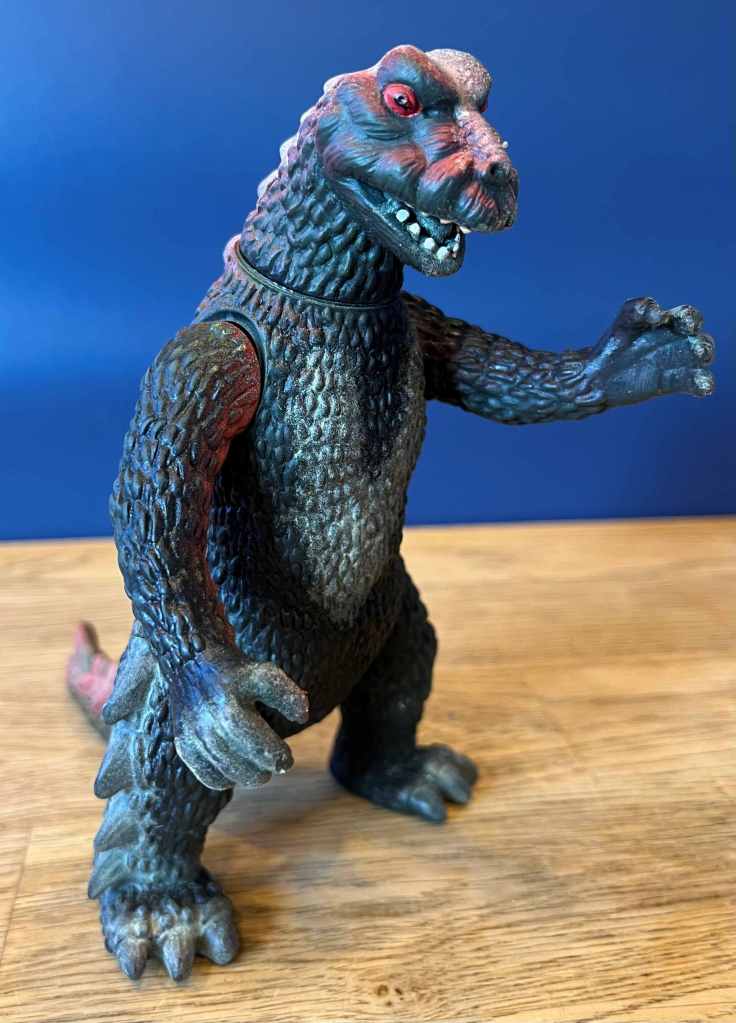
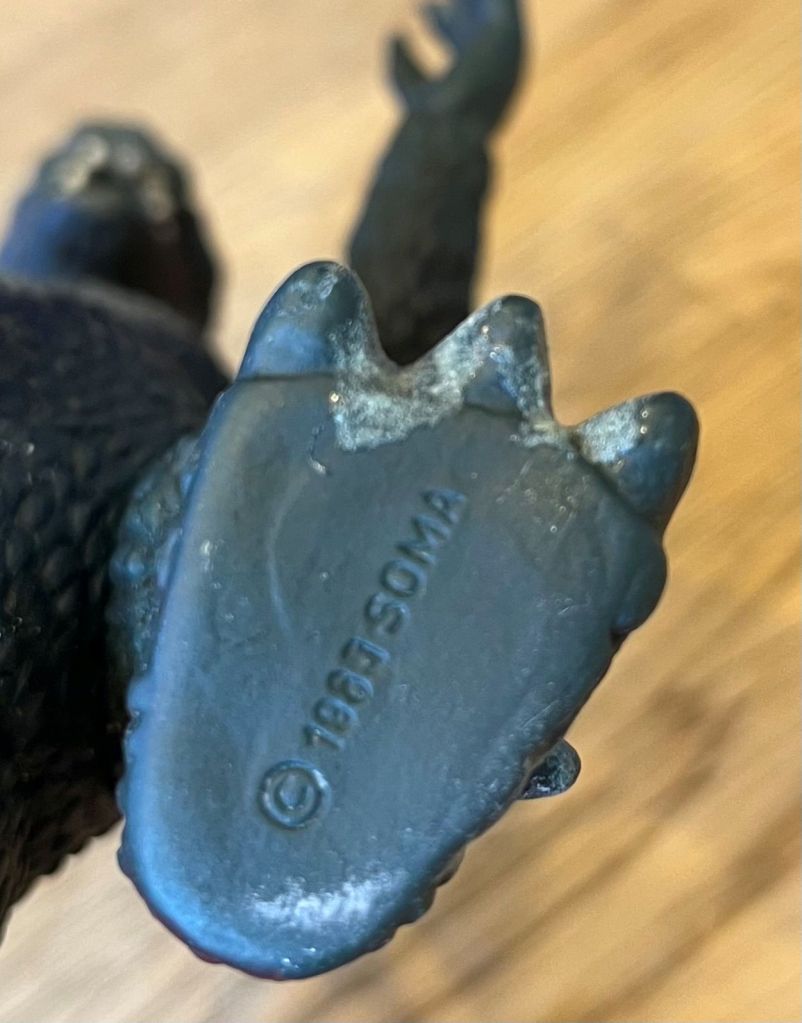
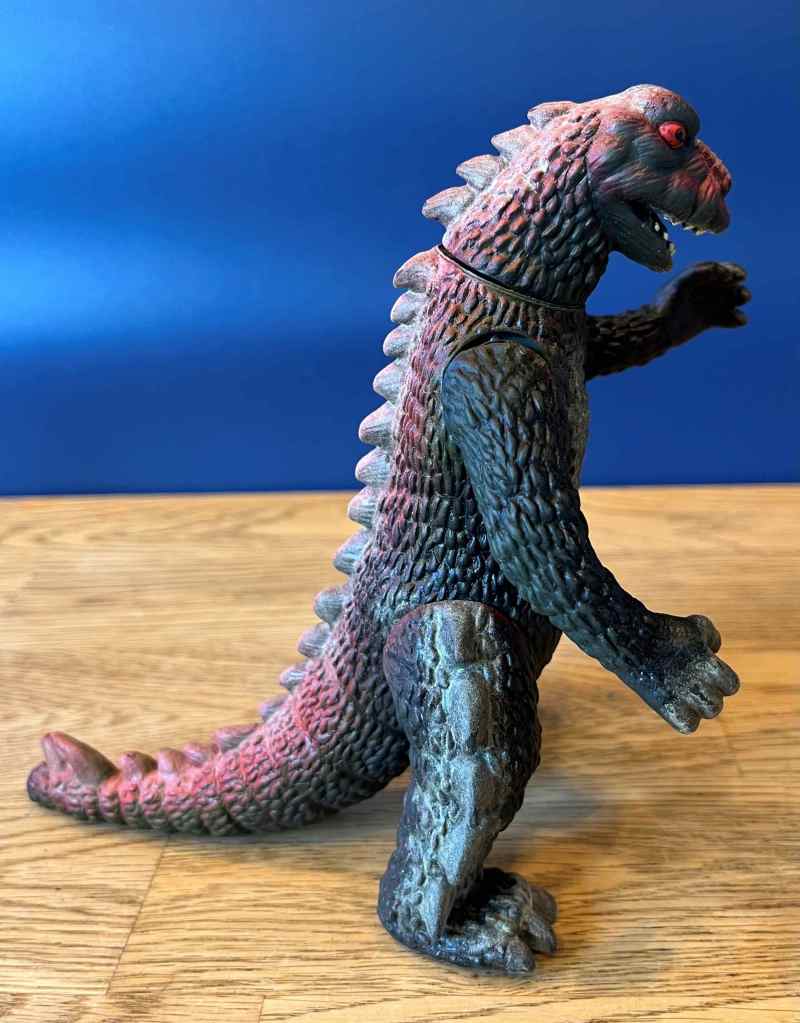
Bizarrely, Soma Toys also produced at the same time as the ones detailed immediately above, another quite different bootleg drawing on the ‘company X’ model. The muzzle design, detailed scale-pattern, row of sawtooth spine fins and three toes that end together in a single line strongly suggest an origin for the design of this figure in the ‘company X’ model. They articulate in the same way as the ‘company X’ models, as well as at the neck. They are in hard vinyl, stand about 155mm. tall (just over 6 inches), and weigh about 29g. They appear in black with green or burgundy-red highlights, and have a further crystalline layer of paint added to their heads, edges of fins or spikes, hands and feet and in a crude ‘V’ shape on their chests. This crystalline paint I discovered by accident while walking through a dark corridor holding mine, glows in the dark. They have a head with notably high skull-top and brow-ridge, and uniquely have rows of smaller sawtooth fins along the outer seam edges of the legs. The throat is closed, and they have “© 1987 SOMA” underneath both of their feet. As with other models above this date should be seen as the beginning of their production run, not a definitive year that all examples were produced in. These models have one notable feature of their own – a design flaw in the legs, that produces a ‘bow-legged’ stance that along with the fact that these legs are set at the back of their lower body makes them extremely unstable, and inclined to lean precariously forward. In this regard the legs are almost as badly spaced and sited as the Yamakatsu 2.5” Godzilla figure or some of the dreaded silently-screaming chinasaurs.
⁂⁂⁂
⁂⁂⁂
Concluding remarks:
These three basic Godzillas, one authorised by Toho (Imperial) but quite amateurish when compared to Toho’s designs, and two other bootlegs (Dor Mei and ‘company x’), spawned a wave of bootlegs in China and Hong Kong in the 1980s and 1990s, and all of the products of that activity flooded the markets of Europe and the Americas as inexpensive Godzilla and dinosaur toys. These were the ones that most of us knew and adored in our childhoods – with the authentic Japanese sofubi of Godzilla a distant dream. In turn, these Chinese and Hong Kong Godzillas would provide the models for almost all bootleg Godzillas then produced in the Americas and Europe (either side of the Iron Curtain) – and I shall attempt to document some of those in subsequent posts.
- 'MUTTON DRESSED AS LAMB': Godzillas and kaiju that look vintage, but are not
- American made Pachi
- BOOTLEG DINOSAURS – a little off topic, but sometimes needed here
- BOOTLEG GODZILLAS
- Bootleg Tokusatsu from China and its immediate neighbours
- Bootleg Tokusatsu from the Americas
- BOOTLEG TOKUSATSU HEROES
- Central Europe – Godzillas and kaiju from behind the Iron Curtain
- Chinese-region bootleg Godzillas -the plastic tide from the East
- Chinese-region made Pachi
- European made Pachi
- European-made Godzillas
- PACHI
- Pachi kaiju
- Pachi kongs
- Pachi superheroes – Ultraman and similar
- The Americas – bootleg Godzillas from the New World

 Confessions of a Kaiju Hunter
Leave a comment