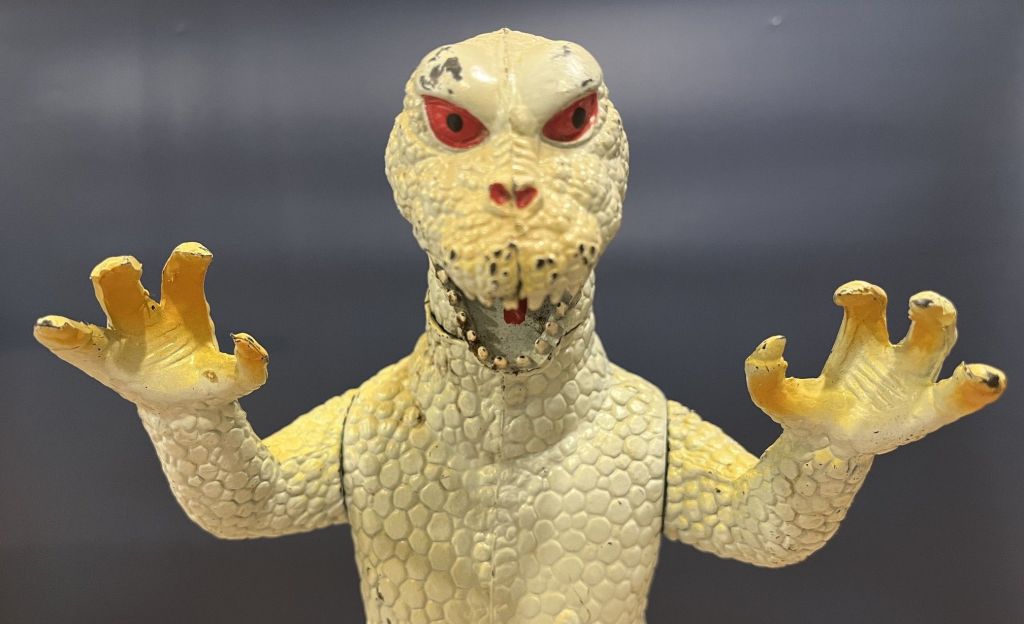
As I have said in another post, the Dor Mei Godzilla bootlegs usually come in two colour schemes: green with orange highlights, and black with red or green highlights. But, there is a third, much rarer, variant in a pale blue-white base colour that was thickly painted over a dark (usually black) vinyl body, and that then highlighted with some combination of red, orange, yellow, brown and occasionally green. For the Dor Mei collector, these are our Moby Dick, and only occasionally sited despite months ‘at sea’ in online sale sites as mad as Ahab and screaming “To the last, I grapple with thee; from Hell’s heart I stab at thee; for hate’s sake I spit my last breath at thee” at our computer screens.
The repainting of the vinyl parts, rather than sourcing vinyl in the desired colour, is an unusual thing in itself among the Chinese bootleggers. It leads towards quite serious scuffing of the paintwork, and is unforgiving of such damage when using a light colour over black – clearly showing the contrasting black showing through with every scrape and chip. It is a technique that usually, among the Chinese Godzillas, points towards the later Chinese bootlegs, such as the Heisei model (my *Bootleg of Imperial model 5) and the final models of the Imperial minis and the ‘company x’ Sharkzillas (for all these, see my earlier post on Chinese Godzilla bootlegs). In fact, the use of this technique by a major toy production company such as Dor Mei probably locates our ‘white Godzillas’ in the 1990s, and perhaps the middle of that decade.
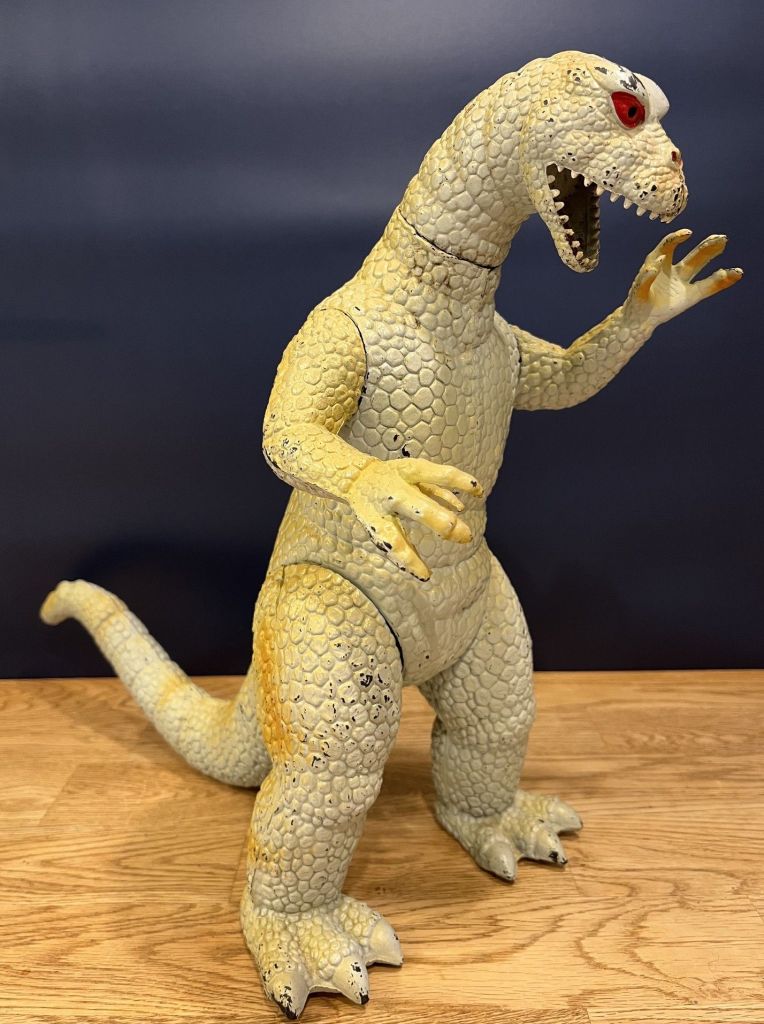
I proudly own one of these ‘white Godzilla’s, acquired last year from a collector who had two and thus could afford to set aside a duplicate. A few days ago, he chanced upon another at a fleamarket (he seems to have an uncanny magnet-like knack for drawing them to him, of which I am extremely envious), and got in contact with me to let me know of his discovery and send me images of both of his. These, as well as the handful of others I know from online sale sites, brought the numbers known to me to just enough to say something meaningful about the main features of this sub-group.
They do not deviate from the main Dor Mei models in height and weight, and so I shall not repeat that information here – but direct my reader to the relevant part of my earlier post on Chinese Godzilla bootlegs.
⁂
There appear to be two main types:
(A.) That using the ‘ridgebrow’ head sculpt, with bright red eyes and the whole figure with a white basecoat of paint except the soles of the feet, and heavy coloured shading all across the back, arms and reverse of the thighs of the beast, just as the usual Dor Mei models are shaded.
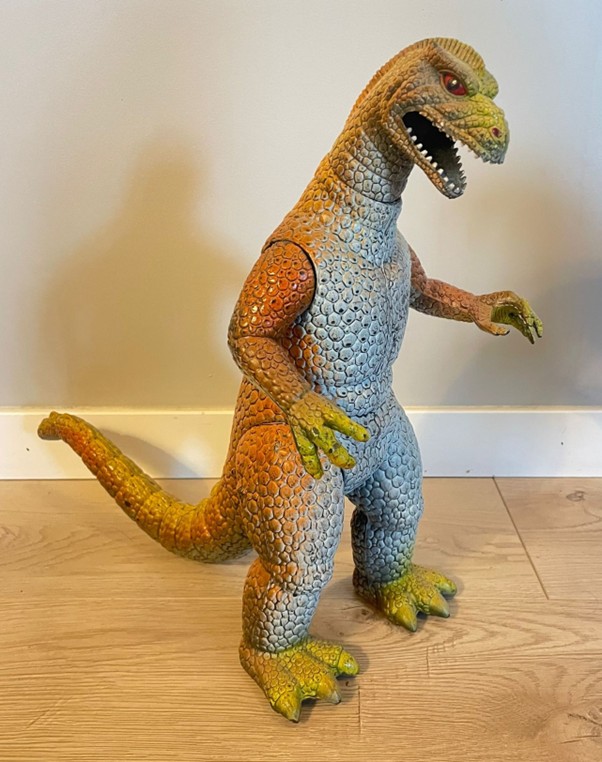
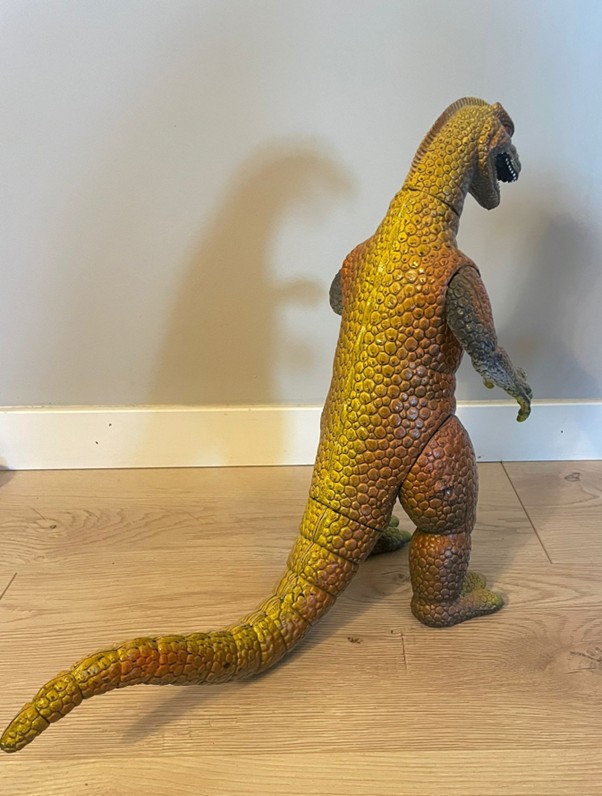
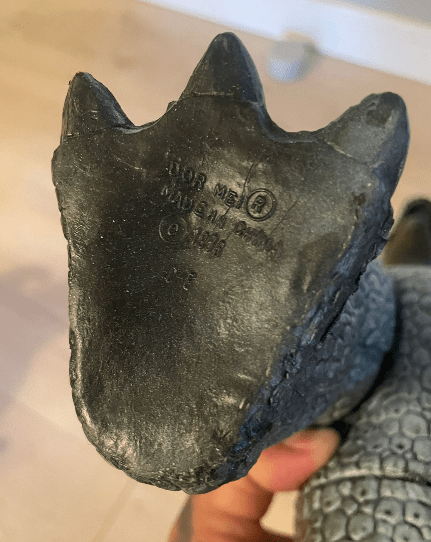
(Private European collection; images reproduced here with the owner’s permission – the left foot is identical to the other Dor Mei models, while the right foot has some crucial variations: on this see below)
I know of another of these, from a Vinted listing, with almost identical features:
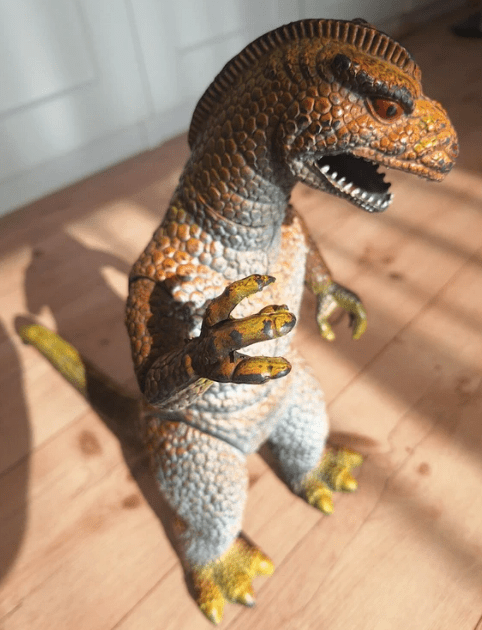
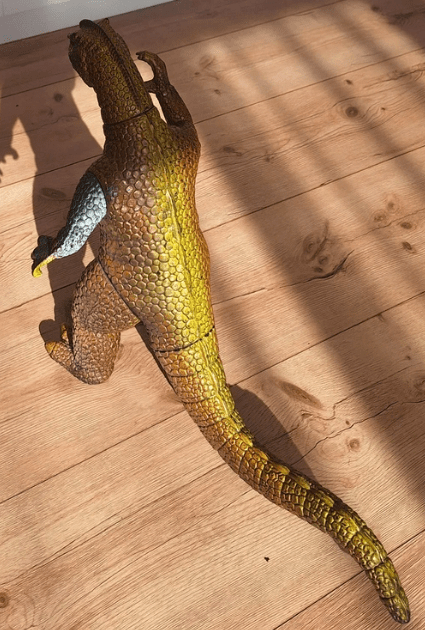
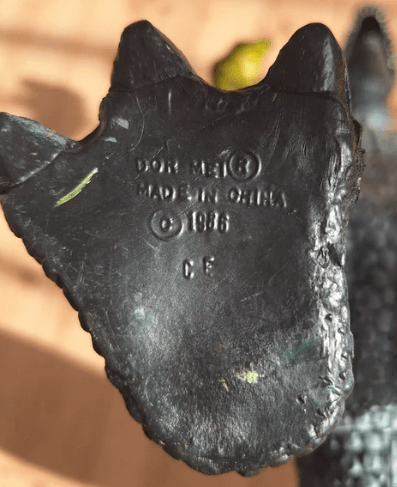
(Images from Vinted listing)
A third example of this type is listed on an online sale site named ‘Vintage Man Stuff’:
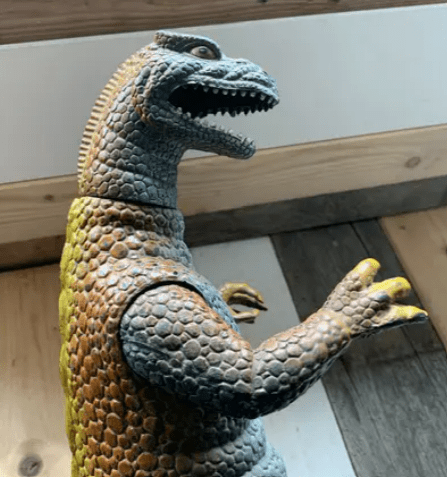
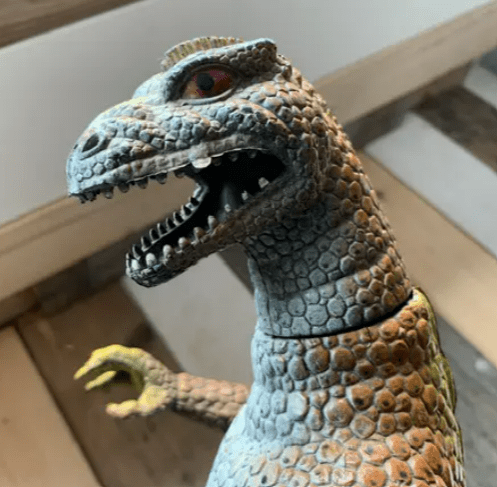
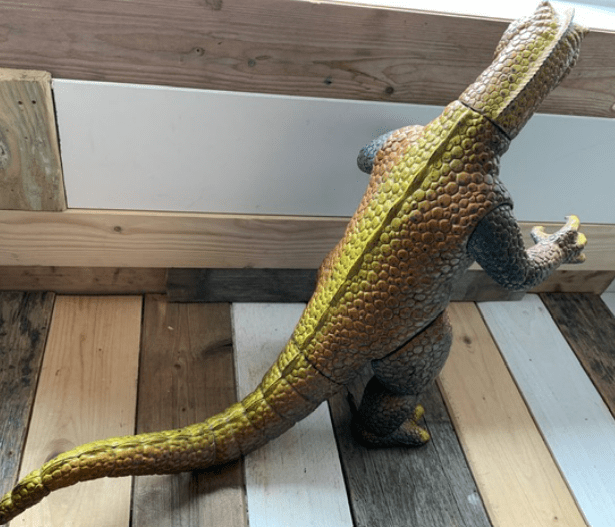
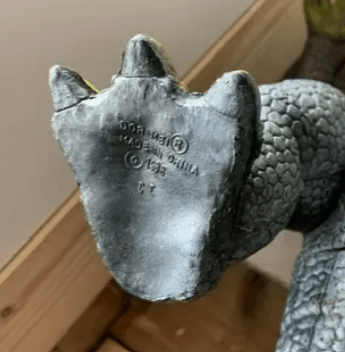
(Images from the Vintage Man Stuff listing)
[UPDATE 4 July 2026: I stumbled over another one of these posted on Instagram in 2018 by a user named ‘lord_fritzkrieg’, see here.
⁂
(B.) The second type uses the ‘rounded muzzle’ head sculpt, with the same bright red eyes and white basecoat over the whole body but now including the soles of the feet (this perhaps meaning that they were sprayed white when there body parts were separate, while the first type was probably sprayed after assembly). These have much lighter coloured shading in the same areas as before, as well as a series of prominent horizontal stripes of paint a few centimetres apart all the way along the spine, tail and the backs of the legs.
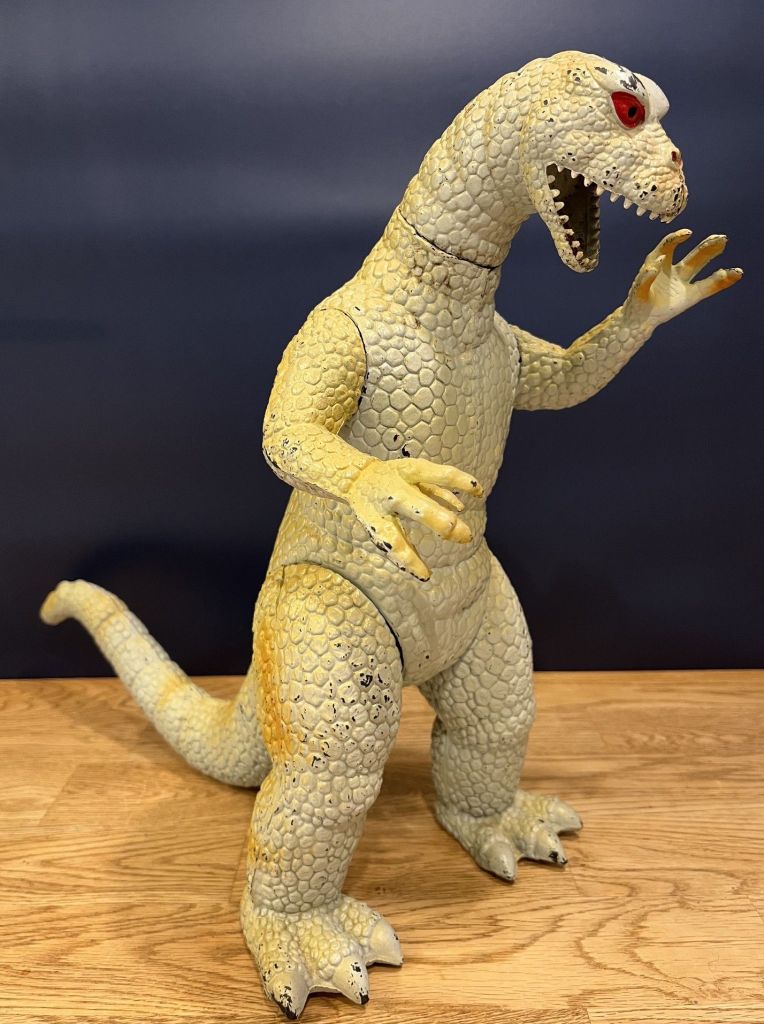
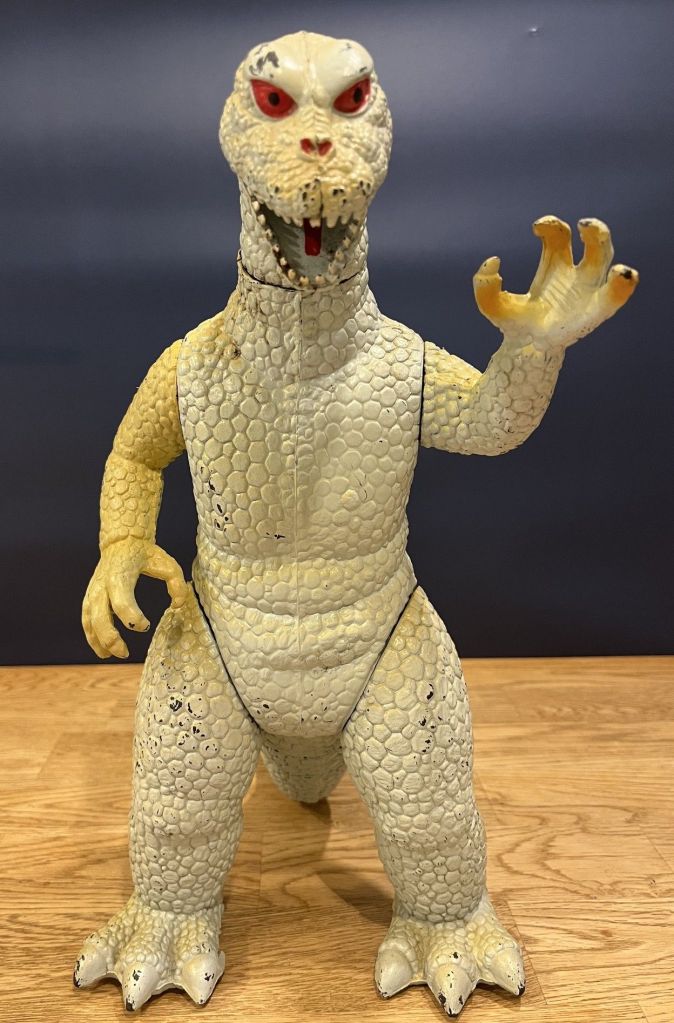
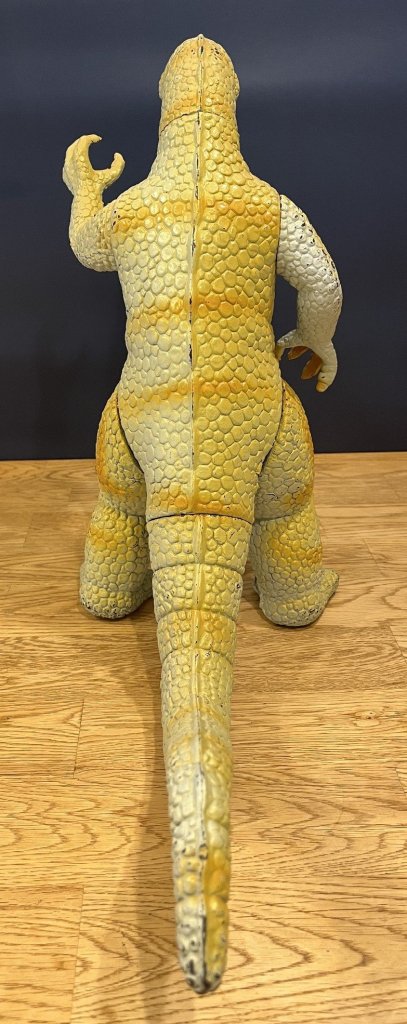
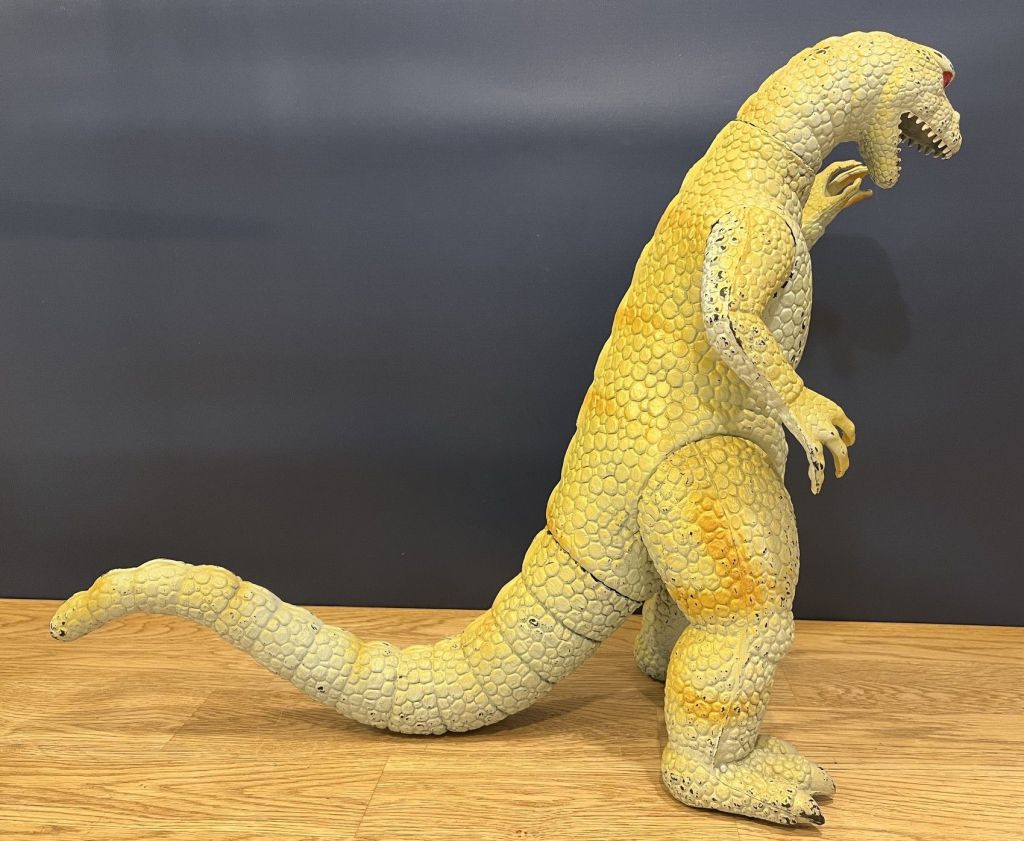
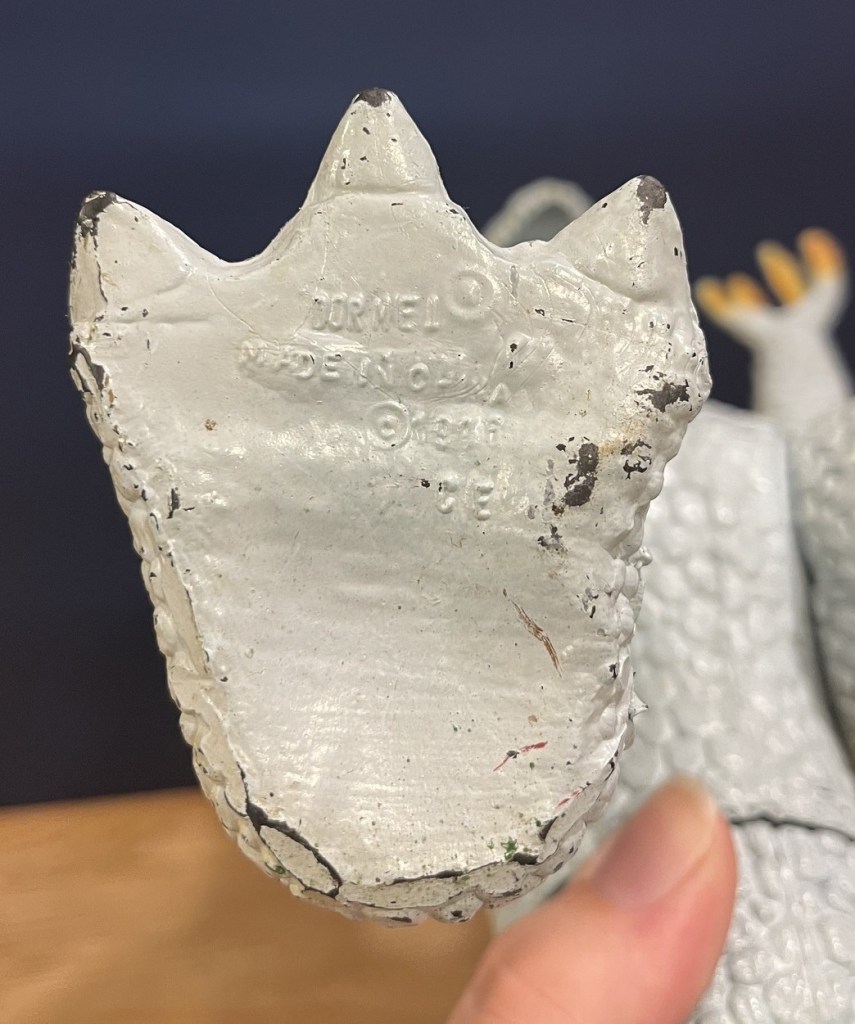
(These images of my ‘white Godzilla’)
I know of another example here, also from a Vinted listing:
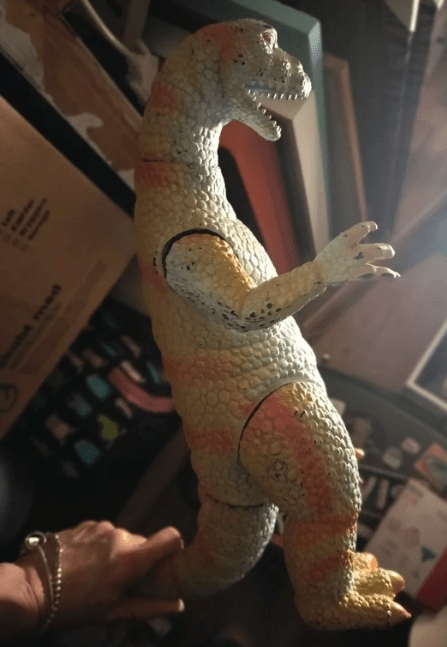
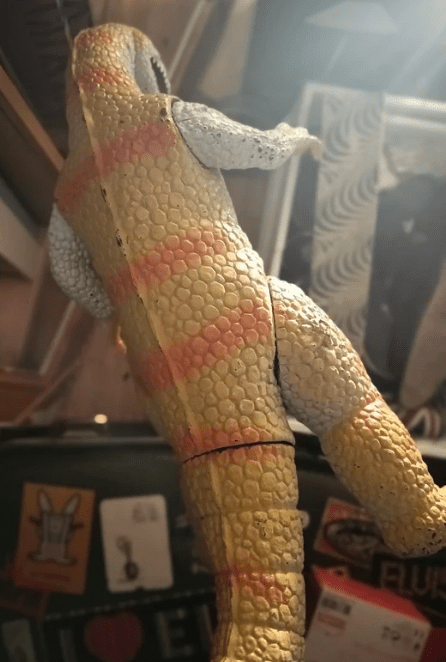
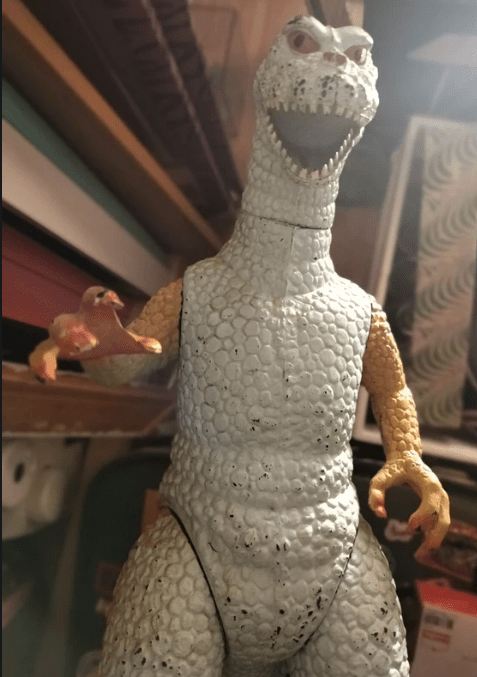
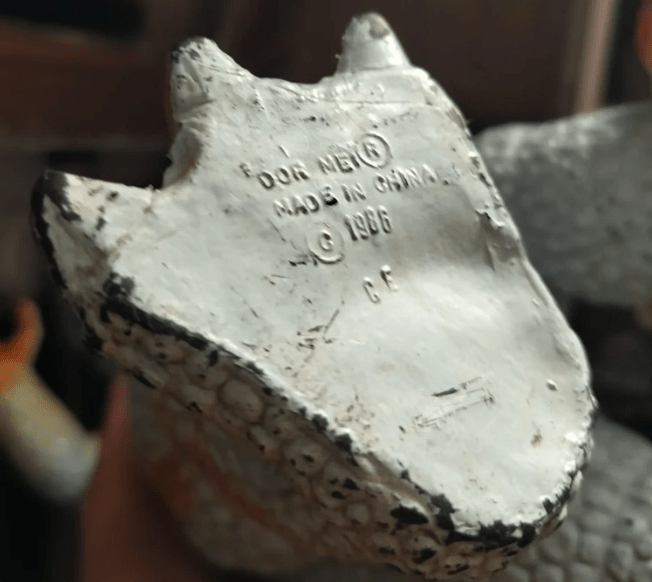
(Images from Vinted listing)
And another example from eBay:
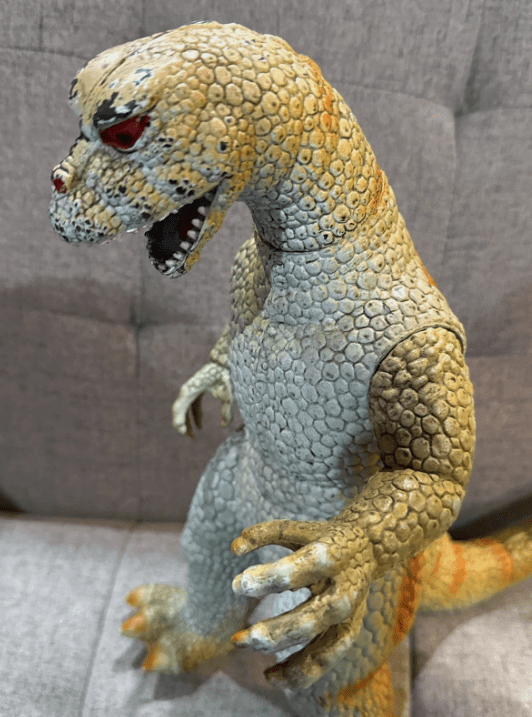
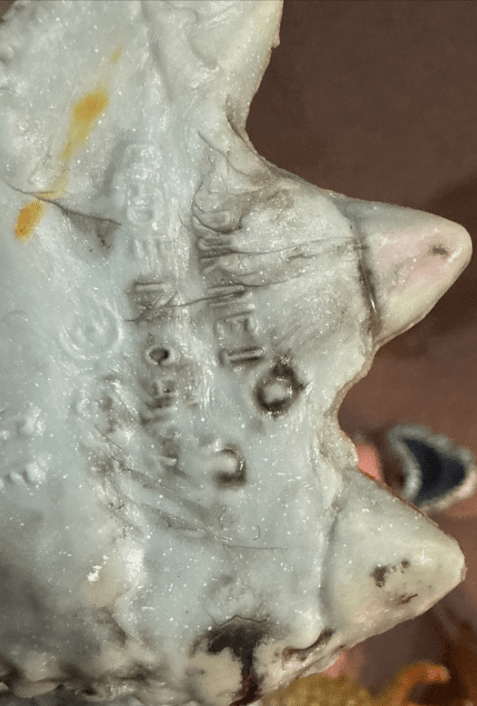
(Images from eBay listing)
A side shot (without images of the marks under the feet) of a final example is used as a background image on the website of a modern furniture designer in Lichfield County, CT., USA.
⁂
What has come to light in the recent fleamarket find is a new mixed type, that combines the features of the two main groups: the ‘ridgebrow’ head sculpt and heavy shading of the back of the beast, with the spine-stripes and the white-painted soles of the feet of the second type.
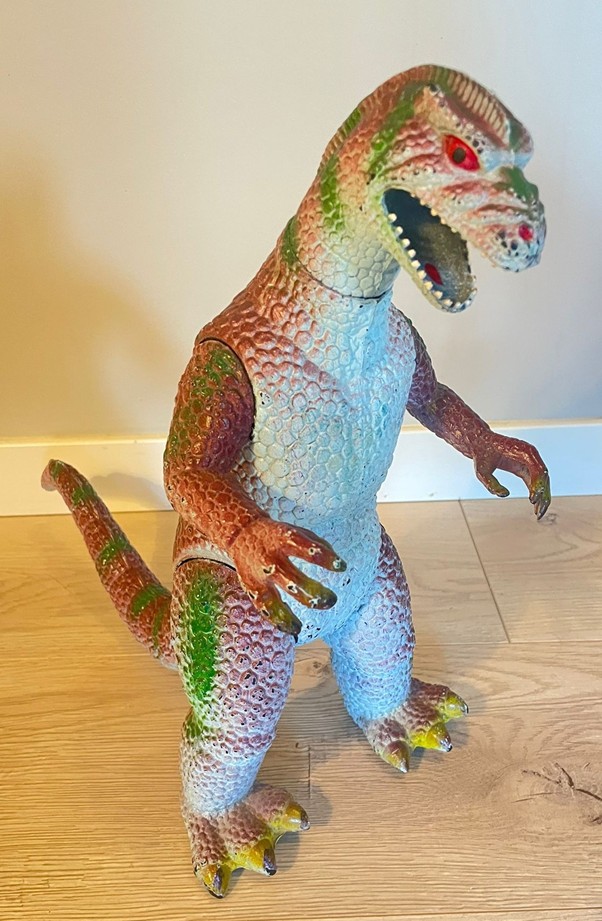
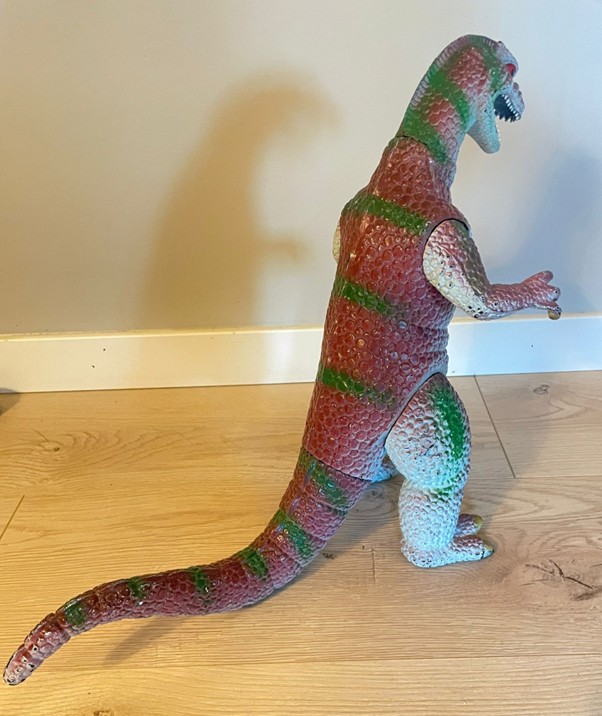
(Private European collection; images reproduced here with the owner’s permission)
Personally, I find this final version the most appealing, with an attention to the colouration and eye for the combination of strong colours that sets this apart from the others in this sub-group. The artist who painted this one had skill and seems to have taken pride in his work.
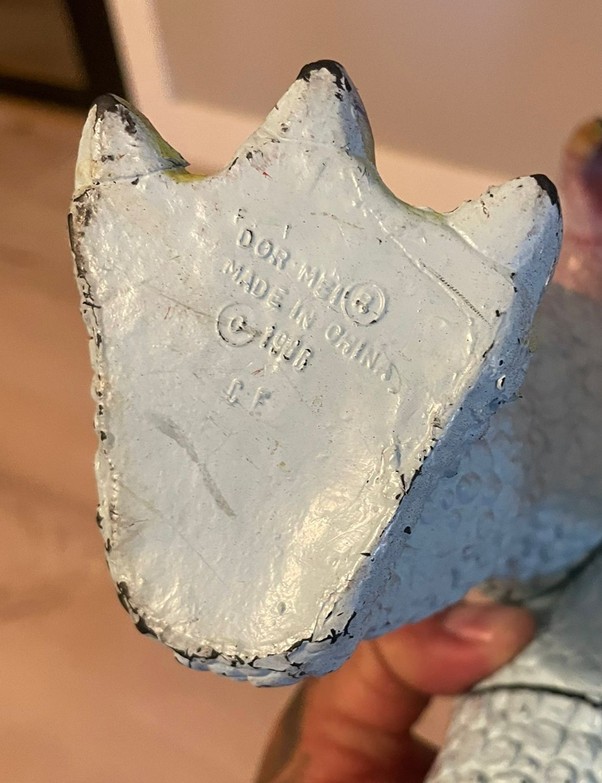
What can we say about the producers of these bootleg Godzillas? Firstly, we should note that every one of the footmarks here gives the place of production as “China”, not Hong Kong where Dor Mei was based and where the earliest waves of production took place. As I said in the main blogpost on those, we cannot take the date “1986” here to be a date of production, and this should be understood in the context of the “©” before it as a copyright date instead, indicating when the type was first made and registered (in this case with the UK authorities).
In addition, a really close look at the marks on the soles of the feet reveal that there are two versions of the legs of this beast, at least – and these suggest that all the types described here were produced within a single workshop or series of related workshops. The differences are in the fonts of the different lines of text, and the alignment of those lines relative to each other, as well as the addition of an unexplained new mark: “F I” diagonally above the first word of the first line.
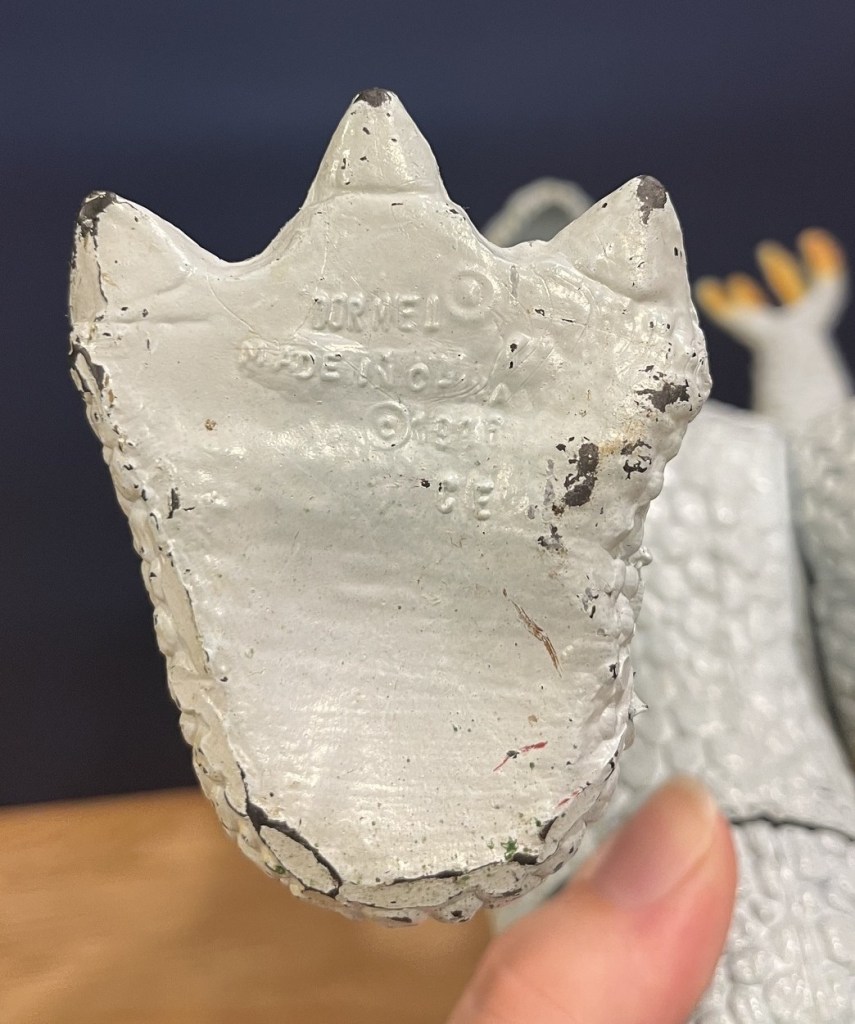
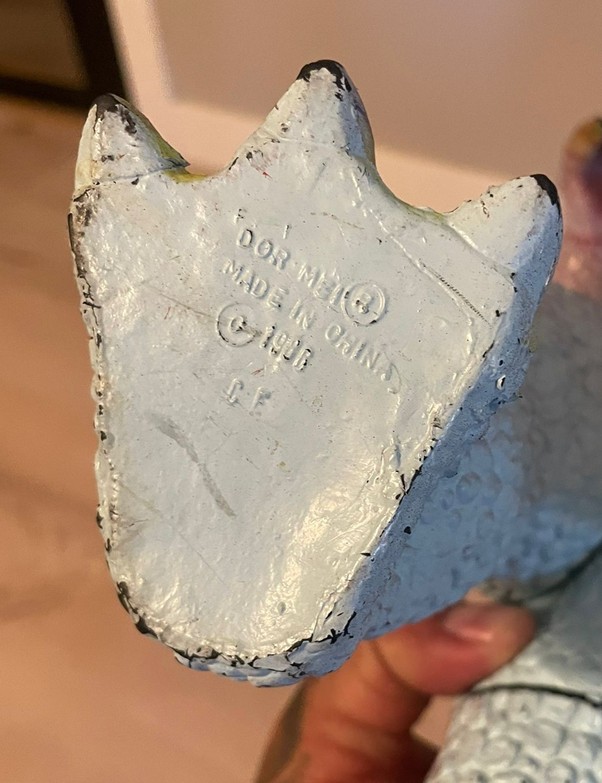
(The right feet of my ‘white Godzilla’, and then the newly discovered one, in that order)
Under the right foot of my ‘white Godzilla’ the “Dor Mei” in the uppermost line is in a different font to that of the rest of the information given, and the copyright mark ‘©’ sits beneath the the ‘N’ of “IN” in the line above. However, others here use a single font throughout and with them the same copyright mark sits beneath the ‘D’ of “MADE” instead. This second type also has an additional “F I” placed diagonally above the “DOR” in the uppermost line. These two different sets of marks appear in both types A and B above, indicating that when painting those two types the decorators had access to a common stock of legs, which had been produced in two waves – rather than working apart from each other, with sets of legs produced in-house within two separate workshops. I should love to hear from anyone with suggestions as to what “F I” means or stands for – and assuming that these were not made for Finland (I’m joking, of course), I am out of ideas.
We might also ask where the inspiration for the stripes along the spine came from. There were a few earlier plastic dinosaurs produced with broadly similar stripes – such as Imperial’s 1985-made Styracosaurus and Dor Mei’s 1986-made T-Rex (see below), but these are either not common or frequent, or have the stripes as emerging from a wide band of the same colour that runs the length of the spine, and these seem unlikely models to me.
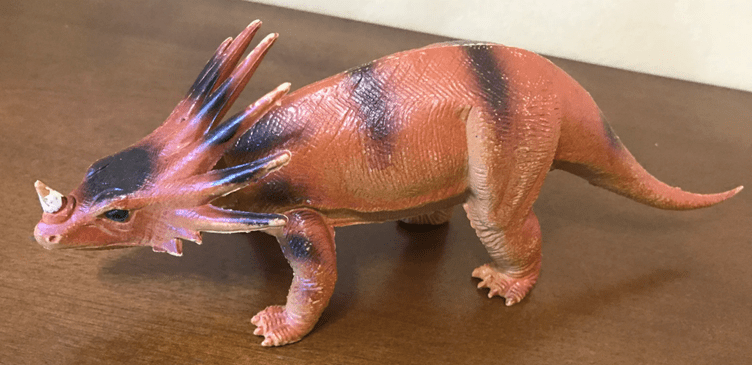
(Image from an Etsy listing)
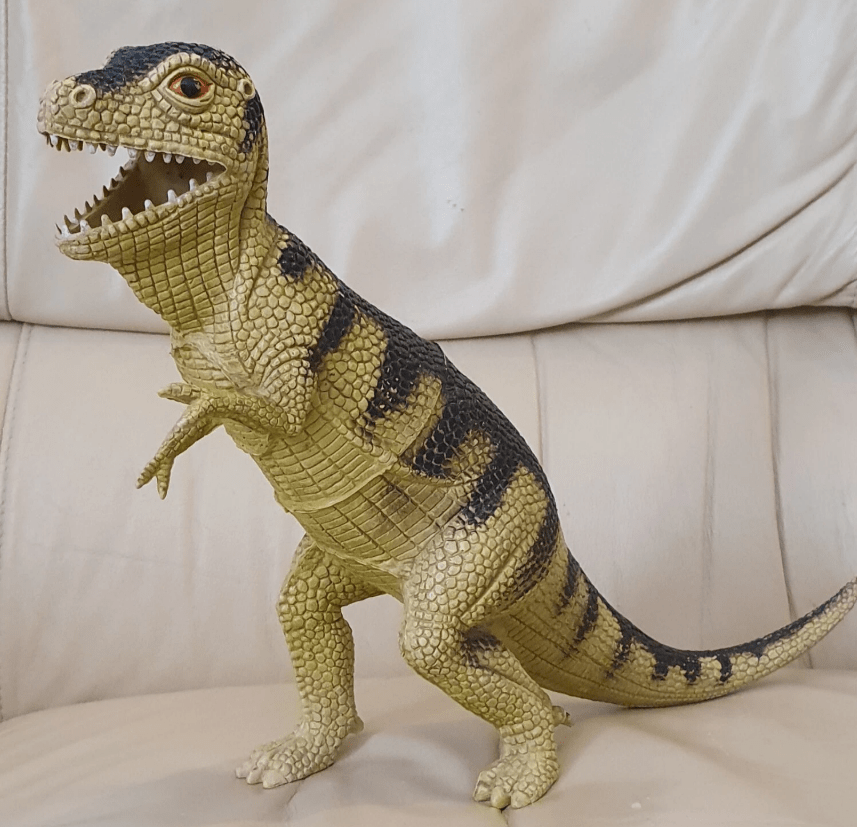
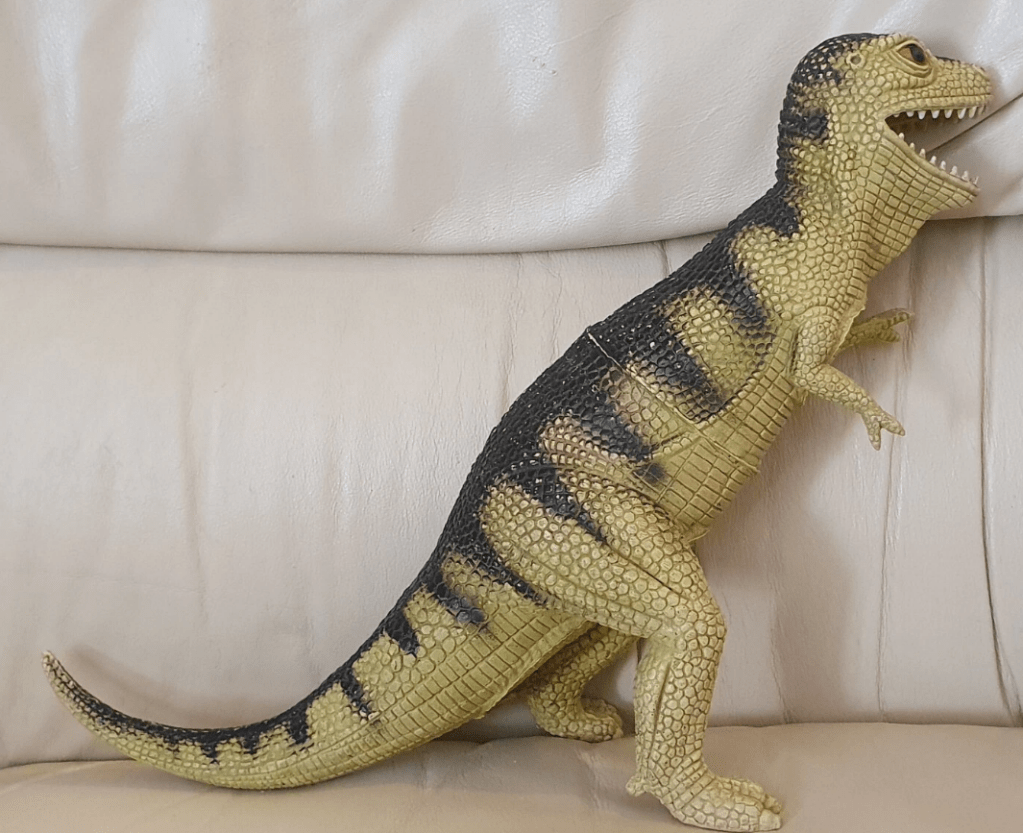
(Images from an eBay listing)
One further possibility occurs to me. In 1993, Kenner released a juvenile T-Rex toy as part of their toy line produced to coincide with the release of the film, Jurassic Park. The juvenile T-Rex had played a role in the book, but was cut from the 1993 film and mentioned only in passing on the caption for Tyrannosaur enclosure in the map of the park as given by Jurassicworld.com (an in-universe website accompanying the release of the film, and now defunct; for information, see here). With no screen model to follow for the juvenile, Kenner decided to mark it with prominent stripes along its spine and tail, thus:
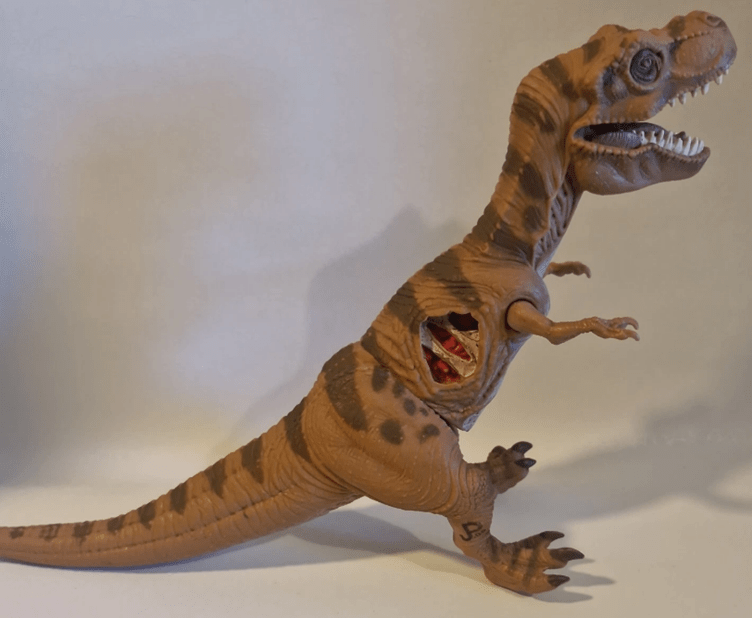
(Image from an eBay listing)
The same toy also has a slightly clumsily painted off-white underside:
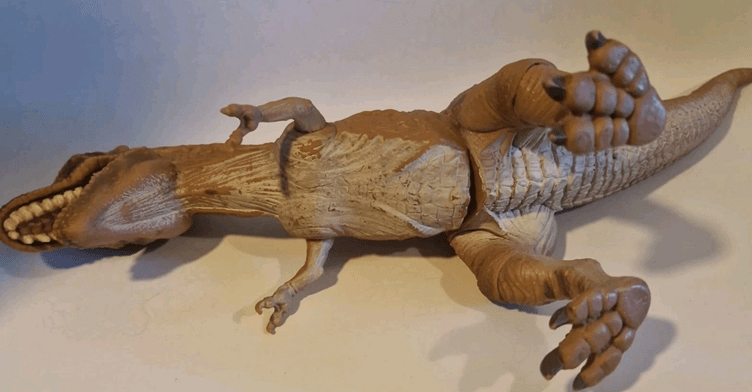
(Image from same eBay listing)
That heavy white overpaint and striped spine and tail may well be the inspiration for the decoration of these ‘white Godzillas’, with their decorators apparently turning to newly minted Kenner toys for artistic inspiration. If so, then we can date these ‘Moby Dicks’ in all their shining albino glory to 1993 or the year or so immediately afterwards.
⁂⁂⁂
UPDATE 25 July 2026: Postscript :- another interesting mixed variant in pale turquoise base vinyl:
Close examination of another of these white Godzillas in a private collection in Taiwan (that of the talented artist Lin TaiHung, who posts on Instagram as ‘taihung_719‘, reveals itself to be a rare variant not encountered by me before.
On 25 July 2026, Lin TaiHung posted some examples of Godzilla bootlegs and toy dinosaurs from his collection on Instagram (see here), including this rather wonderful Dor Mei Godzilla:


(Images kindly supplied by taihung_719 and reproduced here with their permission)
I initially took it to be another example of type A, as described above, but examination of the underside of the feet and the inside (huge thanks to Lin TaiHung for being brave enough to open the beast), show that this was not produced in a base black coloured vinyl, like all the others here, but in a rather alluring pale turquoise vinyl.

(Images kindly supplied by taihung_719 and reproduced here with their permission)
The model was then sprayed like the other type A Godzillas, but when we check the alignment of the text under the right foot it agrees with the type B Godzillas discussed above. So we have a mixed figure, with type A head and body, but type B legs, produced in a variant colour vinyl, but painted like a type B Godzilla.
The use of both type A and B molds argues against the reuse of the molds later in another workshop, and instead it seems most likely that this one is evidence of an experiment with a new colour vinyl – perhaps to try to avoid the work involved in painting the figures in a light base coat, or the black vinyl areas created by even the smallest of scuffs. The rarity of this new variant (this is, as yet, the only one known to me) suggest that this experiment could not be rolled out into main production – perhaps as the cost or availability of the new pale turquoise vinyl proved to be prohibitive. I would of course dearly like to hear from any reader with another, and my personal thanks to Lin TaiHung for preserving this rare Godzilla bootleg as well as having the patience to look at it and realise its rare qualities.]
- 'MUTTON DRESSED AS LAMB': Godzillas and kaiju that look vintage, but are not
- American made Pachi
- BOOTLEG DINOSAURS – a little off topic, but sometimes needed here
- BOOTLEG GODZILLAS
- Bootleg Tokusatsu from China and its immediate neighbours
- Bootleg Tokusatsu from the Americas
- BOOTLEG TOKUSATSU HEROES
- Central Europe – Godzillas and kaiju from behind the Iron Curtain
- Chinese-region bootleg Godzillas -the plastic tide from the East
- Chinese-region made Pachi
- European made Pachi
- European-made Godzillas
- PACHI
- Pachi kaiju
- Pachi kongs
- Pachi superheroes – Ultraman and similar
- The Americas – bootleg Godzillas from the New World

 Confessions of a Kaiju Hunter
Leave a comment