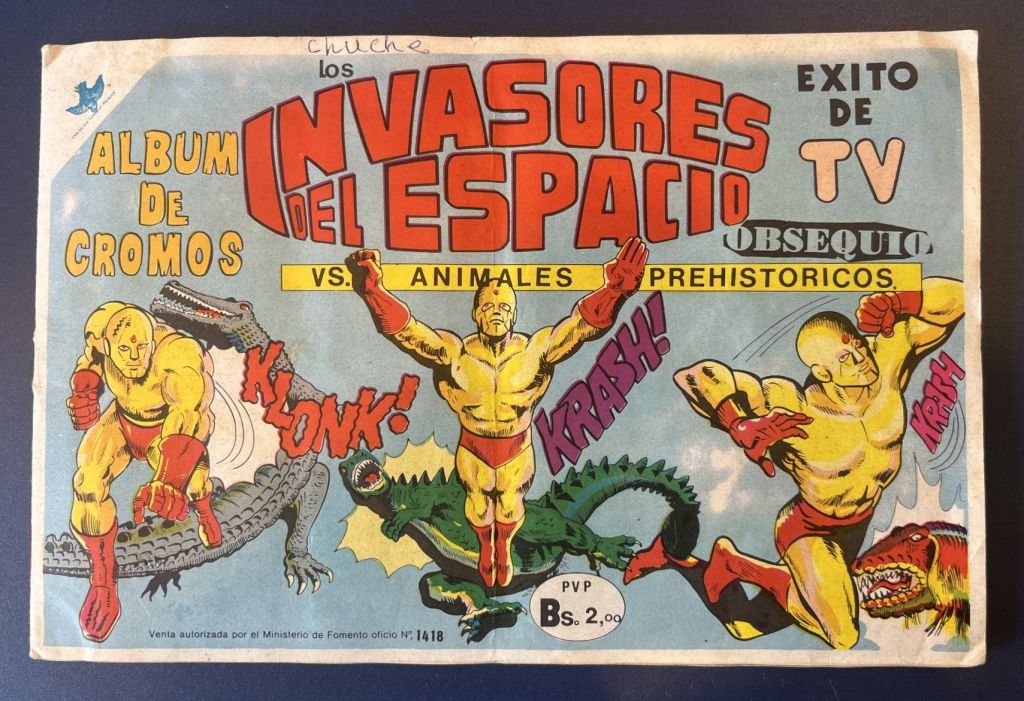
I recently acquired this gloriously illustrated sticker album, complete apart from five stickers – and those missing stickers all from the last leaf of the book where the spaces for the final four stickers in the main sequence were repeated twice more at the end of the album – presumably to drive the original child-owner insane with frustration as they neared the end of the mammoth task of collecting these stickers, only to then to find or swap for the last four stickers twice more. These last four images were, I assume, rarer and thus kept the collector buying more packs of cards long after he had nearly filled the album. The original owner managed to fill three of these additional slots, and initially stuck a sticker in place 131 (“Ejemplar del hombre primitivo”) before moving it to place 127 to complete the main sequence before moving on to the extra ‘victory laps’.
I think we can assume that the slightly sad story here is that not enough of these final duplicates could be found by the original owner before they lost interest or grew up. They might be about 50- or 60-years-old now, and if they should recognise this album here I invite them to get in contact – together we might try now to find the last five stickers and complete this vast labour of love from their childhood.
The same series is known from occasional online sale listings for the loose cards and large countertop sale-point boxes filled with them, as well as a poster advertising their sale posted on Instagram by a Venezuelan collector named Looppapertoys:
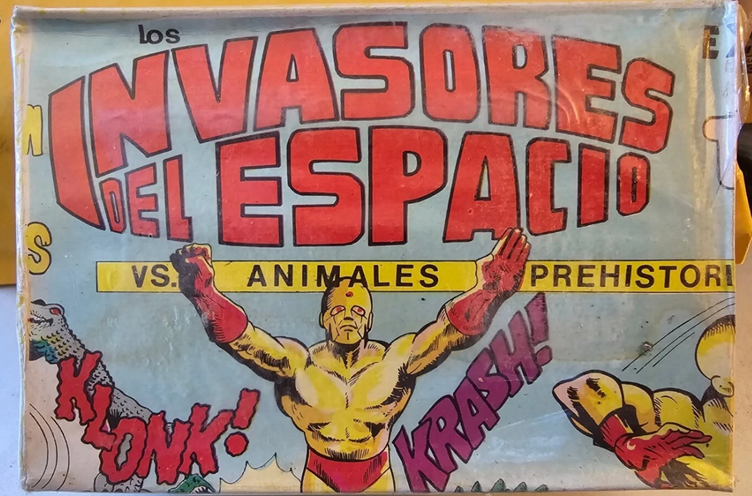


(These images from a recent eBay listing)
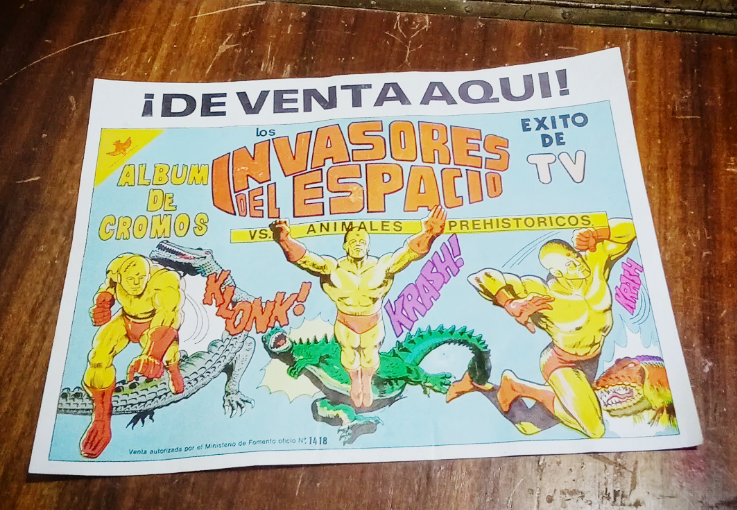
(From Looppapertoys Instagram post)
However, collectors should beware that the manufacturers produced another similarly named ‘Invasores del Espacio’ series at much the same time, and the sealed packets of those are often mistaken for the ones we are discussing here (a somewhat sparse description of one of these albums without stickers, on the Paninimania website, makes just that mistake and shows a sealed packet of the other series for this one). I have not seen a sealed packet of the cards for our album here, but perhaps a reader owns one and will get in contact.
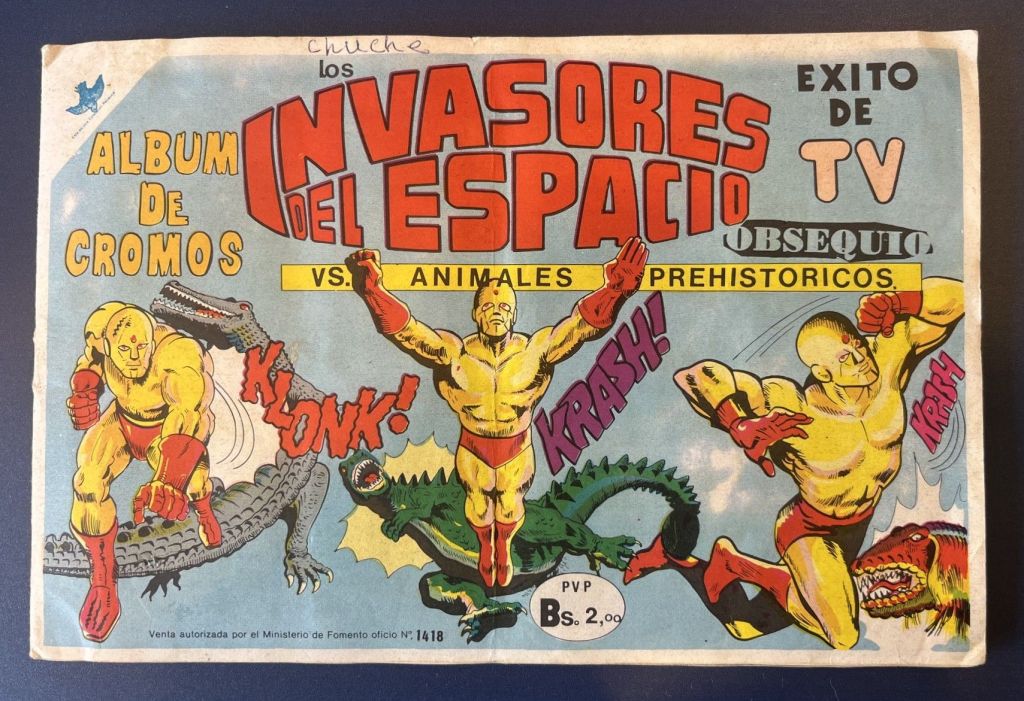
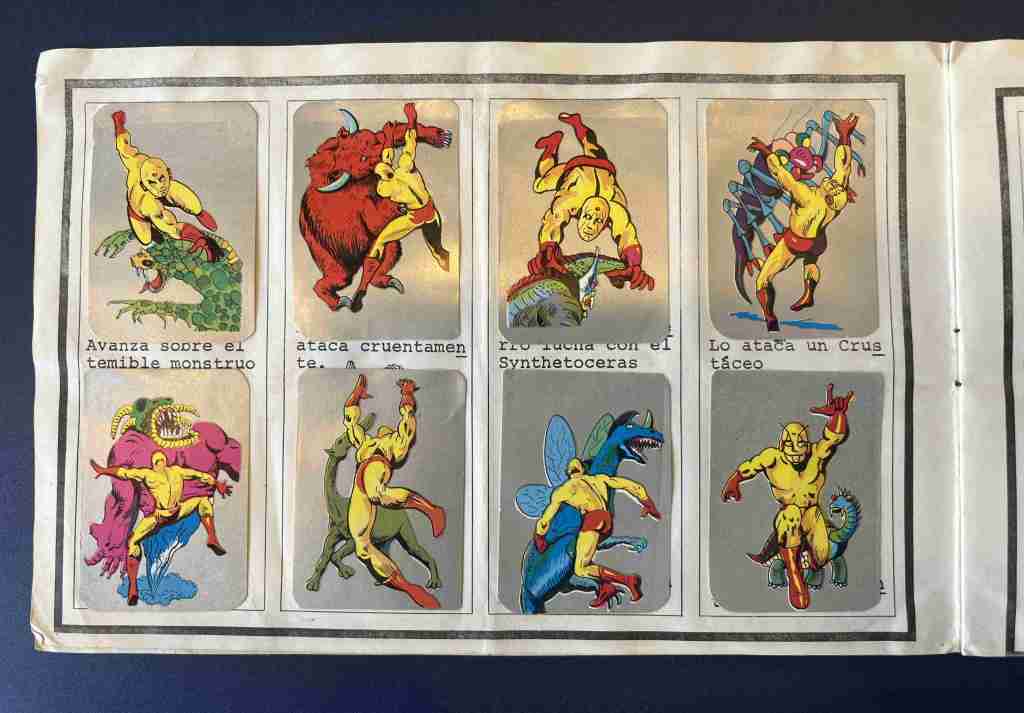
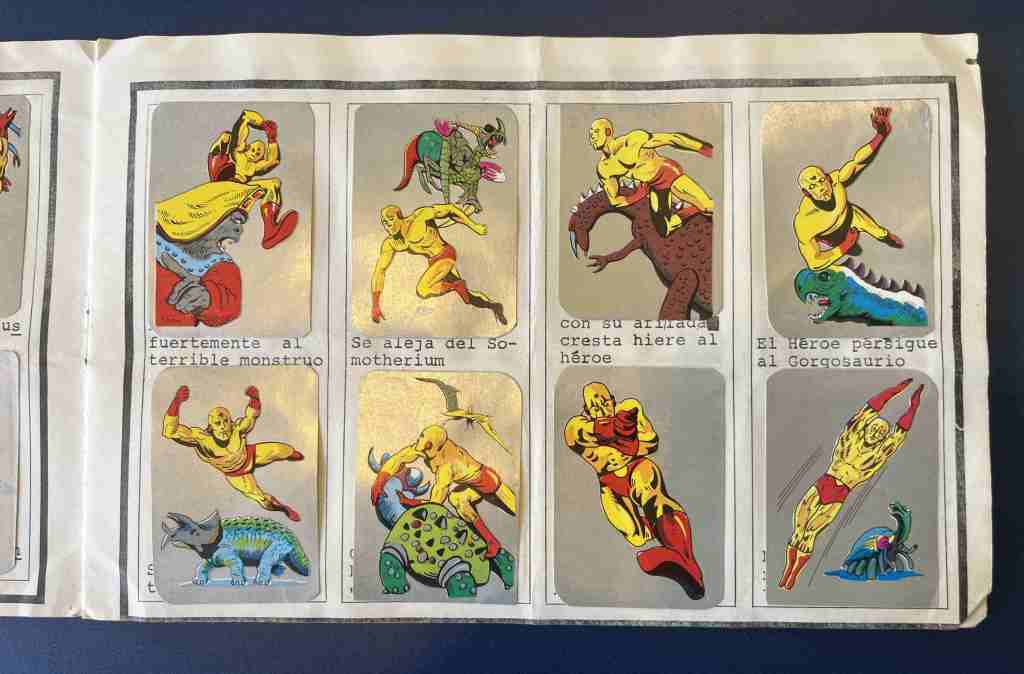
I add photographs below of the entire album, cover-to-cover, in the hope that readers will find the artwork of these images as captivating as I do:
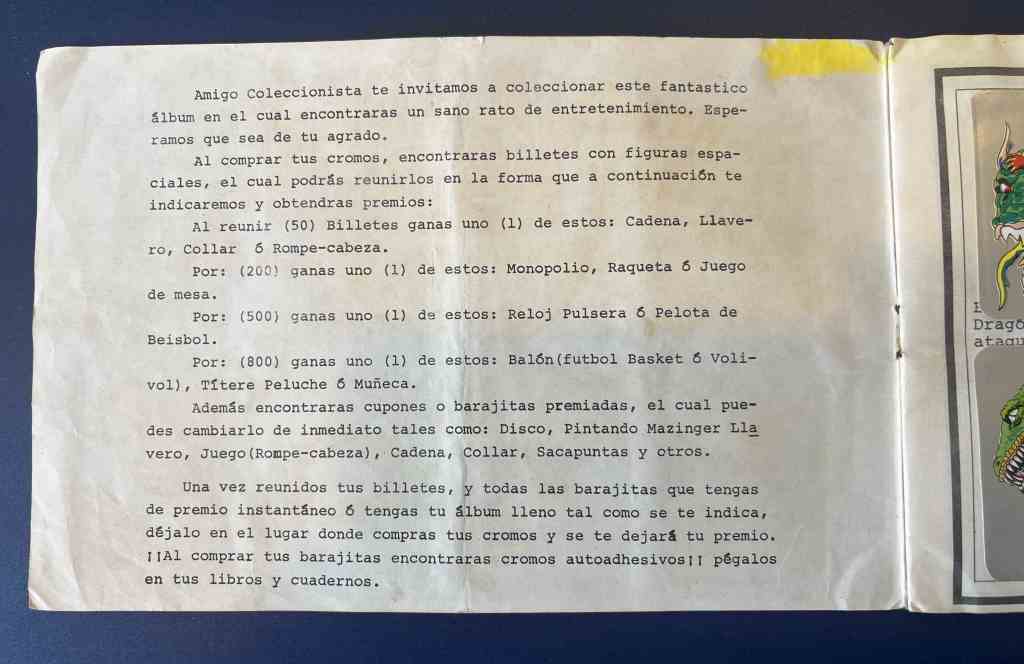
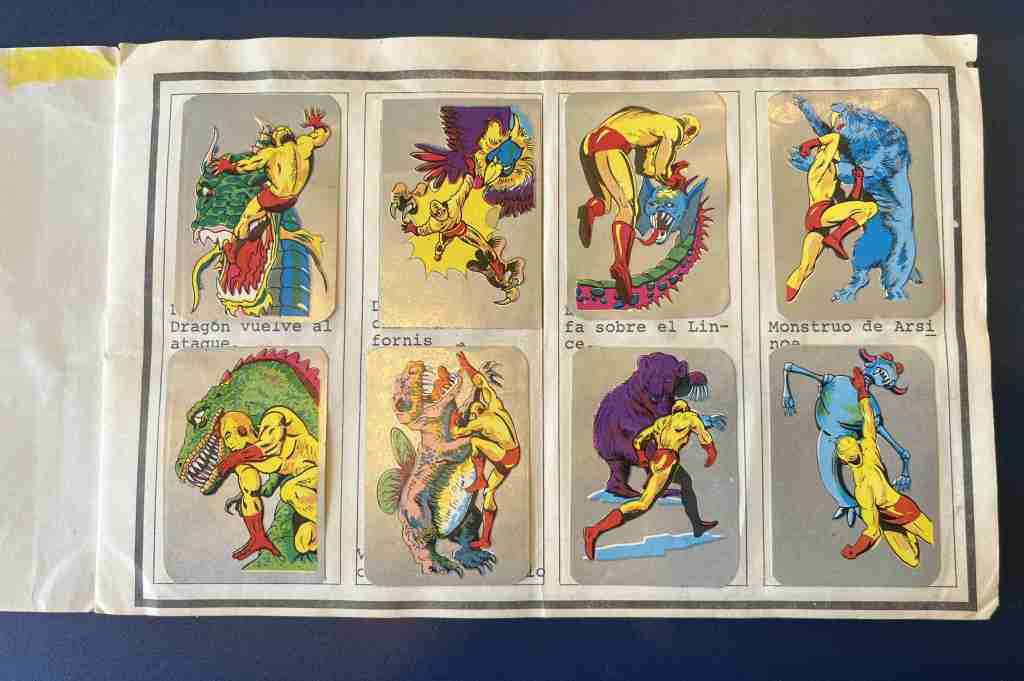
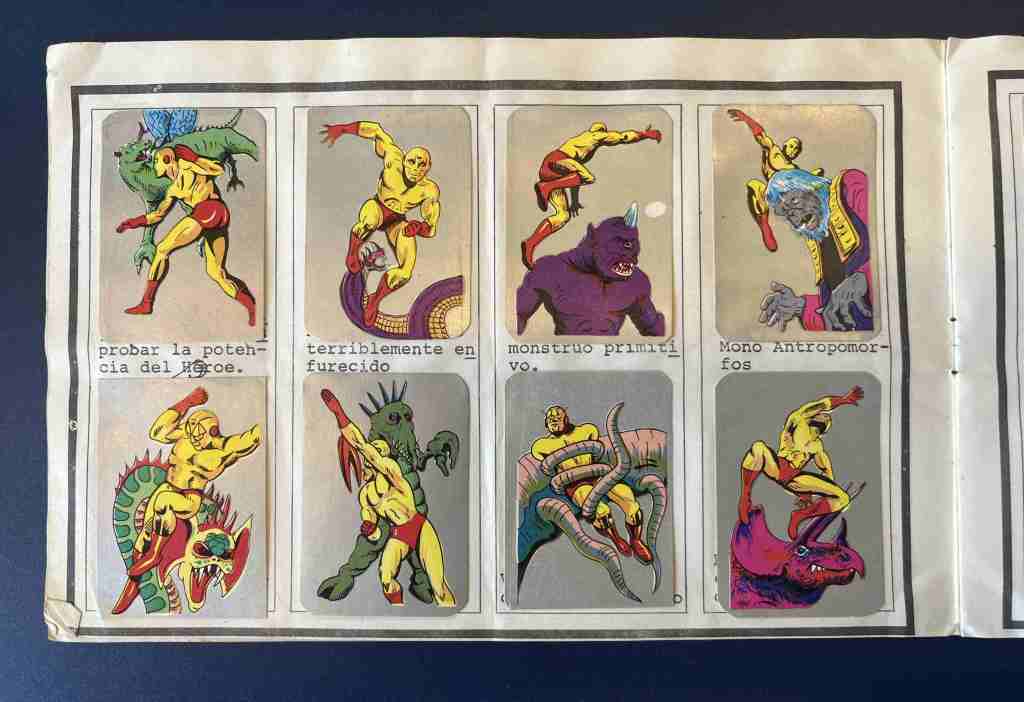
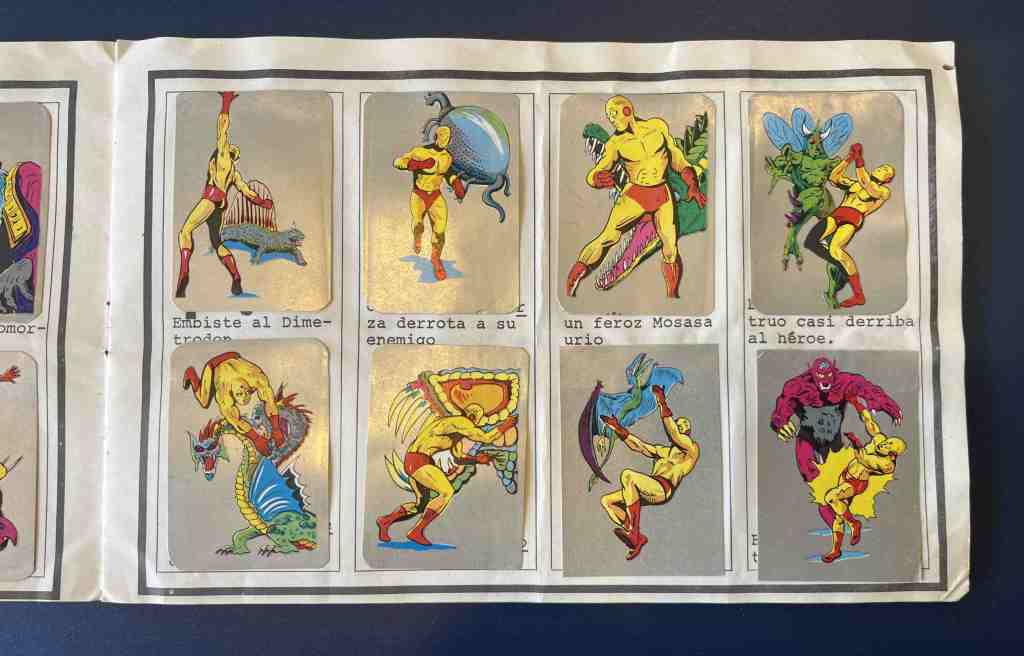
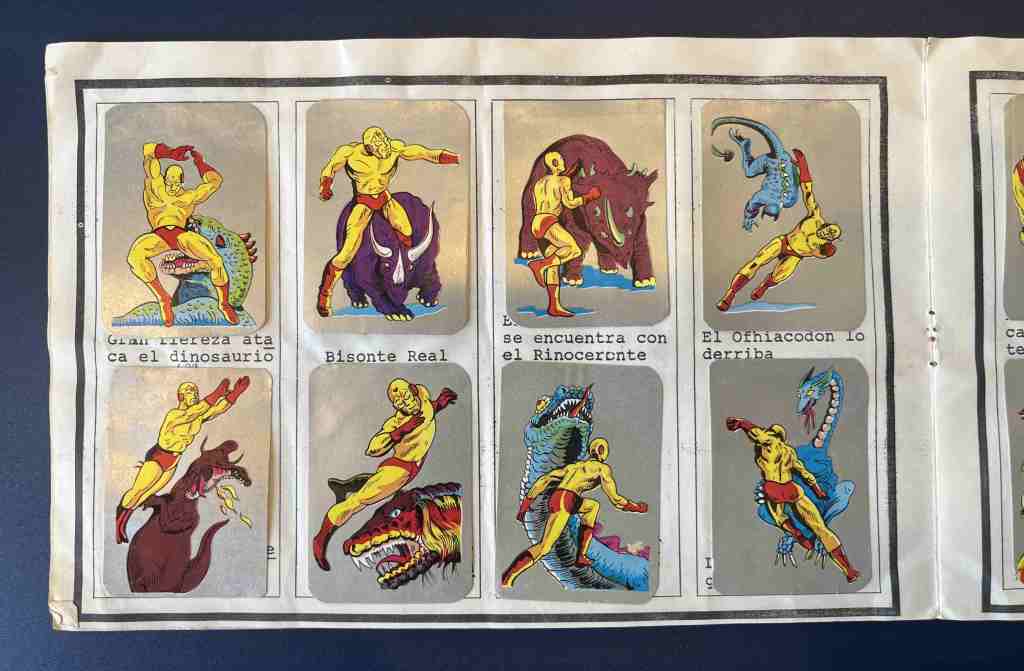
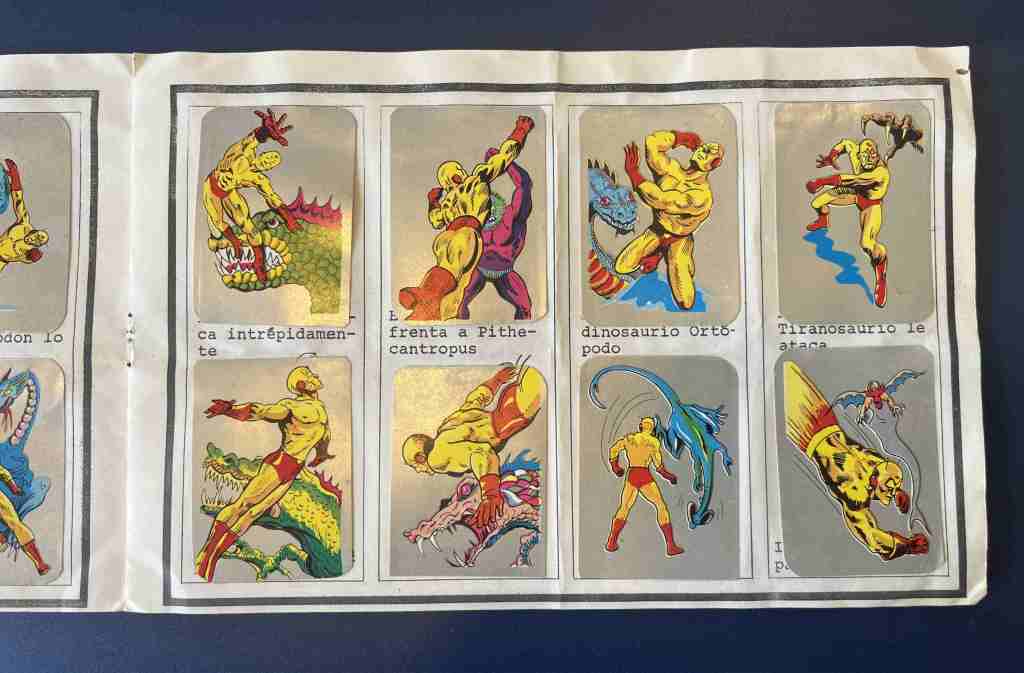
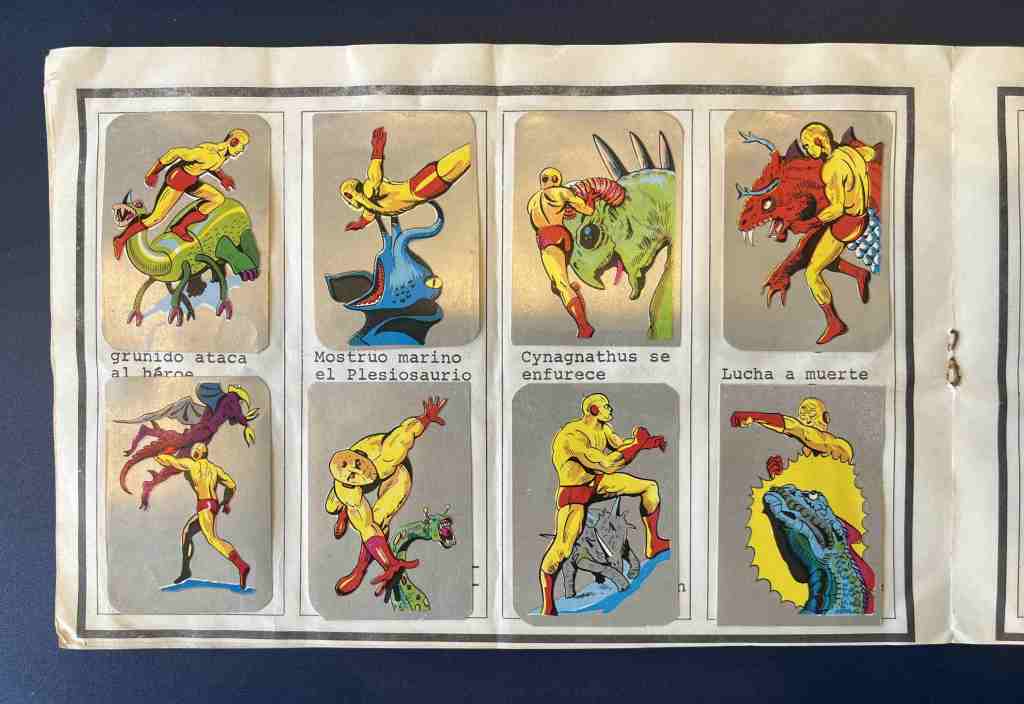
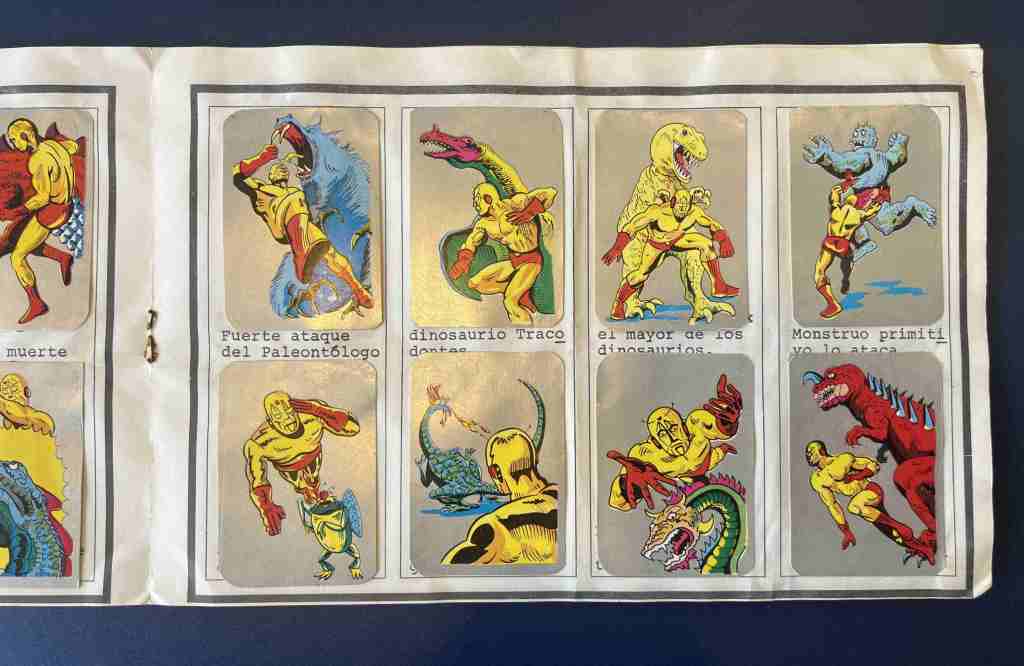
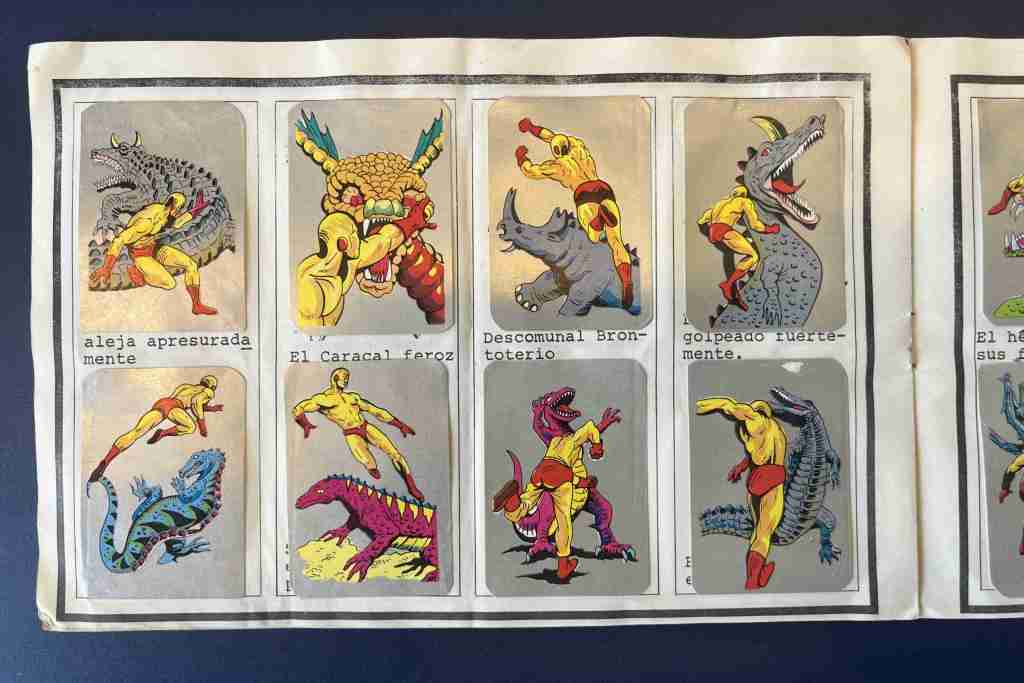
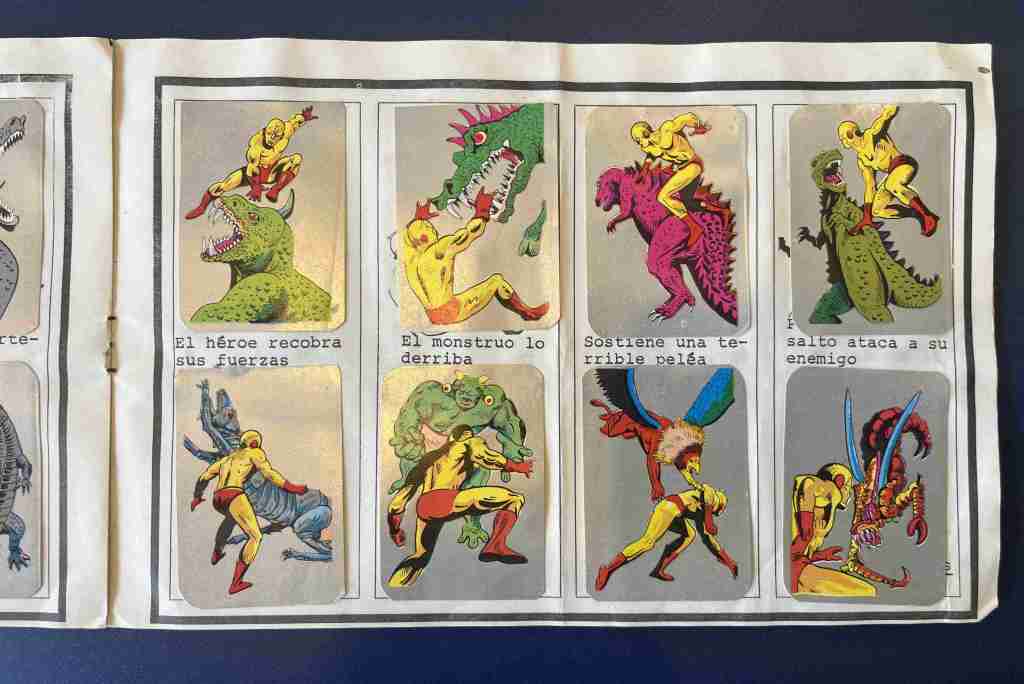
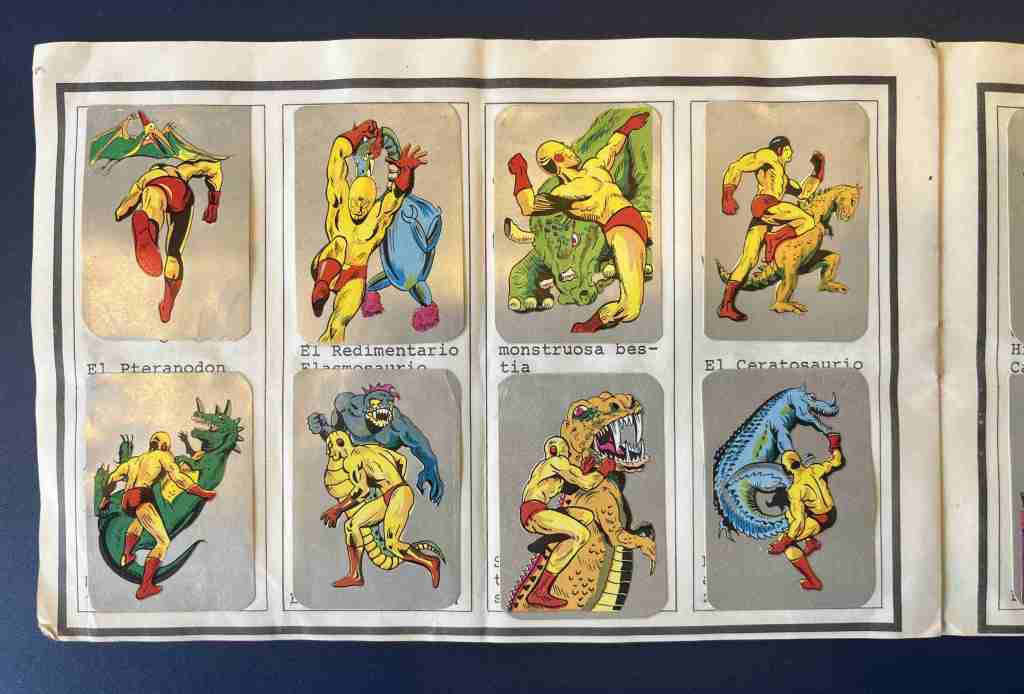
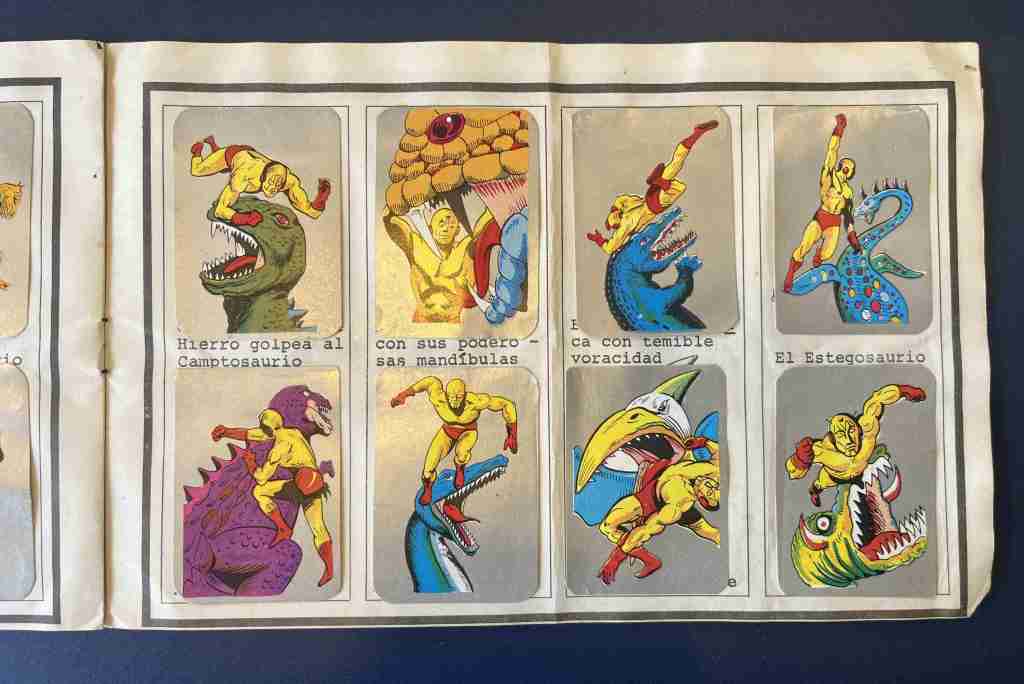
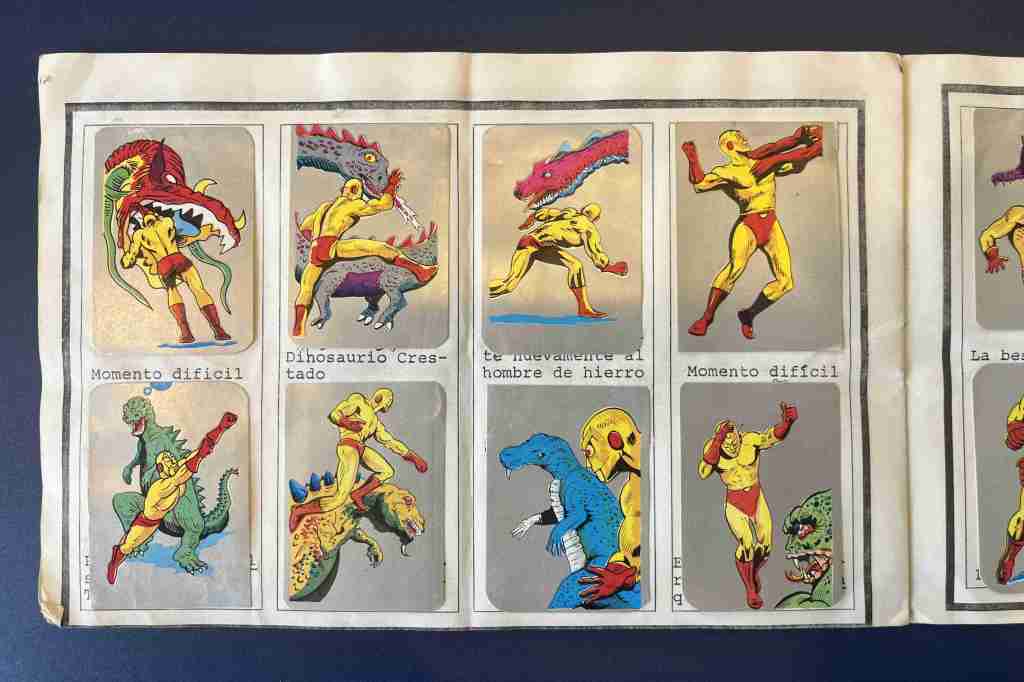
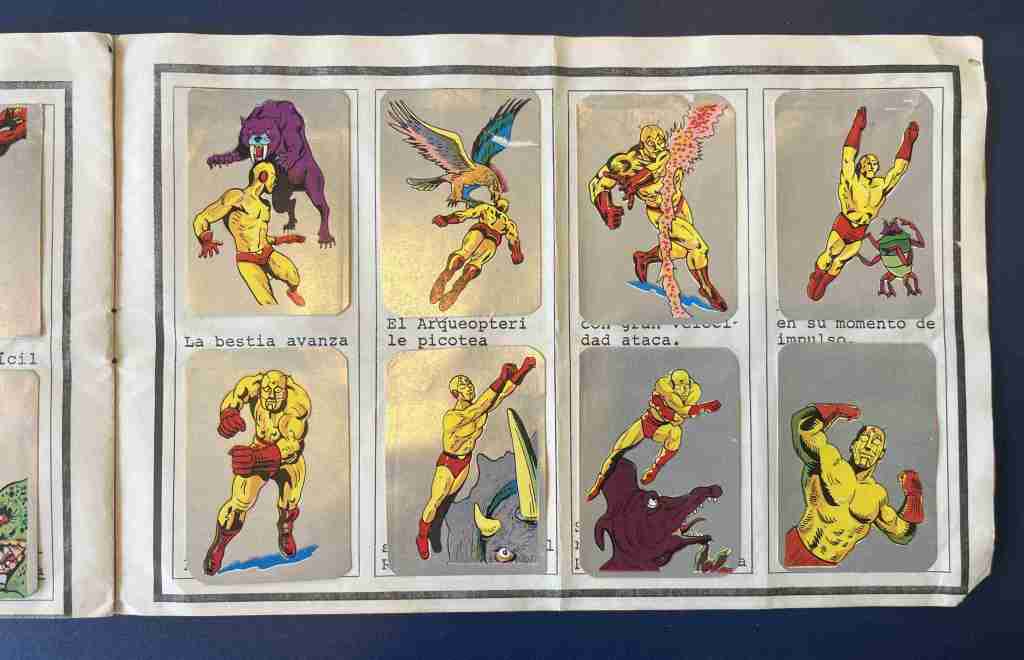
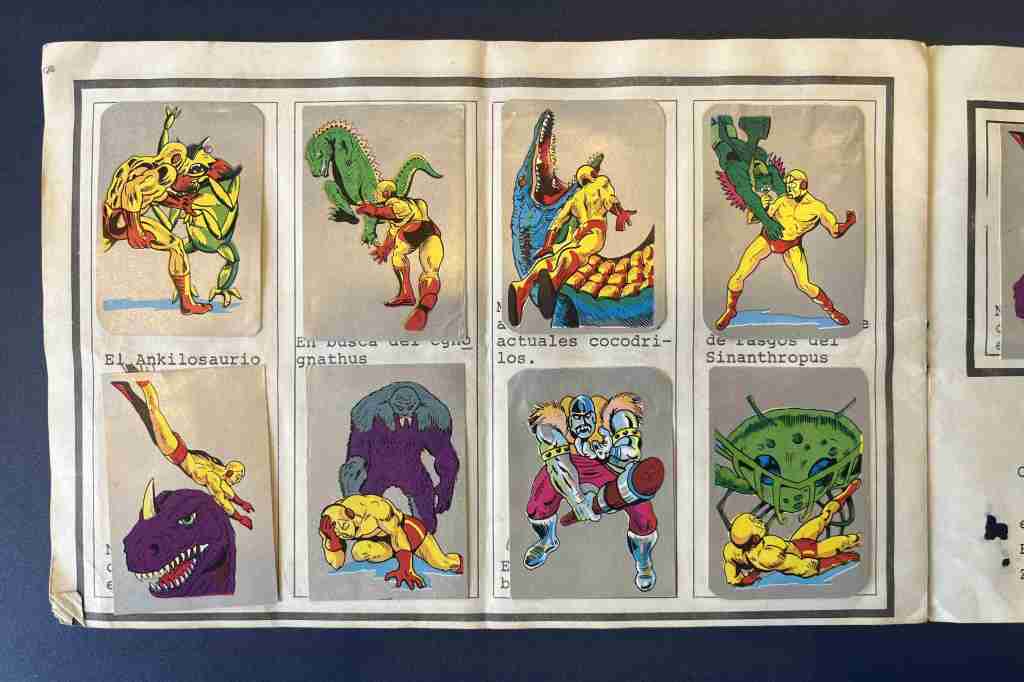
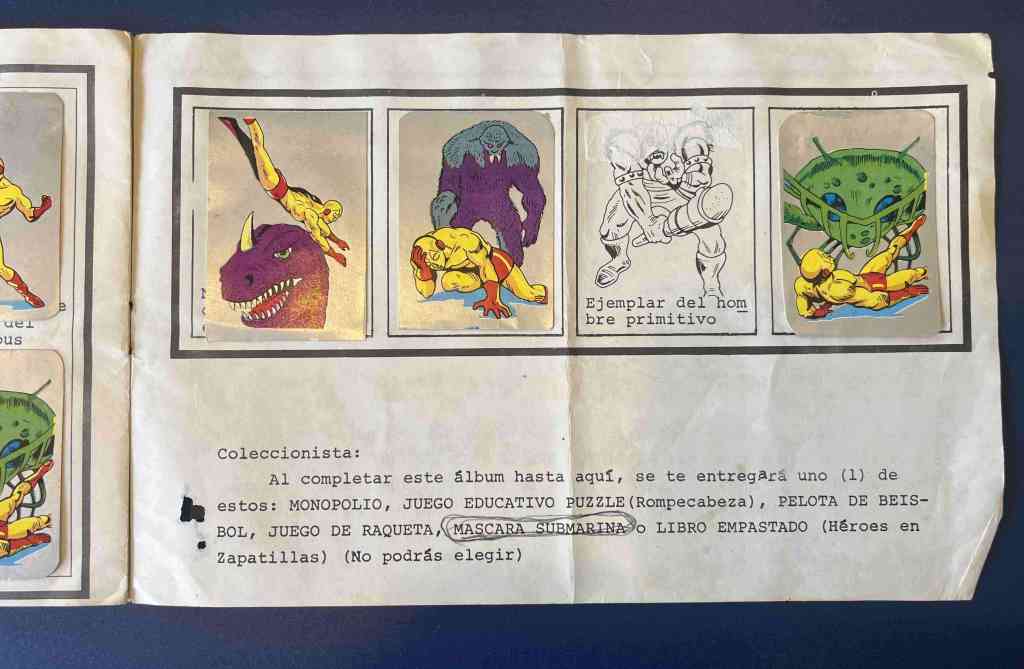
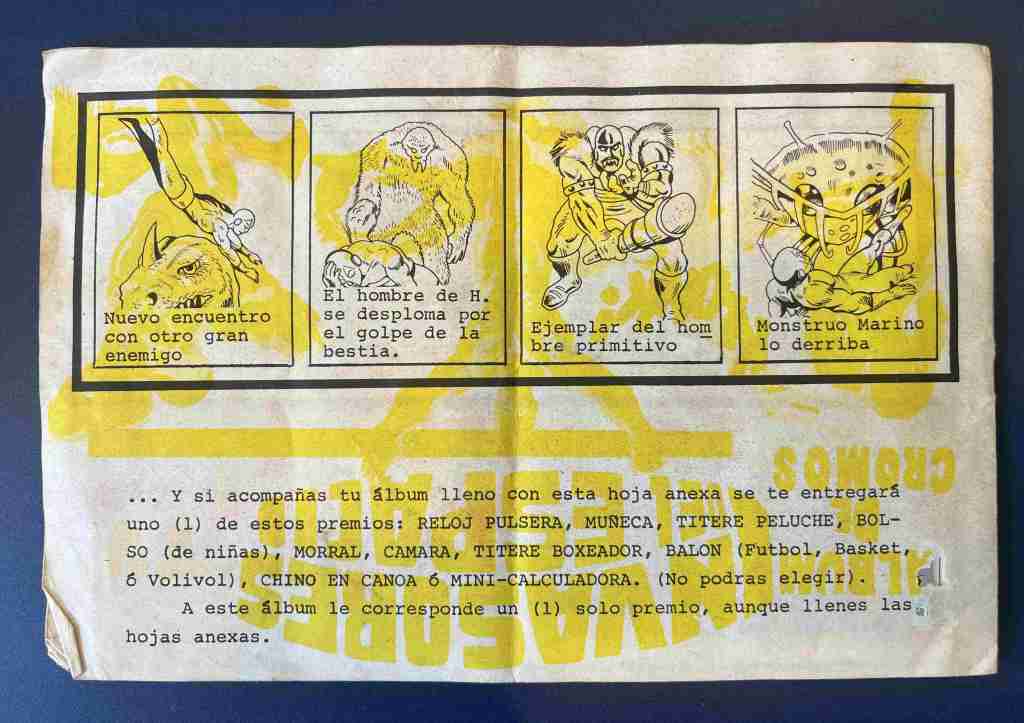
In fact, it is a stroke of luck that our young collector never completed his album, as the explanatory text at the beginning and the end invites us, the “Amigo Coleccionista” to enjoy this “fantastico álbum”, and states that “billetes” were included with the stickers, and these could be exchanged for items: 50 for a chain, a keyring, a necklace or a puzzle; 200 for a Monopoly game, a racket or board game; an eye-watering 500 for a wrist-watch or baseball; and for the most devoted child clearly with overindulgent parents: 800 for a football, basketball, volleyball, a puppet, a soft-toy or a doll/figure. The text goes on to add that once the album was full you should return it to the place you bought it from for a prize. These were, the album explains at the end of the sticker sequence, a Monopoly game, an educational puzzle, a baseball, a racket game, a snorkelling mask or a hardback book (named Heroes en Zapatillas). Somewhat brusquely, the text insists: “No podrás elegir” (‘You cannot choose [between the options]’) – but our original owner made his first choice known by repeatedly circling the “mascara submarina”. One hopes he finally got his swimming mask and still enjoys snorkelling. Over the page we read that if the album was accompanied by the final sheet (with the last four images repeated twice again), then they could receive a larger prize: a wristwatch, a doll/figure, a soft toy/puppet, a handbag “the text here adds “de niñas”, ‘for girls’ to avoid confusion), a backpack, a camera, a boxer puppet, a foot- basket- or volley-ball, a “Chino en canoa” (‘Chinese man in a canoe’, presumably a wind-up or battery operated toy) or a mini-calculator, and ending this list with the somewhat stern reminder again: No podrás elegir”. These albums seem to now be quite rare, and as those that were completed and returned must have been eventually discarded, they survive mostly in partly completed albums such as this one.
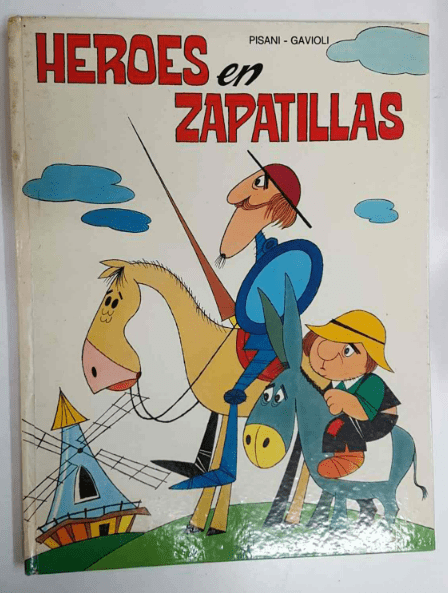
From the long list of prizes given above, we can at least identify the book offered:
(From an online sale listing)
This Heroes en Zapatillas was published in 1974 by Ediciones Paulinas in Spain, and was popular throughout the Spanish-speaking world.
The album itself measures 143 by 218mm. and includes 18 pages, each with spaces for 8 stickers, in addition to the first and last leaf. The spaces for the stickers were marked with black-and-white line-drawings of the scenes on the stickers, and short and usually general descriptions in Spanish of the action. The stickers are a little too large for the places they were meant to attach to, and cover the majority of these short bits of explanatory text, but as they attach at their tops to the album, one can lift many of them to peek at the text underneath. An unused album has been very briefly described with images of the pages without any stickers here.
A tiny bluebird in the upper inner corner of the front cover announces that this “Esta es otra colleccion Reyauca” (‘this is another Reyauca collection’), identifying the publishers as Agencia Reyauca of Venezuela, who were founded in 1978 in Guarenas (Capital District), and produced albums commemorating the World Cups as well as collectible children’s heroes such as Batman and Robin and TV characters such as Thundercats or the Muppets (for an informative assessment of the football album side of their output, see this Youtube video from 2023. After the 1980s, the company appears to have focused on its football output, and eventually went out of business soon after 2007. Other additions to the front cover here inform us that it was printed with the authorisation of the “Ministerio de Fomento” (‘Ministry of Development’), giving their reference number “1418”, and the price as 2 Venezuelan Bolívars. An owner, perhaps later, has added the word “Chuche” in pen at the top of the front cover, meaning ‘candy’ or ‘inexpensive, cheap item’ (this word kindly translated for me by the ever generous Mexican collector, Dich Vin – as my Euro-Spanish is not up to the nuances of Venezuelan slang).
The main scene of the front cover, beneath the title: “Los Invasores del Espacio vs. Animales Prehistoricos” shows the same flying hero, dressed in yellow, with red gloves and boots and with a red dot on his forehead, in three scenes as he beats up a giant crocodile, a green Godzilla that seems closest to the version of him as shown in the 1978 Hanna-Barbera animated series, and a shaggy haired kaiju with numerous sharp teeth, each with cartoony “KLONK!” and “KRASH!” action bubbles. The resemblance to Spectreman is uncanny, with that figure’s yellow and red costume reduced to red gloves, boots and trunks, and while the pointed protrusion on top of Spectreman’s head is not present, the green gem on his forehead (the Beam Lamp) is echoed here by the red dot on the forehead of our figure.

(Image from here)
Moving inside the album, the impression that we are looking at a tokusatsu hero grows, and the stickers show a vast array of fight scenes between the hero and Chinese dragons, dinosaurs, cave lions, cave bears, giant insects, a minotaur, humanoid insect monsters, other monsters and a huge number of creatures that show an obvious debt to kaiju. The artwork is brightly coloured and attractively executed, and each scene set on a silver background that glitters as the album is turned in the light.
The Spanish inscriptions mostly focus on dinosaur themes, even when the stickers show insect-based monsters or similar creatures clearly not related in anyway to actual prehistoric animals (note the “Ankilosaurio” that appears twice as a winged beetle standing on two legs, which might be a nod towards Gokinosaurus, the cockroach kaiju from Spectreman).
I find it striking that there are only eleven opponents of our hero here among the 128 different monsters and ‘bad guys’, who are not based on prehistoric animals or monsters apparently of below human intelligence. These are the purple minotaur, a pink fanged bipedal monster, a green winged insect-like bipedal monster, a blue long-tailed bipedal demon-like creature, a spiky-headed pale blue bipedal monster, two Medusa-like creatures with human torsos and heads but serpentine tails, a green flying humanoid monster with pink feathers, a “hombre primitivo” dressed in fur and wielding a club, and two clothed great apes.
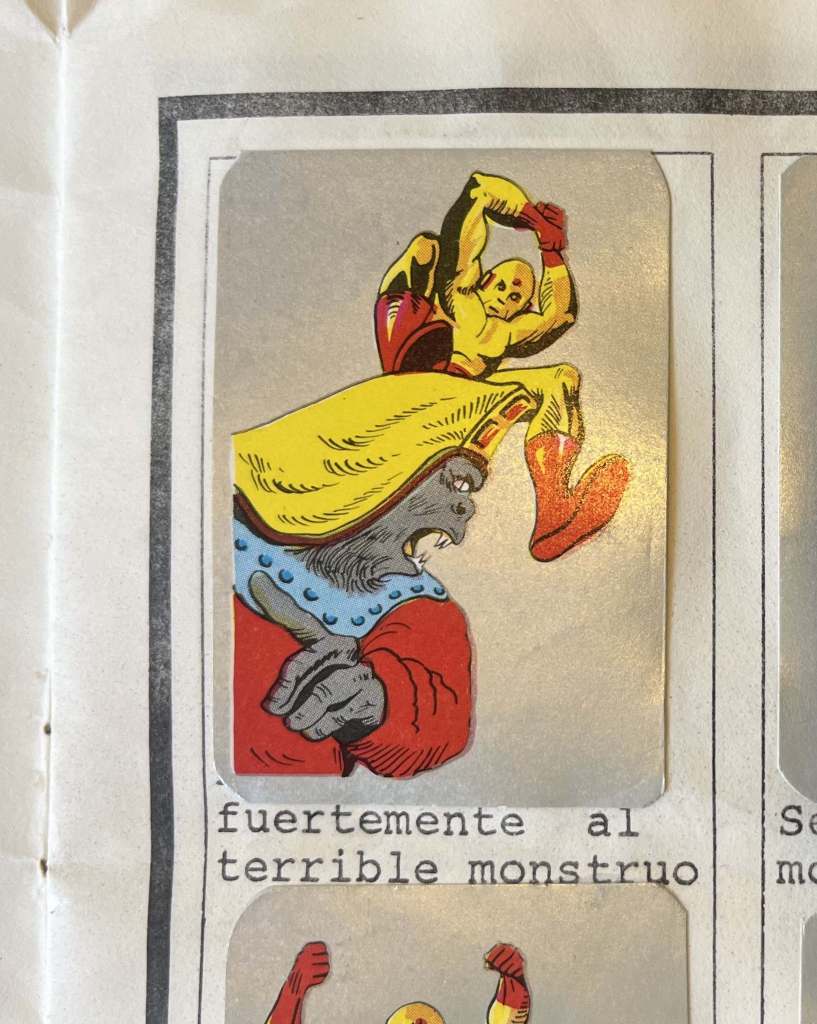
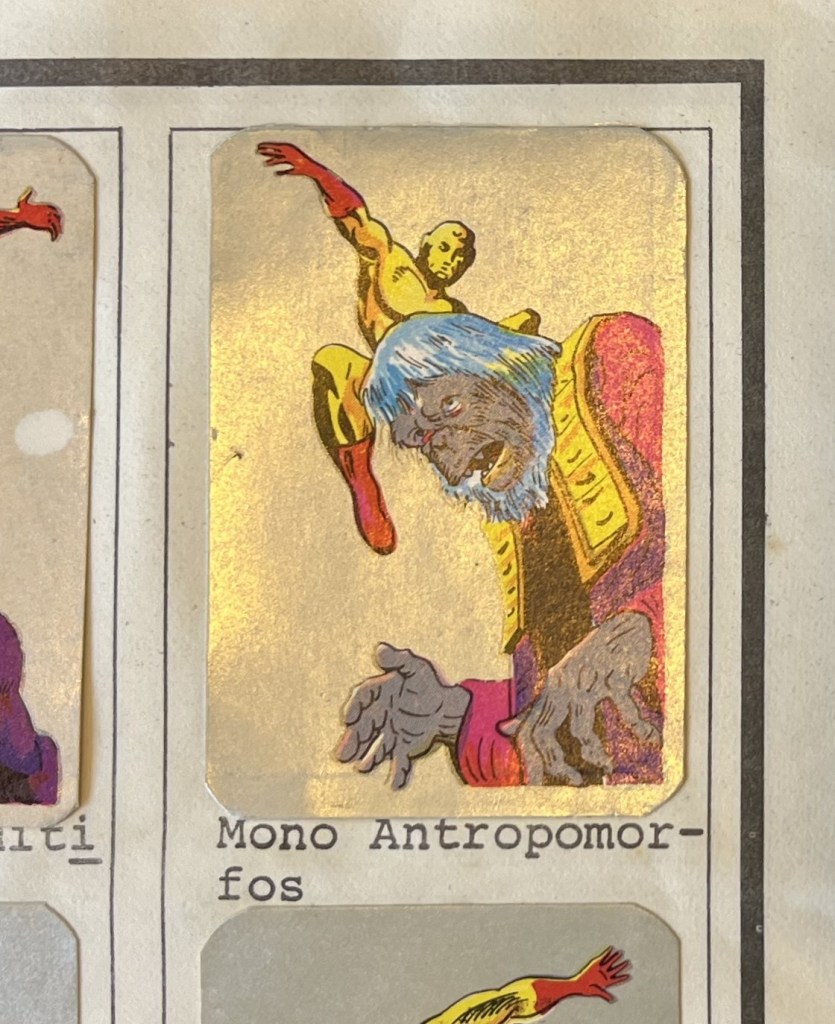
These apes occur at places 17 and 28 (described as “terrible monstruo” and “mono antropomorfos”), and while in their execution here they both hark back to Planets of the Apes characters (the gorilla to General Ursus from ‘Beneath the Planet of the Apes’, released in 1970, with his large flat-fronted headdress; and the bearded orangutan to Dr Zaius, from the original film, ‘Planet of the Apes’, released in 1968, as well as ‘Beneath the Planet of the Apes’, with his distinctive robes), the choice of two apes here strongly recalls Spectreman’s main enemies: Dr Gori and Apeman Ra. Indeed, the selection of bright pink for the robes of the second gorilla here, may be an echo Dr Gori’s distinctive pink suit.


(Images from here)
With these echoes of Spectreman in mind, albeit indirect and well disguised, we turn back to the loudly stated claim of the front cover that these Invasores del Espacio were “Exito de TV” (‘seen on TV’). I can trace no such TV series on Venezuelan TV, or that of any other nation, neighbouring or far afield. However, Spectreman was broadcast in Venezuela during the late 1970s and 1980s under its Spanish title, Espectroman, on free-to-air television networks like RCTV (Radio Caracas Televisión).
In this context, it seems likely that these stickers were an attempt to jump on the Spectreman/Espectroman bandwagon in Venezuela, to tap into the booming interest in tokusatsu and kaiju programmes there, through these thinly concealed homages to the main Spectreman characters. What was produced was something both Japanese and Venezuelan at the same time – and quite magnificent in its execution.
- 'MUTTON DRESSED AS LAMB': Godzillas and kaiju that look vintage, but are not
- American made Pachi
- BOOTLEG DINOSAURS – a little off topic, but sometimes needed here
- BOOTLEG GODZILLAS
- Bootleg Tokusatsu from China and its immediate neighbours
- Bootleg Tokusatsu from the Americas
- BOOTLEG TOKUSATSU HEROES
- Central Europe – Godzillas and kaiju from behind the Iron Curtain
- Chinese-region bootleg Godzillas -the plastic tide from the East
- Chinese-region made Pachi
- European made Pachi
- European-made Godzillas
- PACHI
- Pachi kaiju
- Pachi kongs
- Pachi superheroes – Ultraman and similar
- The Americas – bootleg Godzillas from the New World

 Confessions of a Kaiju Hunter
Leave a comment