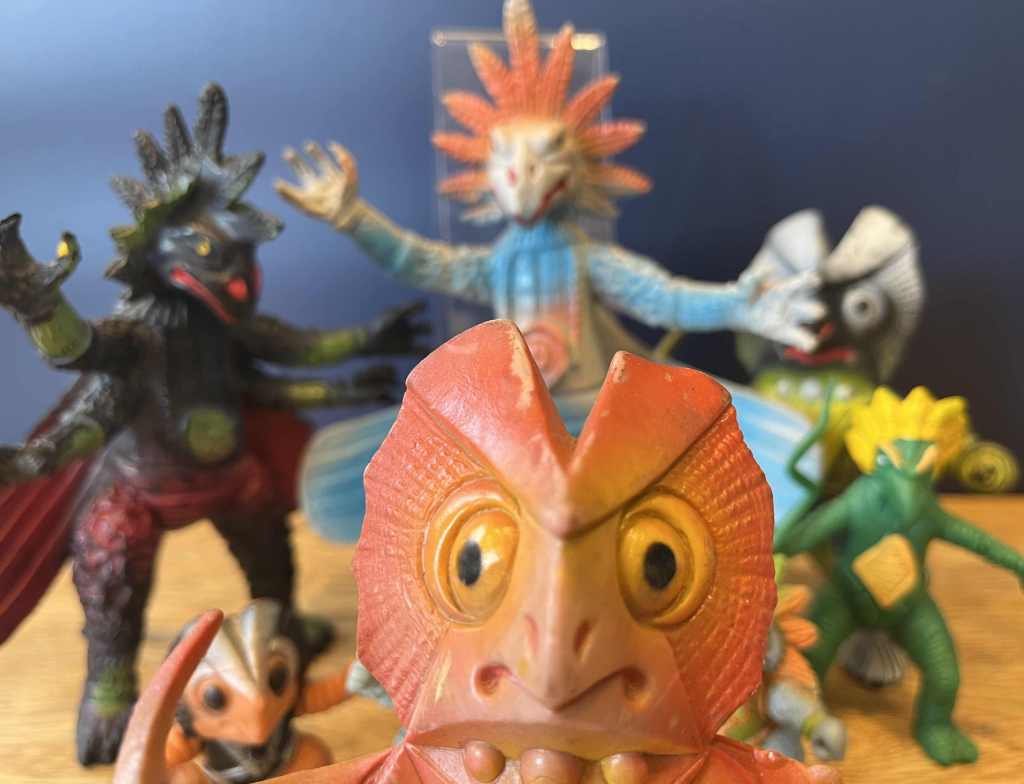
In the last years of the 1980s and around 1990, a Spanish toy manufacturer named Hermanos Pardines (‘the Pardines brothers’; often shortened to HP) from Ibi in the province of Alicante in south-eastern Spain, jumped onto the Dinosaucers figures bandwagon. The region of Spain around Ibi was an important one for the Spanish toy industry, and HP had operated there already for some years, chiefly producing small PVC toy figures without license.
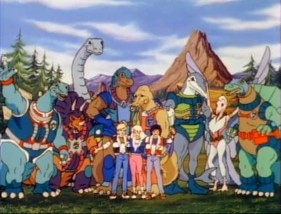
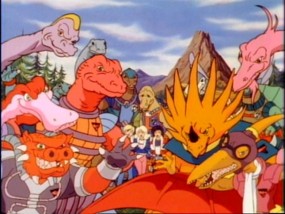
(Promotional images from the Dinosaucers TV series, and not recorded by me where I found them – readers will notice many images here from online sale sites and the like are here without specific references: this is due to the age of the file of mine that stands behind this post)
Dinosaucers was an animated TV series which paired up four children with a group of intelligent anthropomorphic dinosaurs from the planet Reptilon, in their earth-based fights with the evil Tyrannos and his similar dinosaur followers. It was never very popular, and was released in 1987 as a joint US and Canadian venture, making some 65 episodes in a single season before it was canned. Such a short run on a relatively new venture meant that while Galoob had planned complimentary toy productions in the United States, these never actually got past the initial releases, and to cut their losses, Galoob then sold the license to the Brazilian company Glasslite, which produced only 5 figures in limited numbers.
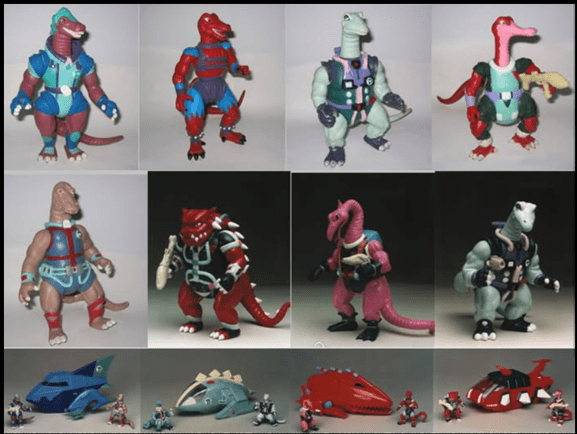
(This image from a wonderfully informative post by ‘Hobby Mania 506 Figuras de Acción’ on Facebook on 13 October 2025. Note that those here with a light background were produced by Galoob; while those with a black background and the spaceships were only ever prototypes, and were not commercially produced)
The cartoon does seem to have been more popular in Spain and Mexico (where in the latter it was called ‘Dinoplativolos’) than elsewhere (see this Wikipedia article on the Spanish language version), and toy producers in Spain such as Yolanda (who did produce under license, as with their Ultraman and Mazinger releases), produced a few small figures around 1987-88.
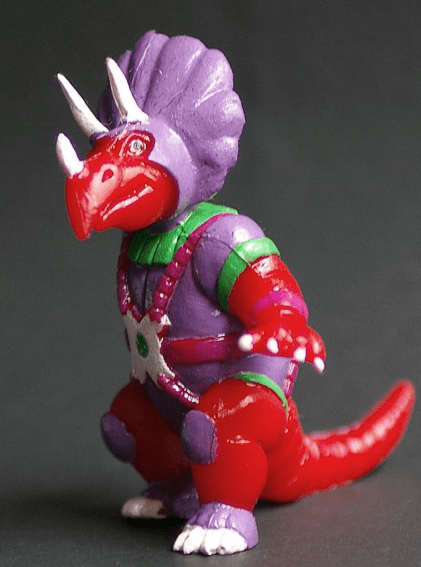
(Image from a Worthpoint listing, noting that the figure is marked “(c) 1986 CC TELECON INC” and “YOLANDA”; this figure produced in this painted version as well as a single colour version)
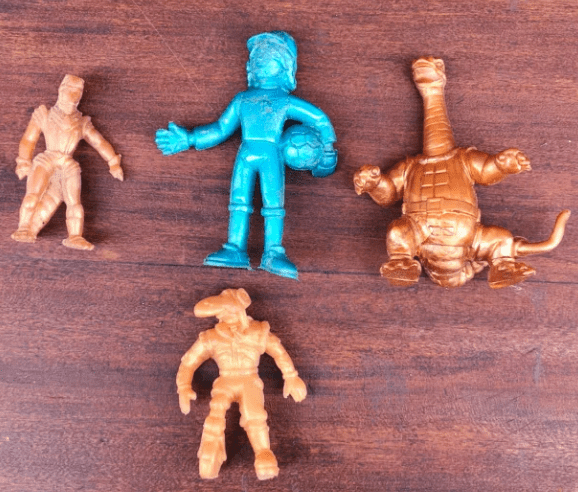
(Image from a Wallapop sale listing; these single colour figures also produced by Yolanda)
Another, as yet unnamed, Spanish producer also made larger figures in hollow plastic (with my Tricero, shown below, standing about 160mm. tall, and weighing about 90g.) at the same time.
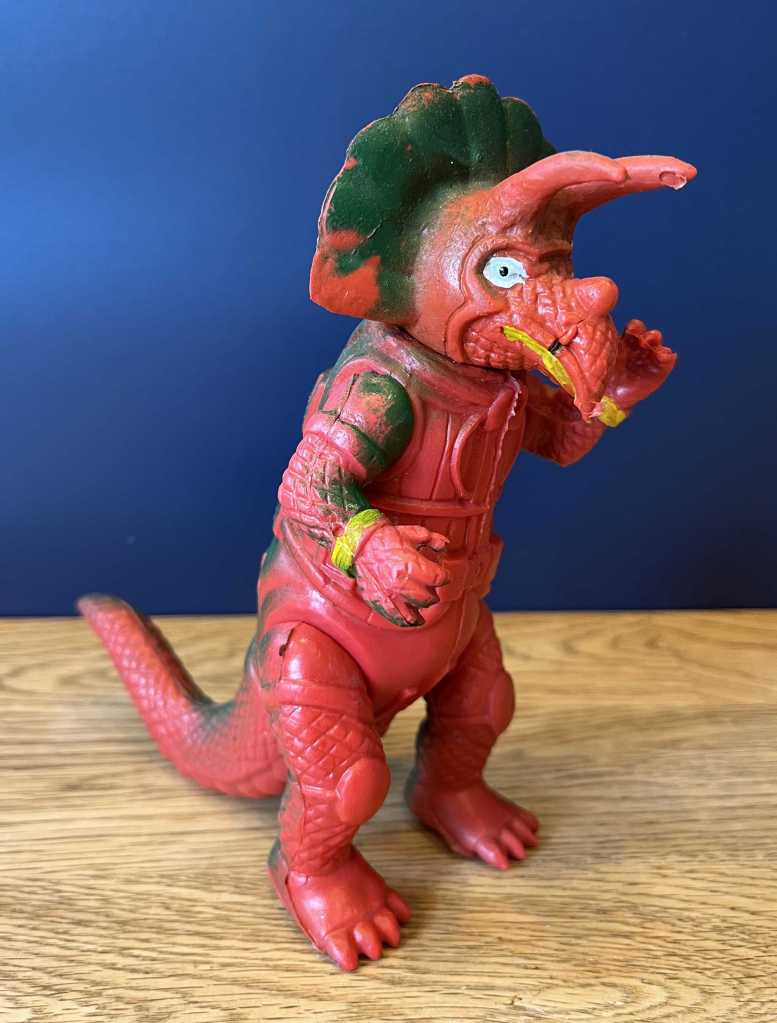
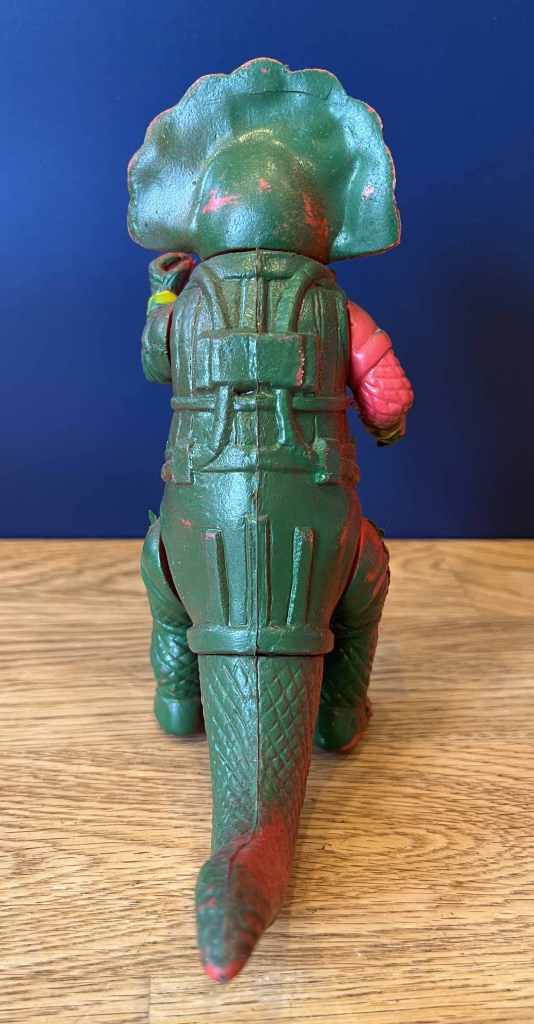
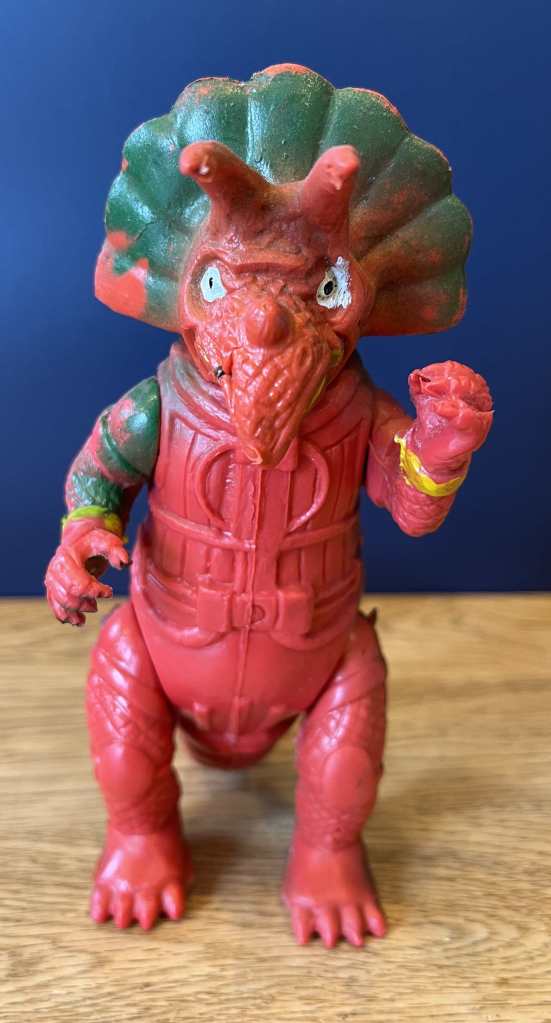
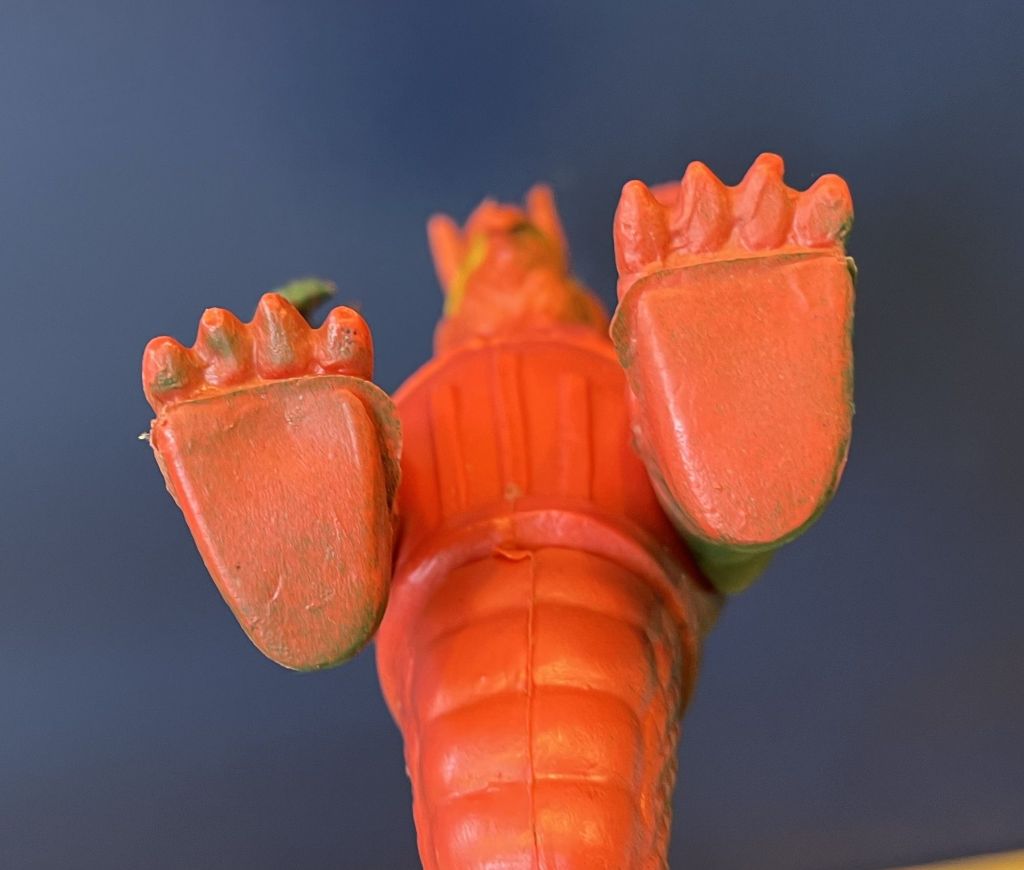
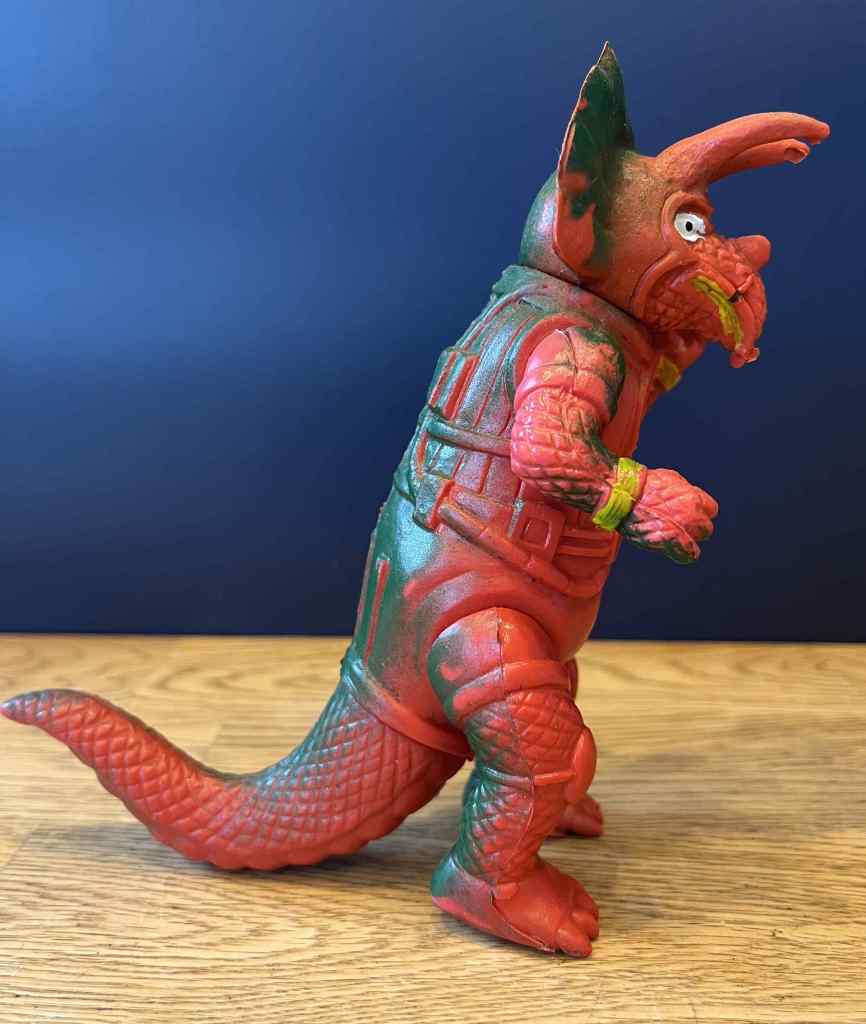
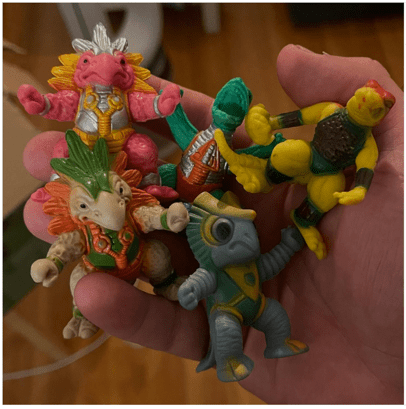
An impressive collection of these is owned by the bootleg toy guru, Chance Priest of Texas:
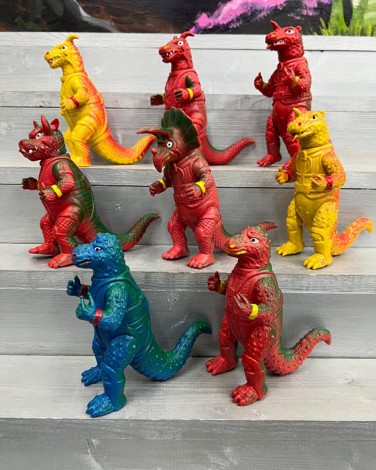
(Image reproduced here with Chance’s kind permission)
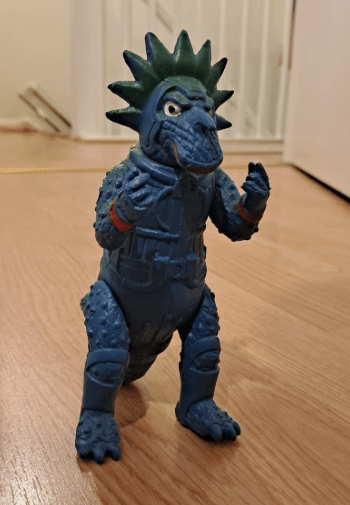
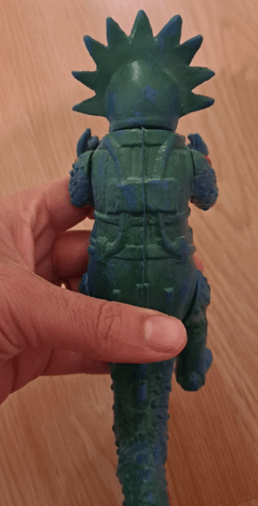
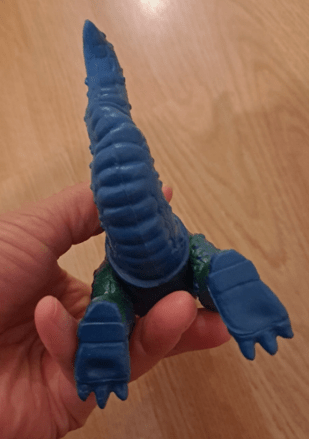
(This one, a figure otherwise not known to me, recently sold by a UK seller on eBay; images from that website)
Of course, Chance also had one of these, in bright banana-yellow, but only found it after the main photo was taken:
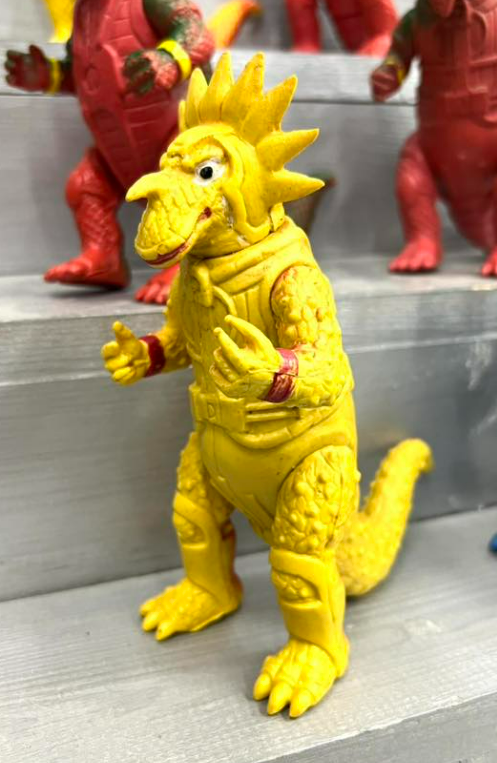
(Image reproduced here with Chance’s kind permission)
One of these lines, and I am not sure which one, was released under the title ‘Dinonauters del Hiperespacio’ (‘Dinonauts of Hyperspace’), and they are frequently now all called by that name. All of them followed relatively closely the characters from the cartoon – and all are rare. The Spanish figures are rare outside Europe, while the Glasslite ones do appear in Mexican and South American market places with some regularity.
⁂
Hermanos Pardines decided, however, on entering this arena, to take these figures in a very different direction. They took only the briefest of details of the cartoon characters and massively embellished these with details drawn from already established kaiju and bootlegs of them, producing large and small figures of some characters, with both painted and keshi-like unpainted versions of the smaller ones.
None of these appears to have had much packaging, and no names were given by HP to their creations that I know of, and so here I will use the names of the corresponding cartoon characters with a ‘*’ before them to show this name is my creation. The main characters in the larger versions were *Teryx and *Tricero (but I shall also list here the other known characters in this line).
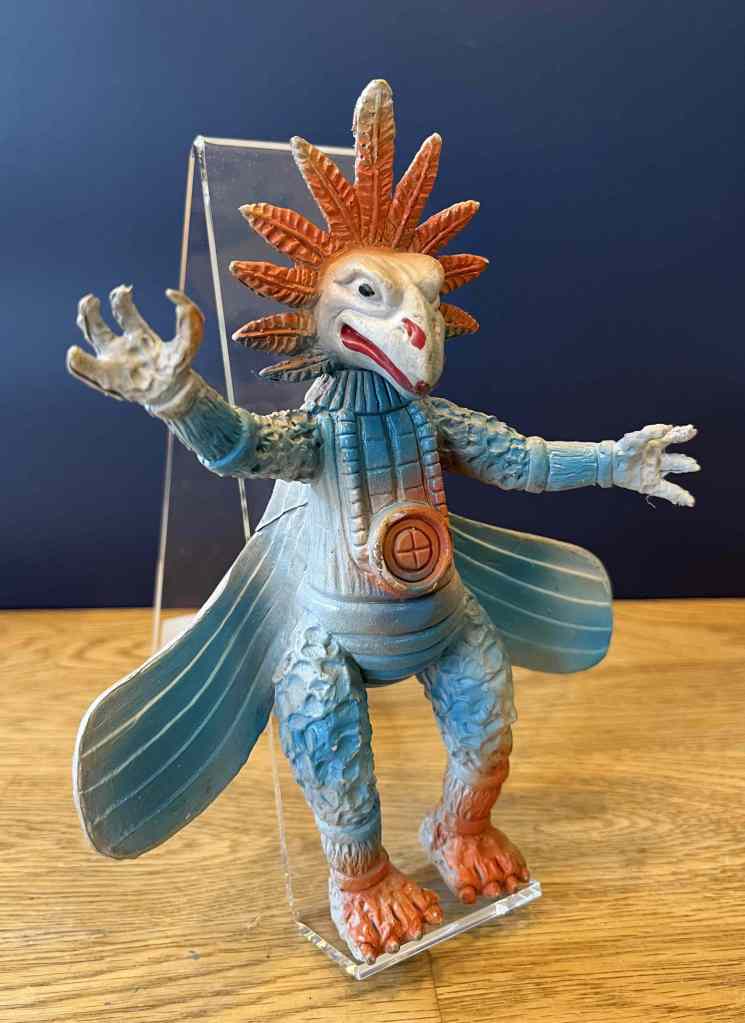
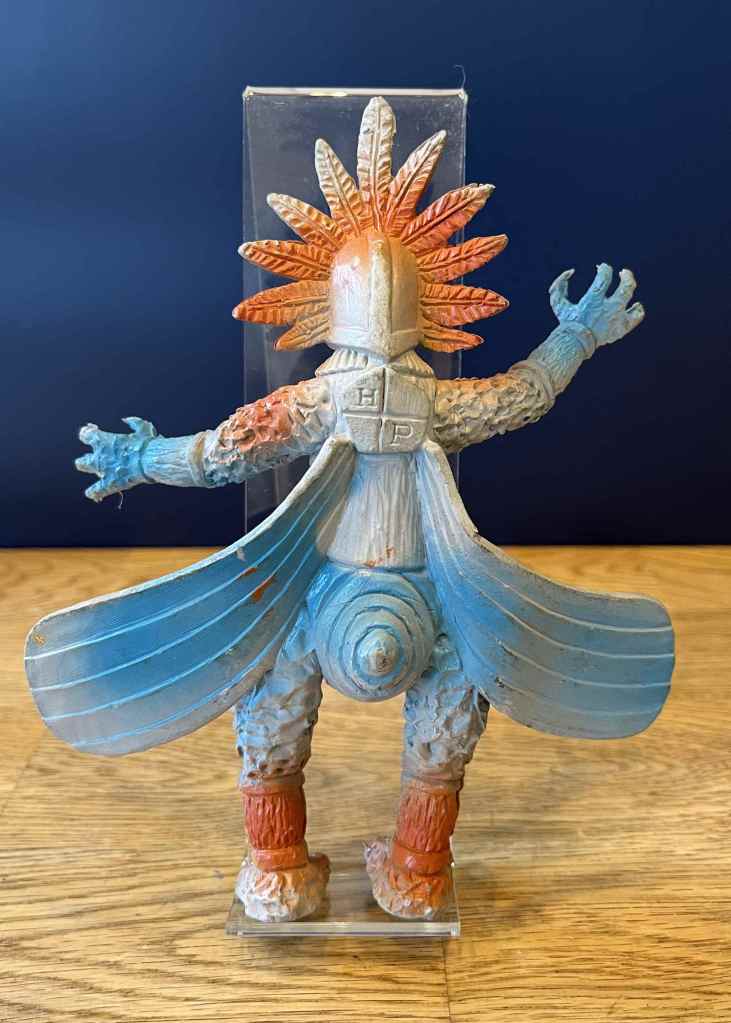
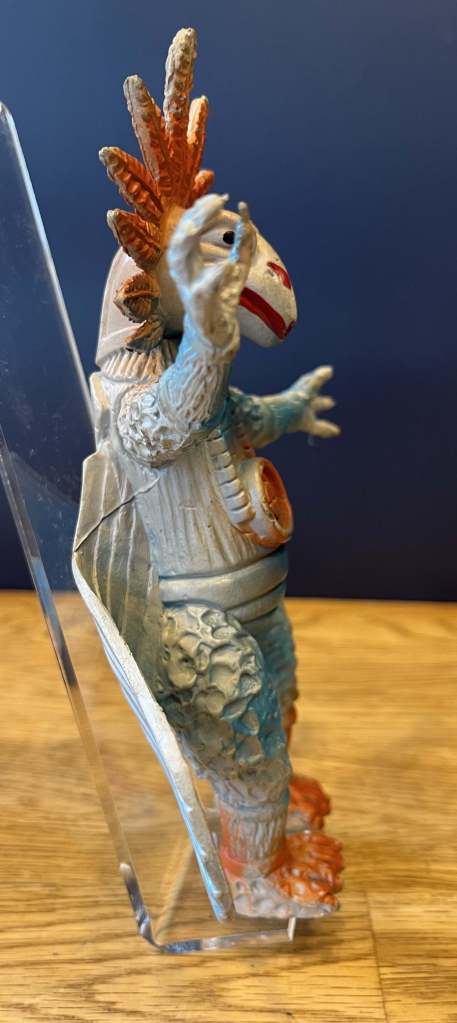
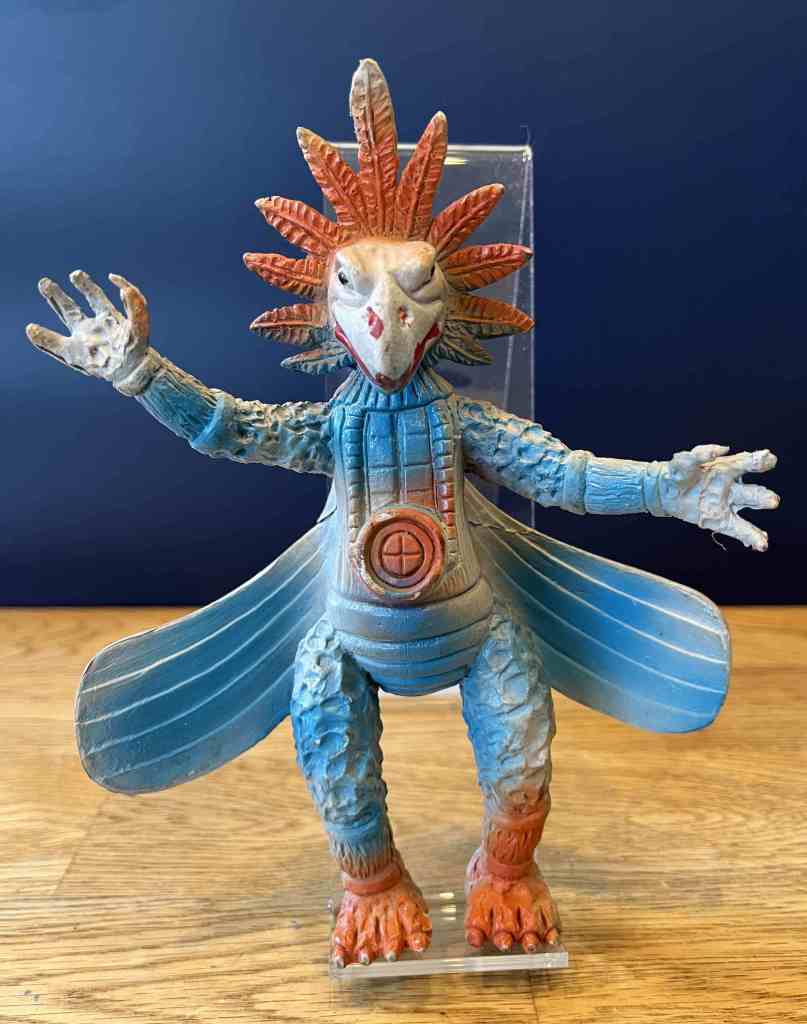
*Teryx stands about 170mm. tall, and weighs 136g. It is made of solid rubber and is unarticulated. I know of examples in black, yellow or grey (the base rubber colour), with red, blue, yellow and green highlights.
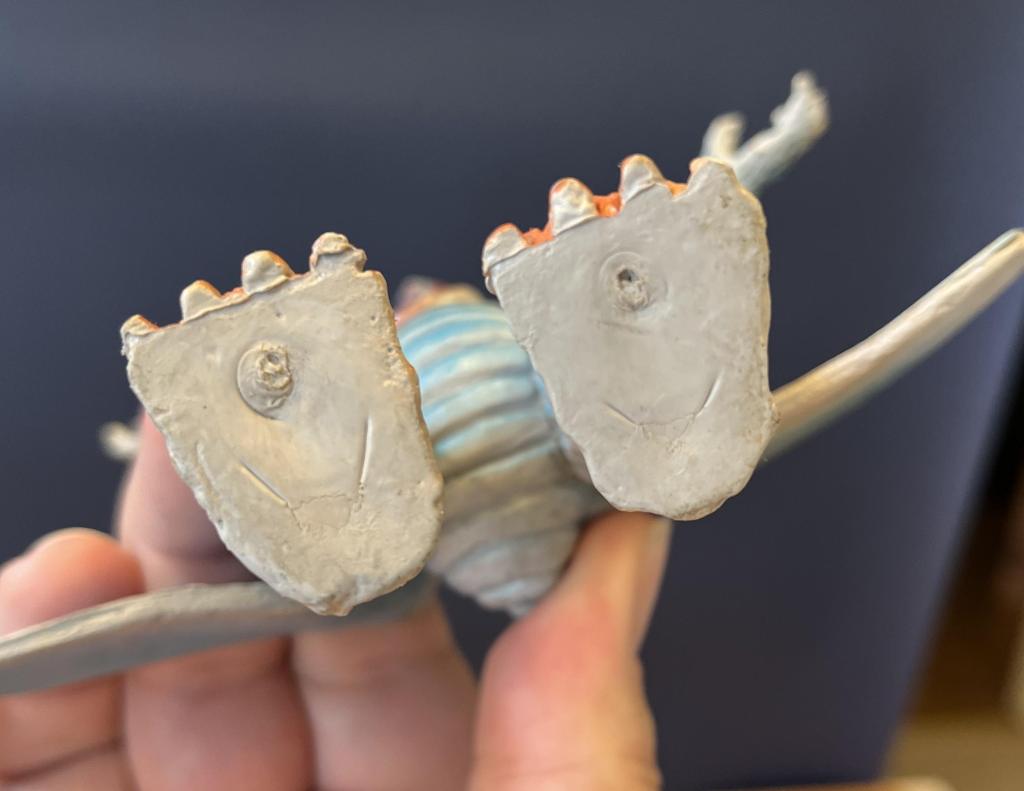
However, I would be surprised if the adaptations here from the cartoon character were made purely to circumnavigate copyright issues, and we have come a very long way from a humanoid Pterodactyl. The short mohican-like stripe of feathers over the top of the head has become a single line of feathers, running around the top of the head to create a halo-like effect. The femininity of the form has been jettisoned and a large medallion has been added to the chest, with a five-sided shield, quartered with the maker’s mark “HP” and blank panels in the centre of the back. The feet have four toes that end in a single flat line together, and the profile of the feet from below is identical to those of the Orion Godzilla clock bootleg and its various Spanish offspring (see my other earlier post on those), albeit in a slightly smaller size (here some 26mm. long from heel to toe-tip). I think we can safely detect elements here of the kaiju Hydra, as well as the ‘Rodan’ figure produced by the Chinese ‘company X’ and JHL’s bootlegs of that in Spain (for those see my earlier posts on Chinese produced bootleg Godzillas and JHL’s productions).
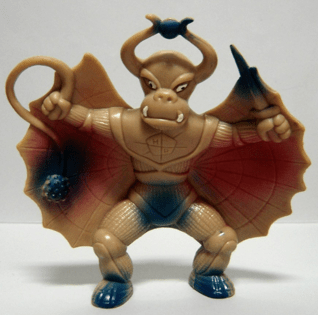
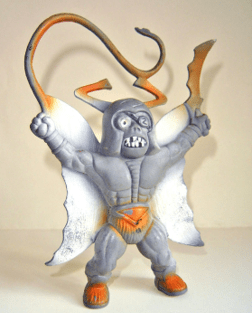
(These images from the coleccionismo80-90 blog in 2015)
The same “HP” mark can be found on the chest of a horned demon-like figure holding a whip and a sword, and is reportedly on the back of another who wears a horned helmet and holds similar implements – and these must be from the same range.
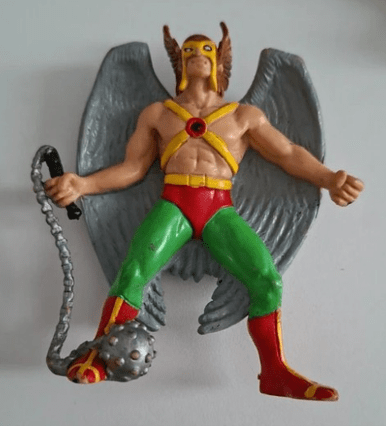
(This image from an eBay listing)
These whip-bearing demons seem not to have taken much inspiration from kaiju. I cannot be certain, but the shape of the wings and presence of the trailing flail ending in a large studded metal ball, suggests to me an origin for these two figures in a common Hawkman figure, created in 1991 in Spain by Yolanda (the figure is dated in the middle of its back, and gives DC Comic’s mark of license there), adapting an earlier Kenner design from 1984 with a studded metal ball on a rigid staff. If correct, then this dates these demon figures to 1991 or soon after.
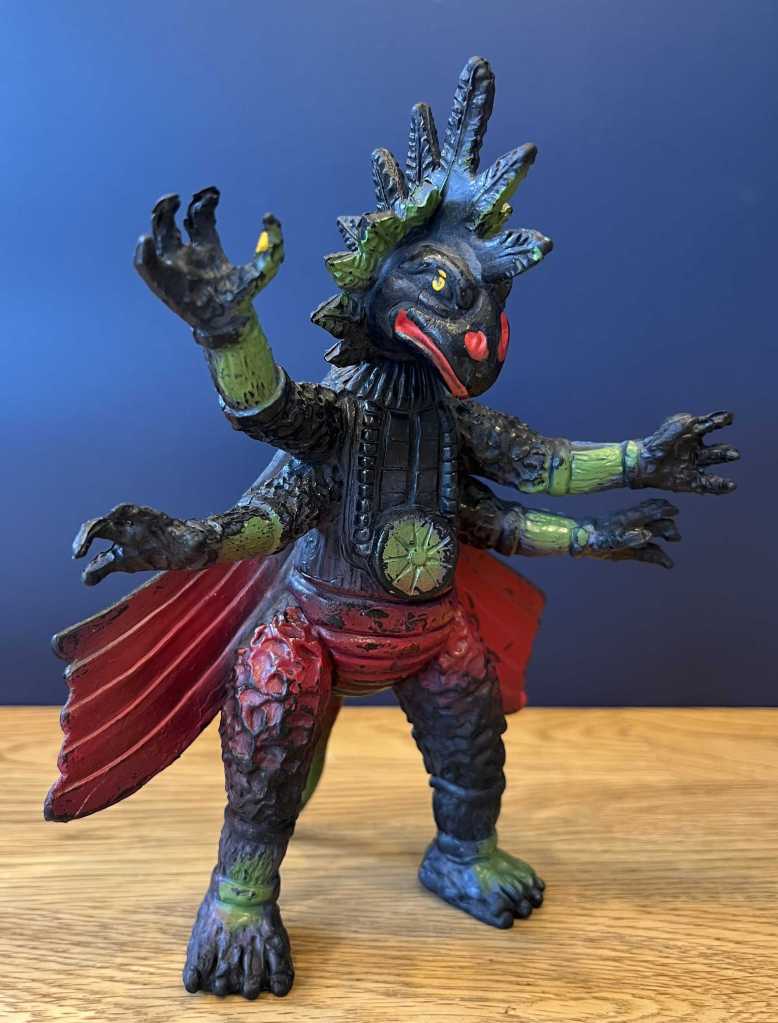
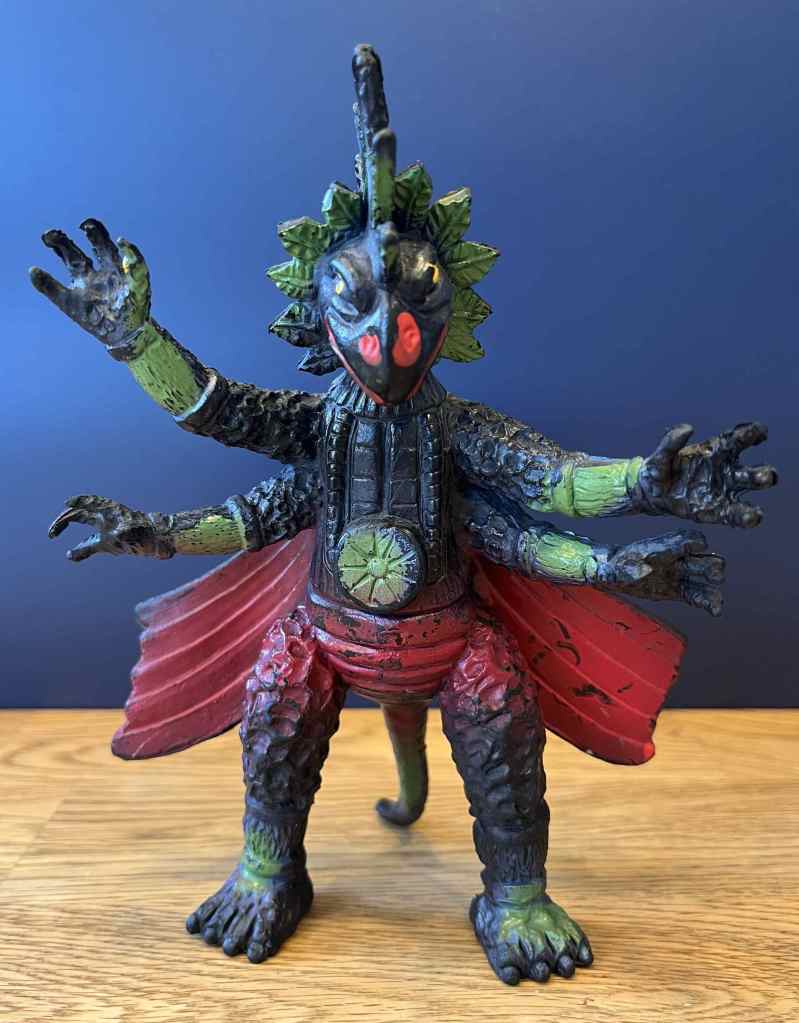
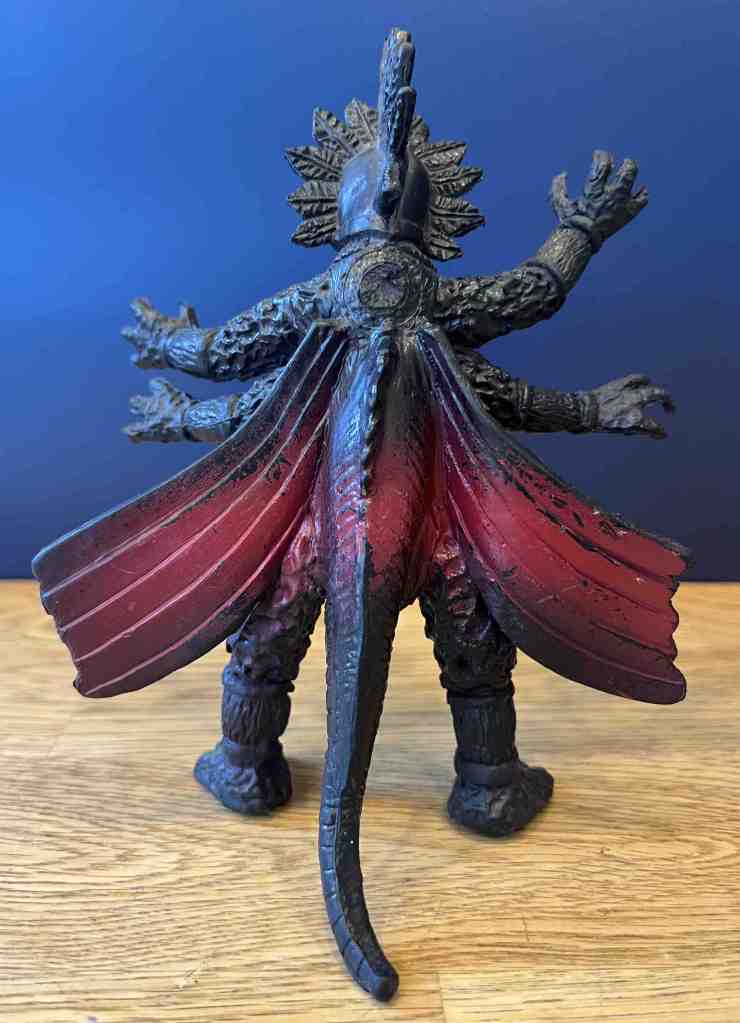
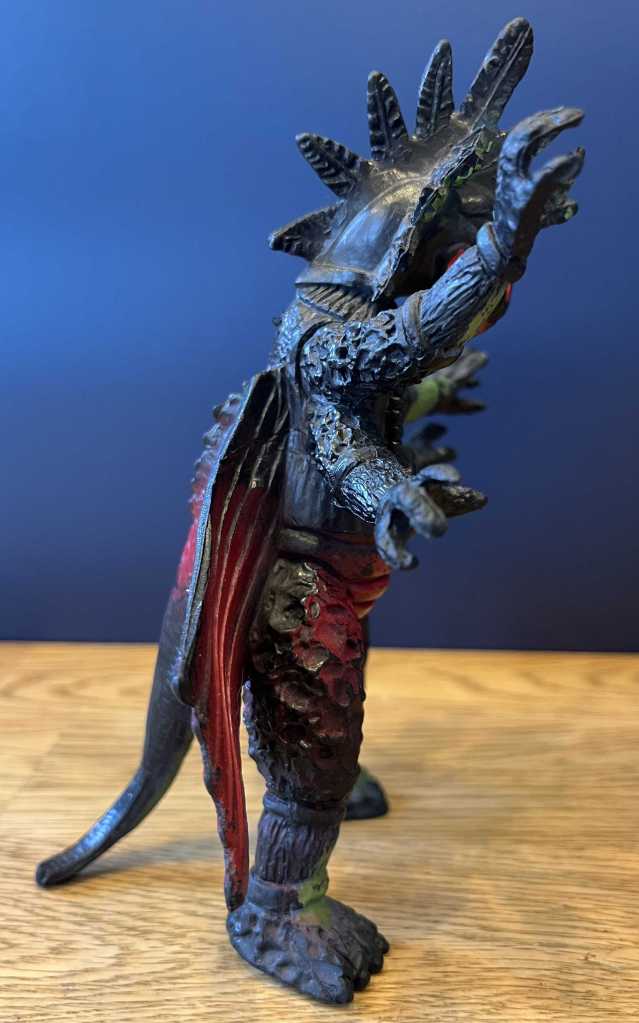
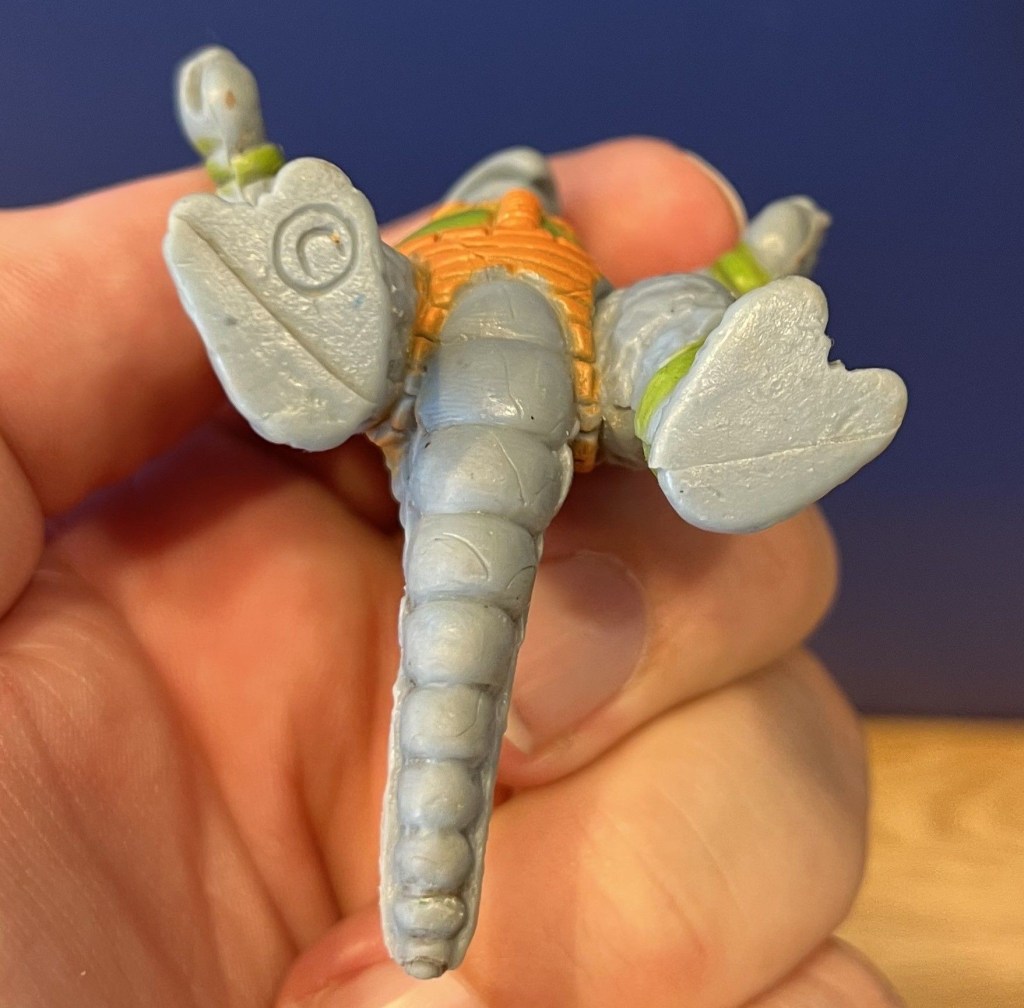
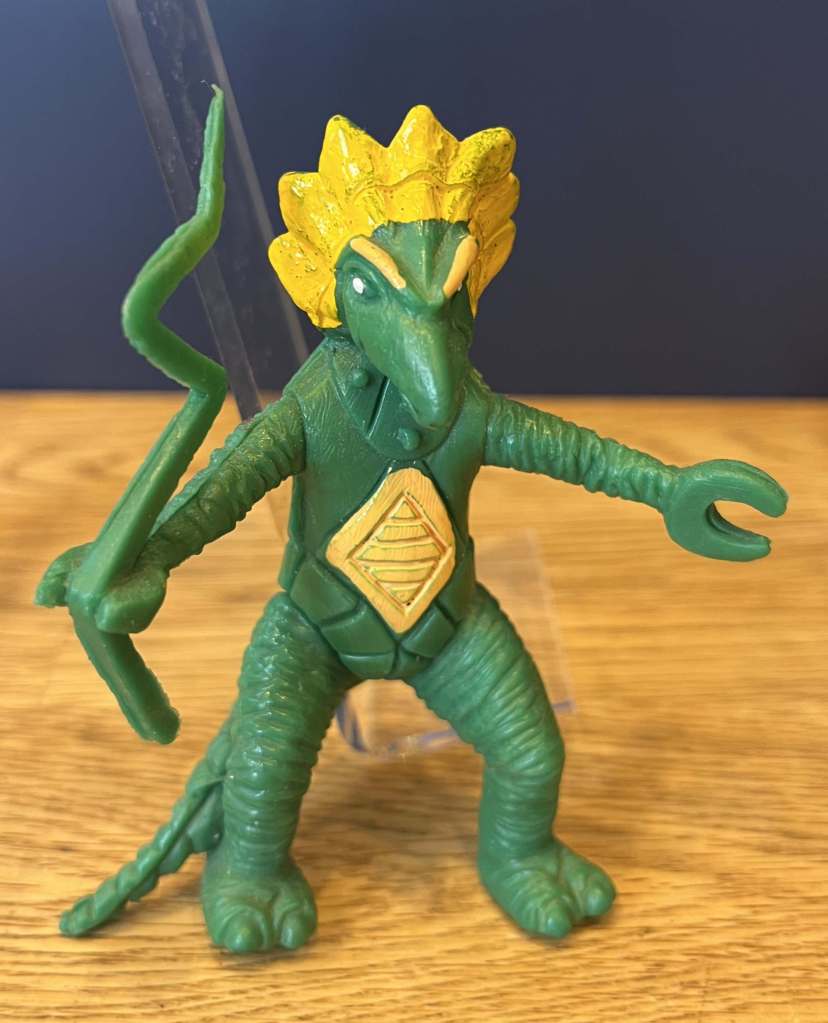
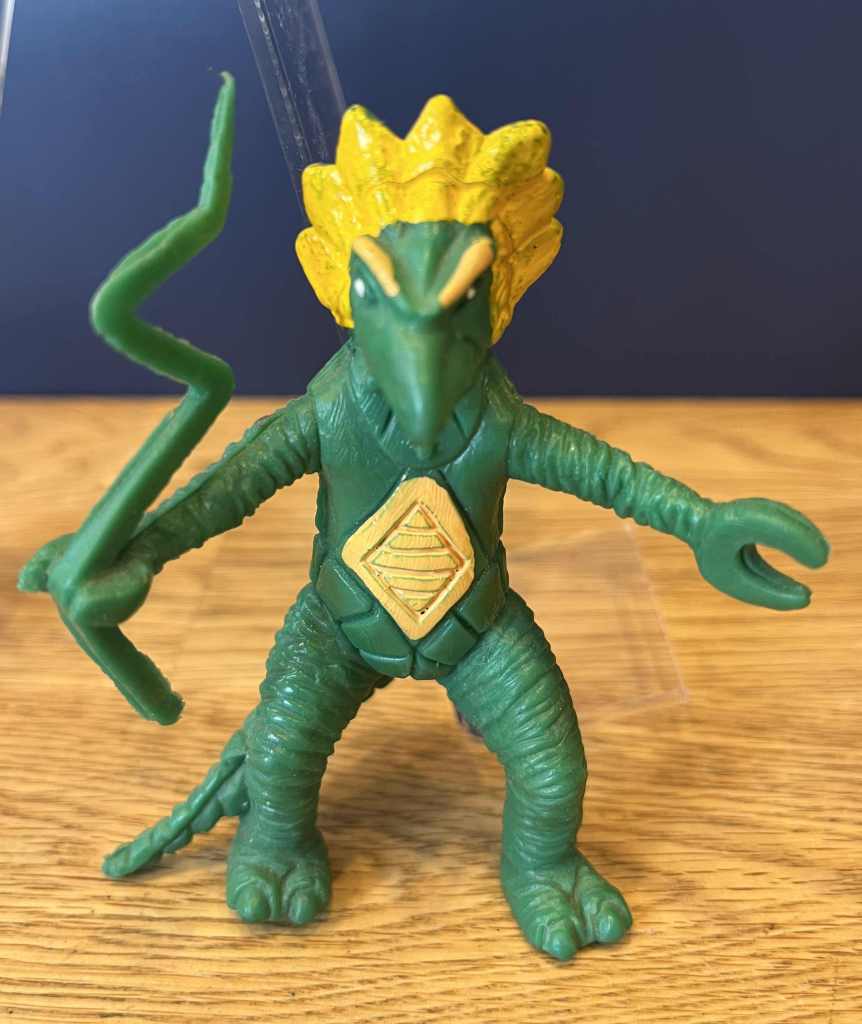
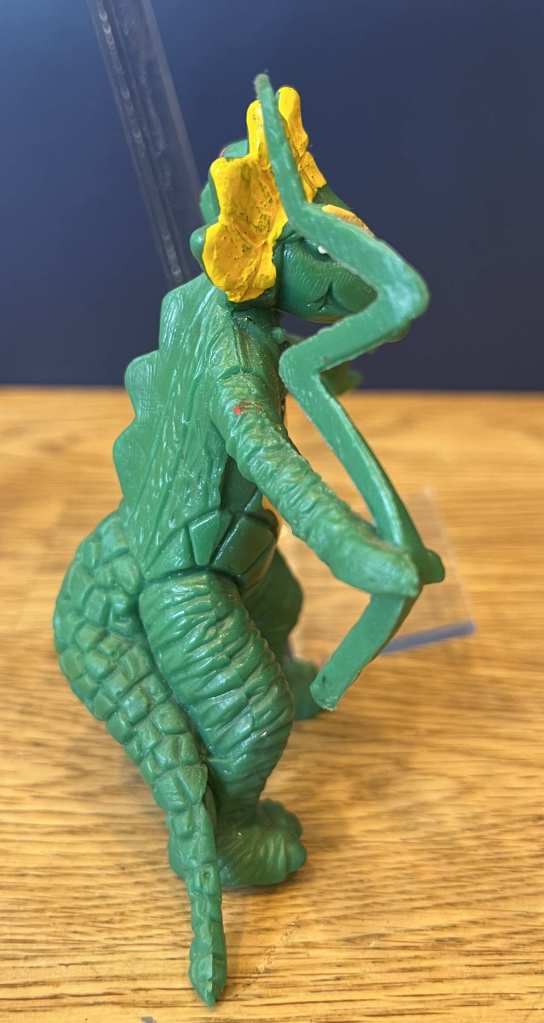
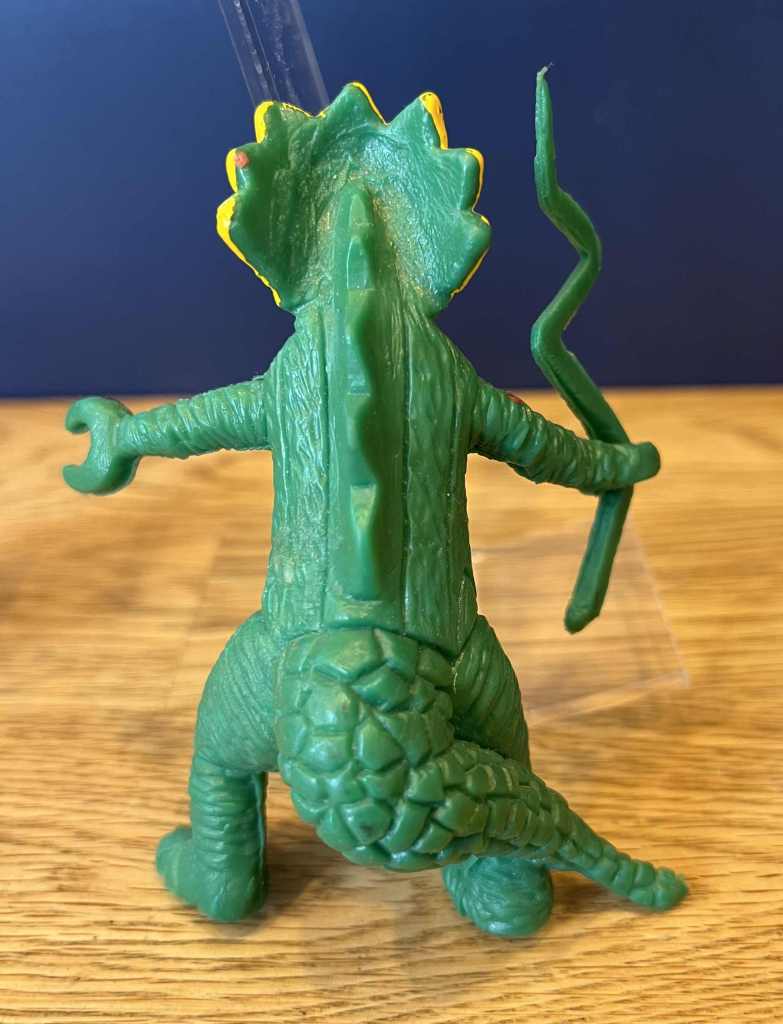
Another figure was closely adapted from the large Hermanos Pardines *Teryx figure, but with another set of arms and a long tail to support the figure and help it stand upright. This one does not have the shield on its back with the maker’s marks ‘HP’, and instead has a mold-injection site there, which leaves a rough circle in its place. This may have been a further bootleg by another company, but considering the wide range of different maker’s marks recorded here for this line, this is most likely another product of Hermanos Pardines. As a quick aside, I note that a Spanish language Instagram post of 2023 asserts that these were Chinese bootlegs of the HP figure, but all of these known to me came to light in Spain, and I have trouble imagining how Chinese toy bootleggers would obtain a Spanish-made toy and then decide to copy it so closely – thus, this assertion is extremely unlikely to be based in fact.
This figure stands about 160mm. tall, and weighs 150g. I find this one has great charm in its cacophony of mismatched details, and is my clear favourite of this group. All of these were produced in a wide range of colour schemes, with some examples in a base material of soft pink, with these given highlights by airbrush (just as with Japanese sofubi) in a variety of bright or iridescent colours.
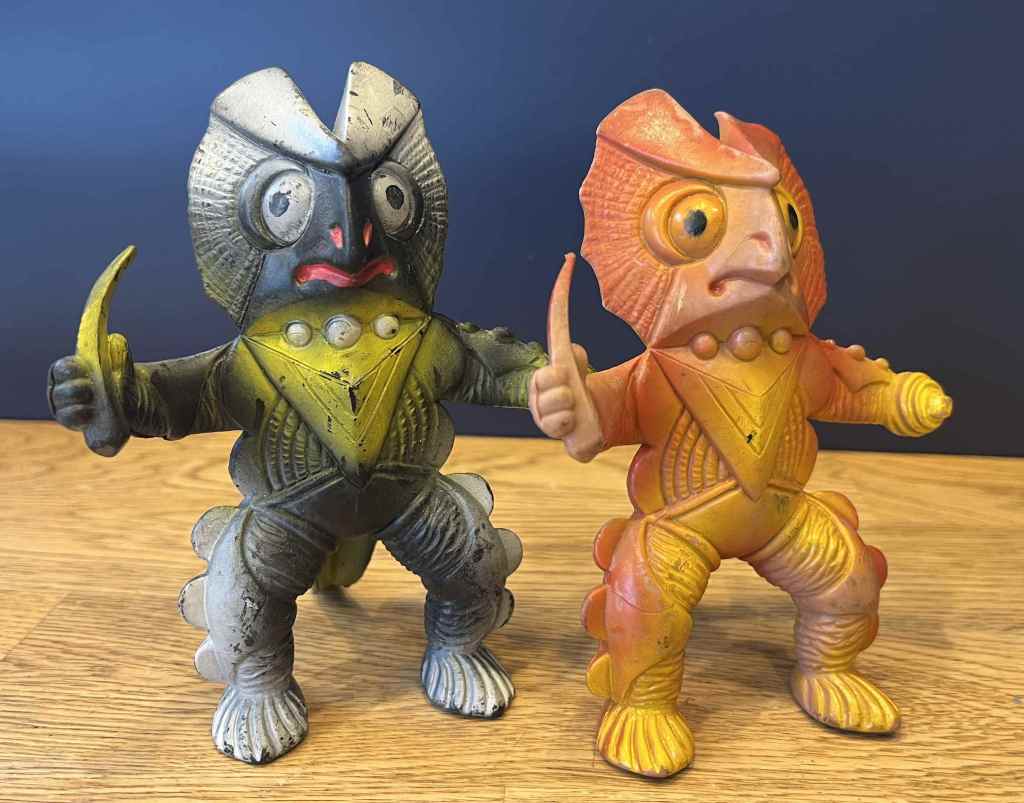
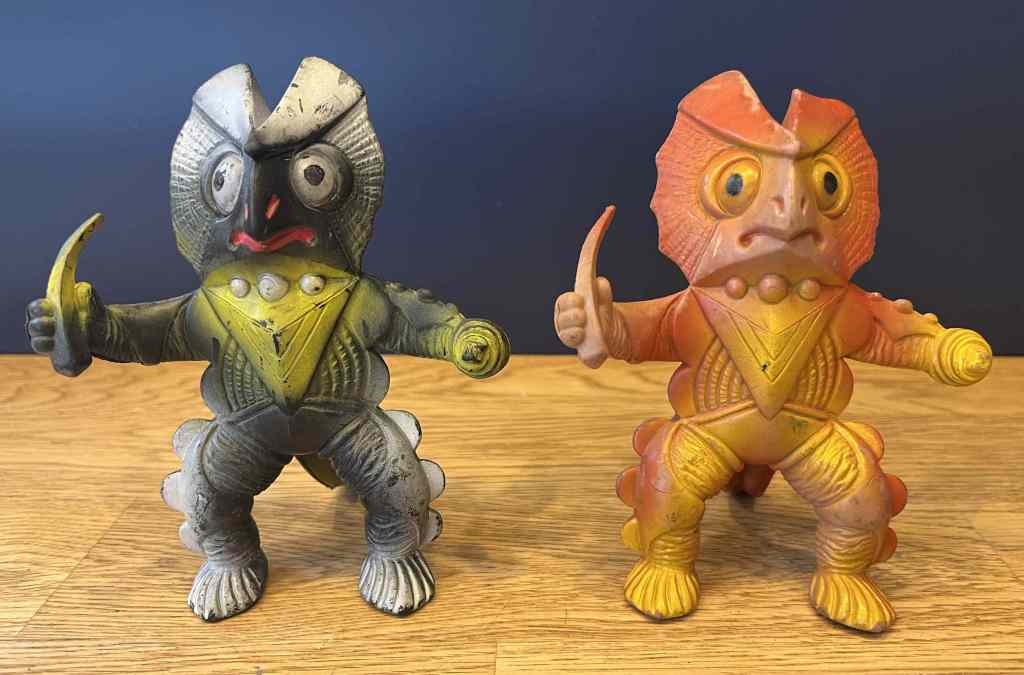
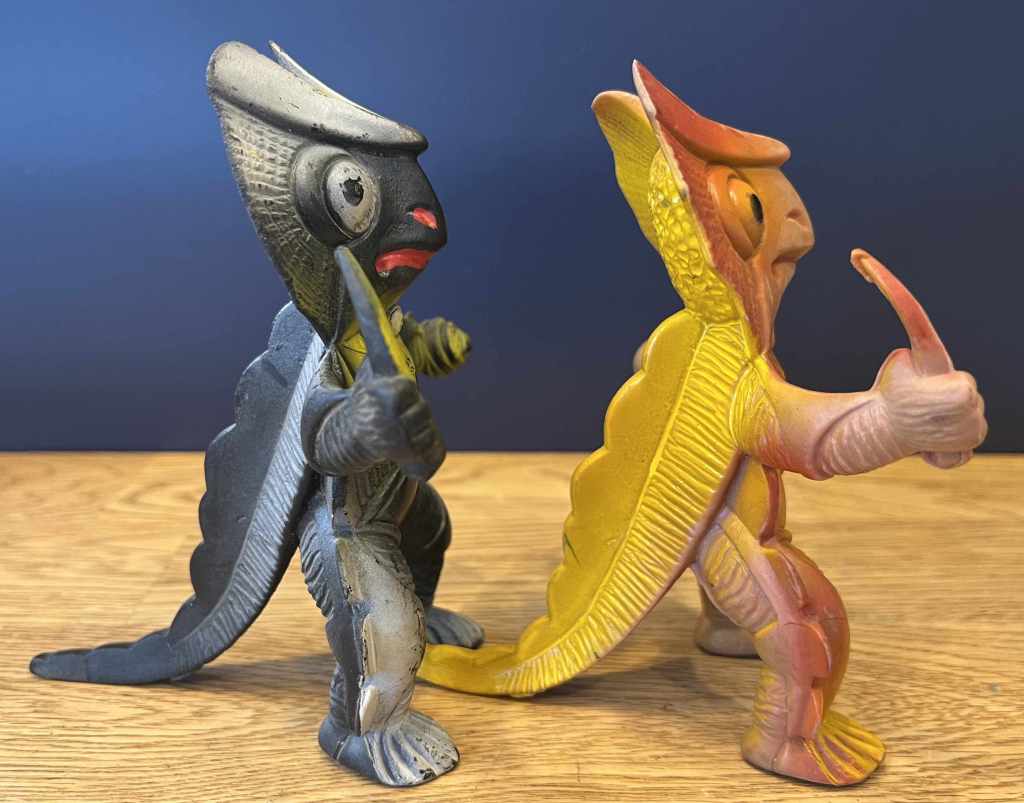
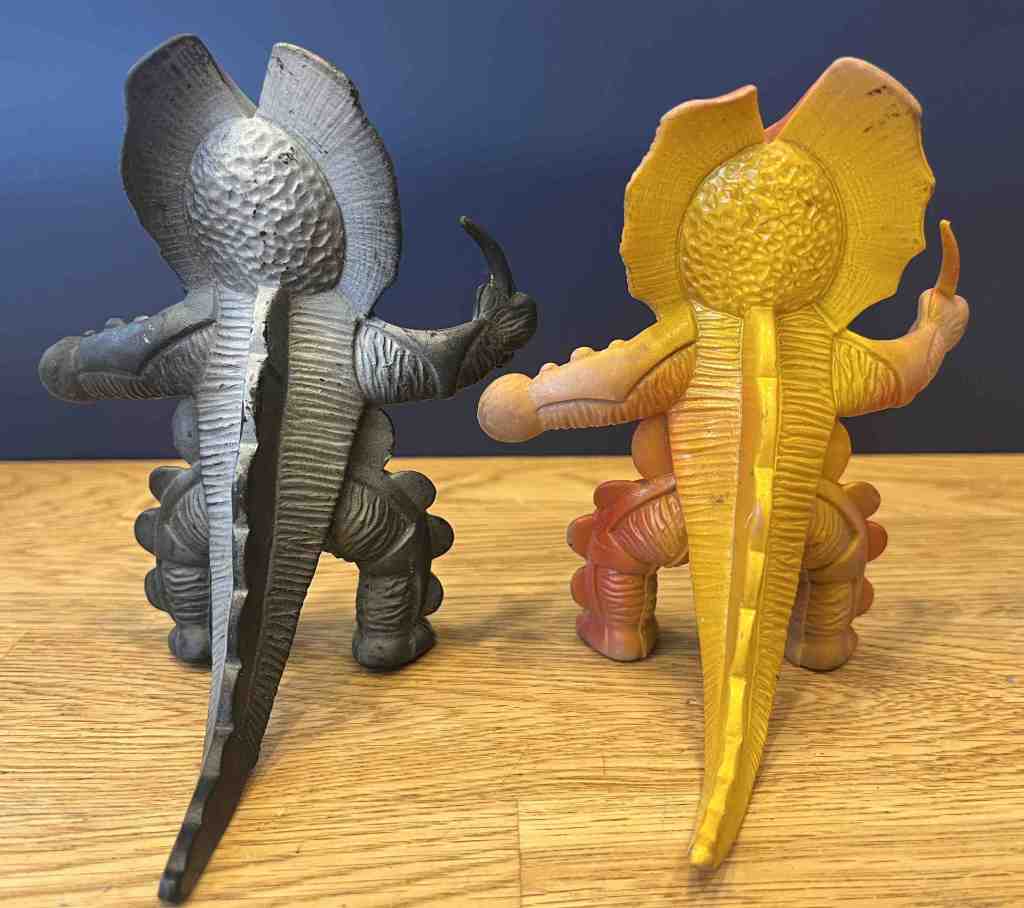
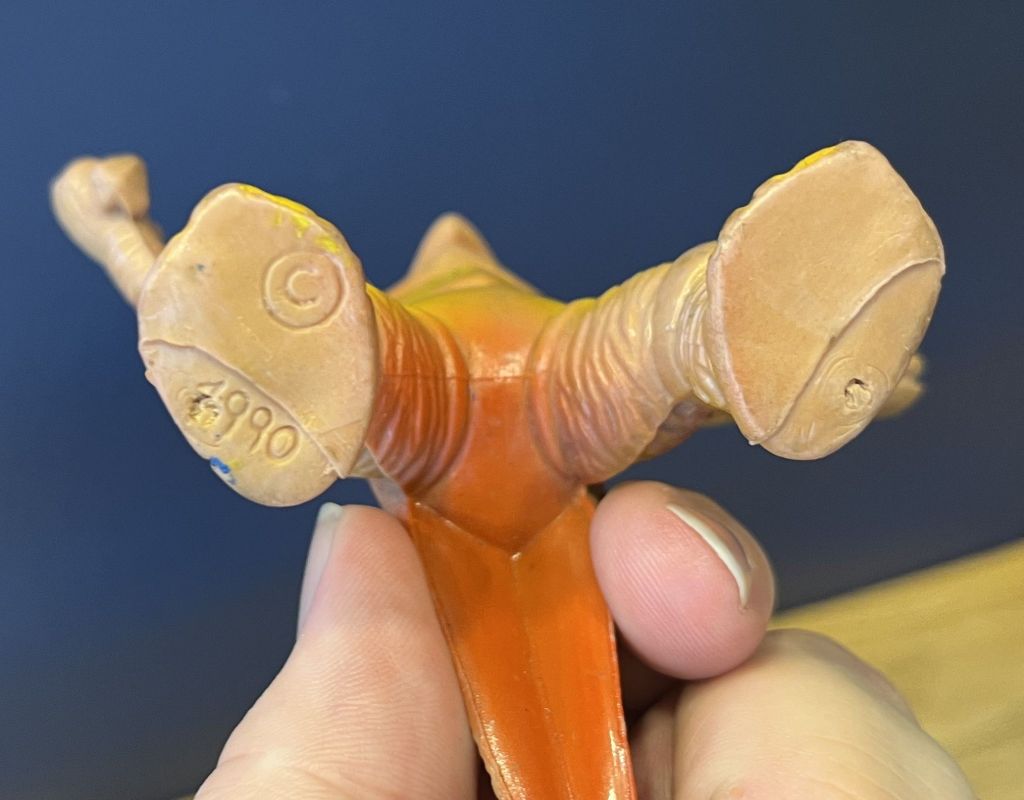
A figure of *Tricero was produced in the same material, and in the same style, and using the same wide colour schemes. Small details such as the fluted feet connect these to other known Hermanos Pardines figures (compare the feet of the demons above), and suggest that this was another item from the Hermanos Pardines line, but for some unknown reason was produced without the ‘HP’ mark (this first argued by the coleccionismo80-90 blog in 2015). The change of maker’s marks does seem important, however, and it is possible that these were produced after the *Teryx and the two demon figures, perhaps by Hermanos Pardines in connection with another company, or even by another company for Hermanos Pardines or reusing their production equipment or team.
This *Tricero stands about 125mm. tall, and weighs 98g. He is made of solid rubber and is unarticulated. I know of examples in black with green, red and white highlights, and orange, red or pale green with similar highlights. He is a long way from being a humanoid triceratops, and has overly large staring eyes (indeed one of mine was described by an online seller as a “strange owl doll”), horns that have been incorporated into the frill as large triangular sections and a split down the middle of the frill like a central parting in a bad haircut. A nod is given to the spacesuit of the original by the triangles on the chest and perhaps the three ovals at the neck, but his feet are fluted without toes, and he has semi-circular fins along the seams of his legs like one of the Chinese ‘Soma’ bootlegs (see my earlier post on the Chinese Godzilla bootlegs, specifically on the *Bootleg of ‘Company X’ model 1, the large ‘Soma’ bootleg). The sole of his right foot is marked “©” and the year “1990”.
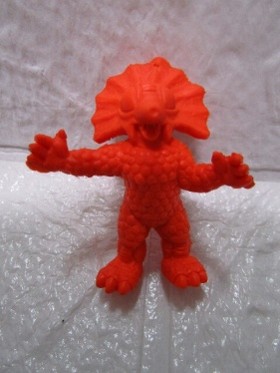
(This image from an unrecorded sale site)
The head fin here may well echo one of the kaiju from the Megaloman series, named Zaninga, who was not produced as a sofubi, but did appear as a keshi.
The fact that he holds an angular horn shape in his right hand may indicate that the smaller Juyba figures holding thunderbolts (see below) were already available, or both go back to an unknown predecessor. However, the series of concentric circles that reach a tip in a four-sided pyramid in his left hand points to an unexpected influence – the smaller model of the Taiwanese ‘Science Space Monster’ Bemstar bootlegs produced sometime soon after 1982, and the stylised red flame-like weapon he holds (see my earlier post on those pachi). While rare, these Bemstar pachis were made in Taiwan for the Western market, and were available in Europe and the US in the late 1980s – and it seems likely our sculptor had access to one before producing his figure.
The same “©” mark on the soles of their feet reveals that a series of mini figures of some of these characters were also produced by the same manufacturer – and each of these is as far away in design and conception from the larger figures as they were from the original cartoon characters:
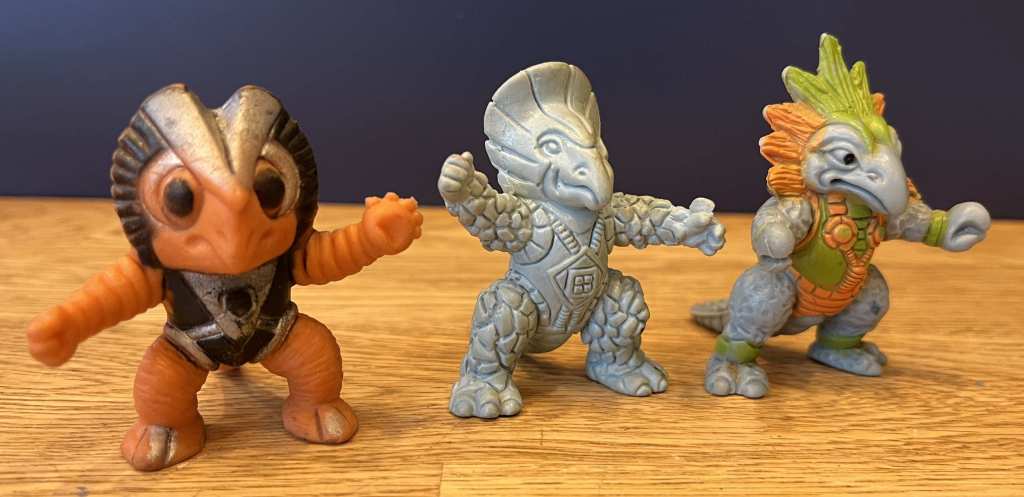
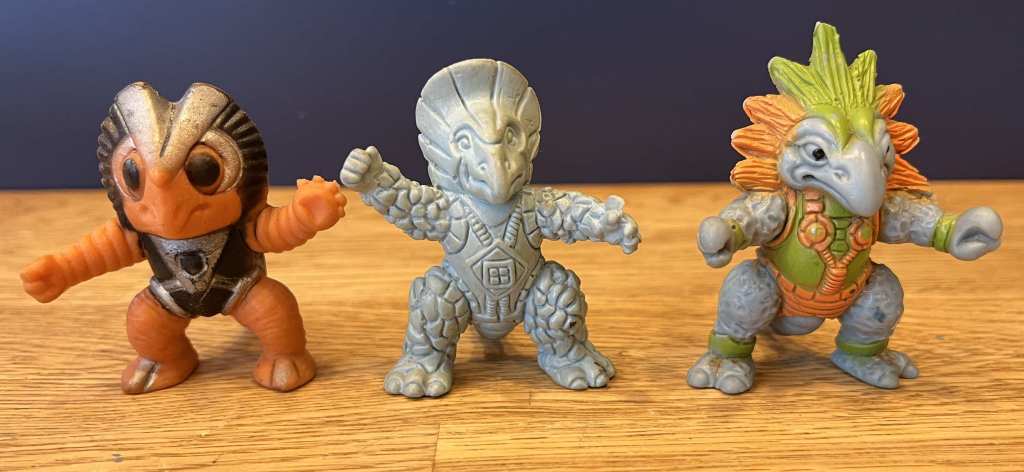
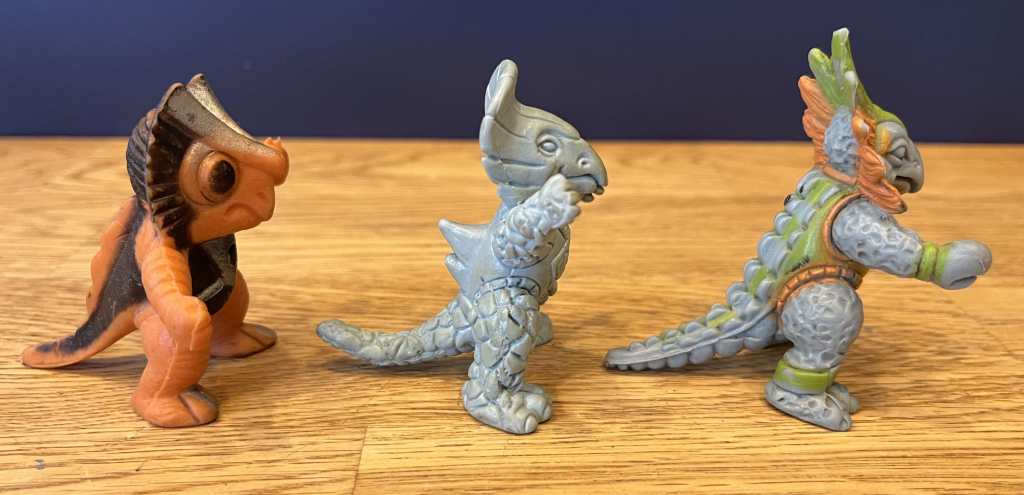
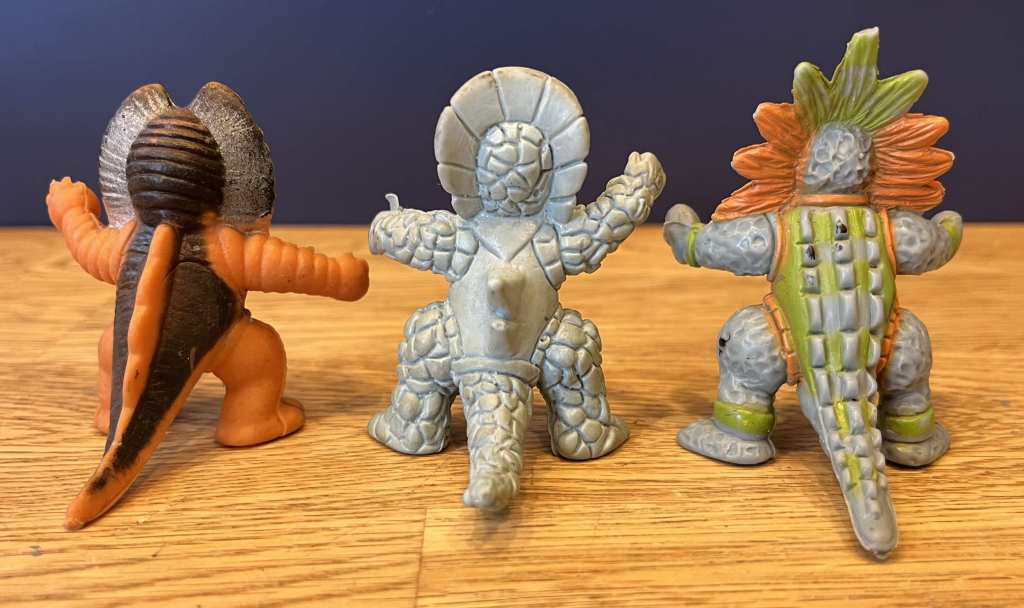
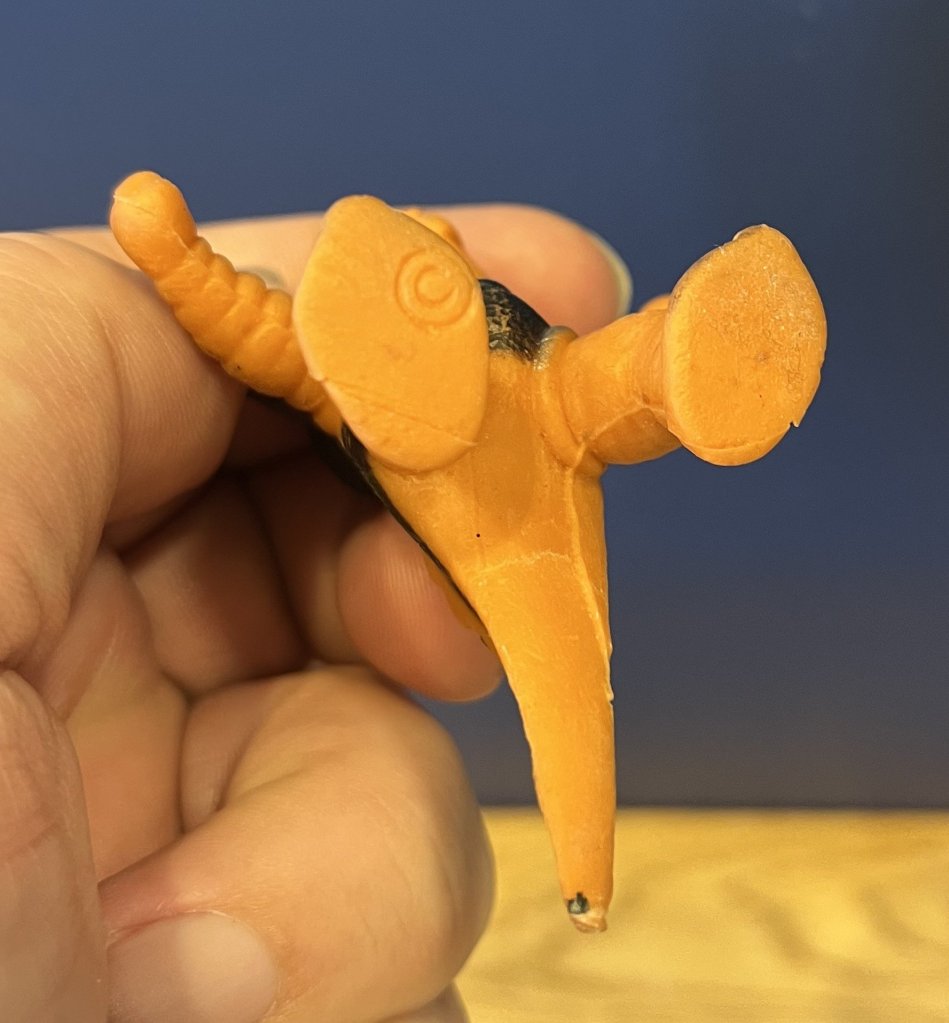
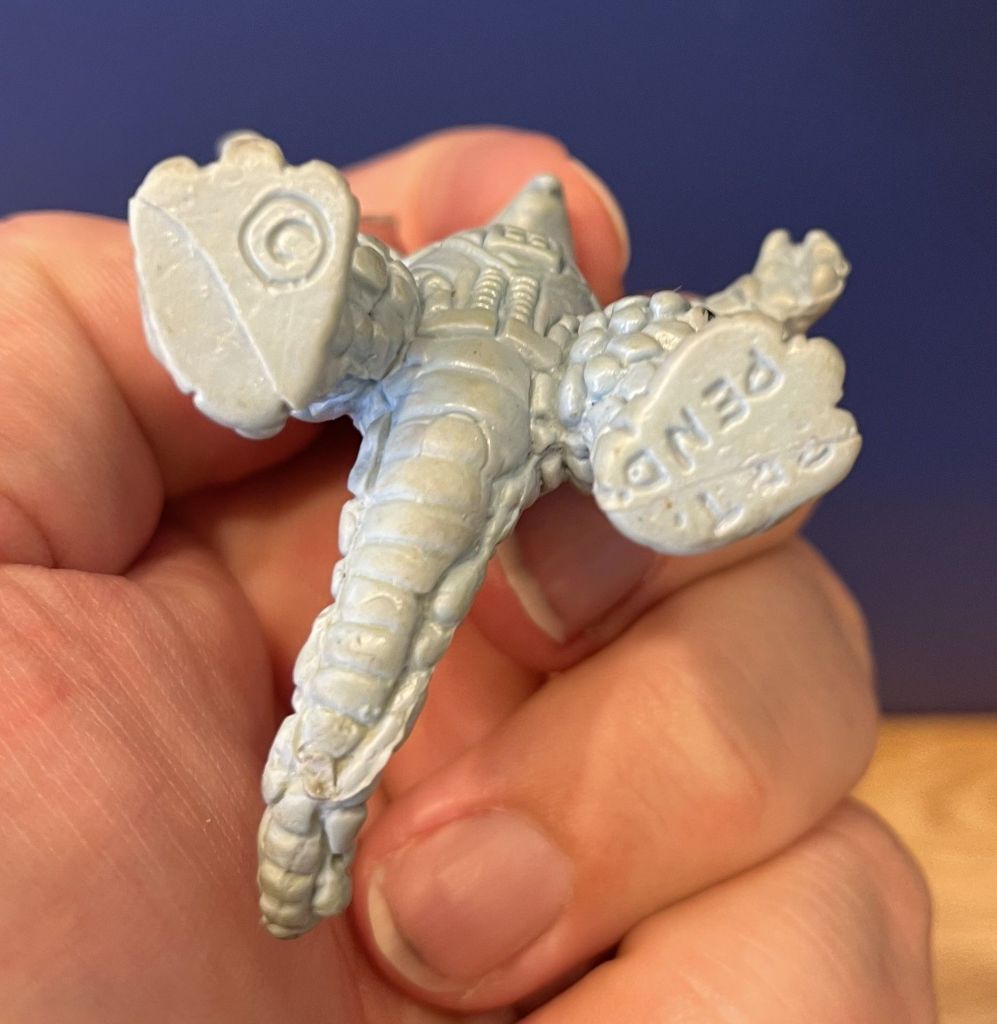
(This image taken from an unfortunately unrecorded Facebook or Instagram post, and not mine; if this is yours and you object to its use here, get in touch and we will remove it)
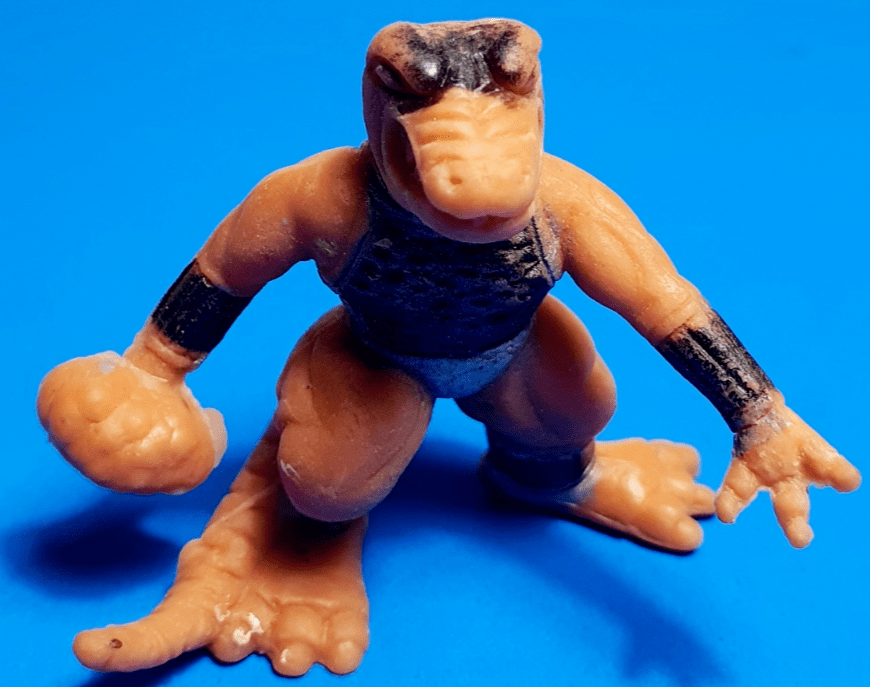
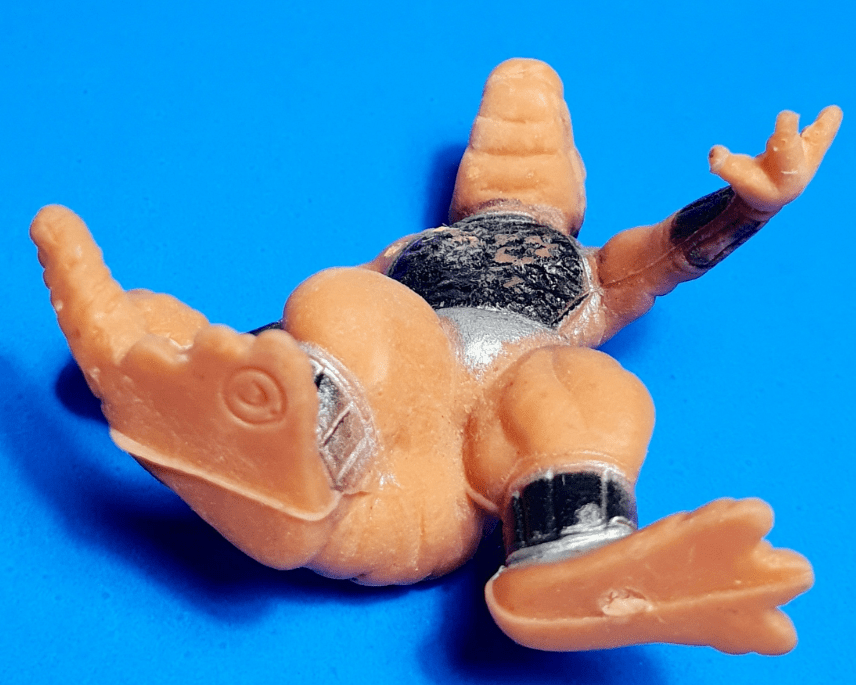
(These images from a Todocoleccion online sale listing)
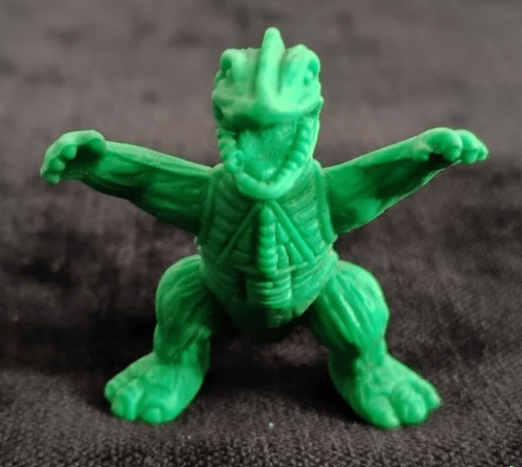
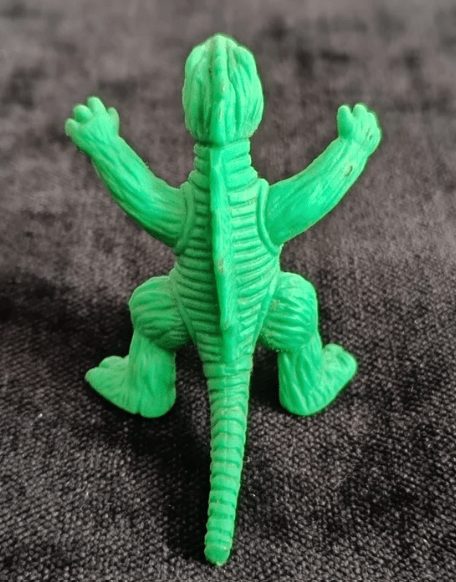
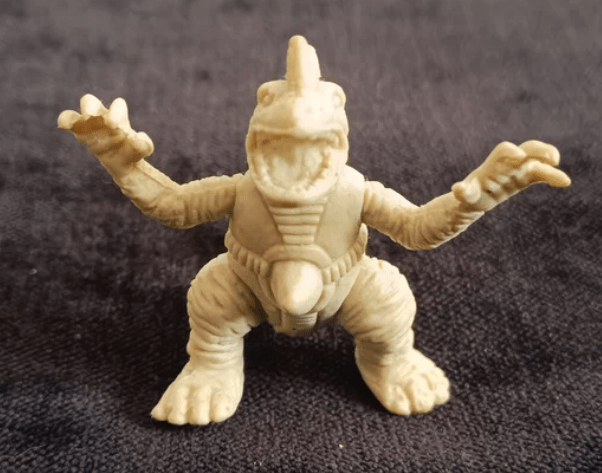
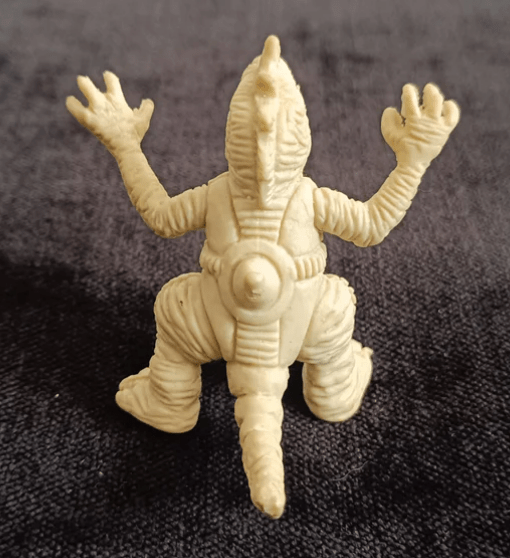
(Images from a Wallapop online sale listing)
Here, *Tricero seems to have been split into two sibling figures. As a nod to the cartoon, all three have been given spacesuit-like clothing, but the sculpt of *Teryx’s head is a long way from that of the larger figure. In fact, we might not have connected these to the larger HP productions, if it were not for the fact that they both have identical “©” marks on the soles of their right feet.
The mini *Teryx stands 58mm. tall, and weighs 25g.; the first mini *Tricero (with central split in frill) stands 67mm. tall, and weighs 24g; and the second mini *Tricero stands 60mm. tall and weighs 22g. These are available in a wide variety of colours, and in an unpainted pink rubber keshi-like form.
Another three minis from the same series (and with the same foot marks) are known to me, perhaps showing *Stego, *Dimetro and another character, but these do not have, to the best of my knowledge, larger versions. The long memory of the ‘coleccionismo80-90’ blog informs us that these, like pachi in Japan and the United States and Godzilla bootlegs everywhere, were sold from cardboard display boxes, in plastic bags (in this case in pairs in each bag), and apparently uniquely to Spain from ball vending machines in cafeterias, bars and restaurants.
⁂
Following these productions by HP, another Spanish company, Juyba, known for its numerous and flagrant bootlegs of cartoon figures, appear to have began to produce similar figures, creating a line of four characters – one of which must be based on the HP *Teryx who has the body of the larger HP figure, but the head frill of the HP mini, and who now holds something very much like *Tricero’s horn in the adapted form of a lightening bolt in its right hand.
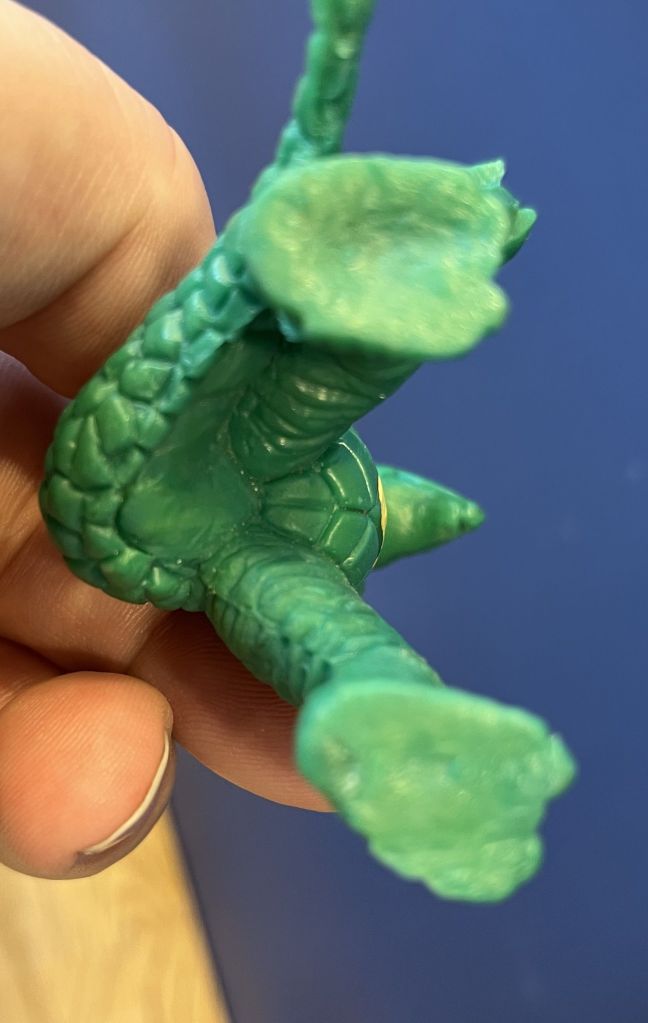
Images of the entire group are available on the excellent ‘coleccionismo80-90’ blog:
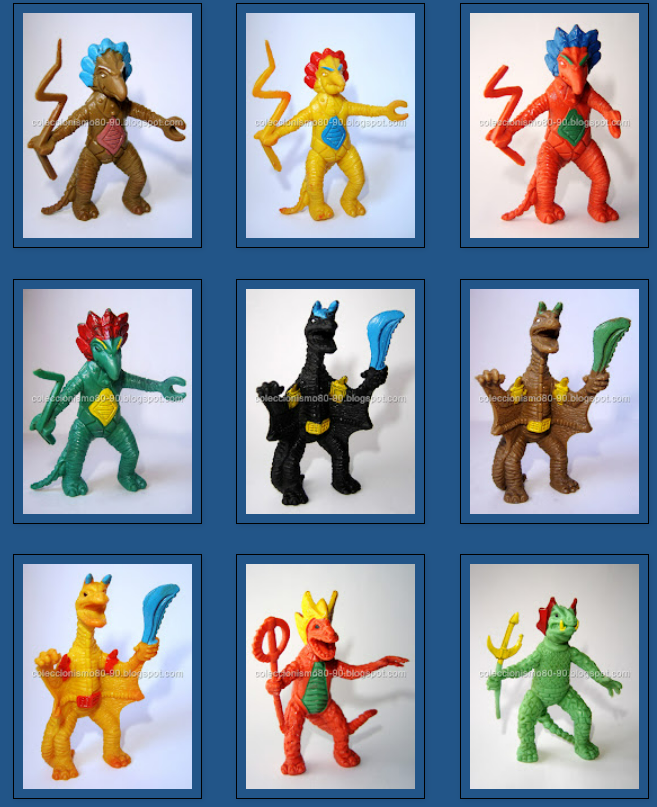
(These images taken from the ‘coleccionismo80-90’ blog)
That owned by me is in soft rubber, stands 90mm. tall, and weighs 35g. These were issued under the toy-line name “Guerreros coleccionables: Enemigos del Mal” (‘Collectable warriors: enemies of evil’).
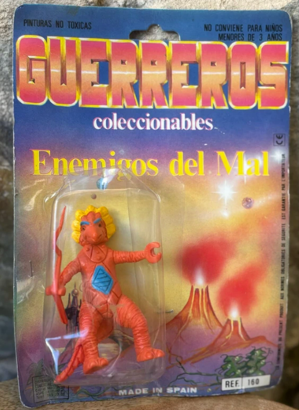
(Images from an unrecorded online sale site)

(The point of display card, showing alternative sale packaging for this line, from a recent Todocollecion sale posting)
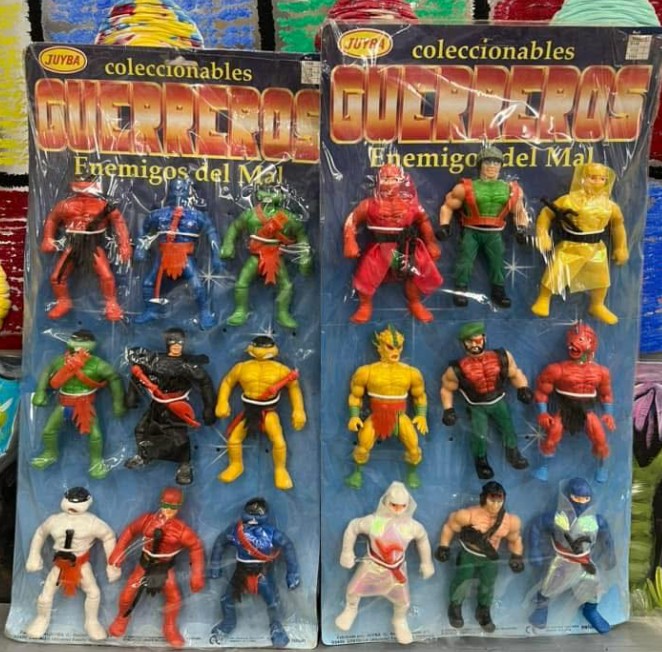
(Image of two sets of Juyba figures in Chance Priest’s collection, posted by him to the ‘Warriors of the Universe’ group on Facebook; reproduced here with his permission)
However, as a word of caution, this “Guerreros coleccionables: Enemigos del Mal” toyline name was not limited to these mini kaiju, and appeared on several other figure lines produced by Juyba – including as above their warrior figures and bootleg TMNTs.
⁂⁂⁂
To sum up: as with all Spanish toy bootlegging this is a complicated story of unlicensed copies breeding more unlicensed copies, until it becomes difficult to see the wood for the trees. However, as noted above, I find it hard to believe that with the Hermanos Pardines larger figures – which are the pinnacle of this group – this was done purely to circumnavigate copyright issues. There are too many changes here, when so many other bootleggers just added a horn or another eye, or changed a colour, and in the proliferation of detail here I think we can almost detect the pleasure of the sculptor in getting carried away in adding more and more to his model.
Here, we seem to have jumped from pure bootlegging into the conscious creation of something new, apparently for the sheer joy of it – and this sets the Spanish bootleggers involved with Hermanos Pardines apart from almost all their peers, and gives these Spanish kaiju a life and beauty of their own.
- 'MUTTON DRESSED AS LAMB': Godzillas and kaiju that look vintage, but are not
- American made Pachi
- BOOTLEG DINOSAURS – a little off topic, but sometimes needed here
- BOOTLEG GODZILLAS
- Bootleg Tokusatsu from China and its immediate neighbours
- Bootleg Tokusatsu from the Americas
- BOOTLEG TOKUSATSU HEROES
- Central Europe – Godzillas and kaiju from behind the Iron Curtain
- Chinese-region bootleg Godzillas -the plastic tide from the East
- Chinese-region made Pachi
- European made Pachi
- European-made Godzillas
- PACHI
- Pachi kaiju
- Pachi kongs
- Pachi superheroes – Ultraman and similar
- The Americas – bootleg Godzillas from the New World

 Confessions of a Kaiju Hunter
Leave a comment