
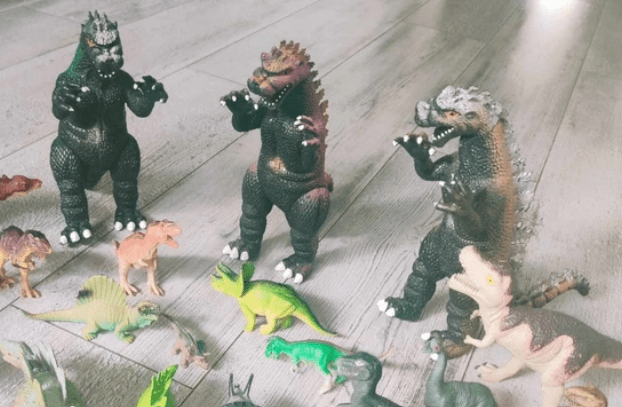
Just as Spain has the crown in the western part of Europe for the number and variety of bootleg Godzillas and kaiju (see my earlier posts on JHL and Hermanos Pardines), then Poland has the equal honour in the eastern part of Europe. There are many similarities to the bootlegger’s art in both, and also some key differences – the latter dictated by the norms of the society that operated around the bootleggers.
Almost all of the attention of those who study Polish bootlegs outside Poland is on the production of locally made Star Wars and MOTU toys there during the 1980s (see this website as an example, and the relevant parts of this; but note that relatively little has been written about MOTU bootlegs beyond notes of their existence), and even for those interested in such things inside Poland, the identification of bootlegs and discussion of them, beyond Star Wars and MOTU figures, seems confined to the private conversations of occasional collectors. Yet there are a large number of Godzilla, kaiju, dinosaur and monster toys, as well as many others, that also deserve our attention.
I am, quite frankly, as in love with bootlegged Polish toys as I am with Spanish ones. For the European collector of bootlegs those two countries in the 1980s and early 1990s outweigh all others. The same conditions of low levels of copyright control (or perhaps wanton ignoring of copyright is a better term) bred a legion of copies of toys, but a key difference is the regionality of Polish toy bootlegging. In Spain, most bootleggers were concentrated in Ibi, and if a particular bootlegging toy became popular it seems to have spread across the country fairly quickly. However, the opposite was true in Poland. (As an aside, thanks are due at this stage to a Polish toy collector, who kindly shared many recollections with me for this blog). In Poland, bootlegging was illegal during the communist era as with many other capitalist enterprises, but was sporadically tolerated by local Communist authorities and run by private entrepreneurs as small scale producers, who suffered periodic crackdowns and government interference. Usually the items they produced were faithfully cast copies of foreign toy figures, even often reproducing the “Made in China” inscriptions or similar, in slightly less quality or smudged detail, but occasionally such toys show the hand of individual design by their Polish sculptors. Their goods were sold either via private market stalls or small retail booths by so-called, somewhat derisively named ‘prywaciarzy’ (‘private entrepreneurs’), or by ‘labour cooperatives’ which were, in essence, state-owned enterprises, with the latter marketing their goods in official state-run stores or newspaper kiosks. This form of activity on the edge of society and always at risk of being shutdown by the same government officials who had allowed it to thrive previously, did not lend itself to wide geographical sales of these products, and just as with locally-made copies of Star Wars and MOTU figures, any Godzillas, kaiju or dinosaurs, were sold in local clusters usually only a few miles from the production workshop. This means that various competing lines often co-existed, with many apparently unrelated bootlegging operations carrying on side-by-side, and that if a regional distribution can be tentatively discerned through where such toys come to the market today.
⁂
- The Polish copies of Chinese ‘Sharkzillas’ – a cornucopia of kaiju:
The largest, grandest and most excitingly innovative Polish bootleg Godzillas and kaiju form a tight-knit group, perhaps produced in the north of Poland in the 1980s. They are magnificent beasts and it must be said from the outset that I owe my own examples of these Godzillas, and a great deal of my knowledge of others, to one of Poland’s foremost bootleg toy collectors and hunters: Łukasz Kłopotek-Główczewski (Facebook and Instagram). To him, I owe my ownership of these:
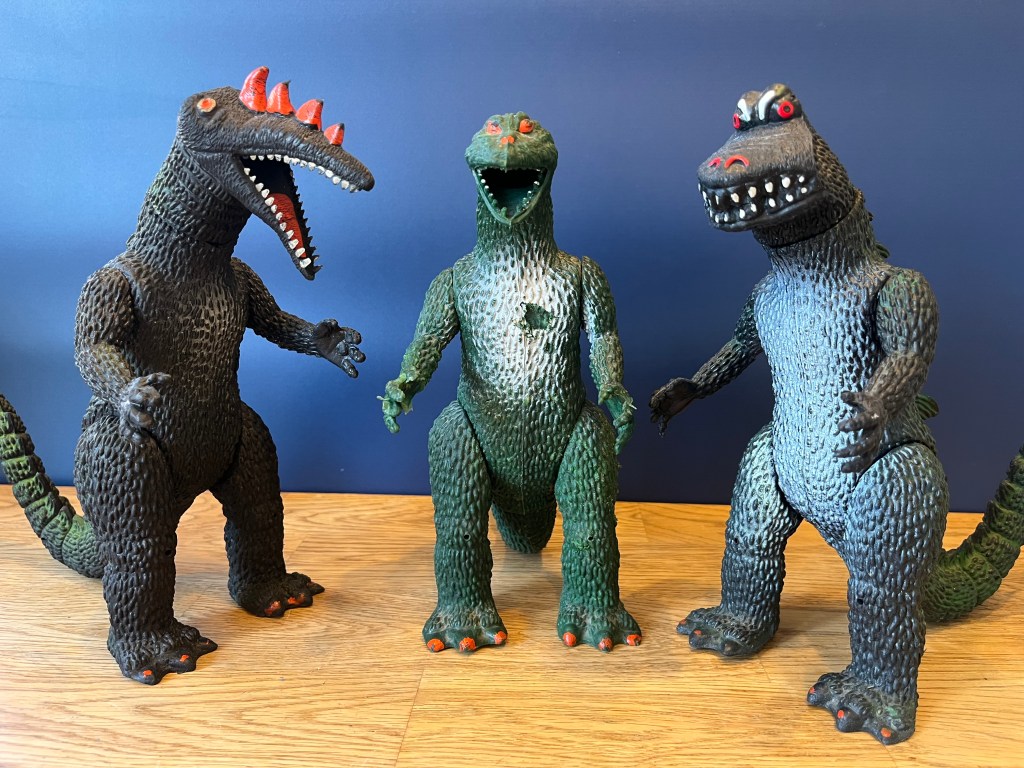
While they do not have any marks on the soles of their feet, they are quite distinct from other Godzilla and kaiju bootlegs and were produced in rubber far cheaper than that used for the Chinese models. Crucially, they almost always turn up in Poland, and often in the north. They are, therefore, almost certainly Polish in origin.
We should briefly discuss the material they are made from – an oily pliable black rubber that occasionally smells of petrol, and is so ‘loose’ in its structure that it approaches the material that jigglers are made from, so that when placed on a table-top they ‘jiggle’ on their legs for a few seconds. This also means that the rubber is prone to tearing and damage, and I presume that is the reason so few survive now or have been traced – they were played with by their original owners until they fell apart and were finally discarded. The rubber is, in fact, easily identifiable as repurposed industrial byproducts, and recycled vulcanised rubber naturally cures to a dark black colour due to its high carbon content (carbon was regularly used in the Soviet world as a reinforcing filler added to synthetic rubber compounds to improve the material’s tear resistance, durability, and elasticity). Brightly coloured pigments were in short supply and tend not to be used in the production of such toys. These figures are likely made from the same stock of material as tyres, industrial gaskets, and even boots, and given the semi-illegal nature of these bootlegging operations, most probably from sources of rubber that in Western Europe we would say ‘fell off the back of a lorry’ (wink, wink). Also, I am advised that such rubber often contains toxic chemical compounds, so if you do own one of these, I recommend not chewing or sucking on it for too long.
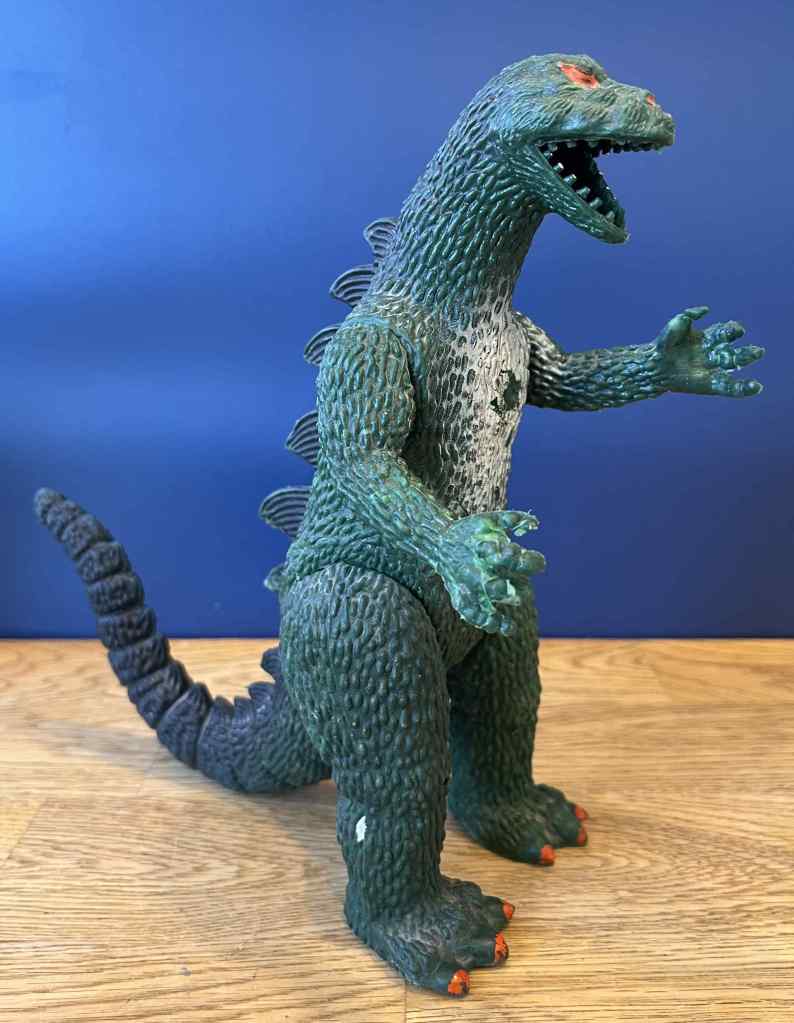
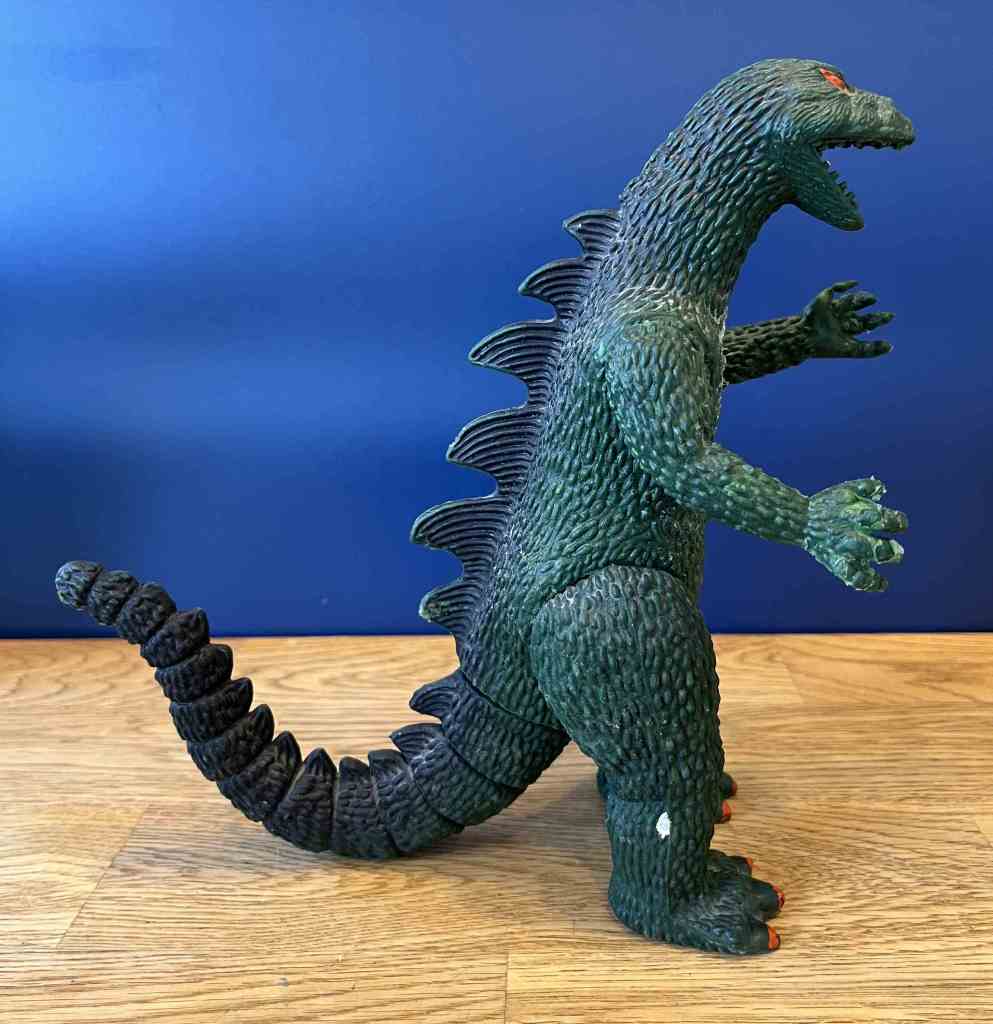
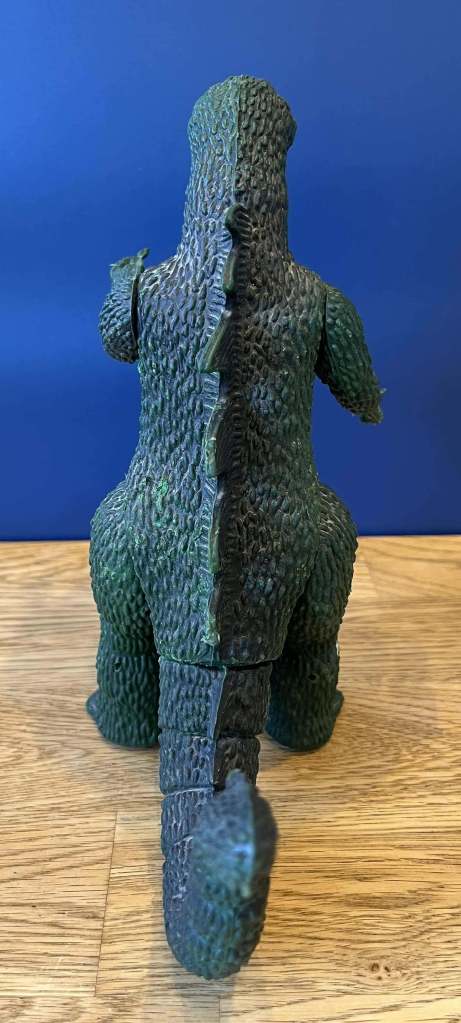

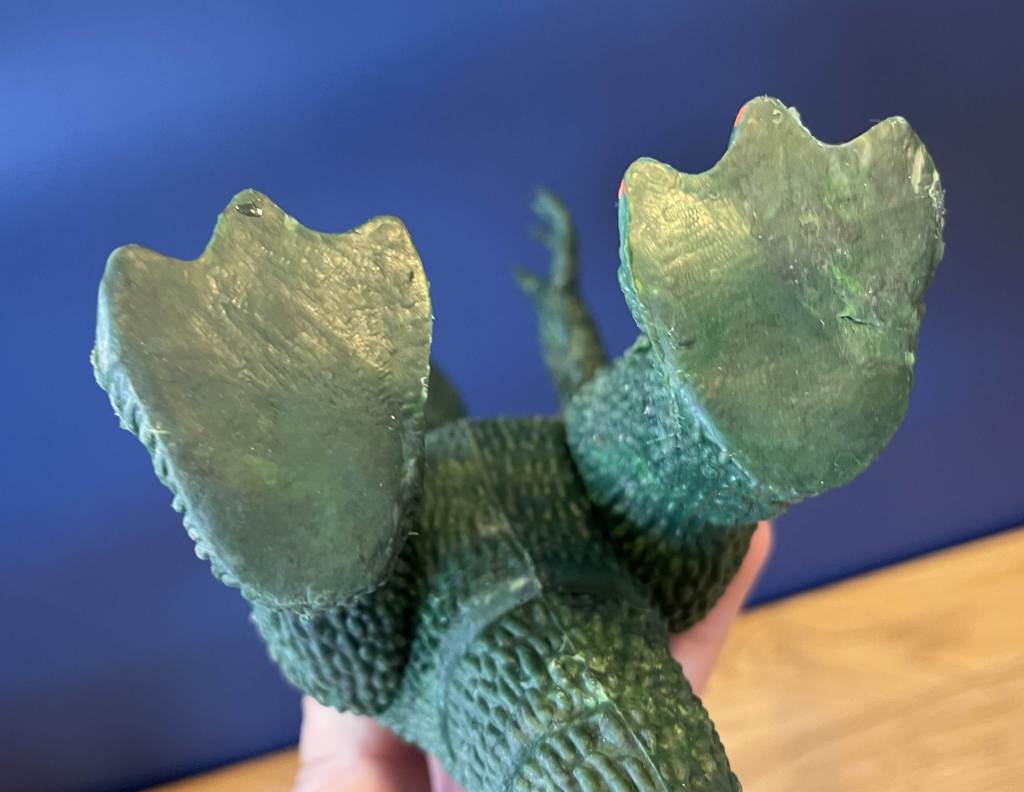
(The copy of the ‘Sharkzilla’)
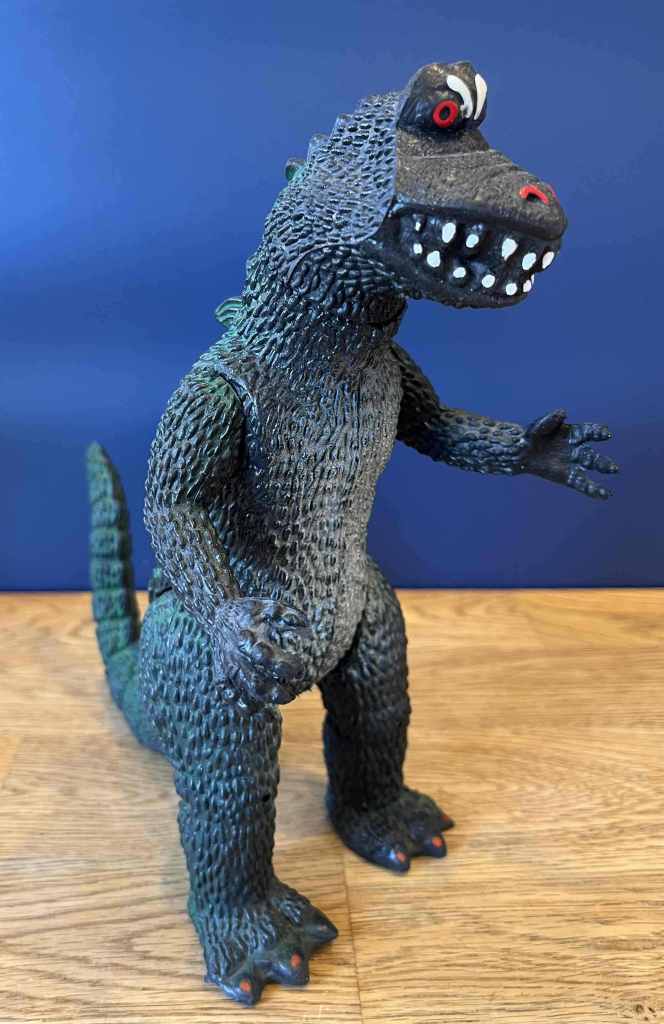
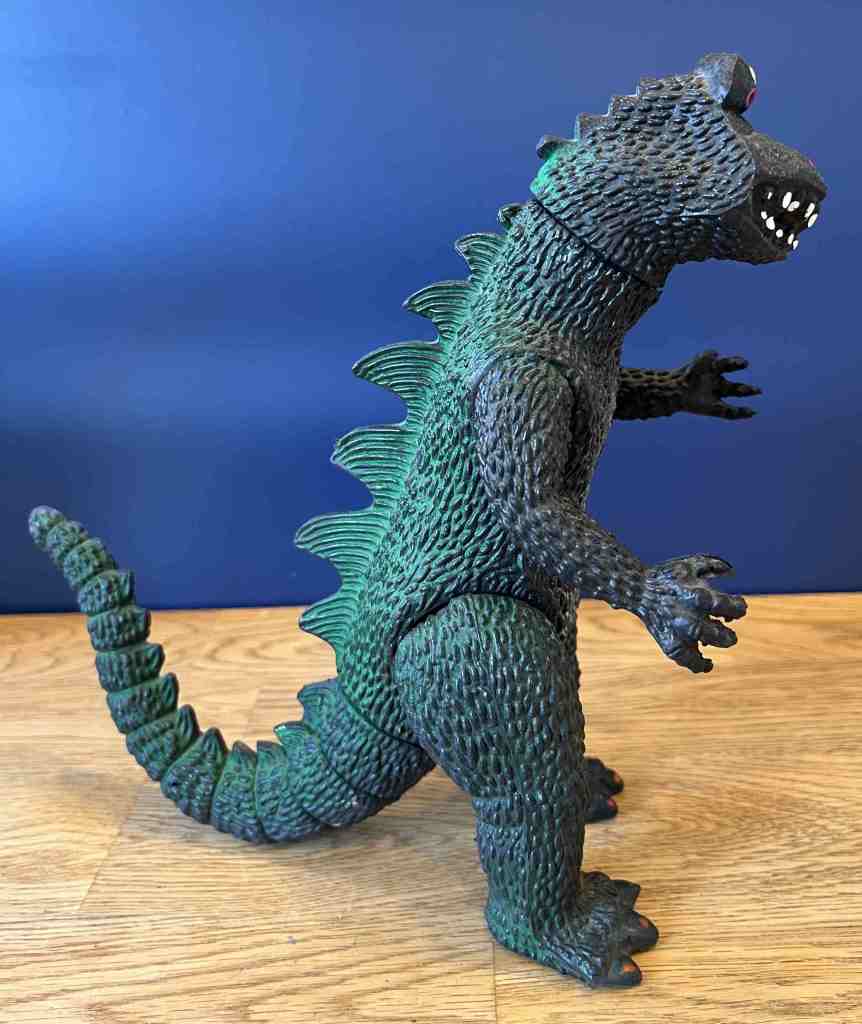
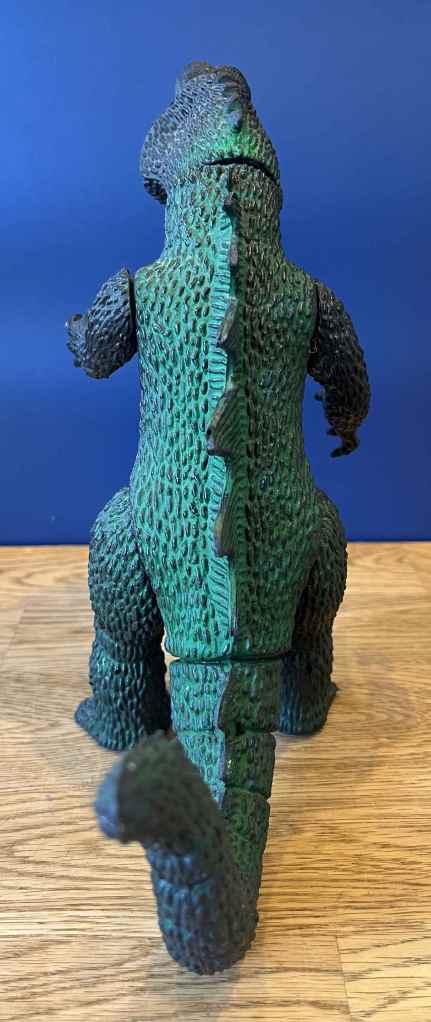
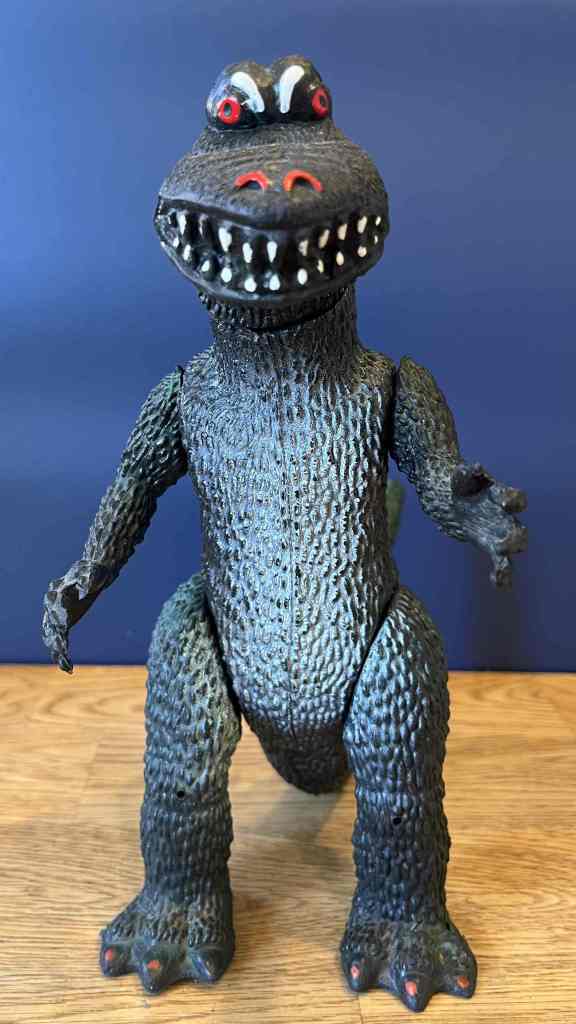
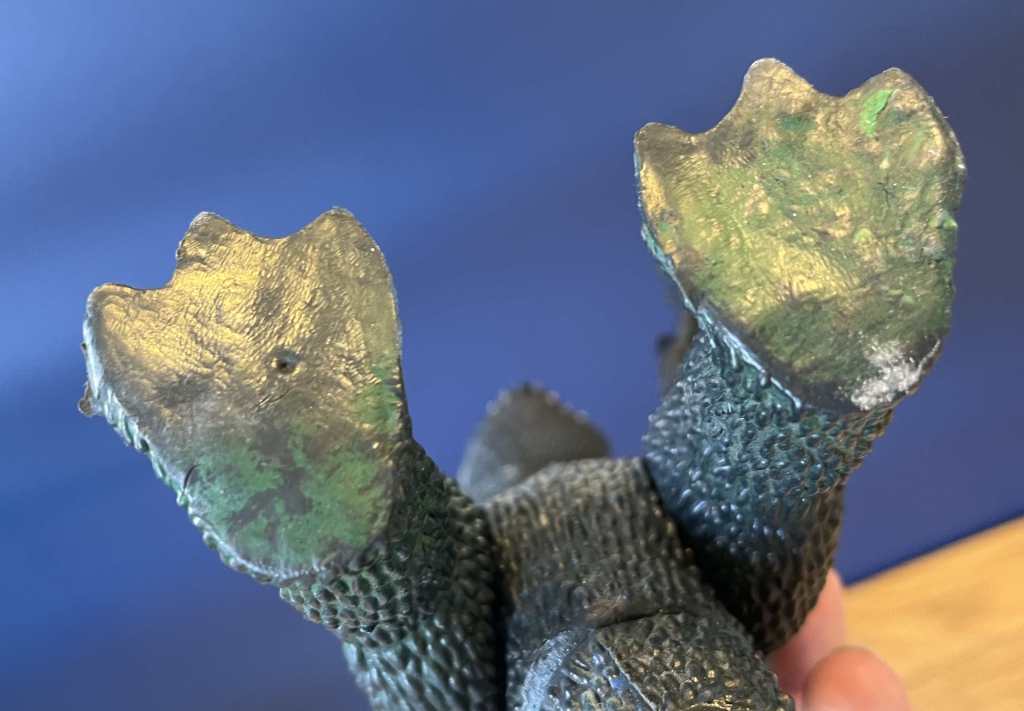
(The grimacing Godzilla bootleg)
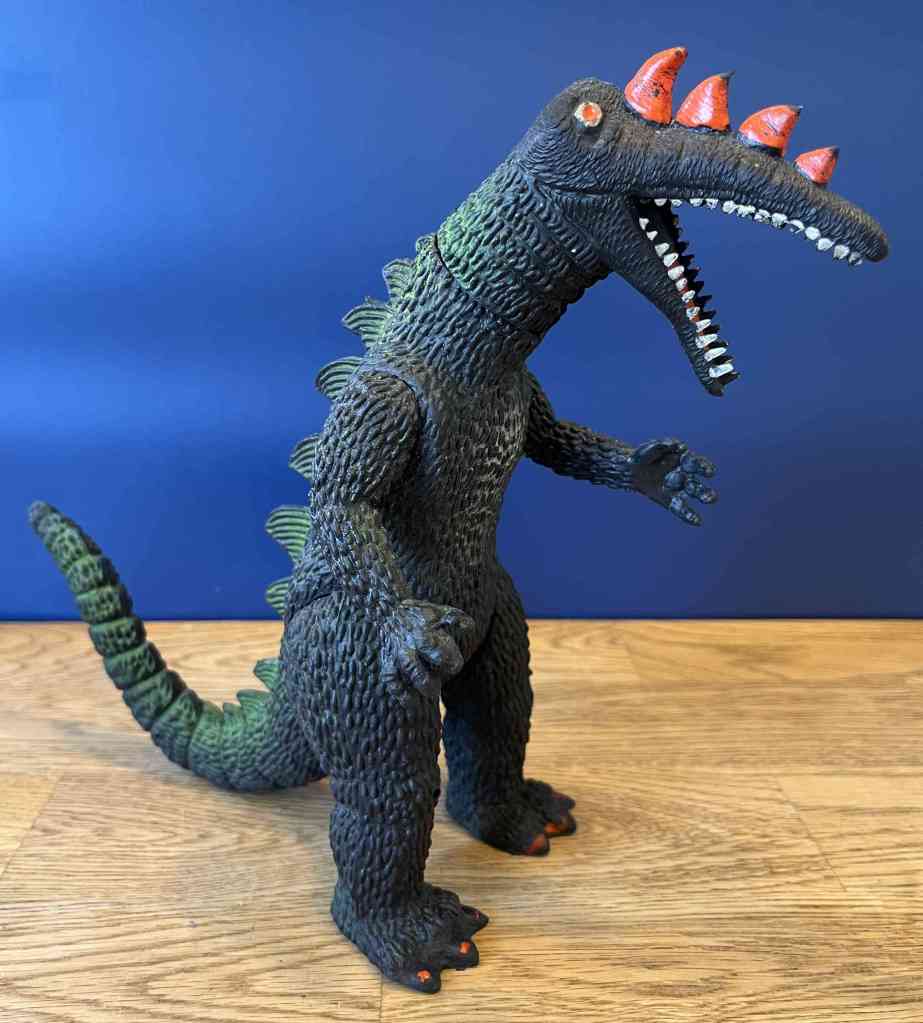
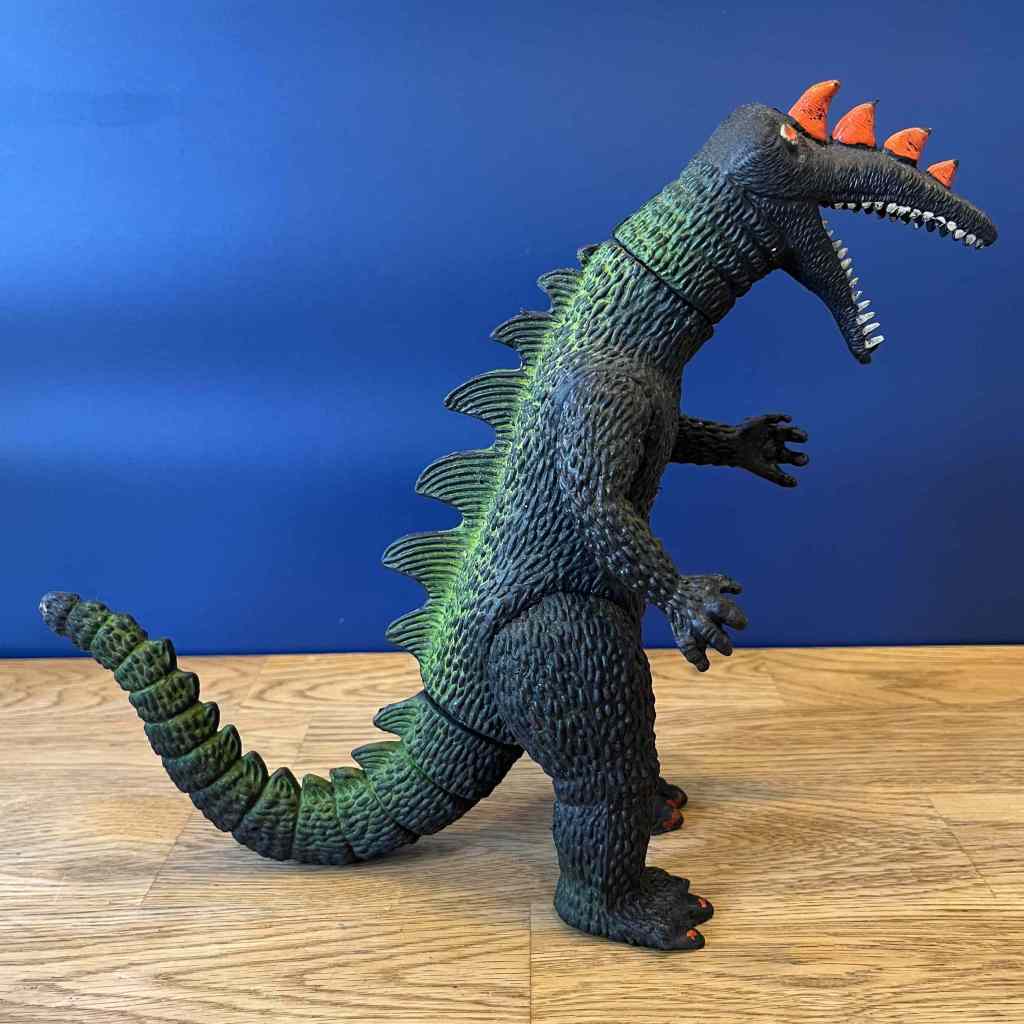
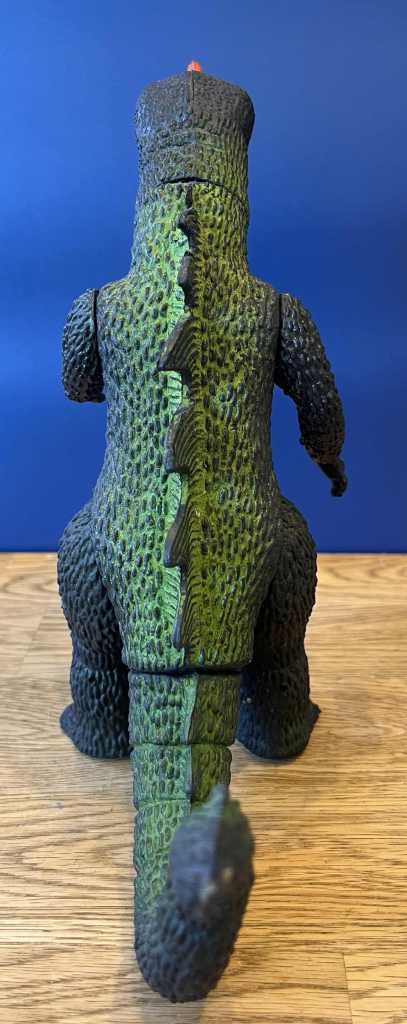
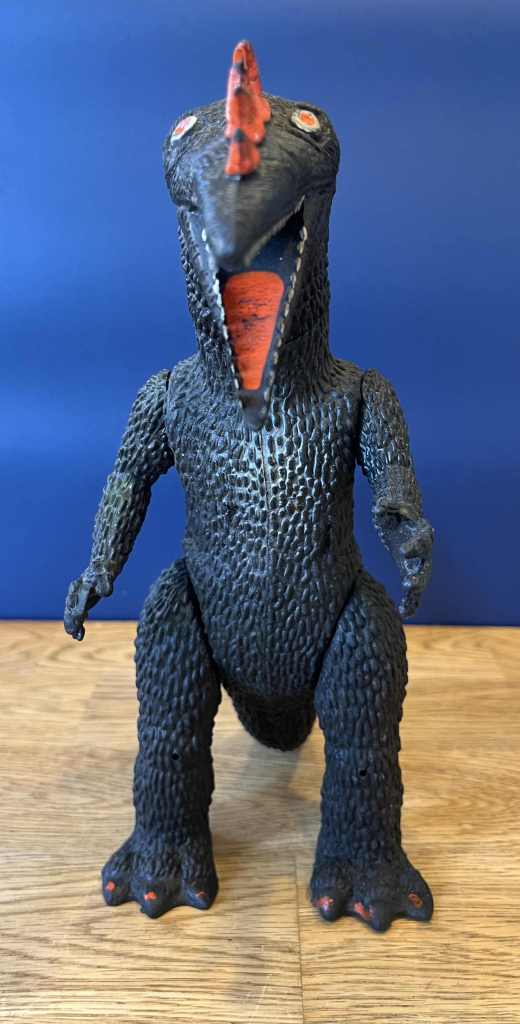
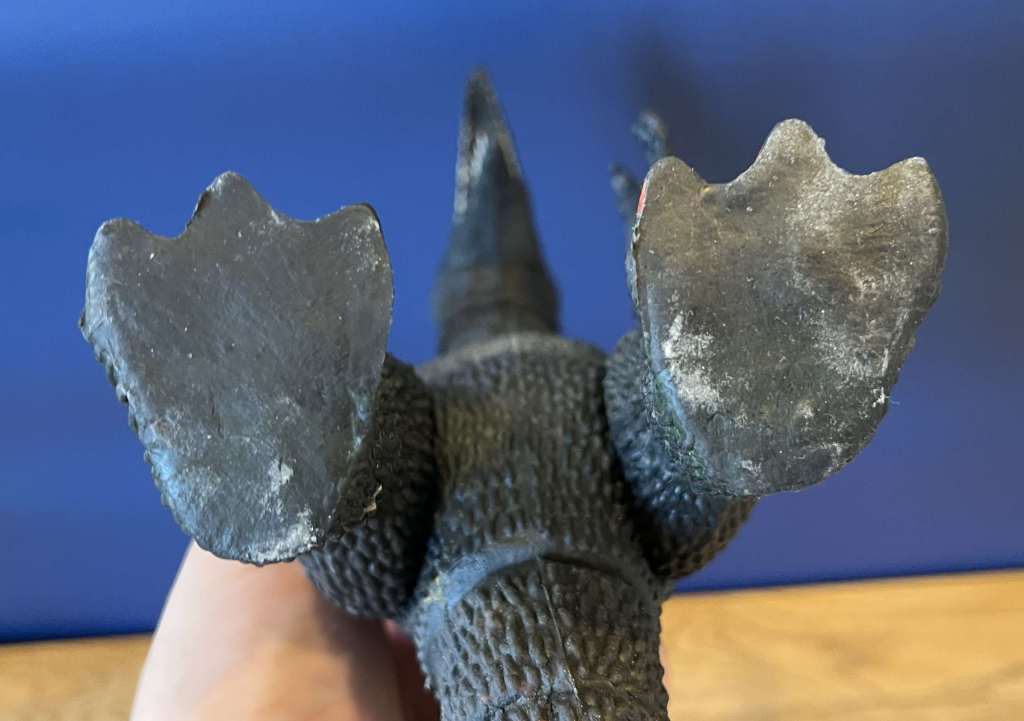
(The ‘horned bird kaiju’, or following Gonzo the Muppet’s description of himself: the ‘whatever’)
All three shown here stand about 220mm. tall and weigh about 290g. One of them – that which perfectly copies the so-called ‘Sharkzilla’ produced by the Chinese ‘company X’ (see earlier post on Chinese Godzilla bootlegs) does not articulate at the neck, but all others do. All articulate at the arms, legs and once at the base of the tail. They have green highlights on their back, and silver-white on their stomachs. Details such as eyes and toenails are picked out in bright red, with teeth and eyes in white or silver-white. The hands frequently suffer in the molding process, and have lost digits of fingers during the production process, or have ‘webbed fingers’ that have failed to be separated fully from each other. The feet are notably thin and flimsy, and the legs and tail have small circular holes in them at the front and back of the knees and on either side of the side of the tail halfway along – these presumably injection or suspension marks from the molding process. The throat of the horned bird kaiju here is sealed, but the grimacing Godzilla here has no hole in its mouth at all, and the rubber seals the mouth just behind the line of the teeth.
The size and shape of the sawtooth spine-fins firmly point towards the Chinese-made ‘Sharkzilla’ bootlegs as their ultimate models, and one of these also copies the same head of that model. The head of that one, as noted above, is not articulated (just like the ‘Sharkzilla’), and it seems likely that this one was produced first as an accurate copy of the Chinese ‘Sharkzilla’, and sometime after that the manufacturers produced variations of this model with the same body but new heads, in order to vary the line, without having to sculpt new figures completely.
These Polish bootlegs are rare, even in Poland, and apart from Łukasz’s various online posts about some of the bootlegs now in my collection, I know of only three more of the grimacing Godzillas – two more acquired by me, and that listed on Facebook in late 2025 by an American collector with requests for help in identification (the post now taken down; but images below). Similarly, I know of only two further examples of the horned bird kaiju – the first of which appeared in an OLX.pl auction in recent years (this listing now taken down, but image below), and the second recorded in Łukasz’s Instagram post of 22 July 2022 (see below):

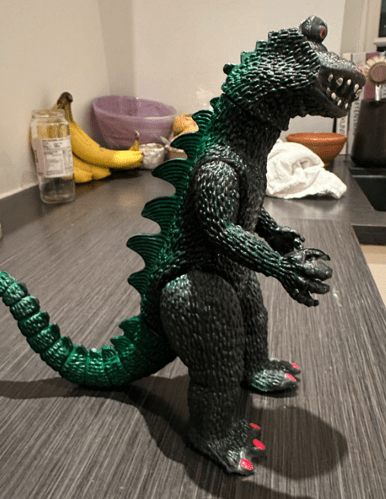
(These images from a now removed Facebook post by an American collector who had inherited the toy, and not mine; if the images are yours and you object to their use here, please get in touch and we will remove them)
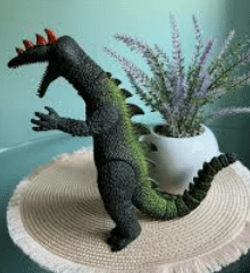
(Image from an OLX.pl sale listing)
However, that is not the end to this line, and there are at least two further head sculpts. On 30 November 2022, Łukasz posted images of two others standing together. (see here) The first of those was another example of the faithful copy of the Chinese ‘Sharkzilla’ model discussed above.
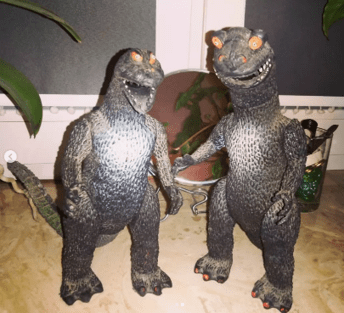
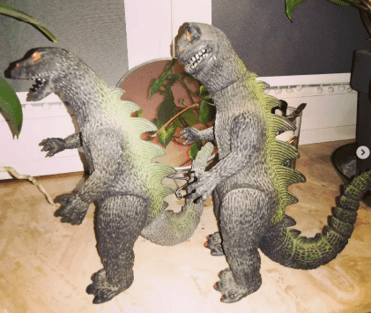
(These images from Łukasz Kłopotek-Główczewski’s Instagram account, and reproduced with his permission)
The second model here, however, is clearly part of the same group, but is not one we have seen before. It articulates at the neck, and has an enlarged head with a dramatically shortened muzzle, and large and flat ‘headlamp’-like eyes.
In addition, on 22 July 2022, Łukasz posted images of three of the Chinese-made ‘Sharkzilla’ models, alongside another example of the horned bird kaiju (with white eyes instead of red and silver-white), and another previously unseen example from this same line, with a body identical to those described here but with a more realistic dinosaur-like head with a substantial overbite (see here).
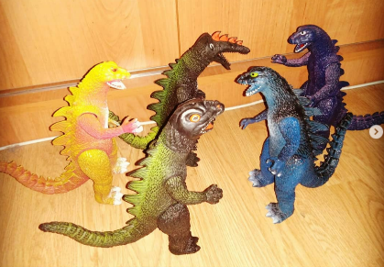
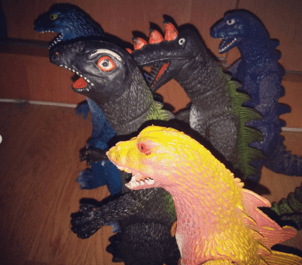
(These images from Łukasz Kłopotek-Główczewski’s Instagram account, and reproduced with his permission)
These last two are, perhaps, the rarest of this line, and thankfully that dinosaur-headed figure with an overbite passed from Łukasz to my friend and fellow bootleg-hunter, Jamie Francis (see Instagram) along with a fully articulated Parasaurolophus in the same black rubber and with eyes coloured in the same red, that must almost certainly be a Polish-made toy cast from a plastic dinosaur probably of Chinese origin.
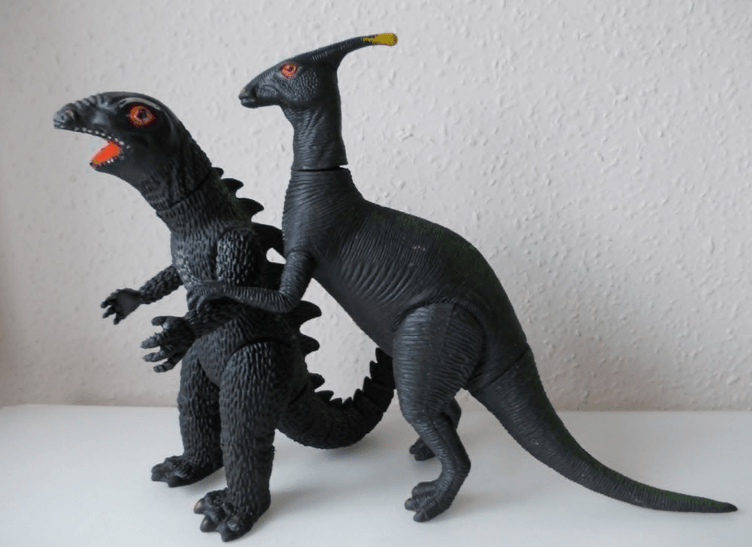
(Image reproduced with Jamie Francis’ permission)
Kindly, Jamie has sent me a full set of images of this bootleg Godzilla to add here:
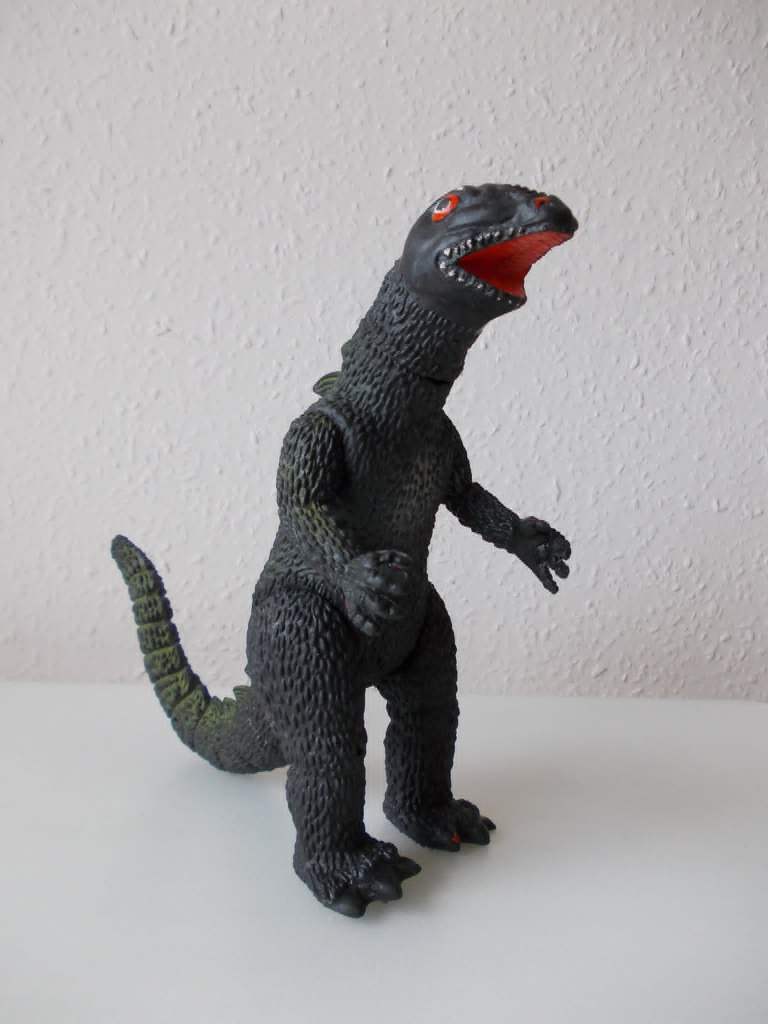
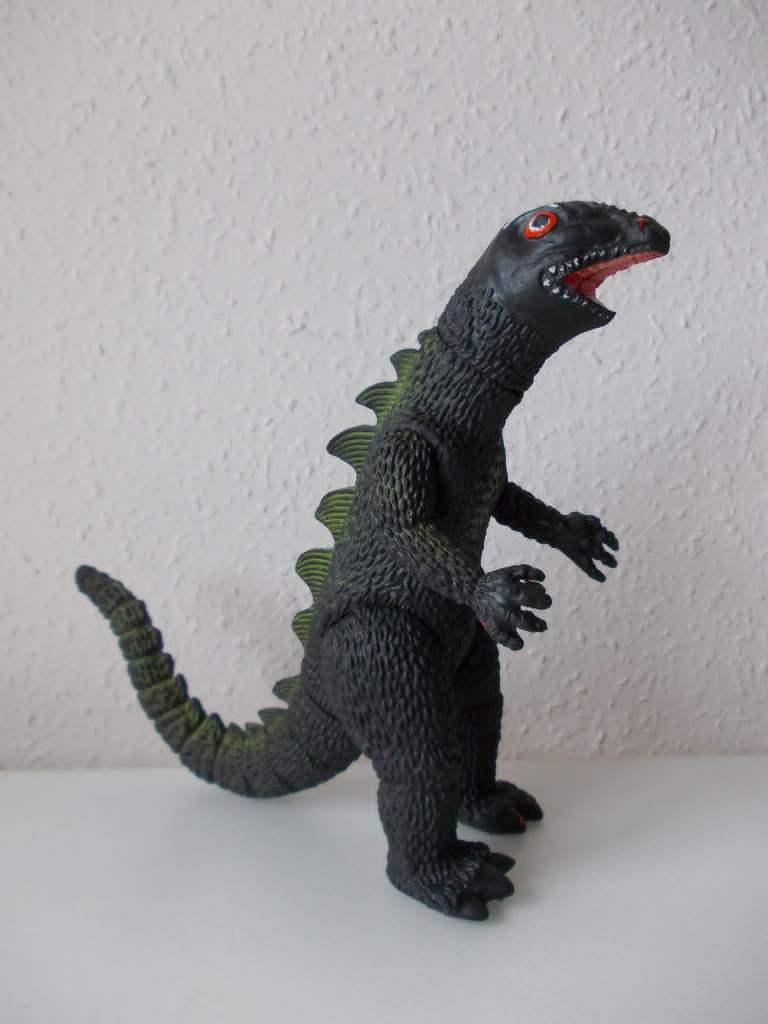
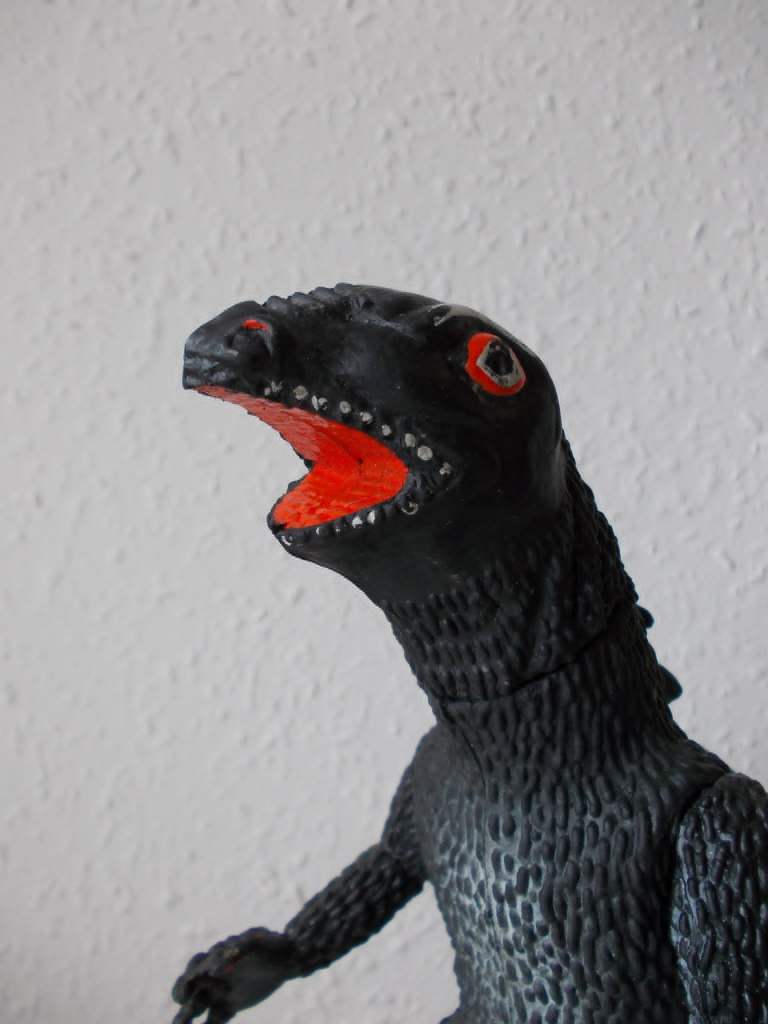
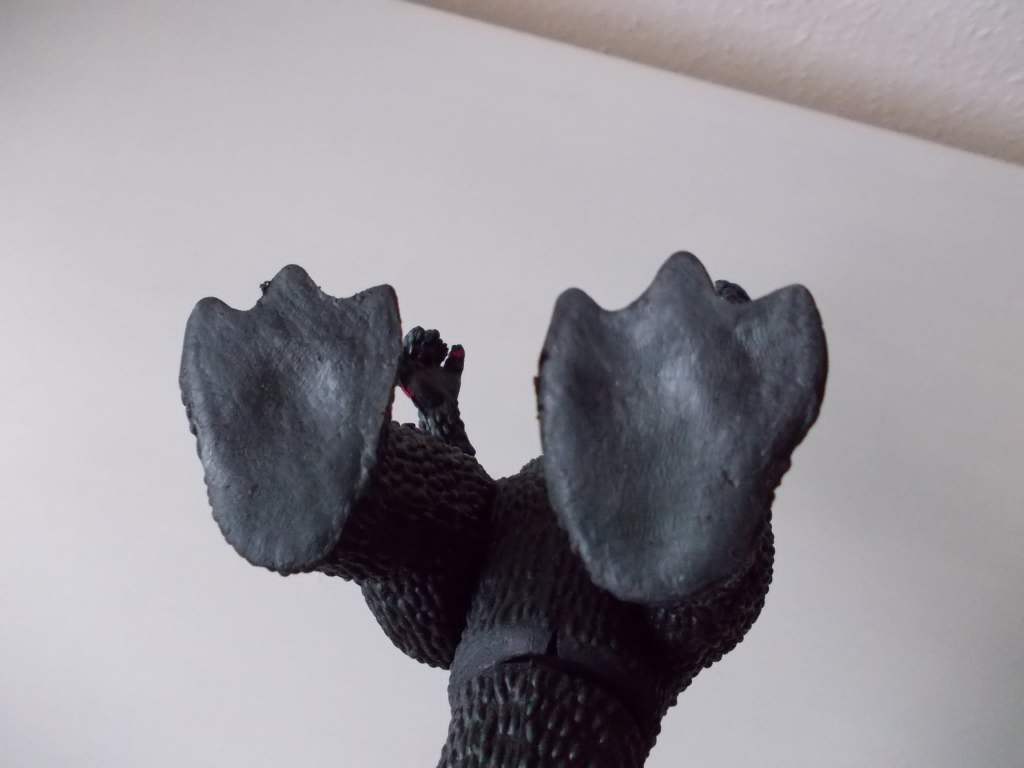
(Images reproduced with Jamie Francis’ permission)
A search of Instagram produces (for me at least) only one more of the grimacing Godzillas, another horned bird kaiju and another of the dinosaur with an overbite type in the collection of ‘dziad_ostwo’:
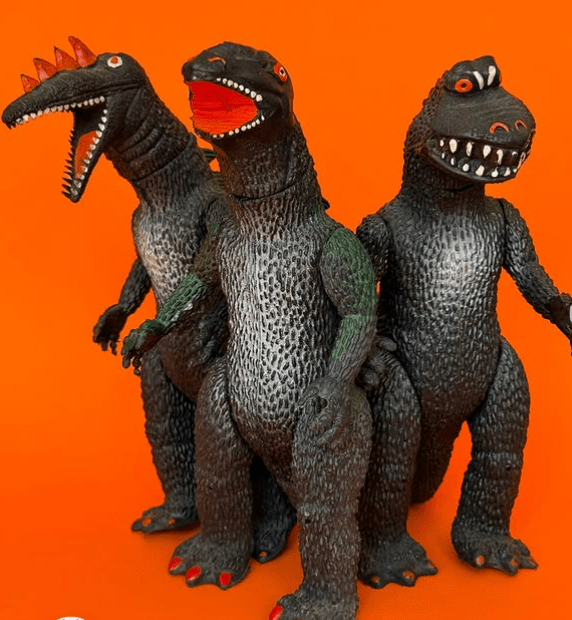
(This image reproduced with the owner’s permission)
Those five models: one a faithful copy of the ‘Sharkzilla’ and the others an adapted form of that with a wonderfully inventive range of heads added, are the total number of the examples known to me from this bootleg toyline.
We can also say something of the models for this range of new heads. The head here of the grimacing Godzilla, with its characteristic high eyes and rounded snout was probably drawn from one of the Chinese Soma bootlegs (which also used the ‘Sharkzilla’ figure as its model). However, it is quite far from its model, and that trend is continued by the next kaiju. In that one, the beak with rows of teeth on the other kaiju here might echo the monster in the 1957 American film, ‘The Giant Claw’, but the four horns on the upperside of its beak have no parallel known to me (unless they are suggested in the small spike at the tip of the beak of the kaiju Terochilus, who appeared in episodes 16 and 17 of Return of Ultraman in 1970). On reflection, I suspect that this may well be the rarest of things outside of Japan: an original kaiju creation by a local sculptor (otherwise in Europe, found only in Spain).
The possible identification of a model for one of these heads also allows us to say something about the probable production date. The Soma model on which the ‘grimacing Godzilla’ appears to depend for its face sculpt, was produced from 1987 onwards, fixing the potential date of the Polish bootlegs’ production to that year and perhaps also the last years of the 1980s and opening of the 1990s.
I suspect that we might also be able to identify other products of this same bootlegging workshop. While many Polish bootleg toys were produced in black vulcanised rubber, the use of that alongside white and red paint for small highlights has already been used to suggest that a relatively rare Polish-made Gremlins toy, copying the rubber bendable ‘Spike’ figure made by LJN Toys in 1984 might be connected to these black rubber Godzillas and kaiju.
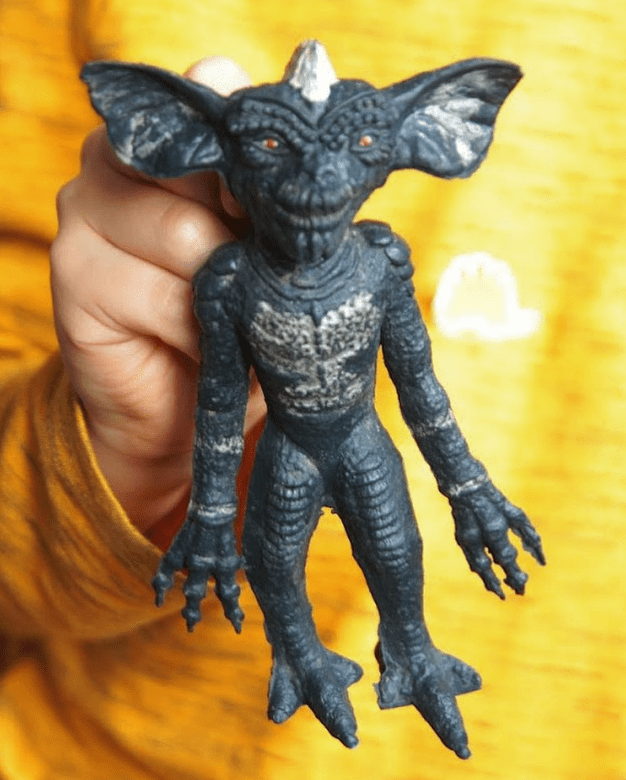
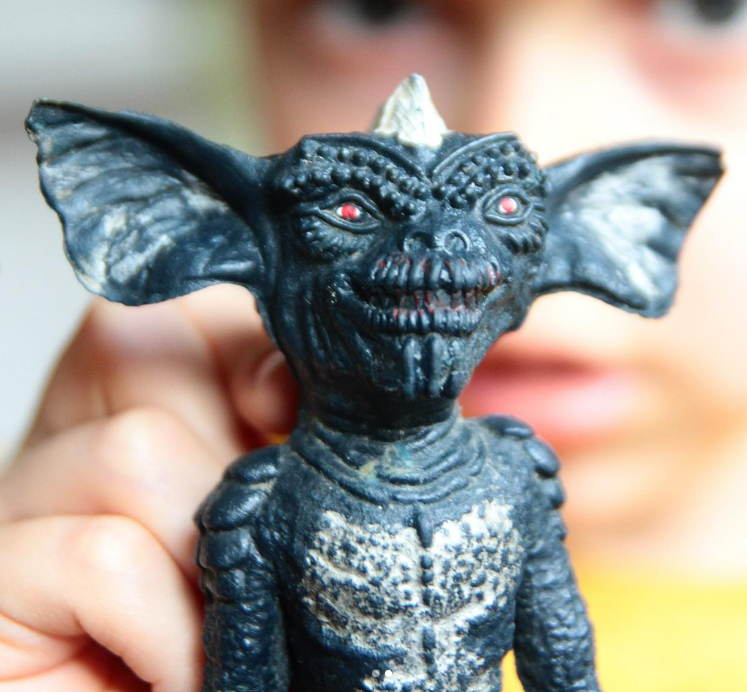
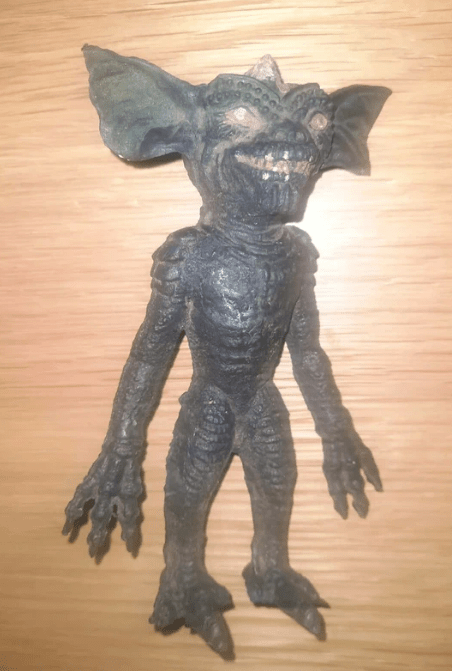
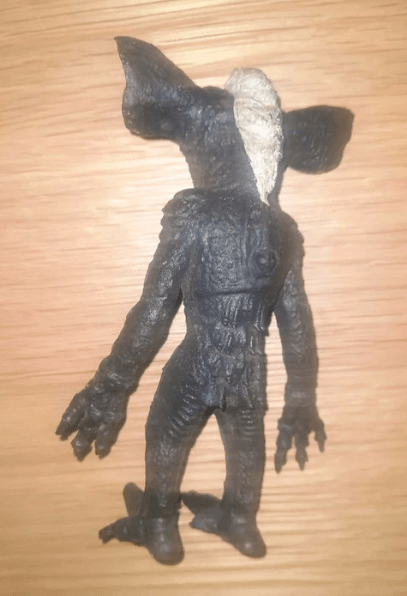
(Images from an unfortunately unrecorded Instagram posts and a recent Vinted post – and not mine; if these are yours and you object to their use here, please get in contact and we will remove them)
There is also a short video of one by our friend and fellow bootleg collector, Turrencio on Instagram, which is well worth viewing.
In addition, there is a series of copies of Chinasaur toys in the same black rubber and usually with the same white and red highlights, which often appear in northern Poland, and these would also appear to be related:
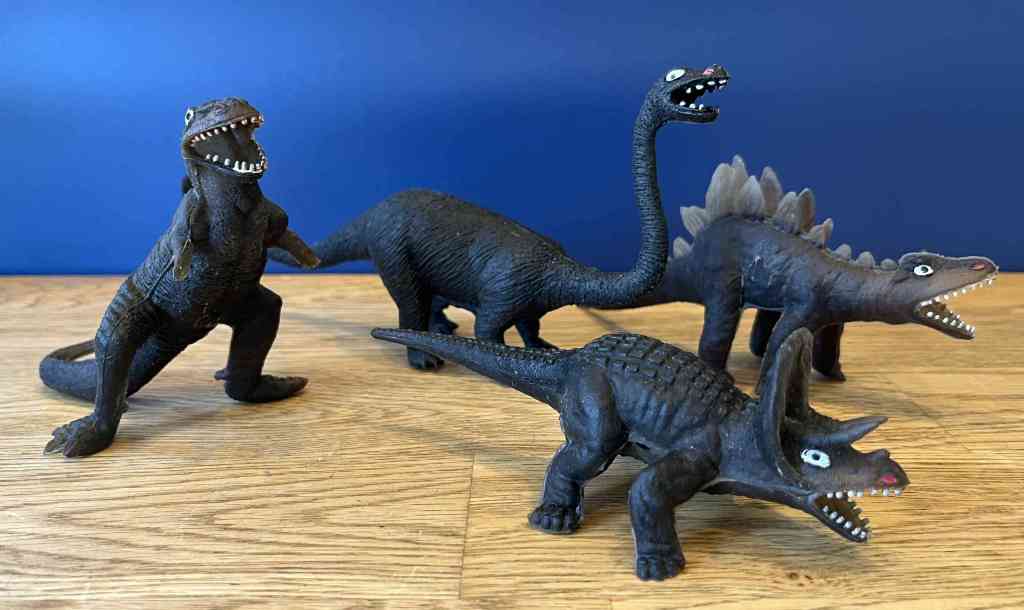
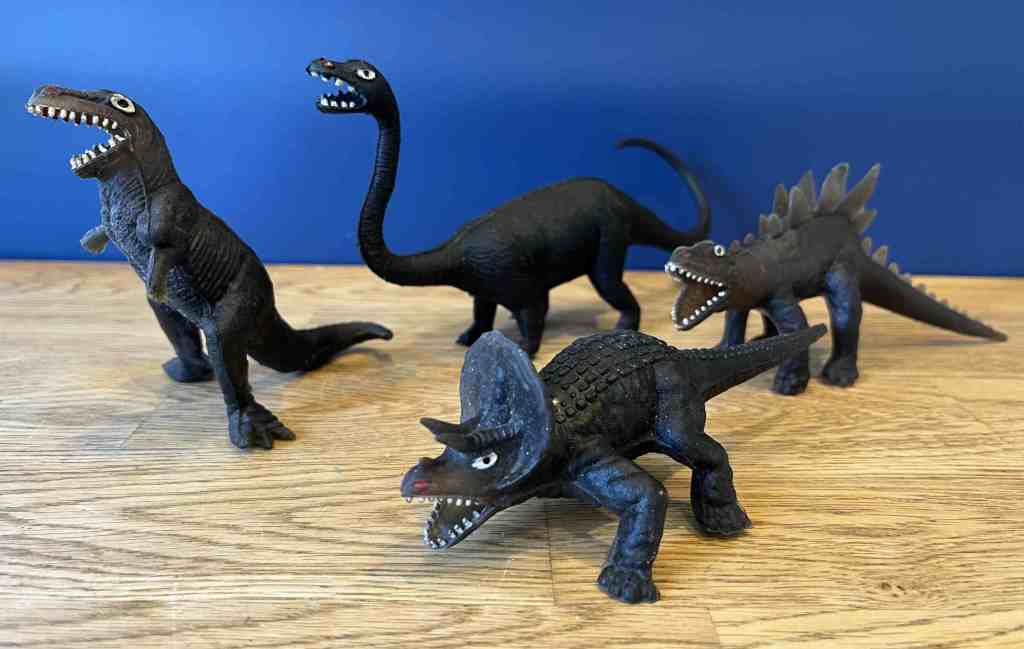
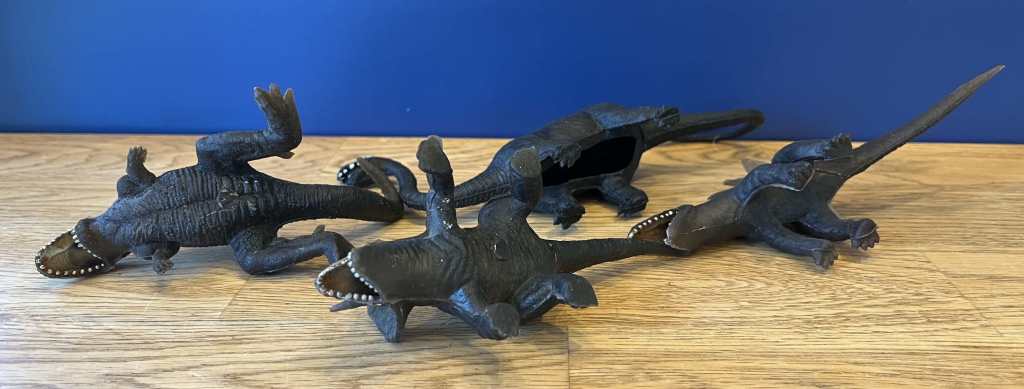
Thanks to a Polish friend, I have his childhood set of these in my ‘museum’ (he is the grown-up ‘Andy’ here in this Polish real-life Toy Story, and his childhood friends sit as treasured items in my ever-growing collection – pride of place and never to be deaccessioned), as well as the eye-witness information that he bought these himself in Elbląg (south-east of Gdansk), piece-by-piece with modest pocket money during the last decade of Communist Poland in the 1980s.
These manage somehow to be even more ‘derpy’ than the silently screaming chinasaurs they were cast from, and they have enormous charm. For the record, they measure:
- Tyrannosaurus with unstable, slightly backwards facing legs: 100 by 100mm.
- Triceratops: 50 by 145mm.
- Stegosaurus: 70 by 145mm.
- Brontosaurus or Apatosaurus (with a hollowed out interior, presumably to reduce the amount of rubber needed for each figure): 105 by 205mm.,
and while in the same vulcanised black rubber, it is a little stiffer in these than the Godzillas and kaiju, and at its thinnest points (as in the extremities of the Stegosaurus) is slightly translucent and a murky brown instead of black when light is shone through it.
I shall post in more detail at another time on these Polish dinosaur bootlegs, as well as others.
On the basis of material used, colour and type of paint employed for highlighting, and approximate geographical distribution of the emergence of these bootleg toys onto the market, I think we can make a case for these all being the products of a single workshop, or series of closely related workshops. The dinosaurs would appear to have been produced first, in the 1980s and before the slow implosion of the Communist Polish People’s Republic from mid-1989 onwards (with the dissolution of the communist Polish United Workers’ Party in January 1990, and the election of Lech Wałęsa as the country’s first democratically elected president in November 1990 key events in that). The Gremlin bootlegs presumably date to soon after the release of the original toy by LJN in 1984. The Godzillas and kaiju would appear to date to the late 1980s, with one of the ones with articulated heads probably from after 1987, but the production of these could stretch into the early 1990s – and in another earlier post I have discussed a mini kaiju bootleg most probably made in Poland around 1990.
⁂
2. A miniature Godzilla bootleg, almost certainly of southern Polish origin – the ‘Wawelzilla’:
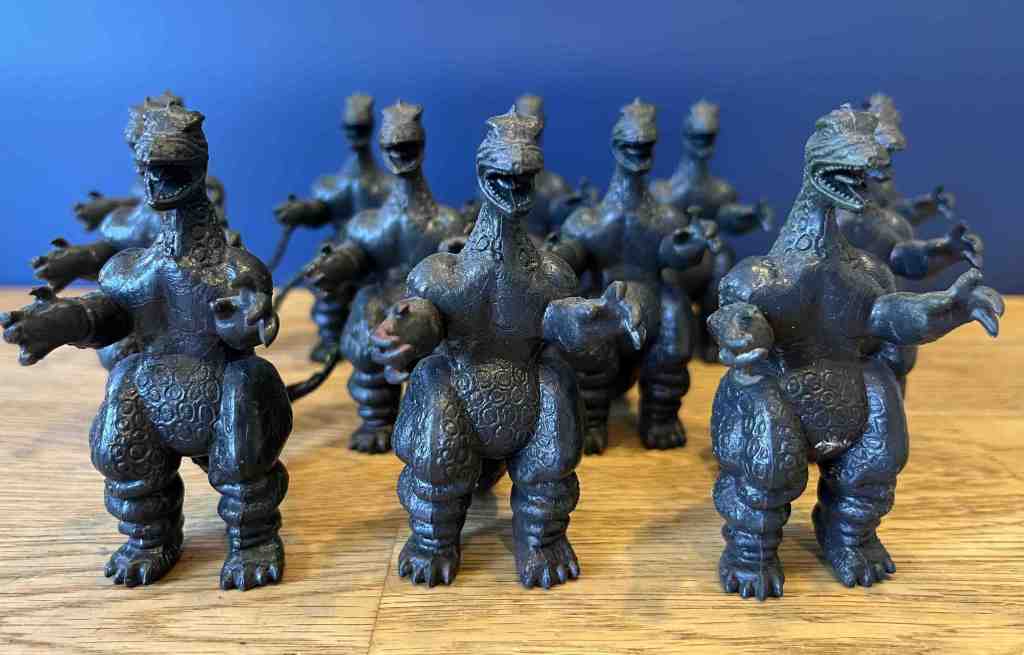
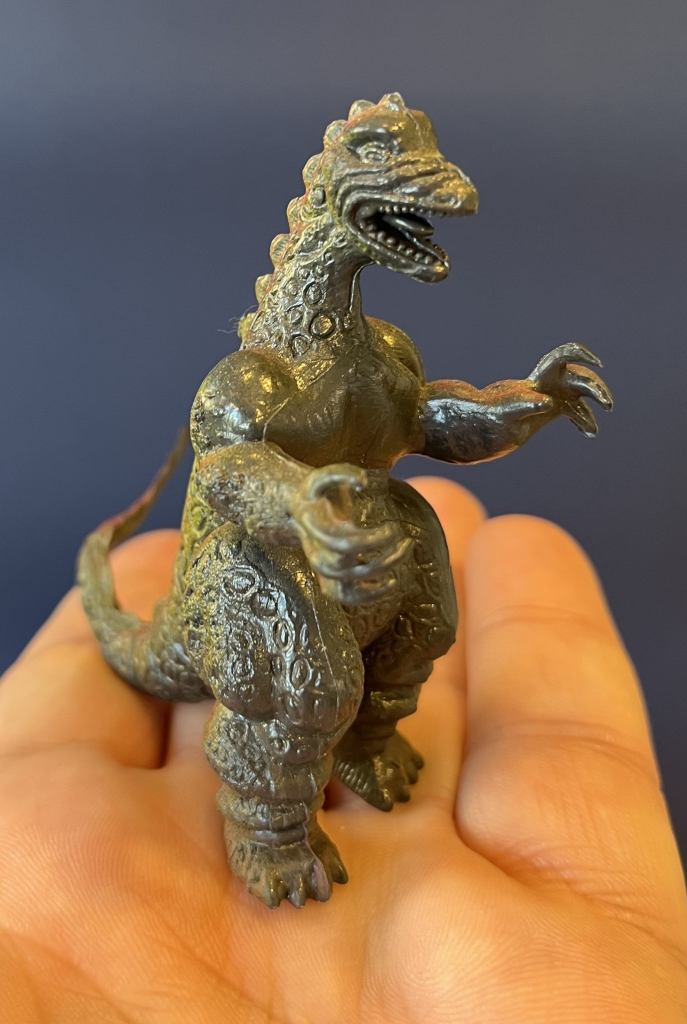
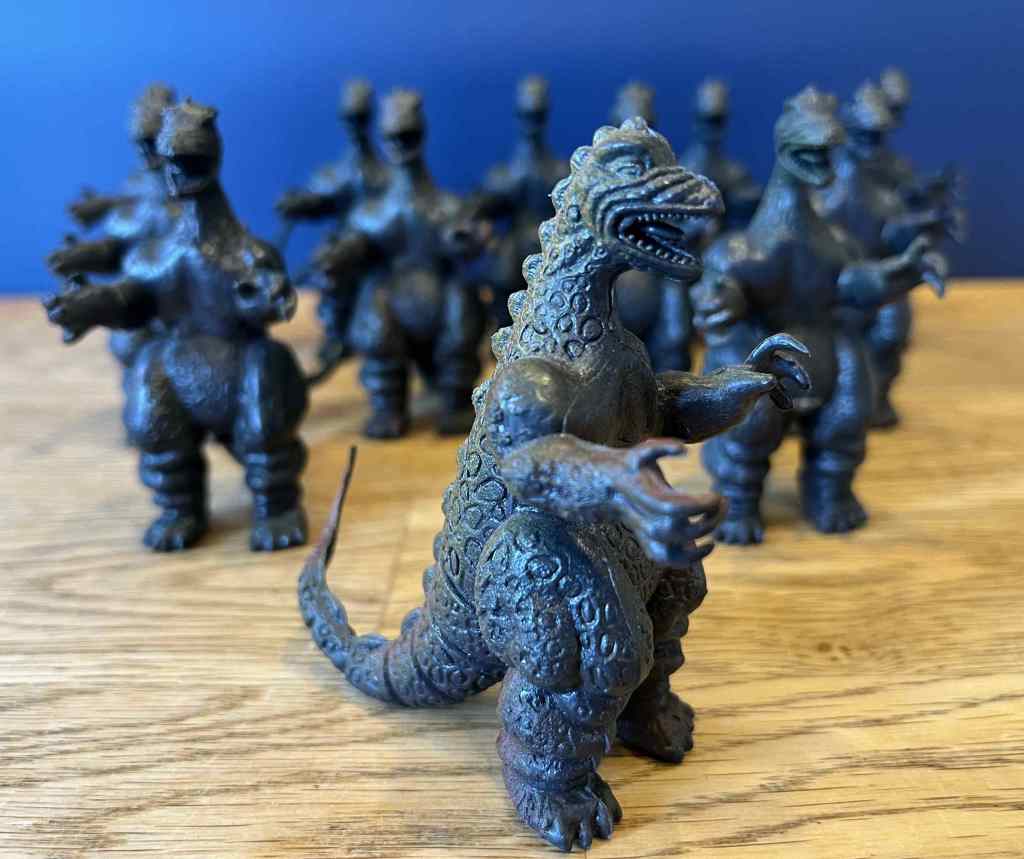
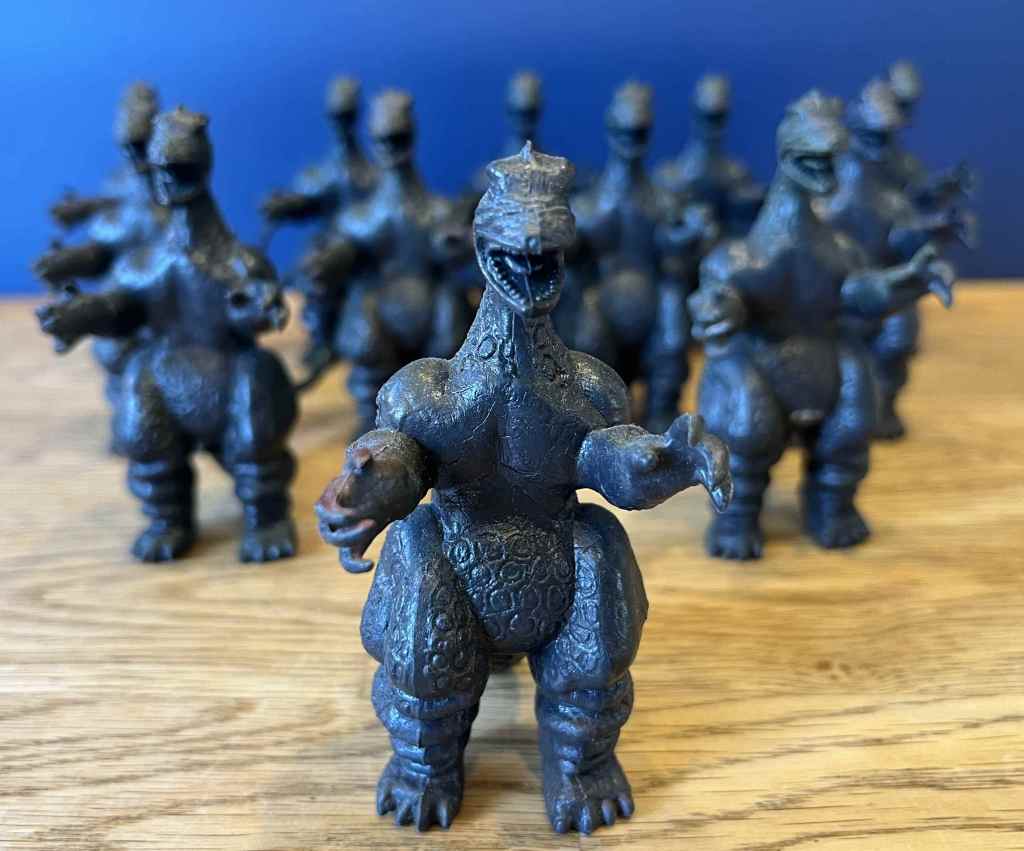
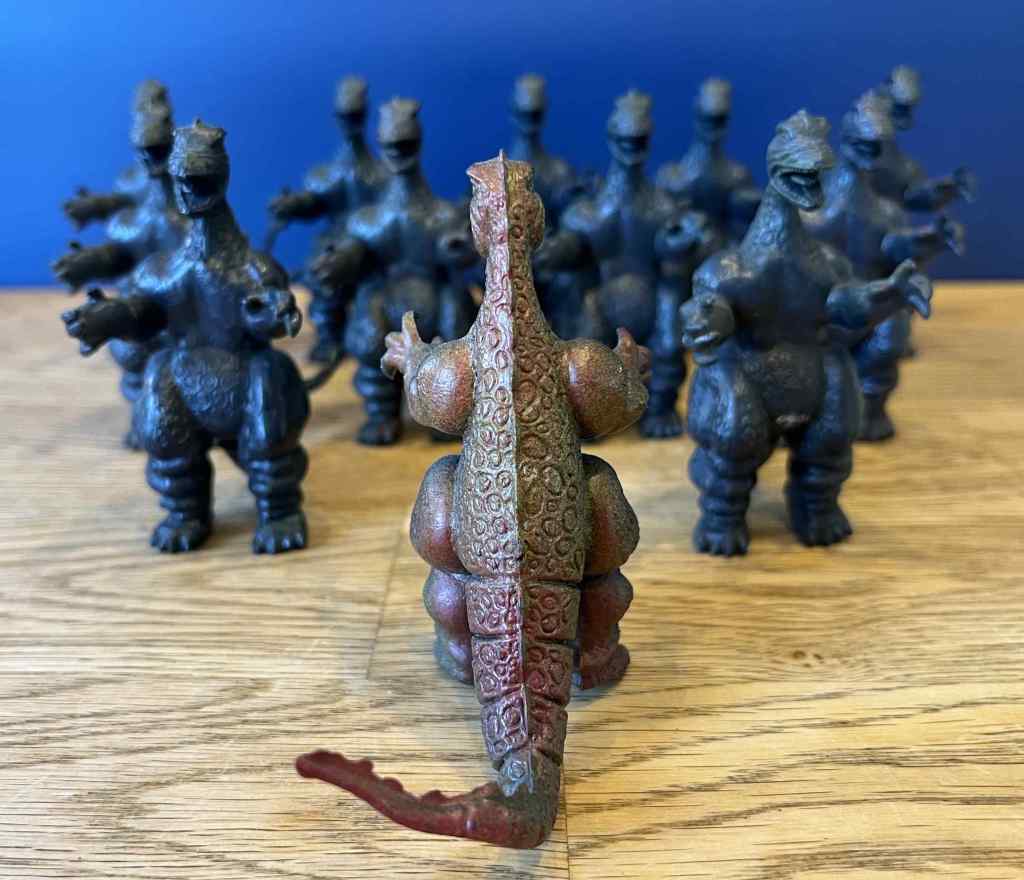
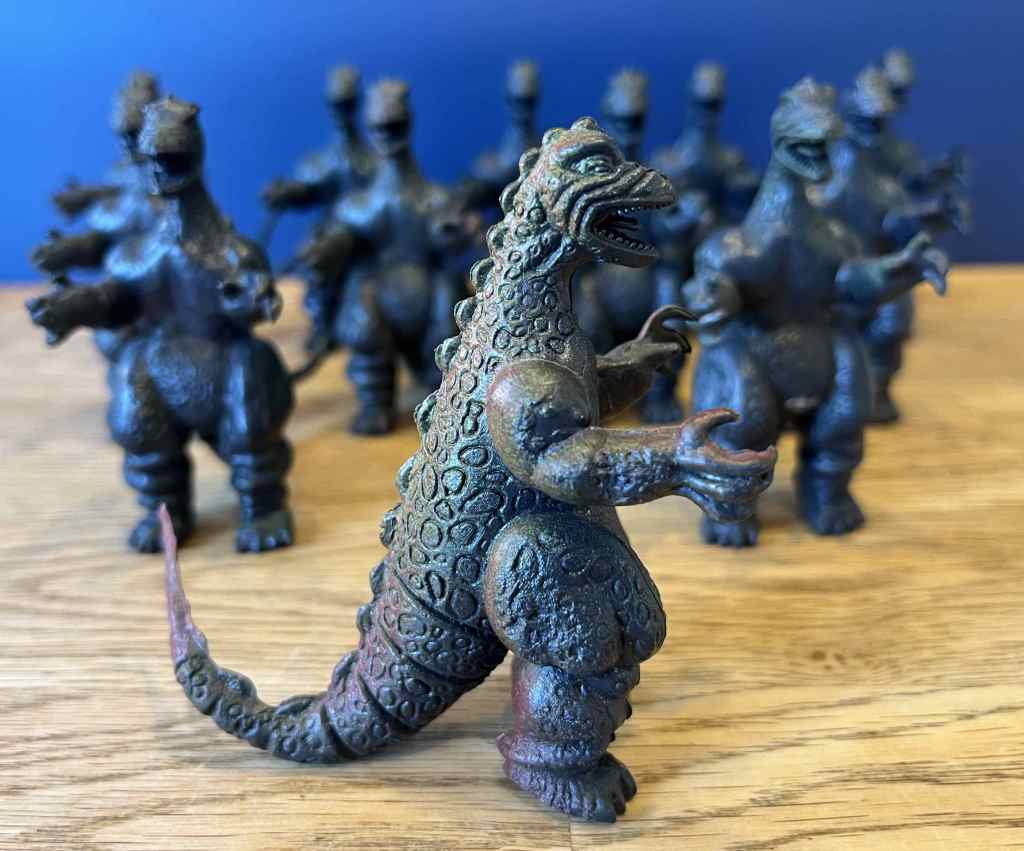
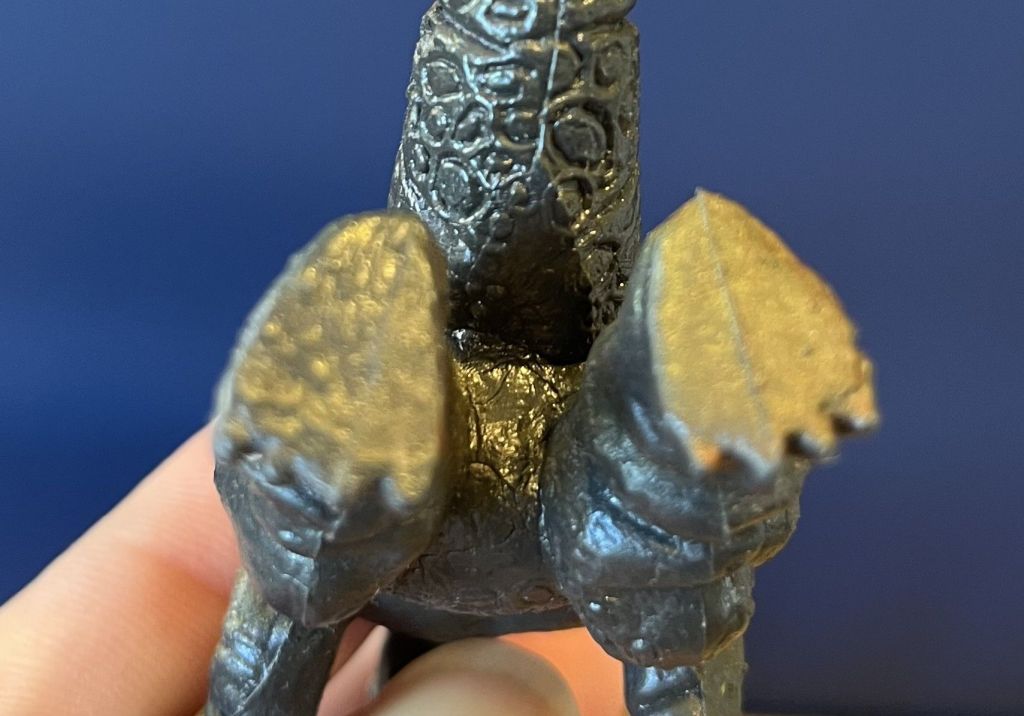
These delightfully tiny Godzillas were produced in hard dark grey-black plastic, stand 78mm. tall, and weigh 35g. The sculptor has attempted to give them a scale pattern, but due to their diminutive size has had to resort to covering these figures in tessellating circles, leaving only their chests and parts of their arms free of these. Their backs are highlighted in green and red. Their stance, head shape, protruding tongue and large bulging legs show that these are miniature copies of the Chinese-made ‘big leg Godzilla’ bootleg (my ‘*Bootleg of Imperial model 1’ in my earlier post on Chinese Godzilla bootlegs). Only the tail is substantially different, with that trailing off to a thin point, and this was probably changed as it was the point at which these figures were joined to a central mold bar, with multiples of them produced in a single mold.
The identification of these as Polish in origin depends on the fact that while I have managed to acquire a small army of these (enough to form a phalanx – see picture above) over the last few years on OLX.pl and Polish Vinted, I cannot find any outside of Poland, and for that matter, southern Poland (the named places I have acquired these from are Warsaw, Rybnik and Zolynia). I have acquired them individually or in small groups, often alongside Chinasaurs or mass-produced Chinese plastic dinosaurs of the 1970s and 1980s, and from sellers who have occasionally told me that they purchased them in local markets. I do not know of any other identification of these as Polish in origin, even among Polish sellers. As the apparent discoverer of this bootleg Godzilla, I suppose I should at least name it. Kraków sits on the southernmost line of the triangle formed by the three cities I have acquired these in, between Rybnik in the west and Zolynia in the east, and it is just too good of an opportunity here to not note the famous medieval legend of the ‘Smok Wawelski’ or ‘Dragon of Wawel’. From the thirteenth century through to the Renaissance, Polish accounts claimed that a terrible holophagus (‘monster that swallows things whole’) had once lived under a rock near Kraków, and was fed a weekly offering of cattle (or rams in some versions), or it would emerge and eat humans instead (very kaiju-like behaviour), and was eventually killed by being fed a cowskin filled with smouldering sulphur (where is Ultraman when you need him? Not in medieval Poland, that’s for sure). Correspondingly, in honour of his medieval sibling, I would like to call this tiny plastic bootleg beast, the Wawelzilla.
Again their affiliation with a Chinese bootleg allows us to date them somewhat precisely – and they must date to the period soon after the production of the ‘big leg Godzilla’ sometime in the second half of the 1980s.
⁂
3. An almost certainly Polish bootleg Godzilla adapted from the Chinese-made Heisei bootleg:
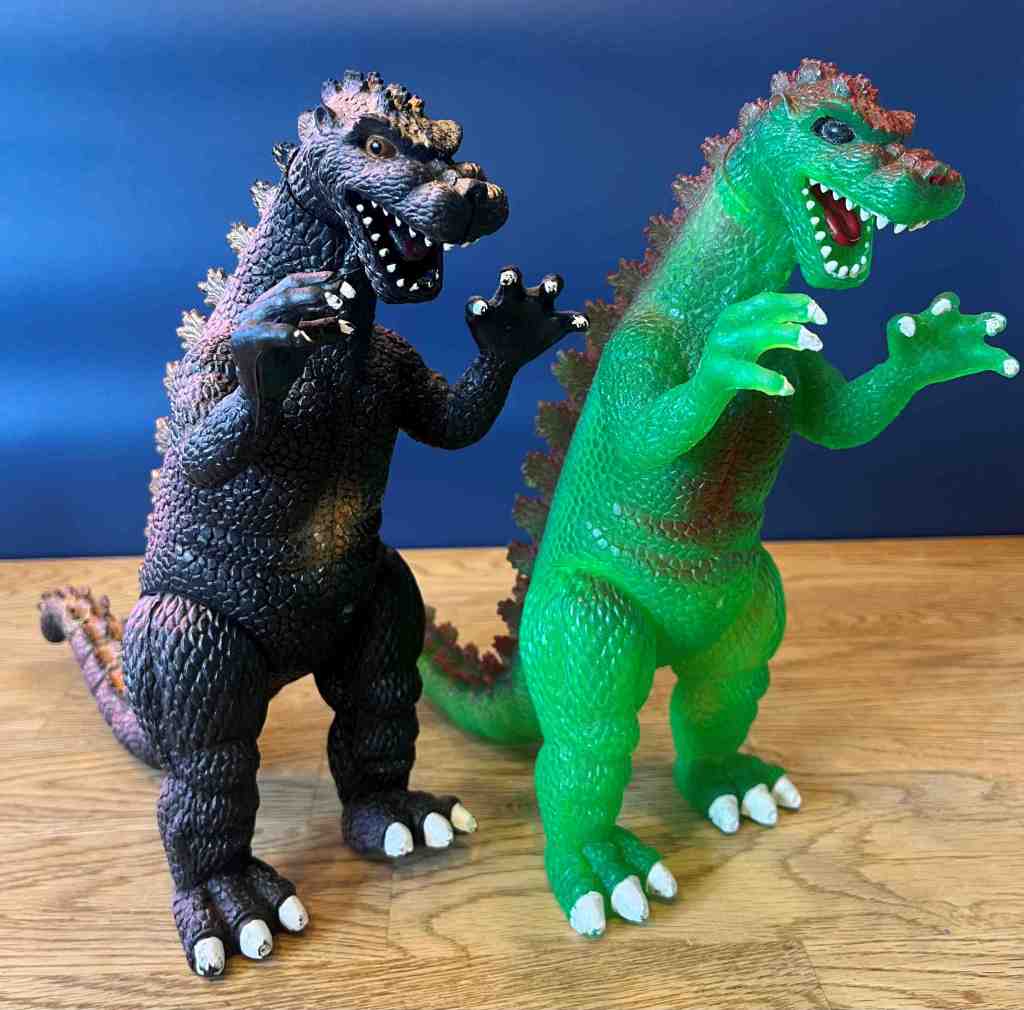
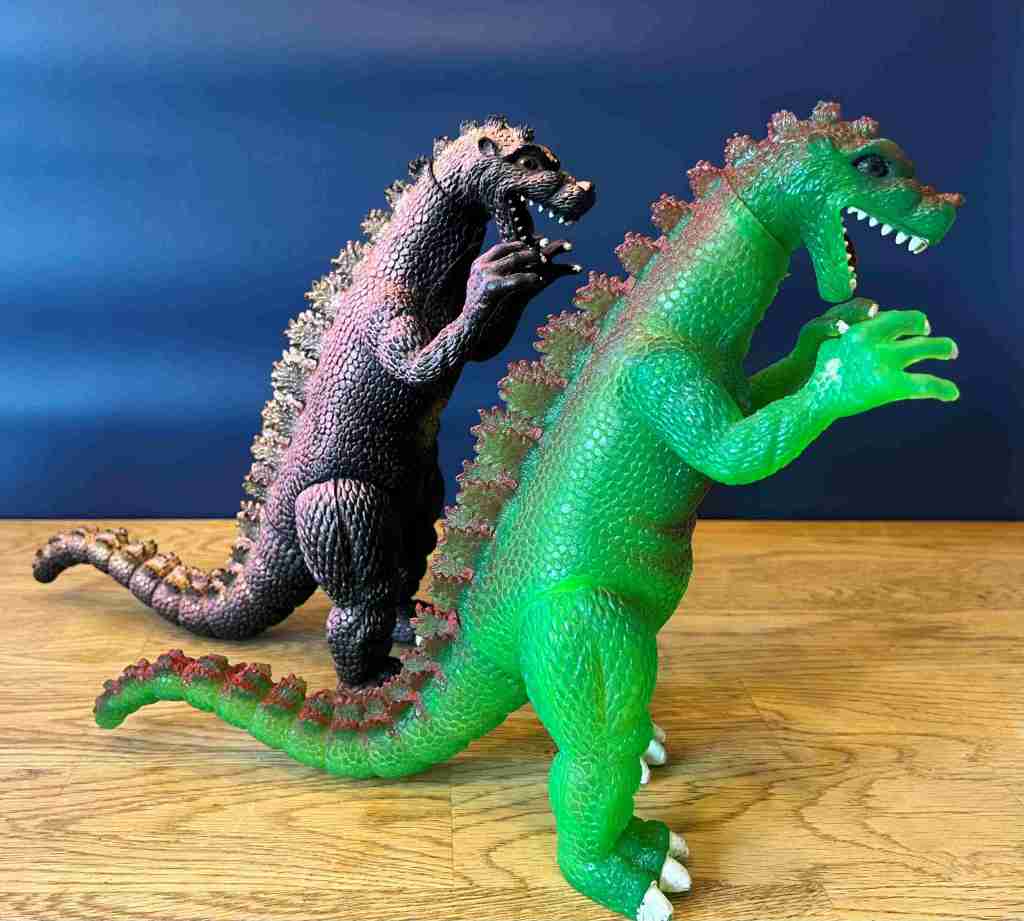
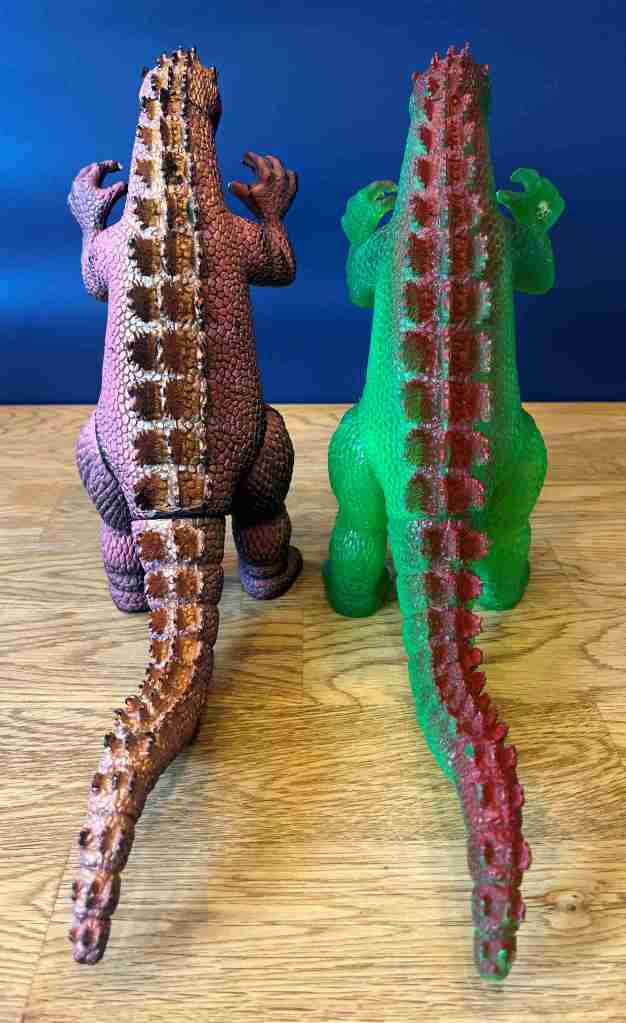
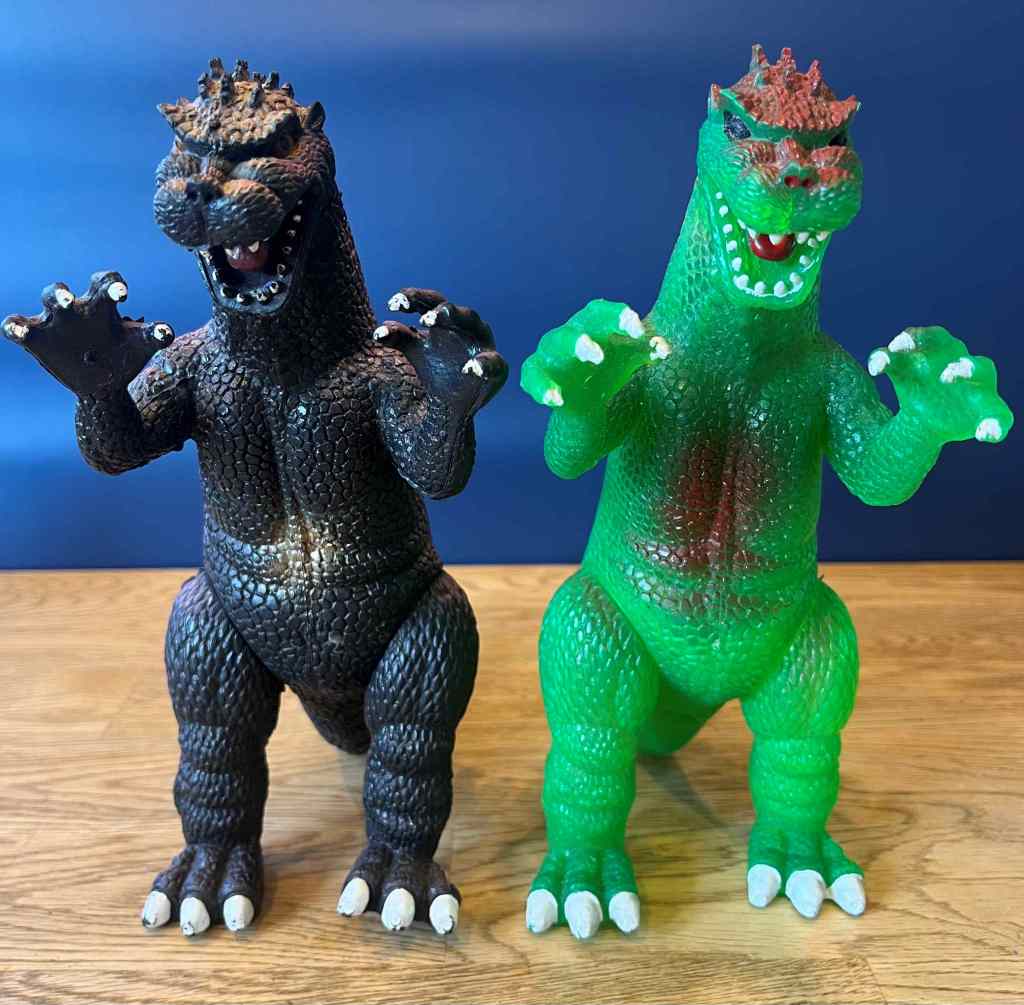
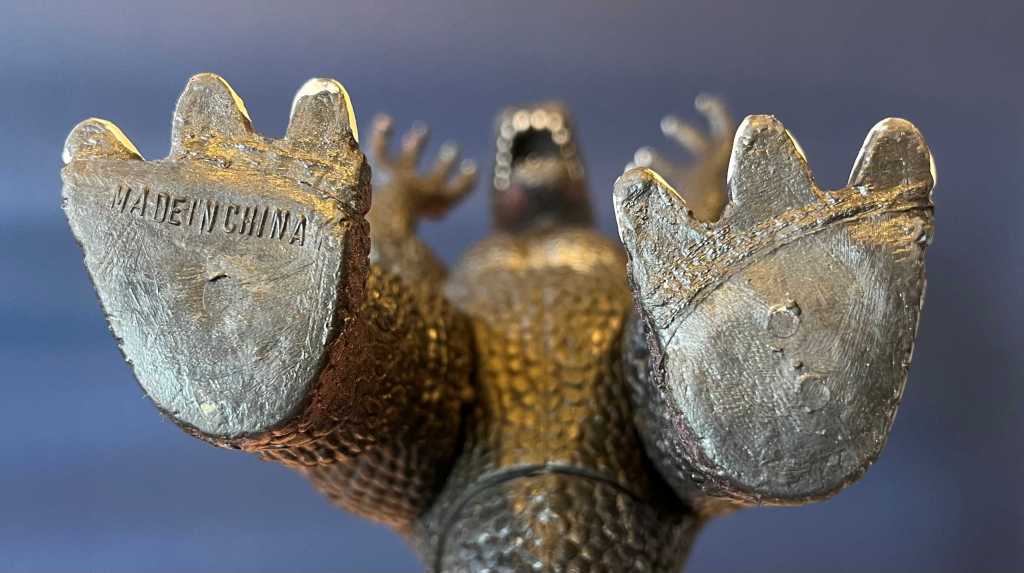
I have already discussed these strange beasts in my catalogue of Chinese-made Godzilla bootlegs (as ‘*Bootleg of Imperial model 4, the ‘long-muzzled Heisei bootleg’, noting there that they may well not be Chinese). As I said there, they are enormously rare, known to me only in five examples now, and clearly have “MADE IN CHINA” on the sole of their right feet. Normally I would not doubt the country of origin when confronted with such a blatant statement, but nothing else here agrees with a Chinese origin. All ones known to me (including a new one in dark blue, offered on Vinted and bought by me, but then the sale frustratingly cancelled by the seller in an act of seller’s remorse – and on some level I see why she could not part with it) have come to light in Poland.
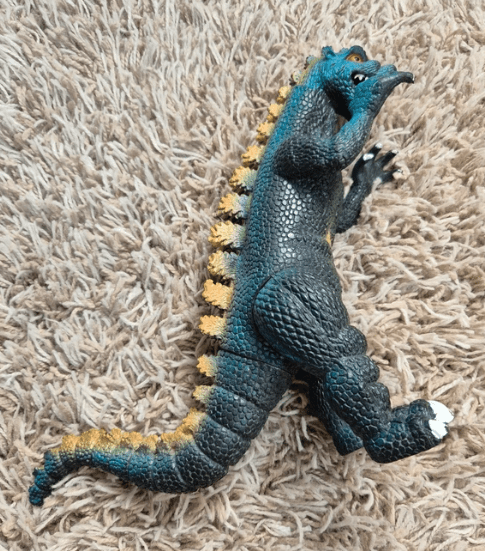
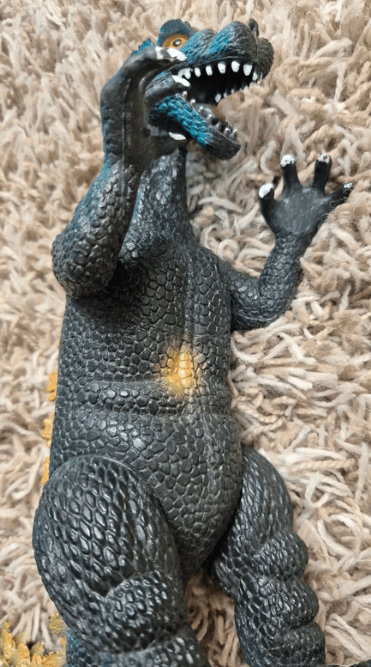
(This the newly discovered example; from a Vinted sale listing)
(Image from an old Vinted sale listing showing other examples)
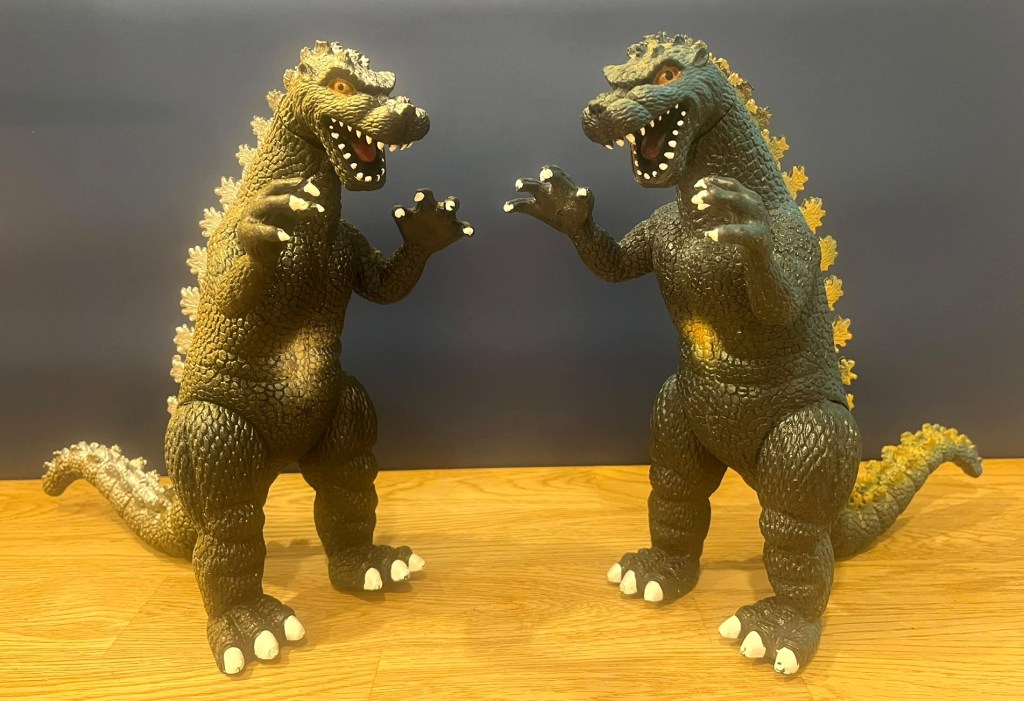
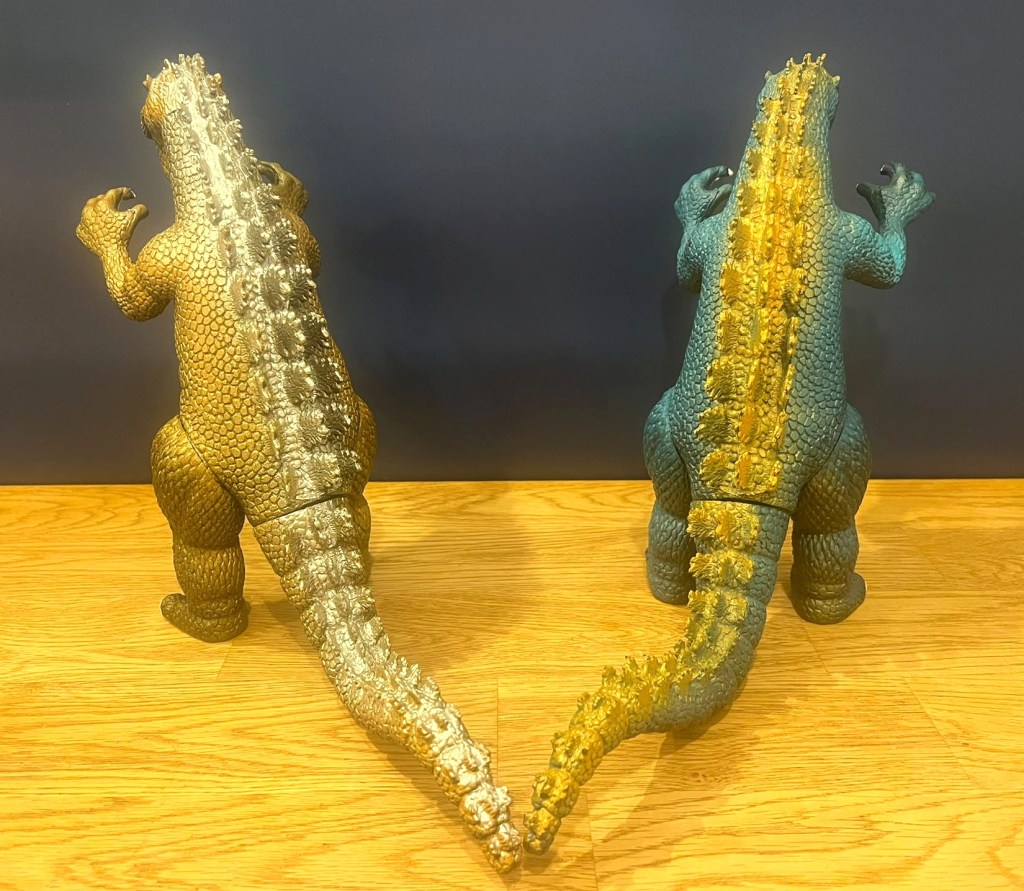
[UPDATE 12 September 2026 – by chance, I have been able to acquire two more recently, one in the yellow spray on its back with silver spine fins shown in the image above, and another in a blue spray with gold spine fins (the latter was ‘de-gassing’ when it arrived, and is in almost flawless condition, so I assume it is deadstock stored in plastic since the 1990s, that has recently come to light.
As with the other examples, these came from Polish sellers)]
The quality of the rubbery plastic they are produced in is worse than any known to me from China, and some of these have been resprayed after an initial spraying in the most common colour of green shading, and that is also out of place in a Chinese production setting. The arms of the figure are fixed in a raised ‘don’t shoot’ position, and this is unlike any other Chinese bootleg, but does agree with several European bootlegs. The amateurness of the sculpt is again unlike Chinese Godzilla bootlegs, with legs that do not equally meet the floor. Finally, to add to this, I have heard from a Polish collector who bought one in Poland during his childhood in the 1990s.
That last report is particularly convincing, as it my inability to find these anywhere other than Poland, and it seems increasingly likely that these are Polish in origin. However, as they were not cast from an existing Godzilla bootleg we must explain the “Made in China” underneath the feet of some examples (as this mark cannot have been blindly carried over from a casting of another figure). All I can think of, is that this label was added to the feet of the toy to give it a seal of authenticity as a foreign-made toy and probably push up its retail value. I shall discuss the use of such false or fabricated marks employed by Polish bootleggers in future posts.
They are made in thin rubber that bends easily when squeezed, and stand 240mm. tall, and weigh about 350g. They have articulated legs and at a single point at the base of the tail. They also have an articulated head, but the arms are fixed in the raised ‘don’t shoot’ position. They seem to have been predominantly black with green shading and silver spine-fins. Some have orange or blue shading with silver spine-fins and others (as with one of mine) have pink-purple shading with gold spine-fins – however, close inspection of mine reveals that a base-coat green shows through on the spine-fins and so it must have originally have been shaded in that colour, before some of these bootlegs were over-painted in the other two colour schemes. Another one, in my collection (and obtained from the helpful dziad_ostwo on Instagram), has a quite different colour scheme – and was produced in translucent bright green, with solidly black eyes and the edges of its spine-fins coloured orange-brown. It is identical in its features to the others, and clearly from the same molds, but was made in very different rubber. This one has no “Made in China” marks under its feet.
Clearly they follow the facial resculpt of the ‘Heisei bootleg’ with the same facial features down to the carefully sculpted (rather than painted) bulging tongue, but the muzzle is lengthened and the fins extended over the top of the head. Moreover, they are considerably smaller than their model, and while their toes end in a single flat line together, one of the toes of the ‘Heisei bootleg’ has been removed to give this figure three equally long toes. The impression is not one of quality, but they do have great charm, and score high on the ‘derpy’-scale.
As these appear to follow the Heisei model, these must date after that model to the 1990s.
⁂⁂⁂
Concluding remarks:
As a vintage bootleg toy collector, when you begin to look at the wealth and diversity of surviving Polish-made products it is staggering that little has been done to identify and catalogue these when compared to the work on bootleg Star Wars and MOTU toys. On the Godzilla and kaiju front, I hope this blog makes a few steps towards filling that gap, and another post will follow soon with Polish bootleg dinosaur toys aiming to make some small inroads into that field as well. However, much more work remains to be done.
There is real innovation in design here, with some of the large black rubber Godzillas and kaiju produced in the Polish People’s Republic equal to the productions of Hermanos Pardines in Spain for their creativity – and those toys are witness to a sculptor creating wonderful monsters partly just for the joy of making these. Similarly, while we commonly think of Polish bootleg toys as predominantly recastings of existing foreign toys, the last example here is an adaptation of an existing Chinese model, and in many ways an improvement on it – and the Polish manufacturers then went one step further and made a few in a striking translucent green rubber that sets this apart as one of the most visually appealing bootleg Godzillas produced anywhere in Europe. As one would expect with such regionalised toy-bootlegging operations, the Godzillas and kaiju here show enormous variety between the groups or clusters of surviving figures – with each producer apparently working in complete isolation to each other. In my opinion, what they each produced were magnificent European kaiju, with every single one to be admired and adored in its own way.
I invite any reader to send me images and information about any potential Polish Godzilla or kaiju bootlegs you may own or have seen, or potentially related bootleg toys. Every post on these pushes back against the Tsunami-like dominance of Star Wars toys in the discussion of Polish bootlegs. Not that I’m against those Star Wars toys – I rather like them, especially the nightmare-fuel Ewoks and ‘mardi-gras’ Gamorrean Guards – but those toys have their champions, and focus on them has eclipsed other and equally interesting bootleg toys to the point where it feels like the Star Wars bootlegs have a tyrannical grip on our knowledge of the glories of Polish toy-bootlegging. To paraphrase John Conner: if you’re listening to this (and own or know of a Polish Godzilla), you are the Resistance.
⁂
[Final note: just like with the Chinese Godzilla bootleg post, I shall treat this post as a form of encyclopedic entry rather than a fixed blog post, and if new examples are found, these will be added to the text above without square brackets and update dates]
- 'MUTTON DRESSED AS LAMB': Godzillas and kaiju that look vintage, but are not
- American made Pachi
- BOOTLEG DINOSAURS – a little off topic, but sometimes needed here
- BOOTLEG GODZILLAS
- Bootleg Tokusatsu from China and its immediate neighbours
- Bootleg Tokusatsu from the Americas
- BOOTLEG TOKUSATSU HEROES
- Central Europe – Godzillas and kaiju from behind the Iron Curtain
- Chinese-region bootleg Godzillas -the plastic tide from the East
- Chinese-region made Pachi
- European made Pachi
- European-made Godzillas
- PACHI
- Pachi kaiju
- Pachi kongs
- Pachi superheroes – Ultraman and similar
- The Americas – bootleg Godzillas from the New World

 Confessions of a Kaiju Hunter
Leave a comment