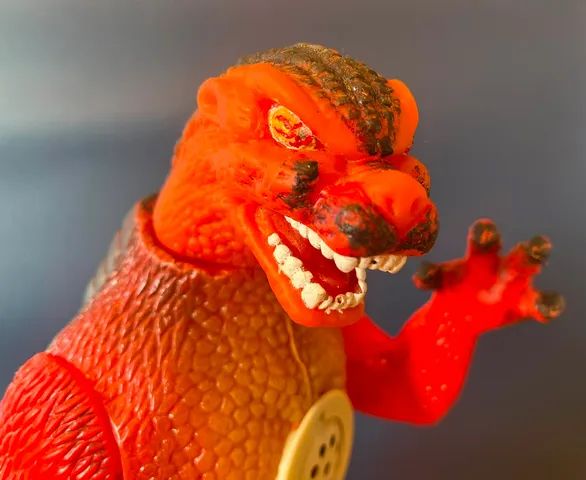
Some bootleg Godzillas are so glorious that it would be wrong to look at them too quickly – so just breathe with me and keep your eyes focused up here, and we can count together to steady our nerves:
1-hippopotamus,
2-hippopotamus,
3-hippopotamus,
4-hippopotamus,
5-hippopotamus.
Ok, now look down:
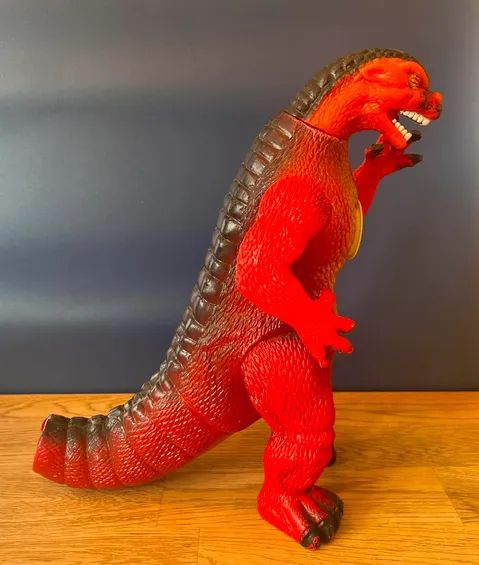
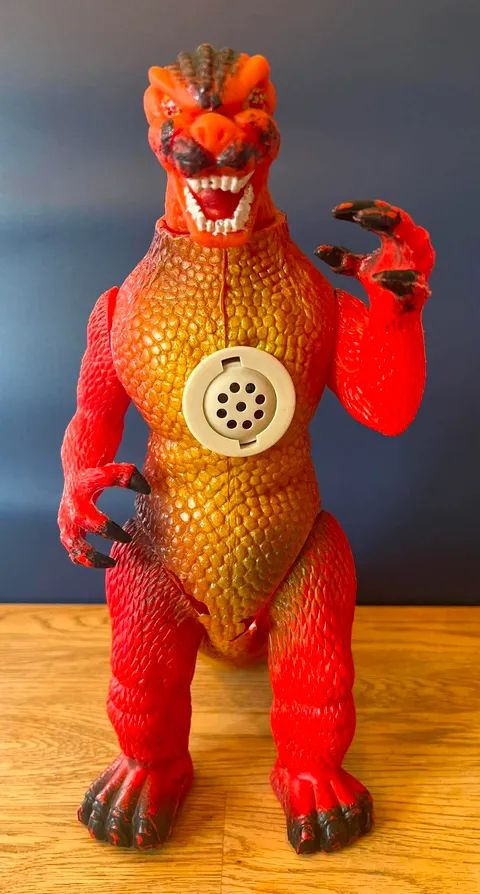
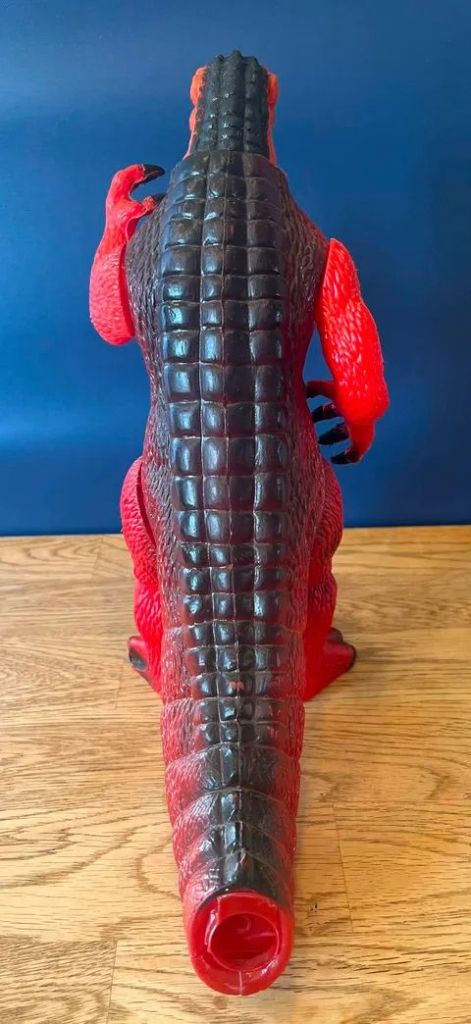
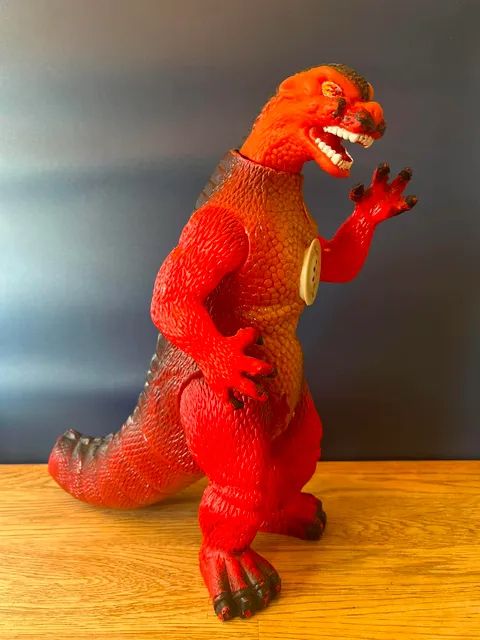
We finally come to the wonders that are Argentinian bootleg Godzillas. These are fantastically rare, even in Argentina – perhaps as their bodies are of the thinnest blowmold, but still very large (probably as large as thin blowmold plastics can be pushed), while the heads are solid rubber, making them top-heavy and after a few decades prone to being brittle and splitting. Mine (shown above), has an unrepairable split along the top of the right hip joint leading to a tear/hole in its groin, and so is in semi-retirement as an ‘adore from afar, but don’t take down off the shelf’ figure. That said, I still beam with pride at owning one, and he is the one that uninitiated visitors march past the shelves of Chinese- and Spanish-made Godzillas to look at and say, “Oh, he’s pretty!”
⁂
Before diving into the nuts and bolts of these Godzillas, we should say a few words first about the history of bootleg toys in Argentina. The subject is both fascinating and individual to that country. Toy producers there had long made local versions of international toys under license. The most obvious example in our context is the Peguila kaiju toy made by Supersol (an Argentinian toy manufacturer, whose output was cut short after a warehouse fire) in 1969, as a copy of a sofubi in blowmold plastic with a solid rubber head (and sensationally rediscovered in 2004, on this, see here). However, this began to change in the mid-1980s as the government there tried to combat a debt crisis by imposing strict import tariffs on most foreign-made goods, making American- and European-made toys prohibitively expensive. In response to these tariffs, Argentinian toy producers simply carried on with the licensed molds they had in hand, adapting the end products to produce something new, or turned to open copying of smuggled in examples of international toys – often with a local adaptation or redesign to domesticate the toy to the styles and norms of Argentina’s vibrant toy industry. This situation lasted throughout the 1990s and produced the famous Guerreros del Mañana (‘Warriors of Tomorrow’) toyline – all bootlegs and adaptations of MOTU toys, with their own individual paint sprays and with parts swapped with other toys of the same size, and the Argen Seven series – seven figures created in Argentina by Plastirama who had obtained the rights to make local versions of G.I. Joe toys in 1985, but when Hasbro stopped sending new designs and molds, they went ahead and adapted the products of the molds that they had in-hand. Similarly, Argentinian toy maker Jocsa kept the Real Ghostbusters toyline alive there, after Kenner stopped producing those figures in 1991, and went on to produce new versions of older items from this line as well as entirely newly designed and sculpted toys. There appears to have been a real pride in producing something quite new and fundamentally local among Argentinian toy creators, and their work more-often-than-not has a hallmark of self-consciously unrestrained creativity. Thus Argentinian bootleg toys (or ‘toys adapted-following the termination of the licensed arrangement’ in some cases, as those are not strictly full bootlegs) of this period can feel like some animal species in South America, cut off from the Old World in terms of evolutionary development – still recognisably part of the same genus, but on their own very different path.
⁂
To return to the details of my Argentinian Godzilla: he stands some 295mm. tall, and I haven’t given a weight measurement as he is missing the end of his tail (I will add one in the future when, and if, I can closely examine a complete one). These come in two base colours: a muted-green and a flamboyantly hot-red, and both are highlighted in yellow and black. They have a distinctive spine without fins – unique to this model, with this composed of three parallel lines of low-humped ridges. Some have roarers mounted in their chests (as here), but this is not consistent across the known examples and many do not. The heads are especially ill-fitting with the bodies – and I suspect that when new heads were designed, little care was given to how well these would fit with the existing stock of bodies. Most have something individual to their decoration – I am especially delighted that my one has painted fiery eyes and a moustache, giving him ‘gaucho chic’.

The soles of the feet are without marks, apart from a mold mark that runs in a straight line parallel to the tips of the toes at the point where these join the body of the feet.
The form of the body and presence of four toes shows a strong debt to the Chinese-made Imperial large-size Godzilla. However, the sculptors were open to other influences as well, and the peculiar double articulation of the tail shows that these Argentinian Godzillas were partly informed by the super articulated version of the Chinese-made ‘lunar crater skin’ Godzilla (itself a bootleg of the Dor Mei model). As these super articulated Godzillas appear to have been the last ones produced by their Chinese manufacturers, we must date these Argentinian Godzilla bootlegs to somewhere in the 1990s.
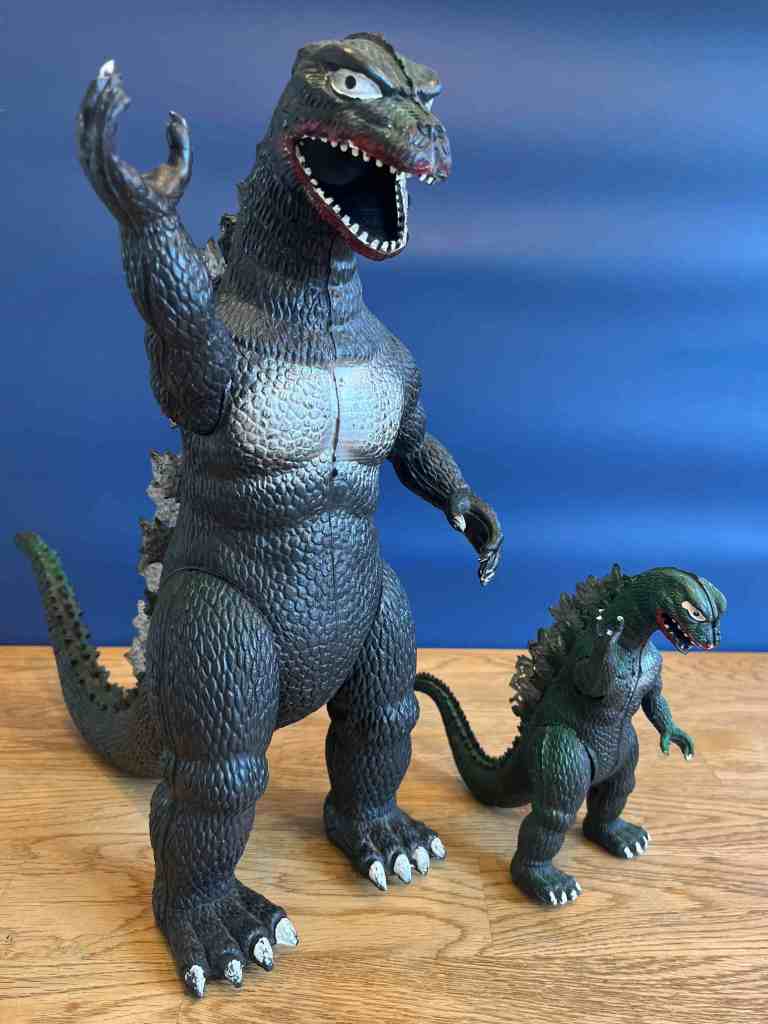
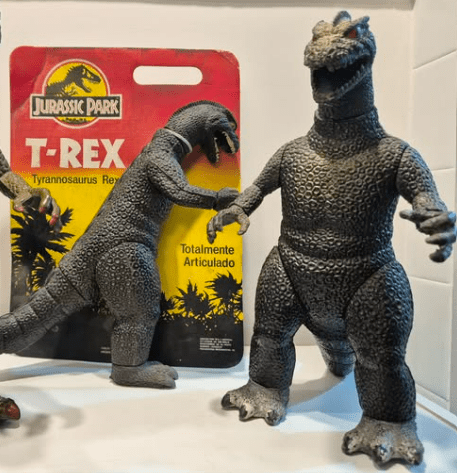
(Left: The larger Imperial Godzilla bootleg; right: the lunar carter skin Godzilla bootleg with its double articulated tail and in its Argentinian ‘Jurassic Park’ packaging)
The survival of Argentinian ‘Jurassic Park’ themed packaging of one of the super-articulated Chinese-made bootleg Godzillas (now in the collection of Alejandro Kiryluk), allows us to hone down that date a little closer. As Jurassic Park was not released until June 1993, then it is unlikely that these super-articulated Chinese-made Godzillas were present in Argentina long before that date. We should probably date them to the mid-1990s (from around 1993 to 1995).
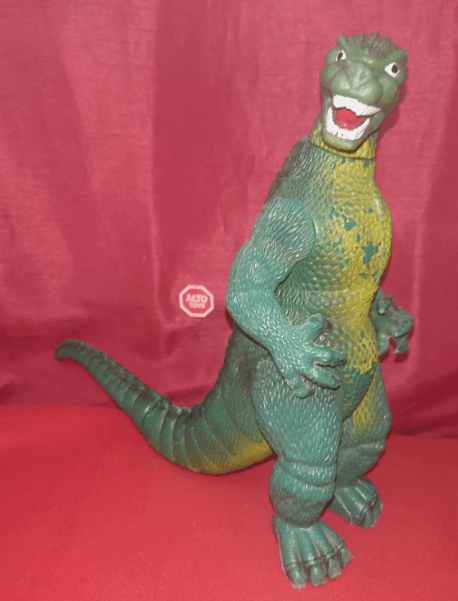

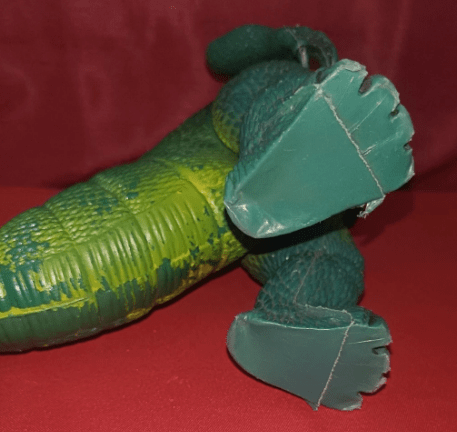
(images from an eBay sale listing)
Another similar example, in green and with a complete tail, can be found on eBay at the time of the writing of this blog, but I think the red might have the edge in the appeal of these Godzilla bootlegs.
⁂
It is at this point that the Argentinian toy producers began to let their wild side out. All other examples of these bootleg Godzillas and kaiju known to me are in the same red or green blowmold plastic – and that alone suggests we are dealing with a small team of producers, perhaps in a single workshop site. However, their individual touches mainly appear in the creation of wildly different heads and even extra body parts.
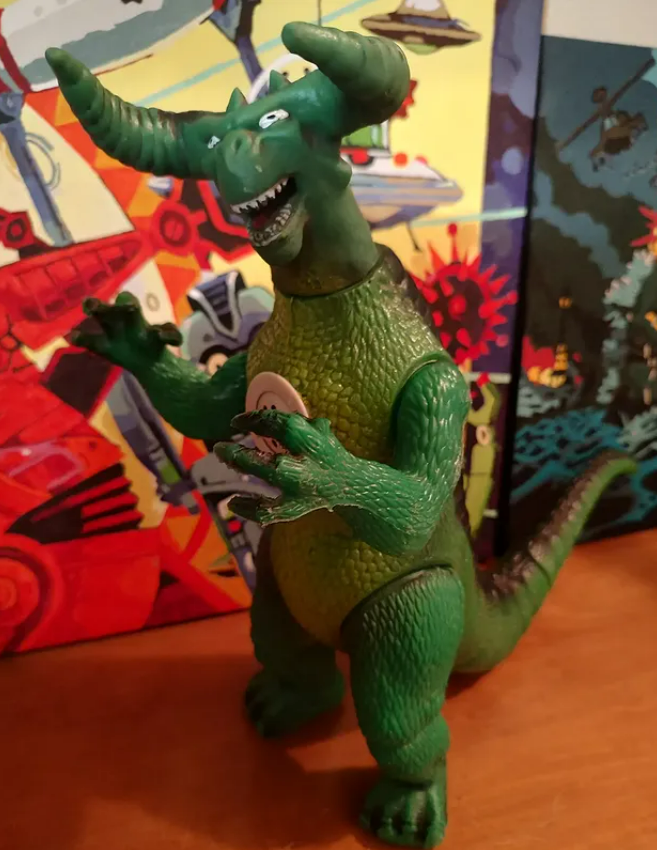
(From Jim Maitland’s Instagram post; and reproduced here with his permission)
This breathtakingly impressive beast (see above), with large water buffalo-like horns that make me think of Tim Curry’s demonic role in the 1985 film, Legend, is in the collection of Jim Maitland in the US (his collection is gargantuan and jaw-dropping btw – how can you not feel envy for at least 30 of his things, if not more, way more?).
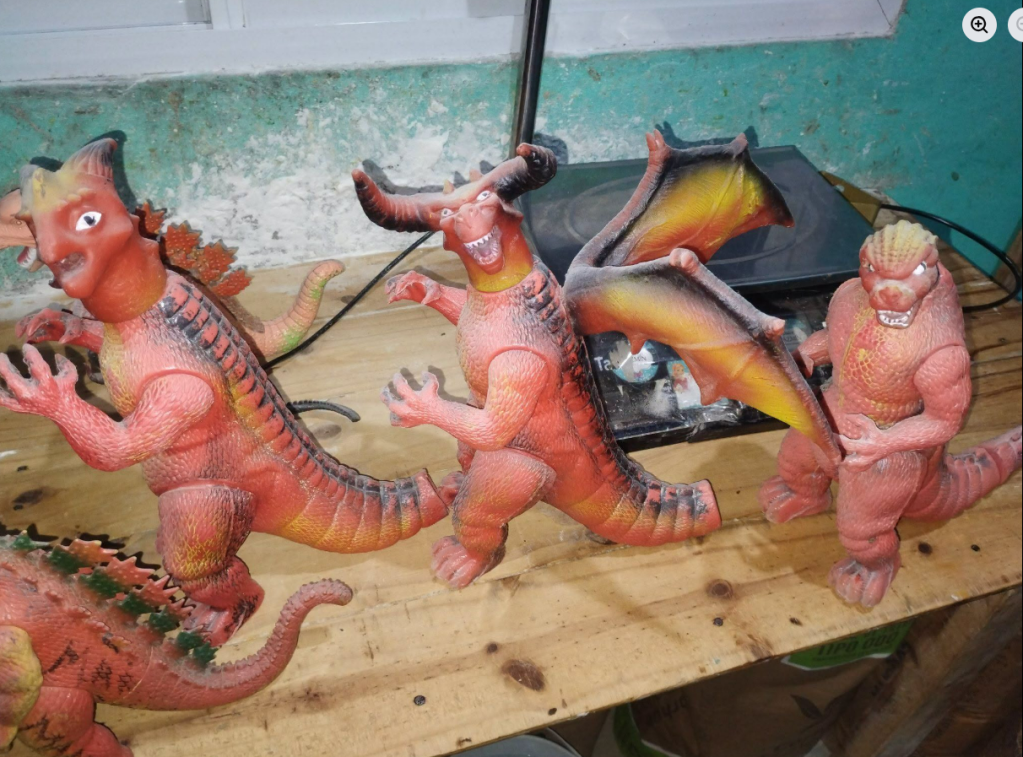
(Image from Facebook; and reproduced with owner’s permission)
Another example of this strange toy, this time in red and with a large set of wings added, appeared most recently in a Facebook post by the Argentinian toy dealer, Carlos Francia.
Another image of the same figure appears in two more of Carlos’ Facebook posts (see also here and here):
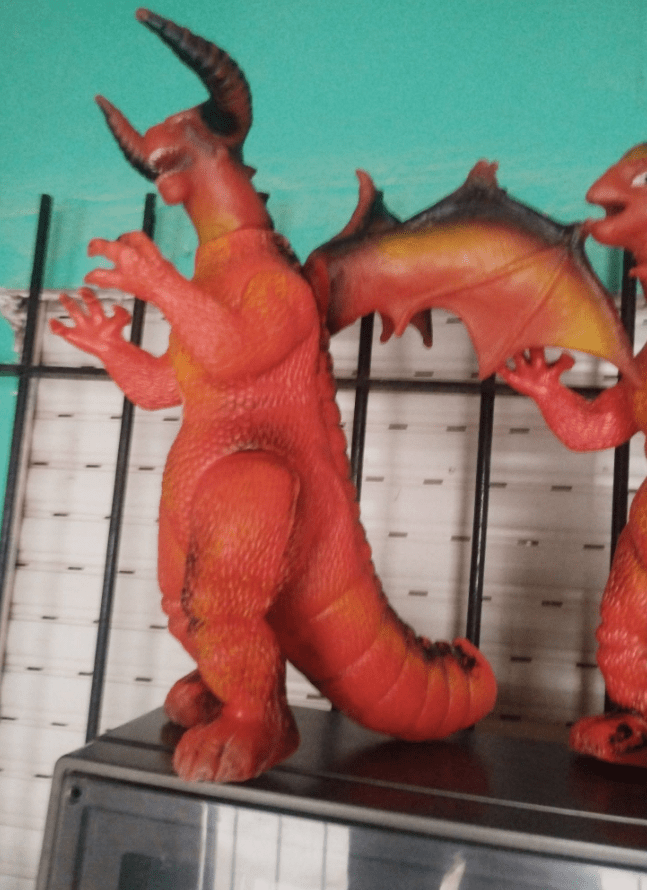
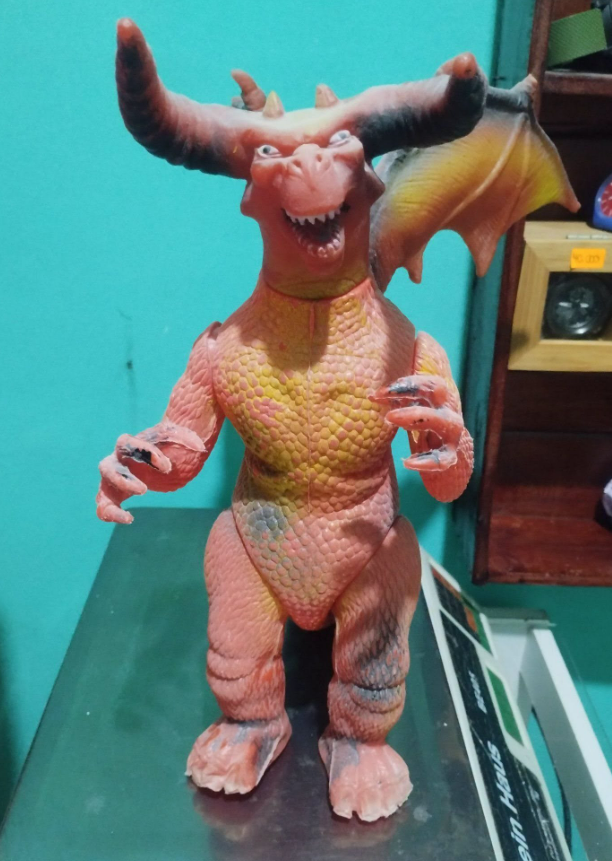
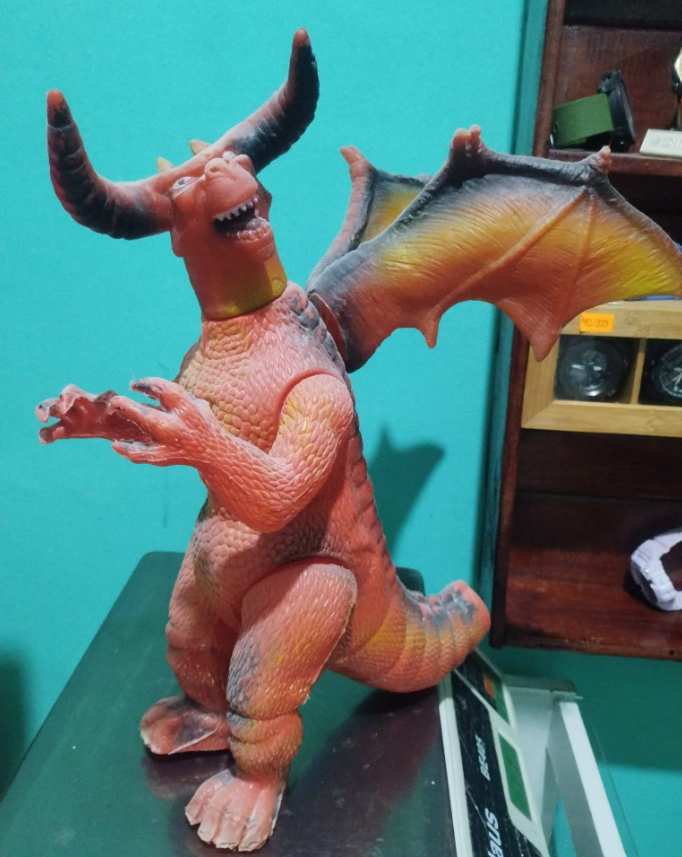
(Images from Facebook; and reproduced with owner’s permission)
I know of only one other winged one, but with a normal Godzilla head, that was offered for sale on Instagram (alongside another standard green model), by the almost unpronounceable ‘jugueteriarinconencantado’ on 21 April 2021:
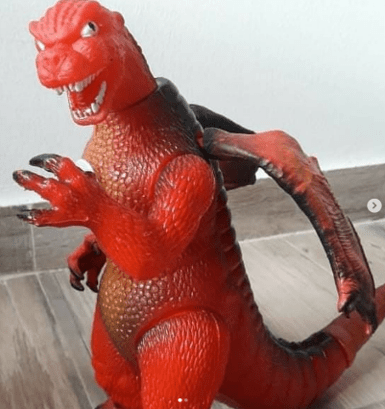
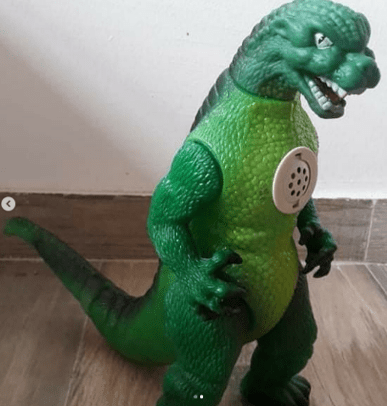
(The two Godzillas offered by ‘jugueteriarinconencantado’ on Instagram)
Through the kindness of the Argentinian collector, Alejandro Kiryluk, I have some images of how the wings attach to these magnificent beasts:
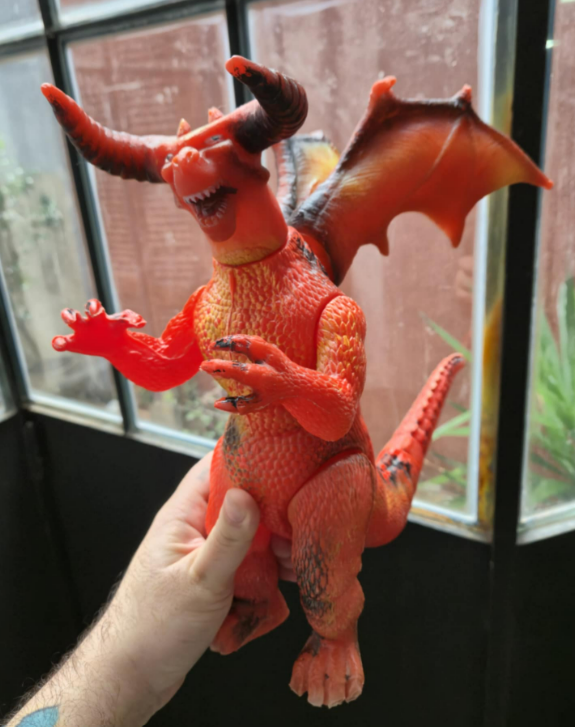
(Alejandro Kiryluk’s example of this horned kaiju; image reproduced here with his permission)
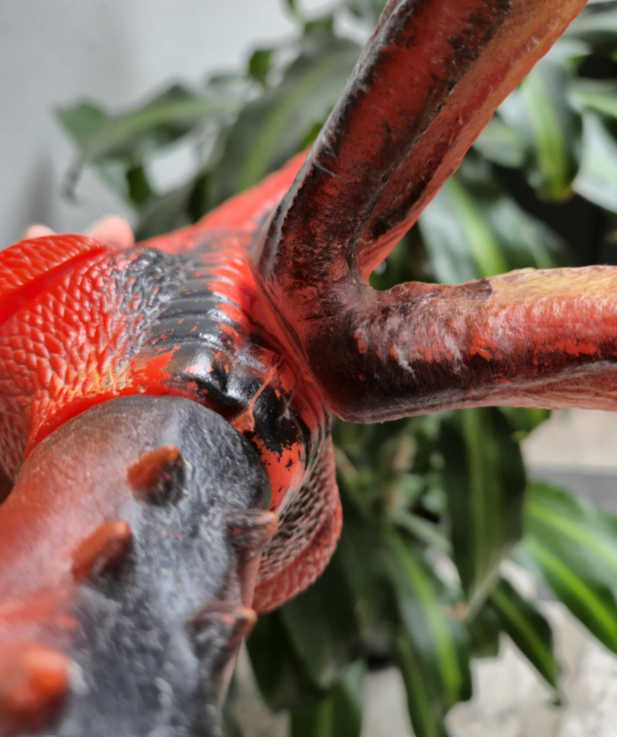

(The wing attachments, taken from above and from the side; image reproduced here with Alejandro’s permission)
The wings of this horned kaiju are joined together at their base, and attach through a large hole punched in the spine of the beast. However, those attached to the Godzilla shown above, appear to have been separated from each other and rotated so that they sit more horizontally, and then mounted individually in smaller holes punched into the area of the shoulder blades.
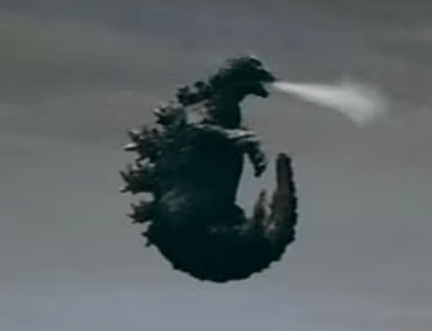
Now as ‘any fole kno’ (to quote Molesworth) Godzilla cannot fly (other than on one occasion in the 1971 film Godzilla vs. Hedorah, by forming his body into a ‘C’ shape and shooting himself along backwards like an airborne radioactive squid. That said, toys don’t have to be factually accurate and I have seen less aerodynamic creatures in toy-form with wings – including a very modern and realistic Brontosaurus toy with large wings (how would that even work?).
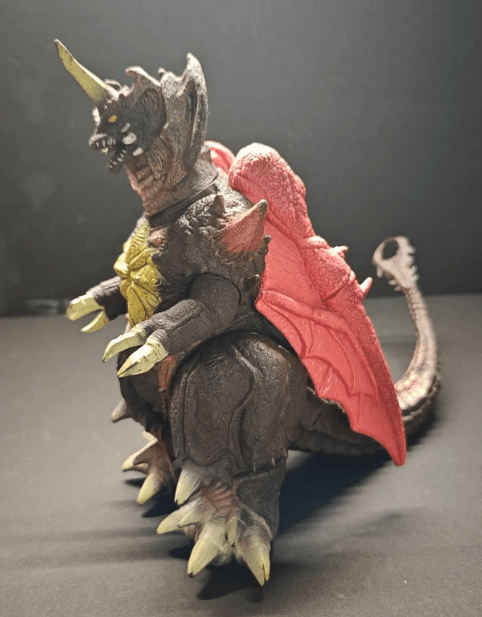
(From a Mercari sales listing)
Perhaps the addition of wings is an obvious step when toy bootleggers are designing demon-like horned heads or working on a toy that might well look dragon-like to the untrained eye, but to me this addition this looks suspiciously like the kaiju, Destroyah, who appeared first in the 1995 film: Godzilla vs. Destroyah, and for which Bandai produced the earliest sofubi in that same year – with ribbed wings edged in spiked claws much like those on these Argentinian Godzillas and kaiju (for more details of the Destroyah sofubi, see Clubtokyo). If I am correct in this, then we have another possible date in the mid-1990s for the creation of these Godzilla bootlegs.
Carlos Francia’s photographs also show another variant head, perhaps adapted from a realistic herbivore dinosaur toy, somewhat crudely sculpted with eyes mounted on the sides of its head and ridges of three spikes above these eyes, a wide-open beaked mouth and two prominent horns on the back of its skull.
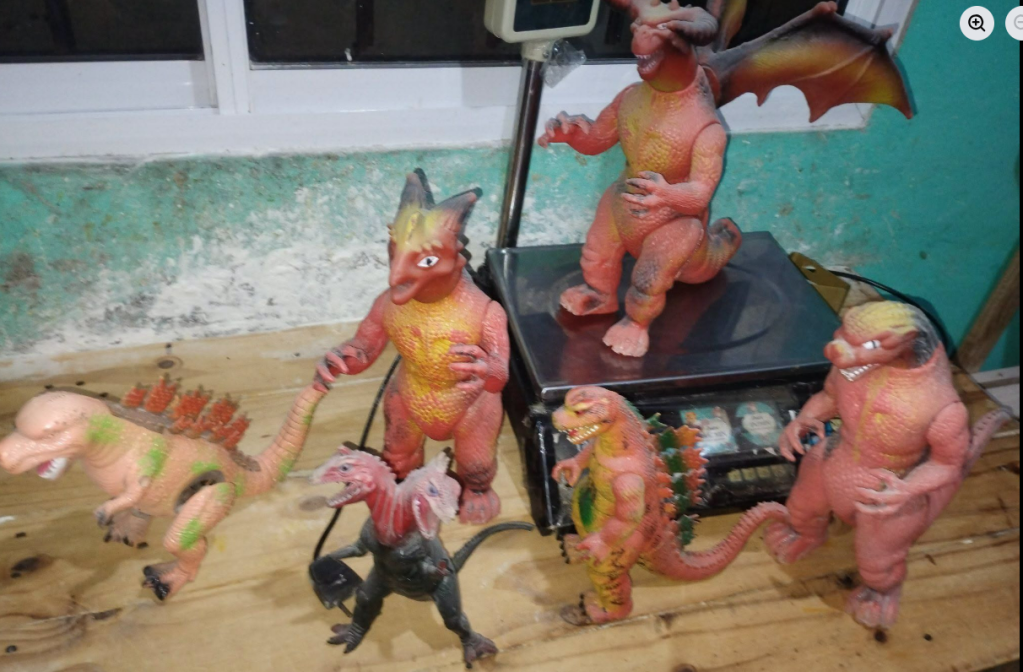
(Here I am talking about the two-horned figure in the centre of the image; this image reproduced from a Facebook post, with owner’s permission; also note that while Carlos Francia identifies all of these as Argentinian, the paler ‘walking’ Godzilla and hard plastic two-headed monster in the bottom left-hand corner are common Chinese products: see my post on Chinese bootleg Godzillas for the first of these)
Again Carlos’ other Facebook posts include a more detailed image of this figure (see also here and here):
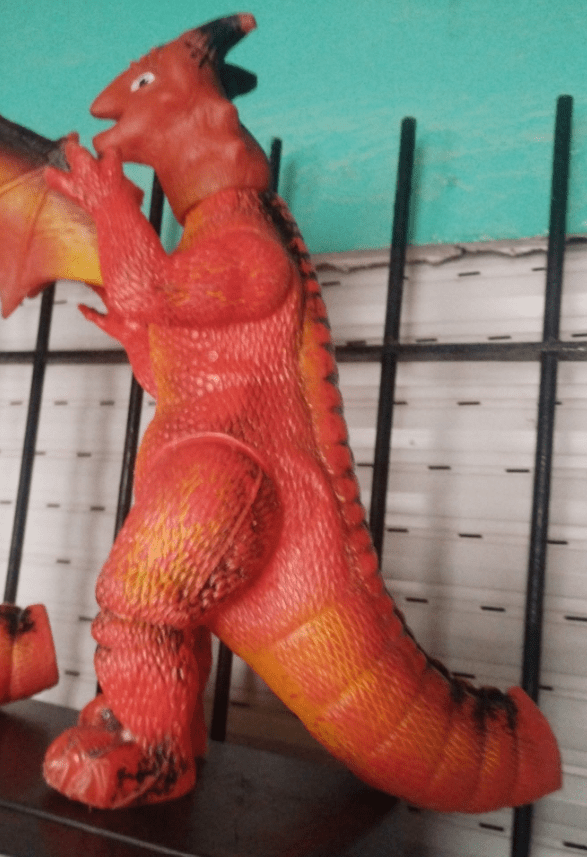
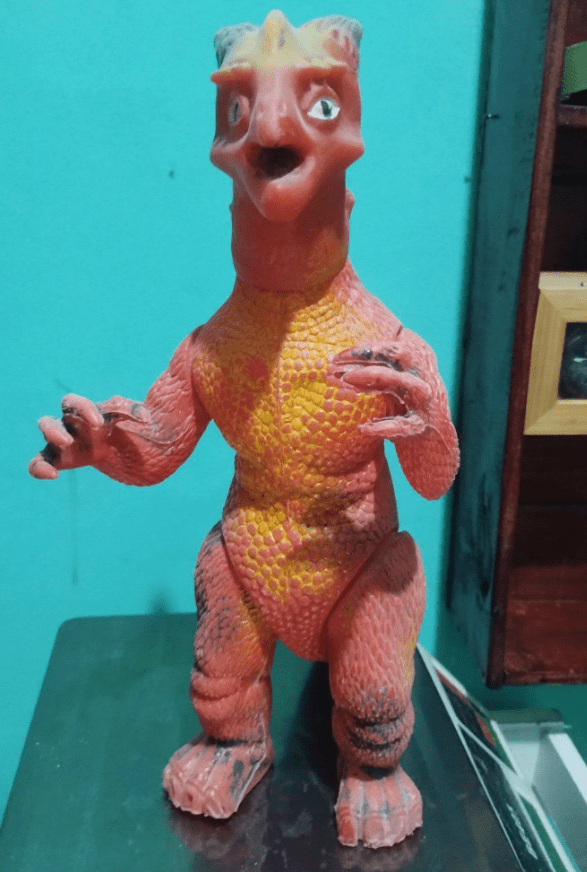
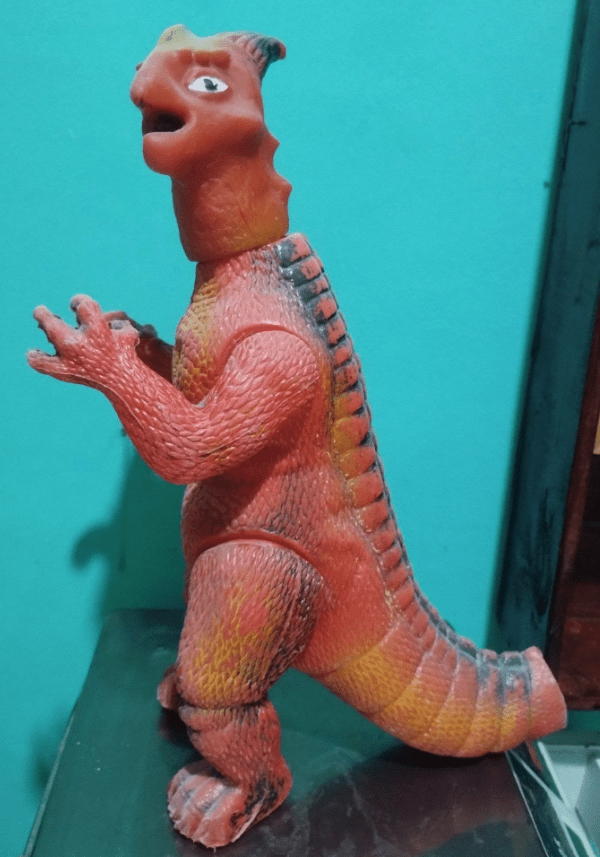
(Image from Facebook; reproduced with owner’s permission)
I happen to also have a better photograph of this head, through the kindness of an Argentinian private collector:
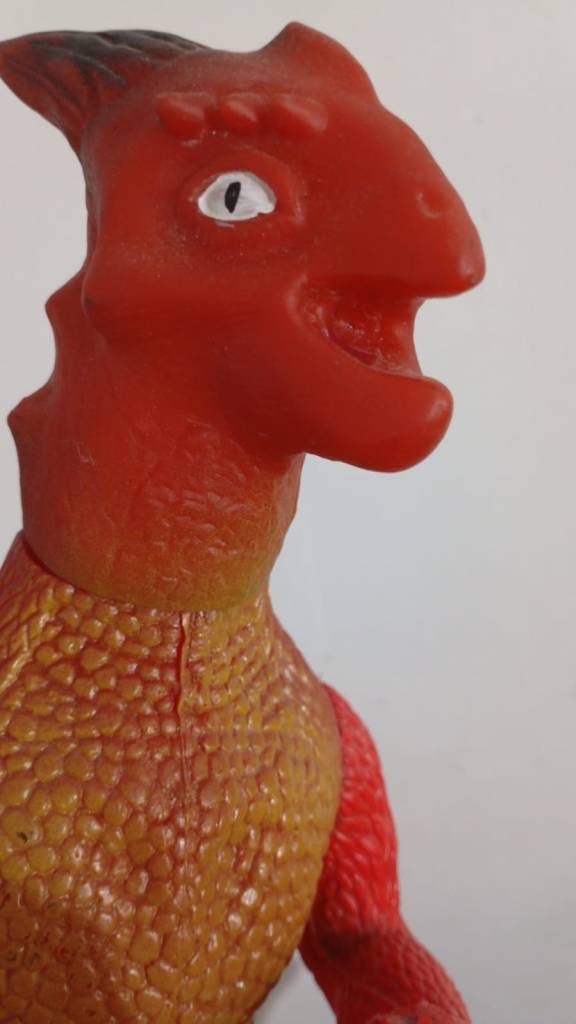
These are all the variants with this large-size Godzilla known to me – but, of course, if any reader has another, then please do get in contact. I should be delighted to document them here.
⁂
However, this story does not end here, as Carlos Francia’s photographs also show two more Godzilla bootlegs, both likely made in Argentina, and these perhaps solving a recent mystery for me. We should turn our attention to this Godzilla figure with prominent spine-fins here in the image below, in the middle of the front row, with a child’s name written on its left leg:
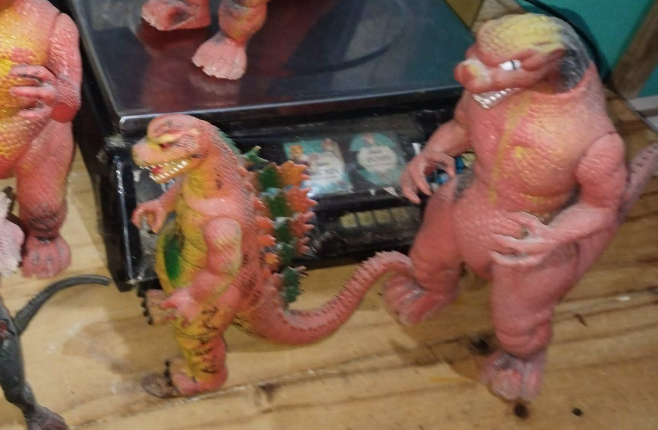
Clearly, this is a copy of the Chinese-made Godzilla bootleg I have elsewhere called the ‘second spotty finned Godzilla’ (the *Bootleg of Imperial model 2, in my earlier post on Chinese bootleg Godzillas). It appears identical to that Chinese-made bootleg in form, but is in the same faded red plastic as the other Argentinian Godzilla bootlegs here. A rough comparison of size with that of the adjacent Argentinian Godzilla (which must be about 295mm. tall like mine), shows that this apparent Argentinian take on the ‘second spotty finned Godzilla’ is about the same height as the Chinese-made original (220mm. tall).
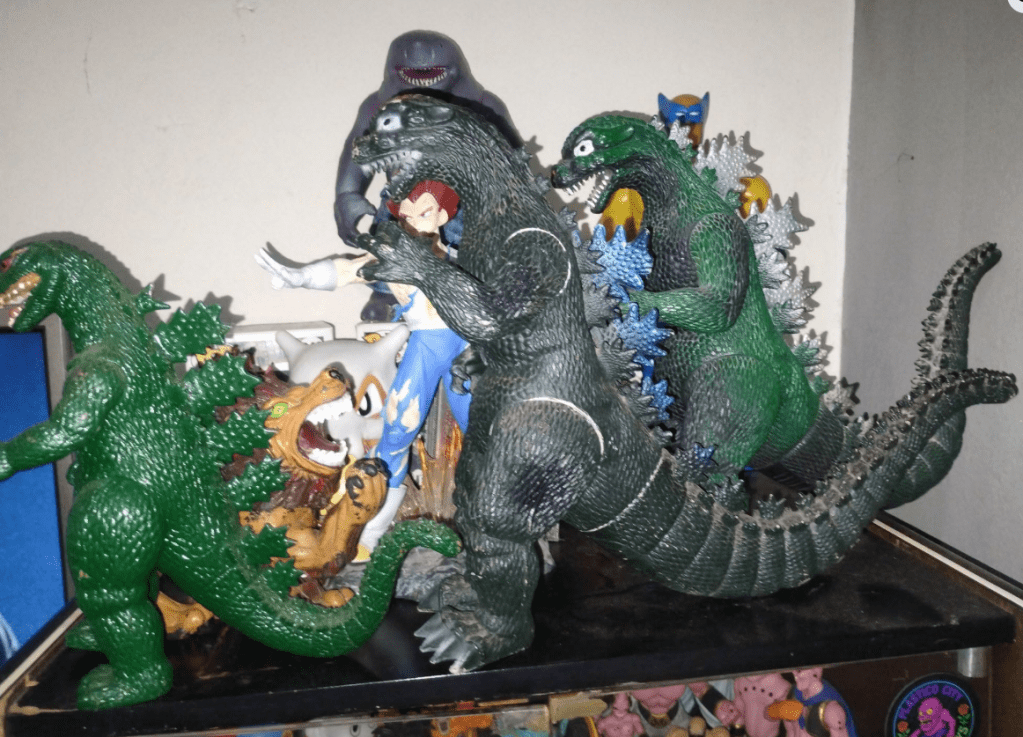
In addition there is a notably similar Godzilla bootleg in other images published by Carlos Francia in another post to the ‘Warriors of the Universe’ Facebook group. The images are below, and our focus should be on the shiny green Godzilla bootleg to the left of each image (and in the second image partly out of the shot):
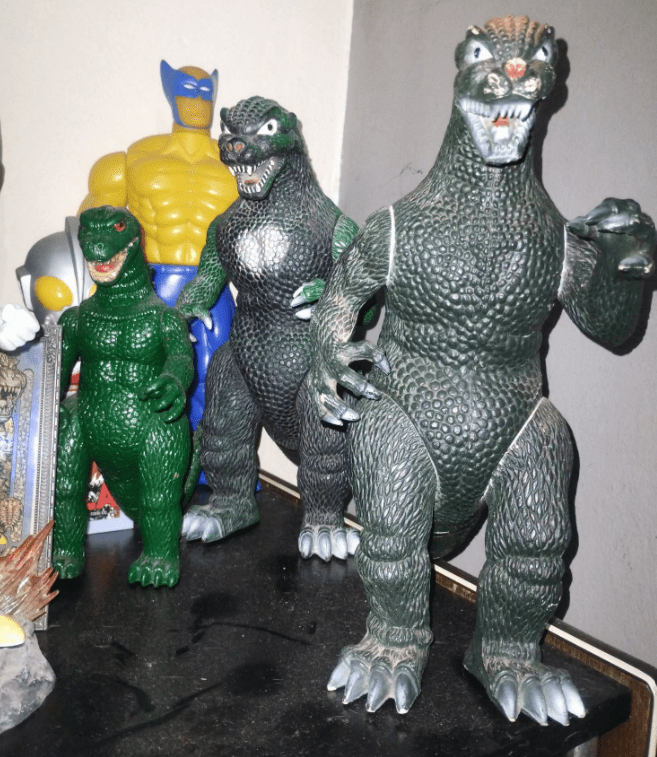
(Images from Facebook; reproduced with owner’s permission)
Again Carlos is slightly misinformed when he identifies the second and third Godzilla bootleg in these pictures as Argentinian – they are clearly Heisei Godzilla bootlegs, made in China in the 1990s, (and discussed in my earlier post on Chinese Godzilla bootlegs as ‘*Bootleg of Imperial model 5’). However, the shiny green smaller Godzilla bootleg is of the same design as the red one in the previous images, and is not of a colour known to me from any Chinese-made model – indeed the shiny nature of the green here suggests this is in blowmold plastic, not vinyl as the Chinese examples. This is presumably also Argentinian in origin.
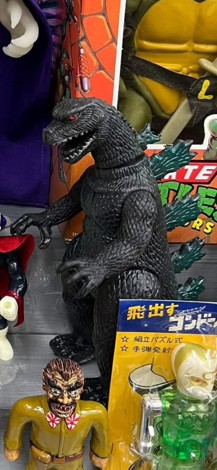
This identification of a smaller Argentinian Godzilla bootleg perhaps also answers one of the open questions in my kaiju-hunter in-tray, in that at the end of April this year, a strange Godzilla toy appeared in one of Chance Priest’s auctions, and was described by Chance as having a solid rubber head but a blowmold plastic body. It is shown below:
(Image reproduced with owner’s permission)
This also is a copy of the Chinese-made ‘second spotty finned Godzilla’, and the only apparent differences to my eye are (1) the fact that it articulates at the neck (unlike its Chinese model and the smaller Argentinian ones discussed above); and (2) the rows of lines on the spine-fins (rather than rows of dots as in the Chinese original and the smaller Argentinian Godzillas).
However, the bringing together of a solid rubber head with a thin blowmold plastic body is the hallmark of the larger Godzilla bootlegs produced in Argentina, and strongly suggests to me that this was an attempt to redesign the faithful copy of the ‘second spotty finned Godzilla’ to a form where variant heads could be added (as with the larger Argentinian Godzillas). If nothing else, this suggests that all of these were products of a single manufacturer, perhaps with a small and tight-knit team of sculptors and production operatives.
⁂⁂⁂
What can we then say about the production of Godzilla bootlegs in Argentina in the 1990s? That nation from the mid-1980s onwards was set to be the hotbed of inventive and imaginative toy bootlegging, and Godzilla was a near-perfect showcase for that. All the Godzilla bootlegs from Argentina seem to have been the work of a single workshop (or at least a closely associated group), and any indications of date that we have suggest they operated in the early to mid-1990s. However, the efficiency of production as large-scale figures in thin blowmold plastic perhaps ensured that most of the figures produced broke during normal levels of play and were thrown away. Thus, these Godzilla bootlegs are now exceptionally rare. Those that survive are wild and thrilling rollercoasters-of-imagination – perhaps the best and brightest of all Godzillas produced on the South American continent.
- 'MUTTON DRESSED AS LAMB': Godzillas and kaiju that look vintage, but are not
- American made Pachi
- BOOTLEG DINOSAURS – a little off topic, but sometimes needed here
- BOOTLEG GODZILLAS
- Bootleg Tokusatsu from China and its immediate neighbours
- Bootleg Tokusatsu from the Americas
- BOOTLEG TOKUSATSU HEROES
- Central Europe – Godzillas and kaiju from behind the Iron Curtain
- Chinese-region bootleg Godzillas -the plastic tide from the East
- Chinese-region made Pachi
- European made Pachi
- European-made Godzillas
- PACHI
- Pachi kaiju
- Pachi kongs
- Pachi superheroes – Ultraman and similar
- The Americas – bootleg Godzillas from the New World

 Confessions of a Kaiju Hunter
Leave a comment