There are two main roads open to a toy bootlegger when they begin their noble work – either they try to reproduce something as perfectly as they can and attempt to ‘cuckoo’ their product in with the licensed items on sale, or, they set off on a cut-and-paste adventure, taking a little from this item and a little from another, to create a ‘trifle’ of bootlegged elements (for non-British readers, this awful cacophonous dessert is a trifle: here – just be glad you have never been force-fed it regularly). Often, the second course (open to bootleggers I mean, not the awful dessert) produces much more exciting results, and some bootleggers put so much effort into these ‘chimera’ that one must stand up, take your hat off and salute their effort.
This is precisely the case with this odd Ultraman model kit in yellow plastic:
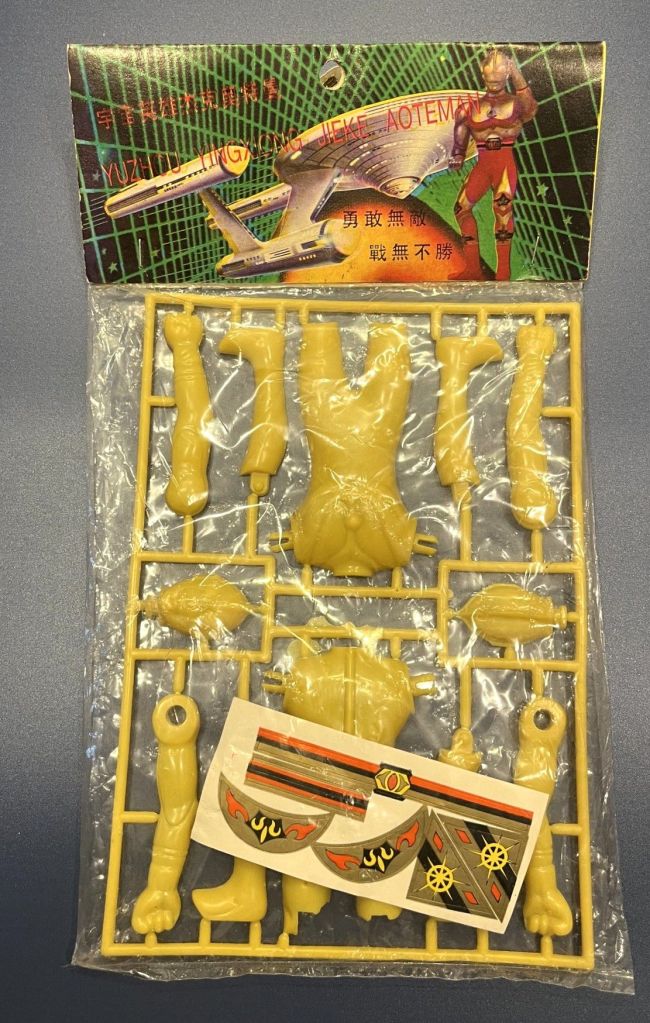
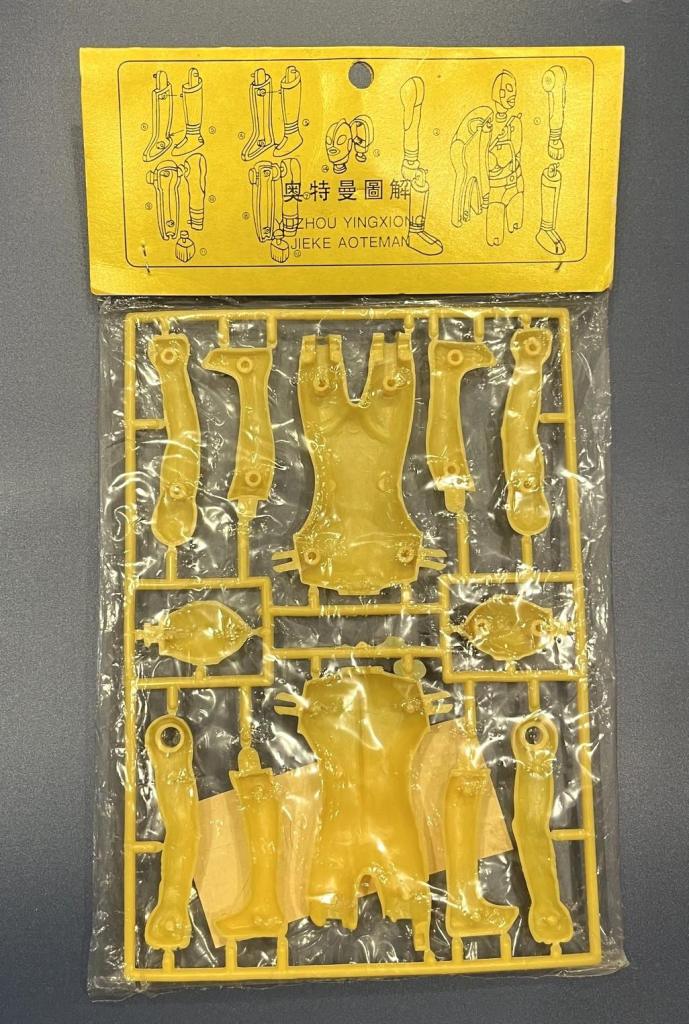
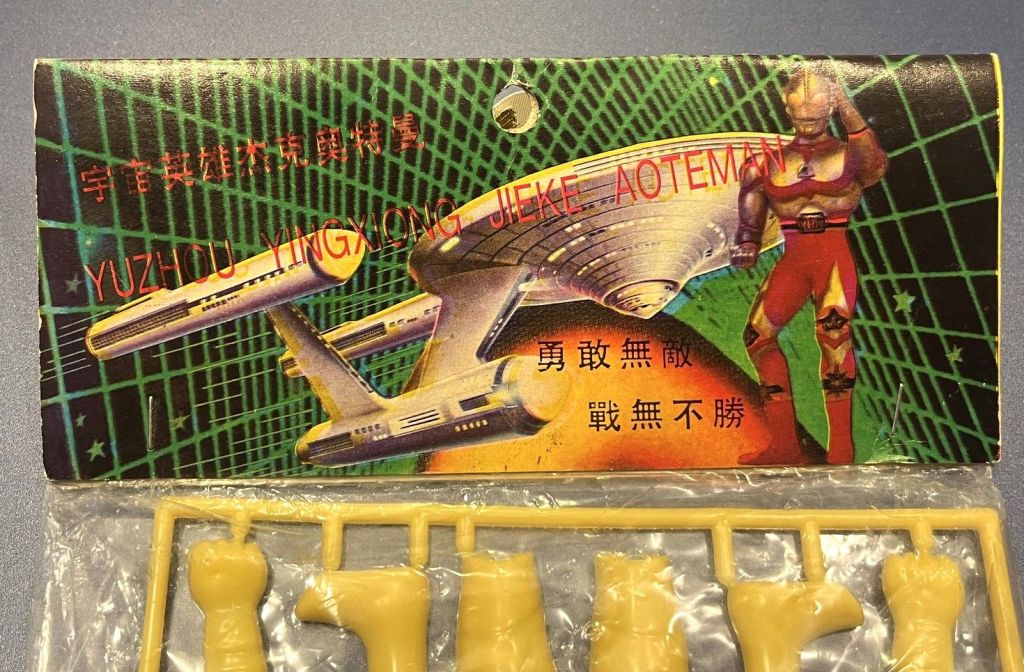
The figure is thankfully still in its unpopped-out state, and includes the decals in the bag, as well as a confusing header card that we shall return to in a moment. There is sufficient crackling to the plastic of the bag, and wear at its points where the figure sits highest (including a few holes here and there, such as at the nose of the front of the head), as well as yellowing to the header card and dog-earing at its corners, that we may feel confidant that this is the original packaging and it has never been opened. (As an aside, and as a warning to the wise, I have recently noticed a few eBay adverts –mostly from an Italian seller – for obscure or pachi sofubi, that are in bags where the plastic looks too new and uncrackled to agree with the age of the figure, and where the header card does not agree with others recorded for the same figure – and have been forced to conclude that these are vintage figures rebagged with new headers to increase the value: as prices increase, caveat emptor rings ever more true). Anyway, that here measures 200 by 140mm. to the outermost edges of the plastic frame, with the decal sheet measuring 42 by 94mm., the head of the figure measuring 35mm. from the top of its crest to the bottom of the attachment pin, and the header card measuring 70 by 160mm.
The figure is a slightly crude, but passable, copy of Ultraman Jake, and this agrees with the statements on the header card that it is “Yuzhou Yingxiong Jieke Aoteman” (‘Space Hero Ultraman Jake’ in Mandarin Chinese in phonetic Western letters, as well as ‘Cosmic Hero Ultraman Jake/Jack’ and something perhaps closest to ‘courageous and invincible’ and ‘victorious in every battle’ in Mandarin Chinese in Chinese letters). These were the official Chinese name and promotional slogans used when the ‘Return of Ultraman’ (featuring Ultraman Jack) was broadcast for the first time in mainland China in 1993, when it adapted for the Shanghai Oriental Television channel. As an aside, the original ‘Return of Ultraman’ also plays its part in our saga of confusion and copying here, as when it was broadcast in Japan in 1971-72, the Ultraman in that show was originally meant to be the original Ultraman who had returned some decades later, but Tsuburaya changed his suit significantly under pressure from Bullmark who wished to market a new line of distinct toys, and young fans thereafter called this distinctively different figure ‘New Ultraman’. This lead to an official renaming of this Ultraman as ‘Ultraman Jack’ in 1984 for the ‘Ultraman Zoffy: Ultra Warriors vs. the Giant Monster Army’ film (on this, see here). This is relevant for our purposes here as this fixes the absolute earliest date at 1984 at which this ‘Jieke Aoteman’ can have been called that, and more likely 1993 during the Chinese broadcasting of the show.
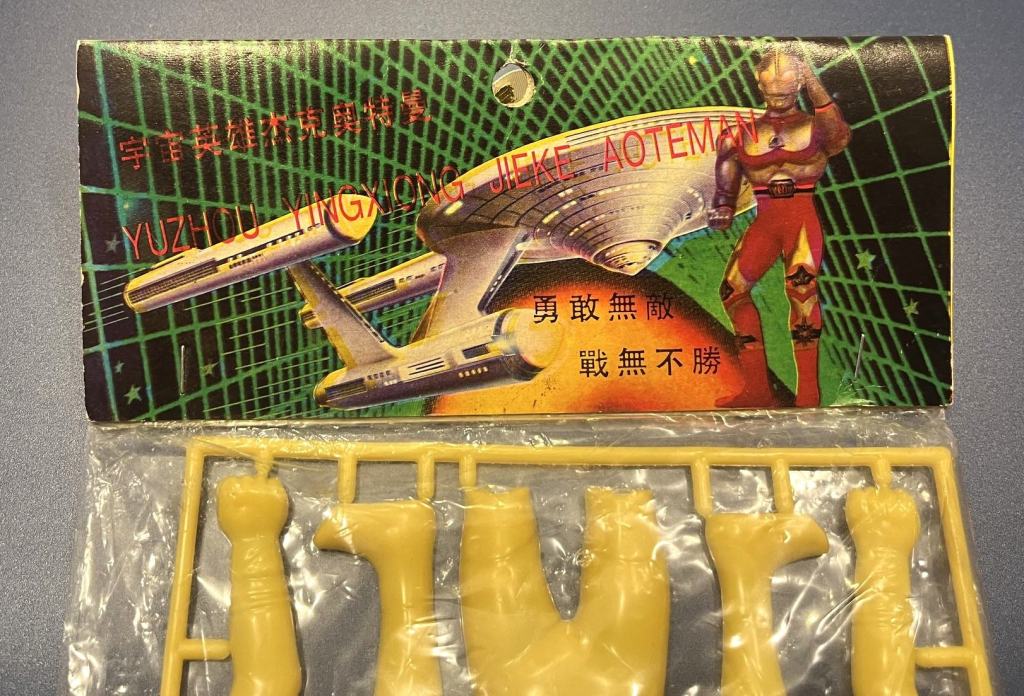
However, when we look at the rest of the package here, we take our leave from Ultraman Jack. The obvious place to start is the laughably mismatched USS Enterprise from Star Trek in the middle of the header card. Even the Enterprise here is in a mixed form combining elements of the original ship as seen in the 1966-69 TV series (mainly the tubular twin Warp engines, with circles of light at their fronts) with that seen first in ‘Star Trek: the Motion Picture’ in 1979 (note the wide and thin swept back arms that attach the Warp engines to the main body of the vessel – I know you read that in your mind in Checkov’s voice as “Wessel”, as did I). I was a Star Wars rather than a Star Trek child, and that probably betrays a natural cynicism to my character (Star Wars being a realistic depiction of the real world embracing all its flaws with only occasional hope; and Star Trek being more of an optimistic view of how the real world could be in a more refined future), so I do not know the Star Trek bootlegs well enough to know if this was a common bootleg Enterprise used on a lot of Chinese bootleg toy marketing, or if it was created for this header card. Perhaps a reader with a greater passion for Star Trek Chinese bootlegs could help with this?
The placement of the red planet behind the ship echoes the opening title sequence of the original Star Trek series, but with the angle of the ship altered for visual effect. The geometric green gridlines in the background (minus the crudely added five-pointed stars) are of a common type for computer-screen maps of the era found in the opening credits of ‘Star Trek: the Wrath of Khan’ (1982) as well as ‘Tron’ (1982) and the original Star Wars trilogy (1977-83).
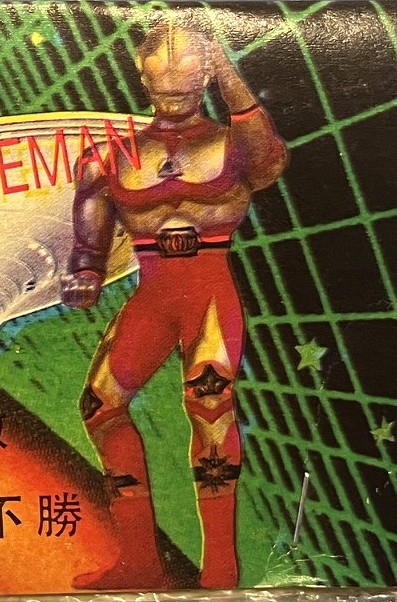
(Apologies for shine on image here, but this detail is tiny and ferociously hard to photograph)
Most surprisingly here, the Ultraman shown on the header card is not Ultraman Jack, but is a photograph of a figure of Ultraman Great produced by Dreamworks Toys in 1990 or 1991. That Dreamworks figure was made for distribution alongside the initial showing in 1990 of the series ‘Ultraman: Towards the Future’, which somewhat bizarrely was set in South Australia and was produced by both South Australian Film Corporation and Tsuburaya Productions together. These figures were produced by roto-molding and so had limited articulation, and the arms are fixed in the distinctive positions here with the right arm bent 90 degrees at the elbow and closing in a fist, and the left bent in a wider angle and ending with a flat open hand:
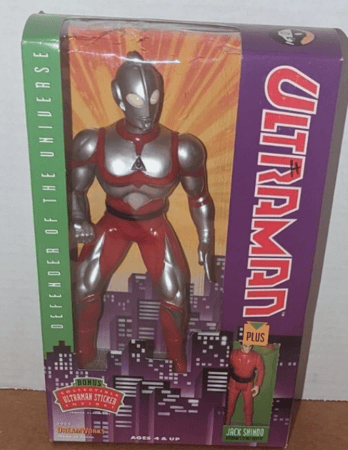
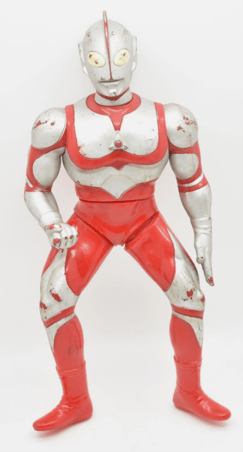
(Examples of the Dreamworks Toys Ultra Great figures; both from eBay sales listings – and before you ask, no I do not know why the seller of the loose figure made him squat so obviously before he took his picture)
To this photograph of a figure, the bootleggers then added small details by drawing or painting them directly onto the photograph, such as the designs at the wrists, knees, lower legs and a belt at the waist. These additional features are the same as the decal stickers that came in the pack with the plastic figure (however, with only one wristband present in the decal set).
Ultraman Jack and Ultraman Great have nearly identical heads, and the colouration of their upper bodies is generally the same, so we should probably presume that when producing this label the bootleggers turned to what they could source quickly that was ‘close enough’, rather than try to find an accurate Ultraman Jack model. Interestingly, Dreamworks Toys produced these figures in China for distribution in the West, and I suspect that the one photographed here is one that quietly left one of the Chinese factories involved, rather than a toy commonly found in Chinese households. Importantly, this adds another date to the earliest possible production point of our model kit: 1990 or 1991 and the years immediately following when Dreamworks Toys were producing their Ultraman Great figures.
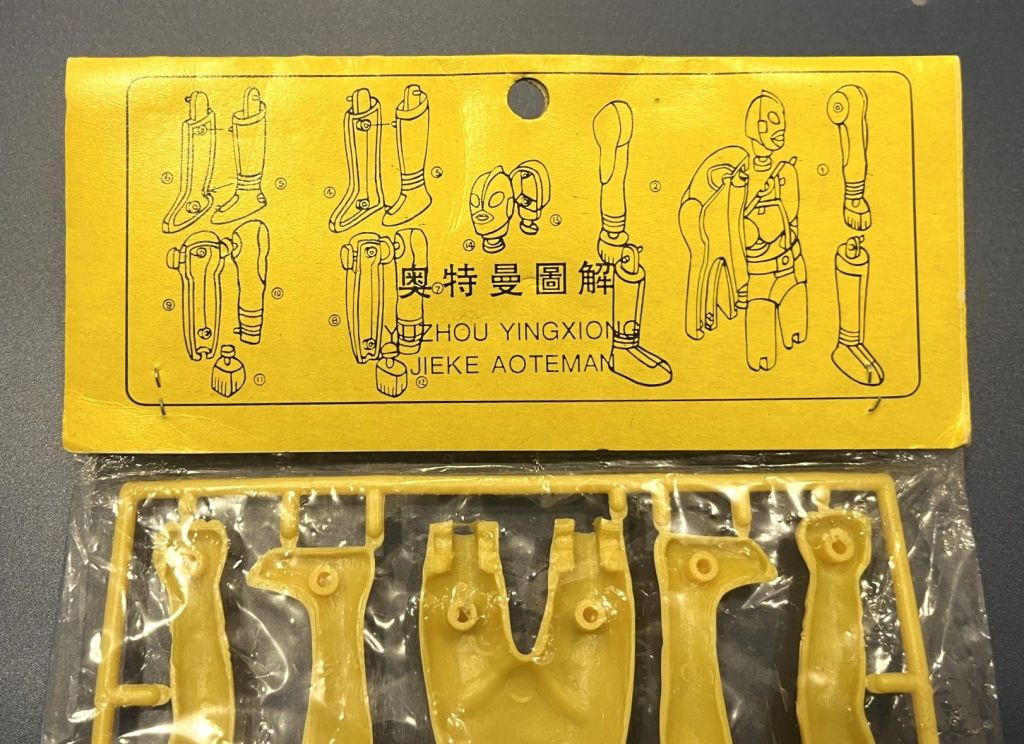
The reverse of the header card shows a line-drawn assembly diagram and ‘Ultraman illustration’ in Mandarin in Chinese letters and the same “Yuzhou Yingxiong Jieke Aoteman” from the front of the card in Mandarin in phonetic Western characters.
The only fact left to add here is that I bought this from a collector who told me he had obtained it while in China in the 1990s – and that accords perfectly with the other details discussed above.
So, to sum up what we know so far – this is a Chinese-made bootleg, which to judge from the languages on the header card must have been produced for distribution in mainland China. The header card (and most probably the whole kit) cannot have been produced before 1990/91 when the Ultraman Great figure that appears on its card was produced, and in fact, the production of this kit fits best into the context of the 1993 Chinese broadcasting of the ‘Return of Ultraman’.
⁂
However, there is more. Similar sets to this one, but with different packaging, commonly occur on Western sale sites, and I am sure that many readers will already have had that ‘I have seen one of those somewhere before’ feeling. What they are remembering is this:
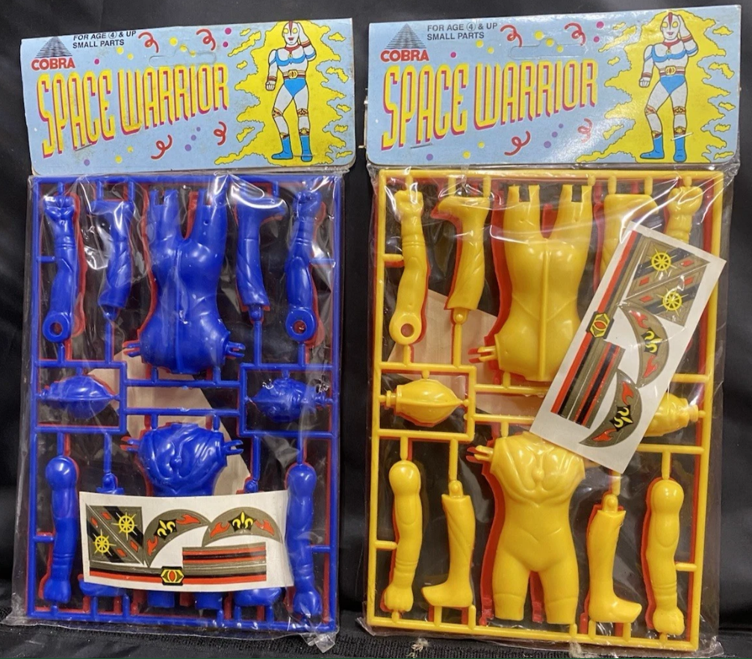
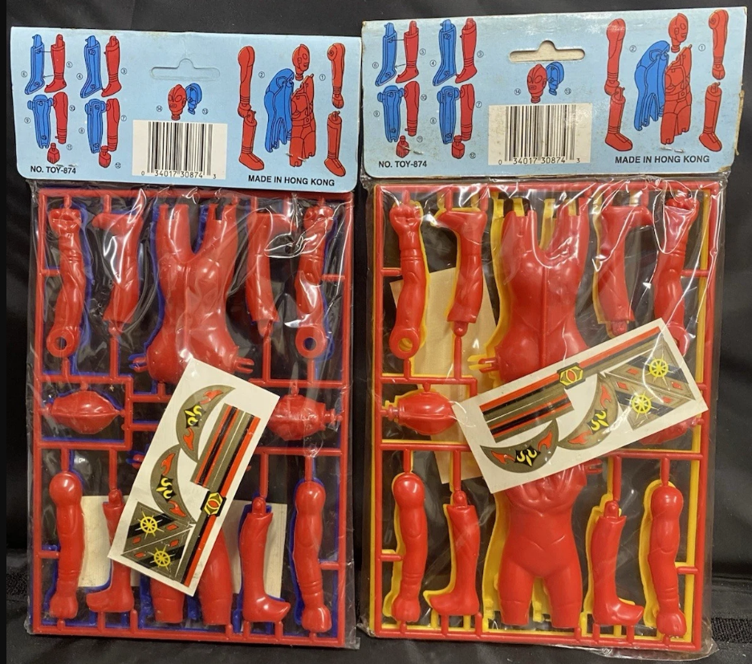
(From eBay sale listings)
This ‘Space Warrior’, as the header cards announces, was made by Cobra Toys in Hong Kong (of this manufacturer I can find nothing except this name). Surviving price labels, the language used on the label and the high frequency of these in US online sale sites, all strongly suggest that they were made for exclusive export to the US:
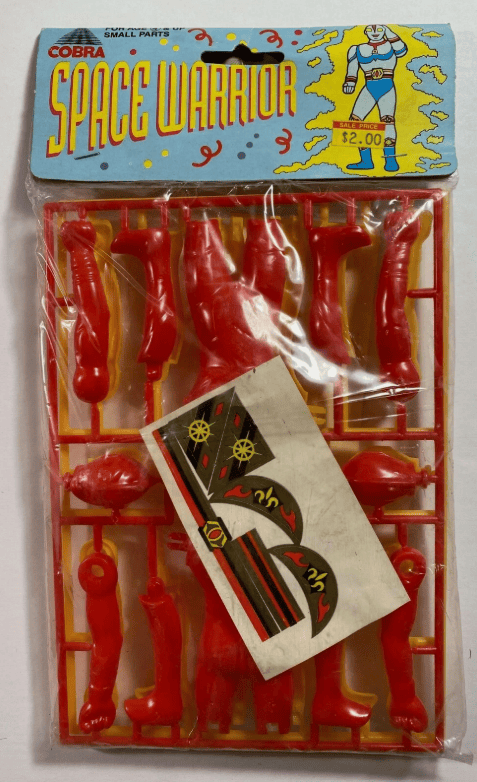
(From an eBay sales listing; note the sticker with the sale price; $2)
Here the exact same model kit appears in the same yellow as mine, as well as in blue and red variants, with the main difference being that two model sets were included in the Hong Kong-produced version, and only one in the Chinese-made one. We might suspect that mine is a recasting of the other, or vice versa, but the decal sets are also identical, and the header cards have the same Ultraman figure (reduced to a coloured drawing on the Hong Kong one) and these also have near-identical assembly diagrams on their reverse (with the only changes to the Hong Kong one being the addition of “Made in Hong Kong” and a product number and the exchanging of the Chinese taglines with a barcode). Most likely these two model kits drew from the same production stock, or produced from the same molds in different factories either side of the China-Hong Kong border.
It is important that the Hong Kong-made one has a drawing of the Ultraman Great on its header card, as this fixes this one as the second in the line of production here, after the Chinese-made header cards. In essence, it would be a simple task if a Hong Kong bootlegger wished to copy a Chinese header card that included a photograph of a figure, by drawing it. However, it would be impossibly difficult and quite unbelievable if we supposed instead that a Chinese bootlegger saw the Hong Kong header card, and having recognised the Ultraman Great figure from the simplified line-drawing, then sourced a Western-marketed toy (which would not have agreed with his naming the figure ‘Jieke Aoteman’ anyway) which he could pose in the same way and photograph for his own header card. This detail has the additional benefit of dating these Hong-Kong model kits to after the initial Chinese production in 1993 – and is quite at odds with the ‘1970s’, ‘1980s’ or even occasionally ‘1960s’ guesstimate-datings usually given to these on online sale sites.
This moving of toy production across the Chinese-Hong Kong border makes a great deal of sense when one considers the history of the region at the time. After a period of rapid industrial development in the 1960s and 1970s, the production-giant of Hong Kong first began to feel its limitations in the 1980s, in the form of increasing land rents and labour costs, and the relatively small population size of the island inadvertently capping the available workforce. In response, Hong Kong industrialists shifted into the ‘front shop, back factory’ production method, with the heads and administrative departments of their companies based in Hong Kong, but their factories sited just across the border in mainland China (predominantly in the nearby Pearl River Delta and later the whole Guangzhou and Foshan regions, where the average wages were reportedly over 30 times less and industrial building land was shockingly cheap). This, of course, was the period in which Dor Mei shifted some of their Godzilla and dinosaur toy production in the same direction, presumably in response to the same pressures.
⁂⁂⁂
Given all of the above, it seems likely that this Hong Kong-based company named Cobra, or a related business associate of theirs, initially produced the Chinese-distributed Ultraman model kit discussed here to cash in on the sudden success of the ‘Return of Ultraman’ on Chinese TV in 1993. Then later they moved production to Hong Kong to mass-produce these same kits with rebranded packaging for the Western market. It is possible that the Chinese-made kits are only rare in the West, and occur commonly on Asian online sale sites, and I invite any reader from there who has seen one or has any more information on them or the bootleg toy company Cobra to get in touch.
- 'MUTTON DRESSED AS LAMB': Godzillas and kaiju that look vintage, but are not
- American made Pachi
- BOOTLEG DINOSAURS – a little off topic, but sometimes needed here
- BOOTLEG GODZILLAS
- Bootleg Tokusatsu from China and its immediate neighbours
- Bootleg Tokusatsu from the Americas
- BOOTLEG TOKUSATSU HEROES
- Central Europe – Godzillas and kaiju from behind the Iron Curtain
- Chinese-region bootleg Godzillas -the plastic tide from the East
- Chinese-region made Pachi
- European made Pachi
- European-made Godzillas
- PACHI
- Pachi kaiju
- Pachi kongs
- Pachi superheroes – Ultraman and similar
- The Americas – bootleg Godzillas from the New World

 Confessions of a Kaiju Hunter
Leave a comment