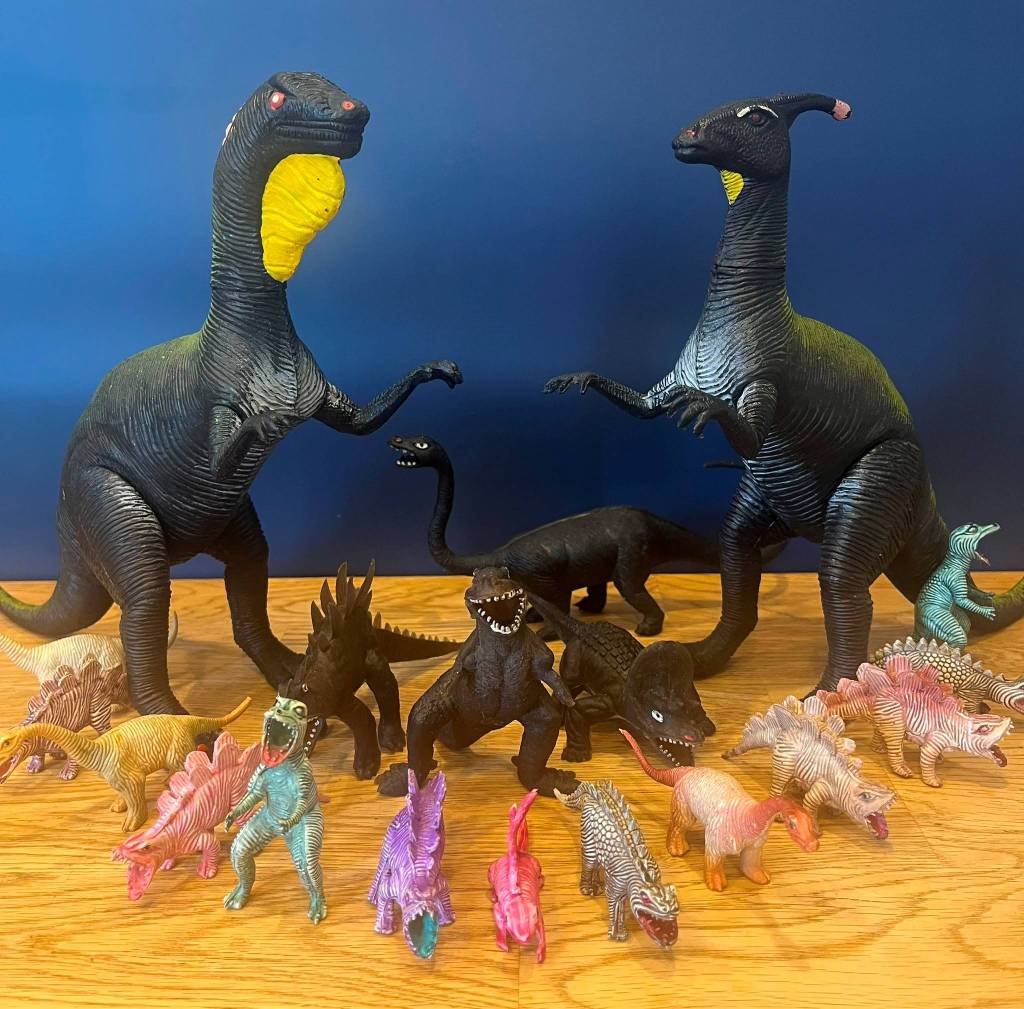
Before we get going with this post, it should be recognised that at least half the work below has been done by my esteemed friend and bootleg co-hunter and researcher, Jamie Francis (see here and here). Thus, this blog is published in both his and my name as a collective research project. Like any good collaboration, there are large areas of what follows where I am unsure as to what was him, and what was me – but if something here impresses you or makes you think, ‘I want one of those’, then almost certainly he was the originator, with me running along behind forensically analysing everything, and adding detail to the dataset.
It should also be noted that this follows a post on bootleg Godzillas from the PRL by me (KH), and we direct our readers to that earlier post to read about the nature of the Polish toy-bootlegging industry, and how this created toys that were offered mainly in only one locality around the production site. This is important as frequent finds in one particular area can help with the localisation of the bootlegging workshop. We are aware that we’re stepping a little off the Godzilla and kaiju path here by turning our attention to dinosaurs – but in Poland both before and after the fall of Communism, the bootlegging of one so often included the bootlegging of the other, and so it has relevance for our core topic here. Humour us for a few minutes – it gets good fast.
Finally, like my (KH) ever-growing encyclopedic post on Chinese Godzilla bootlegs (my apologies for size there – I am aware that few people now read more than 25 words even when pushed, and I really tried to keep it to a minimum while being comprehensive), this post will be added to without ‘[UPDATE …’ marks. As new discoveries are made, a a dedicated post on them will appear, and the new details will be incorporated here, in chronological order of production as far as that can be known. We both get the gut feeling there will be many more.
⁂
To begin – when one embarks on the matter of actually trying to identify Polish-made bootleg dinosaurs, the first thing one must establish is a workable methodology by which we can decide if a particular dinosaur toy is more likely to be Polish than not. As their production was only ever temporarily tolerated by local authorities, rather than legal in any sense, Polish bootlegs never have accurate maker’s marks – and when these can be found on a Polish-made toy, these usually state “China” as a country of origin, as an accidental and secondary mold-mark carried over from a Polish casting from a Chinese-made toy. In addition, many toy sellers in Poland will list or sell you a Chinese-made item genuinely believing it to be Polish in origin, as they had seen them (or their Polish copies) during their childhoods, but on physical inspection these often turn out to be a Chinese-made item. One must ‘kiss a lot of frogs’ in this hunt. Finally, many Chinese-made toy dinosaurs were produced to a high quality, but others were not (looking at you and your gloriously ‘derpy’ collections, Uglysofubi and Creaturesafari), and so quality cannot be used solely as a factor to winnow out the wheat from the chaff. To try to identify the Polish dinosaurs here, we have used a mental checklist when looking at these toys, and the more of these items below that we can ‘tick’ the more likely a Polish origin becomes:
- Is the item for sale in Poland, or one of the neighbouring countries that Polish toys seem to have navigated towards, such as the Czech Republic or Romania?
- Is the item made in a material, such as black or dark brown vulcanised rubber, that would be unlikely to be used by Chinese manufacturers, but was commonly used in the Soviet world in the 1980s and 1990s?
- Following on from 2, are there aspects of its decoration that link it to other Polish-made toys?
- Is it obviously a copy or cast of a Chinese-made toy, and perhaps is slightly smaller than that toy (owing to casting from existing toys, rather than using the original molds), or in a colour scheme not recorded elsewhere for the Chinese-made toy?
- Are there any specific quality control issues – even the worst of the silently screaming Chinasaurs are quite competently painted, whereas Polish toys often were decorated by either the ‘spray and pray’ airbrush method or ‘it’s almost lunch and I have to do another 50 of these before then’ brushstroke method.
- The most important question: are there eye-witness accounts of Polish people who were children in the correct era, who saw these items for sale in Poland, or even better bought them then and have held onto them as childhood treasures ever since?
So, onwards to the main attractions.
⁂
The Lesser Polish ‘Jiggler-saurs’:
In a previous post on Polish bootleg Godzillas, I (KH) briefly discussed a group of almost certainly Polish-made Godzilla bootlegs, kaiju and gremlin toys, most probably produced by a single workshop (or group of closely associated producers) in the 1980s, who appear to have worked in northern Poland, perhaps not far from Gdansk or nearby Elbląg. These producers made these toys in black vulcanised industrial rubber that moves much like the material ‘jigglers’ were made from, with simple red and white paint highlights. For the sake of comprehensiveness, we will repeat below some of the detail of what was previously said in the earlier post, and add to it here.
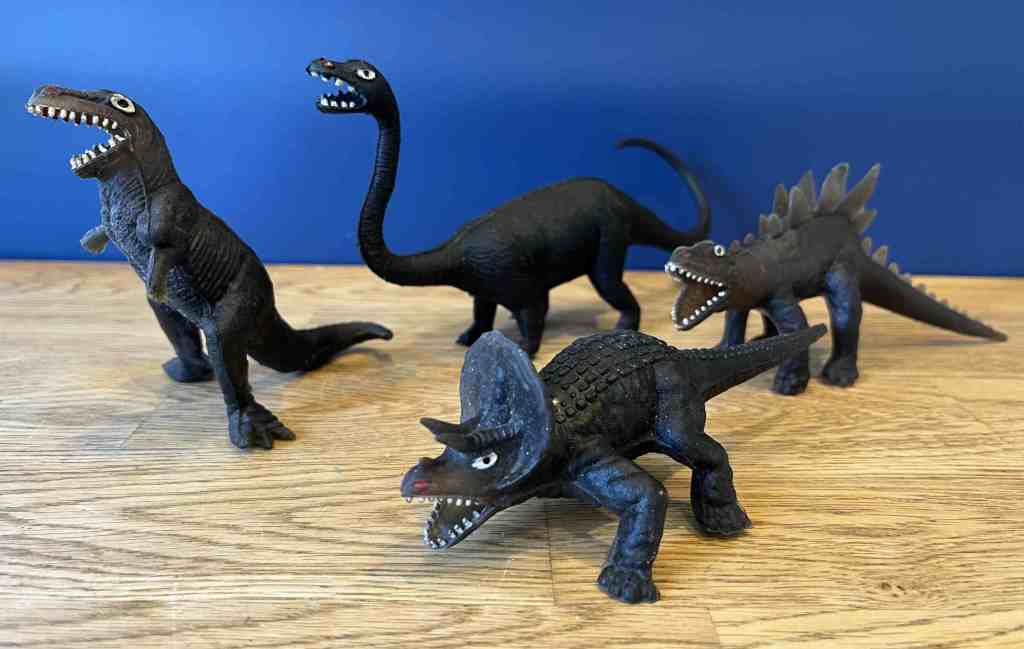
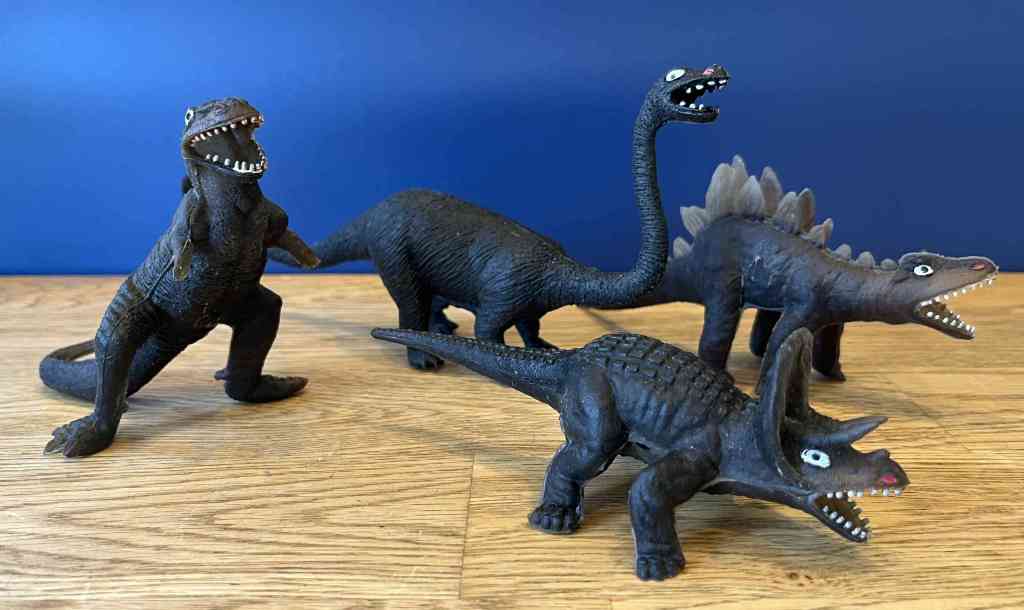
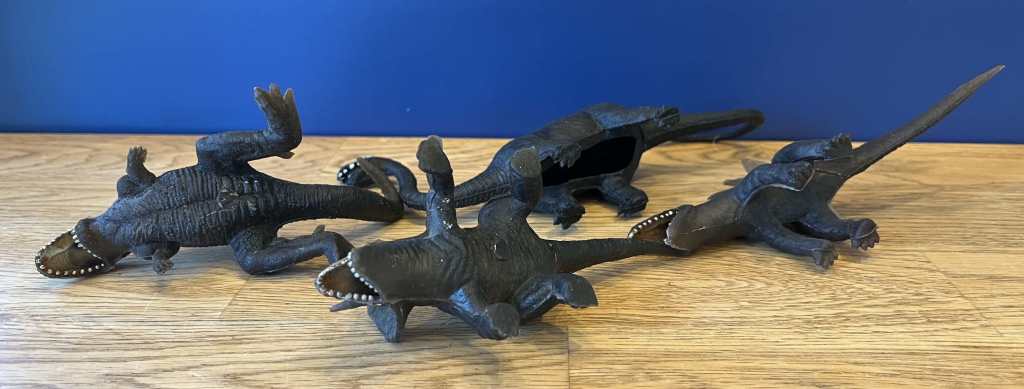
They manage somehow to be even more ‘derpy’ than the silently screaming Chinasaurs they were cast from, and they have enormous charm. Despite long searches, we only know of the four shown here, and for the record, they are:
- a Tyrannosaurus with unstable, slightly backwards facing legs: measuring 100 by 100mm. and weighing 42g., and apparently copied from a common Hong Kong Chinasaur made by Imperial in 1977, and with many other Chinese-region copies of that. This below, the Chinasaur they are copied from:
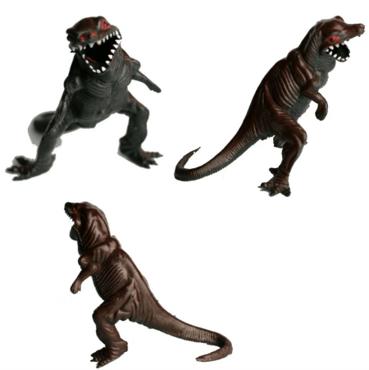
(Image from an eBay sales listing)
2. a Triceratops: measuring 50 by 145mm. and weighing 39g., and apparently copied from a common Hong Kong Chinasaur made by Imperial in 1975, and with many other Chinese-region copies. This below, the Chinasaur they are copied from:
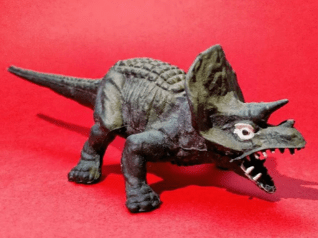

(Images from a Todocoleccion sales listing)
3. a Stegosaurus: measuring 70 by 145mm. and weighing 33g., and apparently copied from a common Hong Kong Chinasaur made by Imperial in 1976, and with many other Chinese-region copies. This below, the Chinasaur they are copied from:
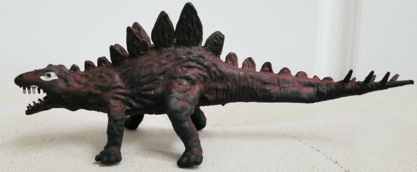
(Image from an eBay sales listing)
4. a Brontosaurus or Apatosaurus (with a hollowed out interior, presumably to reduce the amount of rubber needed for each figure): measuring 105 by 205mm. and weighing 51g., and apparently copied from a common Hong Kong Chinasaur made by AAA in the mid-1980s, and with many other Chinese-region copies. This below, the Chinasaur they are copied from:
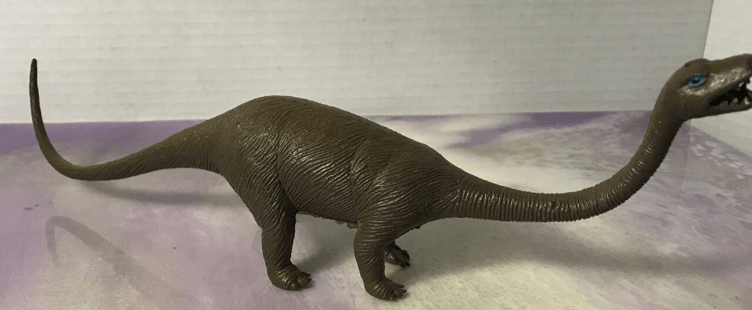
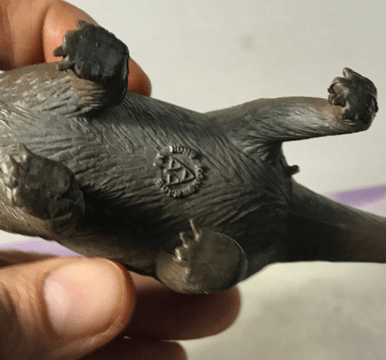
(Images from an Etsy sales listing, with apologies for trimming off nose of beast on one side in the full image given here – this the fault of the original photograph)
It should be noted that the last of the models used to cast these black rubber dinosaurs from was produced in the mid-1980s, and we should probably date these to soon after that. In addition, thanks to a Polish friend, we have the eye-witness information that he bought these himself piece-by-piece with modest pocket money in Elbląg (south-east of Gdansk) during the last decade of Communist Poland in the 1980s.
⁂
The Greater Polish ‘Jiggler-saurs’:
We are excited to share here a new discovery – that the smaller Polish ‘Jiggler-saurs’ shown above have larger cousins, almost certainly produced by the same bootleggers, using the same materials and some of their distinctive production methods. We currently know of only two of these beasts, the first of which is a copy of a Chinese-made toy Parasaurolophus.
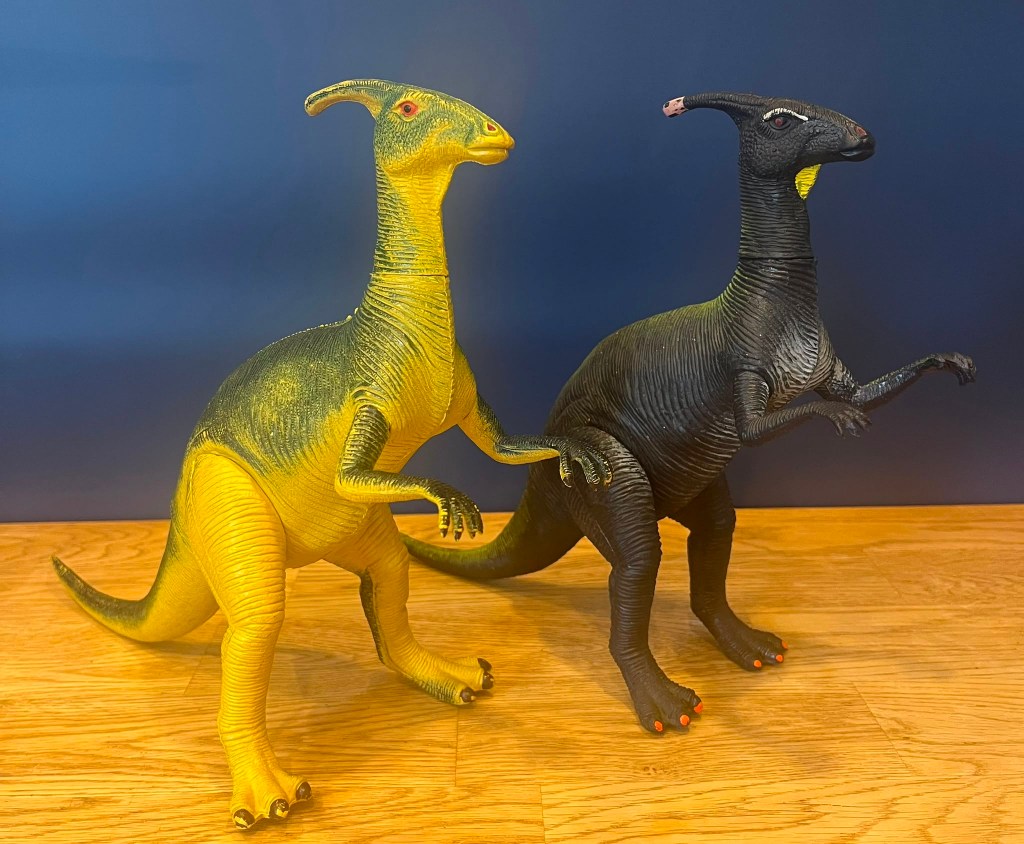
(Focus your attention on the model to the left of the first image; that on the right we shall discuss in a moment)
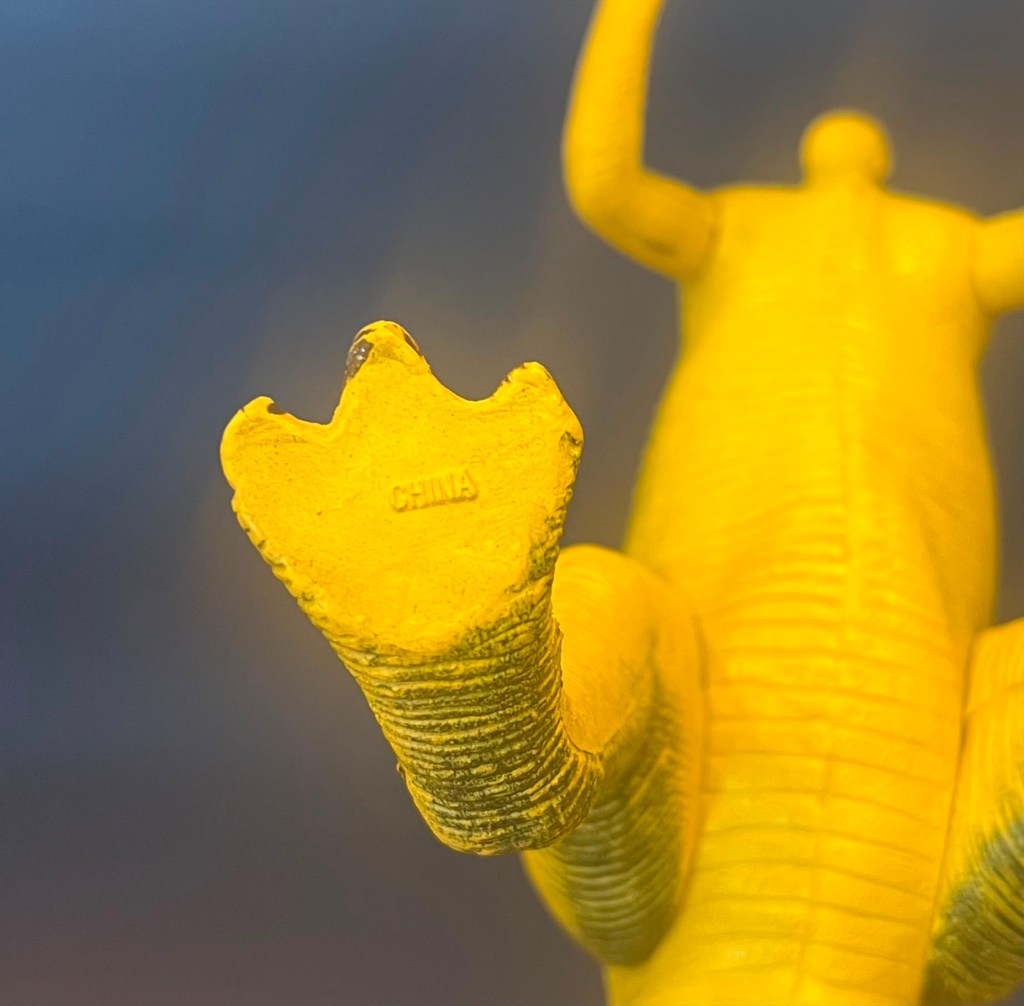
Let us begin with the Chinese-made original. It was produced in hard yellow plastic with green highlights, and has “CHINA” marked under its right foot. It stands about 245mm. tall, and weighs about 237g. The design of these closely follows a large Imperial model, about 220mm. (9 inches) tall, but the Imperial toy does not have articulated limbs or the prominent circular bulge that runs around the top of the hip joint parallel to the leg attachment (interestingly, this bulge is also found in large Dor Mei dinosaurs, such as the 1986 produced Brontosaurus). We do not know what anonymous Chinese company produced these adaptations of the Imperial Parasaurolophus, but we presume them to date to the 1980s, and we can be certain they were available in Poland (as well as other European countries) as the example in one of the author’s collections (KH) came from a Polish seller (along with two Polish bootleg dinosaurs).
Now to the second dinosaur, on the right of the image above:
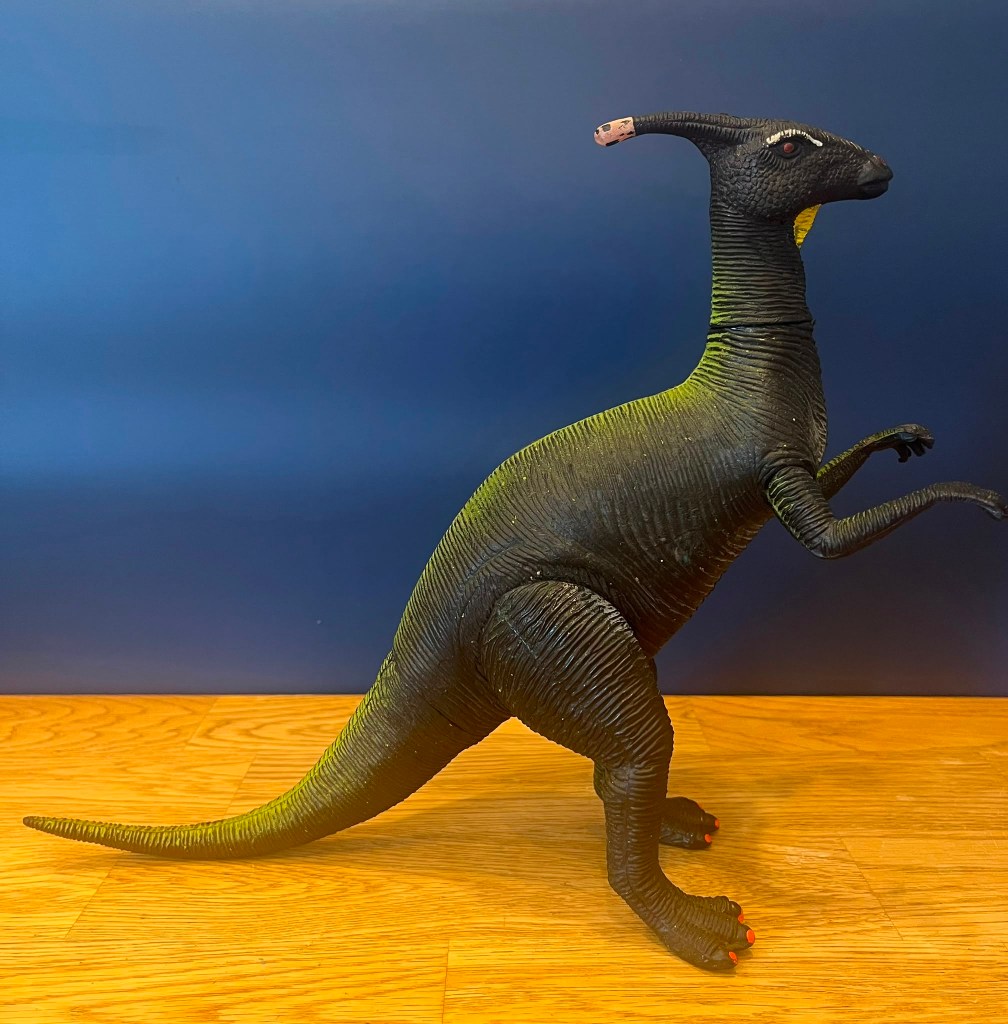
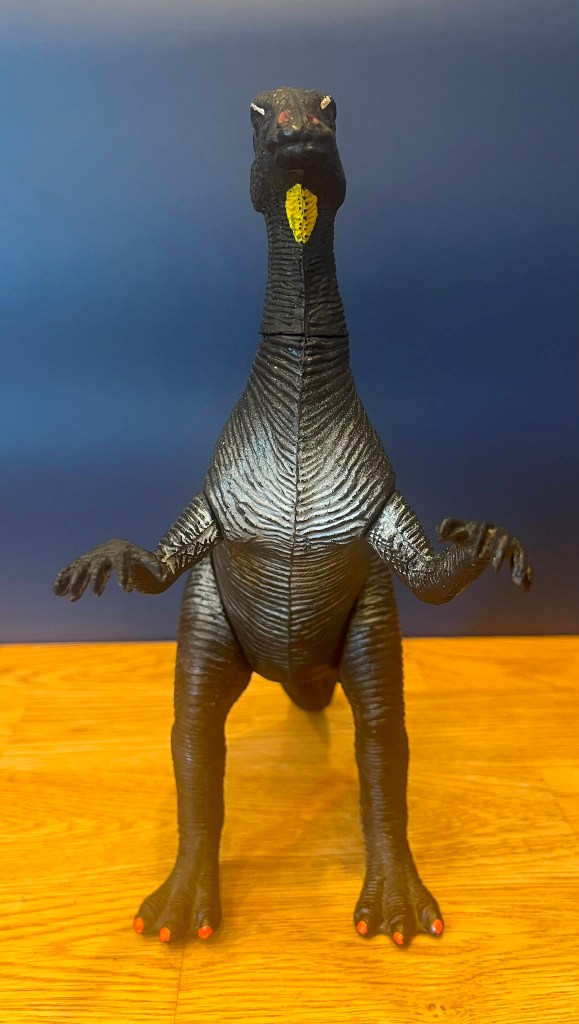
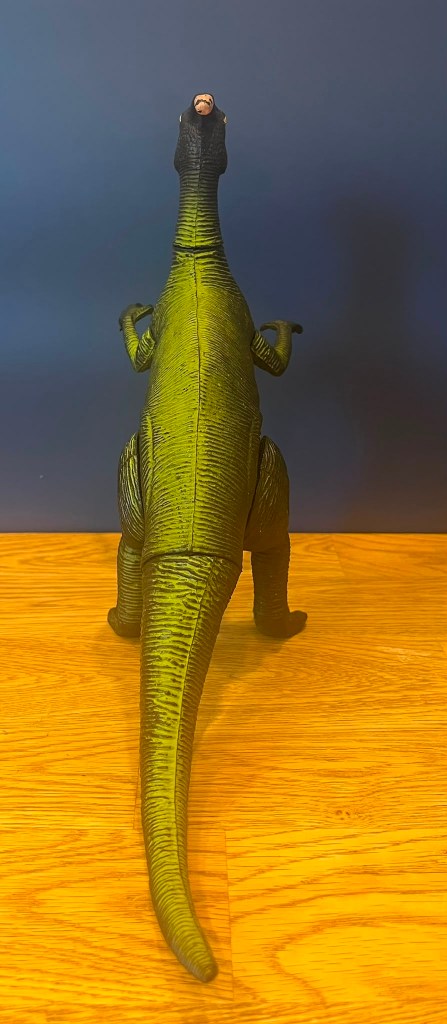
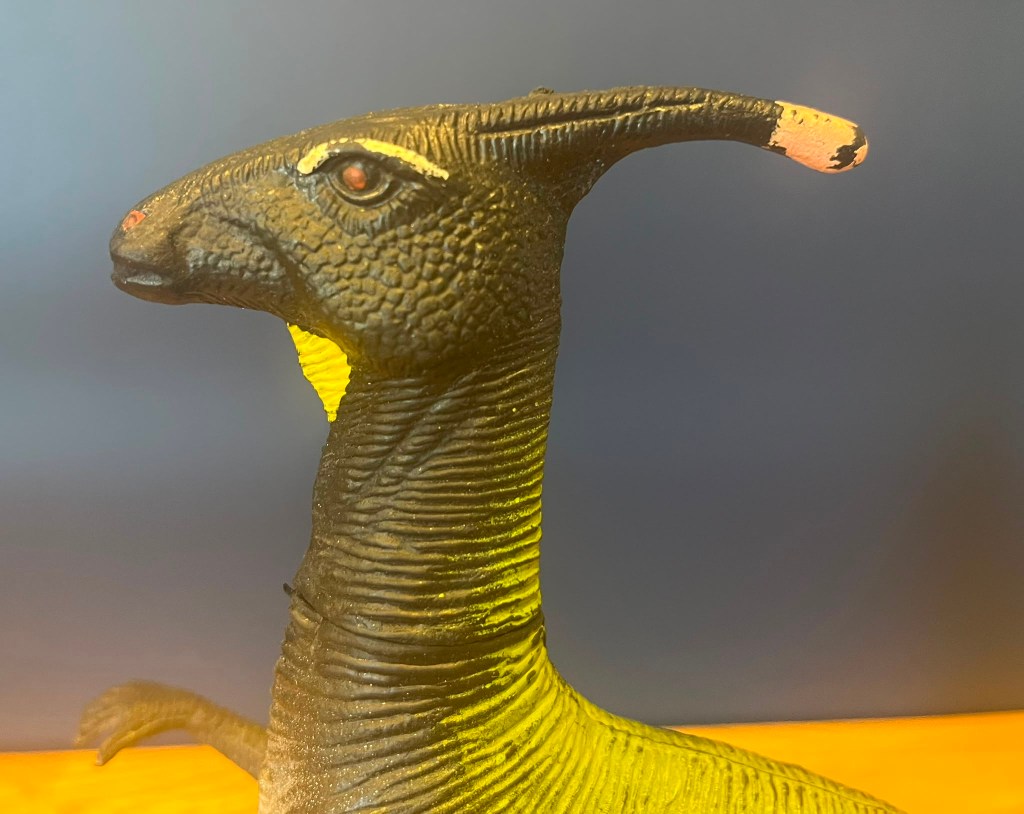
The design of the Chinese-made articulated Parasaurolophus was perfectly copied by a toy produced in black vulcanised rubber, which stands 240mm. tall and weighs about 240g, and is known to us in only two examples (one each in each of our collections):
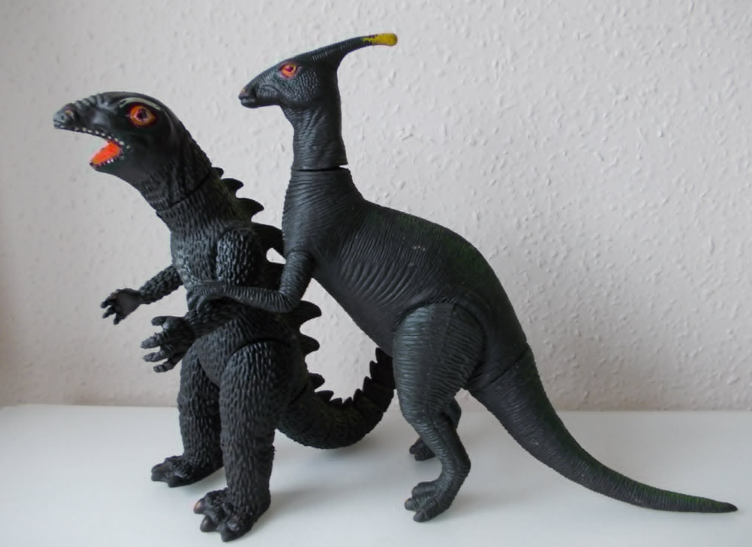
(Image of that in the collection of Jamie Francis’ permission, along with a shocked-looking black Polish ‘overbite’ Godzilla, presumably holding back the Godzilla from involvement in a pub fight, while shouting, “He’s not worth it, Steve!”)
Both examples known to us were obtained in Poland, and they were produced in identical wobbly black rubber to the large size Godzilla bootlegs and kaiju discussed in the previous post. They have the same small red details as those other figures, and in KH’s case single-line white eyebrows that are identical to the others. In fact, the only new details of the materials and paints used are the addition of two new colours to the decoration: pink and yellow. The Parasaurolophus owned by KH has red toenails (a nice touch, which makes him recall Bugs Bunny’s famous line while acting as hairdresser to the monster Gossamer: “My stars! If an inter-resting monster can’t have an inter-resting hairdo [and in our opinion here – inter-resting toenails to boot], then I don’t know what things are coming to” (see here) , and while Jamie’s has a small yellow wattle and a yellow tip to its horn, KH’s has the same yellow wattle as well as a soft pink tip to its head horn.
Direct comparison of the sizes of these Parasaurolophus toys makes it very likely that the black rubber one was cast from an existing example of the Chinese-made one, with the details of the former consistently about 5mm. smaller than the latter:
- Tip of horn to tip of nose: 85mm. on black rubber Parasaurolophus; 90mm. on Chinese;
- Base of foot to top of leg in middle: 120mm. on black rubber Parasaurolophus; 125mm. on Chinese;
- Height of head and neck upwards along middle line: 55mm. on black rubber Parasaurolophus; 60mm. on Chinese.
This shrinkage is a common side effect of casting from an existing toy, rather than reusing the original molds, as when the parts of the existing toy are cast to produce a new mold-master there is slight shrinkage of the product (usually in wax) during the cooling process. That slight loss is added to once a final metal mold has been created from the mold-master (most probably by the lost-wax method), as the products of that mold will have the original shrinkage of the mold-master as well as the shrinkage of their own products in the final toy part produced.
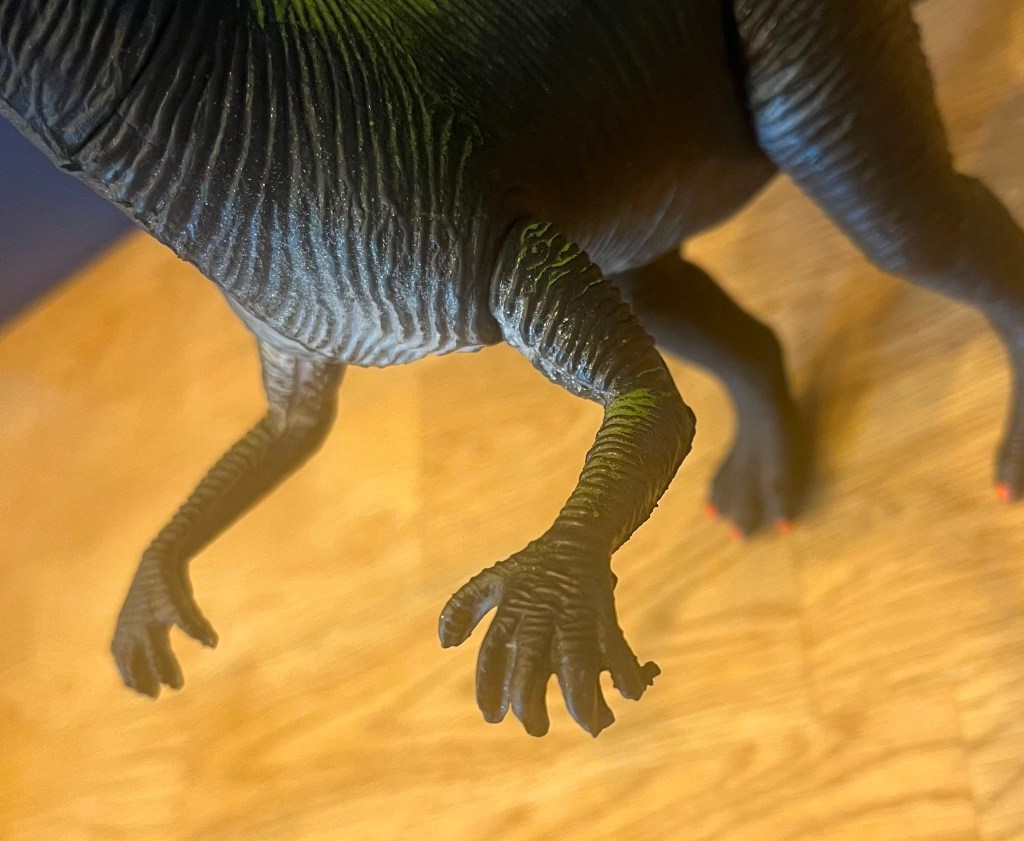
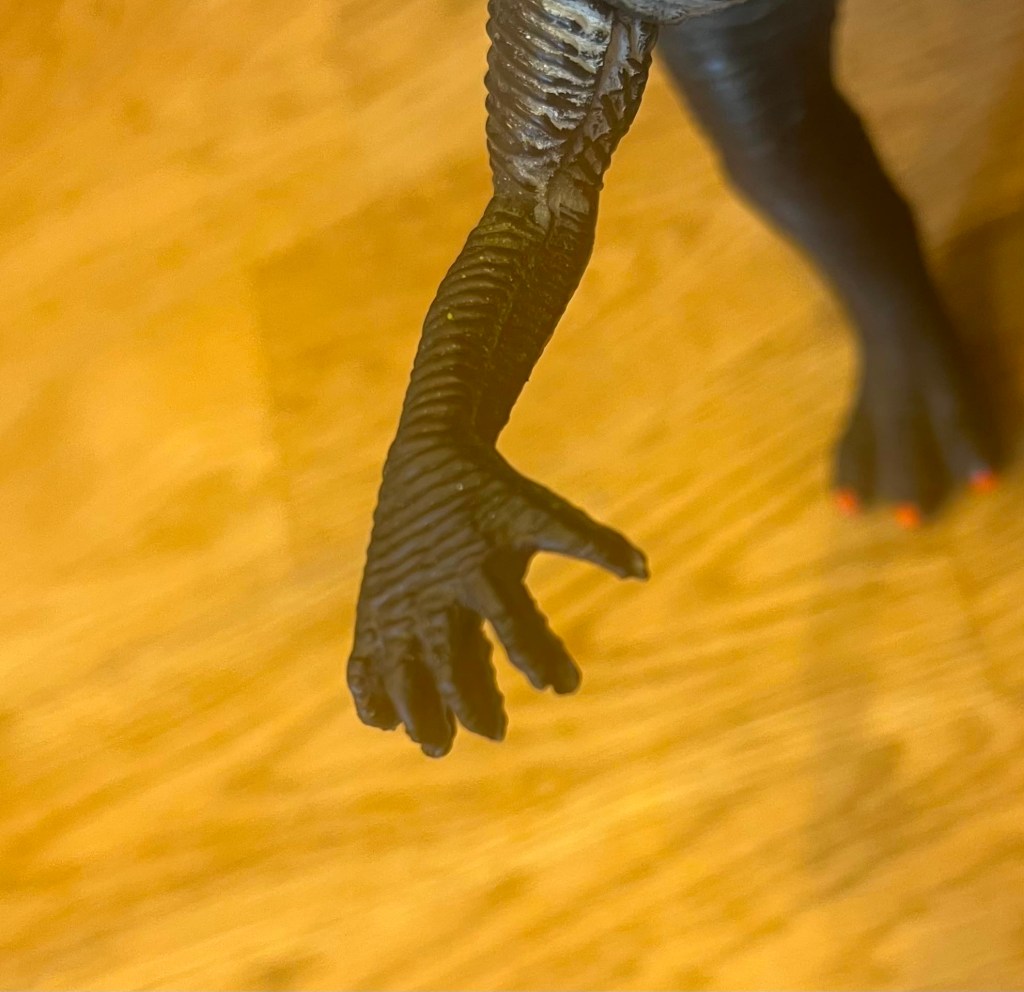
We can also see in the raggedy and partially lost fingers of these dinosaurs, that there was a significant loss of fine detail in this casting from an original Chinese-made toy.
Finally, the likelihood that these were the products of the same workshop to produce the Godzilla and kaiju bootlegs discussed in the previous post, increases when we turn to consider the only other one we know of from this group:
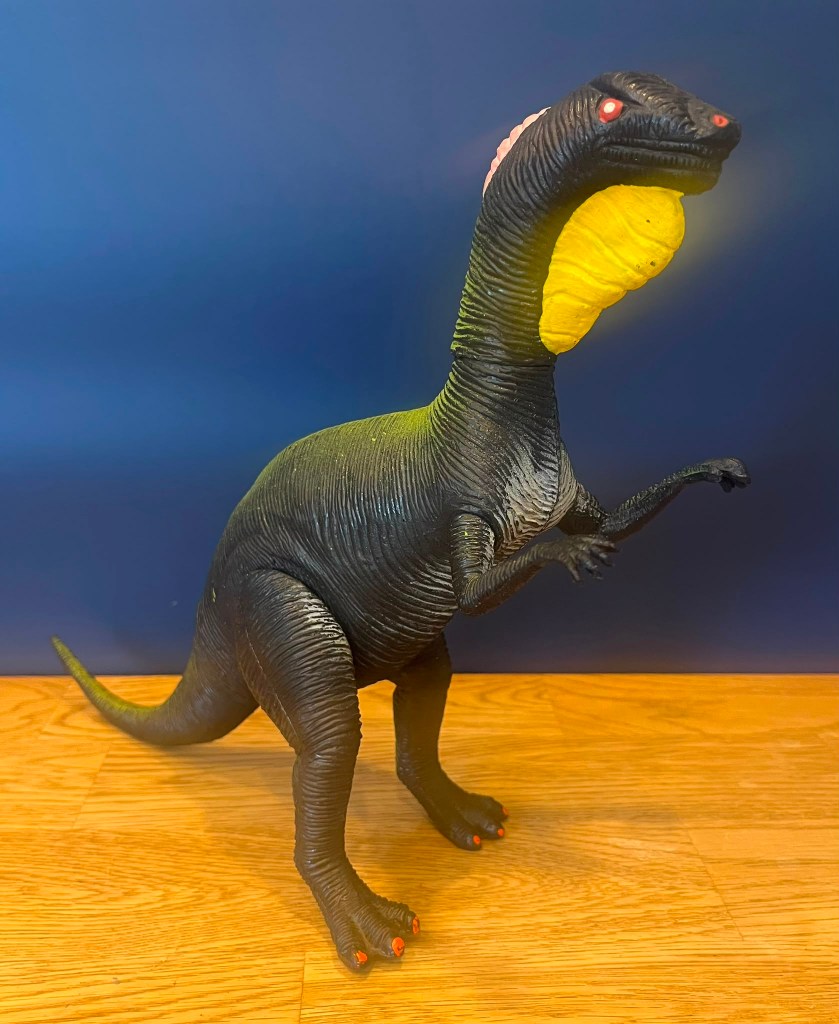
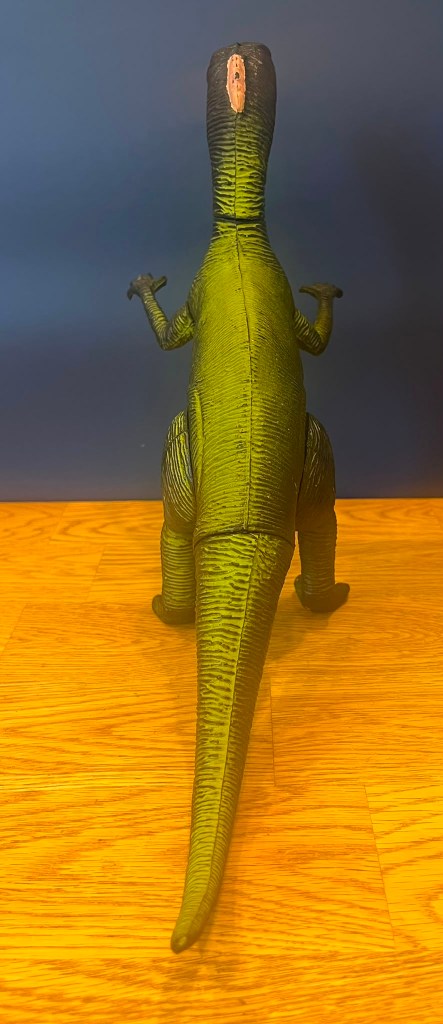
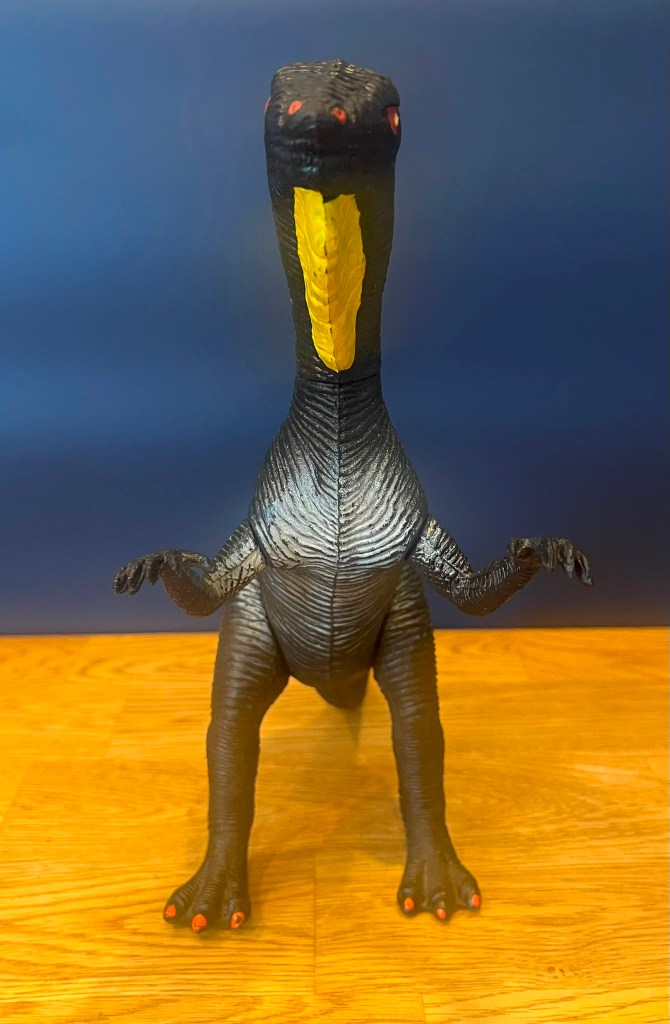
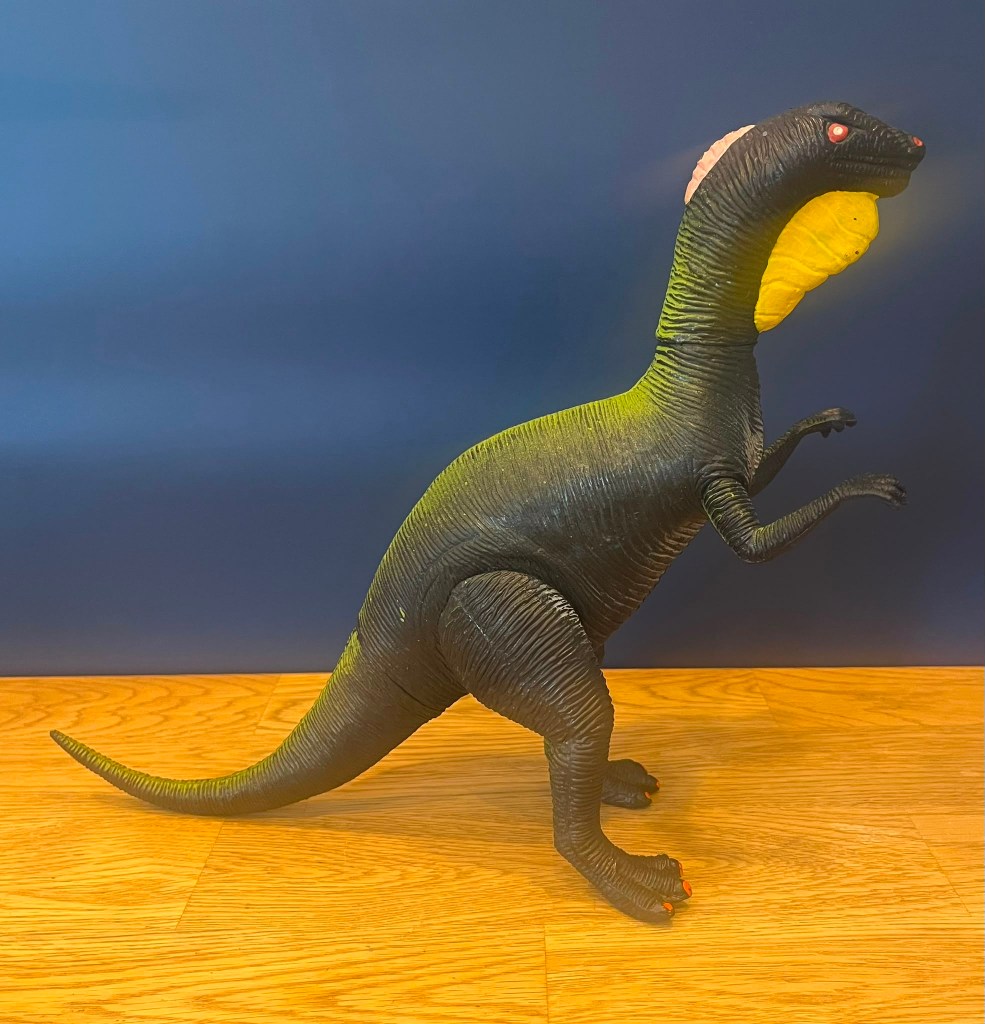
This magnificently inaccurate beast is in the collection of KH, and again was acquired in Poland. It stands 245mm. tall, and weighs 258g., and has the same body as the Parasaurolophus described above, but exactly as with the modus operandi of the Polish Godzilla bootlegs (that is: perfectly copy the Chinese-made ‘sharkzilla’, then remove the head and add others to diversify the line with fantastical kaiju), its head has been swapped for an extravagantly designed new one, following no previously existing dinosaur design known to us. The new head is loosely based on a common dino-design, but has wild staring eyes picked out in red with white dots, and a small pink frill on the back of its neck (very ’80s hairdo) as well as a large yellow wattle under its throat.
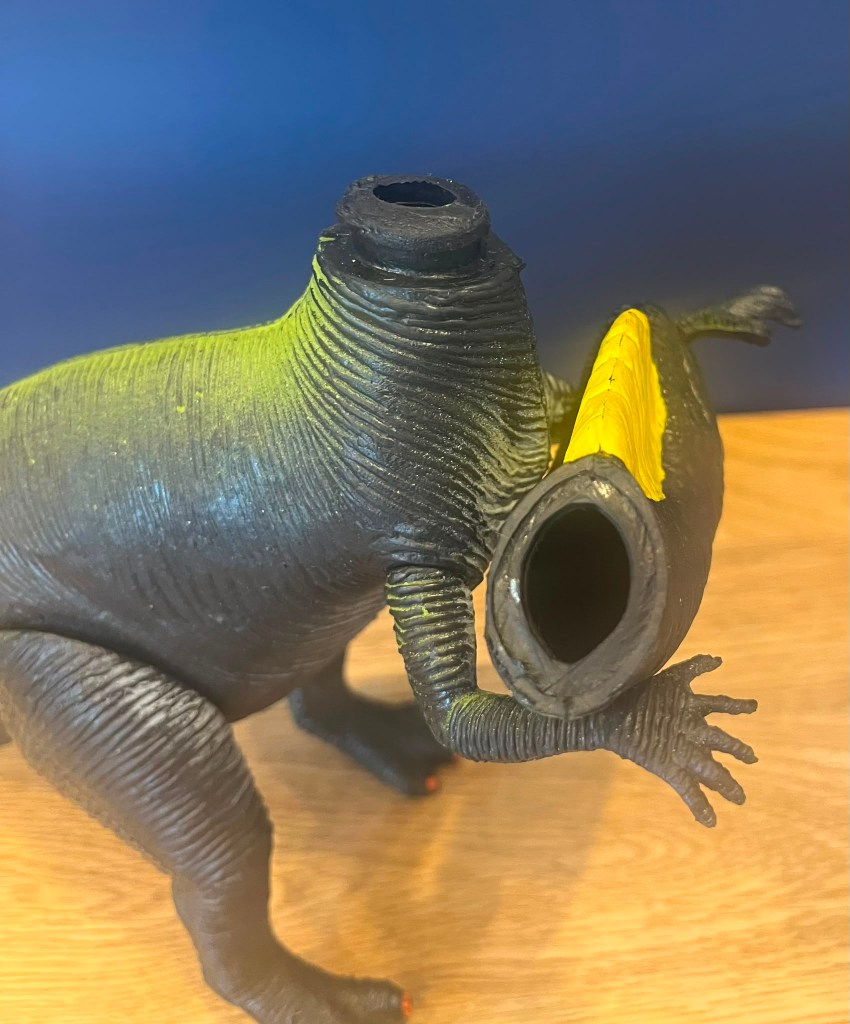
Luckily, the rubber of this one is not so perished that it has become fragile, and the head can be removed to show the internal colour (same as outside), and the method by which these heads attach to the bodies.
We do not think these two are all that survive of this line of larger dinosaur bootlegs, and we dearly hope a reader will get in contact with details of others.
⁂
The Chorzów ‘Polskasaurs’:
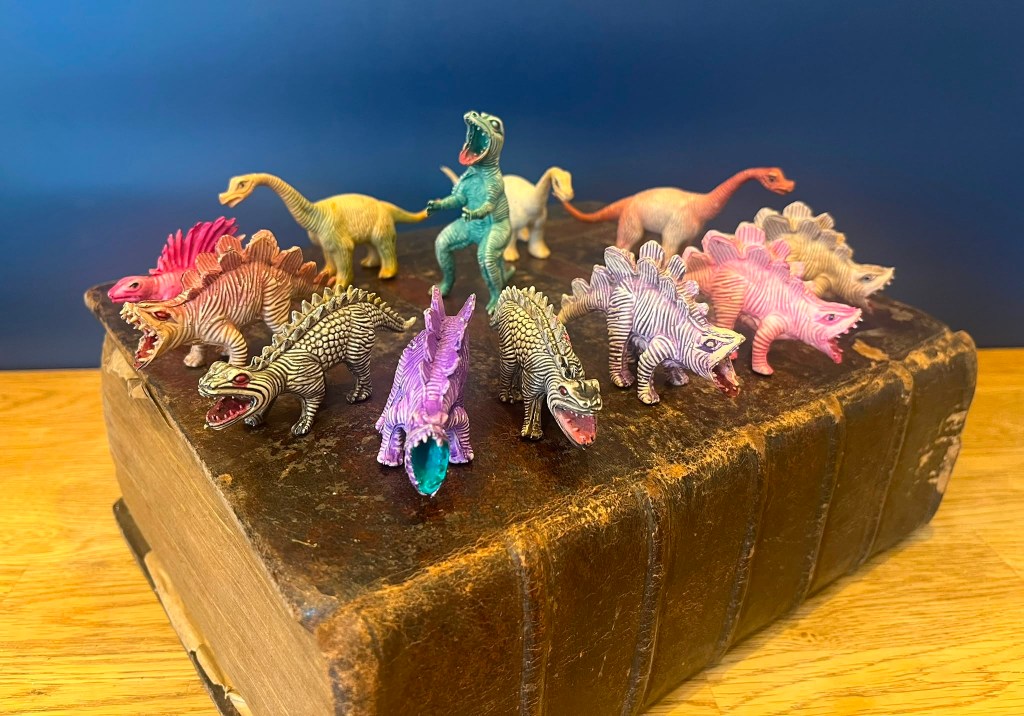
These again would appear to be another new discovery. Another, completely unrelated, group of Polish-made mini dinosaurs, all copies of Chinasaurs, appears to have co-existed with those above. These focus (for their distribution at least) on an amusement park in Chorzów, on the outskirts of Katowice in southern Poland. One of us (KH) had peered at images of these for some time, when they would very occasionally appear in large collections of cheap dinosaurs for sale with Polish vendors, wondering if these might be Polish in origin, until the other (Jamie Francis) recently stumbled over the image below posted by an Instagram user named ‘rolka_wspomnien’ on 27 May 2022 (see here). That post was our ‘Eureka moment’ for these wonderful little ‘Polskasaurs’ (if Chinasaurs is now an accepted term, then we guess that one works as well).
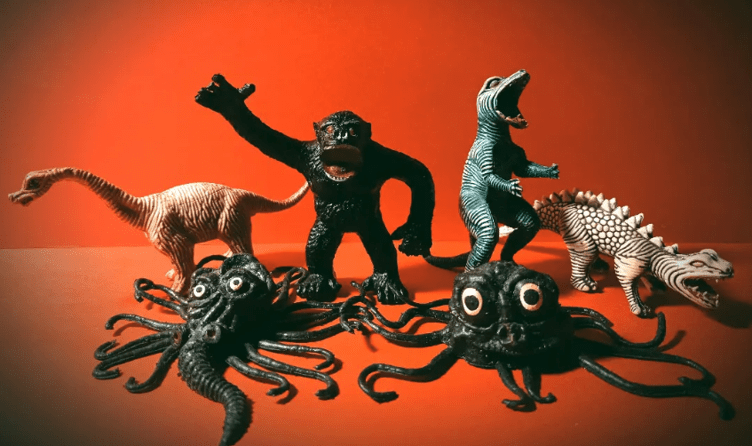
(The image posted to Instagram by ‘rolka_wspomnien’; reproduced here with their permission)
There, ‘rolka_wspomnien’ recalled buying these at an amusement park in Chorzów in 1991. The Chorzów amusement park (originally called Śląskie Wesołe Miasteczko, and now rebranded as Legendia) was the oldest one in Poland. It opened in September 1959, and for a long time was the largest and most popular, with 63 rides in 1960, and an average footfall of 6000 people on weekdays and 50,000 on holidays (see here):
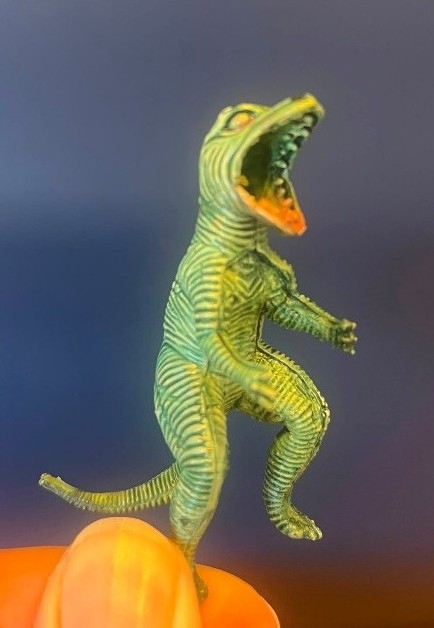
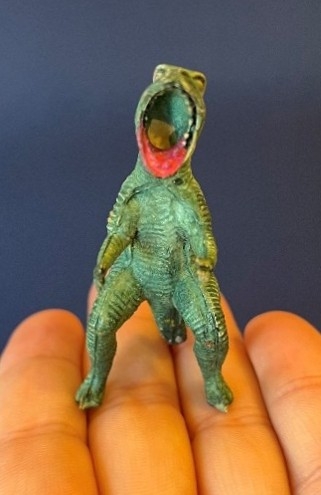
Eagle-eyed-readers will have seen this green bipedal dinosaur (a screaming Tyrannosaurus rex? – perhaps screaming due to his significant deviations from the accepted reconstructions of the dinosaur) proudly front and centre in the lead image of the previous post on Polish bootleg Godzillas and kaiju. Like that ‘green screamer’, the others here have all been purchased in Poland, and pleasingly, the majority of these have been from sellers within half an hour’s drive of Chorzów.
The total set of five Polskasaurs known to us, are:

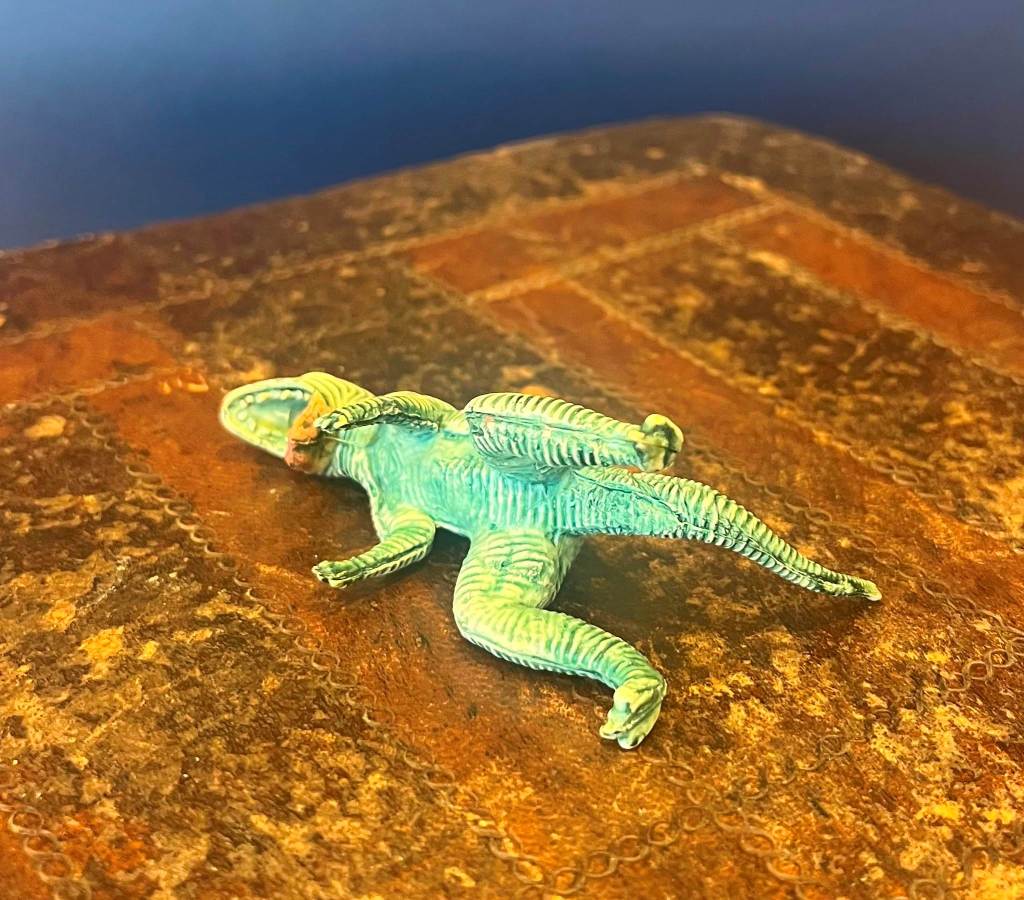
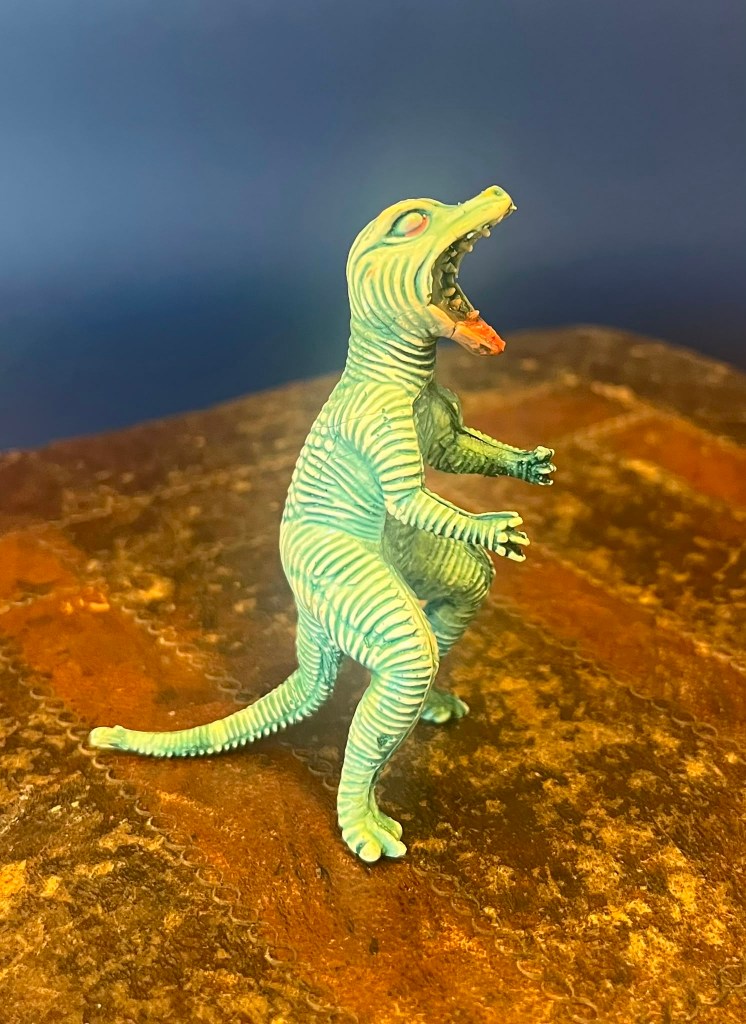
1. the green screaming Tyrannosaurus rex(?) figure, measuring 73 by 55mm., and weighing 13g.;
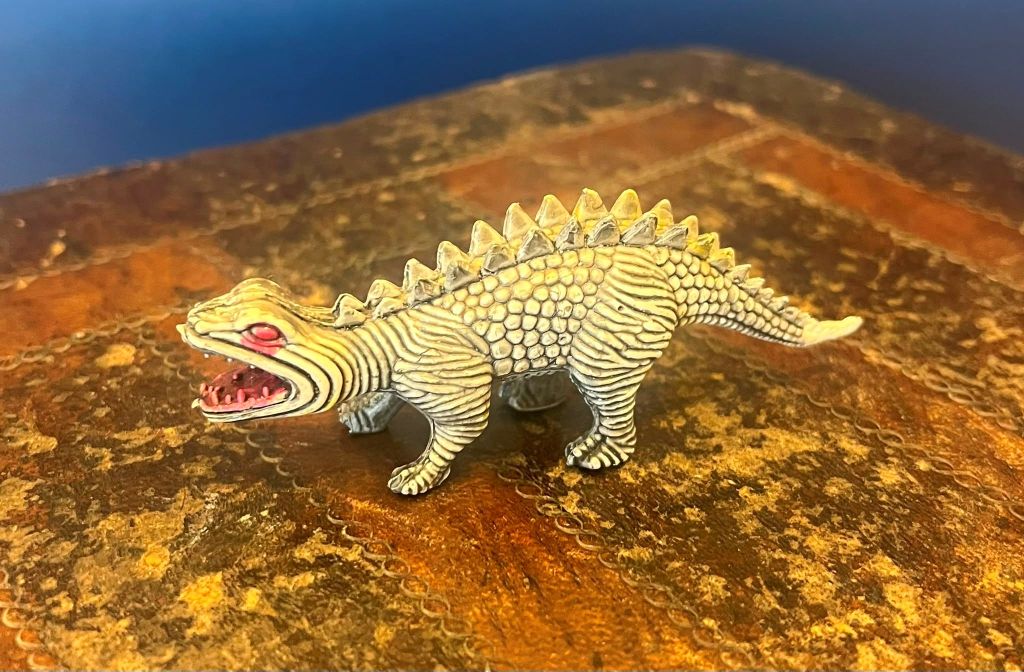
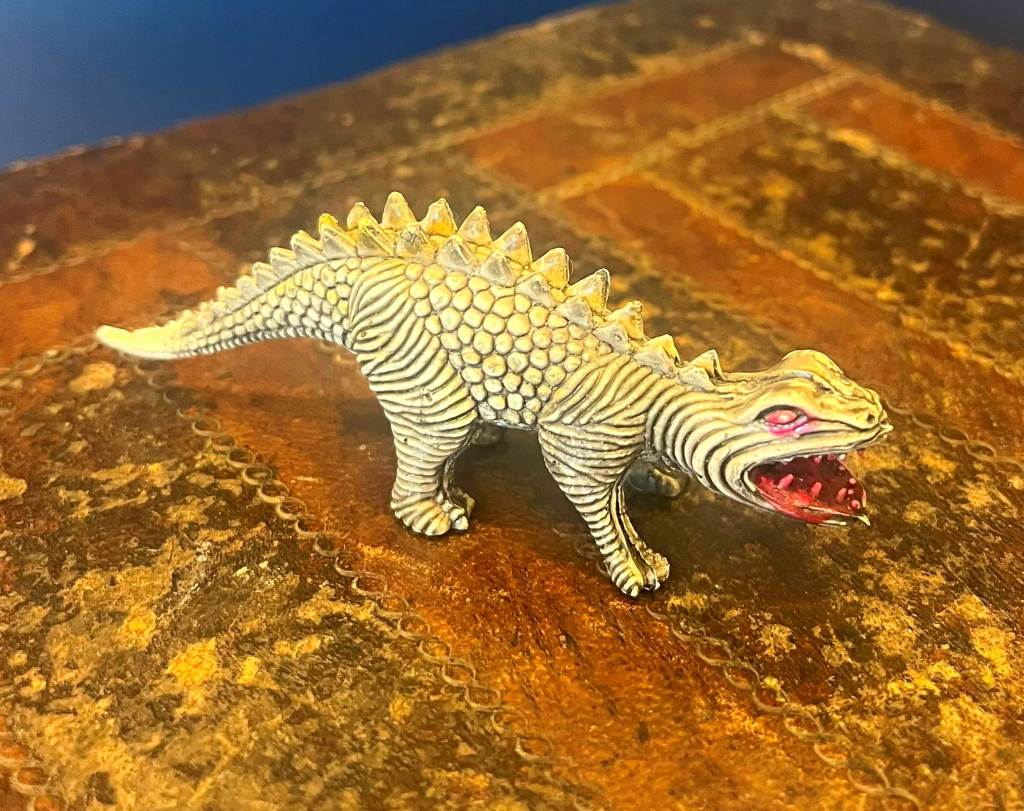
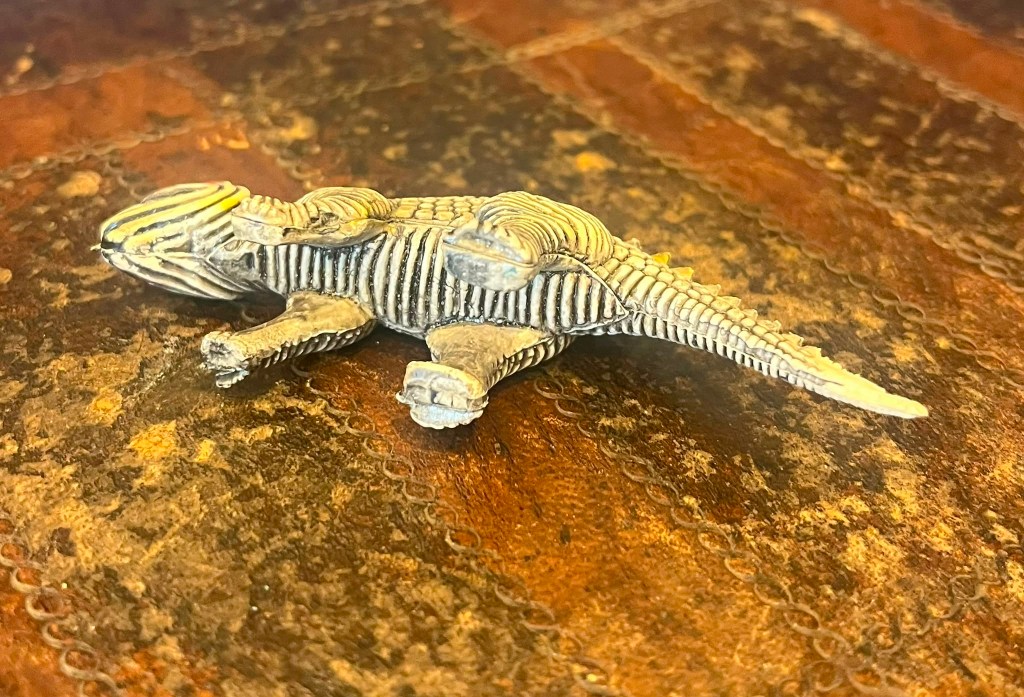
2. a spiky-finned quadrupedal dinosaur figure, measuring 88 by 32mm., and weighing 13g.;

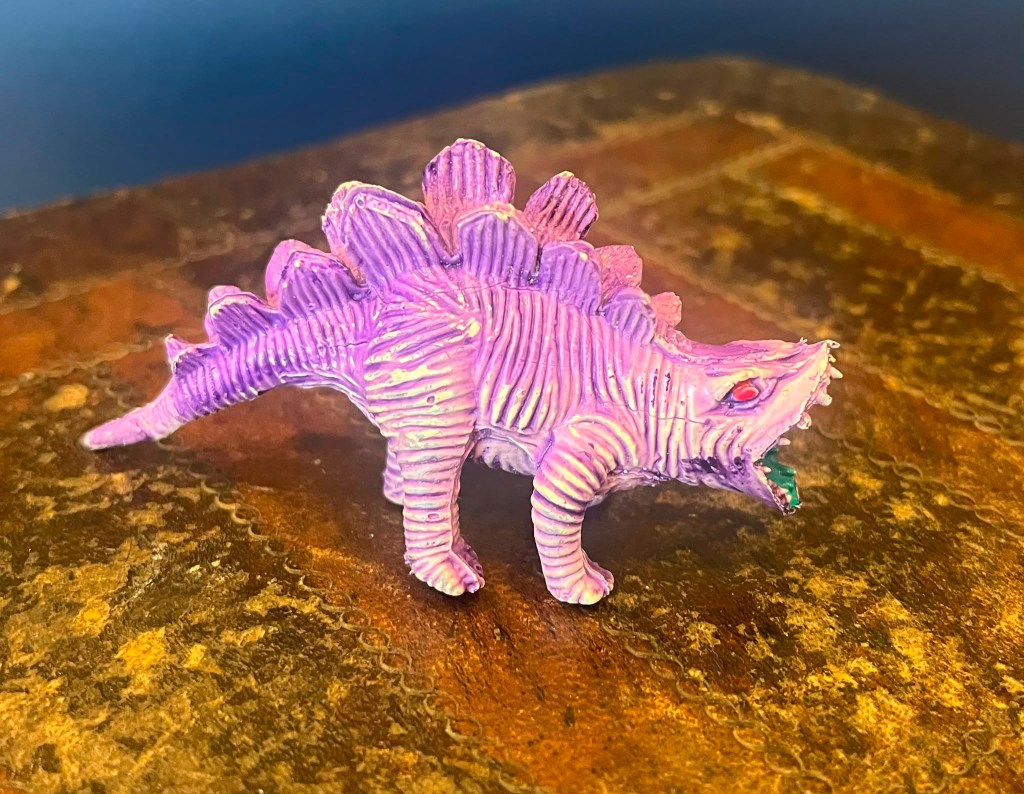
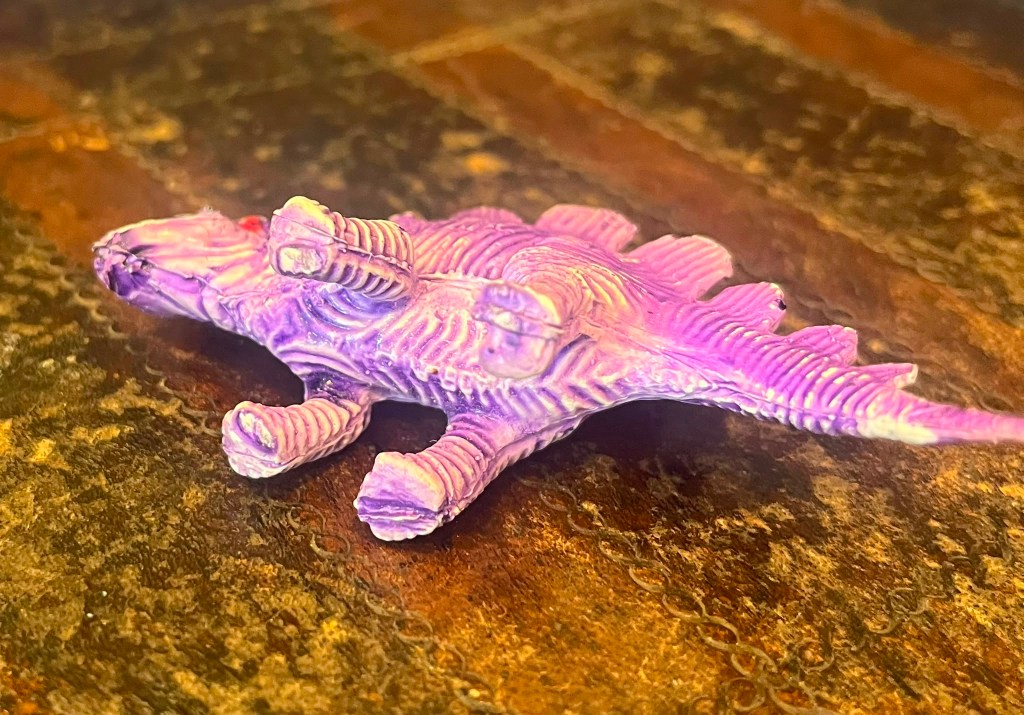
3. a stegosaurus figure, measuring 90 by 42mm., and weighing 14g.;
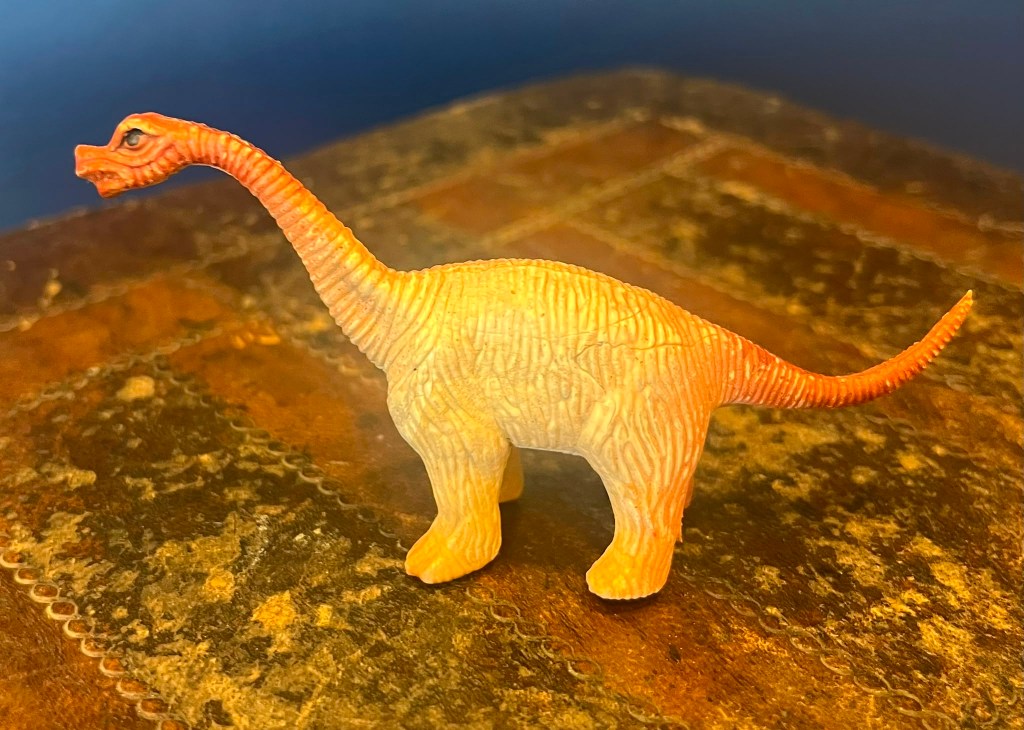
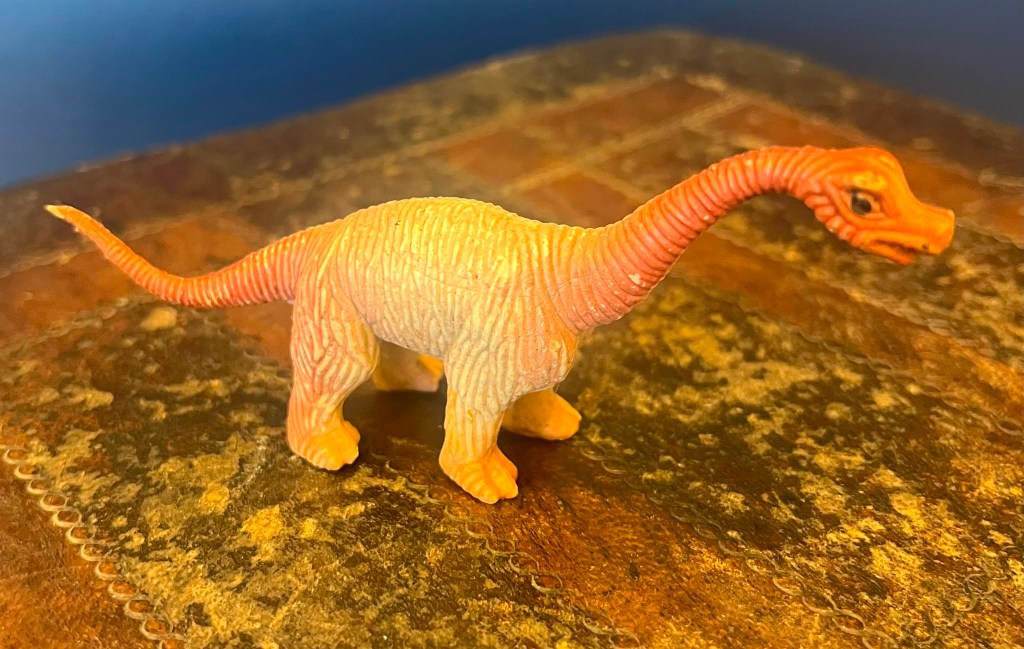
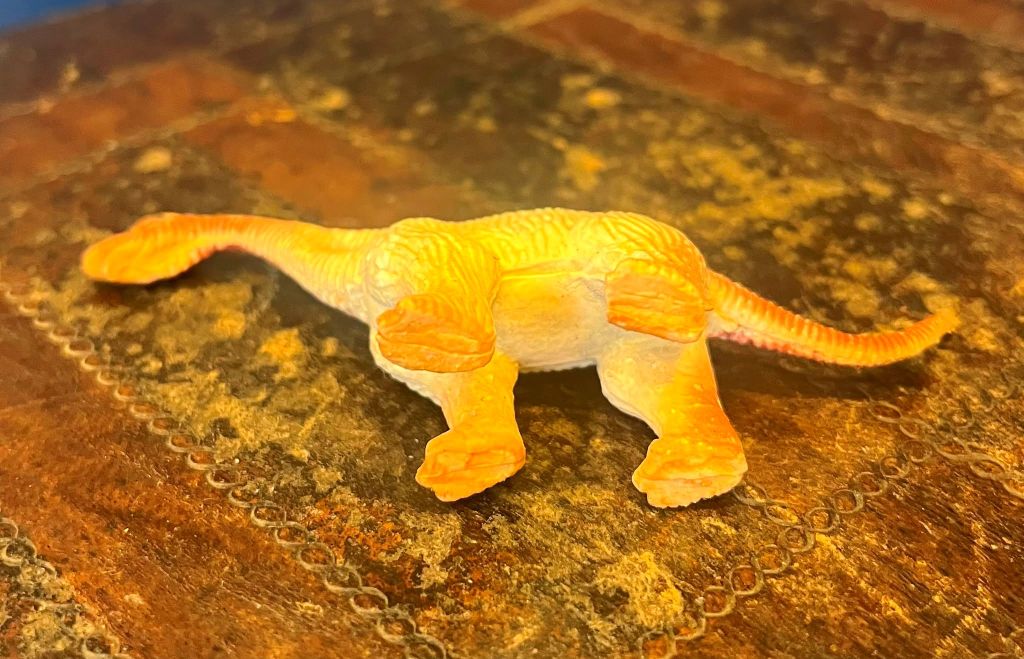
4. a sauropod figure, measuring 95 by 47mm., and weighing 14g;
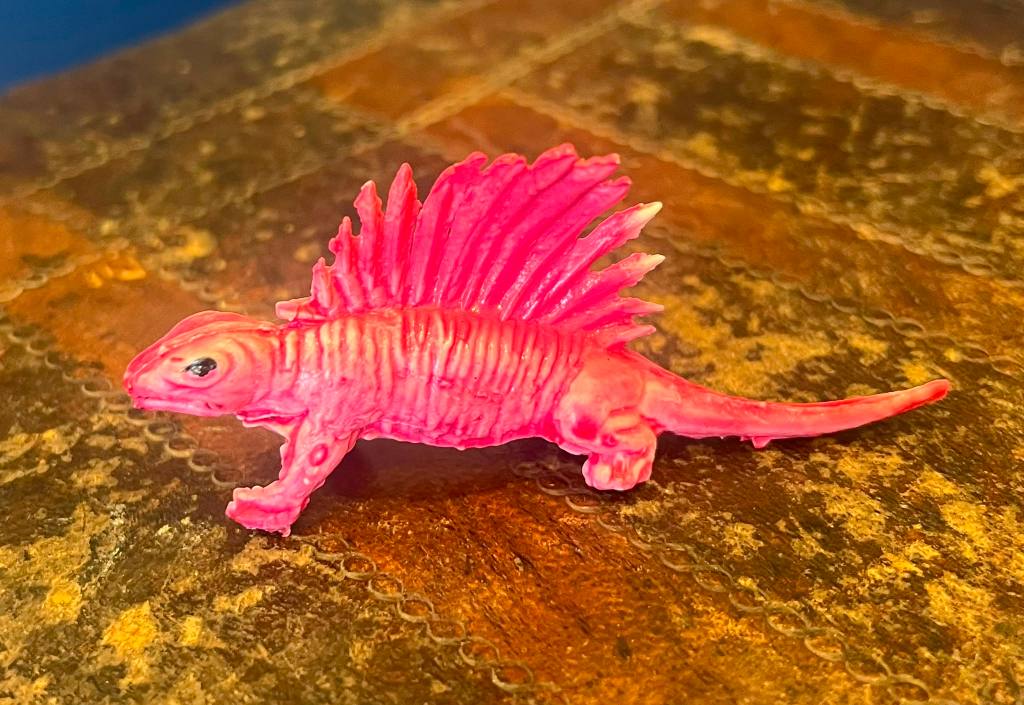
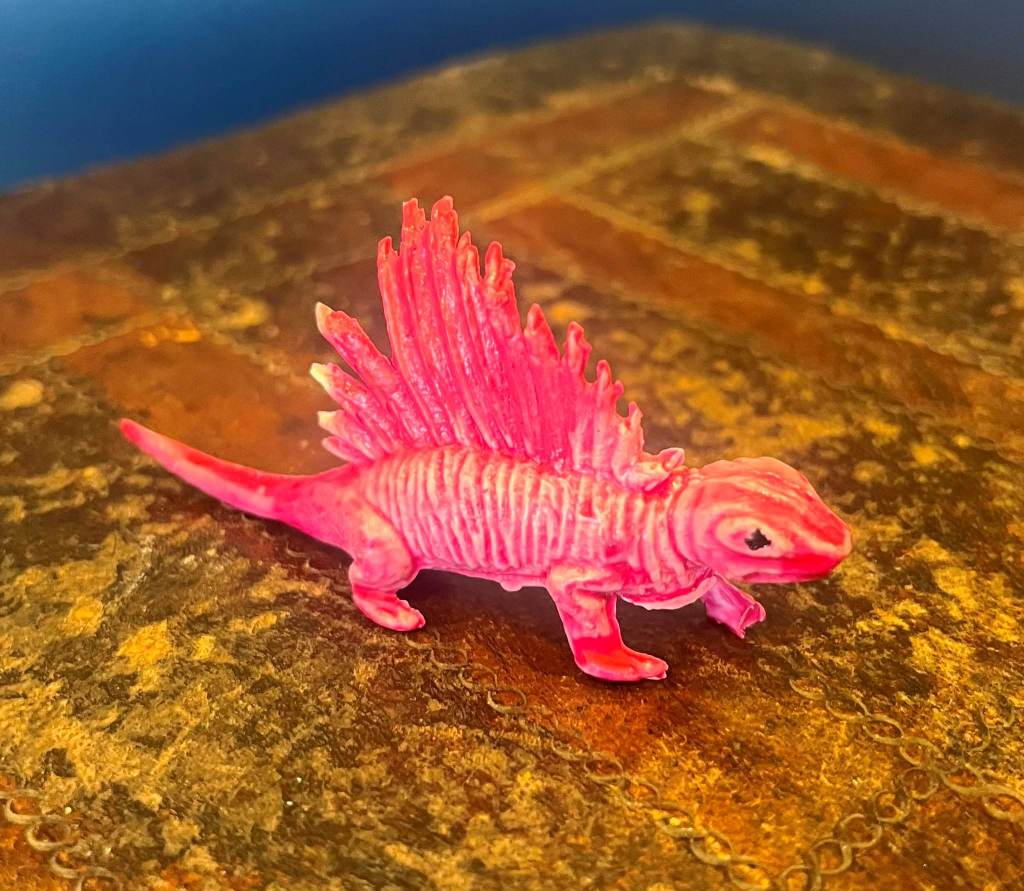
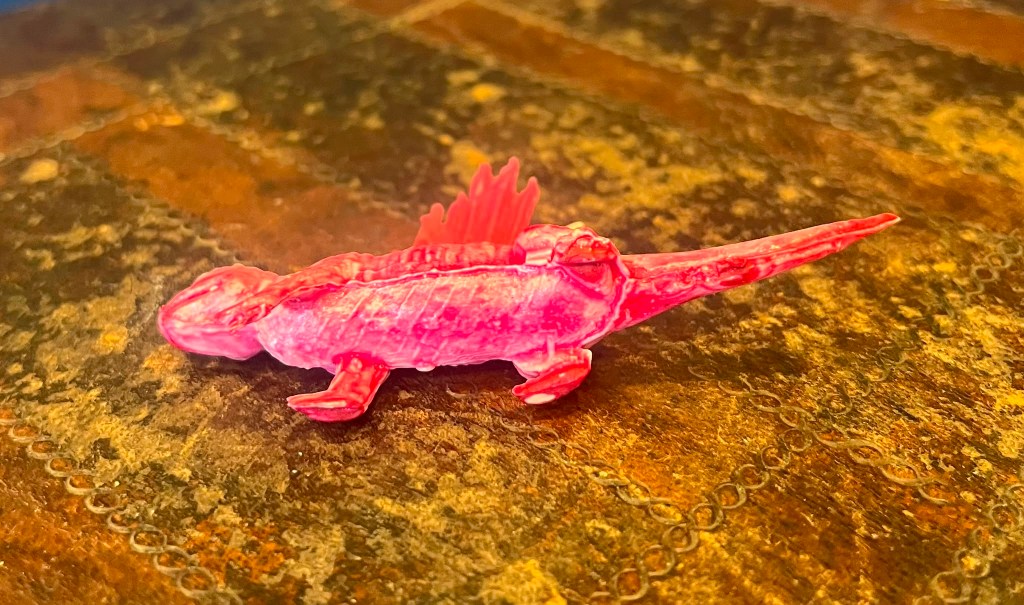
and 5. a smaller pink Dimetrodon, measuring 76 by 37mm., and weighing 7g. This figure is smaller than the others, but was produced in the same rubber and decorated in similar pink paint, and as it came to one of us (KH) with a handful of the other ones, it is likely to be from the same series.
We would, of course, be delighted to learn of any others.
All are copied from common rubber Chinasaurs, and their differences from those are really only apparent when one compares them to the originals:
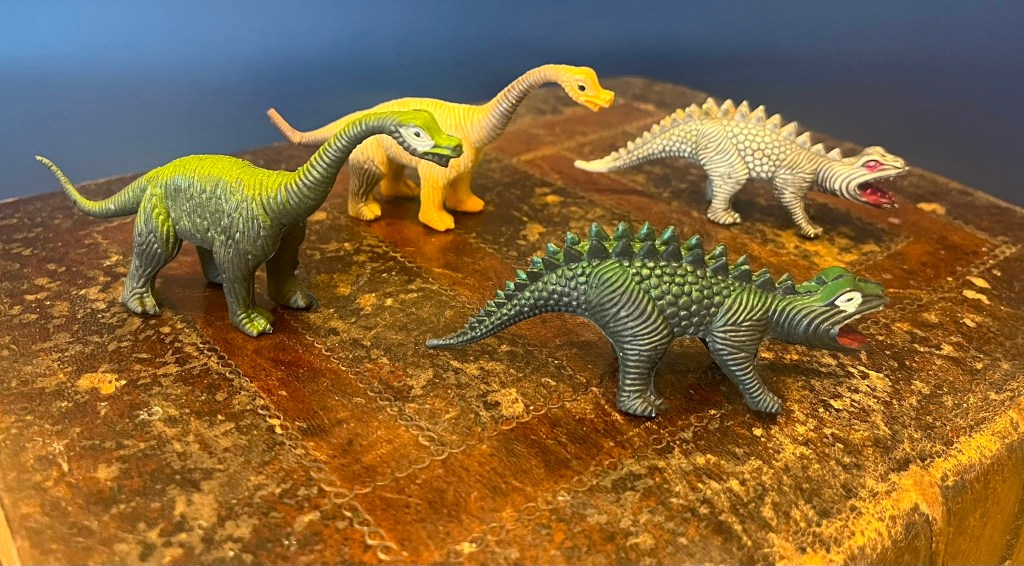
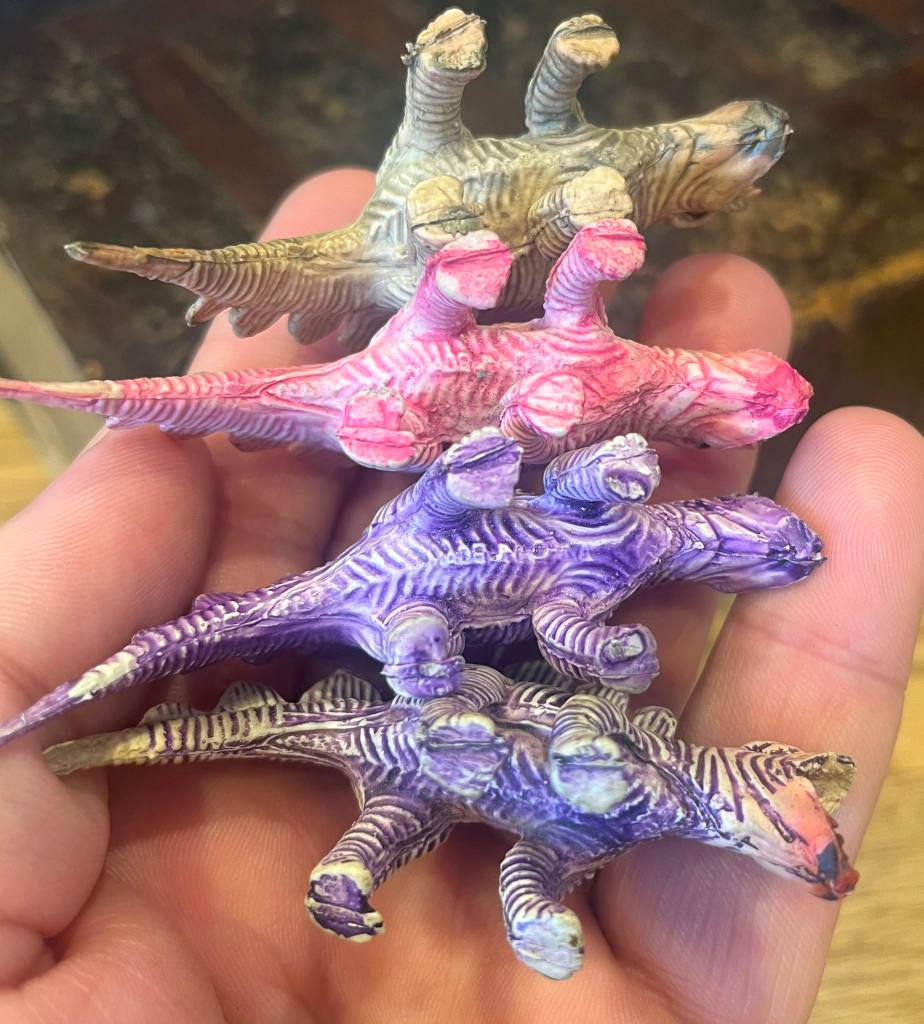
(Chinese-made ones in front, with probable Polish-made ones behind)
Whereas the Chinasaurs were produced in carefully sourced rubber in the main base colour, with only small details then added in paint, these Polskasaurs are all made from a light flesh-coloured rubber, which has been overpainted with a paint that sticks poorly to the rubber, and tends to settle in the folds of the body giving them a ridged or wrinkled appearance.
When examined in detail, the painting is especially revealing, and areas such as the inside of the throat are often left unpainted, and somewhat bizarre colours are used for details such as the inside of the mouth (see the green used in the mouth of the purple stegosaurus shown above in our list of models in this line) – these features, of course, are never found in Chinese manufactured items.
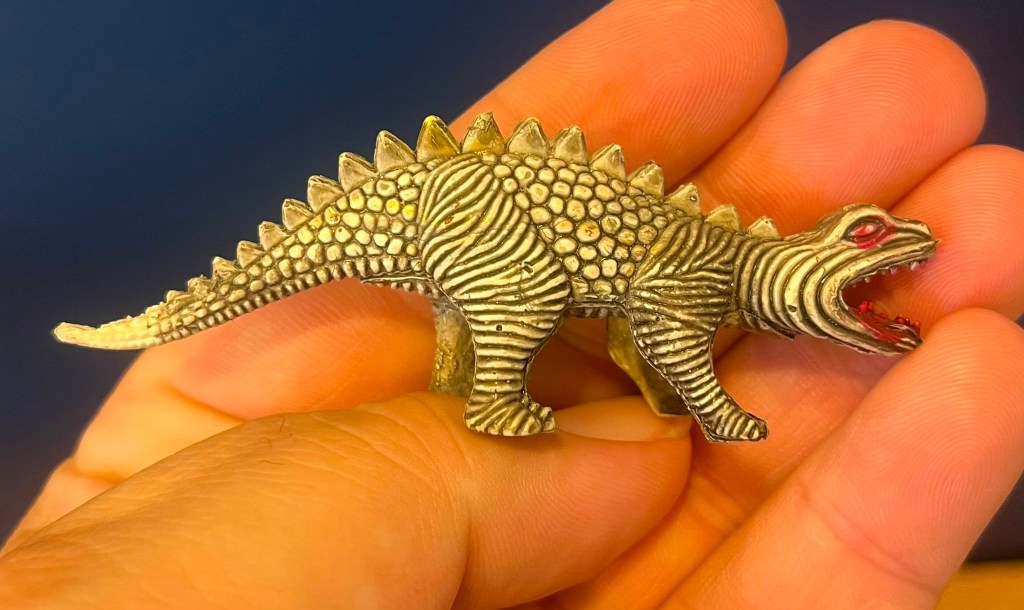
Moreover, a few clues survive as to the somewhat amateur nature of their decoration, such as the tip of the tail of the quadrupedal dinosaur shown above which remains unpainted – presumably as this is where it was held when dipped into the paint. Again, this is wholly uncharacteristic of Chinese produced toy dinosaurs.
Often we find scratches and erased areas on the undersides of the Polskasaurs, where the “Made in China” mark sits on the belly of the Chinasaurs:
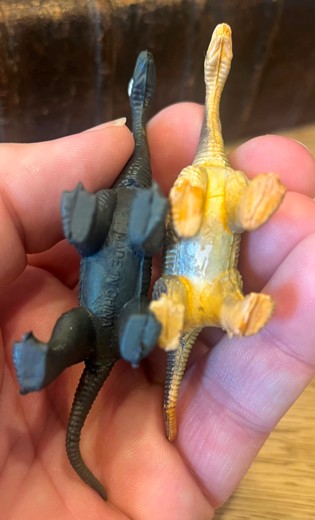
However, in one case – that of the Stegosaurus – the “Made in China” partly survives on the underside of all examples known to us, but in a poorly stamped and ‘smudged’ version, suggesting again this is the accidental result of a local bootleg casting of the Chinese-made dinosaur.
The evidence would all appear to point towards a southern Polish origin for these copies of Chinasaurs, and that they were sold in the vicinity of Chorzów in the early 1990s (and probably the 1980s as well), perhaps primarily through the amusement park.
With all that said, these are sweet little things, of remarkably simple design and execution. In addition, when the context of their probable origin is known, they have real charm as witnesses to the wonderful efficiency of toy production in Poland in the Communist era and immediate post-Communist era. Each of the authors here has a set of these, and they would have to be pried from our cold, dead hands, before we would give them up.
⁂
One more example might be included here, perhaps pointing to another, as yet, undiscovered Polish dinosaur toy line. The sole example we know of this is presently on its way to us, and we will add more details when it arrives. Until then, we note that it is a small model of Moschops (a heavy set dinocephalian synapsid, a mammal-like reptile that lived during the Middle Permian period). An Instagram user, named ‘rylengy’ kindly informs us that it was most likely cast from a Tootsie Toy Moschops.
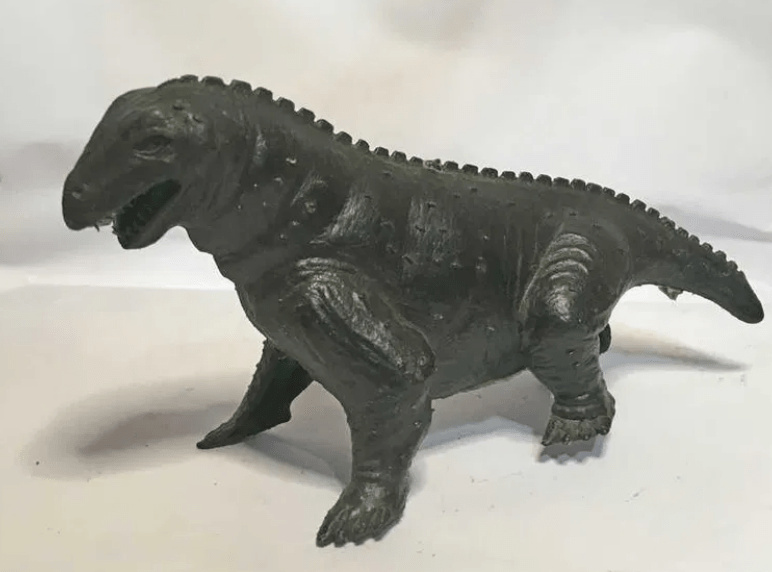
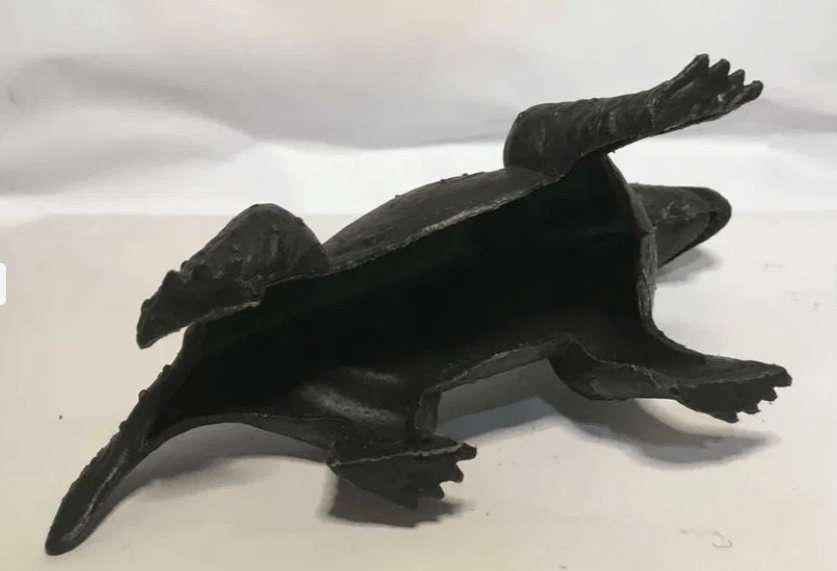
No other example in black plastic has been traced by us, and so we tentatively suspect that this is a Polish bootleg, perhaps with others in the same black plastic toy-line waiting to be discovered.
⁂ ⁂ ⁂
Concluding remarks:
Overwhelmingly, research into Polish toy-bootlegging has focused on Star Wars and MOTU figures to the exclusion of all other lines, but when one starts to examine the toy dinosaurs probably produced in Poland during the Communist era or immediately after its collapse, exciting discoveries are made almost as soon as you start looking. In fact, while Poland was the equal to Spain in the frequency of its toy-bootlegging and the delightful artistry of the toys produced, it is still a wide open and unexplored vista of virgin territory – just waiting for the right curious minds to pick up the relics of the PRL and ask the right questions. We hope this post will inspire others to experience some of the magnificence of Polish bootlegged toys just a little off the more-heavily beaten tracks of the Star Wars and MOTU lines.
KH & JF
- 'MUTTON DRESSED AS LAMB': Godzillas and kaiju that look vintage, but are not
- American made Pachi
- BOOTLEG DINOSAURS – a little off topic, but sometimes needed here
- BOOTLEG GODZILLAS
- Bootleg Tokusatsu from China and its immediate neighbours
- Bootleg Tokusatsu from the Americas
- BOOTLEG TOKUSATSU HEROES
- Central Europe – Godzillas and kaiju from behind the Iron Curtain
- Chinese-region bootleg Godzillas -the plastic tide from the East
- Chinese-region made Pachi
- European made Pachi
- European-made Godzillas
- PACHI
- Pachi kaiju
- Pachi kongs
- Pachi superheroes – Ultraman and similar
- The Americas – bootleg Godzillas from the New World

 Confessions of a Kaiju Hunter
Leave a comment