I accept that on the reading front, the world and I have diverged onto increasingly different paths – and if Melville or Tolkien wrote today they would be under pressure to get their point across in under 140 characters or in some earworm dance segment that reveals the author in his underwear in the last few seconds (of course, I’m not comparing my own meagre efforts to those literary behemoths, but they can be occasionally accused of being a touch long-winded – also try not to think about Melville or Tolkien in their underwear). That is why, for the sake of my less detail-obsessed readers who might not need to examine and understand every aspect of something (how do you people sleep at night?), I try to throw in a quick and relatively straightforward post now and then. This is one of those (I can imagine your collective sigh of relief).
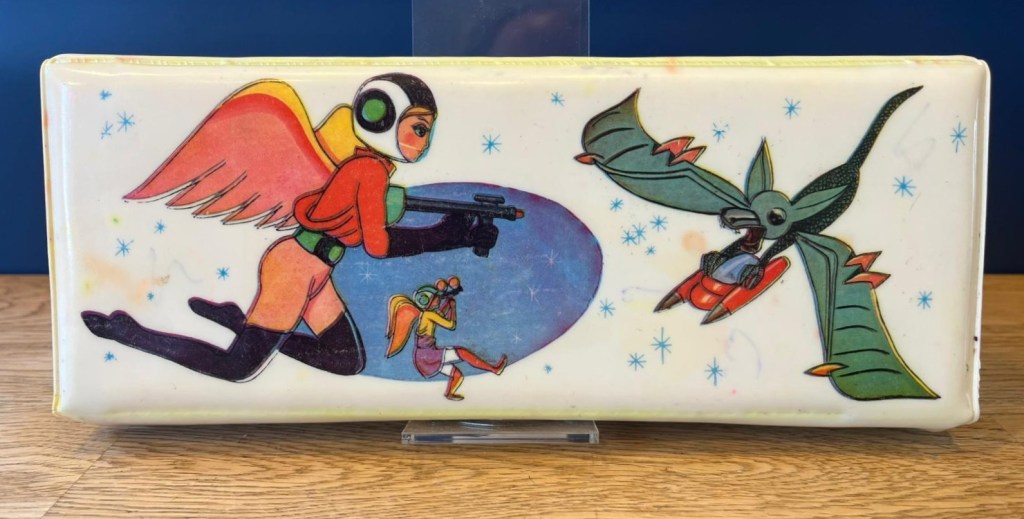
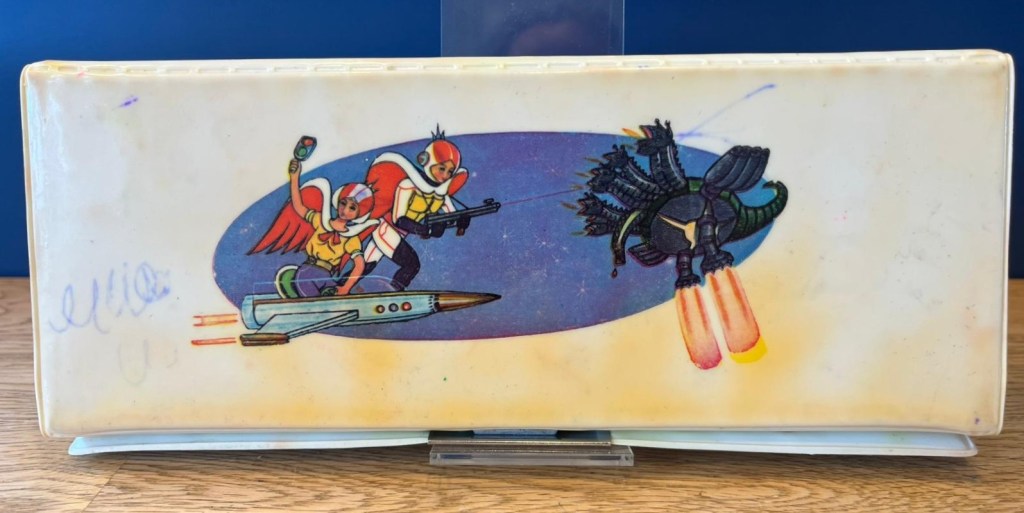
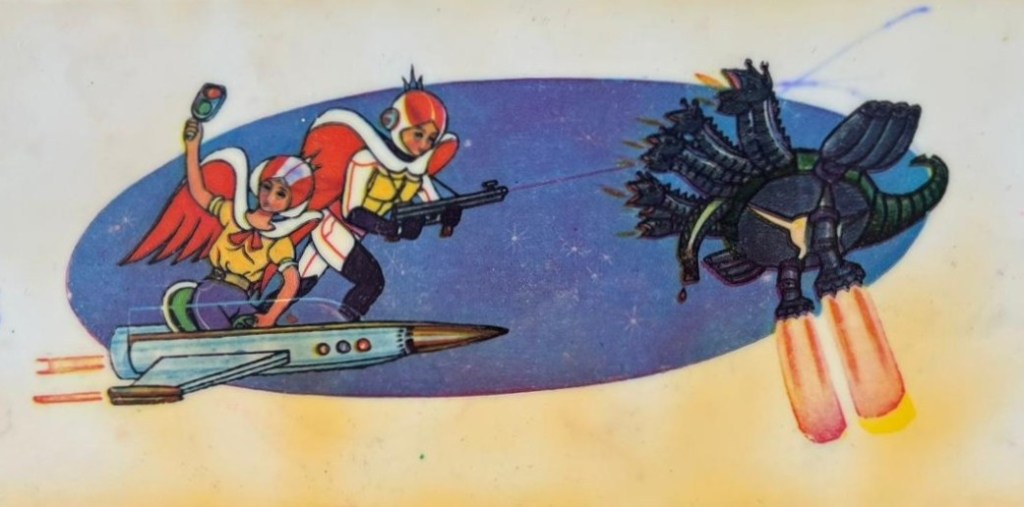
This pencase is part of the vast explosion of inexpensive plastic goods made in China for the Western market in the 1970s and 1980s, many aimed at children, and is of interest to us here due to the bootleg Tokusatsu and kaiju figures printed on its exterior. I should say upfront that the printing was not of the best quality, and the failure to align the print-masks correctly, gives this a permanently out-of-focus look. So do not adjust your screens, squint through your reading glasses and then curse me for poor quality control in the photography department. That’s really what it looks like.
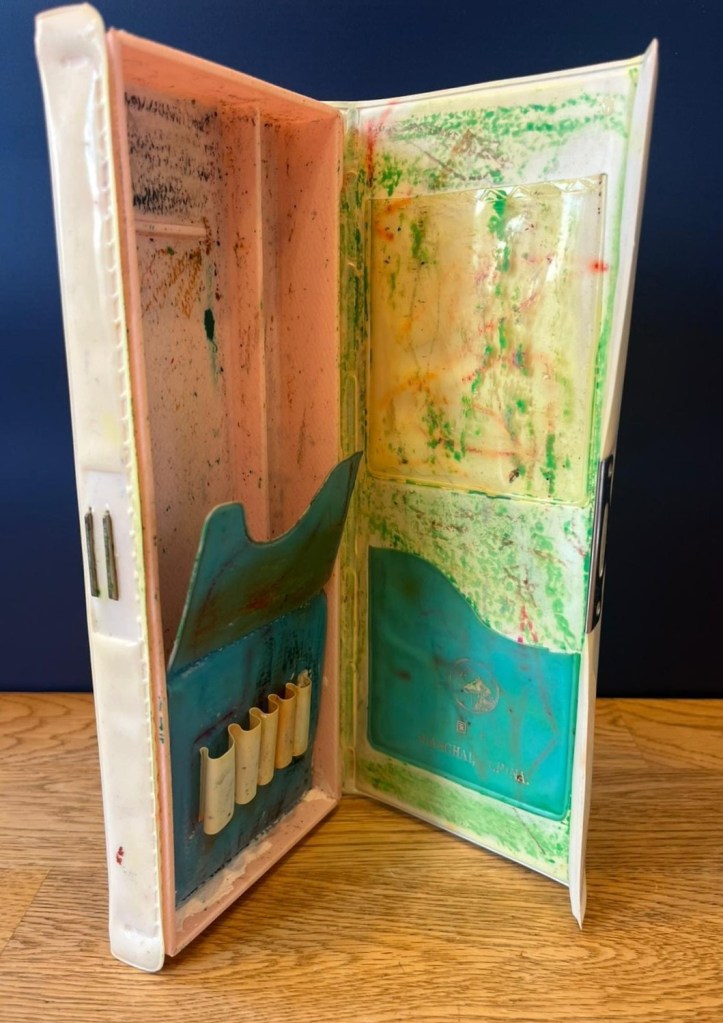
Whatever crayon-happy little darling owned it then clearly decided its interior colour scheme needed a ‘glam-up’, and this is the result (can you hear my teeth grinding?). This crayon can be scraped off, occasionally damaging the surface, but will not wash off with any soap product known to me, and I am loathe to pour very hot water over a plastic product. I’m as certain as I can be that I shall not be using this to keep pens in, and I rarely even open it, so have left it in the state you see here.
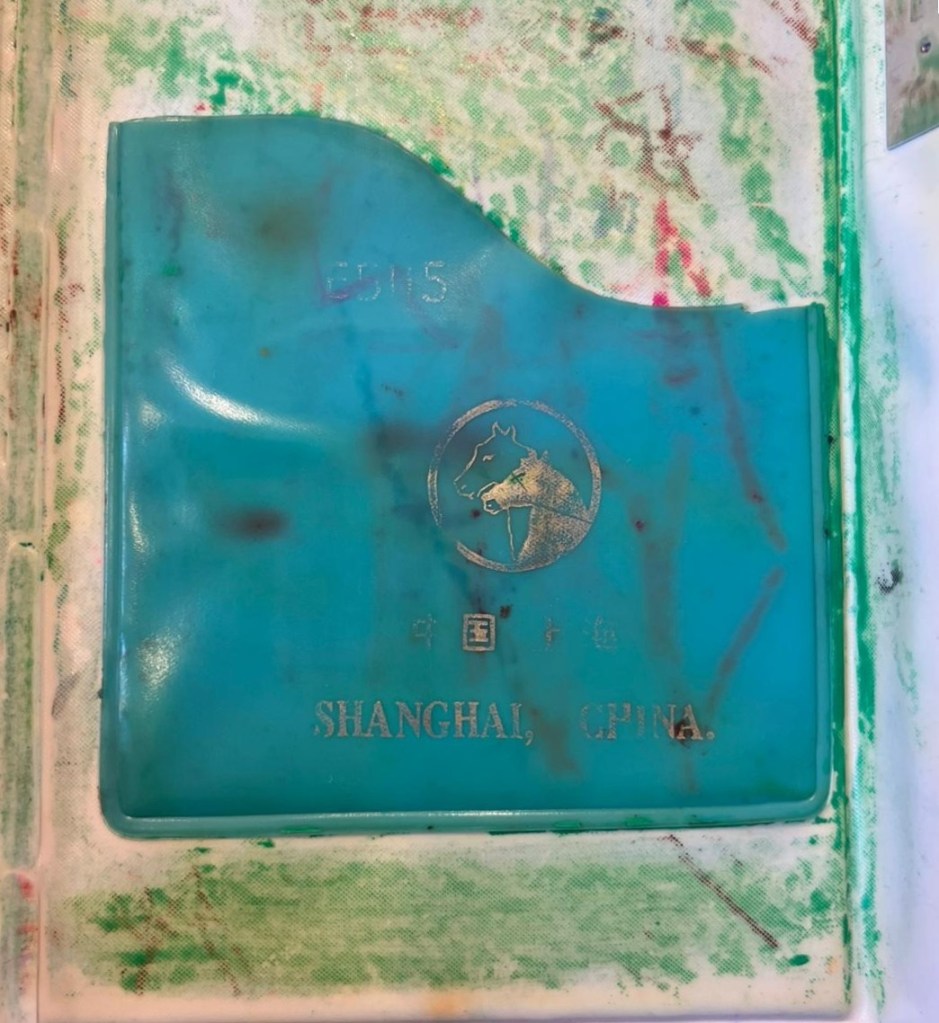
Thankfully our ‘crayon-monster’ did not do too much damage to the maker’s mark, printed in silver on the lower internal pocket attached to the lid, and from that we learn that this was produced in “Shanghai, China” (with Mandarin characters saying the same thing in the line above), all below a double horse’s head (the closer infilled with cross-hatching, and the further in outline) within a circle, and perhaps the product number: “E505”(?). The place of origin here is also the maker’s mark, and this was made by ‘Shanghai Toys’. This was a complex entity, more properly known as ‘Shanghai Children’s Toy Industrial Company’, established in 1965 as a Chinese State-run venture to centrally manage and scale up the production of toys by numerous small producers in Shanghai (it became the ‘Shanghai Toy Import & Export Co., Ltd.’ in 1980 – it’s current name: see here). So, the maker’s mark here indicates an official stamp of production within the State-run collective, rather than the mark of an individual business entity, and as these marks were made in a myriad of Shanghai factories they have great variety in their earliest forms (incidentally, I suspect the double horse head mark here to be that of the individual anonymous factory within the collective, and would be delighted to hear if any reader has seen this mark on another toy or related item, or has any more information about it).
The artwork here looks 1970s on first glance, and a look at the human figures confirms this impression.
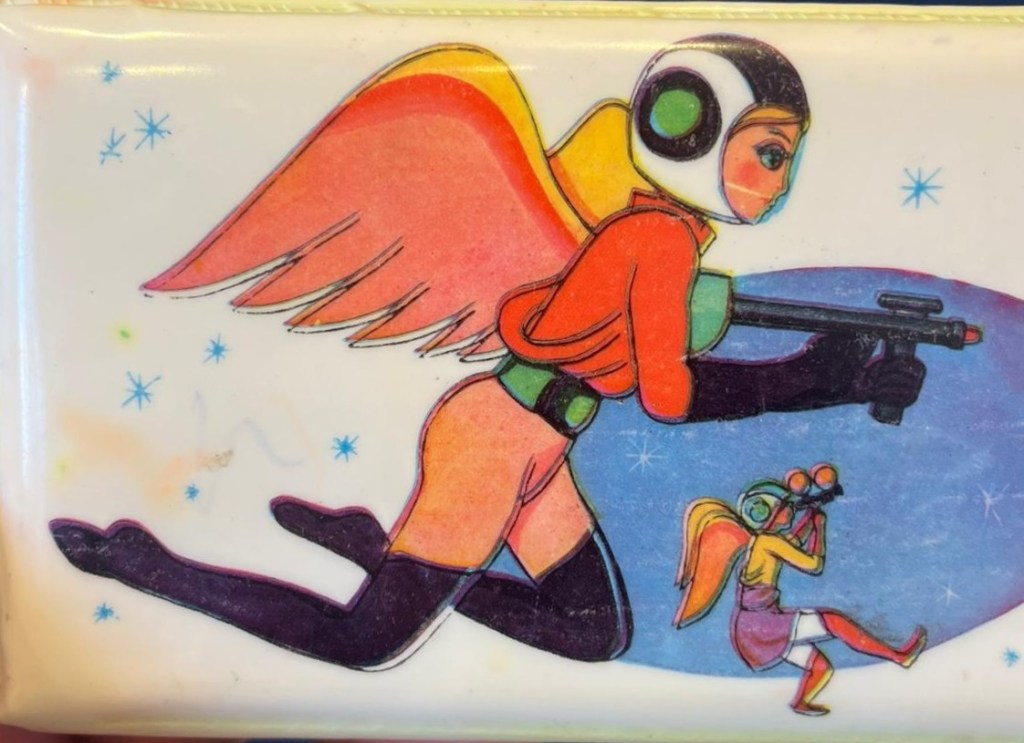
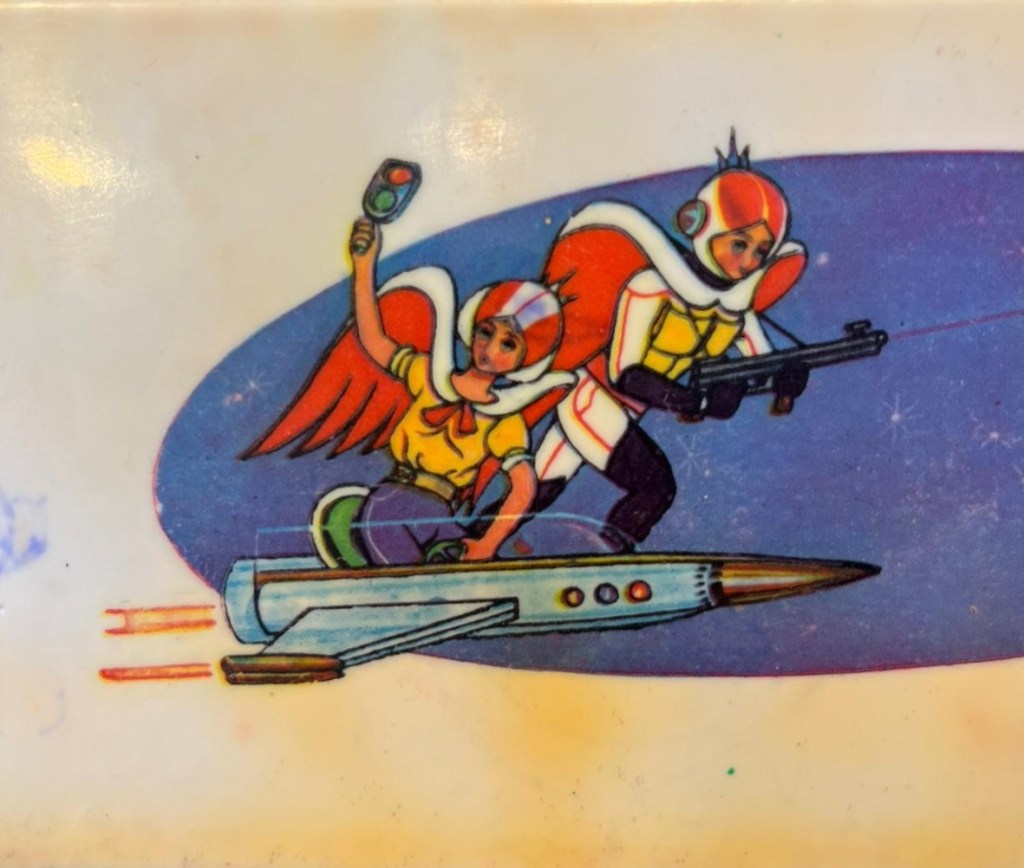
Both sets of humans here are clearly set within the Tokusatsu mold, and appear to be free interpretations of the heroes from the Anime ‘Science Ninja Team Gatchaman’ (first aired 1972-74), with close approximations of their distinctive bird suits and helmets. The female figure flying on her own in the foreground of one of these images is particularly close to Jun, the main female character of Gatchaman. Also, the appearance of two of these figures (the flying smaller figure in the background of the first image, and the female pilot of the spaceship in the other), dressed only partly in bird suits (with capes and helmets), and partly in their normal clothes, echoes the TV series’ plot in which four teens and a single slightly younger youth don various bird-themed costumes to take on associated powers and fight an organisation of technologically advanced villains (that named Galactor).
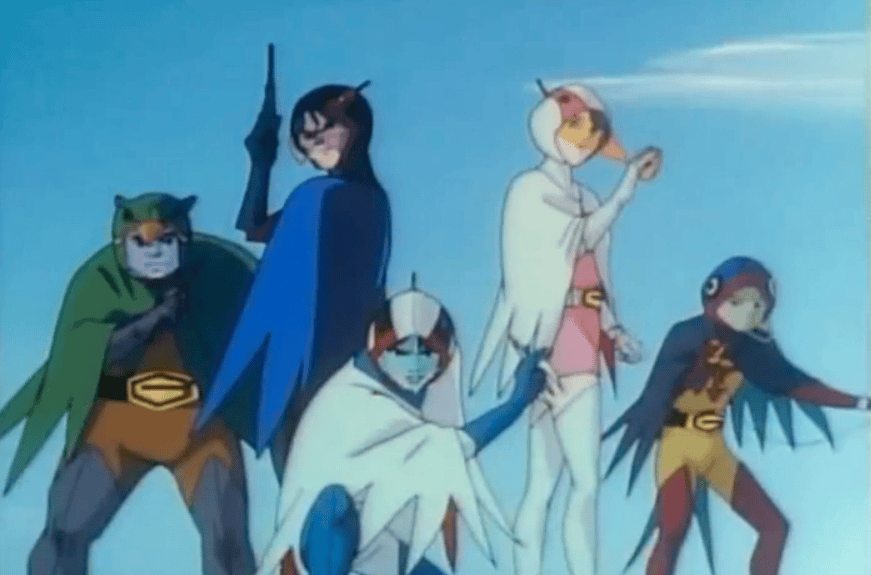
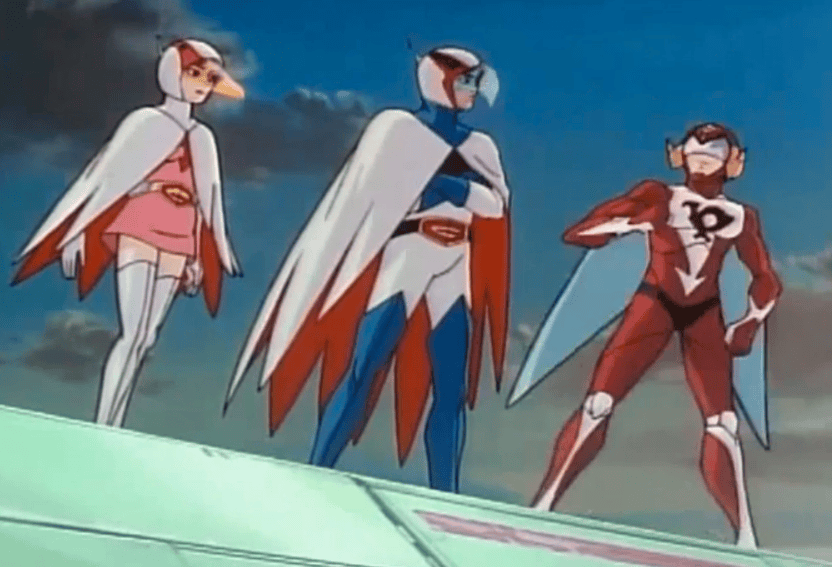
(Gatchaman character images from here)
After its initial run on Fuji TV, Gatchaman was licensed to Sandy Frank Syndication, who created an adaptation for US TV entitled ‘Battle of the Planets’ that aired in 1978. Then an animated film and two sequel series followed the original series in 1978 (‘Gatchaman II’) and in 1979 (‘Gatchaman Fighter’). The original series was dubbed into English initially in 1986 (as ‘G-Force: Guardians of Space’). Finally, too late for our consideration here, but perhaps the format perhaps best known in the West, ‘Gatchaman II’ and ‘Gatchaman Fighter’ were dubbed into English by Saban as ‘Eagle Riders’ in 1997.
I am at a loss as to why the female pilot here is holding up a paddle with a red and green light on it – there is nothing in Gatchaman known to me like this, but as I am not an early Anime aficionado this may be obvious to others. If so, would someone please get in contact and put me out of my misery, and I will update this post.
When we turn to the monstrous adversaries of these figures, we have clearly moved into traditional pachi-kaiju territory.
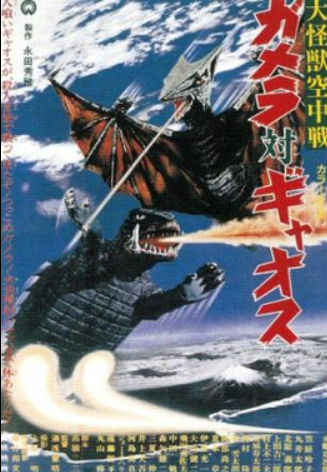
(Second image from here)
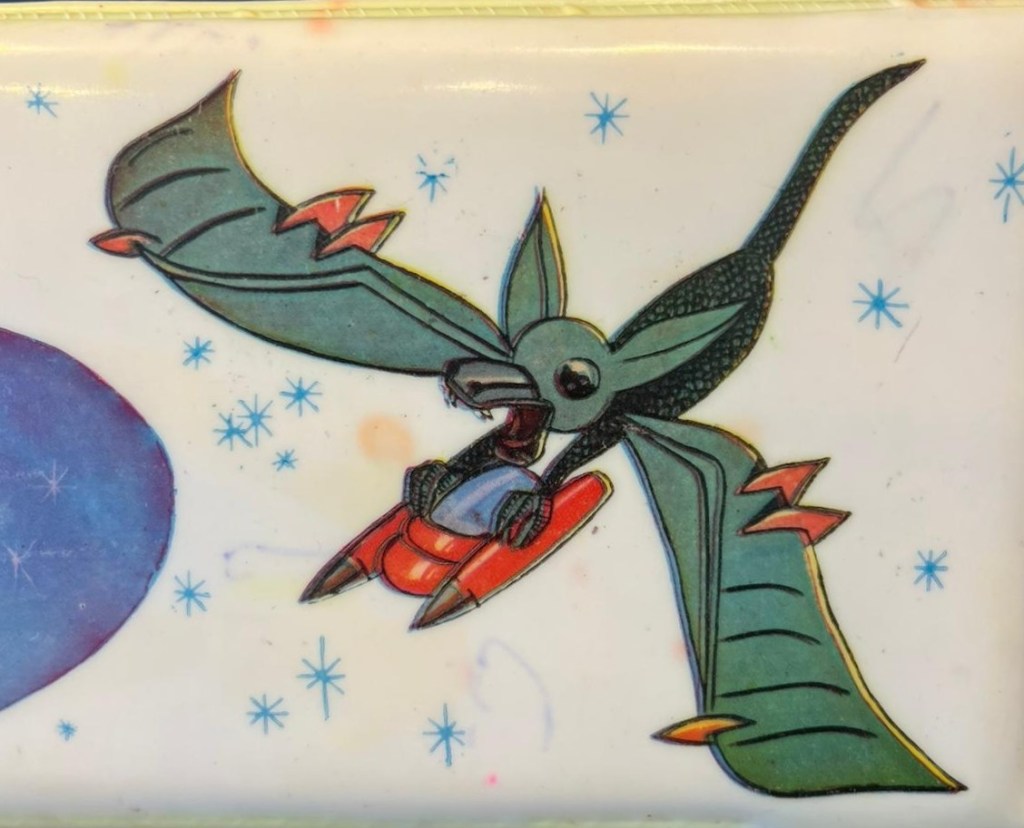
The first of these, a flying green Pterosaur-like creature, with bat-like ears, who grasps onto a spaceship with his back legs, was probably based loosely on Gyaos (from the 1967 film, ‘Gamera vs. Gyaos’) with that kaiju’s two horns converted into the bat-like ears here.
(Second image from here)
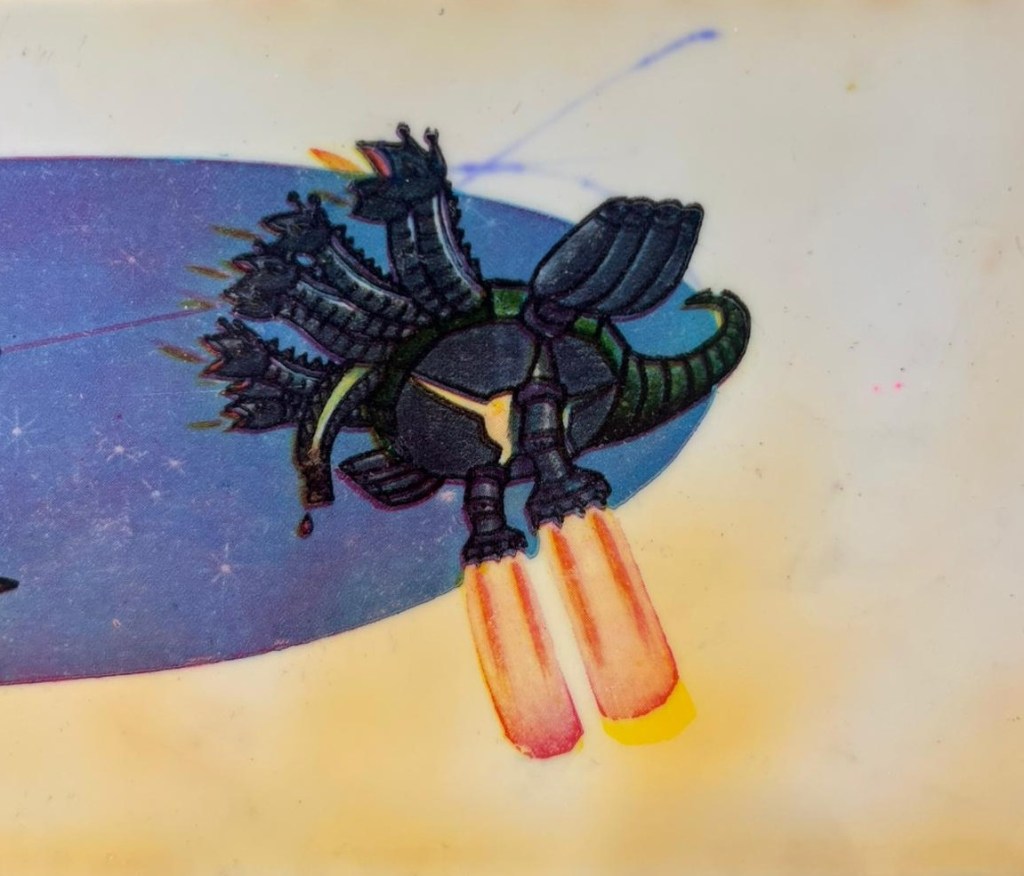
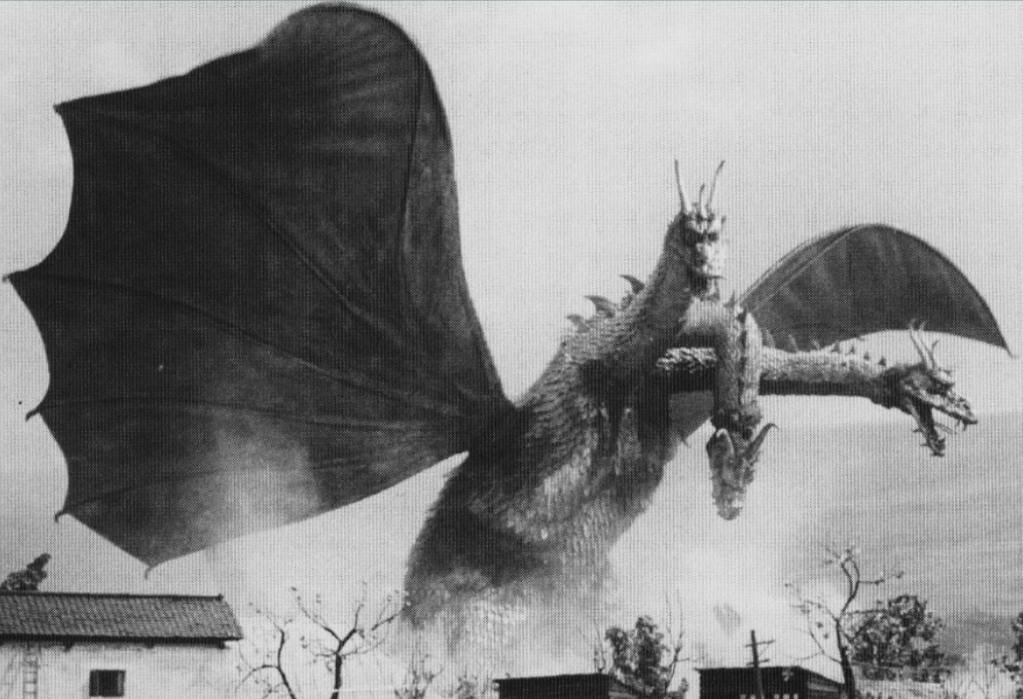
The second – a green and somewhat portly fire-breathing dragon with nine heads on long necks including one which has been decapitated and hangs loose dripping blood, loosely recalls King Ghidorah (who appeared first in the 1964 film, ‘Ghidorah, the Three-Headed Monster’). Note that the living heads of our kaiju here are clearly grouped into three separate clumps echoing King Ghidorah’s own three heads. The artist deviated from his model mainly in the increased number of heads and the addition of a flying-saucer-like metallic underbelly and rocket legs.
The metallic body-parts here cannot be a reference to Mecha-Ghidorah, as that kaiju did not appear until the 1991 film, ‘Godzilla vs. King Ghidorah’. However, they do look very similar in general shape to Gamera’s body (especially in his spinning flight form, in which in his first film, ‘Gamera the Giant Monster’, 1964, he is mistaken for a flying saucer), and we can recognise the same kaiju’s distinctive twin rocket-powered legs here.
The number of heads is particularly interesting here. Rather than add one or two more in an apparently slowly creeping ‘arms race’ with Toho’s kaiju, we have jumped up to nine in one massive step. Two possible sources for this aspect of this kaiju occur to me. The first is the obvious one to a Western observer: the multi-headed Lernaean Hydra from Greek and Roman myth, which around the year 600 BC. was given nine heads by the Greek lyric poet, Alcaeus (but with later writers giving it as many as 50). The same number, but specifying that it had ‘eight mortal heads, and a ninth one in the middle that was immortal’ was repeated in the first or second century CE. collection of myths known as the ‘Bibliotheca’, and wrongly ascribed in Antiquity to one Apollodorus (this is the source of the title-quote here), and from then on this part of the Hydra legend became common. In this context, it is worth bearing in mind that the second part of King Ghidorah’s name is a Japanese transliteration of ‘Hydra’ (as ヒドラ ‘Hidora’) showing that the Hydra stood in part behind the modern design of that kaiju (with the ‘King’ part alluding to the three-headed dragon Zmey Gorynych/King Dragon in the Japanese version of the 1956 Soviet film ‘Ilya Muromets’, that was released in Japan in 1959).
However, while Japan in the 1960s and 1970s was almost flooded with Western literature (including translations of the Greek myths), such things were virtually unknown in Communist China in the same period. There is another candidate that was much closer to home for our Shanghai artist. A well-known type of Yokai, named Kuzuryū dragons, have nine heads, and are worshiped as local water deities throughout Japan, but particularly in Hakone (Kanagawa Prefecture), Nagano Prefecture and Fukui Prefecture. The first references to them are believed to date to the eighth century CE., and they are still actively worshipped today within Shinto Buddhism as influential ‘spiritual power spot’ deities. They seem to have entered Japan through Shinto Buddhism as representations of the Hindu deities Vāsuki and Śeṣa (often shown as snakes with numerous heads), with these then combined with local folkloric legends. For my money, I suspect that legends of this Japanese Yokai partly stand behind the pachi-kaiju created here in Shanghai in the 1970s.
- 'MUTTON DRESSED AS LAMB': Godzillas and kaiju that look vintage, but are not
- American made Pachi
- BOOTLEG DINOSAURS – a little off topic, but sometimes needed here
- BOOTLEG GODZILLAS
- Bootleg Tokusatsu from China and its immediate neighbours
- Bootleg Tokusatsu from the Americas
- BOOTLEG TOKUSATSU HEROES
- Central Europe – Godzillas and kaiju from behind the Iron Curtain
- Chinese-region bootleg Godzillas -the plastic tide from the East
- Chinese-region made Pachi
- European made Pachi
- European-made Godzillas
- PACHI
- Pachi kaiju
- Pachi kongs
- Pachi superheroes – Ultraman and similar
- The Americas – bootleg Godzillas from the New World

 Confessions of a Kaiju Hunter
Leave a comment