In a previous post (‘“Call me Ishmael”: the hunt for the great white Gojira’) I discussed a close-knit group of white Dor Mei Godzillas, all produced in China and with the copyright date ‘1986’ under their feet. It is clear from that post that the manufacturers struggled with their materials in the production of these Godzilla bootlegs, and probably because of availability were forced to use black vinyl, which they thickly overpainted with white to achieve the desired colour – the black underlayer giving the paint a very pale blue tinge. The resulting models scuffed badly during play, leaving large black areas of the base vinyl colour visible. In an update to that earlier blogpost, I noted that a single example of one of these Godzillas produced in a pale blue/turquoise vinyl, had come to light in the collection of the artist Lin TaiHung of Taiwan (see here for his Instagram posts as ‘taihung_719‘), presumably as an attempt to address these scuffing issues. The rarity of these (I then knew of only one) suggests that this variant vinyl colour proved too costly to roll out into the main production lines.
Another recently popped up on a local auction site, and was acquired by me (almost for a song, and not quite enough for three coffees), and a close look at the newly discovered one also shows that the manufacturers of these white Godzillas struggled with the materials available and experimented further in order to achieve the best possible result. It also allows us to focus our attention on the final days of production of Godzillas in the name of Dor Mei in the mid- to late 1990s.
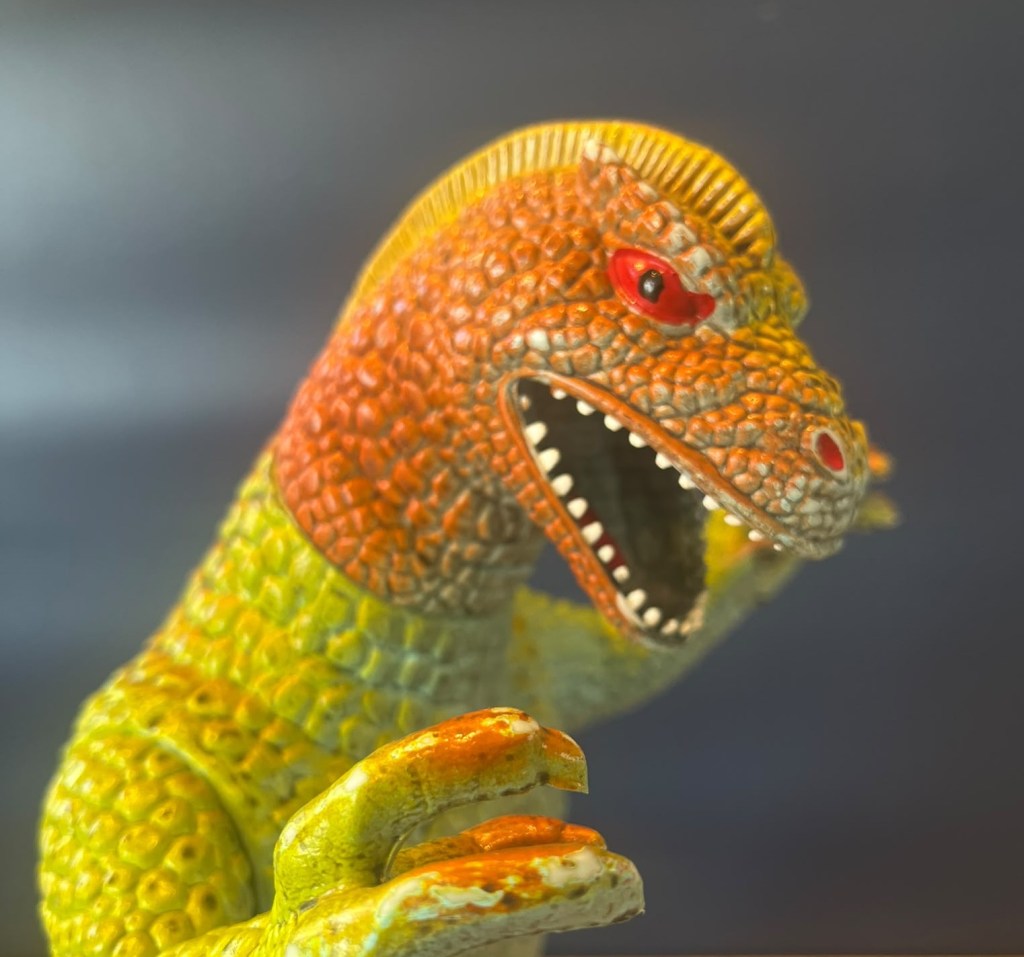
This is the new Godzilla – a handsome and colourful beast:
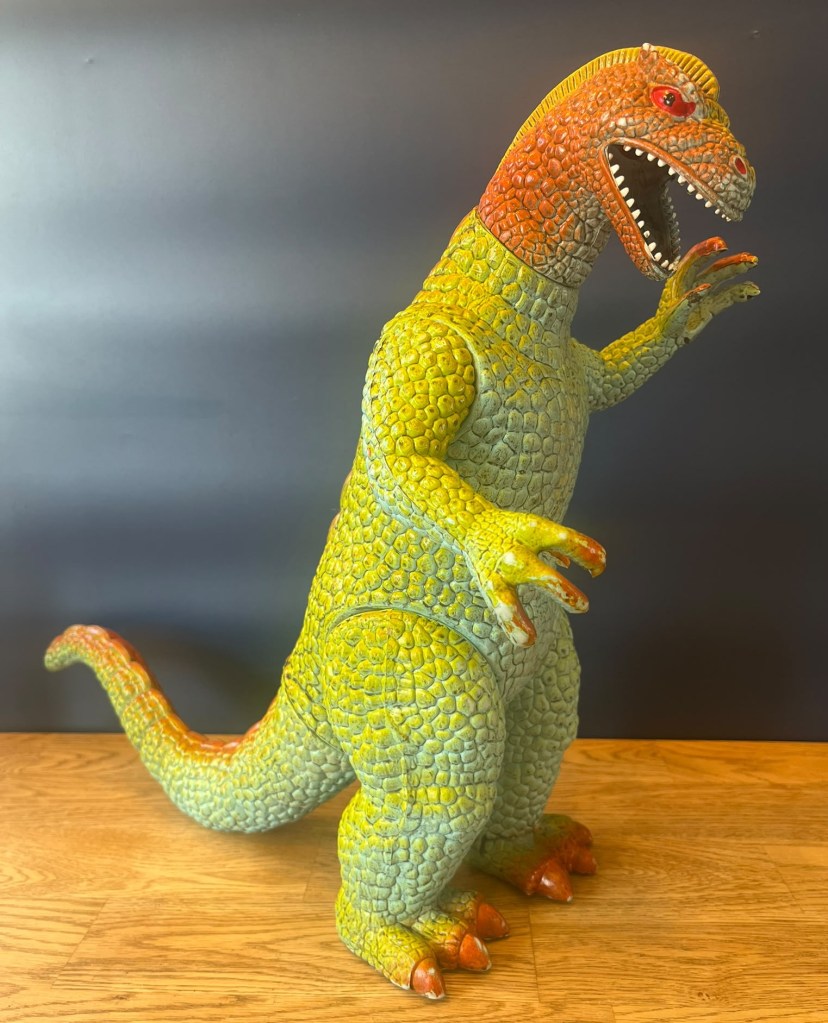
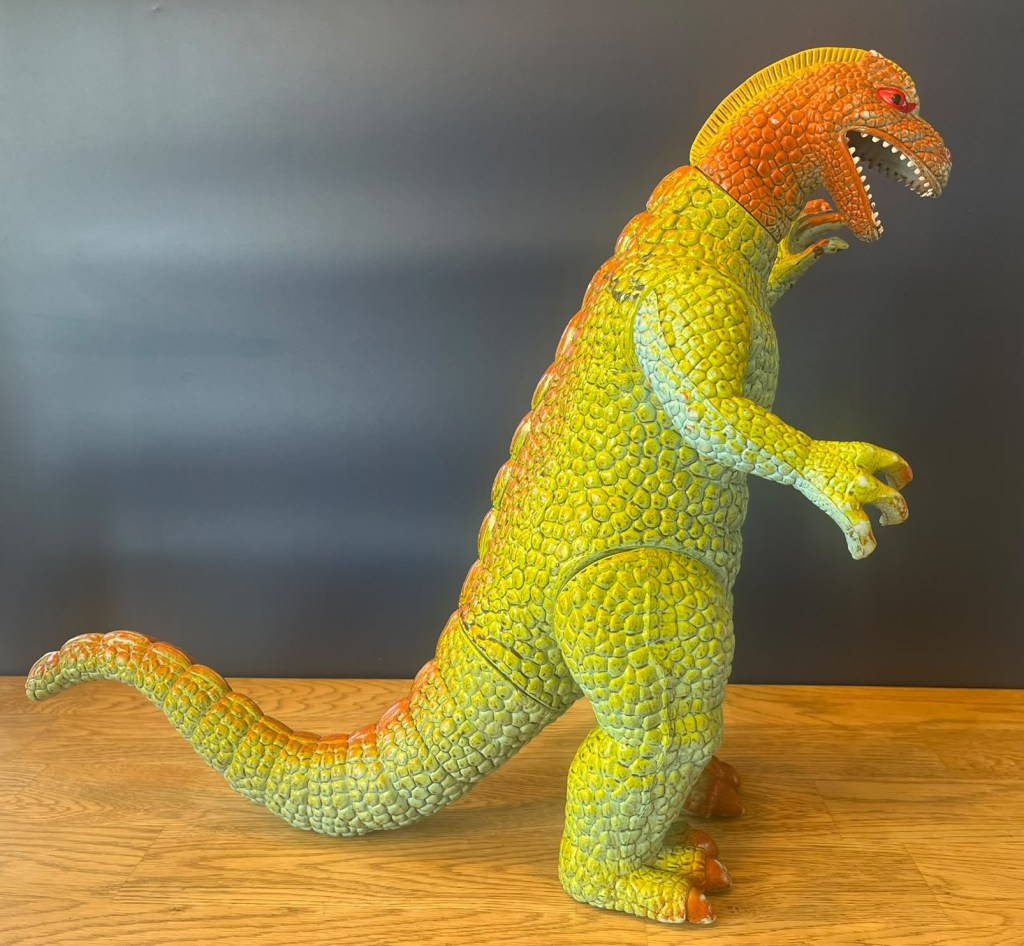
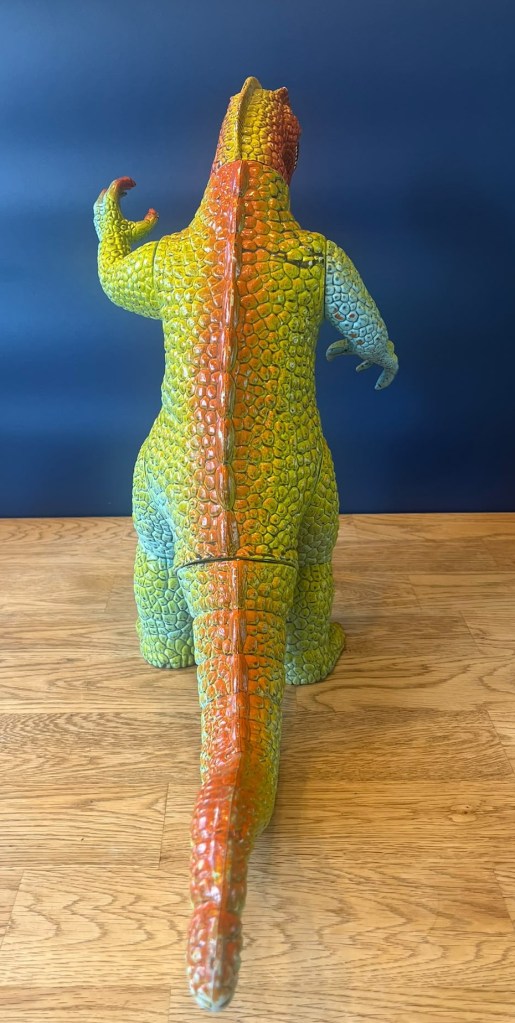
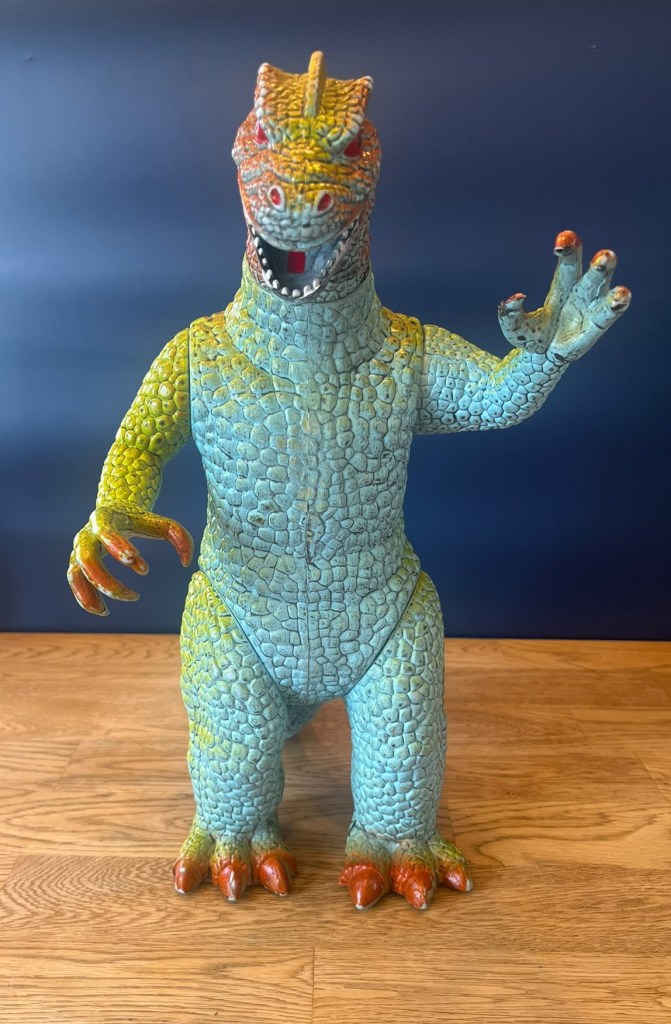
The new variant appears on initial inspection to be of the type A of my earlier post: with the ‘ridgebrow’ head sculpt and bright red eyes, but there are two really big differences:
(1) Unlike the other white Godzillas in my previous post, it uses the chunkier body and legs design (with a wider chest with less defined stomach folds and virtually no fold around the base of the neck below the join with the head, as well as much wider thighs), as first spotted by an internet user calling themselves Splitt in 2013 (and later Rebecca Loves-Monsters and Splittyhead on Flickr) – her image reproduced below (and I direct the reader’s attention to the first and second Godzillas shown there):
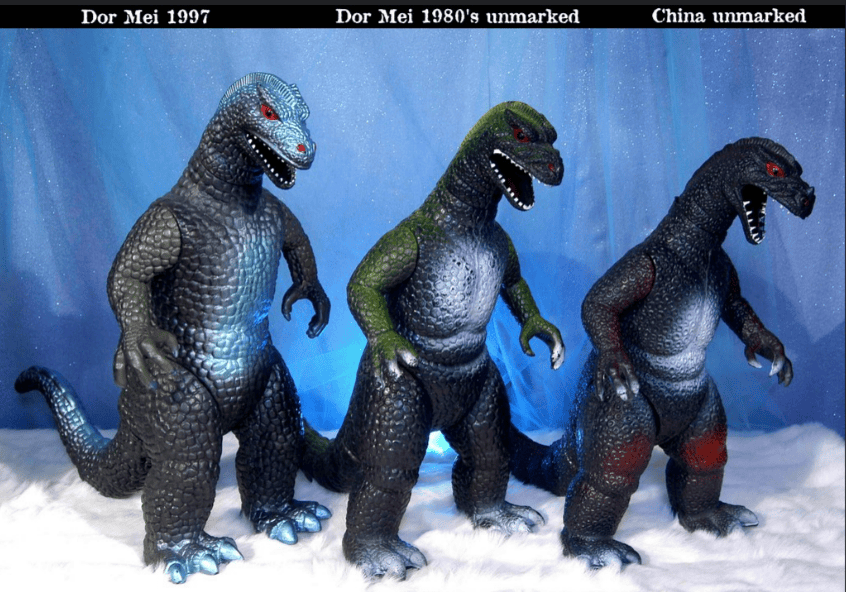
(Image from here: link; and as I have said in my main post on Chinese bootleg Godzillas, I do not have contact with this Splitt, and if a reader could please put me in touch with them, or Splitt get in direct contact, I would be very grateful)
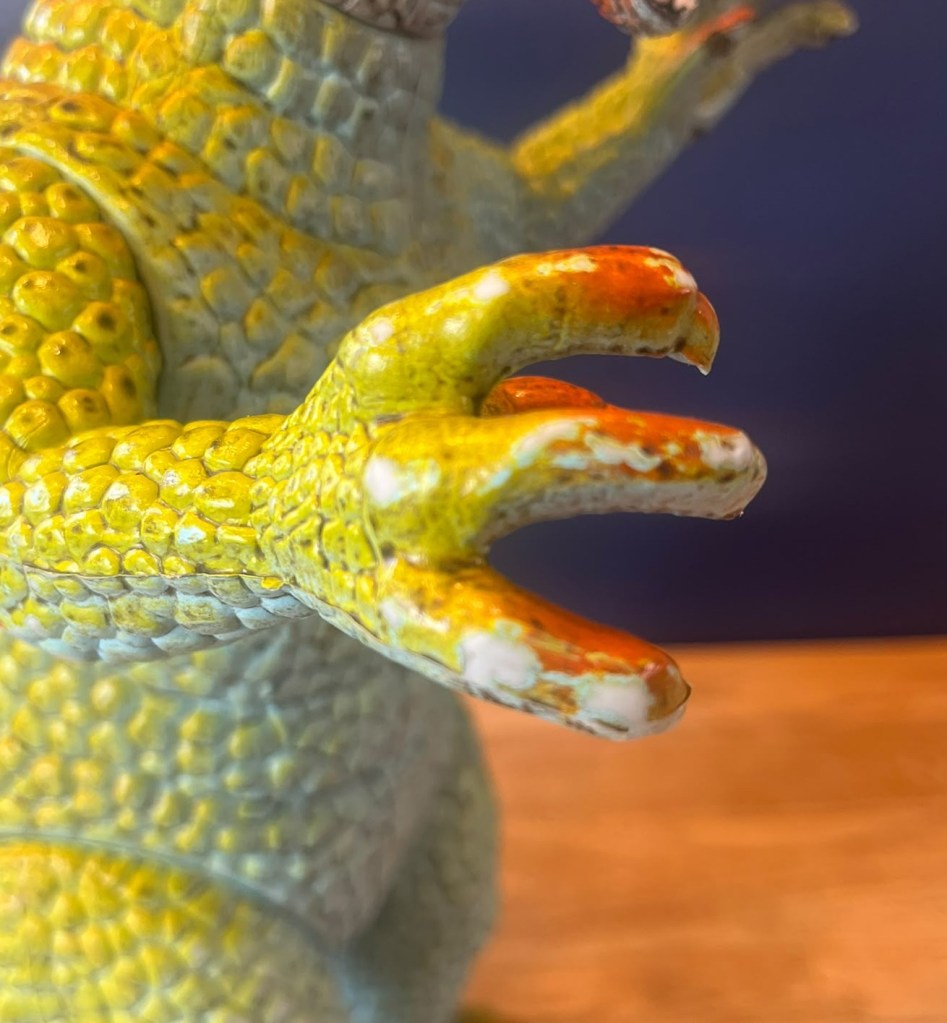
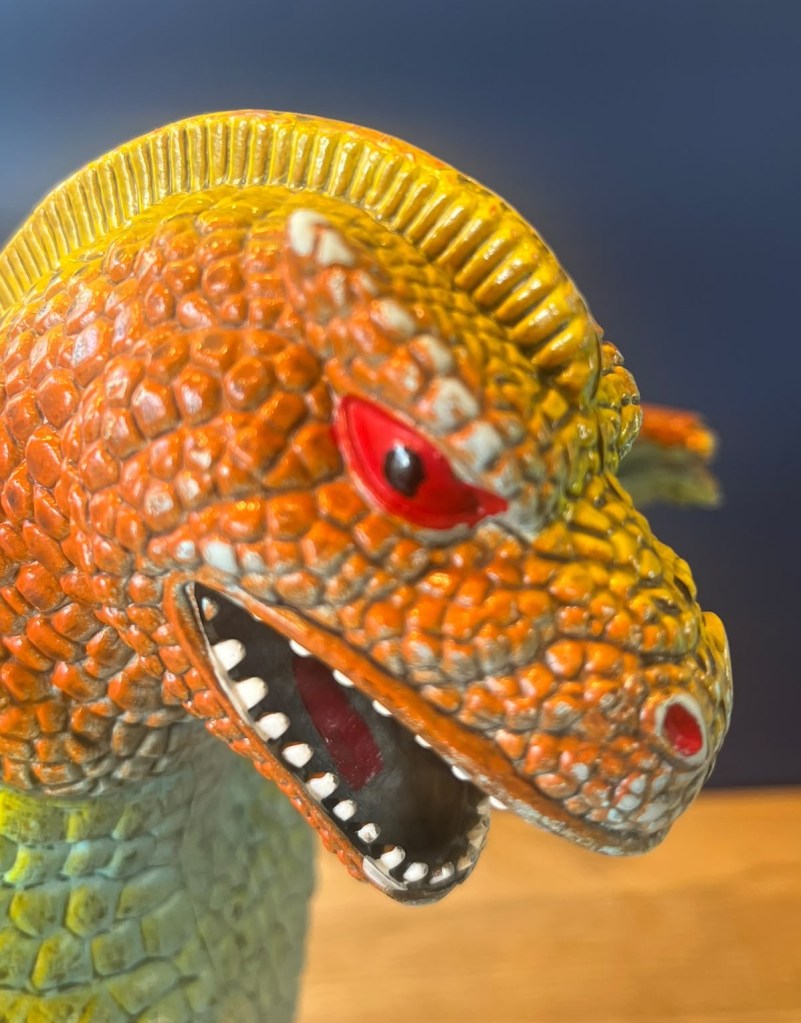
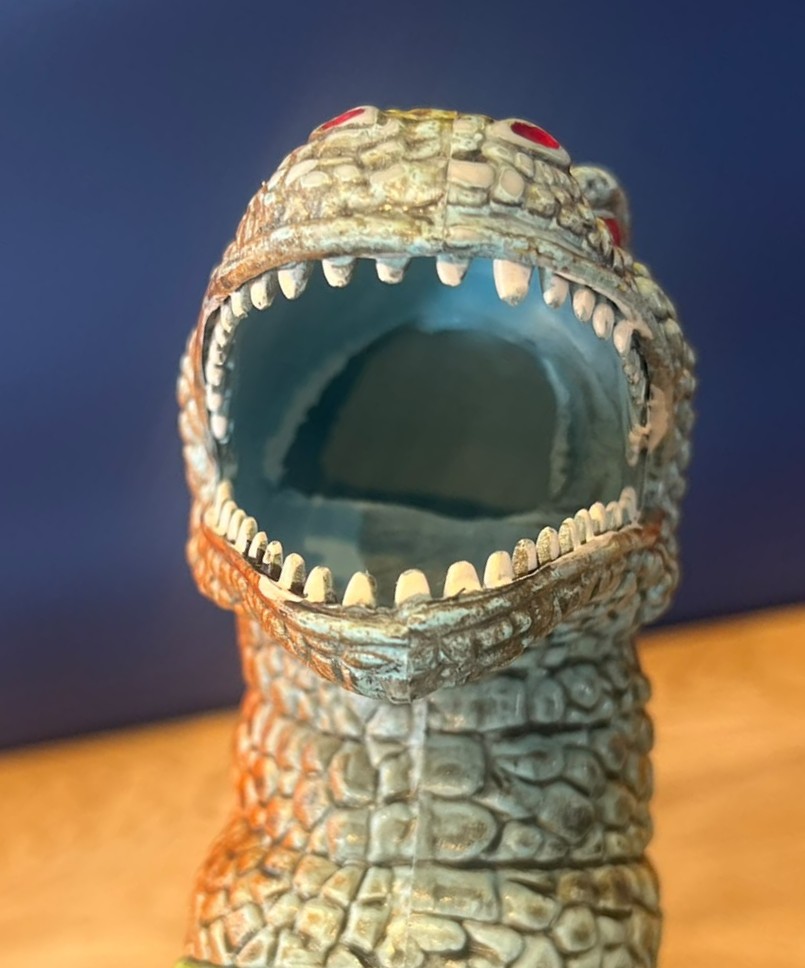
(Details to show the base colour of the vinyl of this newly discovered Godzilla)
(2) It was produced in a pale turquoise vinyl (like that in the collection of Lin TaiHung, but his figure uses the less chunkier, and more traditional, body design). For this new colour vinyl, see in particular the scuffs on the knuckles and eye-ridges, and inside the mouth, where a hole cut at the back of the throat shows the internal colour.
Over this pale turquoise base, reds and greens were sprayed as shading, all across the back, arms and reverse of the thighs of the beast. As with other examples, it is clear from the lines of the spray-painting that the beast was sprayed with the arms, legs and tail attached (and the arms raised in the ‘don’t shoot’ position), but unlike others, the head was sprayed separately.
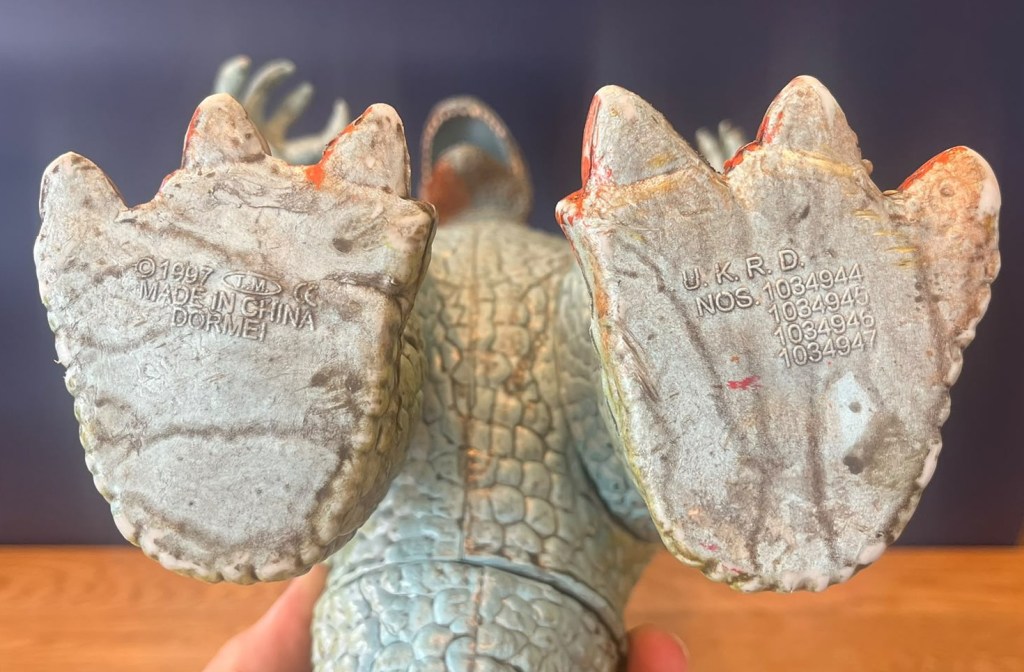
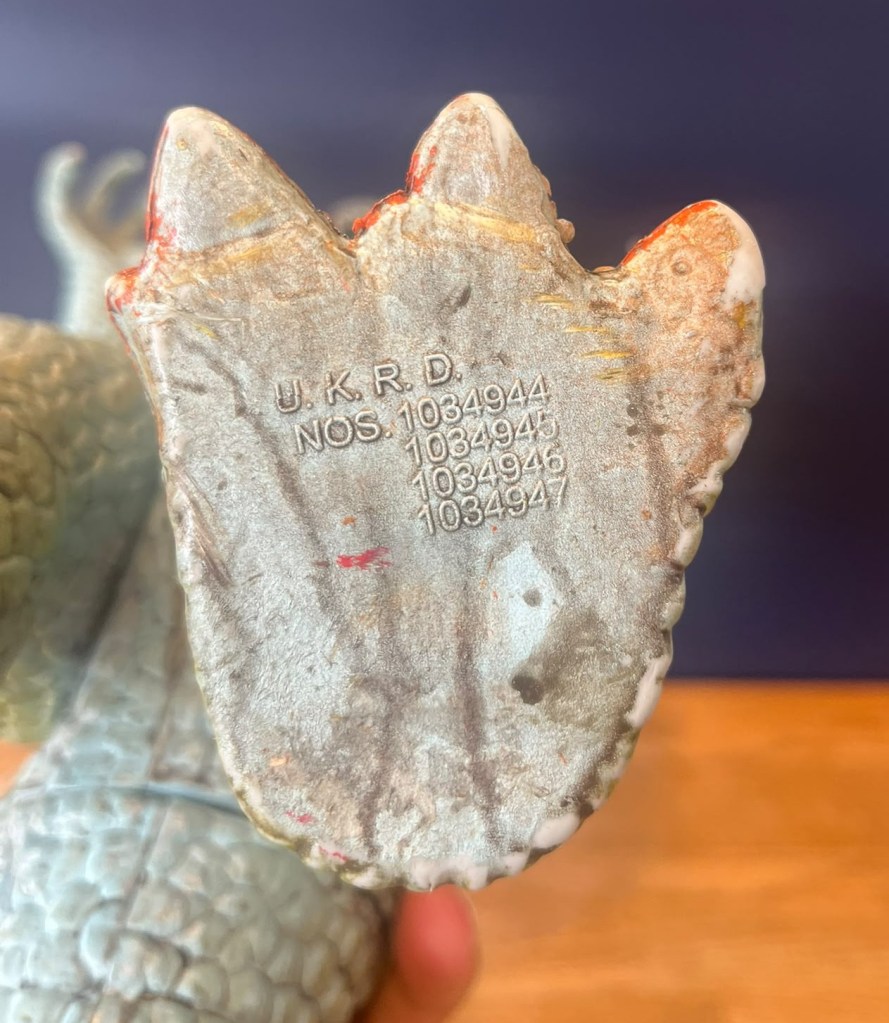
It is when we turn to the marks under the feet and a final dark varnish application that this new Dor Mei Godzilla sets itself apart. All white Dor Mei Godzillas seen by me up to now have the copyright date ‘1986’ under their right foot. As I said in the previous post, “we cannot take the date “1986” here to be a date of production, and this should be understood in the context of the “©” before it as a copyright date instead, indicating when the type was first made and registered (in this case with the UK authorities)”, and I suggested there that the colouration of some of these white Godzillas took their inspiration from toys released alongside the film, Jurassic Park, in 1993. However, the new one has “1997” under its right foot – and I realised only during the writing of this blog that while this year is found on a number of Dor Mei Godzillas, I can only find it with the place of production as ‘China’, never ‘Hong Kong’ (this confirmed by a wide survey of my collection of Dor Mei Godzillas and all examples I can find on online sale sites).
We can compare the footmarks here to those on Chinese-made Dor Mei Godzillas in their chunkier form, and see that the text there, its font and size and even the angle of the text relative to the foot is identical, and in addition there is a spur on the inside of each foot at the base of the innermost claw peculiar only to this Dor Mei design:
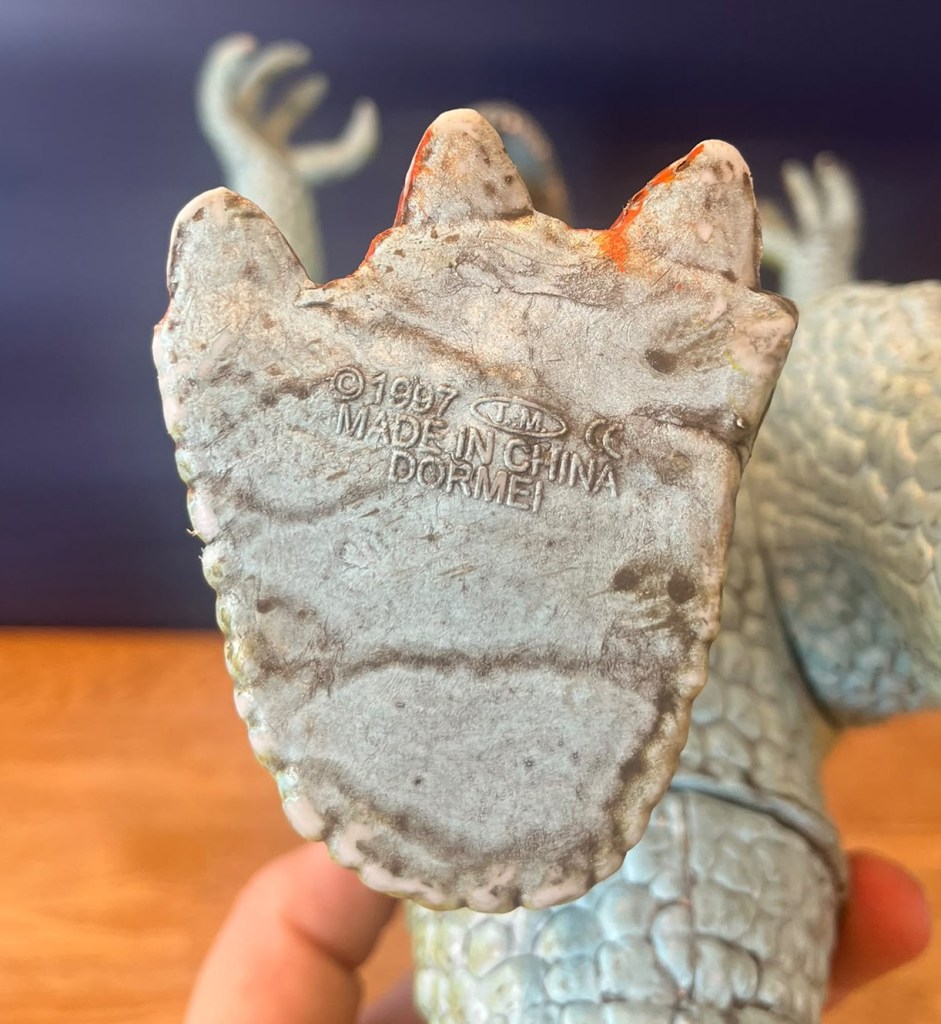
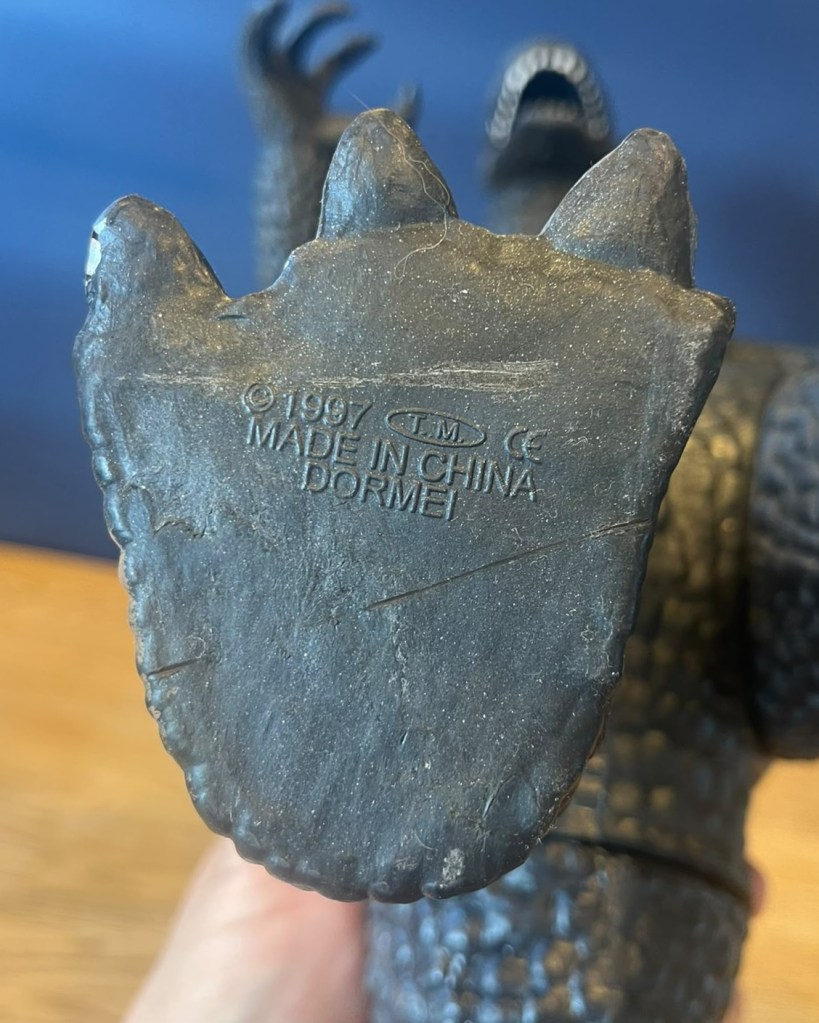
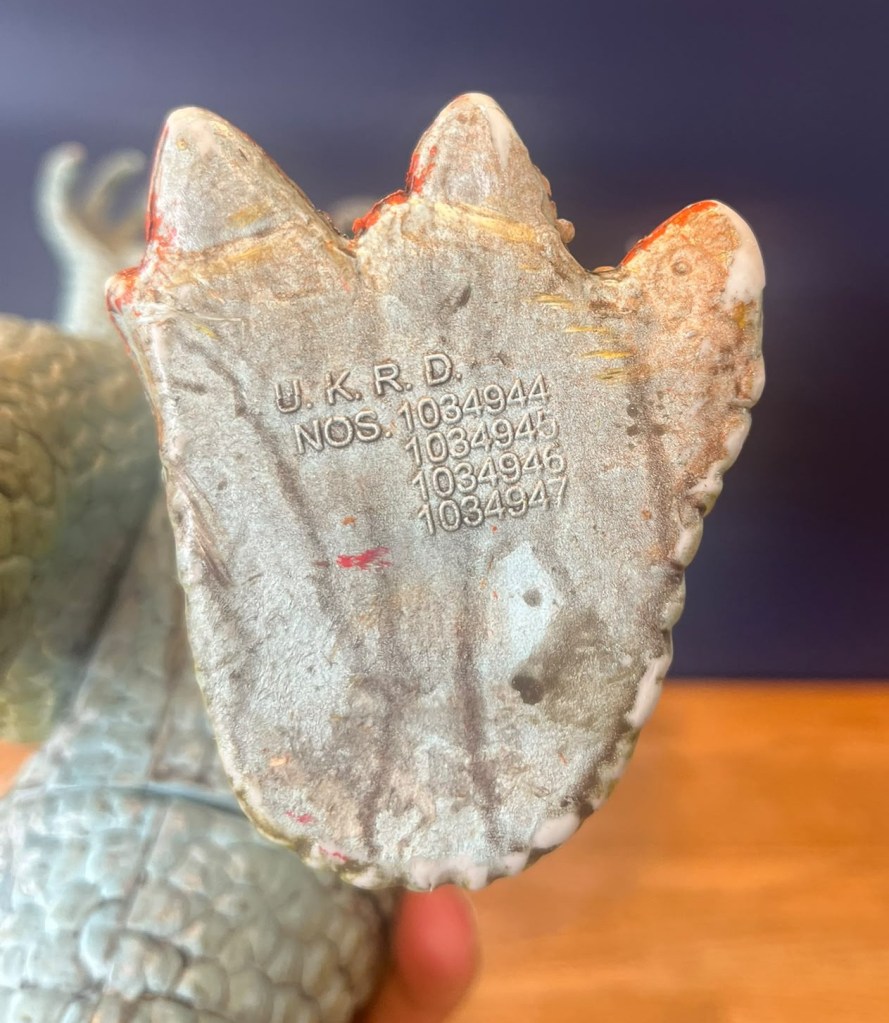
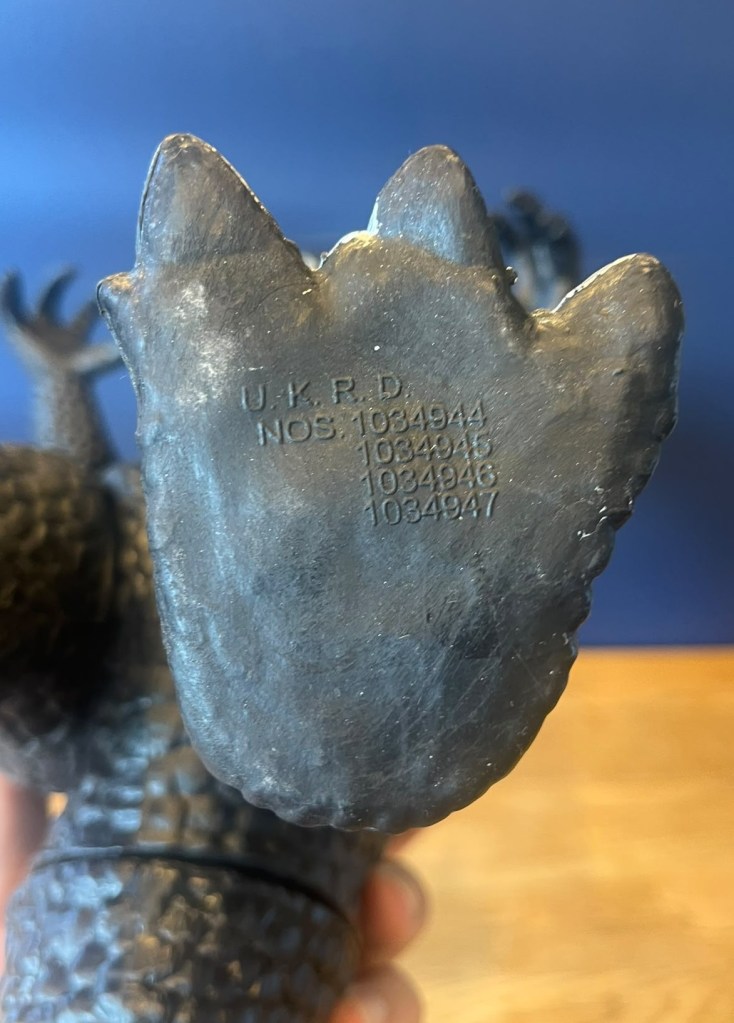
In short, these legs must come from the same molds.
In this context, the large semi-circular hole cut in the back of the newly discovered Godzilla’s throat is of some importance:
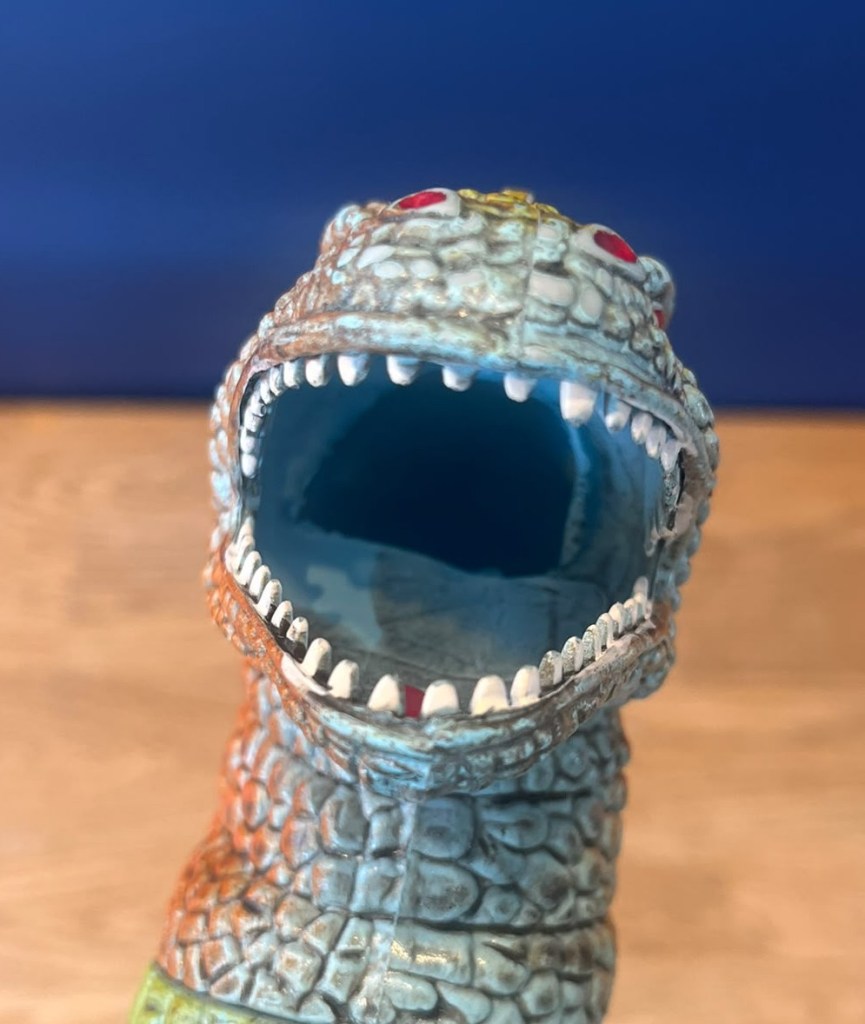
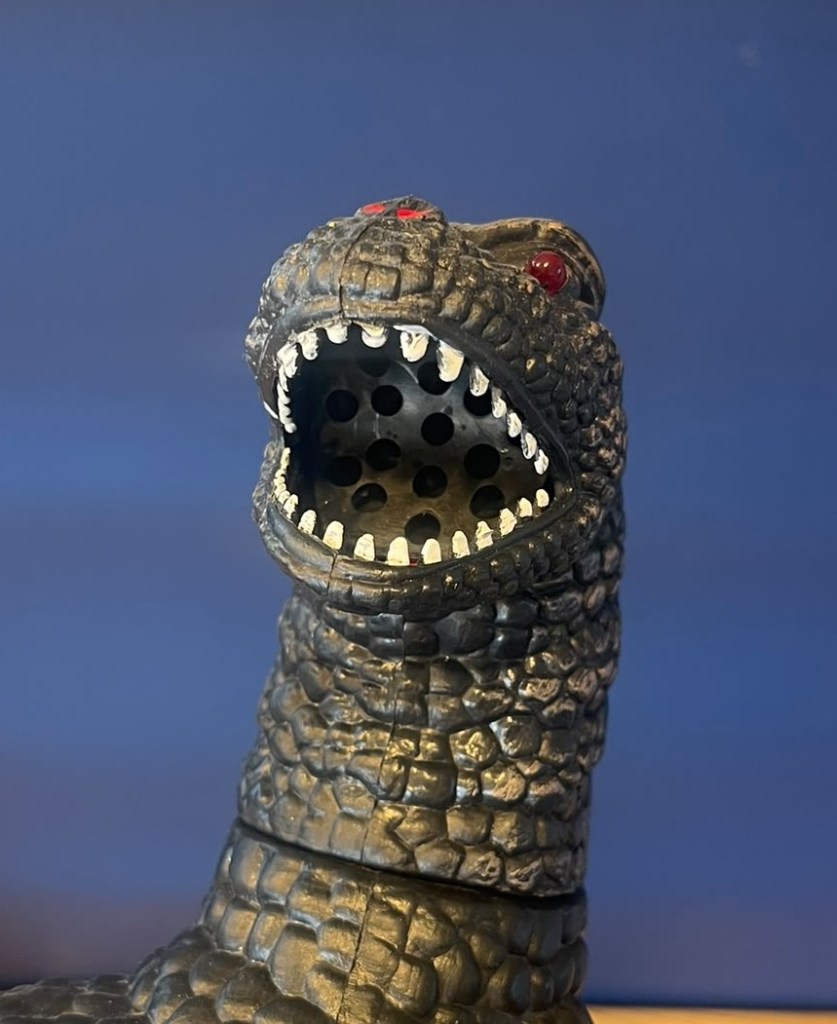
This is likely to be an accidental byproduct of the use of the late models with light-up eyes and roaring sound effects, as I suspect the same holes were also cut with a hot wire or blade in the throats of the ‘roarers’ and these sit behind the plate perforated with holes that is fixed in the mouths of these ‘roarers’ – these features added to allow the speaker inside the body to be heard more clearly. (Sadly, I do not have a broken ‘roarer’ head with the perforated plate removed, and it would break my heart to take a hammer and chisel to one to find out for certain what seems very likely – so if any reader has an unfortunate ‘roarer’ that has already met a terrible accident exposing this part of its inner workings, please do send me a picture of the back of the throat, and I will update this post). So, it appears that the bootleggers, when producing the head for the new pale turquoise Godzilla, cut the same hole in the back of the throat as they would normally do when producing ‘roarers’, but in fact this hole served no purpose in this model.
This new foot mark with ‘1997’ and ‘China’ is important as it helps date the Chinese production of white Godzillas more accurately within the 1990s – with all the dateable examples of production there spanning the period from around 1993, or immediately after the release of Jurassic Park, to 1997 and probably the year or so immediately following. As I noted in my main blog on Chinese bootleg Godzillas, the Hong Kong company directory states that Dor Mei Factory Ltd. was dissolved in August 1994 (see here), and so with the toys marked with the 1997 date we appear to be dealing with an offshoot of the original company or another company entirely who had bought the molds and trademark rights as Dor Mei closed. This later entity would appear to be behind the last chunkier body and legs design.
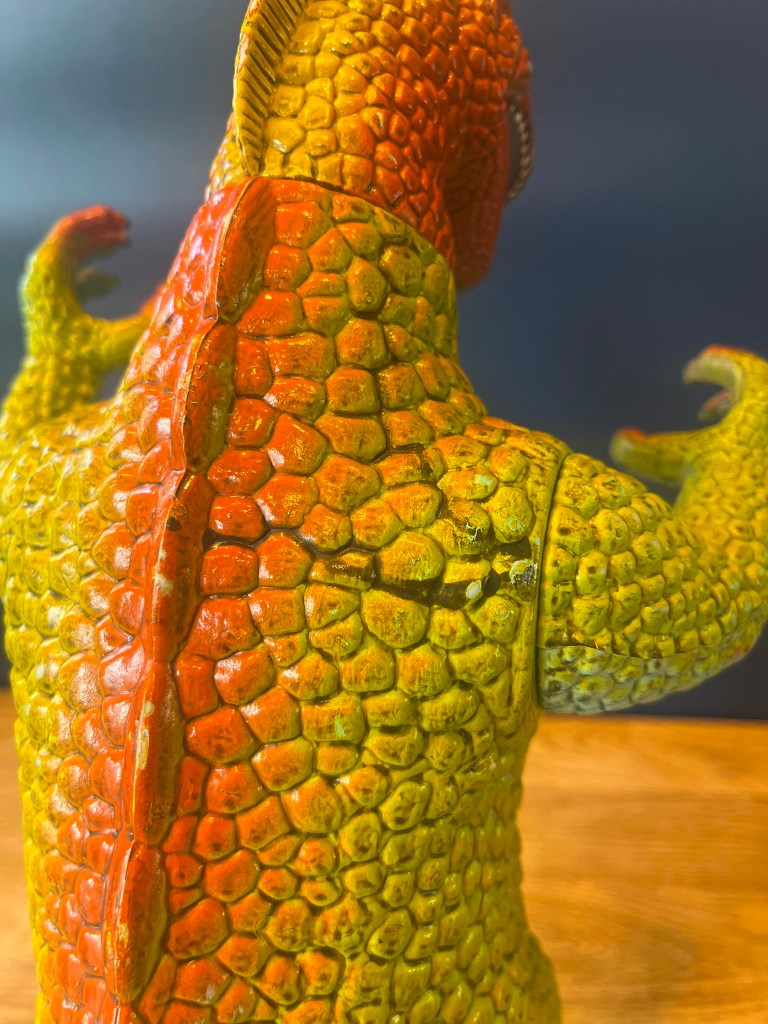
It is also clear that those responsible for these Chinese-made Dor Mei Godzillas were actively working on new research and development as they produced these figures. It was noted in my main blog on Chinese Godzilla bootlegs that the 1997 models often have shading in silver or metallic paints, and some significant efforts were put into the refinement of the white / pale turquoise models. The application of thick white paint to the entirety of these figures made their scale patterns and fine detail almost invisible on first glance, and apparently because of that, here on this newly discovered model, a dark glaze or varnish was added as a final touch to highlight small details. I now realise that another Chinese-made Dor Mei Godzilla (but with the less chunky body design) that I showed in my previous post on white Godzillas, has the same dark varnish applied to it (images of that one reproduced below). (I had previously thought the anonymous seller was a spectacularly grubby little oik who apparently lived in a coal mine or similar, and did not have the decency to wash his toys before selling them – and I hereby offer my public apology to them for this accidental mental slur on their hygiene levels).
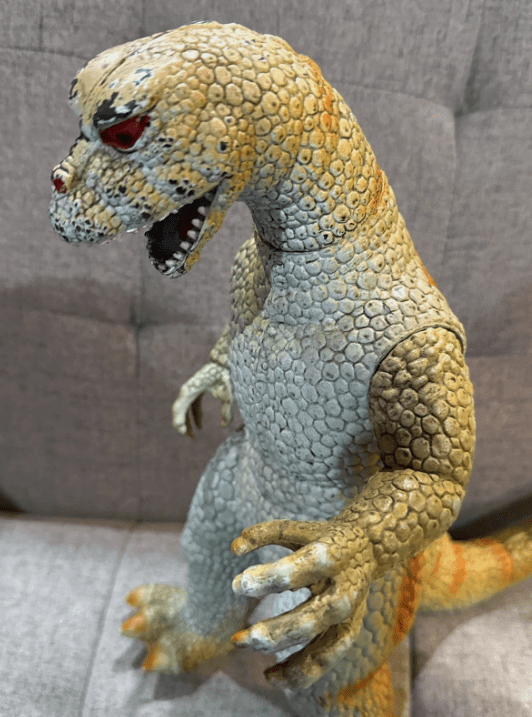
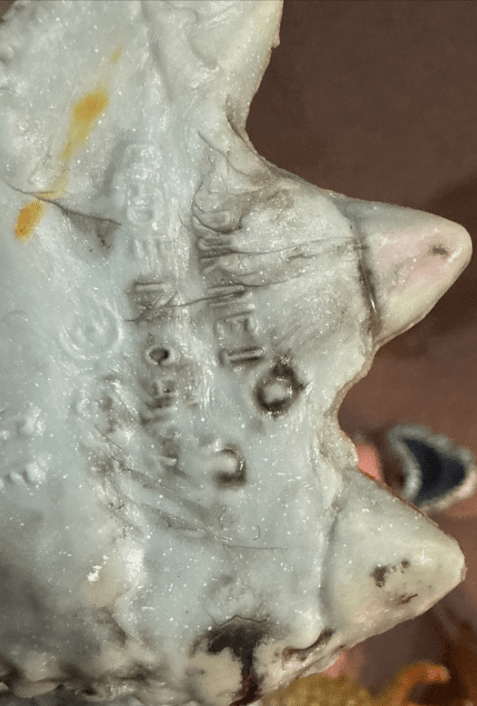
(Images from eBay listing of another white Godzilla with the same dark varnish)
This dark varnish had a tendency to pool in certain areas if not wiped away quickly (see the right shoulder blade of the present figure) and under the feet and the inside of the mouth (where smears and missed sections can be seen).
This is not to suggest that all 1997 white Godzillas were made in this pale turquoise vinyl. I know of two others only from photographs, one from a sale site and another in a private collection, both reportedly with “1997” under their feet.
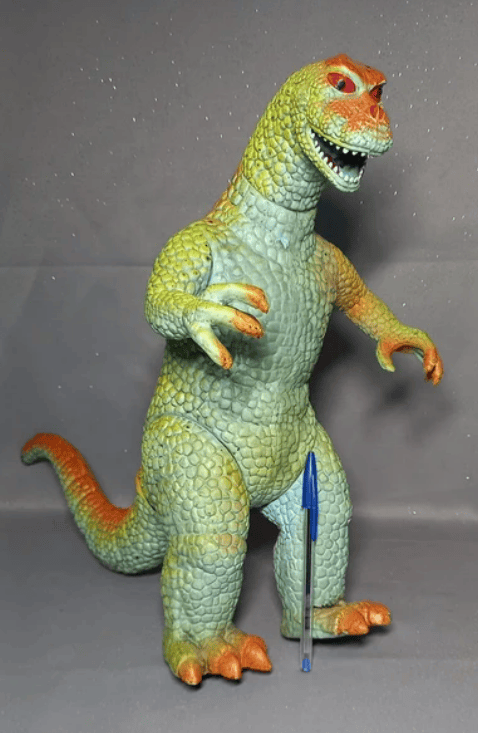
(Image from a European Vinted listing)
The former appears to have been played with very rarely, and not roughly enough to produce scuffing that would allow us to see the base colour of the vinyl, so could be in either black or pale turquoise.
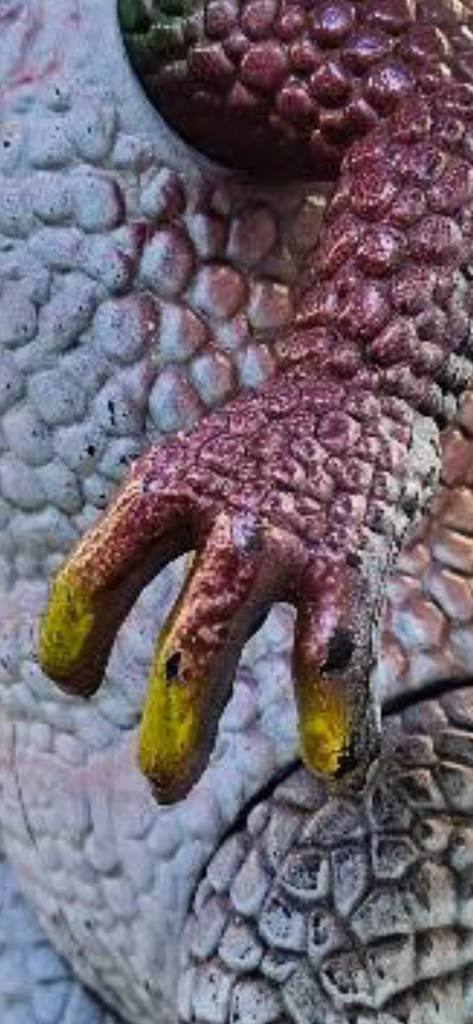
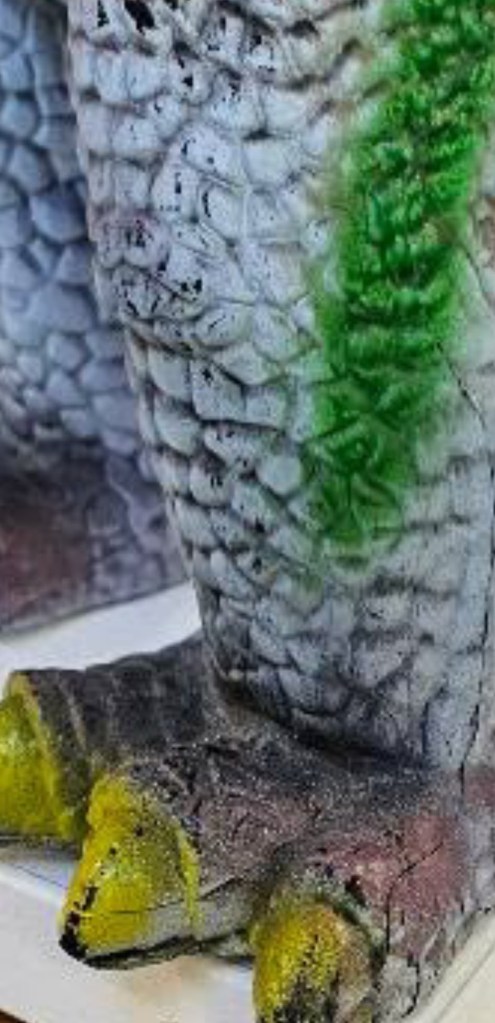
(Details of images of the one in a private collection)
The latter, however, has scuffs to its hands and feet-claws that clearly show the black vinyl underneath. So production did continue in the Chinese factory in the usual black vinyl when they received the molds for the 1997 models, but they also experimented with pale turquoise vinyl, and then with a dark varnish on a small number of both of the ‘1997’ and earlier-design figures in order to make their details ‘pop’.
⁂⁂⁂
So, where does this leave us? A few things seem likely:
(a) all the 1997 marked Dor Mei Godzillas, as well as all the white / pale turquoise ones (even if these bear the copyright mark of 1986 instead, and used the older less chunky bodies and legs) were all produced in China in the mid- to late 1990s;
(b) however, Hong Kong company records indicate that Dor Mei was wound up in 1994, with no further company I can detect there bearing the Dor Mei name;
(c) whomsoever was producing these Chinese-marked Dor Mei Godzillas appears to have felt some freedom from earlier designs, and while many were produced in the traditional styles and colours, some were produced in a slightly larger and chunkier design with metallic sprays, and white / pale turquoise colour variants appear to have been experimented with. So in these last days of Godzilla production in the Dor Mei name, and apparently after Dor Mei itself was wound up, new designs appeared and new types of decoration were trialed and tested alongside the actual production lines while these churned out Godzilla parts. It is this last aspect that seems so out of keeping with the way Dor Mei had operated from its incorporation from 1978 onwards – in that they seem in all other cases to have worked out issues with models before putting them into production, and when in production their products are remarkably consistent. In doing this differently to what had come before, our producers in the mid- to late 1990s were operating more like smalltime bootleggers, rather than a large Hong Kong registered company.
All this leads me to suspect that late in the life of the company, Dor Mei moved some production to factories in adjacent mainland China (almost certainly in the Pearl River delta, easily accessible to Hong Kong via river) – like many other toy producers in the 1980s and 1990s. Then, when Dor Mei was dissolved in August 1994, either an offshoot company that has escaped detection in the records, or as I think more likely, another as yet unknown company, bought the Godzilla molds and the rights to the trademark, and continued production in the same Chinese factory (or factories) through to the late 1990s. As part of this, they must have created the chunkier design Godzilla and all the white /pale turquoise Godzillas – “Curiouser and curiouser”, as Lewis Carroll had Alice say.
⁂
[UPDATE 22 August 2026: Postscript: my friend, the titan of toy lore, Jamie Francis (see here and here), who knows way more about plastic dinosaurs than I ever will, points out that in 1993, Dor Mei seems to have sold designs and rights to some of their solid rubber dinosaur toys to Toy Major Trading Co. of Hong Kong (apparently founded in 1990s and still active), presumably as Dor Mei slid towards their end, and perhaps in an attempt to raise much-needed funds (see here for details). This did not include the rights to the Godzilla designs, but does chart some related events in the months leading up to August 1994 and the final dissolution of Dor Mei. If, as I have suggested above, the molds and rights to Dor Mei’s Godzillas passed to another, as yet, unnamed company at much the same time, then we might observe that this company does not ‘feel’ like a toy-producing-international-giant, but in their immediate tinkering with the designs and colour schemes, and active experimentation on the hoof, like a much smaller operation. In addition, as Dor Mei seem likely to have sold the rights to use their name as well as produce their products to this unnamed company, we might well speculate that this happened some time after the initial sell off of molds and rights of some of their product lines to companies such as Toy Major, when Dor Mei already knew they were certainly going under, and there was nothing to be lost by selling the rights to their trademark as well.
- 'MUTTON DRESSED AS LAMB': Godzillas and kaiju that look vintage, but are not
- American made Pachi
- BOOTLEG DINOSAURS – a little off topic, but sometimes needed here
- BOOTLEG GODZILLAS
- Bootleg Tokusatsu from China and its immediate neighbours
- Bootleg Tokusatsu from the Americas
- BOOTLEG TOKUSATSU HEROES
- Central Europe – Godzillas and kaiju from behind the Iron Curtain
- Chinese-region bootleg Godzillas -the plastic tide from the East
- Chinese-region made Pachi
- European made Pachi
- European-made Godzillas
- PACHI
- Pachi kaiju
- Pachi kongs
- Pachi superheroes – Ultraman and similar
- The Americas – bootleg Godzillas from the New World

 Confessions of a Kaiju Hunter
Leave a comment