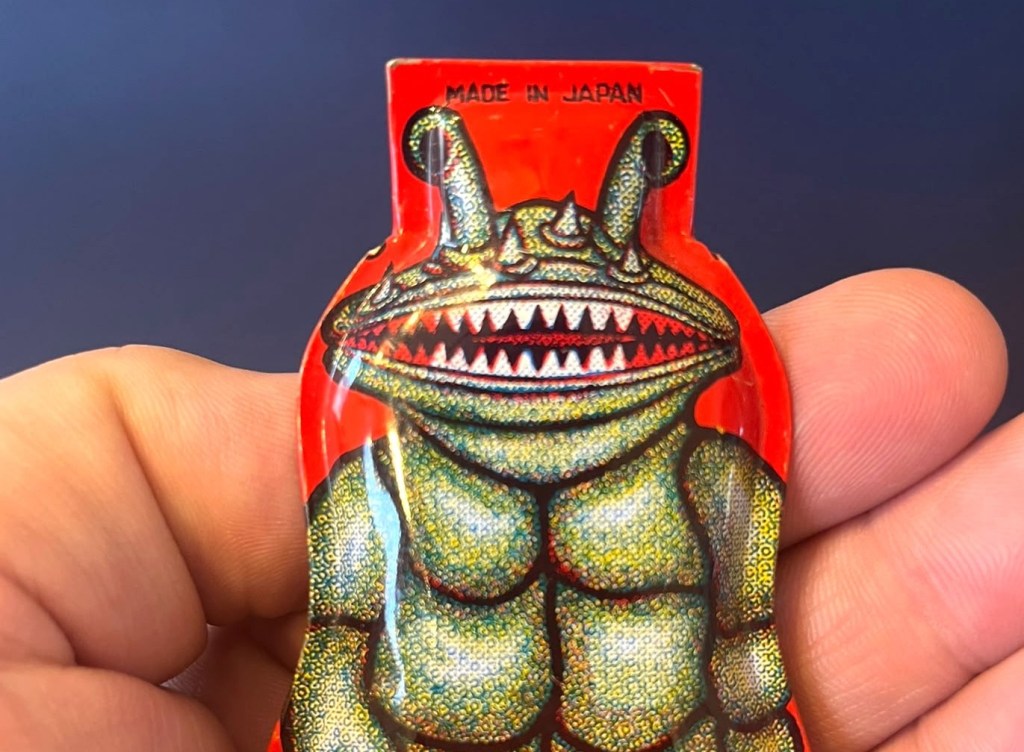
I will happily confess that I am not the one to write the comprehensive history of Japanese ‘cricket’ clicker-toys, but I do not know of any existing write-up of them beyond a line or so in sale descriptions. They survive in vast numbers, and mostly without easy reference points such as solid dates or maker’s marks, so perhaps the task has seemed too daunting. I am not aiming here to do more than shine a little light on one small group of these, and I hope that this might inspire someone else to complete this Herculean task – in which case, I wish you luck and industry through the words of Thomas Jefferson: “I am a great believer in luck. The harder I work, the more luck I have”.
These ‘cricket’ clicker-toys are among the simplest of tin toys, with a long domed upper section which lent itself well to colourful lithographed designs, and a short metal ‘tail’ underneath, that when pressed hard (perhaps too hard for comfort when dealing with vintage toys) makes a loud click sound. Videos of them being used can be seen here, and here.
They appear to have their origin in the famous ‘cricket’ toy made by J. Hudson & Co. in Birmingham, UK, in the 1920s, and that first name stuck with them throughout much of the twentieth century. Some 7000 of them were issued to the US 101st Airborne Division on D-Day to help in identifying friend from foe in the dark behind enemy lines (with one click used to announce your presence and ask about the other person, and two clicks confirming a friendly soldier; see here). In the immediate post-War period production of them boomed, most probably as tin metal was readily available and the toys were not complicated to manufacture. The factories of Occupied Japan and the period up to the late 1960s and very early 1970s churned out legions of them for the Western markets, usually brightly decorated with cartoon insects, dogs, monkeys and other animals, as well as tramps, clowns, cowboys and native Americans, and a host of other human characters. These were sold individually from card displays (see below), as well as packs of party favours. They seem to been quickly replaced in the late 1960s and early 1970s with the rise of the plastic toy industry, and within the first few years of the 1970s, production of them appears to have ceased for good.
The inscription “Made in Japan” appears on many of these from the 1950s onwards, and took over from earlier references to ‘Made in Occupied Japan’ or similar, but none, to the best of my knowledge, are dated, and very few bear any form of maker’s mark. The best we can hope for, to begin to organise this enormous mass of material, seems to be dividing them up into groups based on their shape and size – these factors dictated by the presses used by factories to create the base metal shapes.
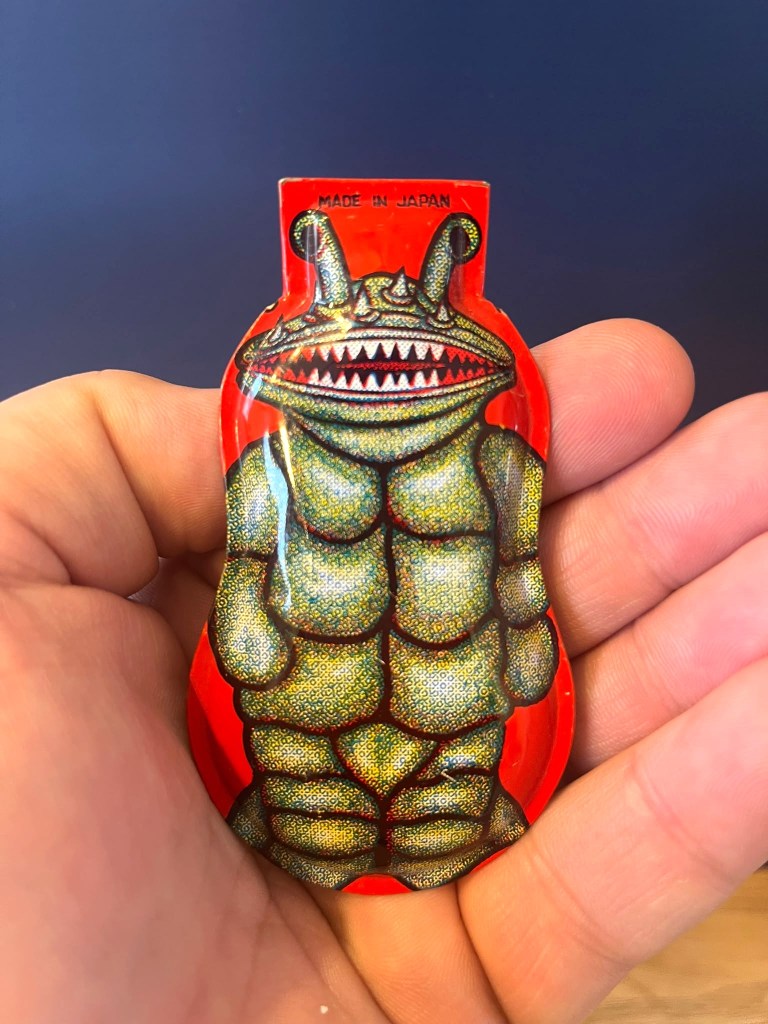
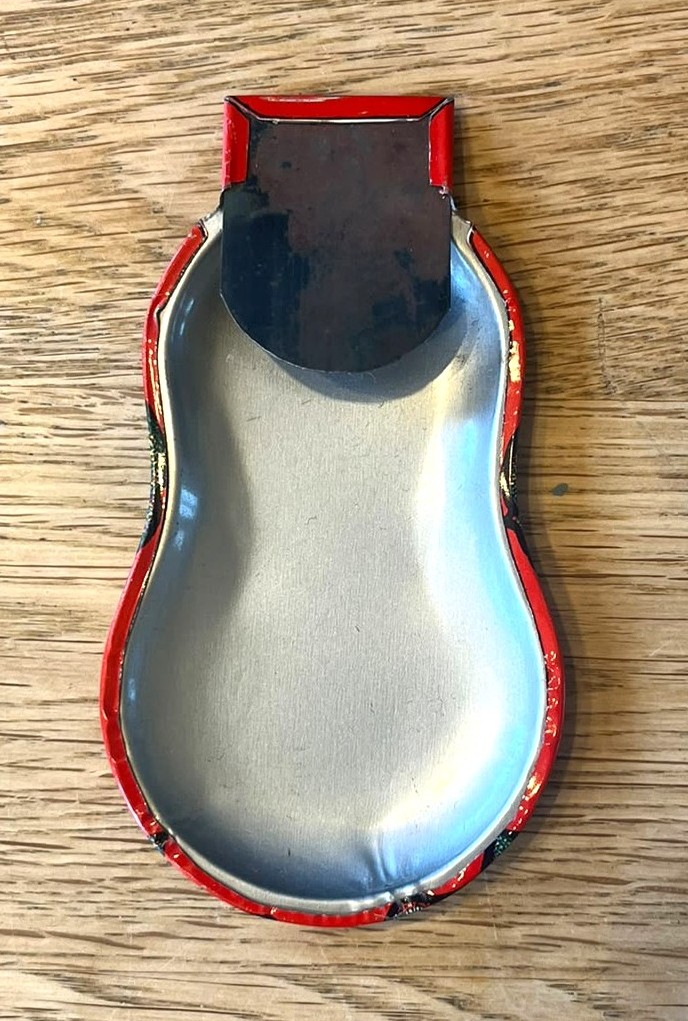
That which concerns us here has the basic peanut shape (with a rectangular head and a slightly larger lowermost bulge of the ‘peanut casing’), which is found on numerous examples in small bag-and-header packaging bearing the apparent trademark of “Aigami” beneath a line-drawn eagle with spread wings (these are not the only shapes of these toys that appear in packaging with this name, but we will only focus on this small sub-group here).
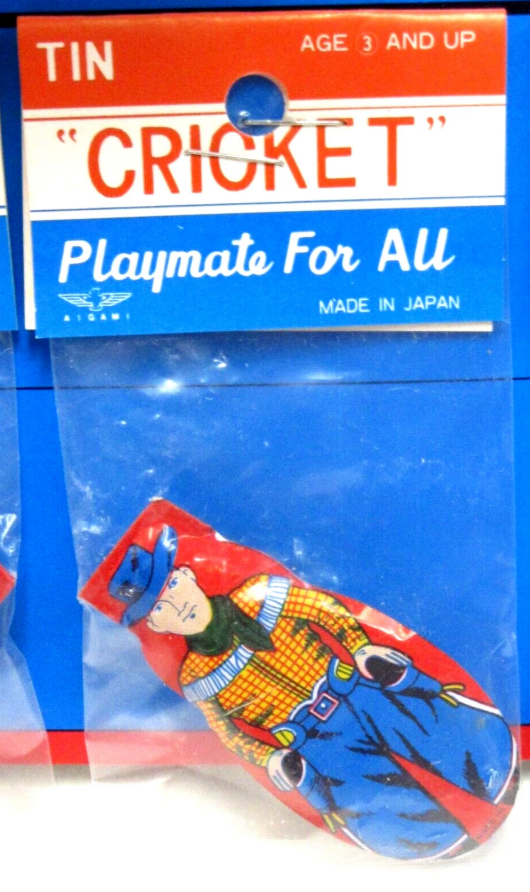
(An example of a clicker-toy of the same size and dimensions in its original packaging; note the “Made in Japan” in the same font, but moved to the foot of the toy; this image from an online sales listing)
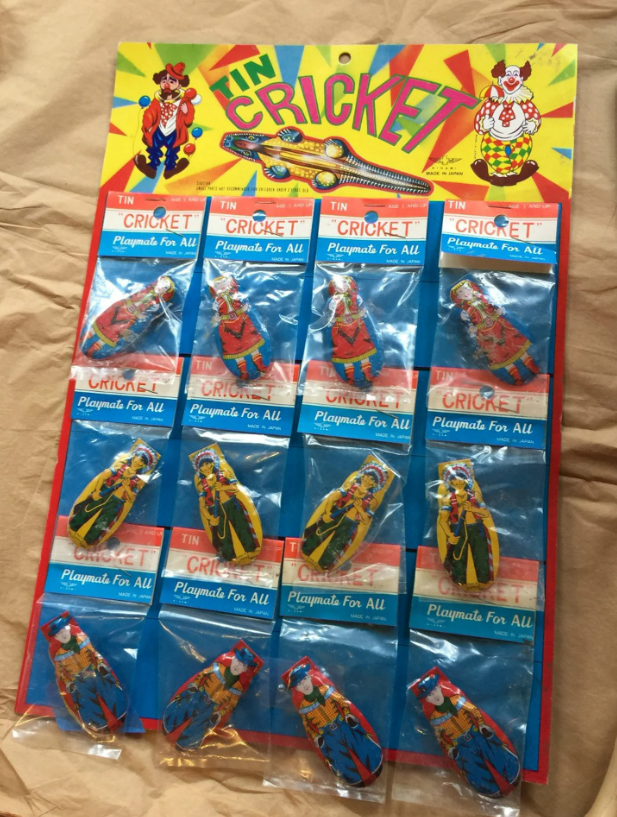
(Image of a display card of Aigami clickers, here from an online sales listing)
However, it is far from certain that ‘Aigami’ was a single company, and this should more probably be understood as a form of export or distribution quality control mark for the products of a number of Japanese factories, added to goods destined for the international market.
In fact, I can trace remarkably few products issued under this ‘Aigami’ mark beyond these clicker toys, with the others all puffy stickers dating to the 1960s and 1970s (see below for examples). If any reader knows of others, please do get in touch.
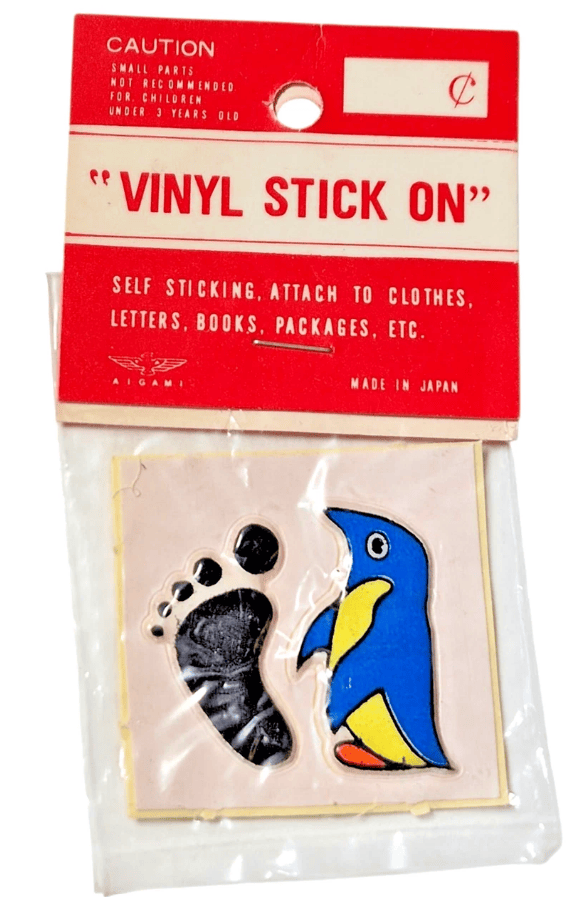
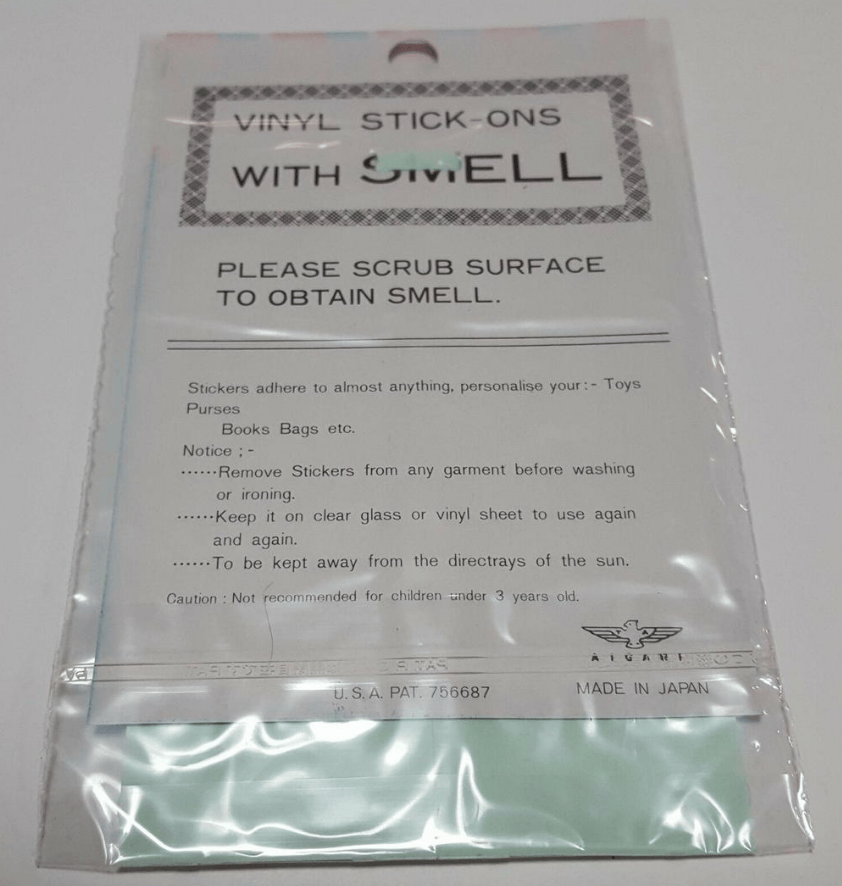
(First image from an online sales listing; second from a Worthpoint listing showing the reverse of packaging for a ‘scratch and sniff’ set of fruit stickers)
Somewhere in the blizzard of anthropomorphised dogs and monkeys, clowns and cowboys and so on, a designer for this group, who was clearly searching for inspiration, appears to have been watching Ultra Q (which ran in 1966-67 on Tokyo Broadcasting System), specifically episode 15, in which the kaiju Kanegon appeared for the first time (although in this appearance Kanegon is a transformed greedy child rather than a monster, and so not strictly a kaiju – see here for details).
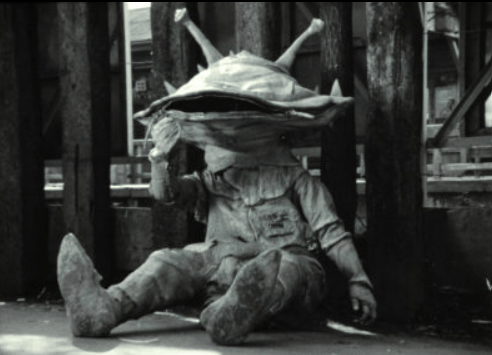
(Image from Ultra Q series; from here)
The design of the clicker-kaiju here is so close to that of the character in Ultra Q, that we must conclude that the designer here quietly lifted this ‘monster’ directly from the Ultra Q series. Both have an identical skin-plate-covered body created from influences of frogs and monkfish, and a head intended to echo the shape of a money purse (if not familiar with Kanegon, think of a spiky and amphibious version of Zippy from the British TV series Rainbow). We should note that Kanegon also appeared in the low budget Tokusatsu series, Redman, in 1972 (episode 19: see here for the almost comic and swashbuckling fight scene between Redman, Kanegon and Woo), in muted green tones, but in a suit of considerably lesser quality that lacked the distinctive head spikes and plated skin-folds of the front of his body in the Ultra Q design and here.
The designer responsible for our ‘monster’ was safe in the knowledge that as such clickers were made for the international market, it would be some considerable time (and most probably several decades) before his ‘borrowing’ was noticed. In fact, while United Artists Television did commission an English-language dub of the Ultra Q series through Titra Studios in New York City during the second half of the 1960s, it was canned and never broadcast in the US or Europe due to the increasing favouring there of programmes in colour.
However, our designer did have to fill in a few details himself. Ultra Q was filmed in black-and-white of course, and our designer added a novel vivid green colour scheme (when official Kanegon was first seen in colour, he appeared in shades of copper-brown to reflect the colour of the coins he desired to eat), and he also ‘beefed up’ the teeth to add to the monstrous aspect of the creature here. Marusan produced a large size Kanegon sofubi in base blue in 1966, which when combined with a gold spray in large stripes does look green, and Bullmark followed with their large Kanegon sofubi in 1971 in a series of colours, one of which copied the blue+gold (= green) of Marusan (for images of these, see the excellent resources at Clubtokyo here and here). While the design of those sofubi have slight differences that set them apart from our clicker-kaiju here, it is possible that either of those toys inspired the choice of colour here.
⁂⁂⁂
I have searched and searched for other clicker-toys with kaiju or monsters on them, but found none, and it seems possible that this little pachi Kanegon is the only one of his type. I hope some clicker-toy collector will let me know I’m wrong, and that there are many more as glorious as this one.
- 'MUTTON DRESSED AS LAMB': Godzillas and kaiju that look vintage, but are not
- American made Pachi
- BOOTLEG DINOSAURS – a little off topic, but sometimes needed here
- BOOTLEG GODZILLAS
- BOOTLEG MECHA
- Bootleg Mecha from Europe
- BOOTLEG PRODUCTION MATERIALS – MOLDS ETC.
- Bootleg Tokusatsu from China and its immediate neighbours
- Bootleg Tokusatsu from Europe
- Bootleg Tokusatsu from the Americas
- BOOTLEG TOKUSATSU HEROES
- Central Europe – Godzillas and kaiju from behind the Iron Curtain
- Chinese-region bootleg Godzillas -the plastic tide from the East
- Chinese-region made Pachi
- European made Pachi
- European-made Godzillas
- Japanese-made pachi
- Japanese-made Pachi
- LICENSED GODZILLAS AND KAIJU – deserving honorable mentions despite their official status
- PACHI
- Pachi kaiju
- Pachi kongs
- Pachi superheroes – Ultraman and similar
- The Americas – bootleg Godzillas from the New World
- Uncategorized


Leave a Reply