I am starting to worry that I am becoming the Mason Verger of the bootleg-toy-world, occasionally being offered Godzilla production items by various incarnations of Barney the nurse, and completely unable to stop acquiring them for the thrills they bring me. I’m SURE it’s not that bad if it’s Godzilla bootleg stuff, as opposed to serial killer paraphernalia, or at least I HOPE so. Anyhoo, that’s what I am telling myself today, so let’s move swiftly on ….
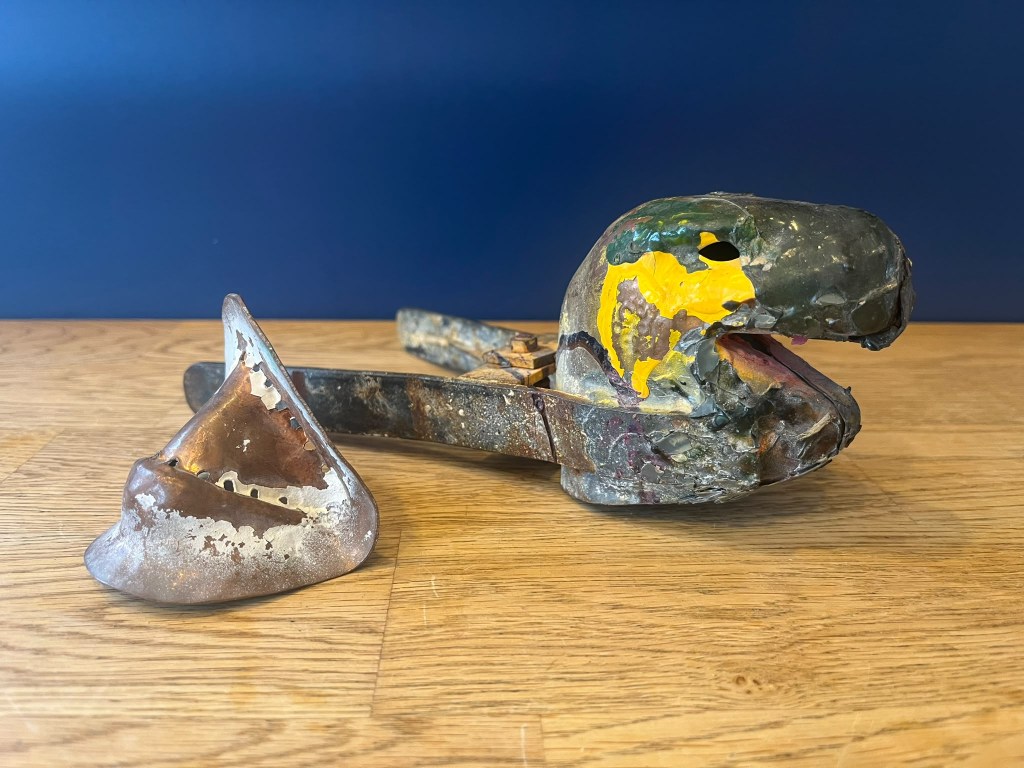
That difficult thought aside, I recently acquired a set of metal paint-masks for the painting of the details of the heads of one variant of the JHL Godzilla bootlegs. As I laid out in an earlier post on JHL (link here), JHL made large-size Godzillas with two variant heads, and the paint-masks here were made to fit around the rounded-muzzle head-sculpt as copied by JHL from one of the Dor Mei Godzilla bootlegs.
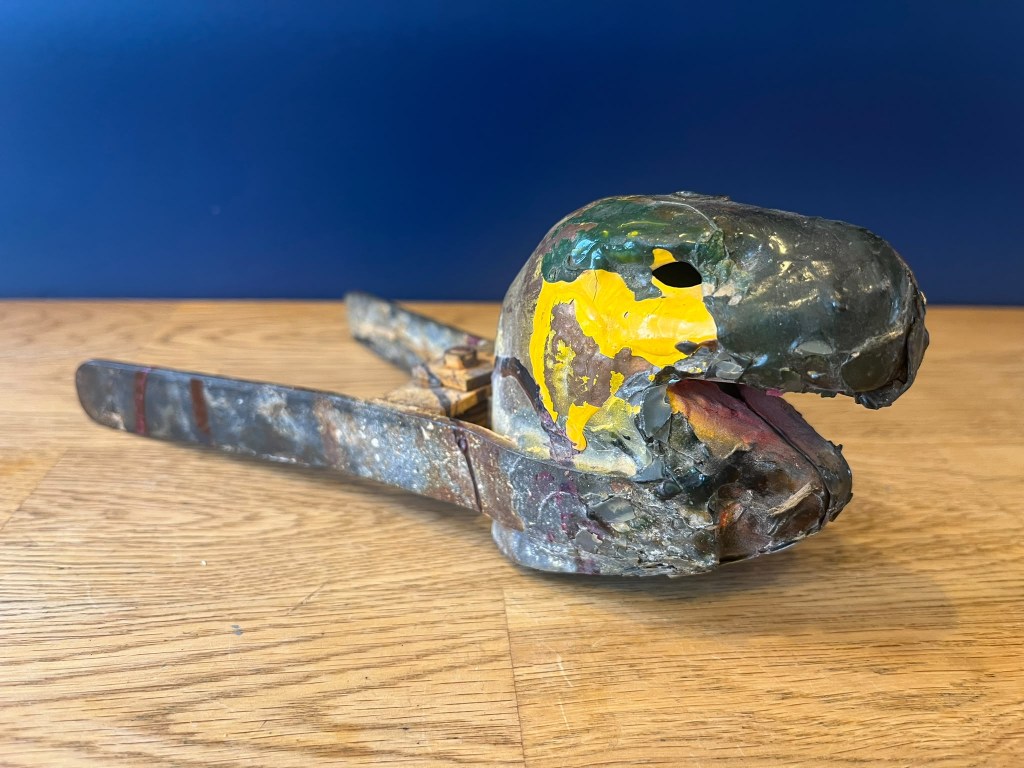
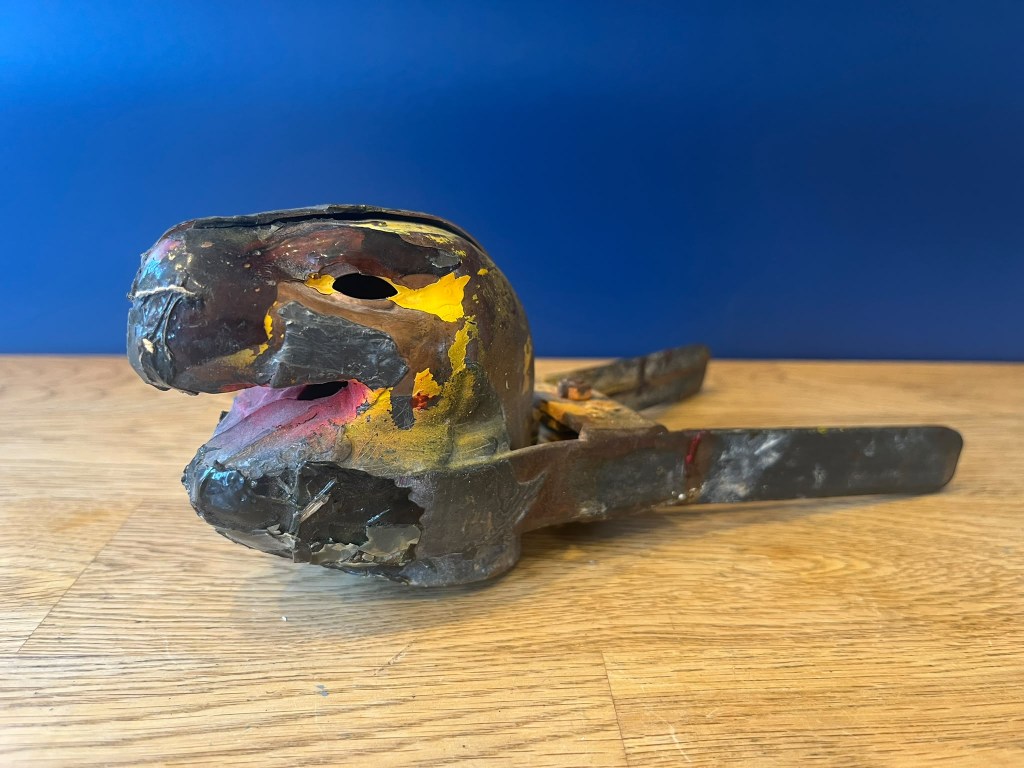
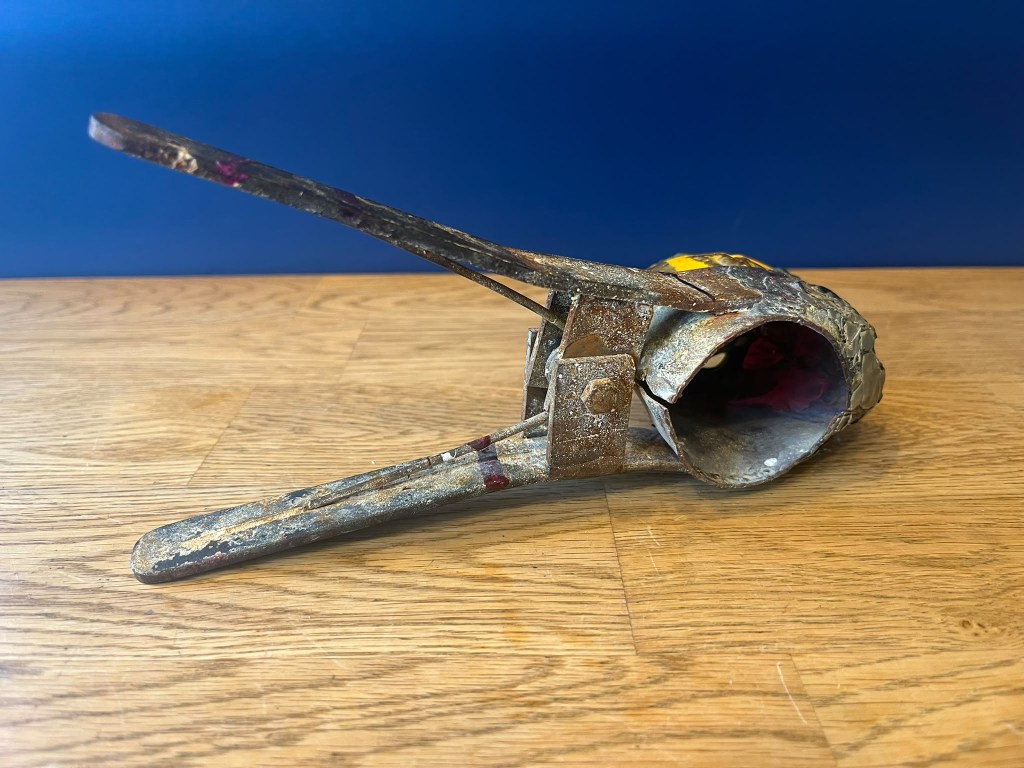
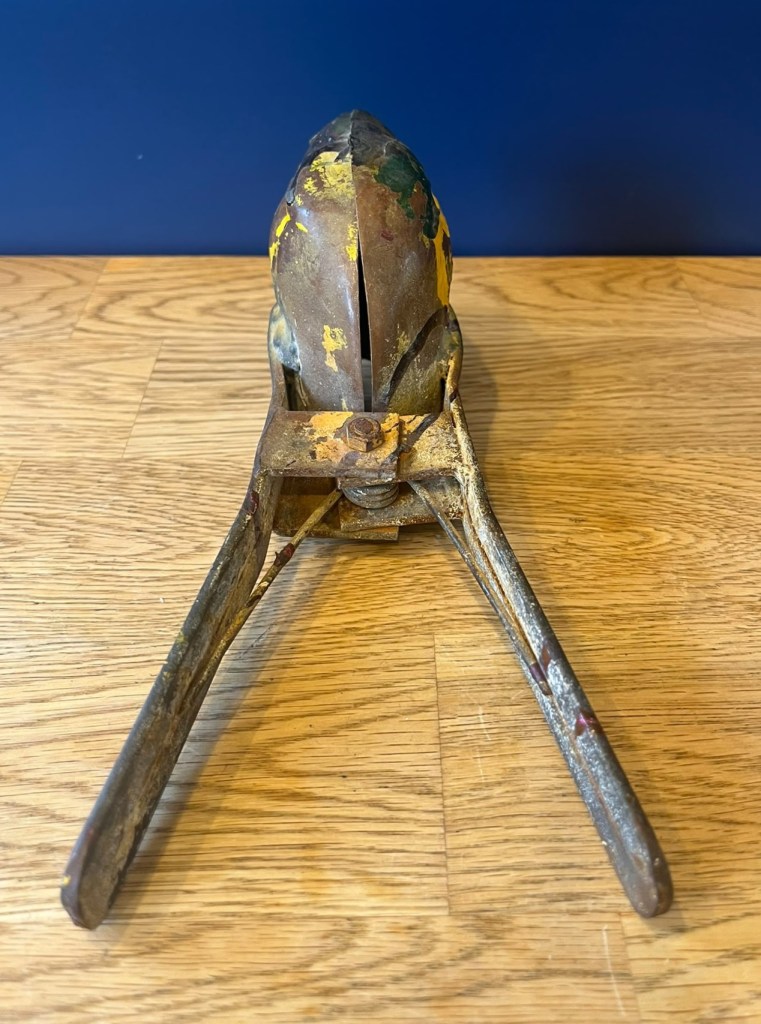
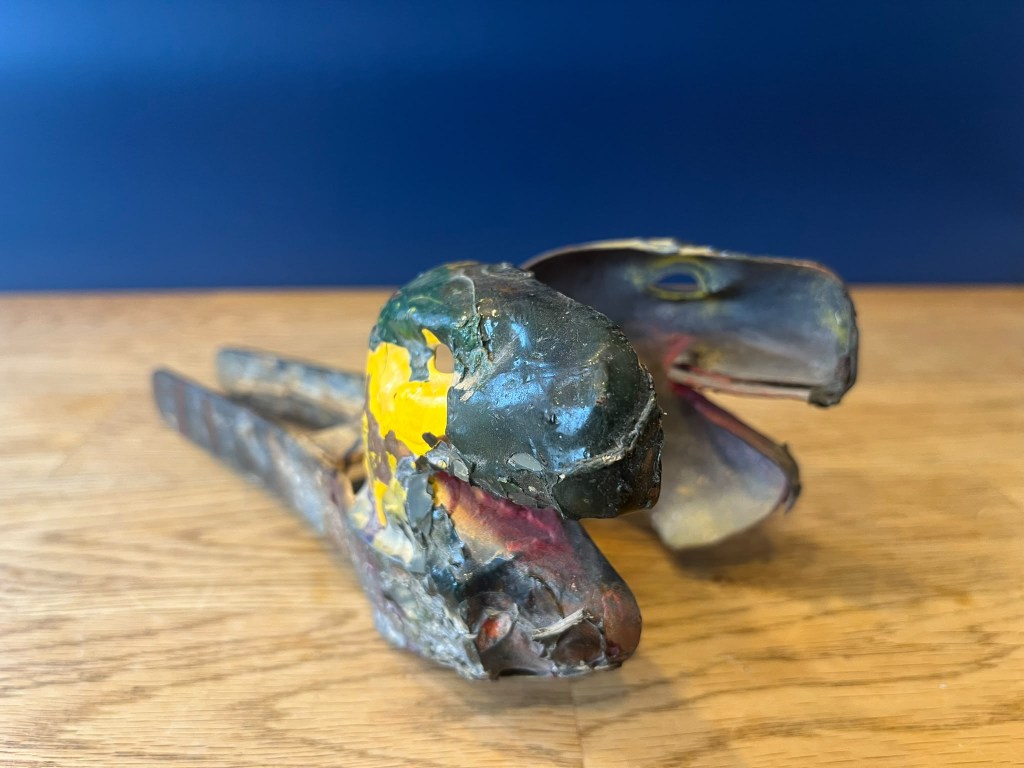
These comprise of:
- (1) a complete head paint-mask (see above for images) made of thin copper sheet, bent and shaped to fit around the vinyl Godzilla heads without marking or damaging them (this part measuring 75 x 90 mm.). These are welded to steel arms that are arranged as spring-loaded pincers (these just over 180 mm. long), so that the device can be opened at the front by squeezing the handles at the back together. Thus, they can be worked with a single ‘off-hand’, while the ‘main hand’ works a paint gun, to paint the details of vinyl heads at a rapid pace (a short video of the painting of toys using this method by a Spanish artist, and the rapidity it can bring to the painting process, can be viewed here).
- (2) a copper piece with two rows of small archway-shaped holes (measuring 70 x 70 mm.; see below for images) shaped so that it can be quickly pressed over the mouths of the bootleg figures, and the white of the teeth can be sprayed through the holes.
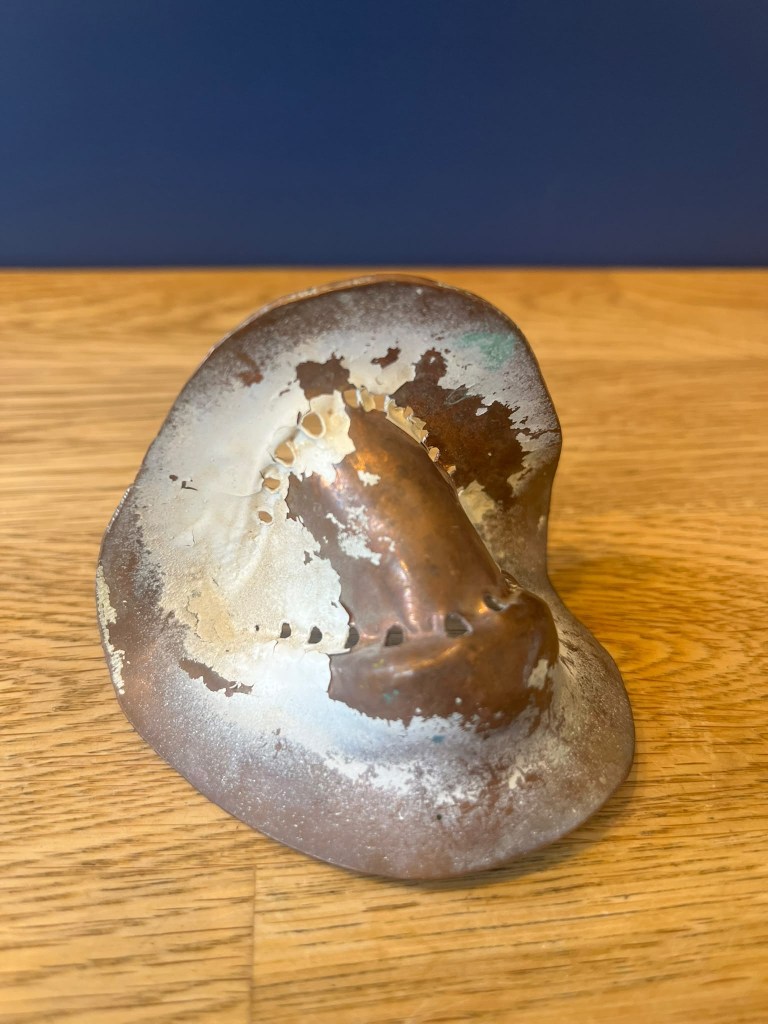
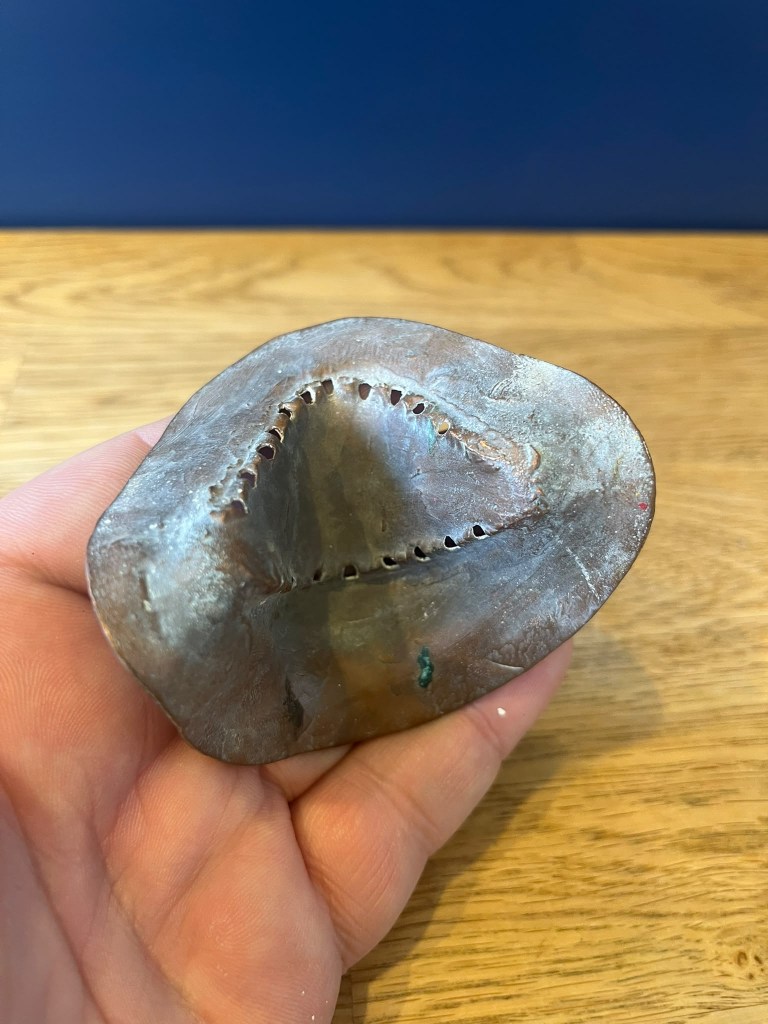
Among the old paint splatters and other signs of long and frequent use, one odd thing catches my eye here – a small patch on the inside of both halves of these masks/guards at the widest point of the cheek just under the eye, where the impression of some of the scales of the figure’s face are imprinted in the metal (see below for images). This is not vinyl residue, it is imprinted into the surface of the copper.
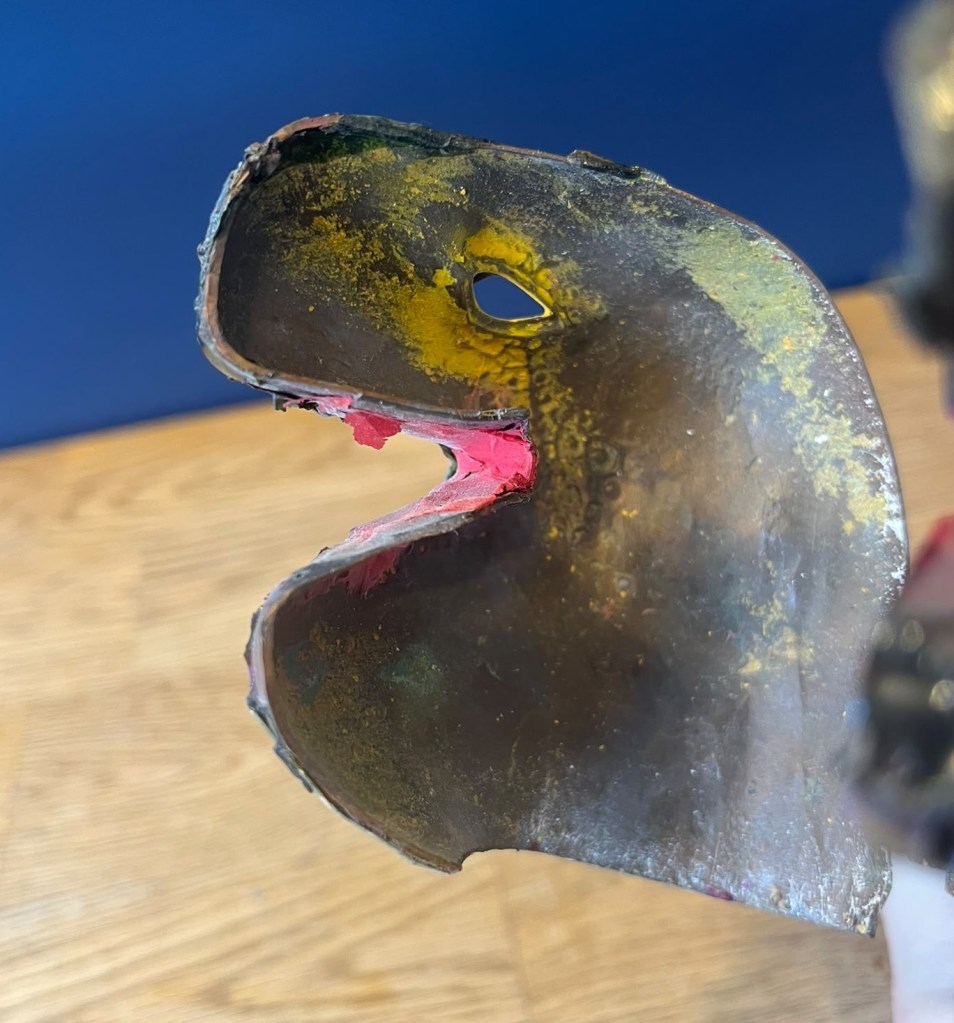
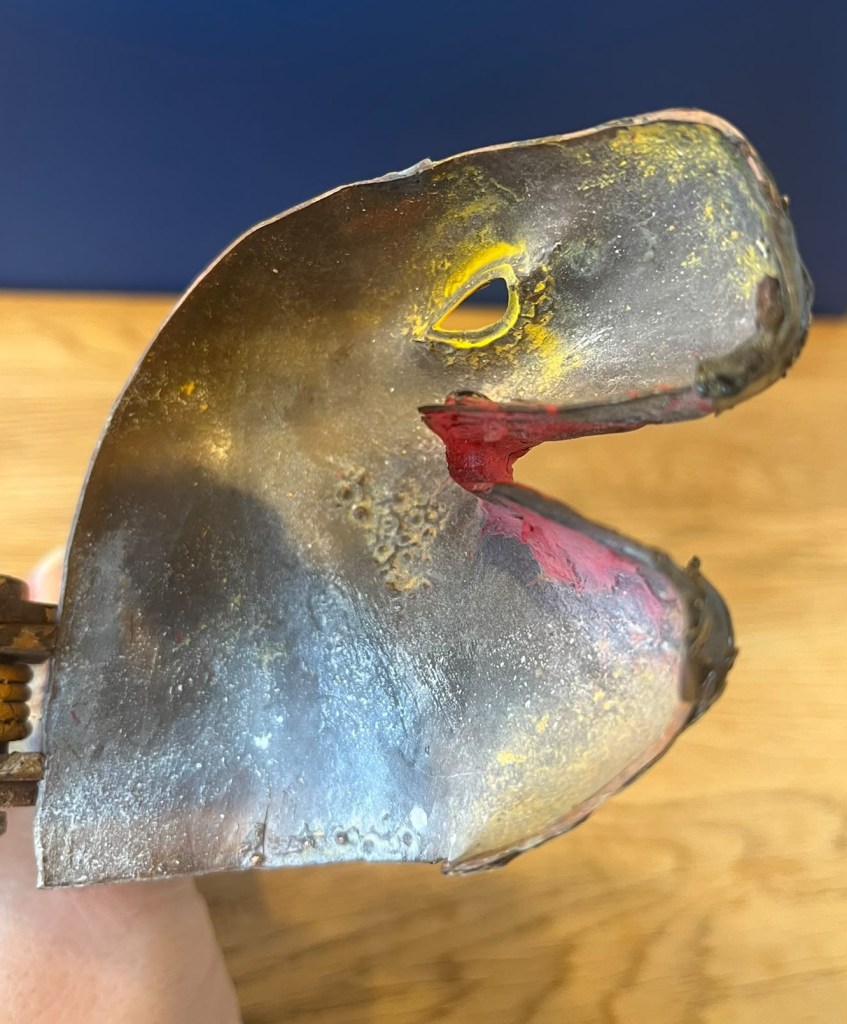
Marks on the outer-side of one of these small patches suggest that these are from hammer blows to the outside of the masks/guards. I doubt if any vinyl head would stand up to such hammering, so I am left to conclude that these paint-masks were made by producing a version of the figure’s head in a hard substance (probably a metal with a low melting point), and that was then used to fold and hammer hot copper sheets around, with the hammer blows from that process leaving these marks at the widest extremities on each side of the head. I presume that the metal head piece used for this was made from a simple cast of one of the vinyl heads.
These devices are called ‘trepa’ (pl. ‘trepas’) in Spanish, meaning stencil or similar, and the word has a fascinating etymology. Ultimately, it comes from the medieval Latin trepare (‘to leap or dance’), which evolved under the influence of Germanic words like treppe (‘stairs’) in the sense of taking rhythmic and repetitive steps. From there, around the thirteenth century CE., in the context of the Spanish textile industry, the word seems to have taken on a new meaning: to pierce or slash fabric in decorative patterns, with the action of using a needle or blade to work its way up and down through cloth being likened to a climbing motion. From that use, all cut-out cloth patterns and lace-pieces became known as trepa/trepas, and then later the word was used for all perforated decorative masks or stencils no matter what the base material was.
I wonder if this is a distinctively Spanish method of decoration. Unfortunately, few Chinese molds and other pieces of production equipment survive the recycling processes there, so we cannot easily know much of the production processes there. That said, Spanish Godzilla bootlegs usually have more clumsily or cursorily painted eyes and teeth than Chinese ones, and in the case of the latter the common presence of white paint on the inside of the surface of the teeth, as well as the outside, suggests the use of a physical brush (rather than an airbrush).
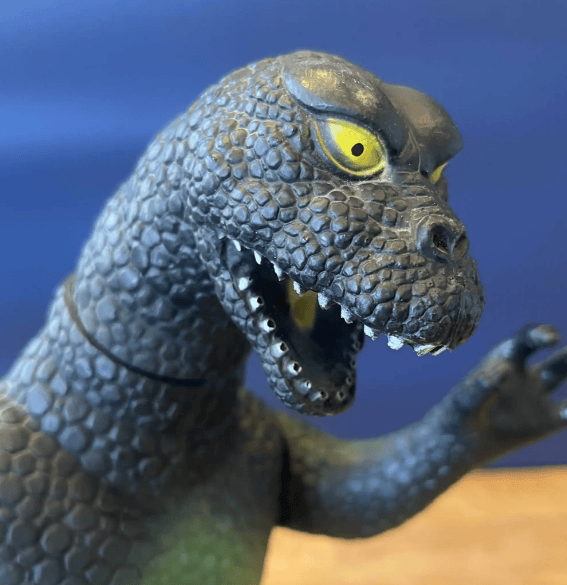
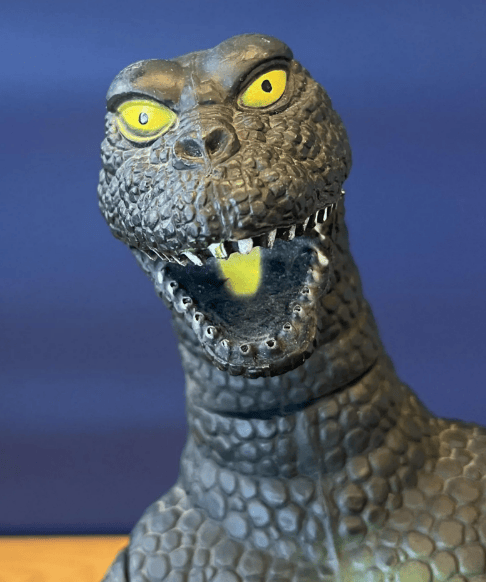
(Details of the correct variant of the JHL Godzilla head showing the misaligned and clumsily painted facial details)
⁂⁂⁂
I have said it before, and I will say it again – in my opinion, there are those who collect vintage toys, and flying high above them are those who collect bootleg vintage toys, and then in the rarefied atmosphere far above them, are those who collect production materials for vintage bootleg toys. I suspect that soon these items will all be gone – ignored, overlooked and melted for scrap value. Every single one has its own part to play in helping us see the production processes for these figures, and I would willingly crawl a mile over broken glass, naked, for every single one. Beautia est in oculis illi qui vis.
- 'MUTTON DRESSED AS LAMB': Godzillas and kaiju that look vintage, but are not
- American made Pachi
- BOOTLEG DINOSAURS – a little off topic, but sometimes needed here
- BOOTLEG GODZILLAS
- BOOTLEG MECHA
- Bootleg Mecha from Europe
- BOOTLEG PRODUCTION MATERIALS – MOLDS ETC.
- Bootleg Tokusatsu from China and its immediate neighbours
- Bootleg Tokusatsu from Europe
- Bootleg Tokusatsu from the Americas
- BOOTLEG TOKUSATSU HEROES
- Central Europe – Godzillas and kaiju from behind the Iron Curtain
- Chinese-region bootleg Godzillas -the plastic tide from the East
- Chinese-region made Pachi
- European made Pachi
- European-made Godzillas
- Japanese-made pachi
- Japanese-made Pachi
- LICENSED GODZILLAS AND KAIJU – deserving honorable mentions despite their official status
- PACHI
- Pachi kaiju
- Pachi kongs
- Pachi superheroes – Ultraman and similar
- The Americas – bootleg Godzillas from the New World
- Uncategorized


Leave a Reply