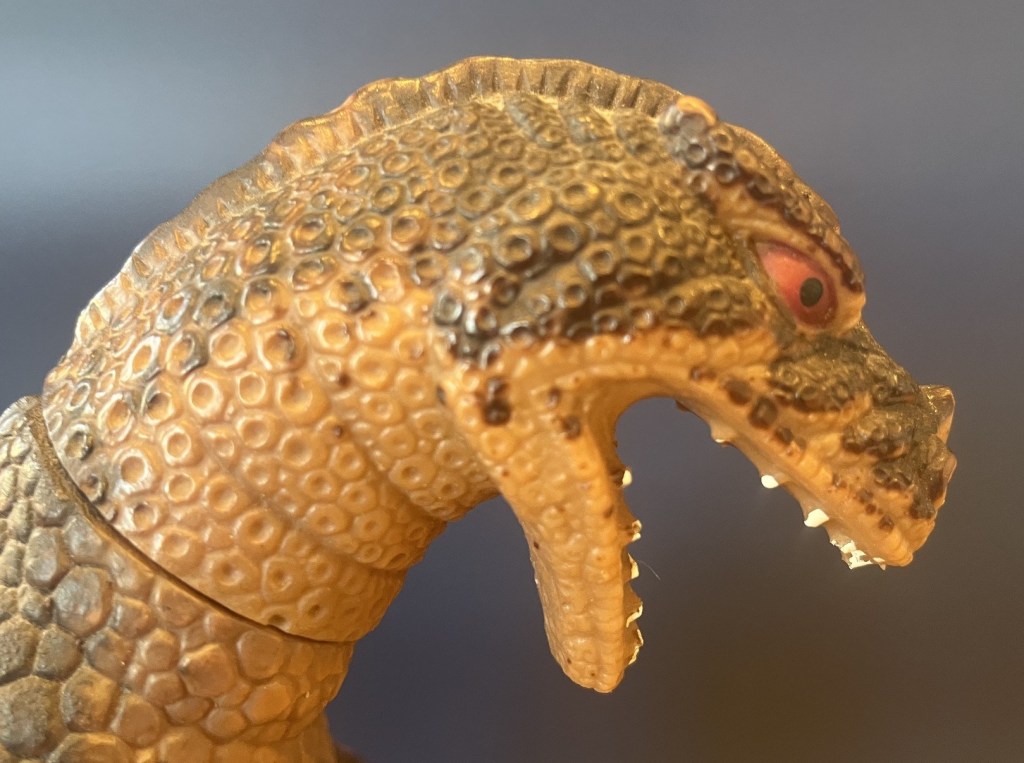
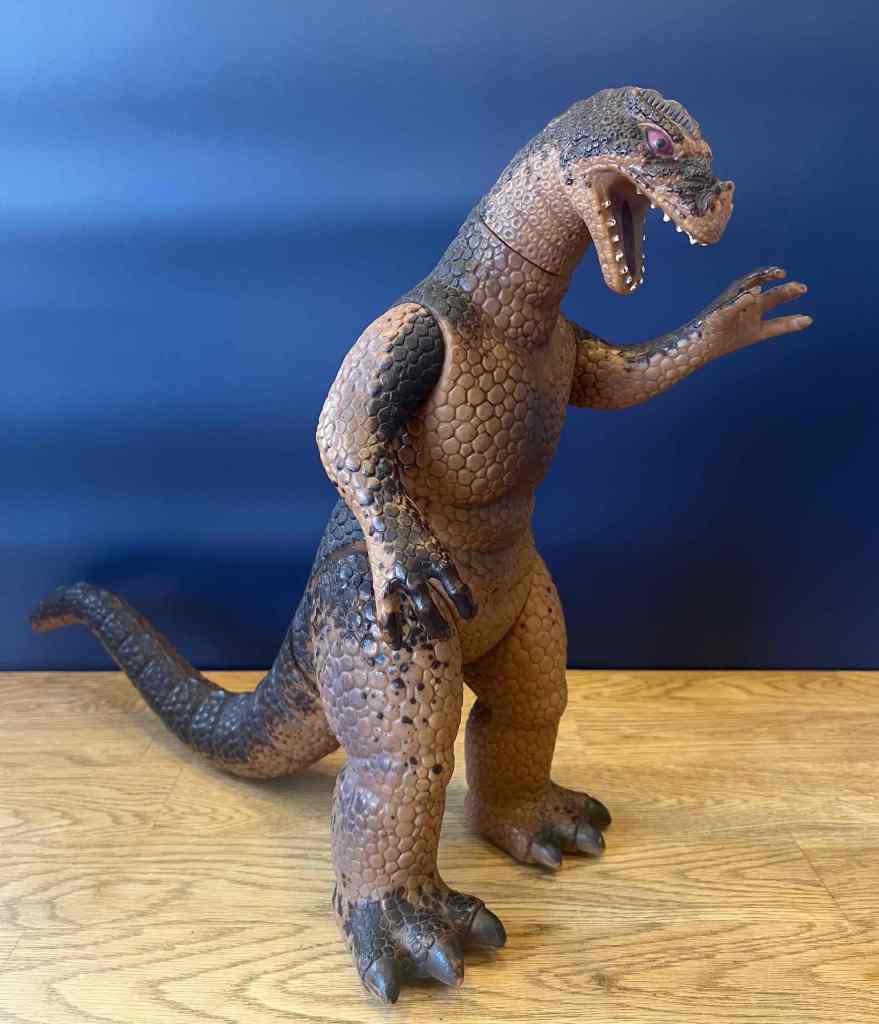
My passionate love for all things JHL continues – a few weeks ago, I saw a sale post by the friendly and helpful Luis Cesar Marquez (I heartily recommend him to any reader as a contact in the Spanish toy-trade) and added an update to my main post on JHL about a brown variant with unusual paint shading. There I stated that I intended to show some much needed restraint, and not buy this model. Most collectors will know how that plays out, and I lasted almost a week before I succumbed and bought it. I remain proud of my enormous show of willpower here, but the family disagrees (my wife remains silent and tight-lipped on the matter, while the children have concluded I am a ‘weako’).
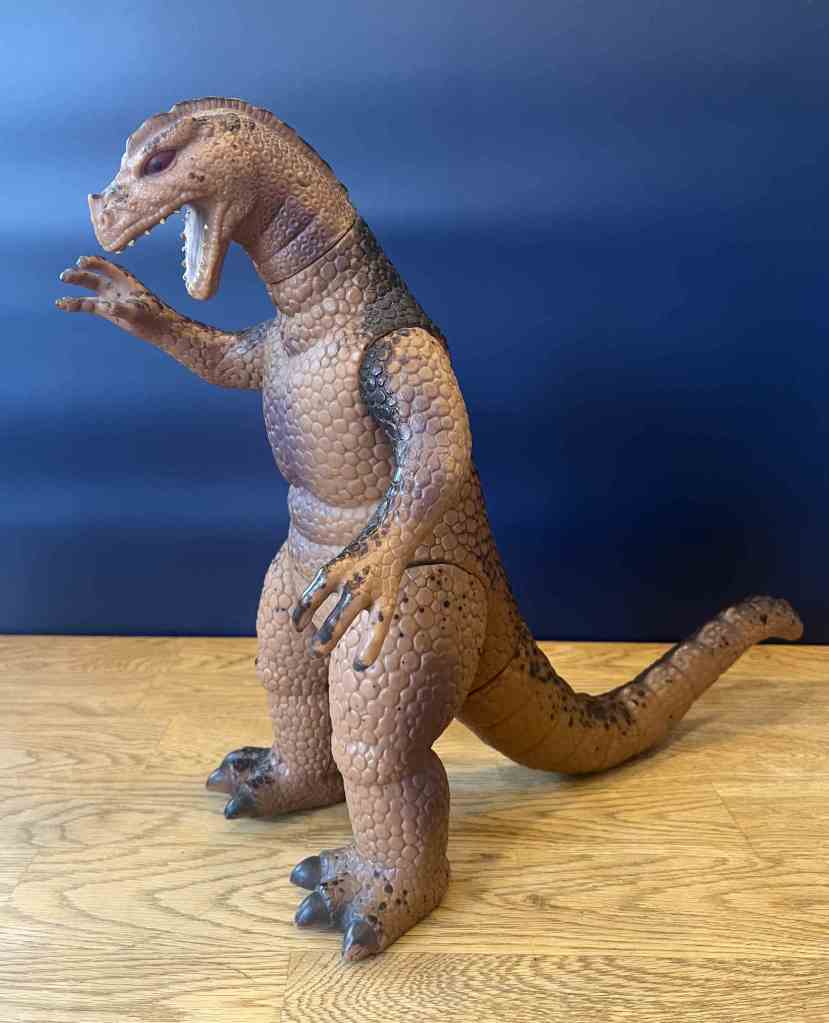
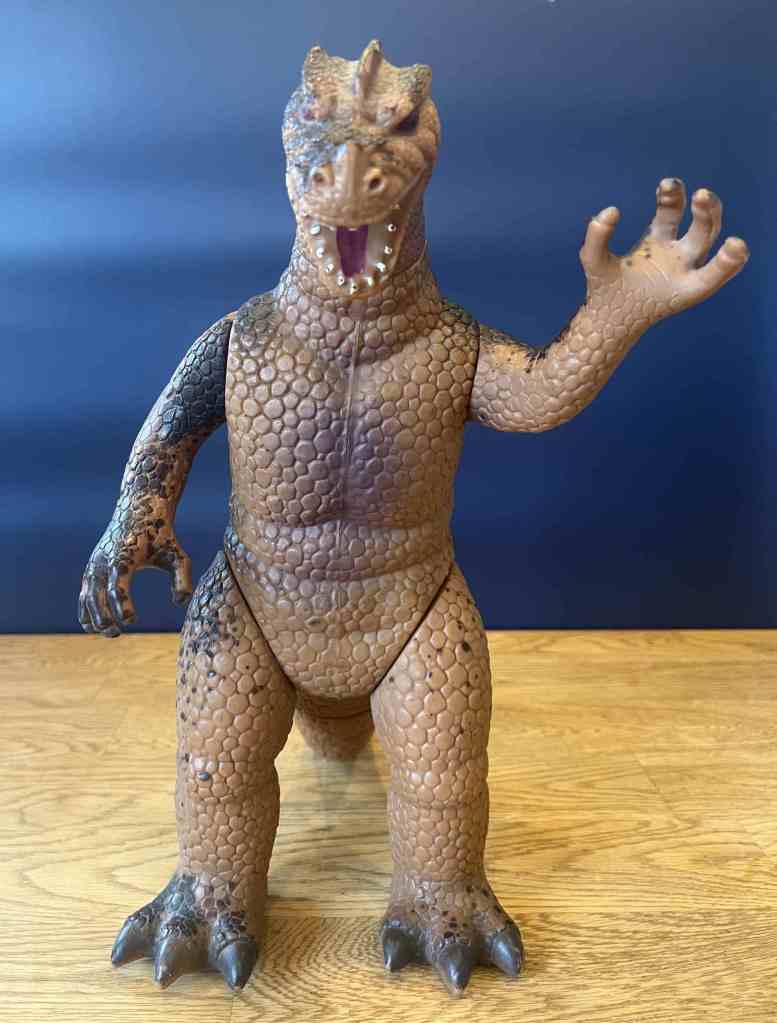
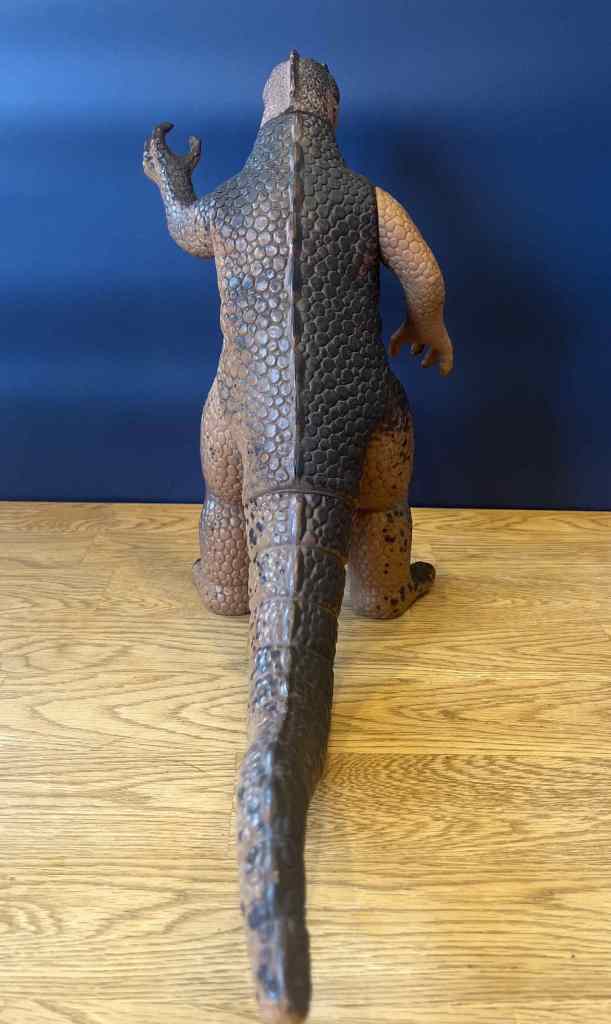
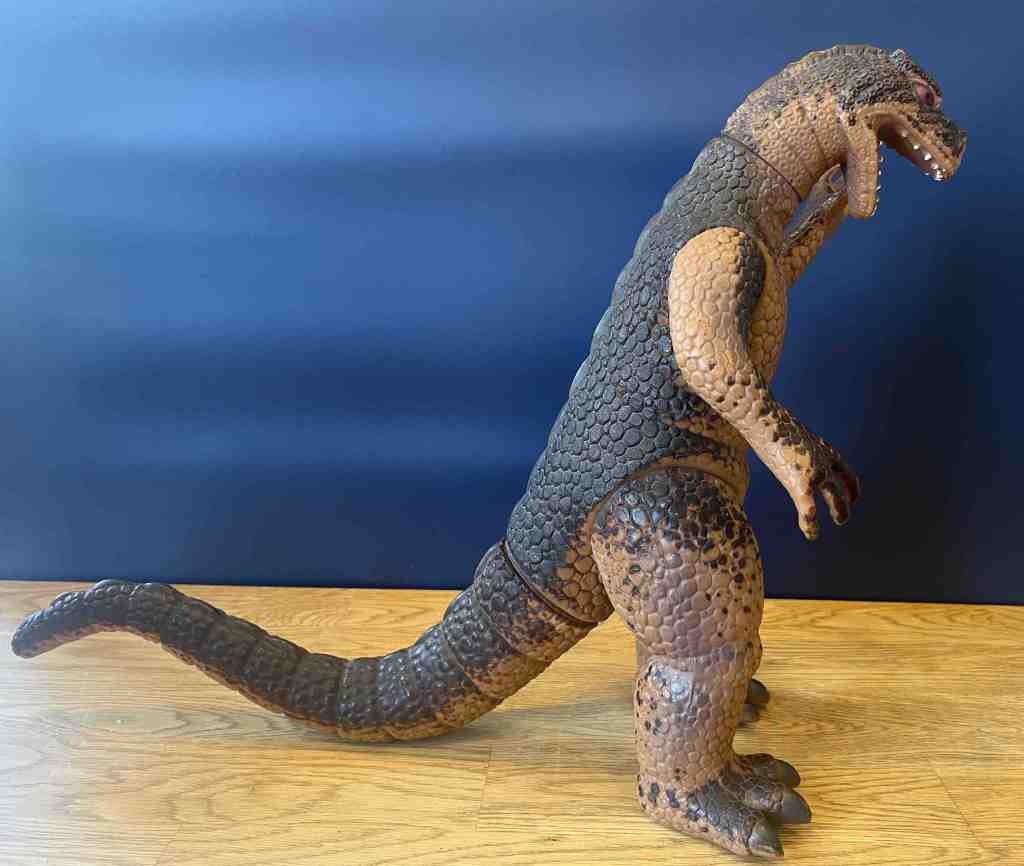
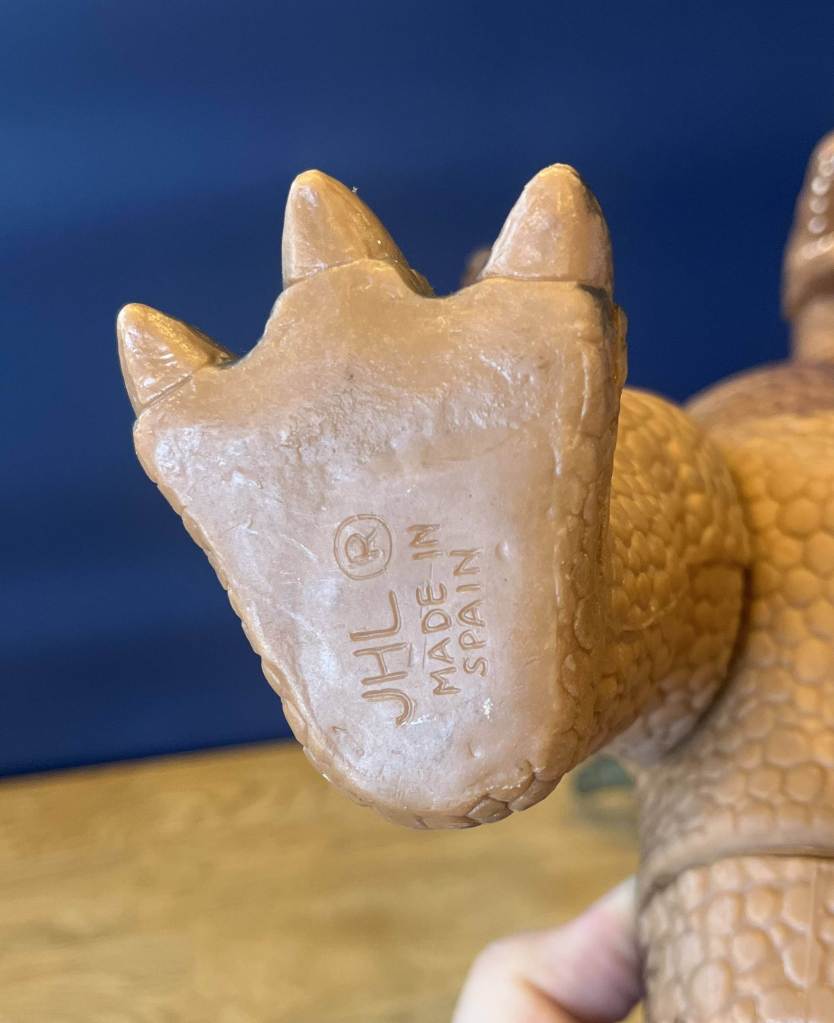
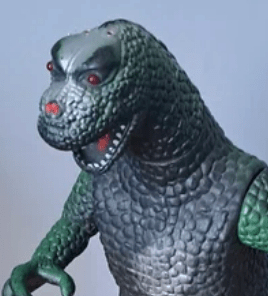
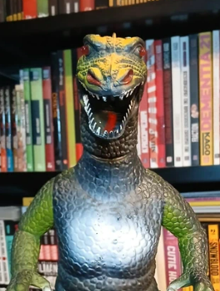
However, now that I have the Godzilla in hand, I feel vindicated in my self-indulgence. In form it is a good example of the normal type (ii) JHL Godzilla (as outlined in my earlier post: a precise copy of the Dor Mei Godzilla model, with a head cut-and-pasted from an anonymous Chinese bootleg of the Dor Mei Godzilla: the ‘lunar-crater skin Godzilla’: my *Bootleg of Dor Mei model 1 in my post on Chinese Godzilla models and bootlegs). In addition, the JHL marks on the sole of its right foot are crisp and clear. What is different is the size and the colour of the bootleg.
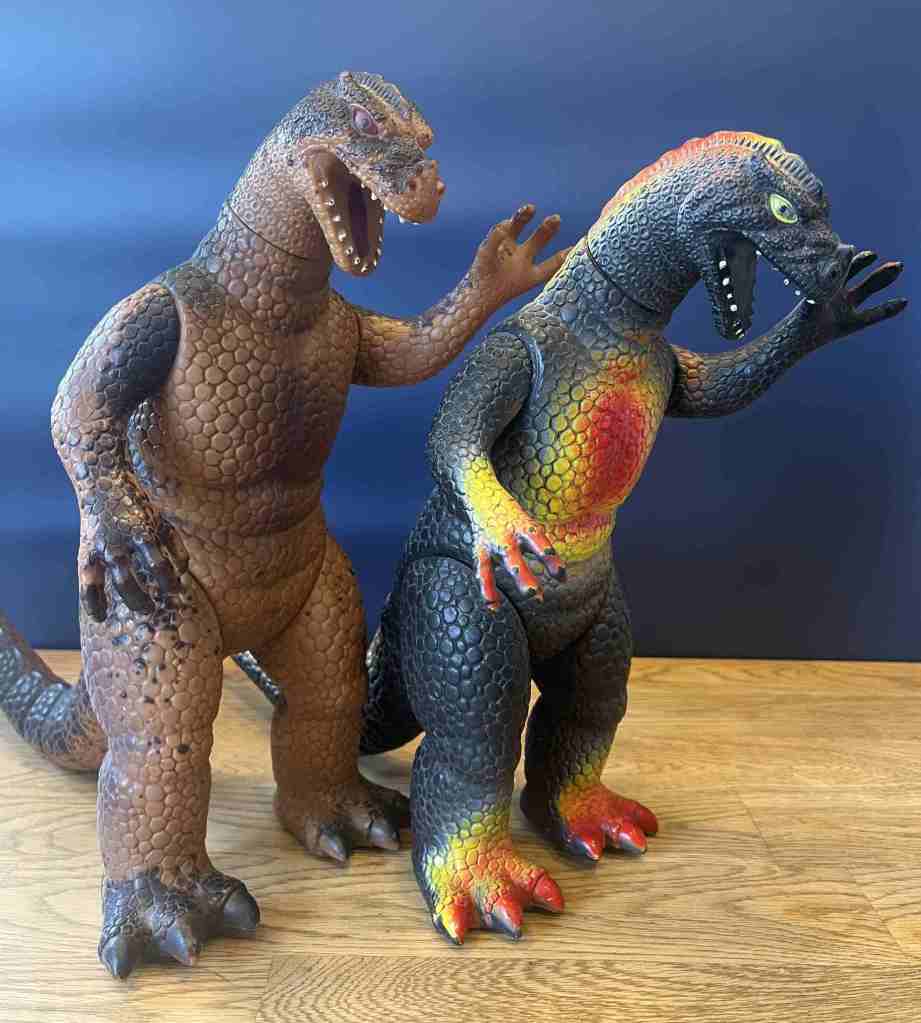
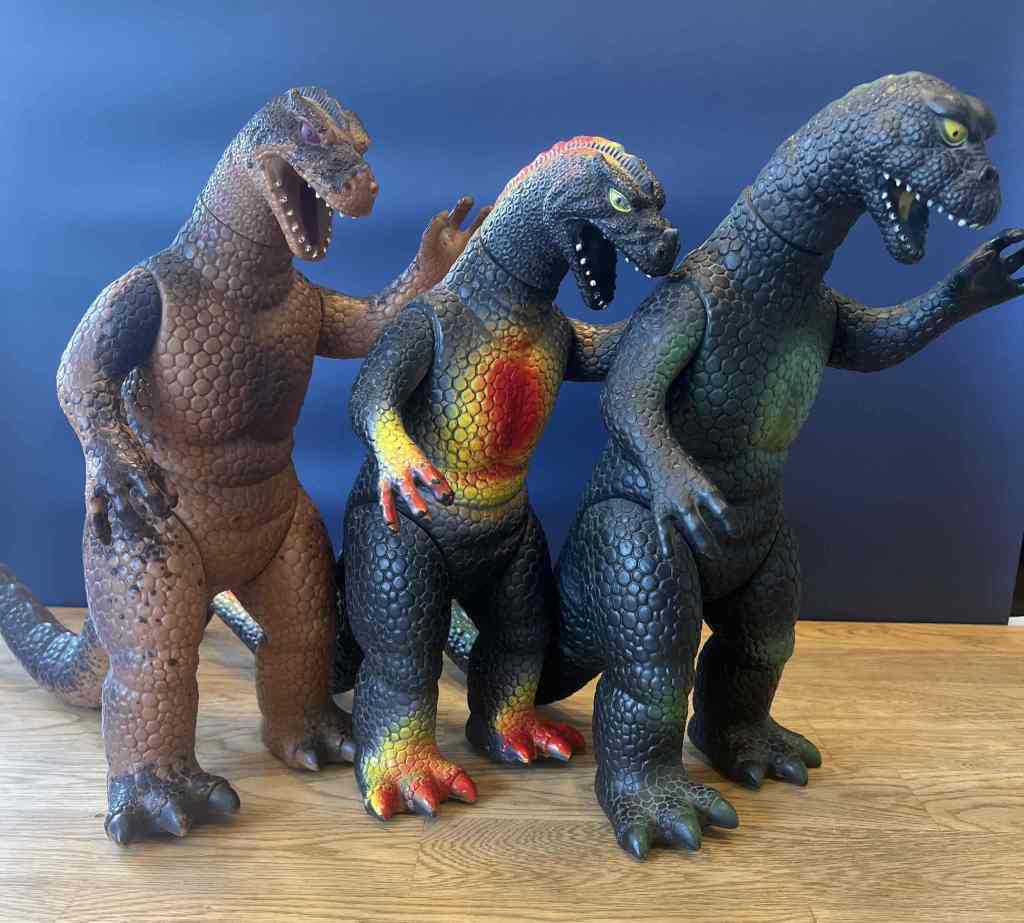
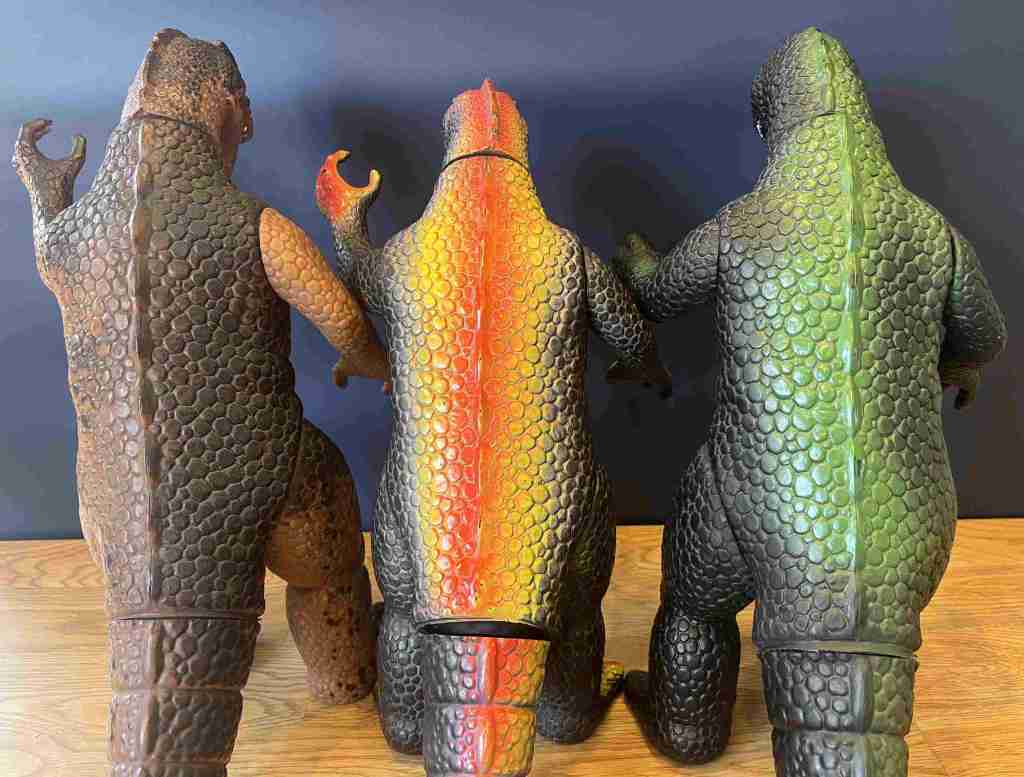
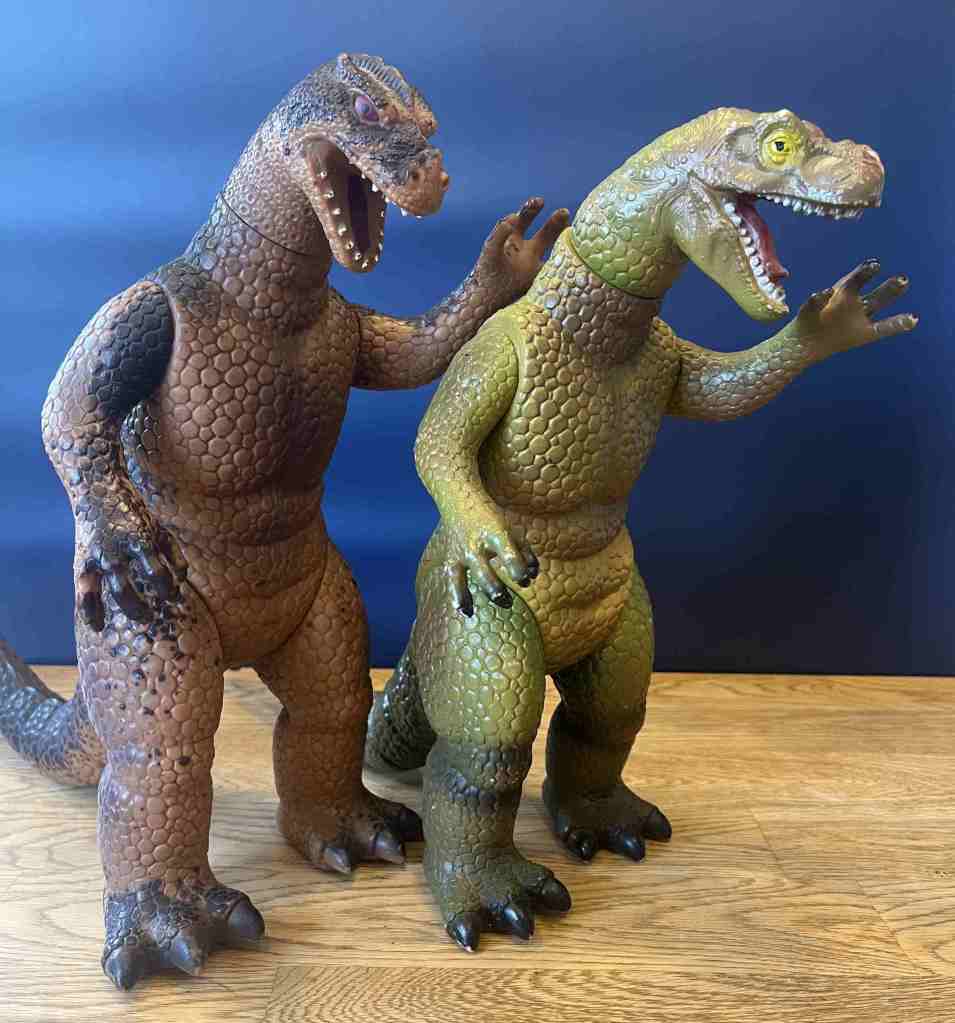
(The Choco-zilla next to his shorter sibling; and beside the same and another same size sibling)
Let us look at size first – when placed next to some of its peers: the type (ii) JHL Godzilla I own (that with ‘sunset’ colouration above) and the ‘G-Rex’ I own (see my other post on JHL for details of these), it stands about 20mm. taller than them. However, it is identical in height to my type (i) JHL Godzilla (in black with green shading above). I did not expect at this stage to discover that there are two slightly different sizes of these toys! Close measurement of their constituent parts shows that while the tail, head and arms are identical in size, the main body and legs are slightly longer:
** my type (ii) body length along spine: 190mm, while the Choco-zilla measures 200mm in the same place;
** my type (ii) leg height from soles of feet to top of hip attachment: 145mm., while the Choco-zilla measures 155mm in the same place;
** and the soles of the feet from heel to middle-toe-tip on my type (ii) model measures 68mm., while the Choco-zilla in the same place measures 73mm.).
This variance of body length, while the tail stayed the same, changes the angle at which the tail meets the floor and gives the shorter JHL Godzillas a distinctive stoop and more pronounced downward gaze at the floor infront of them.
After some thought, I suspect there may be a quite mundane explanation for these two sizes, which can best be explained by laying out the facts in order, here:
- The details on the bodies and feet on the large and small models is precisely the same (with every slight misshapen scale or peck mark identically reproduced on both models), and so we can get rid of the idea that two sets of molds for the bodies and feet were made from scratch by JHL. One of these molds must have been used to reproduce another.
- Typically plastic molded parts get slightly smaller when one produces a new mold by casting from an existing body part , rather than the original ‘mold master’. This is through the parts being slightly smaller than the molds that made them. Then the parts produced from the new and slightly smaller molds continue this process by another tiny increment. we must also add to this a small amount of shrinkage of the final parts produced through this method due to cooling of the plastic. This problem was particularly acute for casting in the 1980s.
- Thus, I think it likely that an original set of molds was produced using a method that destroyed the original ‘mold master’, through it being made of wax or similar, and then when the products became popular and production had to be scaled up, new ‘mold ,masters’ were produced from existing body parts as the original ‘mold master’ had been destroyed, and new molds were made from those. These later molds were slightly smaller, and in turn would produce slightly smaller parts. Production then continued with the original molds in use alongside the daughter molds, and by chance the parent molds were used to produce this Choco-zilla and my type (i) Godzilla. (Incidentally, while it is hard to measure my set of molds due to the irregular thickness of the metal, it is clear that these were used to produce smaller models, not larger).
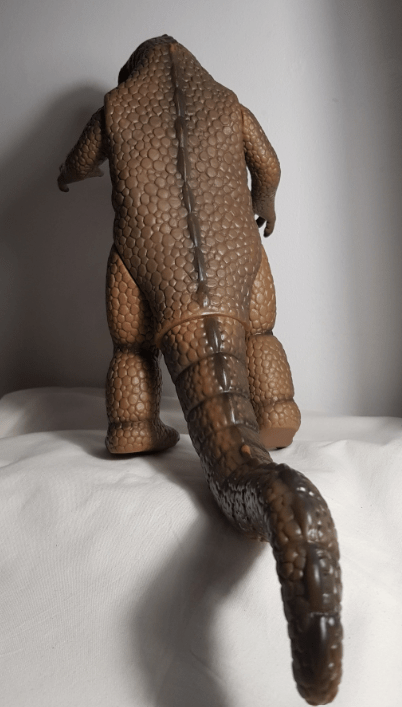
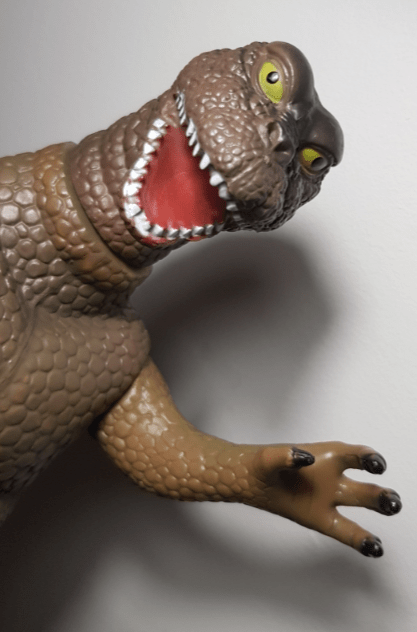
So, on to the new colour – the colour of the base vinyl and the overlying colour spray is very different to the usual JHL Godzillas, with those produced in slightly faded black vinyl, which can appear in dark blue or purple variants, usually shaded with the ‘sunset’ colouration of iridescent yellow or orange with a bright and shiny red or green overlaid (as with my example shown in pictures above). However, in these mainstream JHL productions, there are some rarer and more muted colour schemes predominantly in black vinyl sprayed with various shades of green (again as with my example shown in pictures above), apparently made to copy the Chinese-made models. Instead, the Choco-zilla was produced in a rich brown base vinyl, and over that some shading has been irregularly applied in a dark brown to the back, arms and feet, with a barely noticeable splash of a faint metallic purple in the centre of its chest and down the outer seams of both legs. Its eyes are not the more common bright yellow or occasional white found on the other models, but red. However, that colour is found now and then on the traditional JHL Godzillas.
One odd feature here is the addition of a single red brushstroke inside the mouth depicting a tongue. Normally the inside of the mouth of JHL Godzillas is left in the base vinyl colour, but I have seen a handful of models where the inside of the mouth is completely painted red, and a quick survey of the available items in Todocoleccion’s sold lot archive and their active listings at the time of writing upholds this impression. This is an unusual feature, but is known in other Spanish bootleg Godzillas: specifically the Spanish bootleg of a Chinese model that in turn was copying a Godzilla-clock produced for an Orion Home Videos promotion in November 1989 (see my earlier blog on these). It can also be found in some Chinese-made models, including the Chinese bootleg of the Orion Godzilla-clock just referred to (where the ‘red tongue’ is usually shorter than in its Spanish copy), and a very small number of Dor Mei Godzillas (I know only of two of the white Dor Mei Godzillas shown in a previous post with this feature; and all others in the Dor Mei battalion owned by me have base vinyl inside their mouths, or a completely/largely red area inside of the lower jaw behind the teeth [the corresponding upper jaw area, of course, goes far up inside the head and so cannot be painted]). A quick survey of the Dor Mei offerings currently on eBay and two regions of Vinted produces much the same result, with the exception that four Dor Mei Godzillas of the legions of them there have single red brushstroke tongues, and all of these are late productions (the first three with “1997” marks under their feet, and the third with LEDs for eyes and thus also most likely from the 1990s).
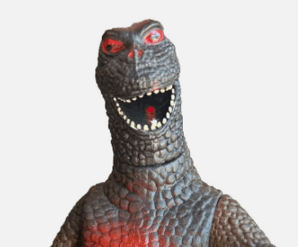
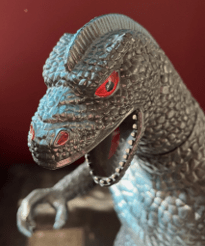
(Images from various eBay listings)
So this feature is not unheard of in Chinese-made models, but is rare and appears to be associated with later models from the 1990s. Also, when found in Spanish-made models this red-line-tongue is, more often than not, longer than those in Chinese-made models.
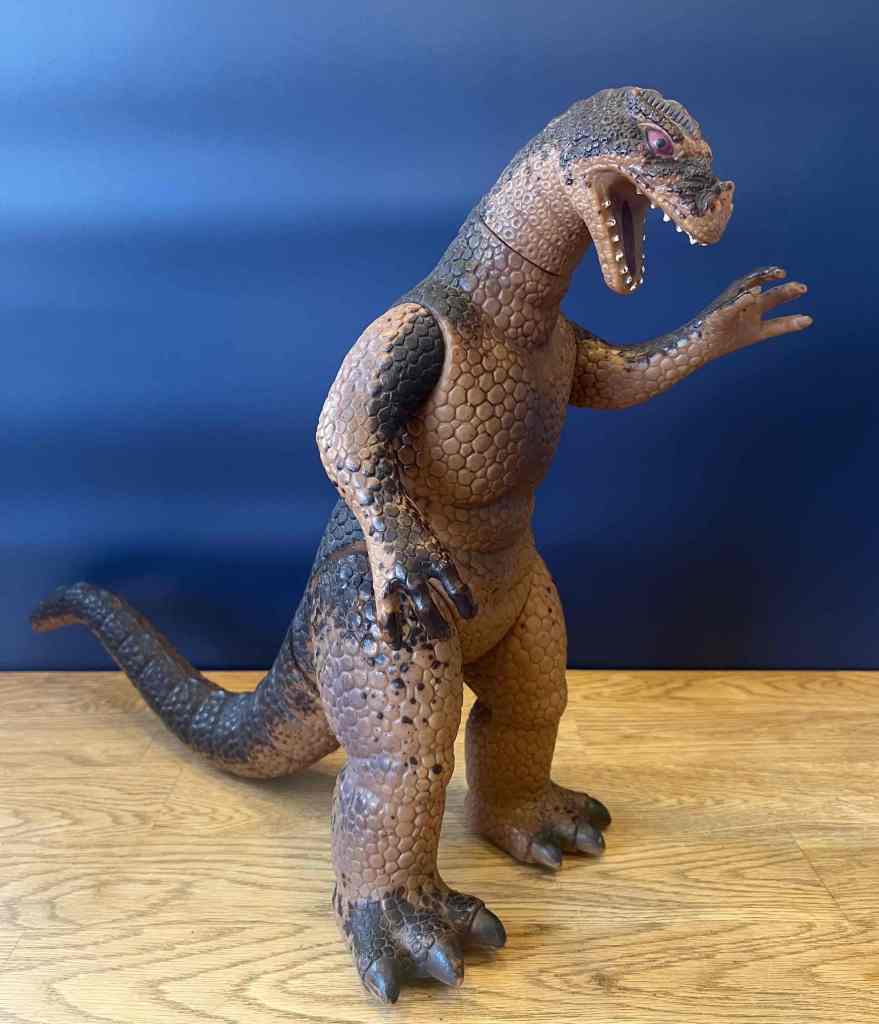
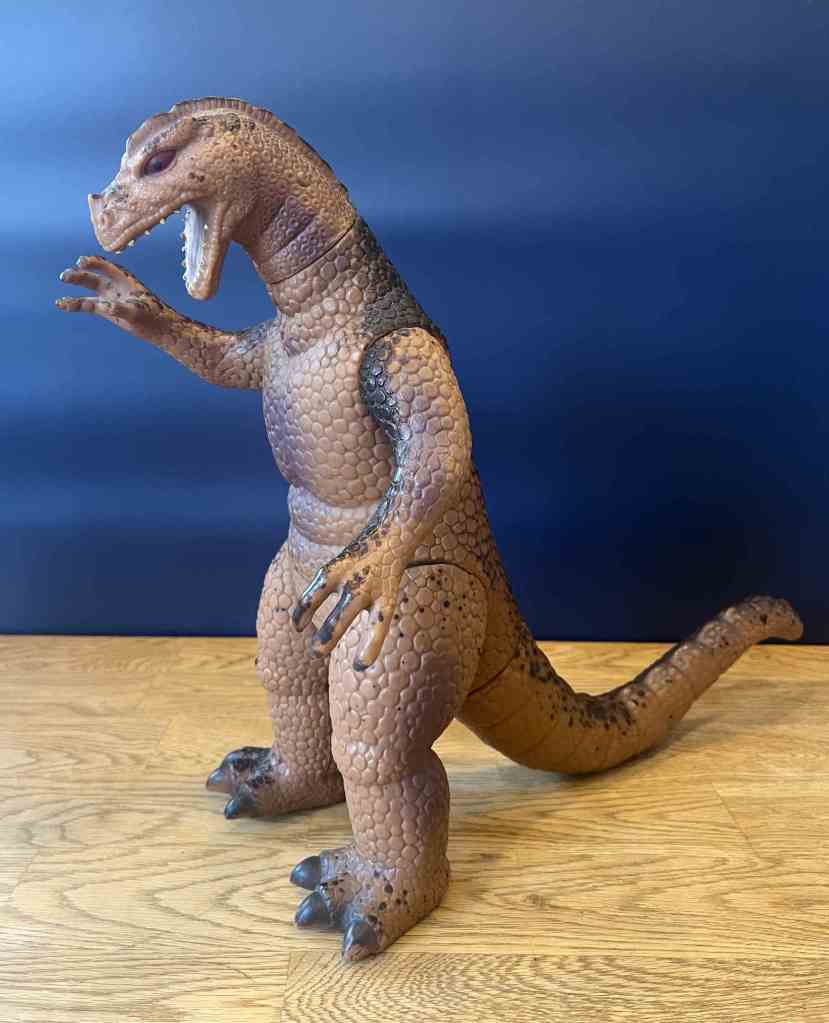
This Choco-zilla gets even more interesting when we look at the brown paint shading in detail. When I made my update to my main JHL post, I was working from low-res photographs and stated that it was “shaded in a black paint that appears to wear off easily (but has given the figure above rather fetching eyebrows)”. We can now see that this shading colour is indeed black, but it is not wearing away but splattered when applied, creating large areas of black surrounded by paint droplets giving it a ‘freckled’ appearance in places.
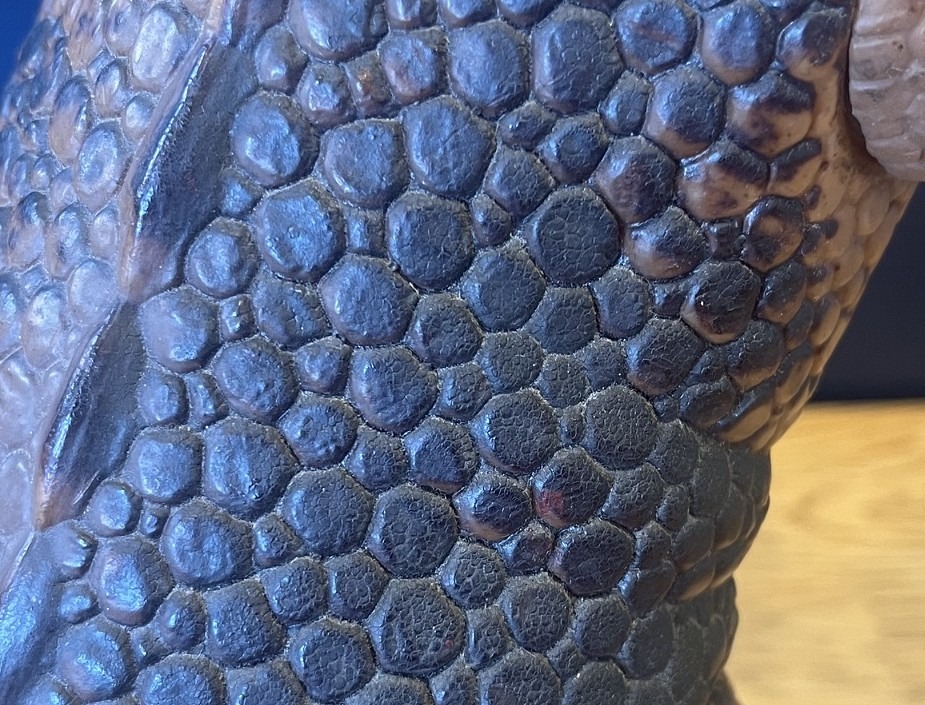
In addition, when one looks very closely at the back of the beast you can see that the paint there has shrunk as it dried, drying in a crystalline and crackled texture in the areas it was applied most heavily. Finally, the right-hand side of the beast’s body is heavily shaded, while the left is quite the opposite – and from different angles the views could be mistaken for those of two different models. The paint-lines on the beast make it clear that it was spray-painted with its arms in a raised ‘don’t shoot’ position, and without its present head on. Pulling apart the head from the neck gently, we can see that the shading paint has not covered the top of the head aperture, and a clean ring of base vinyl has been left around that aperture – so, most likely there was a head on when it was painted, but it is not the present one. With other mainstream JHLs, where we can see, there is some evidence of being sprayed with the arms raised as here, and the heads overwhelmingly show continuous paint-lines from the body, indicating the heads were attached when the model was painted.
The impression here with this Choco-zilla is of an artist struggling with his materials, leading to a splatter-pattern that would impress any Police- or FBI-forensic scientist. Having ended up overshading on the right side, and perhaps the left shoulder and up the neck, the artist went much lighter on the rest of the left side, but still splattered much of the body of the beast with paint droplets, and appears to have been forced to then change the head for another, I’m guessing as the original head was coated in shading paint on at least the right side. I begin to wonder if this Choco-zilla was an experiment, or part of a batch that were experimental – using different colour vinyl and new shading colours?
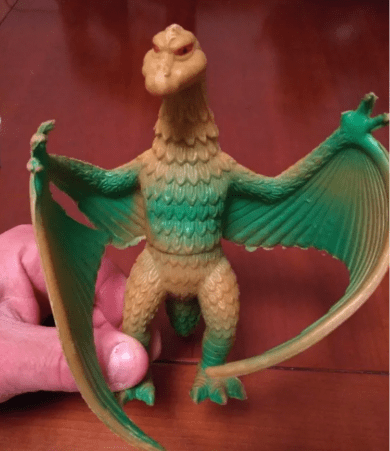
The sold lots archive of Todocoleccion and the active listings at the time of writing produces only one more JHL product in brown vinyl:
(Image from Todocoleccion)
In fact, this ‘Rodan’ bootleg, sold in October 2023, is in the same brown vinyl as the Choco-zilla, and has the same red eyes, but has its body shaded in the bright green paint commonly used on these ‘Rodan’ models (see the others documented in my earlier post on JHL).
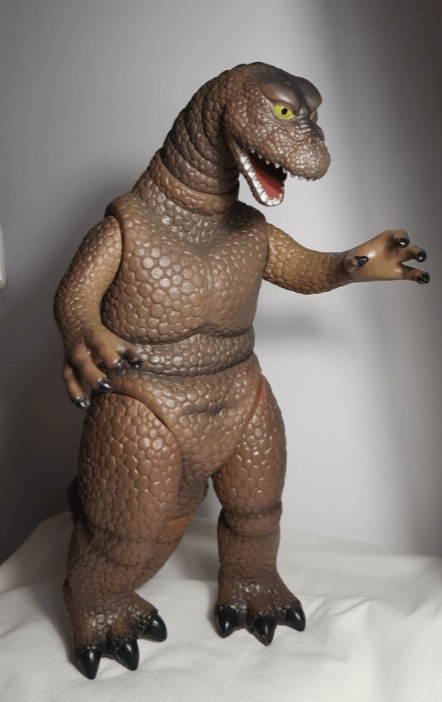
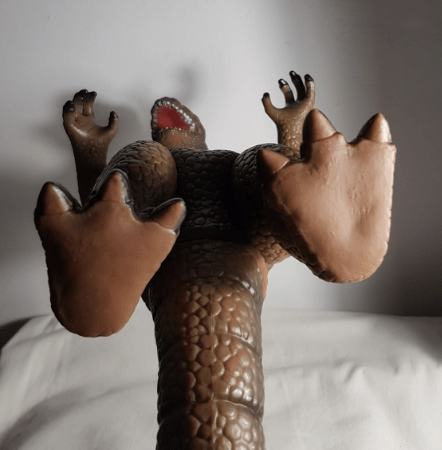
[UPDATE 29 June 2026: while searching Todocollecion’s sold lot archive for an unrelated item, I chanced across another brown JHL Godzilla sold in 2022 – but as the foot marks are absent (or very faint), it was not obvious to the seller that it was made by JHL. It uses the alternative head sculpt to mine, and almost completely avoids the darker shading, adding only the lightest of airbrushing in a darker shade to the spine, the top of the head and the claws. I think we can see this one as an attempt to learn from the mistakes that led to the spray problems with my one, and avoid the use of the darker shading paint that had created such problems].
[ADDITIONAL UPDATE 15 September 2026:
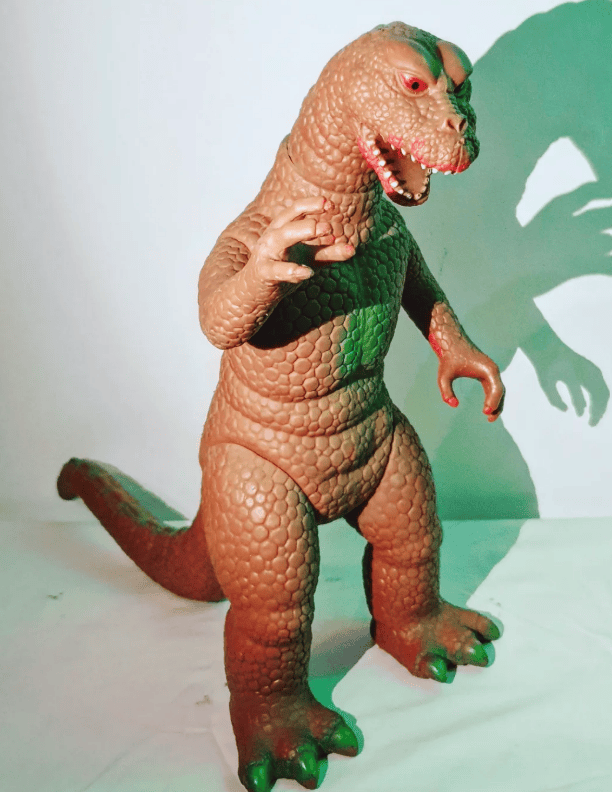
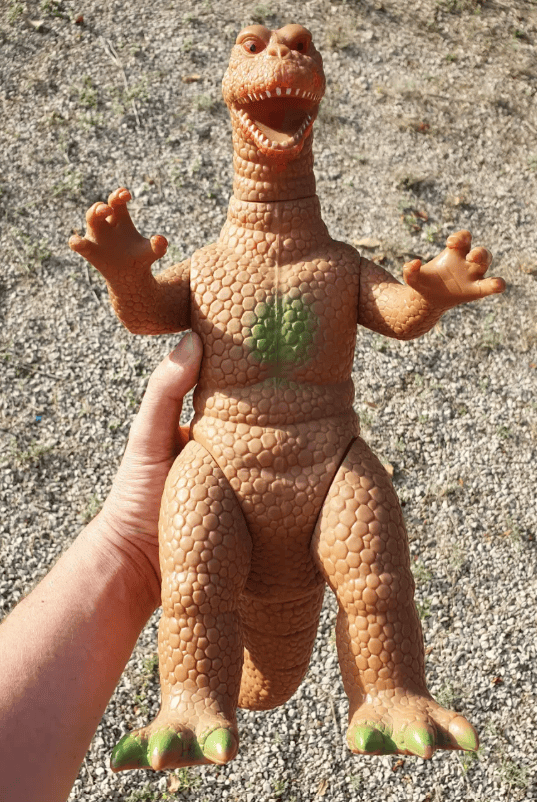
(Images from zardoz2022’s Instagram posts of September 2023 – the lighter brown here is probably due to differing lighting conditions when the pictures were taken)
Another brown JHL Godzilla has turned up in several Instagram posts by a user named, ‘zardoz2022‘ there – identical to that above, but with green claws rather than black (see the main posts here, and here). In another post on that platform the same user suggests that someone may be using the old JHL molds to make new Godzillas noting that the vinyl is different to the main ones and that his brown one smells very strongly. If so, then the modern forger would need to also have access to the molds for the ‘Rodan’ creatures also found in the same brown vinyl, and that is very unlikely. Most probably, these brown ones are original, and the smell that zardoz2022 reports is de-gassing (from his model being stored in a plastic bag for decades)]
For the sake of completeness, I should also mention that a grey-brown vinyl JHL Godzilla came to light in the same search:
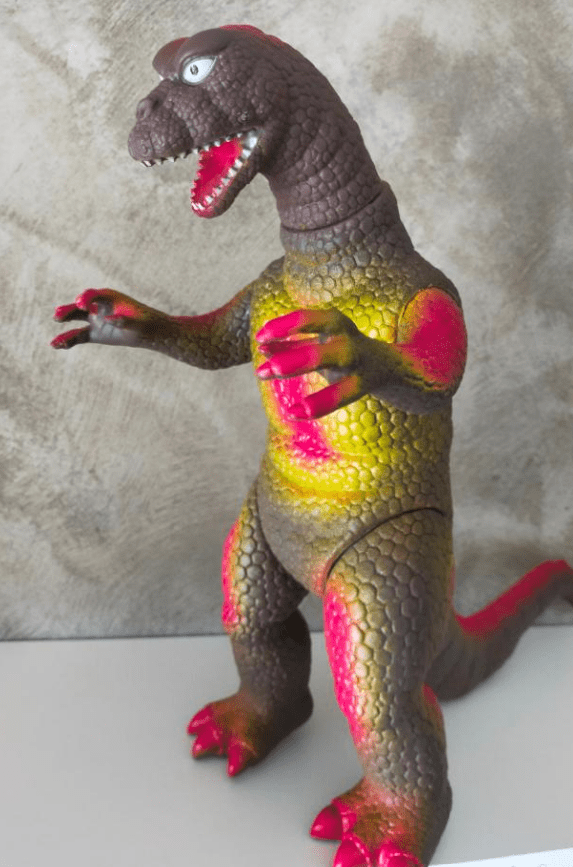
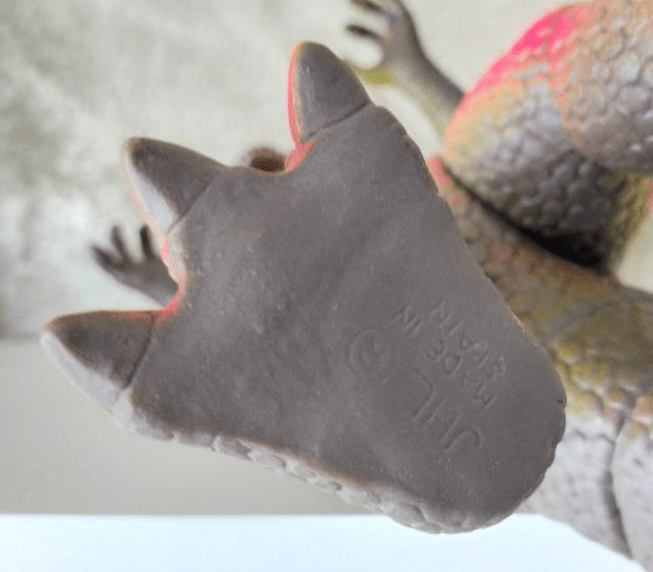
(Images from Todocollecion’s sold lot archive)
This was sold in April 2023, and has white eyes, a pink-filled mouth, and shading in the more usual iridescent colours of the ‘sunset’ colouration, albeit introducing an apparently novel use of hot pink here in the place of the usual bright red.
I do not know of other non-standard colours of vinyl or shading used by JHL, and should be delighted to hear from any readers who might have examples in their collections.
⁂
What can we now say about this Choco-zilla? The existence of the light grey Godzilla shows that JHL did on occasion experiment with new colours for the vinyl of its productions, but these appear to have been made only in small numbers and only occasionally appear on the market. The chocolate-brown Godzilla and ‘Rodan’ bootleg show that this colour was one of these experiments, but while the overpainted colour spray for the ‘Rodan’ remained the same as its peers, that of the Choco-zilla was a sudden departure from past models, apparently using previously untested paint. In addition, what parallels in decoration-styles can be found seem to suggest that this Choco-zilla was produced in the 1990s. I think we might ask then – when JHL’s productions were usually so bright and eye-catching (this presumably to draw the eye of children passing the sale-point), why did the company suddenly experiment in the 1990s with somewhat dark and dull browns? I suspect that the answer again is in the runaway popularity of the film, Jurassic Park.
As laid out in my main JHL post, we know that JHL mass-produced a variant of their Godzillas in flesh-coloured vinyl painted green with brown painted soles to their feet and with a newly sculpted T-Rex-like head, after the release of Jurassic Park in 1993 (the ‘G-Rex’). I begin to suspect that this newly discovered chocolate-brown model, shaded in black, might have been another attempt to appeal to those who had seen the toy T-Rex produced by Kenner at the time of the film’s release. This Kenner toy was russet-brown, with a lighter and greenish underside, and some black shaded areas and large spots on its upper side and face that start to look very familiar.
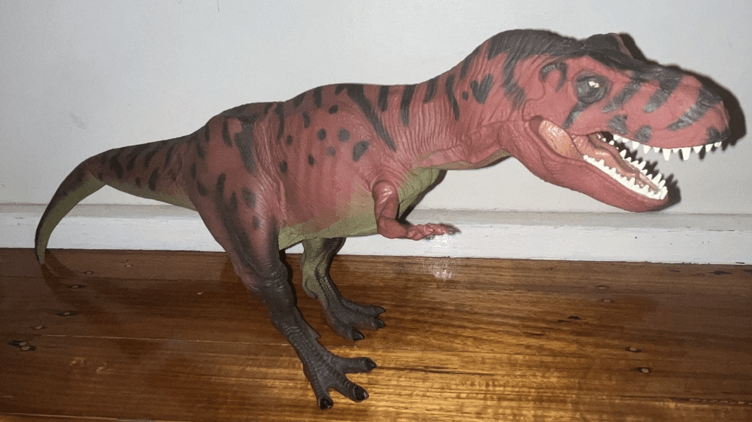
(The Kenner T-Rex toy; here from an eBay listing)
However, the artist of the Choco-zilla seems to have used paint that did not spray well, but splattered and dried in crystalline clumps rather than an even distribution, and while trying to work with it they nearly coated one side of this Choco-zilla, and apparently wrecked the initial head.
The final product appears to have been an unsatisfactory homage to the Kenner T-Rex, and few brown JHL Godzillas appear to have made it past the factory floor to kiosks and shop displays for sale. [UPDATE 29 June 2026: the discovery of another brown Godzilla, in sale records from 2022 (see update above), doubles our number of these, but clearly the heavy dark shading paint was a failure and having been abandoned this figure could not be given the patterning of the T-Rex toys produced by Kenner]. Indeed, that discussed here might well be one of only a tiny handful, kept by workers at JHL and not sold – only the emergence of others can answer that (if you have one, or have seen another, please do get in contact). The experiment was presumably abandoned in favour of the mass-production of the ‘G-Rex’, and the remaining unused brown vinyl then redirected into the production of bootleg ‘Rodan’ figures and other smaller items.
As a final word here, I find, that despite the fact that my wife and children despair of me in my lack of will-power, I am dearly in love this richly-coloured new addition and all its wonderful flaws.
- 'MUTTON DRESSED AS LAMB': Godzillas and kaiju that look vintage, but are not
- American made Pachi
- BOOTLEG DINOSAURS – a little off topic, but sometimes needed here
- BOOTLEG GODZILLAS
- Bootleg Tokusatsu from China and its immediate neighbours
- Bootleg Tokusatsu from the Americas
- BOOTLEG TOKUSATSU HEROES
- Central Europe – Godzillas and kaiju from behind the Iron Curtain
- Chinese-region bootleg Godzillas -the plastic tide from the East
- Chinese-region made Pachi
- European made Pachi
- European-made Godzillas
- PACHI
- Pachi kaiju
- Pachi kongs
- Pachi superheroes – Ultraman and similar
- The Americas – bootleg Godzillas from the New World


 Confessions of a Kaiju Hunter
Leave a comment