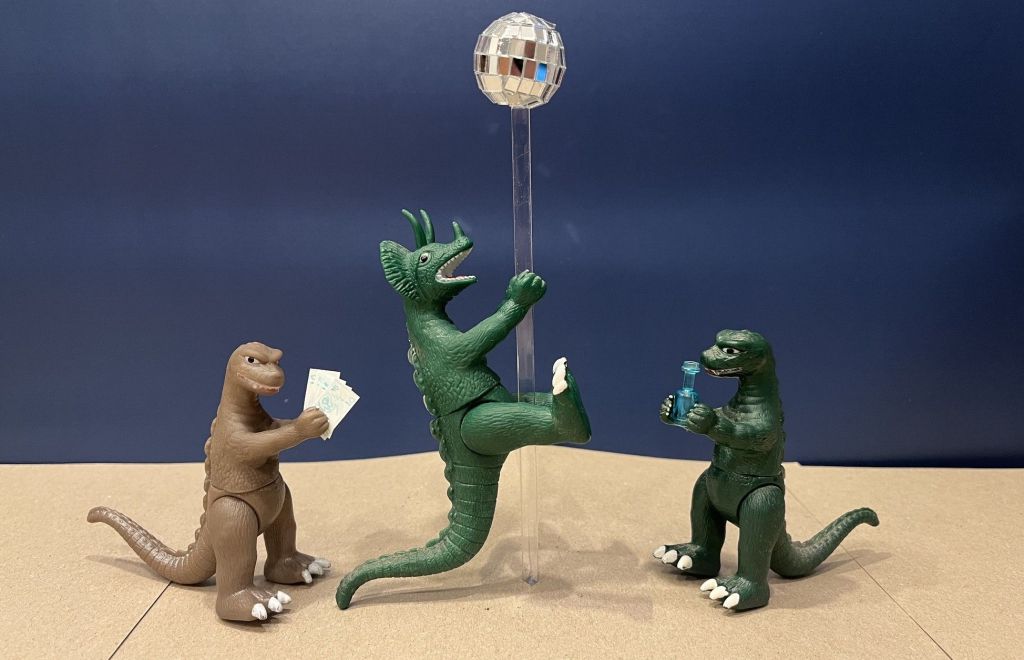
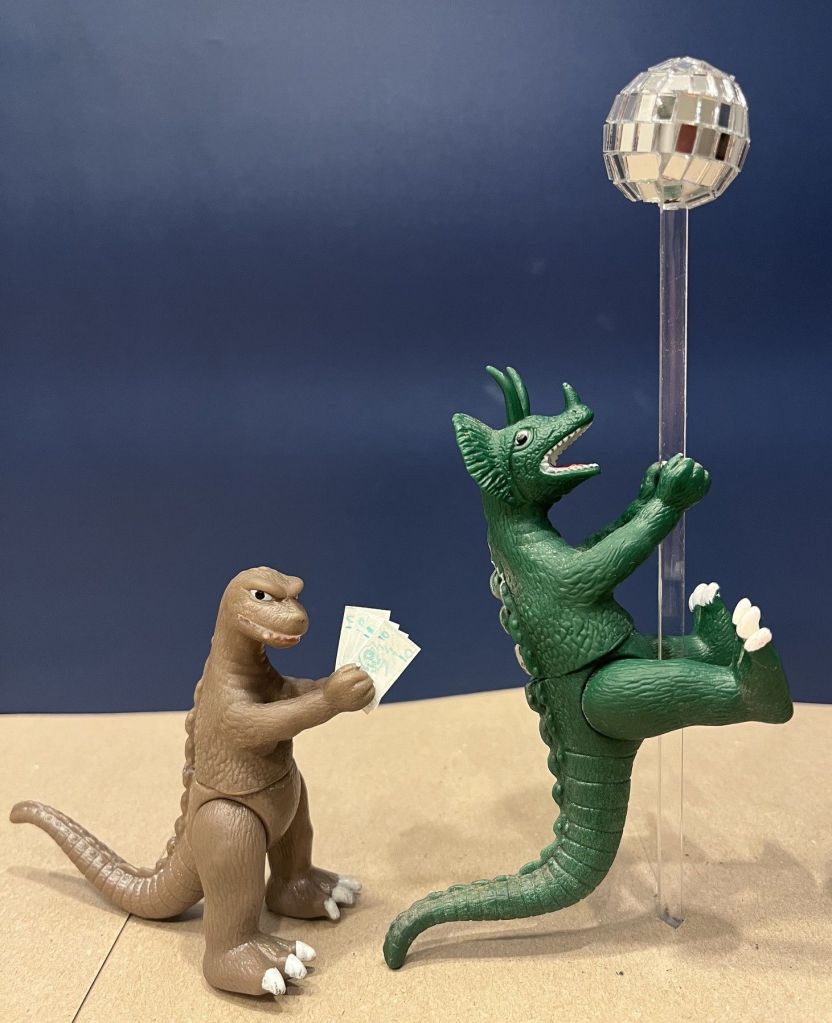
If these little critters, with spring-loaded arms that allow them to be clipped to objects, don’t bring you immediate waves of warm nostalgia, then I’m afraid you might be too youthful and filled with zest, vigor and natural joie de vivre to be reading this blog.
… Ok, now it’s just us old farts lamenting our long-lost youth – on with the fun.
Almost immediately after the division of Korea along the 39th parallel, in the aftermath of the Second World War, South Korea (more formally, the Republic of Korea) began to industrialise rapidly. It soon became a major production centre for cheaply-made toys for the export market, with huge numbers of now-anonymous factories being established to produce toy lines for international distribution by more well-known companies in the American, European, and to a lesser extent Asian markets. Alongside this rapid growth came two things crucial for any bootlegging industry: local interest in international film and cartoons, and a lackadaisical approach to licensing enforcement by the authorities. A vast legion of these ‘clip-ons’, ‘pencil huggers’ or ‘gripper’ toys, whatever one wishes to call them, was a significant part of that output, with small plushies dominating the figures produced, and toys produced both under license as well as not – often only identified by a small sticker with “Made in Korea” affixed to a foot or under the rump of the creature. In the 1980s, it was hard not to find a cartoon character (Disney, Garfield and so on), popular TV puppet-character (like ET, ALF, the Muppets or similar) and collectible creature (such as Monchichis), as well as slightly less obvious lines such as Sungold Wrestlers, who had not been turned into these lapel-, pencil- or curtain-in-kid’s-bedroom-hugging creatures, and they hung from racks and printed display cards in virtually every inexpensive sale point across the Western world. Only towards the end of the 1980s, as labour costs rose in South Korea, and competition from Chinese production increased, did the era of Korean cheap toy manufacturing start to draw to its close, and at the very end of the decade, toy producers there pivoted into producing higher quality goods for the domestic market.
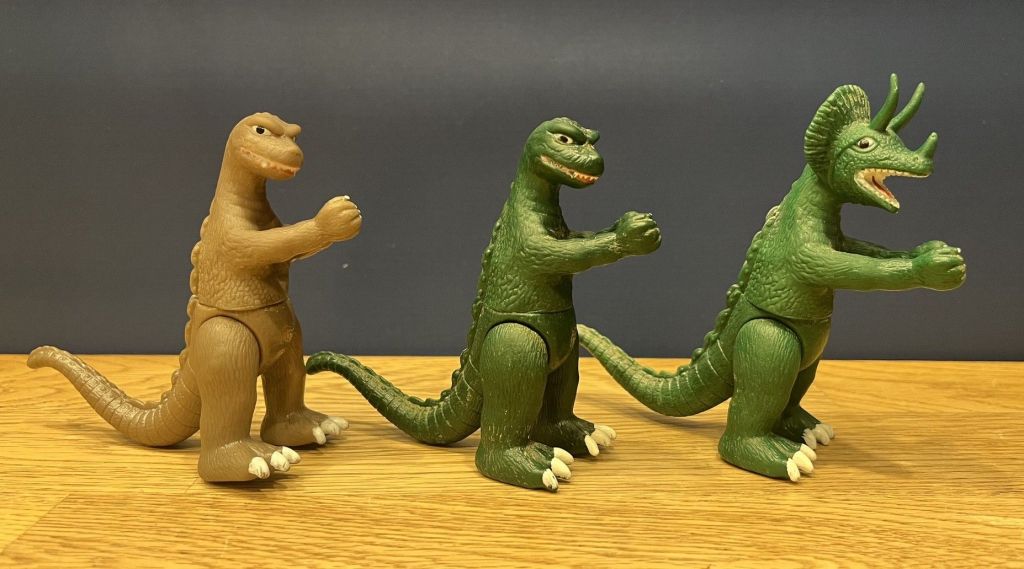
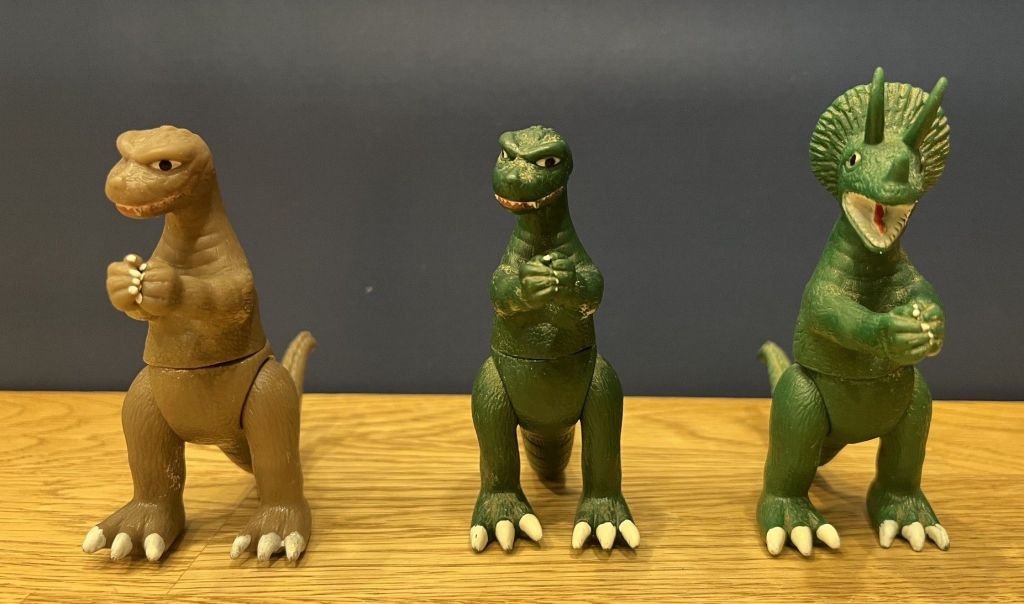
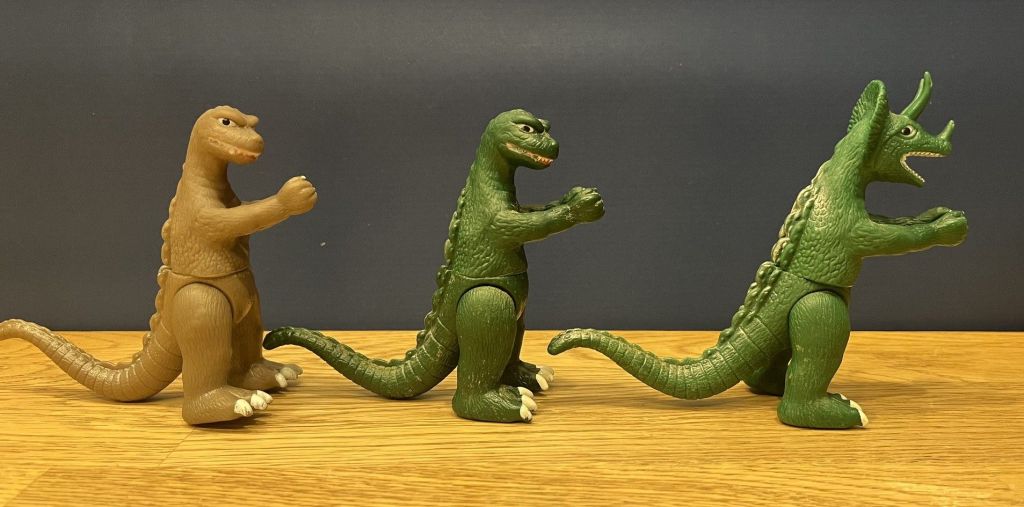
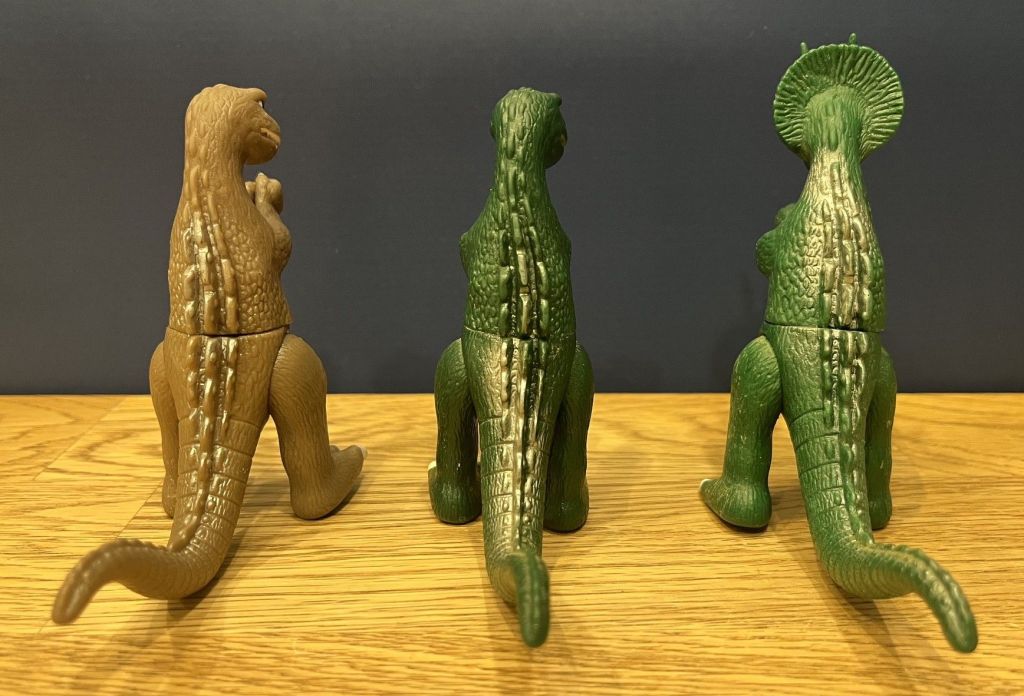
The only examples known to me to bring Godzilla or any kaiju into these toys, are these above (with the Godzilla shown in two colour variants). The pairing of Godzilla with a bipedal Triceratops is not so strange in a 1970s or 1980s Japanese pachi context, and readers of my blog on a Taiwanese-made Bemstar pachi and all his siblings and relatives, will remember this Triceratops-headed pachi from that series:
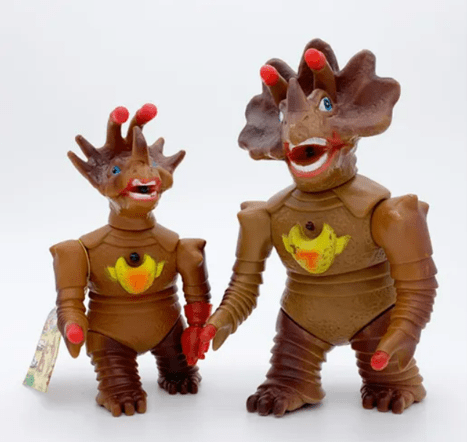
(Image from Pachikaiju’s wonderful Instagram posts; reproduced here with his permission)
as well as it’s probable inspiration from a Japanese pachi sofubi:
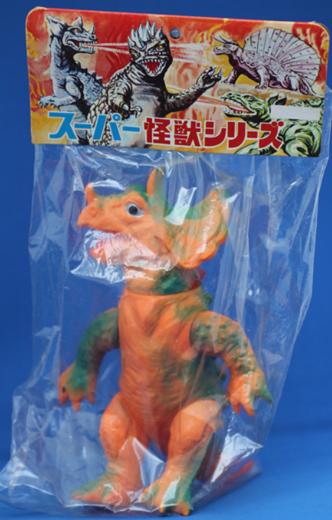
(This image from the inspiring bakadesubakadesu blog, here; who are apparently uncontactable, and so if this image is yours and you do not agree with its reuse here, get in contact and we will remove it)
In fact, when one starts to look, realistic Triceratops figures are not uncommon in Japanese toys and related printed items (like Menko cards, bromides and similar), and I suspect the combination of multiple horns and a large neck frill with a large and rotund dinosaur body made Japanese artists and designers see them as kindred creatures to kaiju:
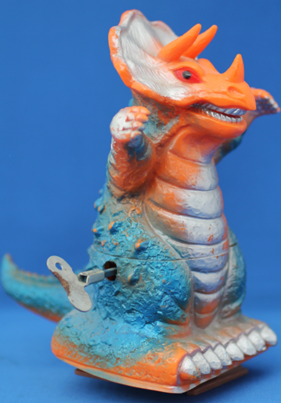
(A Nakajima-made walker in the form of a bipedal Triceratops; again from the bakadesubakadesu blog; see note above)

(A Triceratops-like kaiju (as well as a Moray eel-like one), named here ‘Yvon’ and ‘Sneki’, from the Espro pachi-bromide series; this image from an Instagram post by ‘pachidrunkers‘ (this one here) – BTW, this Instagram user’s posts are a spectacular visual smörgåsbord of similar material, so do go and look when you have a free couple of hours, they are numerous and enthralling; image reproduced here with their kind permission)
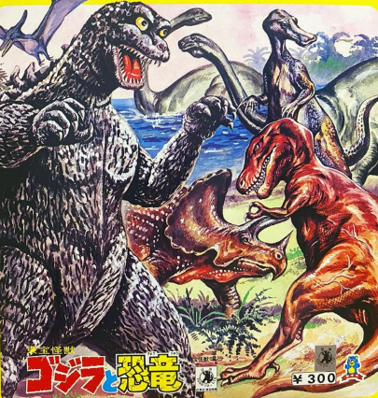
(Dinosaurs, including a battling Triceratops and a Tyrannosaurus Rex, while Godzilla looks on, from the artwork on a Japanese-made children’s activity set – again posted by Pachidrunkers, see here; reproduced here with their kind permission)
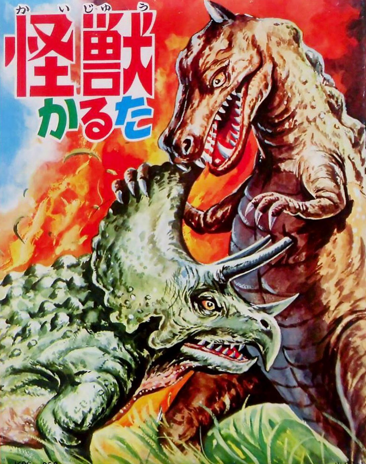
(Artwork from the box of a set of Karuta cards – again posted by Pachidrunkers, see here; reproduced here with their kind permission)
The common pairing of Triceratops and Tyrannosaurus Rex ultimately stems from Charles R. Knight’s painting of them together in his 1916 commission for the New York’s American Museum of Natural History, where they mostly mooch about as meadow-partners.
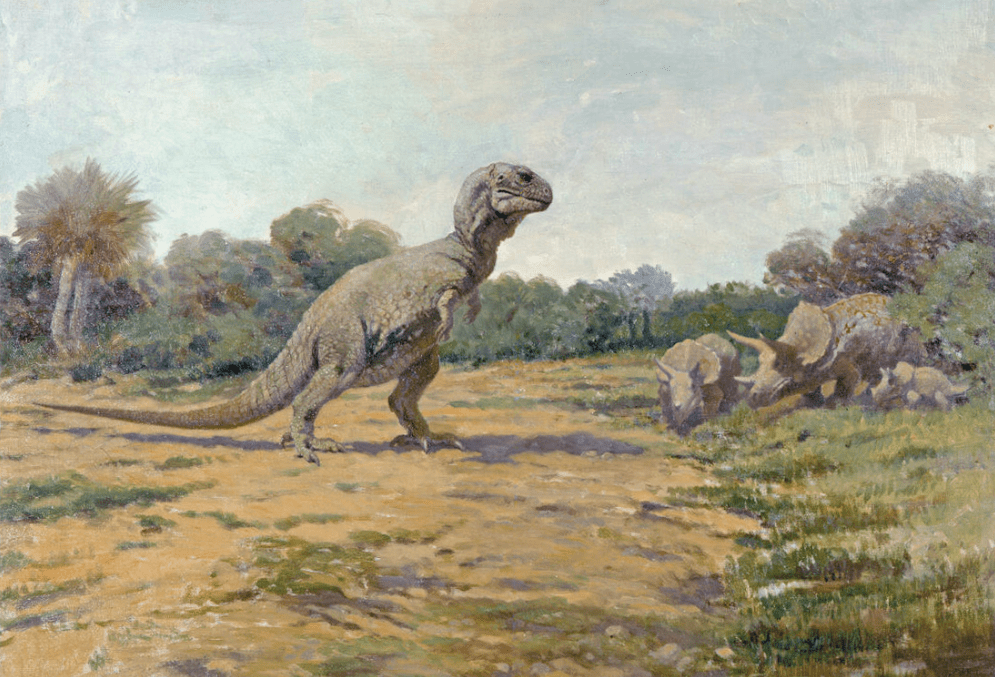
(Detail from Charles R. Knight’s 1916 painting; now thankfully out of all copyright)
However, two years later their imagined relationship was kicked up a notch on the action and drama fronts, and the final scene of the 1918 stop-motion film: ‘The Ghost of Slumber Mountain’ (available on YouTube here) showed them as violent sparring partners.
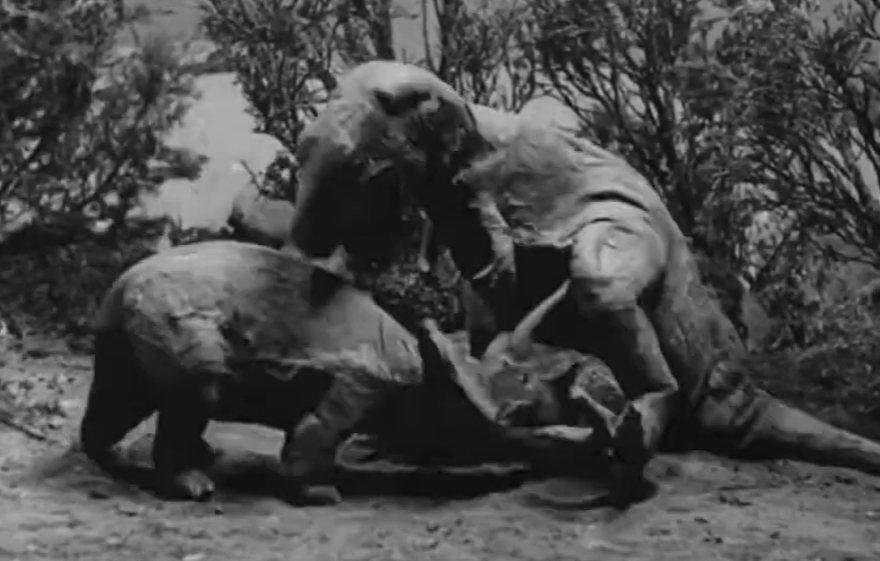
(Detail from ‘The Ghost of Slumber Mountain’; now thankfully out of all copyright)
Thus, in the West, as well as Japan, throughout much of the twentieth century, these two prehistoric creatures were seen as natural adversaries throughout much of the twentieth century. That pairing most probably suggested a Triceratops figure more than any other dinosaur or kaiju as a suitable occasional partner to this diminutive Godzilla bootleg.
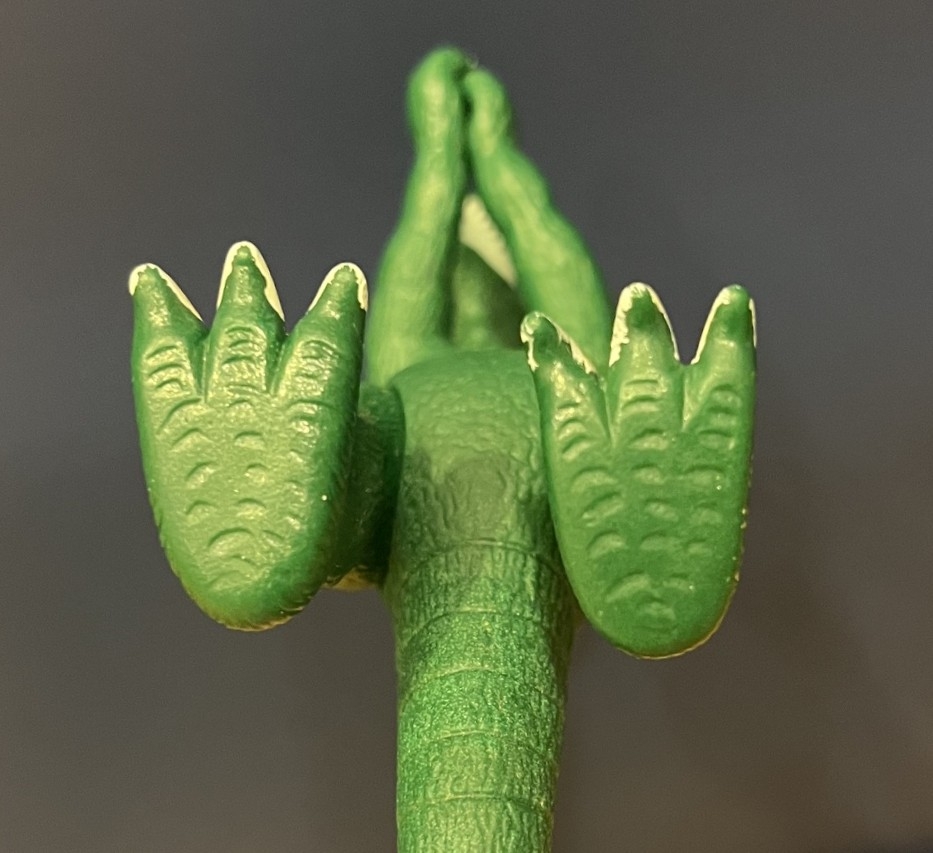
The examples here stand 95mm. (Godzilla) and 105mm. (Triceratops) high, and weigh about 18 or 19g. They were produced in quite pliable and ‘squishy’ vinyl from the waist up, with slightly harder vinyl for their lower bodies, legs and tails. The have articulated legs, and although their bodies join at the waist, they are glued at that point and do not articulate there. Pinching at the shoulders with finger and thumb, operates the internal spring-loaded levers to open and close the ‘hugging’ arms. The feet are textured underneath with a series of chiseled out semi-circles. I know of examples in light green, as well as darker shades and even brown (see images above) – but have only ever seen the Godzilla figure in the brown. The Triceratops would appear to be far rarer than the Godzilla – perhaps due to a smaller production run, and I assume that while these two figures were sold together, the Godzilla was also sold on its own.
The head sculpt, with its more front-facing eyes, high and prominent brow ridges and almost cheeky grin, most probably owes much to our old friend, the Chinese-made ‘second spotty finned Godzilla’ (see my earlier post on the Chinese-made Godzilla bootlegs, where it is named the ‘*Bootleg of Imperial model 2’; and the post on the group of which that beast is a part, named ‘“While thou livest, keep a good tongue in thy head”: a related group of bootleg Godzillas from a strange and intriguing Chinese workshop’). However, the presence of three toes also probably nods towards the Dor Mei Godzilla bootlegs. His spine fins are entirely his own, and composed of three rows of a series of high arched ridges.
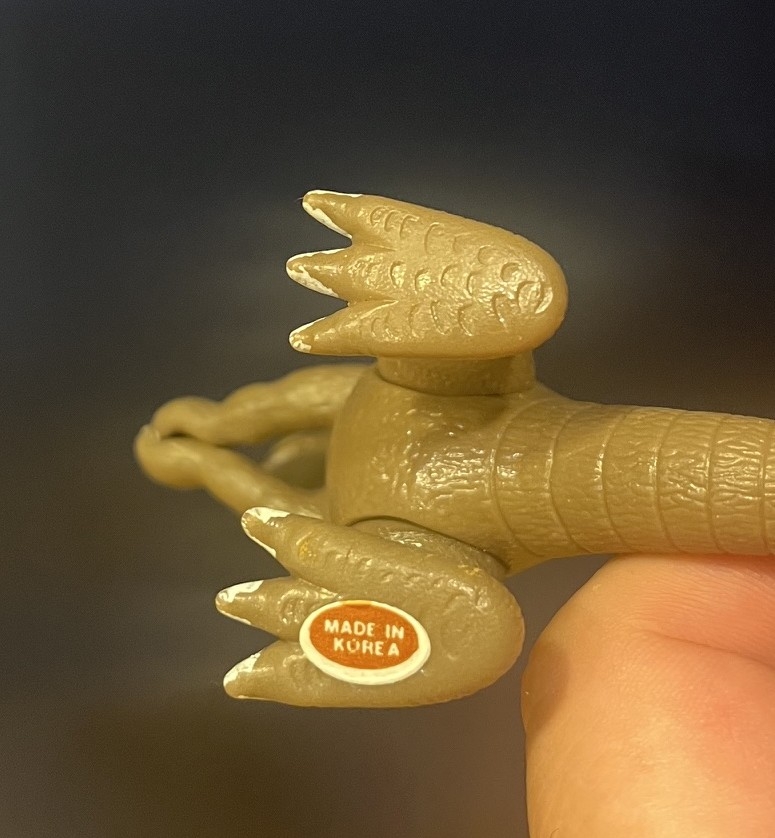
Many of these have small oval paper stickers with “MADE / IN / KOREA” under one of their feet. The sticker which survives under the right foot of my brown Godzilla is also in brown with white text and a white ring around its edge:
These would appear to be most common, but others do survive in gold with black writing:
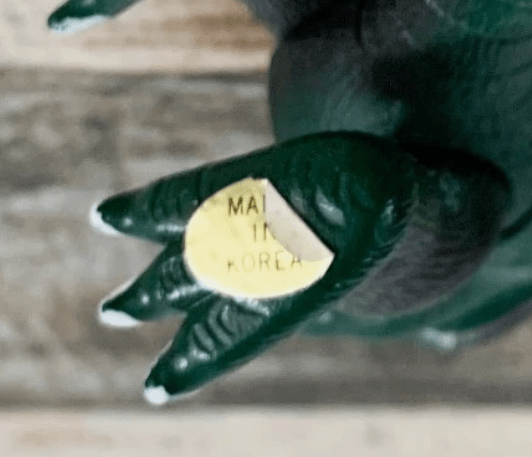
(Image from an eBay sales listing)
This relatively consistent feature is probably enough to suggest production of these Godzilla and Triceratops clip-on toys by a single factory or production entity. Their South Korean producers are unrecorded, and their distributors likewise, but with the latter I think we may assume that many distribution companies were involved in several different countries.
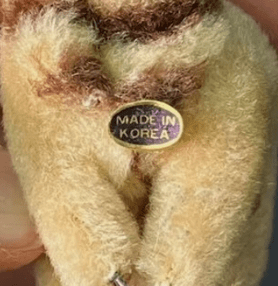
Other similar stickers can be found, such as that on a small squirrel-like toy animal clip-on, which resembles the first variant shown above, albeit with gold writing and a gold edge:

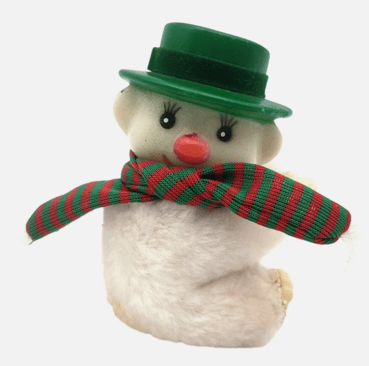
and another often affixed to a Snowman clip-on wearing a hat and scarf resembles the rarer gold sticker:
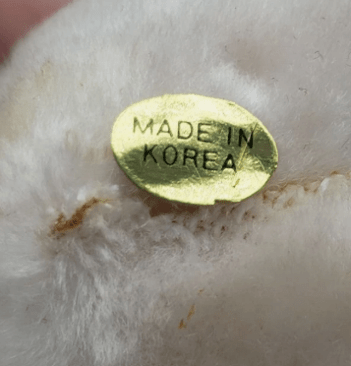
(Images from an eBay sales listing)
but these are not exact matches, and broadly similar stickers were used on many other Korean-made objects, including small ceramic and metal objects often made for sale in the US tourist trade, and even musical instruments by Samick from the 1970s to around 1988 (see here). I think we may presume that the ‘Made in Korea’ sticker industry boomed there alongside the mass production of household goods, and that stickers were supplied ad hoc to factories by a number of printers.
Thankfully, an appeal for information on one of these Godzilla bootlegs by an American poster in the ‘Vintage Toy Central’ group on Facebook on 18 November 2025 (in two related posts, here and here) elicited eye-witness accounts from several other Americans who recalled that they acquired theirs in the 1980s, with some recalling that they “bought him around 1988 at the NYS [New York State] Museum gift shop”, that it was “sold in grocery and drug stores in the mid 80s on a blister card as a toothbrush holder, packaged with a toothbrush in his hands”, and that there “was another one in the assortment that had a triceratops head”. The Sphinx’s excellent Godzilla Guide states that they were also available grouped together with “gumball machine display cards” (see here, vol. 1, near head of bootleg section, p. 99 in the version accessed by me for this blog). These accounts, as well as the likely models, places their creation and wide distribution in the second half of the 1980s.
⁂
These were, I suspect, for many readers their first Godzilla toy, and are probably as widely distributed (or maybe even more so) than the ubiquitous Imperial mini Godzillas (the larger Imperials, Dor Meis and ‘Sharkzillas’ cost a fair bit more pocket money, and were less casually bought). As such, they hold a key place in the distribution of the Godzilla brand across the Western world, and if you don’t have at least one in your home I do not know how you manage to live with yourself (I’m joking, of course – but for decency’s sake, go buy one now, eBay’s full of the grippy little buggers).
⁂⁂⁂
Postscript: the arrangement of the lead images here comes from my showing of the sales listing of my Triceratops one to a good friend, who said that its clipping to a drinking straw in the photo attached to that listing reminded him of certain dance-focused drinking establishments, and I have not been able to see them any other way since 😉 Also word to the wise, when the lady in the shop asks why you need a tiny glitterball and pole, do not tell her it is for a Godzilla themed photoshoot – she will silently judge you.
- 'MUTTON DRESSED AS LAMB': Godzillas and kaiju that look vintage, but are not
- American made Pachi
- BOOTLEG DINOSAURS – a little off topic, but sometimes needed here
- BOOTLEG GODZILLAS
- Bootleg Tokusatsu from China and its immediate neighbours
- Bootleg Tokusatsu from the Americas
- BOOTLEG TOKUSATSU HEROES
- Central Europe – Godzillas and kaiju from behind the Iron Curtain
- Chinese-region bootleg Godzillas -the plastic tide from the East
- Chinese-region made Pachi
- European made Pachi
- European-made Godzillas
- PACHI
- Pachi kaiju
- Pachi kongs
- Pachi superheroes – Ultraman and similar
- The Americas – bootleg Godzillas from the New World

 Confessions of a Kaiju Hunter
Leave a comment